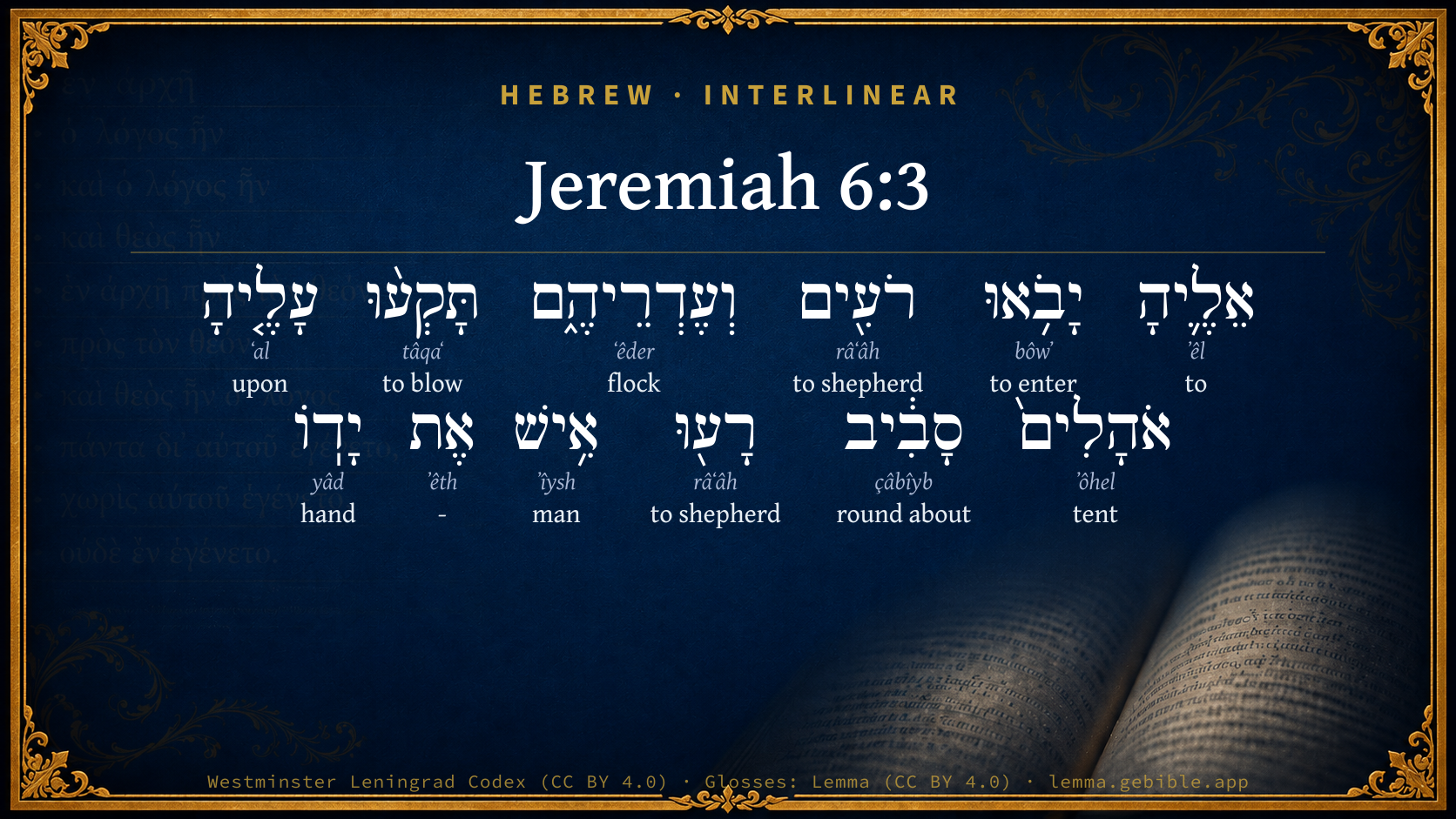
Jeremiah 6:3

Hebrew (Westminster Leningrad Codex) Jeremiah 6:3 appears in the Hebrew Old Testament. The text above is from the Westminster Leningrad Codex. Each word links to its Strong’s number, a concise gloss, and parsing drawn from the Open Scriptures Hebrew Bible morphology. Click any word for its full Brown-Driver-Briggs (BDB) entry.
Download image
Cite this verse

Jeremiah 6:3 (World English Bible). Public Domain. Lemma interlinear Bible study tool, https://lemma.gebible.app/v/jeremiah/6/3.

Show BibTeX & RIS
BibTeX
RIS
English Translation
Shepherds with their flocks shall come to her; they shall pitch their tents against her round about; they shall feed everyone in his place.
World English Bible · Public Domain
Download a study sheet

One document with this verse’s original text, its word-by-word gloss line, the meaning frame, cross-references with their text, attributed commentary, and full source and license credits — printable, and it pastes into notes with its structure intact.

This verse Autodidact and up

Study sheet (.html) Plain text (.txt)

A passage Seminary Student

Up to 50 verses in one chapter. A passage sheet keeps up to 6 commentary sources and 12 cross-references per verse, in the order this page ranks them, and says so on the sheet whenever that leaves anything out. Ask for a single verse and you get the Autodidact verse sheet above.

Everything on this page stays free to read, with no account — the sheet is a download of what is already on screen, not access to it.

Want to remove ads? Support Godless Engineer
Compare translations 3

The same verse in 3 English versions, stacked beneath the original-language interlinear above. Click any original word for its lexicon entry.

Each is an independent rendering of the whole verse — the interlinear is not word-aligned to these translations.

Highlighted words mark where these versions differ — a whole-verse word diff, not a word-by-word alignment.

  • World English Bible Public Domain
    Shepherds with their flocks shall come to her; they shall pitch their tents against her round about; they shall feed everyone in his place.
  • King James Version Public Domain
    The shepherds with their flocks shall come unto her; they shall pitch their tents against her round about; they shall feed every one in his place.
  • unfoldingWord Literal Text CC BY-SA 4.0
    To them shepherds and their flocks will go; they will pitch tents against her all around; they shall pasture each his place. ts\*

unfoldingWord Literal Text — © unfoldingWord, licensed CC BY-SA 4.0. Word-aligned USFM3 via Door43 (git.door43.org/unfoldingWord/en_ult).

Versions to compare (up to 4)

3 of 4 selected

Show all 18 translations

Every available English version of this verse, each an independent rendering of the whole verse.

  • World English Bible Public Domain
    Shepherds with their flocks shall come to her; they shall pitch their tents against her round about; they shall feed everyone in his place.
  • Berean Standard Bible Public Domain
    Shepherds and their flocks will come against her; they will pitch their tents all around her, each tending his own portion:
  • Majority Standard Bible Public Domain
    Shepherds and their flocks will come against her; they will pitch their tents all around her, each tending his own portion:
  • King James Version Public Domain
    The shepherds with their flocks shall come unto her; they shall pitch their tents against her round about; they shall feed every one in his place.
  • American Standard Version (1901) Public Domain
    Shepherds with their flocks shall come unto her; they shall pitch their tents against her round about; they shall feed every one in his place.
  • Revised Version (1885) Public Domain
    Shepherds with their flocks shall come unto her; they shall pitch their tents against her round about; they shall feed every one in his place.
  • Geneva Bible (1599) Public Domain
    The pastors with their flockes shall come vnto her: they shall pitche their tentes rounde about by her, and euery one shall feede in his place.
  • Douay-Rheims (1899) Public Domain
    The shepherds shall come to her with their flocks: they have pitched their tents against her round about: every one shall feed them that are under his hand.
  • Young's Literal Translation Public Domain
    Unto her come do shepherds and their droves, They have stricken tents by her round about, They have fed each `in' his own station.
  • Literal Standard Version CC BY-SA 4.0
    Shepherds and their droves come to her, || They have struck tents by her all around, || They have each fed [in] his own station.”
  • Unlocked Literal Bible CC BY-SA 4.0
    The shepherds and their flocks will go to them; they will set up tents against her all around; each man will shepherd with his own hand.
  • unfoldingWord Literal Text CC BY-SA 4.0
    To them shepherds and their flocks will go; they will pitch tents against her all around; they shall pasture each his place. ts\*
  • Darby Bible Public Domain
    Shepherds with their flocks shall come unto her; they shall pitch [their] tents against her round about; they shall feed every one in his place.
  • World Messianic Bible Public Domain
    Shepherds with their flocks will come to her. They will pitch their tents against her all around. They will feed everyone in his place.”
  • Webster's Bible Public Domain
    The shepherds with their flocks shall come to her; they shall pitch their tents against her on every side; they shall feed every one in his place.
  • Free Bible Version CC BY-SA 4.0
    “Shepherds” and their “flocks” will come to attack her; they will set up their tents all around her, each one looking after his own.
  • Bible in Basic English Public Domain
    Keepers of sheep with their flocks will come to her; they will put up their tents round her; everyone will get food in his place.
  • JPS Tanakh (1917) Public Domain
    Shepherds with their flocks come unto her; they pitch their tents against her round about; they feed bare every one what is nigh at hand.

Literal Standard Version (2020), Covenant Press — licensed CC BY-SA 4.0. Text via the HelloAO Bible API (eBible.org). Unlocked Literal Bible (unfoldingWord) — licensed CC BY-SA 4.0. Text via the HelloAO Bible API (eBible.org). unfoldingWord Literal Text — © unfoldingWord, licensed CC BY-SA 4.0. Word-aligned USFM3 via Door43 (git.door43.org/unfoldingWord/en_ult). Free Bible Version, Dr. Jonathan Gallagher — licensed CC BY-SA 4.0. Text via the HelloAO Bible API (eBible.org).

Word by word

More ways to search: Search by grammar → Find every occurrence → Compare this word →

Practice this passage: Drill this verse → Learn its vocabulary →

וְעֶדְרֵיהֶ֑ם
ʻêder
H5739
“and · flocks · their”
Conjunction + Noun, Common, Masculine, Plural, Construct + Suffix, Personal, 3rd Person, Masculine, Plural
Part of Speech
Conjunction + Noun
Type
Common
Gender
Masculine
Number
Plural
State
Construct
Full BDB Definition

Origin: from H5737

TWOT: 1572a

flock, herd - flock - herds, flocks and herds
  1. אֵלֶ֛יהָ ʼêl H413 “to · her” Preposition + Suffix, Personal, 3rd Person, Feminine, Singular
  2. יָבֹ֥אוּ bôwʼ H935 “to enter” Verb, Qal, Imperfect, 3rd Person, Masculine, Plural
  3. רֹעִ֖ים râʻâh H7462 “shepherding” Verb, Qal, Participle Active, Masculine, Plural, Absolute
  4. תָּקְע֨וּ tâqaʻ H8628 “to blow” Verb, Qal, Perfect, 3rd Person, Common, Plural
  5. עָלֶ֤יהָ ʻal H5921 “upon · her” Preposition + Suffix, Personal, 3rd Person, Feminine, Singular
  6. אֹהָלִים֙ ʼôhel H168 “tents” Noun, Common, Masculine, Plural, Absolute
  7. סָבִ֔יב çâbîyb H5439 “round about” Noun, Common, Both, Singular, Absolute
  8. רָע֖וּ râʻâh H7462 “to shepherd” Verb, Qal, Perfect, 3rd Person, Common, Plural
  9. אִ֥ישׁ ʼîysh H376 “man” Noun, Common, Masculine, Singular, Absolute
  10. אֶת ʼêth H853 “-” Particle, Direct Object
  11. יָדֽוֹ yâd H3027 “hand · his” Noun, Common, Both, Singular, Construct + Suffix, Personal, 3rd Person, Masculine, Singular

About this verse

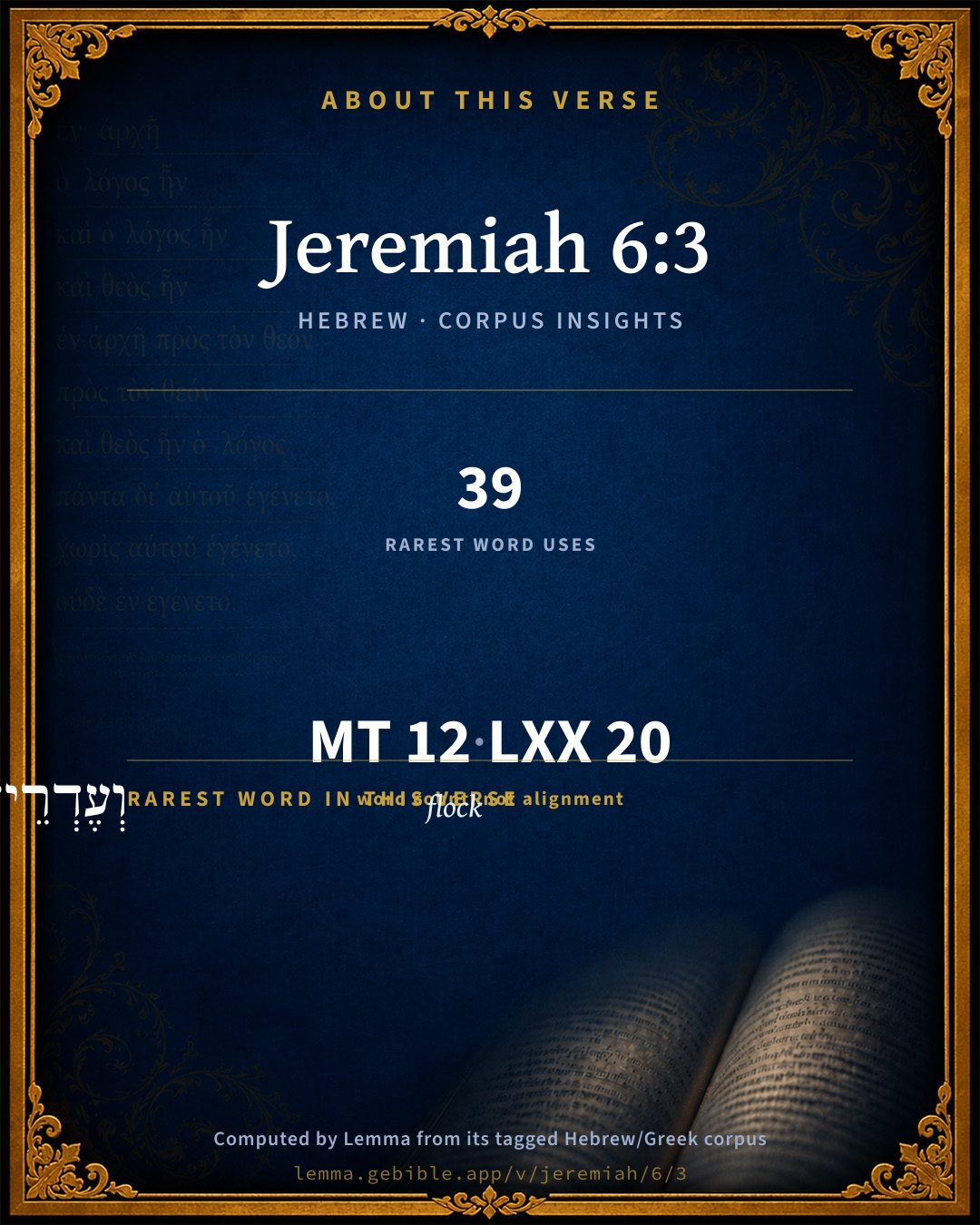
These counts appear in no published source. They are computed here, from the morphology-tagged text and Lemma’s own curated glosses. What Lemma adds →

12
words
11
distinct lemmas
Prophets
section

Shared distinctive vocabulary

וְעֶדְרֵיהֶ֑ם flock H5739 occurs in 34 verses of the Hebrew Bible. Also found in:

Grammatical profile

  • 4 verbs
  • 5 nouns
  • 2 prepositions
  • 1 particle

Verb forms

  • יָבֹ֥אוּ Qal · Imperfect
  • רֹעִ֖ים Qal · Participle Active
  • תָּקְע֨וּ Qal · Perfect
  • רָע֖וּ Qal · Perfect

Repetition

A word recurs within this verse — often emphatic in Hebrew:

  • רֹעִ֖ים to shepherd H7462 ×2

Hebrew & Septuagint length

In the original languages it is 12 Hebrew tokens and 20 Greek tokens — but the two are counted differently (Hebrew bundles its prefixes and suffixes into one token; the Greek is in lemma form), so that isn’t a like-for-like length.

Cross-references

8

Topical passages linked to Jeremiah 6:3 in the Treasury of Scripture Knowledge — connected by theme and wording, ordered by reader-vote popularity; previews shown in the World English Bible.

  • Luke 19:43 For the days will come on you, when your enemies will throw up a barricade against you, surround you, hem you in on every side,
  • Jeremiah 39:1–3 It happened when Jerusalem was taken, (in the ninth year of Zedekiah king of Judah, in the tenth month, came Nebuchadrezzar king of Babylon and all his army against Jerusalem, and besieged it;
  • 2 Kings 24:2 Yahweh sent against him bands of the Chaldeans, and bands of the Syrians, and bands of the Moabites, and bands of the children of Ammon, and sent them against Judah to destroy it, according to the word of Yahweh, which he spoke by his servants the prophets.
  • 2 Kings 24:10–12 At that time the servants of Nebuchadnezzar king of Babylon came up to Jerusalem, and the city was besieged.
  • 2 Kings 25:1–4 It happened in the ninth year of his reign, in the tenth month, in the tenth day of the month, that Nebuchadnezzar king of Babylon came, he and all his army, against Jerusalem, and encamped against it; and they built forts against it round about.
  • Jeremiah 4:16–17 make you mention to the nations; behold, publish against Jerusalem, [that] watchers come from a far country, and give out their voice against the cities of Judah.
  • Jeremiah 12:10 Many shepherds have destroyed my vineyard, they have trodden my portion under foot, they have made my pleasant portion a desolate wilderness.
  • Nahum 3:18 Your shepherds slumber, king of Assyria. Your nobles lie down. Your people are scattered on the mountains, and there is no one to gather them.

Cross-references courtesy of OpenBible.info (CC BY 4.0).

Hebrew and Greek witnesses Masoretic Hebrew ↔ Greek Septuagint

The same verse in the two great witnesses to the Old Testament, shown verse-for-verse.

These are two independent witnesses, not word-aligned to each other, and the Septuagint is shown in lemma (dictionary) form.

Hebrew Jeremiah 6:3 Masoretic · Westminster Leningrad Codex

אֵלֶ֛יהָ יָבֹ֥אוּ רֹעִ֖ים וְעֶדְרֵיהֶ֑ם תָּקְע֨וּ עָלֶ֤יהָ אֹהָלִים֙ סָבִ֔יב רָע֖וּ אִ֥ישׁ אֶת יָדֽוֹ

Shepherds with their flocks shall come to her; they shall pitch their tents against her round about; they shall feed everyone in his place.

World English Bible · Public Domain

Greek LXX Structure differs

In the Septuagint, Jeremiah is about an eighth shorter than the Hebrew and arranges its material differently — the Oracles Against the Nations (Hebrew chapters 46–51) appear in the middle of the Greek book, after 25:13. Because the chapter and verse boundaries do not line up, a verse-for-verse comparison with the Hebrew is not shown.

A verse-for-verse comparison isn’t shown here because the chapters and verses don’t line up. Switch to the LXX edition with the MT / LXX toggle above to read the Greek directly.

On this verse, John Gill's Exposition discusses the Septuagint’s reading. Read the note in Commentary ↓

Hebrew: Westminster Leningrad Codex (CC BY 4.0). Greek: Septuagint (public domain); English from a public-domain English Septuagint. How the Septuagint differs from the Hebrew →

Targum (Aramaic paraphrase)

1

The Targum is the ancient Jewish Aramaic paraphrase of the Hebrew Scriptures — an interpretive translation, not the Hebrew text itself. Onkelos (literal) and Pseudo-Jonathan (expansive) render the Torah, and Jonathan the Prophets. Coverage is partial: where no permissively-licensed English translation exists for a verse, only the Aramaic is shown. This is verse-level text, not a word-by-word alignment to the Hebrew.

  1. Targum Jonathan Prophets (Joshua–Malachi)
    לָהּ יֵיתוּן מַלְכִין וּמַשִׁרְיַתְהוֹן יִגְדוּן עֲלָהּ מַשְׁכְּנִין סְחוֹר סְחוֹר וְסַיְעִין גְבַר יַת חַבְרֵיהּ:

    (no public-domain English translation for this verse)

    Targum Jonathan — Aramaic: “Mikraot Gedolot” (public domain). English: “Sefaria Community Translation” (CC0 1.0 (public-domain dedication)); “London "Chaldee Paraphrase," 1871” (public domain). Text via Sefaria.

Commentary

Notes on Jeremiah 6:3 from classic Christian and Jewish commentators (each source and its license shown beneath its notes). The classic Christian expositions comment on the surrounding passage and are grouped to its opening verse, so a note may address several verses; the Jewish commentaries on the Tanakh (Rashi and others) are per-verse, so they appear only where the commentator wrote on this verse.

Lemma curates 59 commentaries, every one of them public domain or Creative Commons licensed, each selected and text-cleaned for this edition rather than reprinted as found. About our sources →

Trapp's Complete Commentary

John Trapp

Jer 6:3 The shepherds with their flocks shall come unto her; they shall pitch [their] tents against her round about; they shall feed every one in his place.

Ver. 3. The shepherds.] See on Jer 6:2.

John Trapp, A Commentary or Exposition upon All the Books of the Old and New Testament (1647–1656) — public domain. Text from a community e-Sword module.

Geneva Bible (1599)

Geneva Bible translators

She shall be so destroyed; that the sheep may be fed in her.

Geneva Bible (1599) marginal notes — public domain. Text via Bolls.life.

Jamieson, Fausset & Brown

Robert Jamieson, A. R. Fausset & David Brown

shepherds--hostile leaders with their armies (Jer 1:15; Jer 4:17; Jer 49:20; Jer 50:45).

feed--They shall consume each one all that is near him; literally, "his hand," that is, the place which he occupies (Num 2:17; see on Isa 56:5).

Jamieson, Fausset & Brown — Commentary Critical and Explanatory on the Whole Bible (1871) — public domain (CC PDM 1.0). Text via the HelloAO Bible API.

Adam Clarke's Commentary

Verse 3. The shepherds with their flocks] The chiefs and their battalions. The invading army is about to spoil and waste all the fertile fields round about the city, while engaged in the siege.

Adam Clarke's Commentary on the Bible (1810–1826) — public domain. Text from a community e-Sword/MySword module.

John Calvin's Commentaries

But he afterwards adds, Come shall shepherds, etc.; that is, there is no ground for the Jews to deceive themselves, because God has hitherto spared them, and restrained the assaults of enemies; for now shall come shepherds. He keeps to the same metaphor; “come, “he says, “shall shepherds, “together with their flocks; that is, come shall leaders of armies with their forces. But I have already reminded you, that the Prophet here has a regard to the city where he had been born, and adopts a pastoral language. Come then shall shepherds with their flocks; fix shall they their tents, and feed shall each in his place, he means that the whole of Jerusalem would be so much in the power of enemies, that each one would freely choose his own part or his own portion; for when there is any fear, then the shepherds gather their flocks, that they may assist one another; but when everything is in their own power, they move here and there as they please. This free acting then intimates, that the Jews would have no strength, and would be helped by no aid; but that the shepherds would surround the whole city and besiege it: every one, he says, would be in his own place. It follows —

John Calvin's Commentaries (1540-1563) — public domain. Text from the Calvin Translation Society English edition (1840s-50s) via the Christian Classics Ethereal Library (ccel.org). Calvin's coverage is partial (roughly two-thirds of the Bible); uncommented books and verses are honest gaps, never fabricated. The 19th-century editor's footnotes and remarks are omitted so the notes are faithfully Calvin's own voice.

Ellicott's Commentary for English Readers

(3) Shall come unto her.—Better, Unto it (sc., the pasture) shall come shepherds with their flocks—i.e., the leaders and the armies of the invaders. The other verbs are in the past tense, the future being seen, as it were realised, They have pitched, they have pastured.

Every one in his place.—Literally, each on his hand, or perhaps, “they shall feed, each his hand,” i.e., shall let it rove in plunder at will by the side of his own tent. The work of plunder was to go on everywhere. The imagery is drawn from the attack of a nomadic tribe on a richly-cultivated plain.

A Bible Commentary for English Readers, edited by Charles John Ellicott (1878–1897) — public domain. Text from a community e-Sword module.

The Cambridge Bible for Schools and Colleges

gen. ed. J. J. S. Perowne

3. For shepherds in the sense of leaders, rulers cp. chs. Jer_2:8, Jer_3:15.

every one in his place] The Heb. is lit. each his hand. They shall not need to encroach upon one another, finding abundance in their own portion.

The Cambridge Bible for Schools and Colleges (gen. ed. J. J. S. Perowne; Cambridge University Press, 1878–1918) — public domain. Text from a community e-Sword module.

John Gill's Exposition

The shepherds with their flocks shall come unto her,.... Kings and their armies, as the Targum paraphrases it; kings and generals are compared to shepherds, and their armies to flocks, who are under their command and direction; here they design Nebuchadnezzar king of Babylon, with his generals and armies, who should come up against Jerusalem, as to a good pasture:

they shall pitch their tents against her round about; their military tents, in allusion to pastoral ones. The phrase is expressive of the Chaldean army surrounding and besieging Jerusalem:

they shall feed everyone in his place; where he is ordered and fixed by his head general: or, "everyone shall feed his hand" (p): the sheep of his hand; see Psa 95:7, "them that are under his hand", as the Vulgate Latin version renders it; who are committed to his care and charge. The meaning is, he shall direct the company or companies of soldiers under him, where to be, and what part to take in the siege; or "with his hand", as the Septuagint, with the skilfulness of his hands, Psa 78:72, or with might and power; or "at his hand", as the Arabic version; what is at hand, what is nearest to him; or according to his will and pleasure. The Targum is,

"everyone shall help his neighbour.''

The sense, according to Kimchi, is, one king or general shall lay siege against a city, or against cities, and so another, until they have consumed and subdued the whole land.

(p) "paverunt unusquisque manum suam", Montanus; "eos qui sub manu sua sunt", V. L.

John Gill's Exposition of the Whole Bible (1746–1763) — public domain (CC PDM 1.0). Text via the HelloAO Bible API.

Albert Barnes' Notes on the Bible

To it shall come “shepherds with their flocks:”

They have pitched upon it “their tents round about:”

They have pastured each his hand, “i. e., side.”

The pasture is so abundant that each feeds his flock, i. e., plunders Jerusalem, at the side of his own tent.

Albert Barnes' Notes on the Bible (1834–1885) — public domain. Text from a community e-Sword/MySword module.

Haydock's Catholic Bible Commentary

Shepherds. So captains are styled, because they feed and govern soldiers. (Worthington)

George Leo Haydock (1774–1849), Haydock's Catholic Family Bible and Commentary, 1859 edition — public domain. Excludes Psalms (Douay-Rheims chapter numbering differs from Protestant) and Deuterocanonical books (Catholic canon only).

Matthew Poole's English Annotations

The shepherds with their flocks shall come unto her: the prophet here proceeds in his metaphor, and possibly the rather, because he chooseth to speak in the style of his own education, which may also give some countenance to the supplement of pasture or land in the former verse instead of woman: the meaning is, the Chaldean princes, with their armies, as so many flocks, shall come into this pleasant land; see Jer 12:10; in which expression there is something of a scoff, as Jer 4:16,17.

They shall pitch their tents against her round about; they shall so place their warlike tents, as to form a siege to begirt her round, Jer 1:15; Eze 4:2.

Every one in his place, Heb. hand, i.e. near hand, or beside or near one another; thus 2Ch 21:16; Job 1:14; thus hand is taken for place; i.e. each one in his quarter or station, not a man but shall do his part, and shall be skilful and powerful to destroy wherever he comes: it intimates also that every thing shall be so much at the enemy’s own disposal, that they shall be able to choose their own quarters; they shall place their army in wings, and troops, and regiments, as they see good, to their best advantage, to be helpful one unto another, as shepherds are wont to do their flocks; or, they shall fight in several parties, and each destroy his part assigned him through the whole country, and they shall join as it were in one body against Jerusalem.

Matthew Poole's English Annotations on the Holy Bible (1683–1685) — public domain. Text from a community e-Sword/MySword module.

Whedon's Commentary on the Bible

Daniel D. Whedon

3. The shepherds… shall come — The coming destruction is set forth under the familiar figure of shepherds with their flocks, who eat up the substance of the land. The figure of shepherds is a common one for princes and people.

Daniel D. Whedon (gen. ed.), Commentary on the Old and New Testaments (1874–1909) — public domain. Text from a community e-Sword module.

The Pulpit Commentary

The shepherds with their flocks, etc.; rather, To her came shepherds with their flocks; they have pitched their tents round about her; they have pastured each at his side. The best commentary on the last clause is furnished by Num_22:4, "Now shall this company lick up all that are round about us, as the ox licketh up the grass of the field."

The Pulpit Commentary (1880–1919), ed. H.D.M. Spence-Jones & Joseph S. Exell — public domain. Text from a community e-Sword module.

John Wesley's Explanatory Notes

The shepherds - The Chaldean princes, with their armies, as so many flocks, shall come into this pleasant land. In his place - Each one in his quarter or station.

John Wesley, Explanatory Notes Upon the Whole Bible (1754–1765) — public domain. Text via the GEBible commentary corpus.

Rashi

Rabbi Shlomo Yitzchaki (Rashi)

Shepherds and their flocks Figurative of kings and their armies.

they feed bare Heb. רעו, they eat.

his place Heb. ידו [lit. his hand.] His place around him.

Rashi on the Tanakh — English translations: “The Judaica Press complete Tanach with Rashi, translated by A. J. Rosenberg” (CC BY 4.0); “Pentateuch with Rashi's commentary by M. Rosenbaum and A.M. Silbermann, 1929-1934” (public domain); “The Metsudah Tanach series, Lakewood, N.J” (CC BY 4.0); and “The Book of Joshua, Metsudah Publications, 1997” (CC BY 4.0). Text via Sefaria.

Lesson kit

Teaching starters — assembled from the data on this page, not authored interpretation. Every prompt links to the verse data it draws on. Edit before teaching.

Jeremiah, in the Prophets, opens this verse with 12 words (11 distinct Hebrew lemmas). Its most distinctive word is ʻêder (“flock”). A historical commentator’s framing appears above. Read the whole chapter for the surrounding context.

Discussion questions

  1. How does “flock” (ʻêder) shape what this verse is saying?
  2. Genesis 29:2 shares the word «flock» with this verse. How do the two illuminate each other?
  3. “to shepherd” occurs 2× in this one verse. What is the effect of the repetition?
  4. These translations render this verse differently; the difference is in the English rendering, not the original. What questions does that raise?
  5. The verb «יָבֹ֥אוּ» is Qal Imperfect. How does its form color the action?
  6. Reading how Trapp's Complete Commentary and Geneva Bible (1599) read this verse, where do the two commentators agree and where do they part?

Things to notice

Reading settings

Reading text

Shown beneath each verse's original-language words.

Old Testament
Old Testament edition

Read the OT as the Masoretic Hebrew (MT) or the Greek Septuagint (LXX).

English shown for the Greek Septuagint (in the Hebrew ↔ Greek comparison).

Comparing translations? Open the Compare panel on any verse page to stack up to four side by side.