
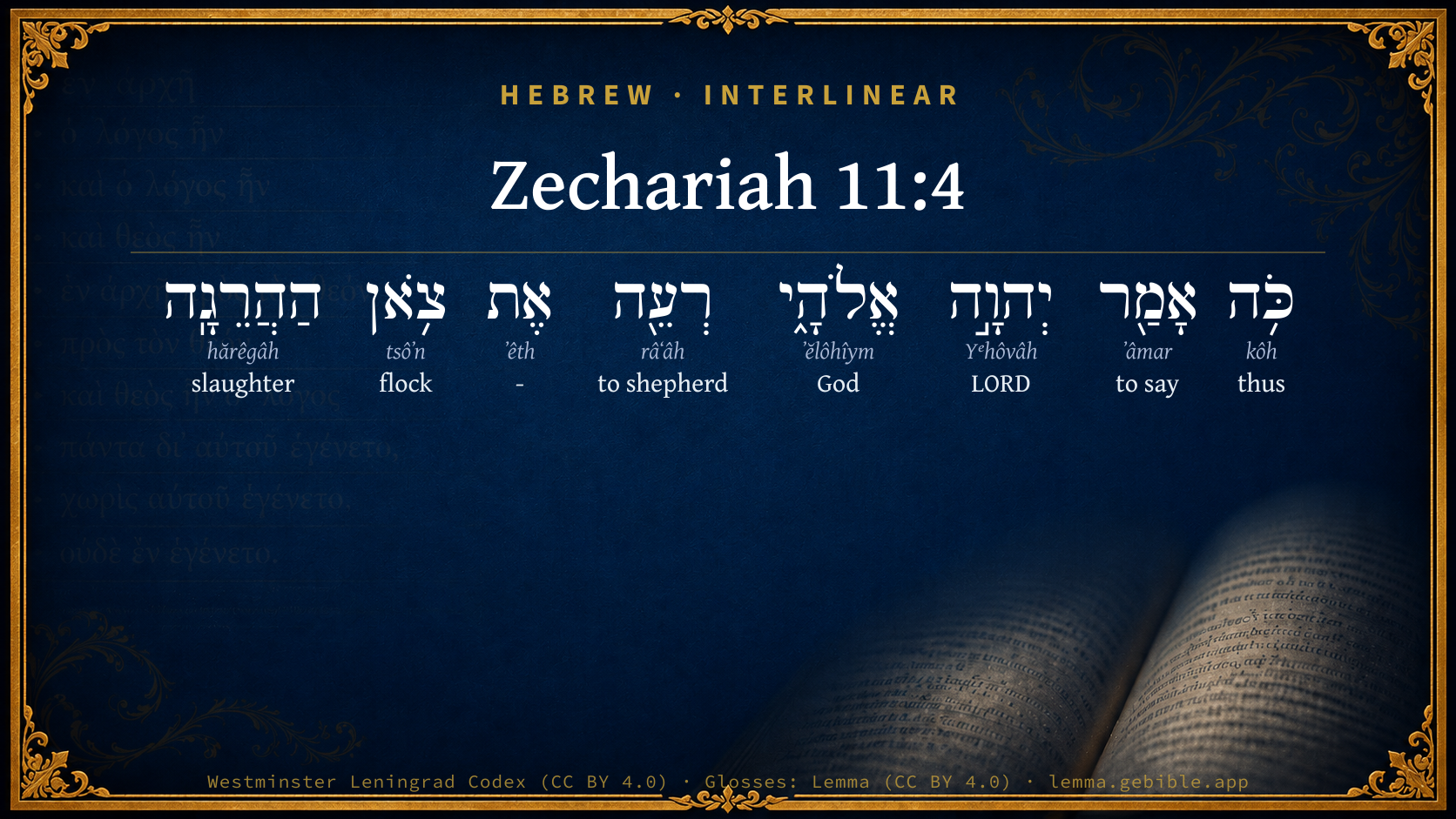
Zechariah 11:4

Hebrew (Westminster Leningrad Codex) Zechariah 11:4 appears in the Hebrew Old Testament. The text above is from the Westminster Leningrad Codex. Each word links to its Strong’s number, a concise gloss, and parsing drawn from the Open Scriptures Hebrew Bible morphology. Click any word for its full Brown-Driver-Briggs (BDB) entry.
Download image
Cite this verse

Zechariah 11:4 (World English Bible). Public Domain. Lemma interlinear Bible study tool, https://lemma.gebible.app/v/zechariah/11/4.

Show BibTeX & RIS
BibTeX
RIS
English Translation
Thus says Yahweh my God: "Feed the flock of slaughter.
World English Bible · Public Domain
Download a study sheet

One document with this verse’s original text, its word-by-word gloss line, the meaning frame, cross-references with their text, attributed commentary, and full source and license credits — printable, and it pastes into notes with its structure intact.

This verse Autodidact and up

Study sheet (.html) Plain text (.txt)

A passage Seminary Student

Up to 50 verses in one chapter. A passage sheet keeps up to 6 commentary sources and 12 cross-references per verse, in the order this page ranks them, and says so on the sheet whenever that leaves anything out. Ask for a single verse and you get the Autodidact verse sheet above.

Everything on this page stays free to read, with no account — the sheet is a download of what is already on screen, not access to it.

Want to remove ads? Support Godless Engineer
Compare translations 3

The same verse in 3 English versions, stacked beneath the original-language interlinear above. Click any original word for its lexicon entry.

Each is an independent rendering of the whole verse — the interlinear is not word-aligned to these translations.

Highlighted words mark where these versions differ — a whole-verse word diff, not a word-by-word alignment.

  • World English Bible Public Domain
    Thus says Yahweh my God: "Feed the flock of slaughter.
  • King James Version Public Domain
    Thus saith the LORD my God; Feed the flock of the slaughter;
  • unfoldingWord Literal Text CC BY-SA 4.0
    This is what Yahweh my God says, “Like a shepherd, watch over the flock set aside for slaughter!

unfoldingWord Literal Text — © unfoldingWord, licensed CC BY-SA 4.0. Word-aligned USFM3 via Door43 (git.door43.org/unfoldingWord/en_ult).

Versions to compare (up to 4)

3 of 4 selected

Show all 18 translations

Every available English version of this verse, each an independent rendering of the whole verse.

  • World English Bible Public Domain
    Thus says Yahweh my God: "Feed the flock of slaughter.
  • Berean Standard Bible Public Domain
    This is what the LORD my God says: “Pasture the flock marked for slaughter,
  • Majority Standard Bible Public Domain
    This is what the LORD my God says: “Pasture the flock marked for slaughter,
  • King James Version Public Domain
    Thus saith the LORD my God; Feed the flock of the slaughter;
  • American Standard Version (1901) Public Domain
    Thus said Jehovah my God: Feed the flock of slaughter;
  • Revised Version (1885) Public Domain
    Thus said the LORD my God: Feed the flock of slaughter;
  • Geneva Bible (1599) Public Domain
    Thus sayeth the Lord my God, Feede the sheepe of the slaughter.
  • Douay-Rheims (1899) Public Domain
    Thus saith the Lord my God: Feed the flock of the slaughter,
  • Young's Literal Translation Public Domain
    Thus said Jehovah my God: `Feed the flock of the slaughter,
  • Literal Standard Version CC BY-SA 4.0
    Thus said my God YHWH: “Feed the flock of the slaughter,
  • Unlocked Literal Bible CC BY-SA 4.0
    This is what Yahweh my God says, “Like a shepherd, watch over the flock set aside for slaughter!
  • unfoldingWord Literal Text CC BY-SA 4.0
    This is what Yahweh my God says, “Like a shepherd, watch over the flock set aside for slaughter!
  • Darby Bible Public Domain
    Thus saith Jehovah my God: Feed the flock of slaughter,
  • World Messianic Bible Public Domain
    The LORD my God says: “Feed the flock of slaughter.
  • Webster's Bible Public Domain
    Thus saith the LORD my God; Feed the flock of the slaughter;
  • Free Bible Version CC BY-SA 4.0
    This is what the Lord my God says: Become a shepherd of the flock marked for slaughter.
  • Bible in Basic English Public Domain
    This is what the Lord my God has said: Take care of the flock of death;
  • JPS Tanakh (1917) Public Domain
    Thus said the LORD my God: 'Feed the flock of slaughter;

Literal Standard Version (2020), Covenant Press — licensed CC BY-SA 4.0. Text via the HelloAO Bible API (eBible.org). Unlocked Literal Bible (unfoldingWord) — licensed CC BY-SA 4.0. Text via the HelloAO Bible API (eBible.org). unfoldingWord Literal Text — © unfoldingWord, licensed CC BY-SA 4.0. Word-aligned USFM3 via Door43 (git.door43.org/unfoldingWord/en_ult). Free Bible Version, Dr. Jonathan Gallagher — licensed CC BY-SA 4.0. Text via the HelloAO Bible API (eBible.org).

Word by word

More ways to search: Search by grammar → Find every occurrence → Compare this word →

Practice this passage: Drill this verse → Learn its vocabulary →

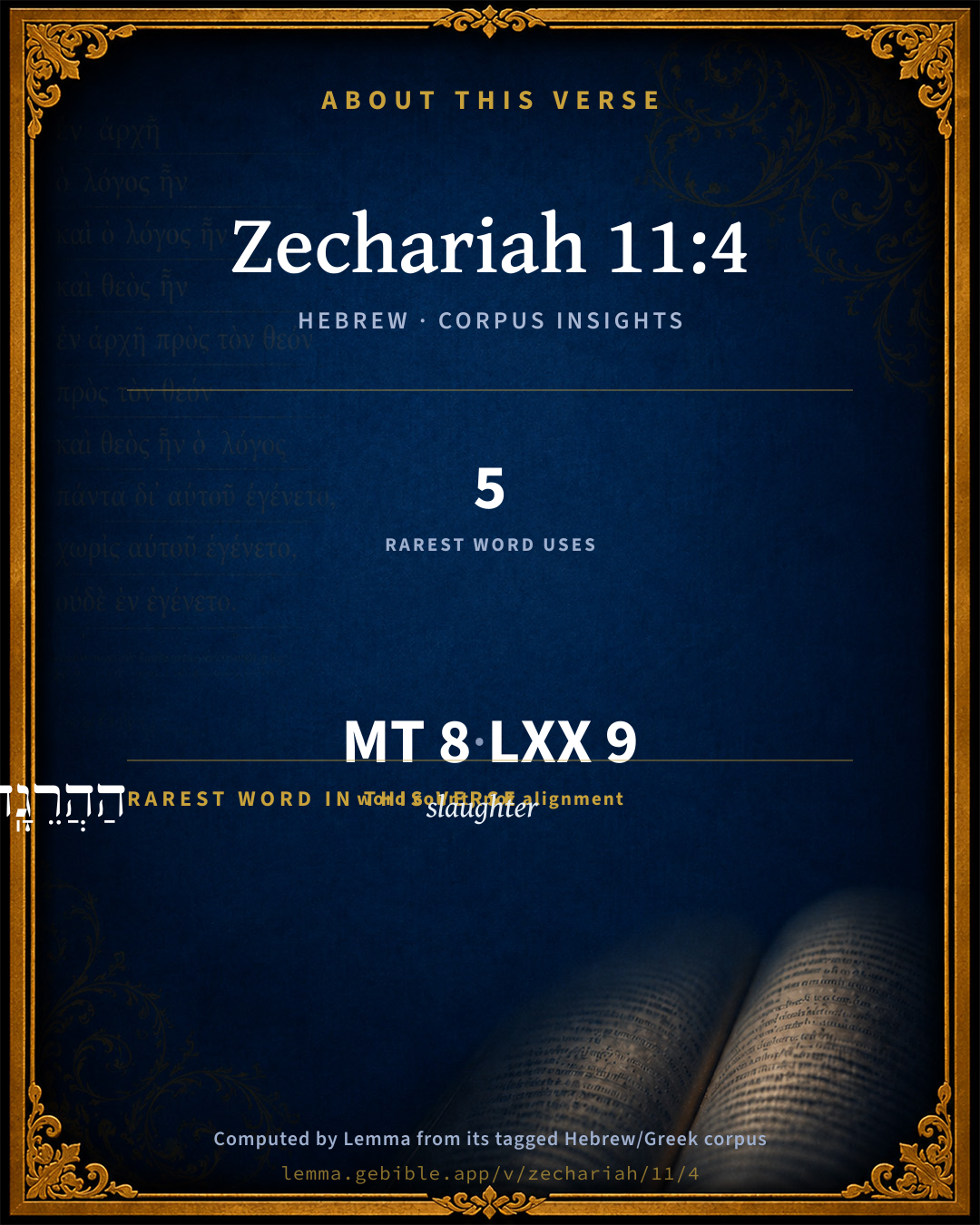
About this verse

These counts appear in no published source. They are computed here, from the morphology-tagged text and Lemma’s own curated glosses. What Lemma adds →

8
words
8
distinct lemmas
Prophets
section

Notable vocabulary

The rarest word here is הַהֲרֵגָֽה slaughter H2028 — appearing just 5 times in the whole Hebrew Bible.

Shared distinctive vocabulary

הַהֲרֵגָֽה slaughter H2028 occurs in 5 verses of the Hebrew Bible. Also found in:

Grammatical profile

  • 2 verbs
  • 4 nouns
  • 1 adverb
  • 1 particle

Verb forms

  • אָמַ֖ר Qal · Perfect
  • רְעֵ֖ה Qal · Imperative

Hebrew & Septuagint length

In English translation the verse runs 10 words from the Hebrew and 11 from the Septuagint (LXX English) — closely comparable.

A rough comparison of the two English renderings, which tokenize alike — not a word-level alignment.

Word counts can differ between the Hebrew and the Greek without any difference in meaning — e.g. the Hebrew direct-object marker אֵת has no separate Greek word, and Greek often adds the article ὁ.

In the original languages it is 8 Hebrew tokens and 9 Greek tokens — but the two are counted differently (Hebrew bundles its prefixes and suffixes into one token; the Greek is in lemma form), so that isn’t a like-for-like length.

Cross-references

13

Topical passages linked to Zechariah 11:4 in the Treasury of Scripture Knowledge — connected by theme and wording, ordered by reader-vote popularity; previews shown in the World English Bible.

  • Zechariah 11:7 So I fed the flock of slaughter, especially the oppressed of the flock. I took for myself two staffs. The one I called "Favor," and the other I called "Union," and I fed the flock.
  • Matthew 23:37 "Jerusalem, Jerusalem, who kills the prophets, and stones those who are sent to her! How often would I have gathered your children together, even as a hen gathers her chickens under her wings, and you would not!
  • Romans 15:8 Now I say that Christ has been made a minister of the circumcision for the truth of God, that he might confirm the promises given to the fathers,
  • Isaiah 40:9–11 You who tell good news to Zion, go up on a high mountain; you who tell good news to Jerusalem, lift up your voice with strength; lift it up, don't be afraid; say to the cities of Judah, Behold, your God!
  • Isaiah 49:4–5 But I said, I have labored in vain, I have spent my strength for nothing and vanity; yet surely the justice [due] to me is with Yahweh, and my recompense with my God.
  • Ezekiel 34:23–24 I will set up one shepherd over them, and he shall feed them, even my servant David; he shall feed them, and he shall be their shepherd.
  • Micah 5:4 He shall stand, and shall shepherd in the strength of Yahweh, In the majesty of the name of Yahweh his God: And they will live, for then he will be great to the ends of the earth.
  • Zechariah 14:5 You shall flee by the valley of my mountains; for the valley of the mountains shall reach to Azel; yes, you shall flee, just like you fled from before the earthquake in the days of Uzziah king of Judah. Yahweh my God will come, and all the holy ones with you.
  • Matthew 15:24 But he answered, "I wasn't sent to anyone but the lost sheep of the house of Israel."
  • Luke 19:41–44 When he drew near, he saw the city and wept over it,
  • John 20:17 Jesus said to her, "Don't touch me, for I haven't yet ascended to my Father; but go to my brothers, and tell them, 'I am ascending to my Father and your Father, to my God and your God.'"
  • Ephesians 1:3 Blessed be the God and Father of our Lord Jesus Christ, who has blessed us with every spiritual blessing in the heavenly places in Christ;
  • John 21:15–17 So when they had eaten their breakfast, Jesus said to Simon Peter, "Simon, son of Jonah, do you love me more than these?" He said to him, "Yes, Lord; you know that I have affection for you." He said to him, "Feed my lambs."

Cross-references courtesy of OpenBible.info (CC BY 4.0).

Hebrew and Greek witnesses Masoretic Hebrew ↔ Greek Septuagint

The same verse in the two great witnesses to the Old Testament, shown verse-for-verse.

These are two independent witnesses, not word-aligned to each other, and the Septuagint is shown in lemma (dictionary) form.

Hebrew Zechariah 11:4 Masoretic · Westminster Leningrad Codex

כֹּ֥ה אָמַ֖ר יְהוָ֣ה אֱלֹהָ֑י רְעֵ֖ה אֶת צֹ֥אן הַהֲרֵגָֽה

Thus says Yahweh my God: "Feed the flock of slaughter.

World English Bible · Public Domain

Greek LXX Zechariah 11:4 Septuagint · lemma form

ὅδε λέγω κύριος παντοκράτωρ ποιμαίνω ὁ πρόβατον ὁ σφαγή

Thus says the Lord Almighty, Feed the sheep of the slaughter;

LXX2012 (modern English Septuagint) · Public Domain

Hebrew: Westminster Leningrad Codex (CC BY 4.0). Greek: Septuagint (public domain); English from LXX2012 (modern English Septuagint) (Public Domain). How the Septuagint differs from the Hebrew →

Targum (Aramaic paraphrase)

1

The Targum is the ancient Jewish Aramaic paraphrase of the Hebrew Scriptures — an interpretive translation, not the Hebrew text itself. Onkelos (literal) and Pseudo-Jonathan (expansive) render the Torah, and Jonathan the Prophets. Coverage is partial: where no permissively-licensed English translation exists for a verse, only the Aramaic is shown. This is verse-level text, not a word-by-word alignment to the Hebrew.

  1. Targum Jonathan Prophets (Joshua–Malachi)
    כִּדְנַן אֲמַר יְיָ אֱלֹהָי אִתְנַבֵּי עַל פַּרְנָסַיָא דְאִתְמְנִיאוּ לְפַרְנָסָא עַמָא וְאִינוּן שְׁלִיטוּ בְהוֹן כְעָנָא לְנִכְסְתָא:

    (no public-domain English translation for this verse)

    Targum Jonathan — Aramaic: “Mikraot Gedolot” (public domain). English: “Sefaria Community Translation” (CC0 1.0 (public-domain dedication)); “London "Chaldee Paraphrase," 1871” (public domain). Text via Sefaria.

Commentary

Notes on Zechariah 11:4 from classic Christian and Jewish commentators (each source and its license shown beneath its notes). The classic Christian expositions comment on the surrounding passage and are grouped to its opening verse, so a note may address several verses; the Jewish commentaries on the Tanakh (Rashi and others) are per-verse, so they appear only where the commentator wrote on this verse.

Lemma curates 59 commentaries, every one of them public domain or Creative Commons licensed, each selected and text-cleaned for this edition rather than reprinted as found. About our sources →

Matthew Henry's Commentary

The prophet here is made a type of Christ, as the prophet Isaiah sometimes was; and the scope of these verses is to show that for judgment Christ came into this world (Joh 9:39), for judgment to the Jewish church and nation, which were, about the time of his coming, wretchedly corrupted and degenerated by the worldliness and hypocrisy of their rulers. Christ would have healed them, but they would not be healed; they are therefore left desolate, and abandoned to ruin. Observe here,

I. The desperate case of the Jewish church, under the tyranny of their own governors. Their slavery in their own country made them as miserable as their captivity in strange countries had done: Their possessors slay them and sell them, Zac 11:5. In Zechariah's time we find the rulers and the nobles justly rebuked for exacting usury of their brethren; and the governors, even by their servants, oppressive to the people, Neh 5:7, Neh 5:15. In Christ's time the chief priests and the elders, who were the possessors of the flock, by their traditions, the commandments of men, and their impositions on the consciences of the people, became perfect tyrants, devoured their houses, engrossed their wealth, and fleeced the flock instead of feeding it. The Sadducees, who were deists, corrupted their judgments. The Pharisees, who were bigots for superstition, corrupted their morals, by making void the commandments of God, Mat 15:16. Thus they slew the sheep of the flock, thus they sold them. They cared not what became of them so they could but gain their own ends and serve their own interests. And, 1. In this they justified themselves: They slay them and hold themselves not guilty. They think that there is no harm in it, and that they shall never be called to an account for it by the chief Shepherd; as if their power were given them for destruction, which was designed only for edification, and as if, because they sat in Moses's seat, they were not under the obligation of Moses's law, but might dispense with it, and with themselves in the breach of it, at their pleasure. Note, Those have their minds woefully blinded indeed who do ill and justify themselves in doing it; but God will not hold those guiltless who hold themselves so. 2. In this they affronted God, by giving him thanks for the gain of their oppression: They said, Blessed be the Lord, for I am rich, as if, because they prospered in their wickedness, got money by it, and raised estates, God had made himself patron of their unjust practices, and Providence had become particeps criminis - the associate of their guilt. What is got honestly we ought to give God thanks for, and to bless him whose blessing makes rich and adds no sorrow with it. But with what face can we go to God either to beg a blessing upon the unlawful methods of getting wealth or to return him thanks for success in them? They should rather have gone to God to confess the sin, to take shame to themselves for it, and to vow restitution, than thus to mock him by making the gains of sin the gift of God, who hates robbery for burnt-offerings, and reckons not himself praised by the thanksgiving if he be dishonoured either in the getting or the using of that which we give him thanks for. 3. In this they put contempt upon the people of God, as unworthy their regard or compassionate consideration: Their own shepherds pity them not; they make them miserable, and then do not commiserate them. Christ had compassion on the multitude because they fainted and were scattered abroad, as if they had no shepherd (as really they had worse than none); but their own shepherds pitied them not, nor showed any concern for them. Note, It is ill for a church when its pastors have no tenderness, no compassion for precious souls, when they can look upon the ignorant, the foolish, the wicked, the weak, without pity.

II. The sentence of God's wrath passed upon them for their senselessness and stupidity in this condition. There was a general decay, nay, a destruction, of religion among them, and it was all one to them; they regarded it not. My people love to have it so, Jer 5:31. Though they were oppressed and broken in judgment, yet they willingly walked after the commandment, Hos 5:11. And, as their shepherds pitied them not, so they did not bemoan themselves; therefore God says (Zac 11:6), "I will no more pity the inhabitants of the land. They have courted their own destruction, and so let their doom be." But those are truly miserable whom the God of mercy himself will no more have compassion upon. Those who are willing to have their consciences oppressed by those who teach for doctrines the commandments of men (as the Jews were, who called those Rabbi, Rabbi, that did so, Mat 15:9; Mat 23:7), are often punished by oppression in their civil interests, and justly, for those forfeit their own rights who tamely give up God's rights. The Jews did so; the Papists do so; and who can pity them if they be ruled with rigour? God here threatens them, 1. That he will deliver them into the hand of oppressors, every one into his neighbour's hand, so that they shall use one another barbarously. The several parties in Jerusalem did so; the zealots, the seditious, as they were called, committed greater outrages than the common enemy did, as Josephus relates in his history of the wars of the Jews. They shall be delivered every one into the hand of his king, that is, the Roman emperor, whom they chose to submit to rather than to Christ, saying, We have no king but Caesar. Thus they thought to ingratiate themselves with their lords and masters. But for this God brought the Romans upon them, who took away their place and nation. 2. That he will not deliver them out of their hands: They shall smite the land, the whole land, and out of their hand I will not deliver them; and, if the Lord do not help them, none else can, nor can they help themselves.

III. A trial yet made whether their ruin might be prevented by sending Christ among them as a shepherd; God had sent his servants to them in vain, but last of all he sent unto them his Son, saying, They will reverence my Son, Mat 21:37. Divers of the prophets had spoken of him as the Shepherd of Israel, Isa 40:11; Eze 34:23. he himself told the Pharisees that he was the Shepherd of the sheep, and that those who pretended to be shepherds were thieves and robbers (Joh 10:1, Joh 10:2, Joh 10:11), apparently referring to this passage, where we have, 1. The charge he received from his Father to try what might be done with this flock (Zac 11:4): Thus saith the Lord my God (Christ called his Father his God because he acted in compliance with his will and with an eye to his glory in his whole undertaking), Feed the flock of the slaughter. The Jews were God's flock, but they were the flock of slaughter, for their enemies had killed them all the day long and accounted them as sheep for the slaughter; their own possessors slew them, and God himself had doomed them to the slaughter. Yet "feed them by reproof instruction, and comfort; provide wholesome food for those who have so long been soured with the leaven of the scribes and Pharisees." Other sheep he had, which were not of this fold, and which afterwards must be brought; but he is first sent to the lost sheep of the house of Israel, Mat 15:24. 2. His acceptance of this charge, and his undertaking pursuant to it, Zac 11:7. He does as it were say, Lo, I come to do thy will, O my God! and, since this is thy will, it is mine: I will feed the flock of slaughter. Christ will care for these lost sheep; he will go about among them, teaching and healing even you, O poor of the flock! Christ did not neglect the meanest, nor overlook them for their meanness. The shepherds that made a prey of them regarded not the poor; they were conversant with those only that they could get by; but Christ preached his gospel to the poor, Mat 11:5. It was an instance of his humiliation that his converse was mostly with the inferior sort of people; his disciples, who were his constant attendants, were of the poor of the flock. 3. His furnishing himself with tools proper for the charge he had undertaken: I took unto me two staves, pastoral staves; other shepherds have but one crook, but Christ had two, denoting the double care he took of his flock, and what he did both for the souls and for the bodies of men. David speaks of God's rod and his staff (Psa 23:4), a correcting rod and a supporting staff. One of these staves was called Beauty, denoting the temple, which is called the beauty of holiness and one of its gates beautiful, which Christ called his Father's house, and for which he showed a great zeal when he cleared it of the buyers and sellers; the other he called Bands, denoting their civil state, and the incorporate society of that nation, which Christ also took care of by preaching love and peace among them. Christ, in his gospel, and in all he did among them, consulted the advancement both of their civil and of their sacred interests. 4. His execution of his office, as the chief Shepherd. He fed the flock (Zac 11:7), and he displaced those under-shepherds that were false to their trust (Zac 11:8): Three shepherds I cut off in one month. Through the deficiency and uncertainty of the history of the Jewish church, in its latter ages, we know not what particular event this had its accomplishment in; in general, it seems to be an act of power and justice for the punishment of the sinful shepherds and the redress of the grievances of the abused flock. Some understand it of the three orders of princes, priests, and scribes or prophets, who, when Christ had finished his work, were laid aside for their unfaithfulness. Others understand it of the three sects among the Jews, of Pharisees, Sadducees, and Herodians, all whom Christ silenced in dispute (Mt. 22) and soon after cut off, all in a little time.

IV. Their enmity to Christ, and making themselves odious to him. He came to his own, the sheep of his own pasture; it might have been expected that between them and him there would be an entire affection, as between the shepherd and his sheep; but they conducted themselves so ill that his soul loathed them, was straitened towards them (so it may be read); he intended them kindness, but could not do them the kindness he intended them, because of their unbelief, Mat 13:58. He was disappointed in them, discouraged concerning them, grieved for them, not only for the shepherds, whom he cut off, but for the people, whom Christ often looked upon with grief in his heart and tears in his eyes. Their provocations even wore out his patience, and he was weary of that faithless and perverse generation. Their soul also it abhorred me; and therefore it was that his soul loathed them; for, whatever estrangement there is between God and man, it begins on man's side. The Jewish shepherds rejected this chief Shepherd, as the Jewish builders rejected this chief corner stone. They had indignation at Christ's doctrine and miracles, and his interest in the people, to whom they did all they could to render him odious, as they had made themselves odious to him. Note, There is a mutual enmity between God and wicked people; they are hateful to God and haters of God. Nothing speaks more the sinfulness and misery of an unregenerate state than this does. The carnal mind, the friendship of the world, are enmity to God, and God hates all the workers of iniquity; and it is easy to foresee what this will end in, if the quarrel be not taken up in time, Isa 27:4, Isa 27:5.

V. Christ's rejecting them as incurable, and leaving them their house desolate, Mat 23:38. The things of their peace are now hidden from their eyes, because they knew not the day of their visitation. Here we have,

1. The sentence of their rejection passed (Zac 11:9): "Then said I, I will not feed you. I will take no further care of you; you shall not see me again; take your own course. As I will not feed you, so I will not cure you; that that dieth, let it die (the Shepherd will do nothing to save its forfeited life); that that is to be cut off, let it be cut off; that which will make itself a prey to the wolf, let it be a prey, and let the rest so far forget their own mild and gentle nature as to eat the flesh of one another; let these sheep fight like dogs." Those that reject Christ will be certainly and justly rejected by him, and then are miserable of course.

2. A sign of it given (Zac 11:10): I took my staff, even Beauty, and cut it asunder, in token of this, that he would be no longer a shepherd to them, as the lord high steward determines his commission by breaking his white staff, and as Moses's breaking the tables of the law put a stop, for the present, to the treaty between God and Israel. The breaking of this staff signified the breaking of God's covenant which he had made with all the people, the covenant of peculiarity made with all the tribes of Israel, and all other people who, by being proselyted to their religion, were incorporated into their nation. The Jewish church was now stripped of all its glory; its crown was profaned and cast to the ground, and all its honour laid in the dust; for God departed from it, and would no more own it for his. When Christ told them plainly that the kingdom of God should be taken from them, and given to another people, then be broke the staff of Beauty, Mat 21:43. And it was broken in that day, though Jerusalem and the Jewish nation held up forty years longer, yet from that day we may reckon the staff of Beauty broken, Zac 11:11. And though the great men did not, or would not, understand it as a divine sentence, but thought to put it by with a cold God forbid (Luk 20:16), yet the poor of the flock, the disciples of Christ, that waited on him, and understood with what authority he spoke, and could distinguish the voice of their Shepherd from that of a stranger, knew that it was the word of the Lord, and trembled at it, and were confident that it should not fall to the ground. Note, Christ is waited on by the poor of the flock; he chose them to be with him, to be his pupils, to be his witnesses; the poor received him and his gospel, when those that had great possessions turned their backs upon him. And those that wait upon Christ, that sit at his feet, to hear and receive his words, shall know of the doctrine whether it be of God, Joh 7:17.

3. A further reason given for their rejection. It was said before, Their souls abhorred him; and here we have an instance of it, their buying and selling him for thirty pieces of silver, either thirty Roman pence, or rather thirty Jewish shekels; this is here foretold in somewhat obscure expressions, as it is fit that such particular prophecies should be delivered, lest otherwise the plainness of the prophecy might prevent the accomplishment of it. Here, (1.) The Shepherd comes to them for his wages (Zac 11:12): "If you think good, give me my price; you are weary of me, pay me off and discharge me; and, if not, forbear; if you be willing to continue me longer in your service, I will continue, or, if to turn me off without wages, I am content." Christ was no hireling, and yet the labourer is worthy of his hire. Compare with this what Christ said to Judas when he was going to sell him, "What thou doest do quickly; be at a word with the chief priests; let them either take the bargain or leave it," Joh 13:27. Those that betray Christ are not forced to it; they might have chosen. (2.) They value him at thirty pieces of silver. Many years' service he had done them as a Shepherd, yet this is all they will now turn him off with - "A goodly price that I with all my care and pains was valued at by them." If Judas fixed this sum in his demand, it is observable that his name was Judah, the same name with that of the body of the people, for it was a national act; or, if (as it rather seems) the chief priests pitched upon this sum in their proffers, they were the representatives of the people; it was part of the priest's office to put a value upon the devoted things (Lev 27:8), and thus they valued the Lord Jesus. it was the ordinary price of a slave, Exo 21:32. Making light of Christ, and undervaluing the love of that great and good Shepherd, are the ruin of multitudes, and justly so. (3.) The silver being no way proportionable to his worth, it is thrown to the potter with disdain: "Let him take it to buy clay with, or for any use that a little money will serve to, for it is not worth hoarding; it may be enough for a potter's stock, but not for the pay of such a shepherd, much less for his purchase." So the prophet cast the thirty pieces of silver to the potter in the house of the Lord: "Let him take them, and do what he will with them." Now we find a particular accomplishment of this in the history of Christ's sufferings, and reference is had to this prophecy, Mat 27:9, Mat 27:10. Thirty pieces of silver was the very sum for which Christ was sold to the chief priests; the money, when Judas would not keep it, and the chief priests would not take it back was laid out in the purchase of the potter's field. Even that sudden resolve of the chief priests was according to an ancient prophecy and the more ancient counsel and foreknowledge of God.

4. The completing of their rejection in the cutting asunder of the other staff, Zac 11:14. The former denoted the ruin of their church, by breaking the covenant between God and them - that defaced their beauty; this denotes the ruin of their state, by breaking the brotherhood between Judah and Israel, by reviving animosities and contention among them, such as were of old between Judah and Israel, the writing of whom as one stick in the hand of the Lord was one of the blessings promised after their return out of captivity, Eze 37:19. But that union shall now be dissolved; they shall be crumbled into parties and factions, exasperated one against another; and their kingdom, being thus divided, shall be brought to desolation. (1.) Nothing ruins a people so certainly, so inevitably, as the breaking of the staff of Bands, and the weakening of the brotherhood among them; for hereby they become an easy prey to the common enemy. (2.) This follows upon the dissolving of the covenant between God and them, and the decay of religion among them. When iniquity abounds love waxes cold. No wonder if those fall out among themselves that have provoked God to fall out with them. When the staff of Beauty is broken the staff of Bands will not hold long. An unchurched people will soon be an undone people.

Matthew Henry's Commentary on the Whole Bible (1708–1710) — public domain (CC PDM 1.0). Text via the HelloAO Bible API.

Jamieson, Fausset & Brown

Robert Jamieson, A. R. Fausset & David Brown

The prophet here proceeds to show the cause of the destruction just foretold, namely, the rejection of Messiah.

flock of . . . slaughter-- (Psa 44:22). God's people doomed to slaughter by the Romans. Zechariah here represents typically Messiah, and performs in vision the actions enjoined: hence the language is in part appropriate to him, but mainly to the Antitype, Messiah. A million and a half perished in the Jewish war, and one million one hundred thousand at the fall of Jerusalem. "Feed" implies that the Jews could not plead ignorance of God's will to execute their sin. Zechariah and the other prophets had by God's appointment "fed" them (Act 20:28) with the word of God, teaching and warning them to escape from coming wrath by repentance: the type of Messiah, the chief Shepherd, who receives the commission of the Father, with whom He is one (Zac 11:4); and Himself says (Zac 11:7), "I will feed the flock of slaughter." Zechariah did not live to "feed" literally the "flock of slaughter"; Messiah alone "fed" those who, because of their rejection of Him, were condemned to slaughter. Jehovah-Messiah is the speaker. It is He who threatens to inflict the punishments (Zac 11:6, Zac 11:8). The typical breaking of the staff, performed in vision by Zechariah (Zac 11:10), is fulfilled in His breaking the covenant with Judah. It is He who was sold for thirty pieces of silver (Zac 11:12-13).

Jamieson, Fausset & Brown — Commentary Critical and Explanatory on the Whole Bible (1871) — public domain (CC PDM 1.0). Text via the HelloAO Bible API.

Trapp's Complete Commentary

John Trapp

Zec 11:4 Thus saith the LORD my God; Feed the flock of the slaughter;

Ver. 4. Thus saith the Lord my God; Feed the flock of slaughter] So lately pulled out of the jaws of those lions, Zec 11:3 cf. Amo 3:12, and yet destined to destruction by the Romans, those Raptores Orbis robbers of the world, (their former preservation being but a reservation to future mischief), for their desperate obstinace and incorrigibility.

Feed them] Saith God to the prophets; for their ordinary shepherds have cast off all care of their good. Tell them what evil will betide them unless they repent; forewarn them "to flee from the wrath to come," Mat 3:7; to take course that they may "escape all these things that shall come to pass," Luk 21:36. Oh the goodness of God to a nation so shamelessly, so lawlessly wicked! Besides himself, the Shepherd of lsrael, that led Joseph like a flock, Psa 80:1, and neglected no good office of seeking and feeding them, of handling and healing them, of washing them and watching over them, &c., how careful was he ever to raise them up "seven shepherds, and eight principal men," Mic 5:5, till at length he sent the man Christ Jesus, who is the chief of ten thousand, the "chief Shepherd," as St Peter calls him, 1Pe 5:4, that one and only Shepherd, as Solomon, Ecc 12:11, that great Shepherd of the sheep, as Paul, Heb 13:20, who came to look up the lost sheep of the house of Israel, whom (to move compassion and affection) he here calleth the sheep of slaughter, until the time prefixed for their total dispersion, by reason of their ingratitude.

John Trapp, A Commentary or Exposition upon All the Books of the Old and New Testament (1647–1656) — public domain. Text from a community e-Sword module.

The Biblical Illustrator

Joseph S. Exell

Zec_11:4-5

Feed the flock of the slaughter

Oppressed people and their opressors

I.

A duty enjoined towards oppressed peoples. Feed the flock (sheep) of the slaughter. These shepherds, these rulers of the Hebrew people, slaughtered the people. Their rights, energies, liberties and independency are slaughtered, their means of subsistence and advancement are slaughtered. People slaughtered in these respects abound in every state and place in Europe. Feed them--

1. With the knowledge of their rights as men.

2. With the knowledge of the true methods to obtain these rights. Not by violence and spoliation but by moral means, by skilful industry, by temperate habits, by economic management, by moral suasion.

3. With the knowledge of worthy motives by which to obtain these rights.

II. Here is a sketch of the authors of oppression.

1. They are cruel. Whose possessors slay them.

2. They are impious. In all their cruelties they hold themselves not guilty. The greatest despots of the world have ever been ready to justify themselves to their own consciences.

3. They are avaricious. And they that sell them, say, Blessed be the Lord; for I am rich. A miserable greed was their inspiration. (Homilist.)

A good shepherd

I would give my life for these poor people of the Soudan. How can I help feeling for them? All the time I was there, every night I used to pray that God would lay upon me the burden of their sins, and crush me with it instead of these poor sheep. I really wished it and longed for it. (General Gordon.)

The Biblical Illustrator, edited by Joseph S. Exell (c. 1880s–1900s) — public domain. Text from a community e-Sword module.

Joseph Benson's Commentary

Zec 11:4-5. Feed the flock of the slaughter — That is, the people, who are so denominated, because they were devoted to ruin by the following mischievous counsels of their false teachers, and the oppressions of their rulers. This command seems to be addressed to Zechariah; but an insuperable objection lies against its being understood as given to him in his own person, because he did not live in such times as are here described; for Zerubbabel the governor, and Joshua the high-priest, it appears, were men of extraordinary piety and virtue; and no doubt the rest of the princes or rulers of the people at this time were good men. We can, therefore, understand it in no other manner, as addressed to Zechariah, than as he typified Christ; and so God commanded him to do that which he had appointed Christ to do, namely, to gather and feed the lost sheep of Israel, which their shepherds scattered and destroyed. Whose possessors slay them — Whose governors and teachers are the cause of their destruction. Those are not improperly said to do a thing who are the cause of its being done. And hold themselves not guilty — Are not aware of the great guilt of their conduct; or, act as if they thought they might lawfully make merchandise of men’s bodies or souls, for their own lucre or advantage. See 2Pe 2:3. And they that sell them — Who betray their persons, or liberty, or property, for profit; or sell them for slaves to foreigners; or, by their exactions and oppressions, reduce them to such poverty that they are obliged to sell themselves; say, Blessed be the Lord, for I am rich — That is, they hypocritically and impiously pretend to return God thanks for having put it in their power to acquire riches by such ungodly practices! And their own shepherds — That is, their chief priests, princes, and rulers, as above; pity them not — Destroy them without remorse. In Christ’s time, which seems to be here referred to, “the chief priests and the elders, who were the possessors of the flock, by their traditions, the commandments of men, and their impositions on the consciences of the people, were become perfect tyrants, devouring their houses, engrossing their wealth, and fleecing the flock instead of feeding it. The Sadducees, who were Deists, corrupted their judgments; the Pharisees, who were bigots for superstitious observances, corrupted their morals by making void the commandments of God, Mat 15:6. Thus they slew the sheep of the flock; thus they sold them. They cared not what became of them, so they could but gain their own ends, and serve their own interests.” — Henry.

Joseph Benson's Commentary on the Old and New Testaments (1811–1818) — public domain. Text from a community e-Sword module.

Whedon's Commentary on the Bible

Daniel D. Whedon

ALLEGORY OF THE GOOD SHEPHERD, Zec_11:4-14.

The interpretation of these verses is a very difficult task, chiefly because it is not possible to determine the historical situation reflected in them (for Marti’s view and other theories see Introduction, p. 589). Two things seem to be certain:

1. There is no immediate connection between this section and Zec_10:3 to Zec_11:3.

2. The verses are descriptive rather than predictive. The preceding section looks into the future, this into the past, most probably the immediate past, so that the author may have been one of the actors in the events described. In the form of an allegory he describes Jehovah’s loving care for the people, their ingratitude, his resentment, and the resulting judgment.

He declares that their experiences, pleasant and unpleasant, were ordained by Jehovah for a special purpose. When they disregarded his pleasant leadings he gave them up, temporarily at least, to calamity and misfortune. In the section immediately following the prophet turns again to the future with the promise that Jehovah will once more have mercy upon them. The close connection between the human agent and the divine Master is indicated in the use of the first person by the former, even when the act described must be regarded as having been executed by Jehovah himself. Whether the symbolical acts described were, either all or in part, actually performed by the prophet, or whether he introduces them only for the purpose of making the description more vivid, cannot be determined and is of secondary importance. The act symbolized is the real thing, and it remains the same whatever one may think of the reality of the symbolical acts (see p. 603f).

The shepherd’s loving care, Zec_11:4-6.

4. The author represents Jehovah as appointing him the shepherd of the flock of slaughter, which Jehovah has determined to deliver from its oppressors.

Feed — Give shepherding care and protection (see on Mic_5:4).

The flock — The community of the Jews (see on Mic_7:14).

Of the slaughter — Not a flock already slaughtered, nor a flock that is to be slaughtered literally (compare Jer_12:3), but a flock that is treated cruelly and shamefully in the manner described in Zec_11:5, which undoubtedly led to the undoing of many.

Whose possessors — Margin R.V., “buyers.” The former is the meaning of the word in Isa_1:3, but the parallelism favors the marginal reading (compare Amo_8:6).

Hold themselves not guilty — Literally, are not guilty; meant ironically, in their own opinion; hence the English reproduces the thought correctly (compare Jer_50:7; Hos_5:15). The buyers, in spite of their cruelty, admit no wrongdoing.

They that sell them — The Jews are represented as cattle or sheep that may be bought or sold at the pleasure of the owner. The sellers succeed in filling their own pockets.

Blessed be Jehovah — Not only do they not recognize guilt; they even exclaim piously that they are prospered by Jehovah; hence their acts must be in accord with his will.

Their own shepherds — This is a translation plus an interpretation; literally, their shepherds. The form of the pronoun indicates that their does not refer to the flock, but to the buyers and sellers.

These two are under the direction of the shepherds.

Pity them not — The form of the pronoun is the same as in their buyers, their sellers; hence it must refer to the flock. Opinions differ as to who are the persons meant by buyers, sellers, shepherds. In all probability the first two are practically identical; they are persons who ill-treat the flock; the distinction is introduced only to make complete the picture of the helplessness of the sheep; they can be bought or sold at the pleasure of their owners and can do nothing to prevent it. Some think that they represent foreign rulers, but the exclamation “Blessed be Jehovah” contradicts this view. It seems best to understand all three terms of native rulers, the buyers and sellers as unscrupulous nobles or officials who oppress the people to serve their own interests, the shepherds as the masters or rulers of these nobles, who should have compassion for their subjects, but were indifferent and allowed their underlings to do as they pleased.

Zec_11:6 is another exceedingly difficult verse. Its connection with the preceding verse is not clear, and Zec_11:7 would form a more suitable continuation of Zec_11:5. Most recent commentators omit it as a later gloss. If it is original, it is best interpreted as a parenthetical sentence introduced by the author to explain the appointment of the shepherd. Jehovah was about to execute judgment upon the whole earth, and during the crisis he desired to have his people in the care of a capable leader.

Inhabitants of the land — Better, of the earth; for the men, which follows, is used ordinarily of all mankind; Jehovah intended to shake the nations (Hag_2:6-7).

The men — Better, mankind, or, the human race; with special reference, perhaps, to the surrounding nations that have proved hostile to the Jews.

Deliver… every one into his neighbor’s hand, and into the hand of his king — The threat is one of anarchy and civil strife among the nations of the earth and of oppression by tyrannical kings. It is not improbable, however, that we should read, with a change of a single vowel point, “into the hand of his shepherd” instead of “into his neighbor’s hand”; the whole clause, “into the hand of his shepherd and into the hand of his king.” Then the thought will be, while the Jews are to have a good shepherd, the nations of the earth are to be placed under the rule of tyrannical shepherds (rulers) and kings.

They — The tyrannical rulers and kings.

I will not deliver — Jehovah will allow the nations of the earth to be destroyed. No further reference is made to the fate of the nations, and in the succeeding verses the author returns to the shepherd appointed over the Jews.

Daniel D. Whedon (gen. ed.), Commentary on the Old and New Testaments (1874–1909) — public domain. Text from a community e-Sword module.

The Preacher's Complete Homiletical Commentary

Joseph S. Exell (gen. ed.)

CRITICAL NOTES.

Zec_11:4.] The cause of the ruin. Feed] The prophet to act the part of a good shepherd. Flock] Jewish nation.

Zec_11:5. Possessors] Lit buyers, who think they can sell or slay for their own advantage.

Zec_11:6. I] Divine pity would not be shown to them; they would be left to civil discord and foreign rule. King] Roman emperor (Joh_19:15).

THE FLOCK OF SLAUGHTER.—Zec_11:4-6

The prophet here performs in vision the acts enjoined, and becomes a representative of the Messiah, who feeds those willing to be fed, and punishes those who reject him. But by obstinate wickedness, instead of becoming “the sheep of his pasture,” they become “the flock of slaughter,” doomed to destruction.

I. The shepherds of the flock were worthless. Not merely negligent, but very wicked.

1. They had no compassion. “Their own shepherds pity them not.” Sad when ministers have no benevolent feeling for their flocks—when rulers in every department under their control are devoid of conscience.

2. They were avaricious. They bought and sold, to make gain of the flock. They sought only to gratify self and covetous desires. “All other love is extinguished by self love; beneficence, humanity, justice, philosophy sink under it” [Epicurus].

3. They were cruel. “Whose possessors slay them.” In ruthless cruelty “they ate the fat, and clothed themselves with the wool, and killed them that were fed.” “Yea, they are greedy dogs, which can never have enough, and they are shepherds that cannot understand: they all look to their own way, every one for his gain, from his quarter.”

4. They are hypocritical. They say, “Blessed be the Lord.” They are cruel and oppressive, yet profess to be religious! They succeed in ways which God abhors and reprobates, and then thank God for their riches! Sin is most daring when committed and defended under the pretence of piety, and claiming the approval of God in success. Sanctimonious hypocrisy is often displayed in covetousness and self-aggrandizement. “Hypocrites do the devil’s drudgery in Christ’s livery,” says one.

II. The flock itself is given up to destruction.

1. Divine pity was withdrawn. God had often displayed compassionate forbearance towards them, but now he “will no more pity the inhabitants of the land.”

2. Evil discord rent them asunder. The zealots and factious Jews expelled and slew one another in the siege of Jerusalem. “I will deliver the men, every one into his neighbour’s hand.”

3. The land was smitten by the foe. “They shall smite the land.” The people generally and individually were delivered into the hands of the Roman emperor. With indignant voice they rejected their own lawful ruler, and cried, “We have no king but Cœsar!” They were dispossessed of their trust, and their precious inheritance was given to others. Those who should have been protectors became oppressors. Without friends or helpers, they were destroyed as a nation, “and live only to perpetuate the memory of their past history, and teach more vividly its great lessons of sin and retribution.” “Out of their hand I will not deliver them.”

HOMILETIC HINTS AND OUTLINES

Zec_11:4.

1. The wrerched flock. Forsaken and flayed by the shepherds, counted all day for the slaughter.

2. The tender compassion of Jehovah. “Feed them,” foster and preserve them with affectionate care. “O the goodness of God to a nation so shamelessly, so lawlessly wicked. He himself, the Shepherd of Israel, neglected no good office in seeking and feeding them; was careful to raise up shepherds for them (Mic_5:5), till at length he sent the Man, Christ Jesus, the Chief Shepherd, who came to look up the lost sheep of the house of Israel, whom (to move compassion and affection) he here calleth the sheep of slaughter, until the time prefixed for their total dispersion, by reason of ingratitude” [Trapp].

Zec_11:5.

1. Wickedness declared to be innocent. “They slay them, and hold themselves not guilty.” They thought there was no wrong in it, and would not be called to account for it. “All that found them have devoured them: and their adversaries said, We offend not, because they have sinned against the Lord” (Jer_1:6-7).

2. Wickedness claiming God as its associate. “Blessed be the Lord.” Can anything be more offensive to God than to thank him for the gains of oppression and fraud! “To what point does not art reach? Some learn even to weep with grace” [Ovid].

3. Wickedness justified by success. “I am rich.” I have succeeded in business, prospered in family and estate, therefore I must be right. God has blessed me, I may thank him! “Success consecrates the foulest crimes [Seneca]. Thus while “through covetousness they with feigned words made merchandise of men,” they at the same time sought to impose upon the omniscient God, and to put him off with words and forms, in which there was no heart and no moral or spiritual obedience. There could not be a juster description of the leading features in the character of the Pharisees. These were avarice and hypocrisy: their hypocrisy being, as is the wont of religious dissemblers, accompanied with a large amount of ostentation and parade. Mark the manner in which our Lord speaks of them (Mat_23:14; Mat_23:23-25).

Zec_11:6. No more pity.

1. God’s pity is very great. Had been displayed in wonderful ways to his people, and is to us.

2. But this pity is limited. “No more.” Forbearance will reach its limit, and heavy woes will fall upon those who despise it. Observe the evils threatened—(a) Deadly feuds; (b) Foreign yoke; (c) Dispossession of land; and (d) Helpless misery. “They shall smite the land, and out of their hand I will not deliver them.”

“Mercy to him that shows it is the rule” [Cowper].

ILLUSTRATIONS TO CHAPTER 11

Zec_11:5. Rich. It is success that colours all in life; success makes fools admired, makes villains honest [Thomson]. Let them call it mischief: when it is past and prospered, it will be virtue [Ben Jonson].

Zec_11:6. Deliver. Such was the fury of contending factions, that all parts of the city and the very temple itself were filled with slaughter. In their mutual frenzy, they burned the very granaries of corn which should have sustained them, and destroyed the magazines of arms which should have defended them. And such was the pressure of the famine, that parents and children, husbands and wives, tore the food from each other’s mouths, scanty and bad as it was, and, as a subsequent verse hints, fed on the very bodies of the dead, envying them the mean while the cessation of their sufferings [Wardlaw].

The Preacher's Complete Homiletical Commentary (gen. ed. Joseph S. Exell; Funk & Wagnalls, c. 1892) — public domain (pre-1929). A full-Bible homiletical/sermon-outline anthology covering 65 of 66 books (2 John is absent from the source module). Text from a community e-Sword module.

Keil & Delitzsch

C. F. Keil & F. Delitzsch

This section contains a symbolical act. By the command of Jehovah the prophet assumes the office of a shepherd over the flock, and feeds it, until he is compelled by its ingratitude to break his shepherd's staff, and give up the flock to destruction. This symbolical act is not a poetical fiction, but is to be regarded in strict accordance with the words, as an internal occurrence of a visionary character and of prophetical importance, through which the faithful care of the Lord for His people is symbolized and exhibited. Zac 11:4. "Thus said Jehovah my God: Feed the slaughtering-flock; Zac 11:5. whose purchasers slay them, and bear no blame, and their sellers say, Blessed be Jehovah! I am getting rich, and their shepherds spare them not. Zac 11:6. For I shall no more spare the inhabitants of the earth, is the saying of Jehovah; and behold I cause the men to fall into one another's hands, and into the king's hand; and they will smite the land, and I shall not deliver out of their hand." The person who receives the commission to feed the flock is the prophet. This is apparent, both from the expression "my God" (Zac 11:5, comp. with Zac 11:7.), and also from Zac 11:15, according to which he is to take the instruments of a foolish shepherd. This latter verse also shows clearly enough, that the prophet does not come forward here as performing these acts in his own person, but that he represents another, who does things in Zac 11:8, Zac 11:12, and Zac 11:13, which in truth neither Zechariah nor any other prophet ever did, but only God through His Son, and that in Zac 11:10 He is identified with God, inasmuch as here the person who breaks the staff is the prophet, and the person who has made the covenant with the nations is God. These statements are irreconcilable, both with Hofmann's assumption, that in this symbolical transaction Zechariah represents the prophetic office, and with that of Koehler, that he represents the mediatorial office. For apart from the fact that such abstract notions are foreign to the prophet's announcement, these assumptions are overthrown by the fact that neither the prophetic office nor the mediatorial office can be identified with God, and also that the work which the prophet carries out in what follows was not accomplished through the prophetic office. "The destruction of the three shepherds, or world-powers (Zac 11:8), is not effected through the prophetic word or office; and the fourth shepherd (Zac 11:15) is not instituted through the prophetic office and word" (Kliefoth). The shepherd depicted by the prophet can only be Jehovah Himself, or the angel of Jehovah, who is equal in nature to Himself, i.e., the Messiah. But since the angel of Jehovah, who appears in the visions, is not mentioned in our oracle, and as the coming of the Messiah is also announced elsewhere as the coming of Jehovah to His people, we shall have in this instance also to understand Jehovah Himself by the shepherd represented in the prophet. He visits His flock, as it is stated in Zac 10:3 and Eze 34:11-12, and assumes the care of them. The distinction between the prophet and Jehovah cannot be adduced as an argument against this; for it really belongs to the symbolical representation of the matter, according to which God commissions the prophet to do what He Himself intends to do, and will surely accomplish. The more precise definition of what is here done depends upon the answer to be given to the question, Who are the slaughtering flock, which the prophet undertakes to feed? Does it denote the whole of the human race, as Hofmann supposes; or the nation of Israel, as is assumed by the majority of commentators? צאן ההרגה, flock of slaughtering, is an expression that may be applied either to a flock that is being slaughtered, or to one that is destined to be slaughtered in the future. In support of the latter sense, Kliefoth argues that so long as the sheep are being fed, they cannot have been already slaughtered, or be even in process of slaughtering, and that Eze 34:6 expressly states, that the men who are intended by the flock of slaughtering will be slaughtered in future when the time of sparing is over, or be treated in the manner described in Eze 34:5. But the first of these arguments proves nothing at all, inasmuch as, although feeding is of course not equivalent to slaughtering, a flock that is being slaughtered by its owners might be transferred to another shepherd to be fed, so as to rescue it from the caprice of its masters. The second argument rests upon the erroneous assumption that ישׁבי הארץ in Eze 34:6 is identical with the slaughtering flock. The epithet צאן ההרגה, i.e., lit., flock of strangling - as hârag does not mean to slay, but to strangle - is explained in Eze 34:5. The flock is so called, because its present masters are strangling it, without bearing guilt, to sell it for the purpose of enriching themselves, and its shepherds treat it in an unsparing manner; and Eze 34:6 does not give the reason why the flock is called the flock of strangling or of slaughtering (as Kliefoth supposes), but the reason why it is given up by Jehovah to the prophet to feed. לא יאשׁמוּ does not affirm that those who are strangling it do not think themselves to blame - this is expressed in a different manner (cf. Jer 50:7): nor that they do not actually incur guilt in consequence, or do not repent of it; for Jehovah transfers the flock to the prophet to feed, because He does not wish its possessors to go on strangling it, and אשׁם never has the meaning, to repent. לא יאשׁמוּ refers rather to the fact that these men have hitherto gone unpunished, that they still continue to prosper. So that 'âshēm means to bear or expiate the guilt, as in Hos 5:15; Hos 14:1 (Ges., Hitzig, Ewald, etc.).

What follows also agrees with this, - namely, that the sellers have only their own advantage in view, and thank God that they have thereby become rich. The singular יאמר is used distributively: every one of them says so. ואעשׁר, a syncopated form for ואעשׁר (Ewald, 73, b), and ו expressing the consequence, that I enrich myself (cf. Ewald, 235, b). רעיהם are the former shepherds. The imperfects are not futures, but express the manner in which the flock was accustomed to be treated at the time when the prophet undertook to feed it. Jehovah will put an end to this capricious treatment of the flock, by commanding the prophet to feed it. The reason for this He assigns in Zac 11:6 : For I shall not spare the inhabitants of the earth any longer. ישׁבי הארץ cannot be the inhabitants of the land, i.e., those who are described as the "flock of slaughtering" in Zac 11:4; for in that case "feeding" would be equivalent to slaughtering, or making ready for slaughtering. But although a flock is eventually destined for slaughtering, it is not fed for this purpose only, but generally to yield profit to its owner. Moreover, the figure of feeding is never used in the Scriptures in the sense of making ready for destruction, but always denotes fostering and affectionate care for the preservation of anything; and in the case before us, the shepherd feeds the flock entrusted to him, by slaying the three bad shepherds; and it is not till the flock has become weary of his tending that he breaks the shepherd's staves, and lays down his pastoral office, to give them up to destruction. Consequently the ישׁבי הארץ are different from the צאן ההרגה, and are those in the midst of whom the flock is living, or in whose possession and power it is. They cannot be the inhabitants of a land, however, but since they have kings (in the plural), as the expression "every one into the hand of his king" clearly shows, the inhabitants of the earth, or the world-powers; from which it also follows that the "flock of slaughtering" is not the human race, but the people of Israel, as we may clearly see from what follows, especially from Zac 11:11-14. Israel was given up by Jehovah into the hands of the nations of the world, or the imperial powers, to punish it for its sin. But as these nations abused the power entrusted to them, and sought utterly to destroy the nation of God, which they ought only to have chastised, the Lord takes charge of His people as their shepherd, because He will no longer spare the nations of the world, i.e., will not any longer let them deal with His people at pleasure, without being punished. The termination of the sparing will show itself in the fact that God causes the nations to destroy themselves by civil wars, and to be smitten by tyrannical kings. המציא ביד ר, to cause to fall into the hand of another, i.e., to deliver up to his power (cf. Sa2 3:8). האדם is the human race; and מלכּו, the king of each, is the king to whom each is subject. The subject of כּתּתוּ is רעהוּ and מלכּו, the men and the kings who tyrannize over the others. These smite them in pieces, i.e., devastate the earth by civil war and tyranny, without any interposition on the part of God to rescue the inhabitants of the earth, or nations beyond the limits of Israel, out of their hand, or to put any restraint upon tyranny and self-destruction.

Keil & Delitzsch — Biblical Commentary on the Old Testament (1861–1891) — public domain (CC PDM 1.0). Text via the HelloAO Bible API. (Old Testament only.)

The Expositor's Bible

7. THE REJECTION AND MURDER OF THE GOOD SHEPHERD

Zec_11:4-17; Zec_13:7-9

There follows now, in the rest of chapter 11, a longer oracle, to which Ewald and most critics after him have suitably attached Zec_13:7-9. This passage appears to rise from circumstances similar to those of the preceding and from the same circle of ideas. Jehovahs people are His flock and have suffered. Their rulers are their shepherds; and the rulers of other peoples are their shepherds. A true shepherd is sought for Israel in place of the evil ones which have distressed them. The language shows traces of a late date. No historical allusion is obvious in the passage. The "buyers" and "sellers" of Gods sheep might reflect the Seleucids and Ptolemies between whom Israel were exchanged for many years, but probably mean their native leaders The "three shepherds cut off in a month" were interpreted by the supporters of the pre-exilic date of the chapters as Zechariah and Shallum, {2Ki_15:8-13} and another whom these critics assume to have followed them to death, but of him the history has no trace. The supporters of a Maccabean date for the prophecy recall the quick succession of high priests before the Maccabean rising. The "one month" probably means nothing more than a very short time.

The allegory which our passage unfolds is given, like so many more in Hebrew prophecy, to the prophet himself to enact. It recalls the pictures in Jeremiah and Ezekiel of the overthrow of the false shepherds of Israel, and the appointment of a true shepherd. Jehovah commissions the prophet to become shepherd to His sheep that have been so cruelly abused by their guides and rulers. Like the shepherds of Palestine, the prophet took two staves to herd his flock He called one "Grace," the other "Union." In a month he cut off three shepherds-both "month" and "three" are probably formal terms. But he did not get on well with his charge They were willful and quarrelsome. So he broke his staff Grace, in token that his engagement was dissolved. The dealers of the sheep saw that he acted for God. He asked for his wage, if they cared to give it. They gave him thirty pieces of silver, the price of an injured slave, {Exo_21:32} which by Gods command he cast into the treasury of the Temple, as if in token that it was God Himself whom they paid with so wretched a sum. And then, he broke his other staff, to signify that the brotherhood between Judah and Israel was broken. Then, to show the people that by their rejection of the good shepherd they must fall a prey to an evil one, the prophet assumed the character of the latter. But another judgment follows. In Zec_13:7-9 the good shepherd is smitten and the flock dispersed.

The spiritual principles which underlie this allegory are obvious. Gods own sheep, persecuted and helpless though they be, are yet obstinate, and their obstinacy not only renders Gods good will to them futile, but causes the death of the one man who could have done them good. The guilty sacrifice the innocent, but in this execute their own doom. That is a summary of the history of Israel. But had the writer of this allegory any special part of that history in view? Who were the "dealers of the flock?"

"Thus saith Jehovah my God: Shepherd the flock of slaughter, whose purchasers slaughter them impenitently, and whose sellers Say, Blessed be Jehovah, for I am rich!-and their shepherds do not spare them. [For I will no more spare the inhabitants of the land-oracle of Jehovah; but lo! I am about to give mankind over, each into the hand of his shepherd, and into the hand of his king; and they shall destroy the land, and I will not secure it from their hands.] And I shepherded the flock of slaughter for the sheep merchants, and I took to me two staves-the one I called Grace, and the other I called Union-and so I shepherded the sheep. And I destroyed the three shepherds in one month. Then was my soul vexed with them, and they on their part were displeased with me. And I said: I will not shepherd you: what is dead, let it die; and what is destroyed, let it be destroyed; and those that survive, let them devour one anothers flesh! And I took my staff Grace, and I brake it so as to annul my covenant which I made with all the peoples. And in that day it was annulled, and the dealers of the sheep, who watched me, knew that it was Jehovahs word. And I said to them, If it be good in your sight, give me my wage, and if it be not good, let it go! And they weighed out my wage, thirty pieces of silver. Then said Jehovah to me, Throw it into the treasury (the precious wage at which I had been valued of them). So I took the thirty pieces of silver, and cast them to the House of Jehovah, to the treasury. And I brake my second staff, Union, so as to dissolve the brotherhood between Judah and Israel. And Jehovah said to me: Take again to thee the implements of a worthless shepherd: for lo! I am about to appoint a shepherd over the land; the destroyed he will not visit, the he will not seek out, the wounded he will not heal, he will not cherish, but he will devour the flesh of the fat."

"Woe to My worthless shepherd, that deserts the flock! The sword be upon his arm and his right eye! May his arm wither, and his right eye be blinded."

Upon this follows the section Zec_13:7-9, which develops the tragedy of the nation to its climax in the murder of the good shepherd.

"Up, Sword, against My shepherd and the man My compatriot-oracle of Jehovah of Hosts. Smite the shepherd, that the sheep may be scattered; and I will turn My hand against the little ones. And it shall come to pass in all the land-oracle of Jehovah-that two-thirds shall be cut off in it, and perish, but a third shall be left in it. And I shall bring the third into the fire, and smelt it as men smelt silver and try it as men try gold. It shall call upon My Name, and I will answer it. And I will say, It is My people, and it will say, Jehovah my God!"

William Robertson Nicoll, ed., The Expositor's Bible (London: Hodder & Stoughton, 1887–1910) — public domain. 65 of 66 books (1 Corinthians is not separately keyed, as that volume carries no machine-parseable verse references); section-level commentary keyed to the opening verse. Introductory and overview sections not keyed to a specific passage are excluded.

Tyndale Open Study Notes

Tyndale Open Resources

11:4-17 The metaphor of the Hebrew leaders as shepherds binds together the last three messages (9:9–11:17) of Zechariah’s first oracle (chs 9–11). This message combines allegory with symbolic action on Zechariah’s part to dramatize the wickedness of Israel’s shepherds. The prophet acts out a parable of a “good shepherd” called by God to lead and unite his people, but the people reject this shepherd along with the promise of protection from the nations (11:10) and unity between Judah and Israel (11:14). Zechariah’s symbolic actions foreshadow the ministry of Jesus the Messiah as the Good Shepherd (see John 10:1-21).

11:4 The people of Israel are God’s flock (see Isa 40:11; Mic 5:4). The relative helplessness of sheep places a premium on their careful shepherding. • intended for slaughter: Like sheep fattened for butchering, the people are being treated as disposable goods in a corrupt economy.

Tyndale Open Study Notes — © Tyndale Open Resources, licensed CC BY-SA 4.0. Text via the HelloAO Bible API.

unfoldingWord translationNotes

Door43 World Missions Community

General Information:

In Zec 11:4-17 is a story about two shepherds. Possible meanings are 1) Zechariah actually became a shepherd over a flock as a symbolic act showing how Yahweh will treat his people or 2) Zechariah tells a parable that teaches how Yahweh will treat his people. Since it is uncertain which of these meanings is correct, it would be best not to specify either option in the translation. (See: Symbolic Action and Parables)

watch over the flock set aside for slaughter

"take care of a flock of sheep that the owners plan to slaughter"

are not punished

This can be stated in active form. AT: "no one punishes them" (See: Active or Passive)

the inhabitants of the land

"the people of the land"

this is Yahweh's declaration

Yahweh speaks of himself by name to express the certainty of what he is declaring. See how you translated this in Zechariah 1:4. AT: "this is what Yahweh has declared" or "this is what I, Yahweh, have declared" (See: First, Second, or Third Person)

See!

"Listen!" or "Pay attention!"

I myself

The word "myself" is used to emphasize that it is Yahweh who will do these things. (See: Reflexive Pronouns)

turn over every person into the hand of his neighbor and into the hand of his king

Here "hand" represents power or control. AT: "allow the people to harm each other and the king will oppress them" (See: Metonymy)

none of them will I deliver them from their hand

Here "hand" represents power or control. AT: "I will not save them from those who are harming them" or "I will not rescue them" (See: Metonymy)

translationWords

Yahweh

God

shepherd

flocks

slaughter

punish

bless

declare

hand

neighbor

king

kingdom of Judah

unfoldingWord translationNotes — © Distant Shores Media and the Door43 World Missions Community, licensed CC BY-SA 4.0. Source: git.door43.org/Door43/en_tn.

Geneva Bible (1599)

Geneva Bible translators

Which being now destinate to be slain, were delivered as out of the lion’s mouth.

Geneva Bible (1599) marginal notes — public domain. Text via Bolls.life.

Adam Clarke's Commentary

Verse 4. Feed the flock of the slaughter] This people resemble a flock of sheep fattened for the shambles; feed, instruct, this people who are about to be slaughtered.

Adam Clarke's Commentary on the Bible (1810–1826) — public domain. Text from a community e-Sword/MySword module.

John Calvin's Commentaries

Here is given a reason why God purposed to deal so severely with his people — even because their obstinacy deserved no pardon. As then in the beginning of the chapter the Prophet threatened ruin to the Jews, so now he reminds them that their punishment was nigh, and that they could not be more gently treated, because their wickedness was wholly incurable. We now perceive the design of the Prophet; but he charges the Jews especially with ingratitude, because they responded so basely and shamefully to the singular benefits of God.

He says first, that he was bidden to feed the flock destined to the slaughter Now the Prophet does not here relate simply what command he had received from God, but teaches us in general that God had ever performed the office of a good and faithful shepherd towards the Jews. The Prophet then assumes the character of all the shepherds, as though he had said, “There is no reason why this people should plead their ignorance, or attempt to disguise their own fault by other names and various pretences; for God has ever offered them a shepherd, and sent also ministers to guide and rule them: it is not to be ascribed to God that this people has not enjoyed prosperity and happiness.” There is now no need of spending much labor about this verse, as interpreters have done who confine what is here said to Christ alone, as one who had received this office from the Father; for we shall see from the passage itself that the Prophet’s words are by them forcibly wrested from their meaning.

Let it then be borne in mind, that his special object is to show — that God had ever been ready to rule this people, so that he could not have been accused by them of not having done what could have been possibly looked for or expected from a good shepherd. If any one objects and says, that this could have been said in other words, the plain answer is — that God’s perpetual care in his government had been fully shown; for he had not only himself performed the duties and office of a shepherd, but had also at all times set over them ministers, who performed faithfully their work. Since God then had so constantly and sedulously watched over the safety of the people, we see that their ingratitude was wholly proved. And by calling it the flock of slaughter, a reference is made to the time of the Prophet; for the Jews were then as though they had been snatched from the jaws of wolves, having been delivered from exile. They were then as dead sheep, whom the Lord had rescued; and we also know to how many troubles and dangers they had been constantly exposed. And hence appeared more clearly the goodness of God; for he was pleased nevertheless to exercise care over his flock. Then the Prophet enlarges here on God’s favor, because he had not despised his sheep though given up to the slaughter. The words might indeed be extended farther, as though the Prophet referred to what had already taken place, and they might thus be applied to many ages; but it seems to me more probable, that he mentions here what belonged to that age. Zechariah then teaches us why God was constrained to adopt extreme severity, even because he had tried all things that might have healed the people, and yet lost all his labor: when their wickedness became wholly incurable, despair as it were at length constrained God to exercise the severity mentioned here. This is, as I think, the meaning of the Prophet.

John Calvin's Commentaries (1540-1563) — public domain. Text from the Calvin Translation Society English edition (1840s-50s) via the Christian Classics Ethereal Library (ccel.org). Calvin's coverage is partial (roughly two-thirds of the Bible); uncommented books and verses are honest gaps, never fabricated. The 19th-century editor's footnotes and remarks are omitted so the notes are faithfully Calvin's own voice.

Ellicott's Commentary for English Readers

(4) Of the slaughter—i.e., which is being slaughtered. (Comp. Zec_11:5.)

(4-17) The great difficulty of this passage, which is metaphorical and symbolical throughout, consists in the fact that hardly any clue to the interpretation is given to us. Thus commentators are quite unable to agree as to whether the shepherds spoken of are heathen or native rulers. And on this point the whole nature of the interpretation turns. Guided by the language of Zec_11:6; Zec_11:10, we conclude that the shepherds represent foreign oppressors. Our prophet seems to have had Eze_37:16-22 in his mind when he, probably in a vision, performed the symbolical acts of the two shepherds; but he had also Ezekiel 34 in view. In feeding the flock, he actually, though, no doubt, unconsciously, represents not only God, who Himself would feed the flock (Eze_34:11-12; Eze_34:15-16), but also that ideal shepherd, “my servant David,” whom He would set up as “one shepherd over them” (Eze_34:23-24). At the same time, he retains his old imagery of Zec_10:3, and speaks of the foreign oppressors as shepherds. The prophet’s historical starting-point seems to be the same here as in Zechariah 9, 10, though his goal is more distant.

A Bible Commentary for English Readers, edited by Charles John Ellicott (1878–1897) — public domain. Text from a community e-Sword module.

The Cambridge Bible for Schools and Colleges

gen. ed. J. J. S. Perowne

4. Feed] The person addressed is Zechariah. The passage is dramatic. The prophet is represented as personating, inclusively perhaps, as is so generally the case in O. T. prophecy, the long line of Jehovah’s true shepherds, but chiefly and ultimately the Good Shepherd of whom they all were types. Compare, as illustrating the rejection alike of the whole typical order and of the Antitype, St Stephen’s words: “Which of the prophets have not your fathers persecuted? and they have slain them which shewed before of the coming of the Just One, of whom ye have been now the betrayers and the murderers.” Act_7:52. “Hic autem non recitat propheta simpliciter quale mandatum ipse acceperit a Deo: sed in genere docet semper Deum officio boni et fidi pastoris defunctum fuisse erga Judæos. Suscipit igitur propheta in se personam omnium prophetarum.” Calv.

flock of the slaughter] Rather, of slaughter, R. V., i.e. exposed to slaughter, as Zec_11:5 explains. Comp. Psa_44:22, where “sheep for the slaughter,” or “sheep appointed to be slain” (P. B. V.) is literally, “sheep of slaughter.”

The Cambridge Bible for Schools and Colleges (gen. ed. J. J. S. Perowne; Cambridge University Press, 1878–1918) — public domain. Text from a community e-Sword module.

John Gill's Exposition

Thus saith the Lord my God,.... The Syriac version adds, "to me"; not the Prophet Zechariah, but the Messiah, who calls the Lord his God, as he was man and Mediator, Joh 20:17 for what follow are the words of God the Father to him, calling upon him, and giving him a commission to

Feed the flock of the slaughter; meaning the people of the Jews in general, to whom Christ was sent as a prophet, to teach and instruct them by the ministry of the word; so "feeding" is interpreted of prophesying, by the Targum and Jarchi: and these are called "the flock of slaughter", because of the cruel usage they met with from their shepherds and owners, mentioned in the next verse Zac 11:5; and because they were appointed and given up to ruin and destruction of God, on account of their sins and transgressions; though there was a remnant among them, a little flock, afterwards in this chapter called the poor of the flock Zac 11:7, who were the special care of Christ, and were fed by him in a spiritual manner; and may go by this name, because exposed to the cruelties of men, and are accounted as sheep for the slaughter, Rom 8:36 these Christ was called upon by his Father in the council of peace to take care of, which he did; and in the everlasting covenant of grace he agreed to feed them; and in the fulness of time he was sent to the lost sheep of the house of Israel, who were as sheep without a shepherd; and he fed them with knowledge and with understanding.

John Gill's Exposition of the Whole Bible (1746–1763) — public domain (CC PDM 1.0). Text via the HelloAO Bible API.

Albert Barnes' Notes on the Bible

Thus saith the Lord my God, Feed the flock of the slaughter - The fulfillment of the whole prophecy shows, that the person addressed is the prophet, not in, or for himself, but (as belongs to symbolic prophecy) as representing Another, our Lord. It is addressed, in the first instance, to Zechariah. For Zechariah is bidden, “take unto thee yet the instruments of a foolish shepherd” Zec 11:15, in words addressed to himself, personally; “And the Lord said unto me.” But he who was to represent the foolish shepherd, had represented the True Shepherd, since it is said to him, “Take unto thee yet.” But He, the Shepherd addressed, who does the acts commanded, speaks with the authority of God. He says, “I cut off three shepherds in one month” Zec 11:8; “I broke My covenant which I had made with all the peoples” Zec 11:10; “the poor of the flock waited upon Me” Zec 11:11; “I cut asunder Mine other staff, Bands, that I might break the brotherhood between Judah and Israel” Zec 11:14. But in Zechariah’s time, no three shepherds were cut off, the covenant made by God was not broken on His part, there was no such visible distinction between those who waited on God, and those who, outwardly too, rejected Him.

Feed the flock of the slaughter - Those who were, even before the end, slain by their evil shepherds whom they followed, and who in the end would be given to the slaughter, as the Psalmist says, “we are counted as sheep for the slaughter” Psa 44:22, because they would not hear the voice of the True Shepherd, and were not His sheep. They were already, by God’s judgment, a prey to evil shepherds; and would be so yet more hereafter. As a whole then, they were “sheep of the slaughter.” It is a last Charge given to feed them. As our Lord says, “Last of all, He sent unto them His Son, saying, They will reverence My Son” Mat 21:37. This failing, nothing remained but that the flock would be given up, as they themselves say, “He will miserably destroy those wicked people, and will let out His vineyard unto other husbandmen, which shall render Him the fruits in their seasons” Mat 21:41, that is, our Lord explains it, “The kingdom of heaven shall be taken from them, and given to a nation bringing forth the fruits thereof. Yet a remnant should be saved” Mat 21:43, for whose sake the larger flock was still to be fed: and, as our Lord, as Man, wept over Jerusalem, whose sentence He pronounced, so He still feeds those who would not turn to Him that they might be saved, and who would in the end be “a flock of slaughter,” “Death their shepherd” Psa 49:14, since they chose death rather than Life.

Albert Barnes' Notes on the Bible (1834–1885) — public domain. Text from a community e-Sword/MySword module.

Haydock's Catholic Bible Commentary

Feed, thou Zacharias; (Menochius) or the prophet announces what God will do. --- Slaughter, whom Herod and his successors, the Zealots, Eleazar, Simon, and John, so cruelly oppressed and brought to ruin. (Calmet)

George Leo Haydock (1774–1849), Haydock's Catholic Family Bible and Commentary, 1859 edition — public domain. Excludes Psalms (Douay-Rheims chapter numbering differs from Protestant) and Deuterocanonical books (Catholic canon only).

Matthew Poole's English Annotations

Thus saith the Lord my God; God the Father.

Feed; O Zechariah, feed, comfort, rule: but rather the Father speaks to Christ the Son, and appoints him who is the eternal Shepherd to feed his sheep.

The flock of the slaughter; appointed to the slaughter by different hands, and for different causes. It speaks of the people of the Jews, who were killed by many hands; during four hundred and fifty years they were a flock of slaughter to the Egyptians, Chaldeans, &c.; afterward to the Romans, who ruined their commonwealth, slew their citizens, and burnt their city.

Matthew Poole's English Annotations on the Holy Bible (1683–1685) — public domain. Text from a community e-Sword/MySword module.

The Pulpit Commentary

Vers. 4-14. The punishment falls upon the people of Israel because they reject the good Shepherd, personified by the prophet, who rules the flock and chastises evildoers in vain, and at last flings up his office in indignation at their contumacy.

Thus saith the Lord. The person addressed is Zechariah himself, who in a vision is commanded to assume the office of the good Shepherd (see ver. 15), and to tend the chosen people, the sheep of the Lord"s pasture. God herein designs to show his care for his people from the earliest times amid the various trials which have beset them both from external enemies and from unworthy rulers at home. The flock of the slaughter; rather, the flock of slaughter destined for, exposed to, destruction at the hands of their present shepherds. (Psa_44:22 Jer_12:3 Rom_8:36)

Vers. 4, 5. Oppressed people, and their oppressors.

"Thus saith the Lord my God; Feed the flock of the slaughter; whose possessors slay them, and hold themselves not guilty: and they that sell them say, Blessed be the Lord; for I am rich: and their own shepherds pity them not." Notice two things.

I HERE IS A DUTY ENJOINED TOWARDS OPPRESSED PEOPLES. "Thus saith the Lord my God; Feed the flock sheep of the slaughter." These shepherds, these rulers of the Hebrew people, "slaughtered" the people. Without figure, oppressed peoples are "slaughtered slaughtered, though they continue to exist, by unrighteous exactions. Their rights are "slaughtered," their energies are "slaughtered," their liberties are "slaughtered," their independency is "slaughtered," their means of subsistence and advancement are "slaughtered." People "slaughtered" in these respects abound in every state and place in Europe. Alas! millions of them groan out a miserable existence in this highly favoured land of ours. What is our duty to these oppressed ones? "Feed the flock." "Feed" them:

1. With the knowledge of their rights as men. Their rights as citizens to make their own laws, their rights as religionists to worship their own God in their own way, to form their own convictions and to work them out according to the dictates of their own conscience.

2. With the knowledge of tins true methods to obtain these rights. Not by violence and spoliation, but by moral means, by skilful industry, by temperate habits, by economic management, by moral suasion, by skilful, honest, and persevering industry.

3. With the knowledge of worthy motives by which to obtain these rights. Teach them that they should struggle for their rights, not for their own selfish aggrandizement, nor for the crushing of others, but in order fully to develop and honour the nature with which Heaven has endowed them. Let the oppressed peoples of Europe be thus fed by a Christly ethical education, and despotism will soon be swept from the face of the earth.

II HERE IS A SKETCH OF THE AUTHORS OF OPPRESSION.

1. They are cruel. "Whose possessors slay them." Not only destitute are they of all practical sympathy for the rights and comforts of the people, but they treat them with a heartless inhumanity, they kill them.

2. They are impious. In all their cruelties they "hold themselves not guilty." The greatest despots of the world have ever been ready to justify themselves to their own consciences. Rulers have been found in all ages, and are still found, who, in originating and conducting the most cruel wars, a hold themselves not guilty." In war, the most fiendish of all the fiendish enterprises of wicked humanity, they have no qualms of conscience.

3. They are avaricious. "And they that sell them, say, Blessed be the Lord; for I am rich." A miserable greed was their inspiration; they hungered, not only for power, but for wealth; and so base were they in heart that they hypocritically thanked God for the riches which they had won by their cruelty and injustice. "Blessed be the Lord; for I am rich." There are men who say this now, men who say, "Blessed be the Lord; for I am rich," not thinking how the riches have come. The history of fortune making is too often the history of crime.

CONCLUSION. Let it be ours to "feed," by wholesome knowledge, those who are "slaughtered" by oppression political slaves and priest-ridden dupes. D.T.

The Pulpit Commentary (1880–1919), ed. H.D.M. Spence-Jones & Joseph S. Exell — public domain. Text from a community e-Sword module.

John Wesley's Explanatory Notes

My God - God the father speaks to Christ. Of the slaughter - Appointed to the slaughter. The Jews, during four hundred and fifty years, were a flock of slaughter to the Egyptians, Chaldeans, and afterwards the Romans.

John Wesley, Explanatory Notes Upon the Whole Bible (1754–1765) — public domain. Text via the GEBible commentary corpus.

Kretzmann's Popular Commentary

Paul E. Kretzmann

The Good Shepherds

v. 4. Thus saith the Lord, my God, in formally engaging the prophet as His pastor with regard to the congregation of Israel, Feed the flock of the slaughter, those suffering with oppression at the present time,

v. 5. whose possessors slay them and hold themselves not guilty, the buyers and masters of the covenant people dealing with them as they pleased, without incurring blame; and they that sell them say, Blessed be the Lord, for I am rich, the expression fitly describing the self-satisfaction felt by the hard-hearted masters in enriching themselves at the expense of the flock; and their own shepherds pity them not. One is compelled to think of the attitude of the rulers of the people at the time of Jesus and before the destruction of Jerusalem by the Romans.

v. 6. For I will no more pity the inhabitants of the land, saith the Lord, no longer spare them after a last effort to save them; but, lo, I will deliver the men every one into his neighbor’s hand, so that internal strife and dissension would ruin the country, and into the hand of his king, the foreign emperor or governor; and they shall smite the land, oppressing it in various ways; and out of their hand, out of the power of such oppressors, I will not deliver them.

v. 7. And I will feed the flock of the slaughter, rather, "I fed the flock," for the prophet here describes how he undertook the commission which the Lord gave him, even you, O poor of the flock, those in his charge being in a very sad condition, lacking in spiritual knowledge. And I took unto me two staves, such as shepherds used in their work; the one I called Beauty, or "loveliness, favor," such as the Lord intended to show His people through the work of His servant, and the other I called Bands, to indicate that the Lord wanted to have His people feel the blessings of true unity over against the oppression of all their enemies; and I fed the flock, performing his work as pastor according to the names of the two staves.

v. 8. Three shepherds also I cut off in one month, the wicked civil authorities, the priests, and the scribes of the Jewish nation being probably meant, who were removed from power in a very short time; and my soul loathed them, since he, the type of the one Good Shepherd and Ruler of His Church, became impatient with their perverse impenitence, and their soul also abhorred me, the sheep foolishly refusing to follow the kind leadership of their shepherd.

v. 9. Then said I, I will not feed you, he declared that he would no longer be their shepherd; that that dieth, let it die, he would let them rush to their own ruin since they refused to be guided by him; and that that Is to be cut off, let it be cut off, destroyed. by the power of the oppressor; and let the rest eat every one the flesh of another, in the civil war, such as preceded the final destruction of Jerusalem.

v. 10. And I took my staff, even Beauty, and cut it asunder, to indicate the withdrawal of God’s favor from His people, that I might break my covenant which I had made with all the people. The person of the prophet here merges into that of his antitype, of the Good Shepherd Himself, for it is He who finally withdrew the blessings of His solemn promise from His former chosen people.

v. 11. And it was broken in that day, the covenant being annulled by Israel’s disobedience; and so the poor of the flock that waited upon me, the lowly among the people, those who were Israelites in truth, knew that it was the word of the Lord. It was from among the poor and lowly that the Lord, even in those days, recruited His Church, even as St. Paul speaks of it, 1 Corinthians 1.

v. 12. And I said unto them, to the flock that did, not recognize the things of its peace, If ye think good, if they desired to recognize and acknowledge the services rendered them, give me my price; and if not, forbear. So they weighed for my price thirty pieces of silver, the value of a slave that had been killed, Exo 21:32, the ordinary price of a female slave, Hos 3:2. Cf Mat 26:15.

v. 13. And the Lord said unto me, Cast it unto the potter, thereby rejecting the insult which they offered. A goodly price that I was prized at of them! this being said in impressive irony. And I took the thirty pieces of silver and cast them to the potter in the house of the Lord. This statement has no meaning in this connection, but it receives a meaning through its fulfillment, for the thirty pieces of silver which the rulers of the Jews weighed to Judas for his betrayal of the Lord were by him cast into the Temple, the money later being used for the purchase of a potter’s field. Cf Mat 27:1-10 and Jer 32:6-15.

v. 14. Then I cut asunder mine other staff, even Bands, that I might break the brotherhood between Judah and Israel, so that, by the punishment of God, there might be lasting dissension in the Jewish camp, a peculiarity which, in the later history of the people, contributed much toward the rapid overthrow of the nation. Sin is a reproach to any people, but the height of folly is the denial and rejection of the Messiah, the one Good Shepherd.

Paul E. Kretzmann, Popular Commentary of the Bible (1921–1924) — public domain. Text from a community e-Sword module.

Rashi

Rabbi Shlomo Yitzchaki (Rashi)

Tend the flock of slaughter Prepare shepherds for them; i.e., prophesy concerning their leaders who are destined to lead them from now on.

the flock of slaughter Israel, whose shepherds slew them and devoured them.

Rashi on the Tanakh — English translations: “The Judaica Press complete Tanach with Rashi, translated by A. J. Rosenberg” (CC BY 4.0); “Pentateuch with Rashi's commentary by M. Rosenbaum and A.M. Silbermann, 1929-1934” (public domain); “The Metsudah Tanach series, Lakewood, N.J” (CC BY 4.0); and “The Book of Joshua, Metsudah Publications, 1997” (CC BY 4.0). Text via Sefaria.

Lesson kit

Teaching starters — assembled from the data on this page, not authored interpretation. Every prompt links to the verse data it draws on. Edit before teaching.

Zechariah, in the Prophets, opens this verse with 8 words (8 distinct Hebrew lemmas). Its most distinctive word is hărêgâh (“slaughter”). A historical commentator’s framing appears above. Read the whole chapter for the surrounding context.

Discussion questions

  1. How does “slaughter” (hărêgâh) shape what this verse is saying?
  2. How does Jeremiah 7:32, which shares the word «slaughter», read alongside this verse?
  3. These translations render this verse differently. What is at stake in choosing one wording over another?
  4. «אָמַ֖ר» is a Qal Perfect verb. How does that grammatical form shape the action described?
  5. Compare how Matthew Henry's Commentary and Jamieson, Fausset & Brown read this verse. Where do they agree or differ?

Things to notice

Reading settings

Reading text

Shown beneath each verse's original-language words.

Old Testament
Old Testament edition

Read the OT as the Masoretic Hebrew (MT) or the Greek Septuagint (LXX).

English shown for the Greek Septuagint (in the Hebrew ↔ Greek comparison).

Comparing translations? Open the Compare panel on any verse page to stack up to four side by side.