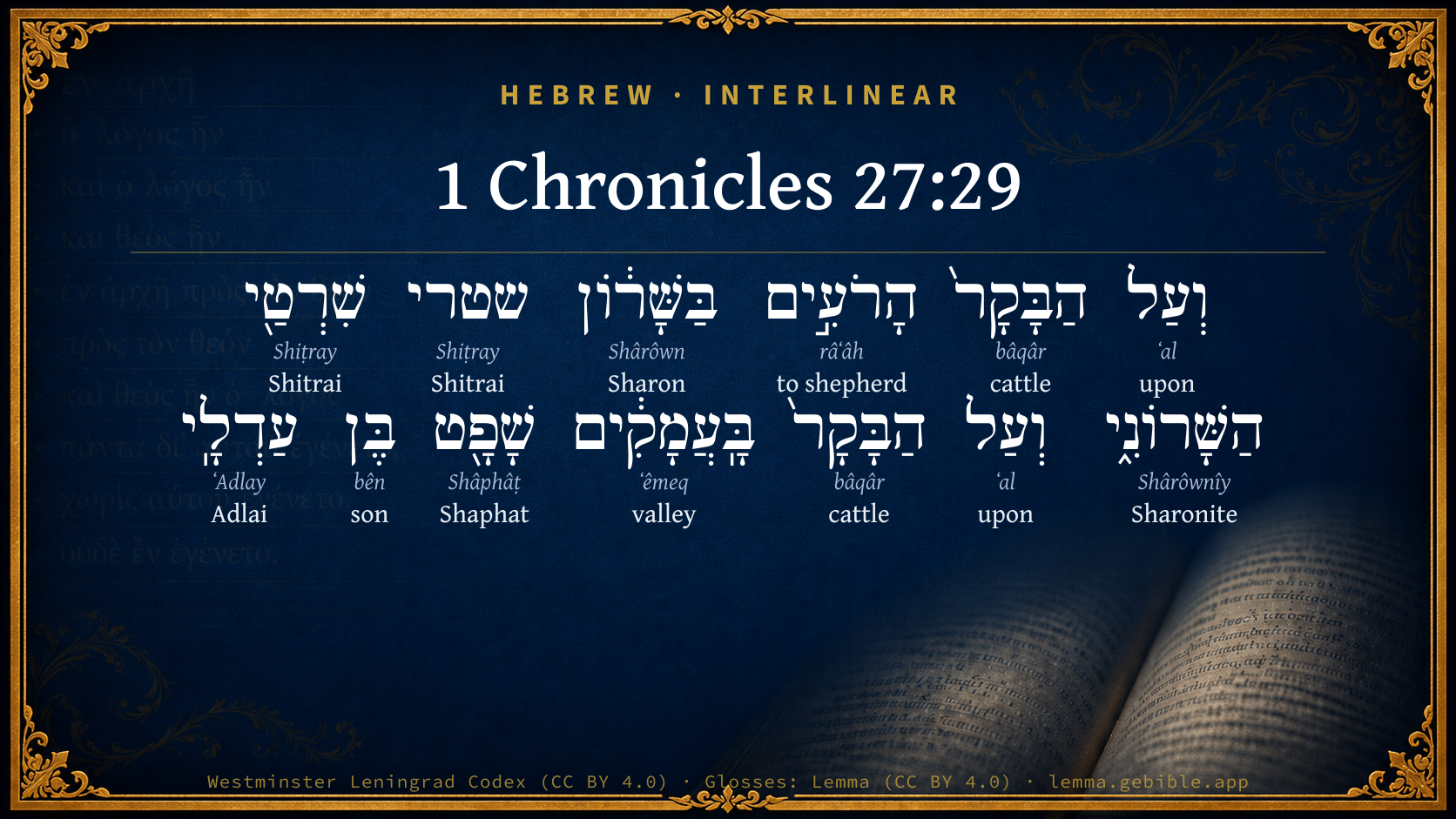
1 Chronicles 27:29

Hebrew (Westminster Leningrad Codex) 1 Chronicles 27:29 appears in the Hebrew Old Testament. The text above is from the Westminster Leningrad Codex. Each word links to its Strong’s number, a concise gloss, and parsing drawn from the Open Scriptures Hebrew Bible morphology. Click any word for its full Brown-Driver-Briggs (BDB) entry.
Download image
Cite this verse

1 Chronicles 27:29 (World English Bible). Public Domain. Lemma interlinear Bible study tool, https://lemma.gebible.app/v/1-chronicles/27/29.

Show BibTeX & RIS
BibTeX
RIS
English Translation
and over the herds that fed in Sharon was Shitrai the Sharonite: and over the herds that were in the valleys was Shaphat the son of Adlai:
World English Bible · Public Domain
Highlights
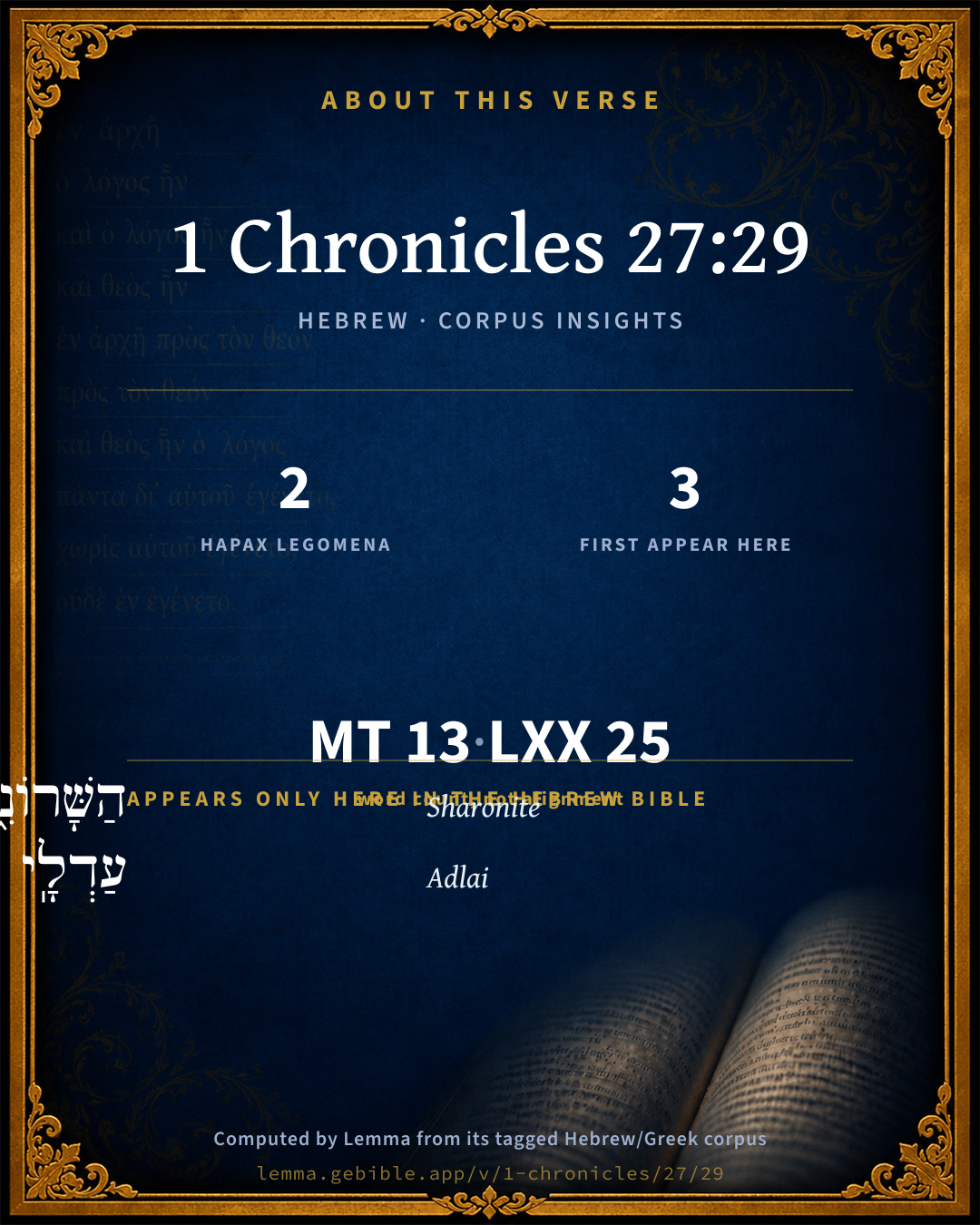
  • 2 hapax legomena — only here in the Hebrew Bible
  • 3 first appearances in the Hebrew Bible
Full analysis ↓
Download a study sheet

One document with this verse’s original text, its word-by-word gloss line, the meaning frame, cross-references with their text, attributed commentary, and full source and license credits — printable, and it pastes into notes with its structure intact.

This verse Autodidact and up

Study sheet (.html) Plain text (.txt)

A passage Seminary Student

Up to 50 verses in one chapter. A passage sheet keeps up to 6 commentary sources and 12 cross-references per verse, in the order this page ranks them, and says so on the sheet whenever that leaves anything out. Ask for a single verse and you get the Autodidact verse sheet above.

Everything on this page stays free to read, with no account — the sheet is a download of what is already on screen, not access to it.

Want to remove ads? Support Godless Engineer
Compare translations 3

The same verse in 3 English versions, stacked beneath the original-language interlinear above. Click any original word for its lexicon entry.

Each is an independent rendering of the whole verse — the interlinear is not word-aligned to these translations.

Highlighted words mark where these versions differ — a whole-verse word diff, not a word-by-word alignment.

  • World English Bible Public Domain
    and over the herds that fed in Sharon was Shitrai the Sharonite: and over the herds that were in the valleys was Shaphat the son of Adlai:
  • King James Version Public Domain
    And over the herds that fed in Sharon was Shitrai the Sharonite: and over the herds that were in the valleys was Shaphat the son of Adlai:
  • unfoldingWord Literal Text CC BY-SA 4.0
    And over the herd pasturing in Sharon Shitrai the Sharonite. And over the herd in the valleys Shaphat the son of Adlai.

unfoldingWord Literal Text — © unfoldingWord, licensed CC BY-SA 4.0. Word-aligned USFM3 via Door43 (git.door43.org/unfoldingWord/en_ult).

Versions to compare (up to 4)

3 of 4 selected

Show all 18 translations

Every available English version of this verse, each an independent rendering of the whole verse.

  • World English Bible Public Domain
    and over the herds that fed in Sharon was Shitrai the Sharonite: and over the herds that were in the valleys was Shaphat the son of Adlai:
  • Berean Standard Bible Public Domain
    Shitrai the Sharonite was in charge of the herds grazing in Sharon. Shaphat son of Adlai was in charge of the herds in the valleys.
  • Majority Standard Bible Public Domain
    Shitrai the Sharonite was in charge of the herds grazing in Sharon. Shaphat son of Adlai was in charge of the herds in the valleys.
  • King James Version Public Domain
    And over the herds that fed in Sharon was Shitrai the Sharonite: and over the herds that were in the valleys was Shaphat the son of Adlai:
  • American Standard Version (1901) Public Domain
    and over the herds that fed in Sharon was Shitrai the Sharonite: and over the herds that were in the valleys was Shaphat the son of Adlai:
  • Revised Version (1885) Public Domain
    and over the herds that fed in Sharon was Shitrai the Sharonite: and over the herds that were in the valleys was Shaphat the son of Adlai:
  • Geneva Bible (1599) Public Domain
    And ouer the oxen that fed in Sharon, was Shetrai the Sharonite: and ouer the oxen in the valleyes was Shaphat the sonne of Adlai:
  • Douay-Rheims (1899) Public Domain
    And over the herds that fed in Saron, was Setrai a Saronite: and over the. oxen in the valleys, Saphat the son of Adli:
  • Young's Literal Translation Public Domain
    and over the herds that are feeding in Sharon `is' Shitrai the Sharonite; and over the herds in the valleys `is' Shaphat son of Adlai;
  • Literal Standard Version CC BY-SA 4.0
    and Shitrai the Sharonite [is] over the herds that are feeding in Sharon; and Shaphat son of Adlai [is] over the herds in the valleys;
  • Unlocked Literal Bible CC BY-SA 4.0
    Over the herds that were pastured in Sharon was Shitrai from Sharon, and over the herds that were in the valleys was Shaphat son of Adlai.
  • unfoldingWord Literal Text CC BY-SA 4.0
    And over the herd pasturing in Sharon Shitrai the Sharonite. And over the herd in the valleys Shaphat the son of Adlai.
  • Darby Bible Public Domain
    And over the herds that fed in Sharon was Shitrai the Sharonite; and over the herds in the valleys was Shaphat the son of Adlai.
  • World Messianic Bible Public Domain
    Over the herds that fed in Sharon was Shitrai the Sharonite. Over the herds that were in the valleys was Shaphat the son of Adlai.
  • Webster's Bible Public Domain
    And over the herds that fed in Sharon was Shitrai the Sharonite: and over the herds that were in the valleys was Shaphat the son of Adlai:
  • Free Bible Version CC BY-SA 4.0
    Shitrai the Sharonite was in charge of the cattle in the Sharon pastures. Shaphat, son of Adlai, was in charge of the cattle in the valleys.
  • Bible in Basic English Public Domain
    And Shitrai the Sharonite was responsible for the herds in the grass-lands of Sharon, and Shaphat, the son of Adlai, for those in the valleys;
  • JPS Tanakh (1917) Public Domain
    and over the herds that fed in Sharon was Shirtai the Sharonite; and over the herds that were in the valleys was Shaphat the son of Adlai;

Literal Standard Version (2020), Covenant Press — licensed CC BY-SA 4.0. Text via the HelloAO Bible API (eBible.org). Unlocked Literal Bible (unfoldingWord) — licensed CC BY-SA 4.0. Text via the HelloAO Bible API (eBible.org). unfoldingWord Literal Text — © unfoldingWord, licensed CC BY-SA 4.0. Word-aligned USFM3 via Door43 (git.door43.org/unfoldingWord/en_ult). Free Bible Version, Dr. Jonathan Gallagher — licensed CC BY-SA 4.0. Text via the HelloAO Bible API (eBible.org).

Word by word

More ways to search: Search by grammar → Find every occurrence → Compare this word →

Practice this passage: Drill this verse → Learn its vocabulary →

הַשָּׁרוֹנִ֑י
Shârôwnîy
H8290
“the · Sharonite”
Particle, Definite Article + Noun, Gentilic, Masculine, Singular, Absolute
Part of Speech
Particle + Noun
Type
Gentilic
Gender
Masculine
Number
Singular
State
Absolute
Full BDB Definition

Origin: patrial from H8289

TWOT: None

Sharonite = see Sharon " a plain" - inhabitant of the district of Sharon
  1. וְעַל ʻal H5921 “and · upon” Conjunction + Preposition
  2. הַבָּקָר֙ bâqâr H1241 “the · cattle” Particle, Definite Article + Noun, Common, Both, Singular, Absolute
  3. הָרֹעִ֣ים râʻâh H7462 “the · shepherding” Particle, Definite Article + Verb, Qal, Participle Active, Masculine, Plural, Absolute
  4. בַּשָּׁר֔וֹן Shârôwn H8289 “in/at the · Sharon” Preposition, Determined + Noun, Proper
  5. שטרי Shiṭray H7861 “Shitrai” Noun, Proper
  6. שִׁרְטַ֖י Shiṭray H7861 “Shitrai” Noun, Proper
  7. וְעַל ʻal H5921 “and · upon” Conjunction + Preposition
  8. הַבָּקָר֙ bâqâr H1241 “the · cattle” Particle, Definite Article + Noun, Common, Both, Singular, Absolute
  9. בָּֽעֲמָקִ֔ים ʻêmeq H6010 “in/at the · valleys” Preposition, Determined + Noun, Common, Masculine, Plural, Absolute
  10. שָׁפָ֖ט Shâphâṭ H8202 “Shaphat” Noun, Proper
  11. בֶּן bên H1121 “son of” Noun, Common, Masculine, Singular, Construct
  12. עַדְלָֽי ʻAdlay H5724 “Adlai” Noun, Proper

About this verse

These counts appear in no published source. They are computed here, from the morphology-tagged text and Lemma’s own curated glosses. What Lemma adds →

13
words
10
distinct lemmas
Historical
section

Notable vocabulary

2 hapax legomena — words that appear only here in the entire Hebrew Bible:

  • הַשָּׁרוֹנִ֑י Sharonite H8290
  • עַדְלָֽי Adlai H5724

First appearance in Scripture

These words make their first canonical appearance in the Hebrew Bible here:

  • שטרי Shitrai H7861
  • הַשָּׁרוֹנִ֑י Sharonite H8290
  • עַדְלָֽי Adlai H5724

Grammatical profile

  • 1 verb
  • 10 nouns
  • 2 prepositions

Verb forms

  • הָרֹעִ֣ים Qal · Participle Active

Repetition

Words recur within this verse — often emphatic in Hebrew:

  • וְעַל upon H5921 ×2
  • הַבָּקָר֙ cattle H1241 ×2
  • שטרי Shitrai H7861 ×2

Hebrew & Septuagint length

In English translation the verse runs 27 words from the Hebrew and 24 from the Septuagint (LXX English) — closely comparable.

A rough comparison of the two English renderings, which tokenize alike — not a word-level alignment.

Word counts can differ between the Hebrew and the Greek without any difference in meaning — e.g. the Hebrew direct-object marker אֵת has no separate Greek word, and Greek often adds the article ὁ.

In the original languages it is 13 Hebrew tokens and 25 Greek tokens — but the two are counted differently (Hebrew bundles its prefixes and suffixes into one token; the Greek is in lemma form), so that isn’t a like-for-like length.

Cross-references

2

Topical passages linked to 1 Chronicles 27:29 in the Treasury of Scripture Knowledge — connected by theme and wording, ordered by reader-vote popularity; previews shown in the World English Bible.

  • 1 Chronicles 5:16 They lived in Gilead in Bashan, and in its towns, and in all the suburbs of Sharon, as far as their borders.
  • Isaiah 65:10 Sharon shall be a fold of flocks, and the valley of Achor a place for herds to lie down in, for my people who have sought me.

Cross-references courtesy of OpenBible.info (CC BY 4.0).

Hebrew and Greek witnesses Masoretic Hebrew ↔ Greek Septuagint

The same verse in the two great witnesses to the Old Testament, shown verse-for-verse.

These are two independent witnesses, not word-aligned to each other, and the Septuagint is shown in lemma (dictionary) form.

Hebrew 1 Chronicles 27:29 Masoretic · Westminster Leningrad Codex

וְעַל הַבָּקָר֙ הָרֹעִ֣ים בַּשָּׁר֔וֹן שטרי שִׁרְטַ֖י הַשָּׁרוֹנִ֑י וְעַל הַבָּקָר֙ בָּֽעֲמָקִ֔ים שָׁפָ֖ט בֶּן עַדְלָֽי

and over the herds that fed in Sharon was Shitrai the Sharonite: and over the herds that were in the valleys was Shaphat the son of Adlai:

World English Bible · Public Domain

Greek LXX 1 Chronicles 27:29 Septuagint · lemma form

καί ἐπί ὁ βοῦς ὁ νομάς ὁ ἐν ὁ ασιδων σατραις ὁ σαρωνίτης καί ἐπί ὁ βοῦς ὁ ἐν ὁ αὐλών σωφατ ὁ ὁ αδλι

And over the oxen pasturing in Saron was Satrai the Saronite; and over the oxen in the valleys was Sophat the son of Adli.

LXX2012 (modern English Septuagint) · Public Domain

Hebrew: Westminster Leningrad Codex (CC BY 4.0). Greek: Septuagint (public domain); English from LXX2012 (modern English Septuagint) (Public Domain). How the Septuagint differs from the Hebrew →

Commentary

Notes on 1 Chronicles 27:29 from classic Christian and Jewish commentators (each source and its license shown beneath its notes). The classic Christian expositions comment on the surrounding passage and are grouped to its opening verse, so a note may address several verses; the Jewish commentaries on the Tanakh (Rashi and others) are per-verse, so they appear only where the commentator wrote on this verse.

Lemma curates 59 commentaries, every one of them public domain or Creative Commons licensed, each selected and text-cleaned for this edition rather than reprinted as found. About our sources →

Joseph Benson's Commentary

1Ch 27:29-30. Over the herds that fed in Sharon — A place famous for its fruitfulness, (see Isa 33:9; Isa 35:2,) which lay about Lidda and Joppa. David seems to have kept great store of cattle in his pastures, particularly in this place. Over the camels was Obil the Ishmaelite — An Ishmaelite was the fittest person to look after the breed of camels, because that country abounded with them, and they best understood their nature. And over the asses, &c. — This was a great part of men’s riches in old times.

Joseph Benson's Commentary on the Old and New Testaments (1811–1818) — public domain. Text from a community e-Sword module.

Jamieson, Fausset & Brown

Robert Jamieson, A. R. Fausset & David Brown

herds that fed in Sharon--a fertile plain between Cæsarea and Joppa.

Jamieson, Fausset & Brown — Commentary Critical and Explanatory on the Whole Bible (1871) — public domain (CC PDM 1.0). Text via the HelloAO Bible API.

Adam Clarke's Commentary

Verse 29. 1Ch 27:25.

Adam Clarke's Commentary on the Bible (1810–1826) — public domain. Text from a community e-Sword/MySword module.

Ellicott's Commentary for English Readers

(29) And over the herds that fed in Sharon.—Heb., the oxen that grazed in the Sharon. The Sharon (i.e., “the Level”) was a fertile strip of pasture-land running along the coast of the Mediterranean, between Cæsarea and Joppa. (See Son_2:1; Isa_33:9.)

Shitrai.—Hebrew margin, Shirtai.

Over the herds that were in the valleys.—Apparently the valleys of the highlands of Judah. Another reading is “in valleys.”

A Bible Commentary for English Readers, edited by Charles John Ellicott (1878–1897) — public domain. Text from a community e-Sword module.

The Cambridge Bible for Schools and Colleges

gen. ed. J. J. S. Perowne

29. Sharon] The great maritime plain bounded on the East by the “lowland” (Shephelah). “The valleys” would probably be the depressions among the hills of the Shephelah which open out into Sharon; cp. Son_2:1.

The Cambridge Bible for Schools and Colleges (gen. ed. J. J. S. Perowne; Cambridge University Press, 1878–1918) — public domain. Text from a community e-Sword module.

Haydock's Catholic Bible Commentary

Saron, a fertile region at the food of the mountains of Galaad; also a vale near the Mediterranean, (Calmet) in Ephraim, extending as far as Joppe. (Adrichomius) (Menochius)

George Leo Haydock (1774–1849), Haydock's Catholic Family Bible and Commentary, 1859 edition — public domain. Excludes Psalms (Douay-Rheims chapter numbering differs from Protestant) and Deuterocanonical books (Catholic canon only).

Matthew Poole's English Annotations

Sharon; a place famous for its fruitfulness. See Isa 33:9; 35:2.

Matthew Poole's English Annotations on the Holy Bible (1683–1685) — public domain. Text from a community e-Sword/MySword module.

The Pulpit Commentary

Sharon. (see 1Ch_5:16, 1Ch_5:21) It means with the article, which, with one exception, always accompanies it, "the level laud," and on the west of the Jordan exactly corresponds with the Mishor on the east, a word of identical signification with Sharon. The tract of pasture-land which it designated stretched from Carmel to Joppa (Stanley"s "Sinai and Palestine," edit. 1866, pp. 485, 260, 264). The valleys here intended are not specified.

The Pulpit Commentary (1880–1919), ed. H.D.M. Spence-Jones & Joseph S. Exell — public domain. Text from a community e-Sword module.

Rashi

Rabbi Shlomo Yitzchaki (Rashi)

And over the cattle that pasture in the Sharon was Shirtai the Sharonite who was knowledgeable in matters concerning them.

Rashi on the Tanakh — English translations: “The Judaica Press complete Tanach with Rashi, translated by A. J. Rosenberg” (CC BY 4.0); “Pentateuch with Rashi's commentary by M. Rosenbaum and A.M. Silbermann, 1929-1934” (public domain); “The Metsudah Tanach series, Lakewood, N.J” (CC BY 4.0); and “The Book of Joshua, Metsudah Publications, 1997” (CC BY 4.0). Text via Sefaria.

Lesson kit

Teaching starters — assembled from the data on this page, not authored interpretation. Every prompt links to the verse data it draws on. Edit before teaching.

1 Chronicles, in the Historical, opens this verse with 13 words (10 distinct Hebrew lemmas). Its most distinctive word is Shârôwnîy (“Sharonite”). A historical commentator’s framing appears above. Read the whole chapter for the surrounding context.

Discussion questions

  1. How does “Sharonite” (Shârôwnîy) shape what this verse is saying?
  2. 2 words here appear nowhere else in the Hebrew Bible. Why might the author reach for such rare wording?
  3. 3 words make their first appearance in Scripture here. What does this debut establish?
  4. How does 1 Chronicles 5:16, which shares this passage’s theme, read alongside this verse?
  5. What does the repetition of “upon” (2× in this one verse) do in this verse?
  6. These translations render this verse differently; the difference is in the English rendering, not the original. What questions does that raise?
  7. «הָרֹעִ֣ים» is a Qal Participle Active verb. How does that grammatical form shape the action described?
  8. Compare how Joseph Benson's Commentary and Jamieson, Fausset & Brown read this verse. Where do they agree or differ?

Things to notice

  • 2 words in this verse appear nowhere else in the Hebrew Bible.
  • 3 words make their first canonical appearance in Scripture here.
  • This verse counts 13 Hebrew ↔ 25 Greek words.
  • These translations choose different wording for 4 words in this verse.
  • “upon” occurs 2× in this single verse.

Reading settings

Reading text

Shown beneath each verse's original-language words.

Old Testament
Old Testament edition

Read the OT as the Masoretic Hebrew (MT) or the Greek Septuagint (LXX).

English shown for the Greek Septuagint (in the Hebrew ↔ Greek comparison).

Comparing translations? Open the Compare panel on any verse page to stack up to four side by side.