
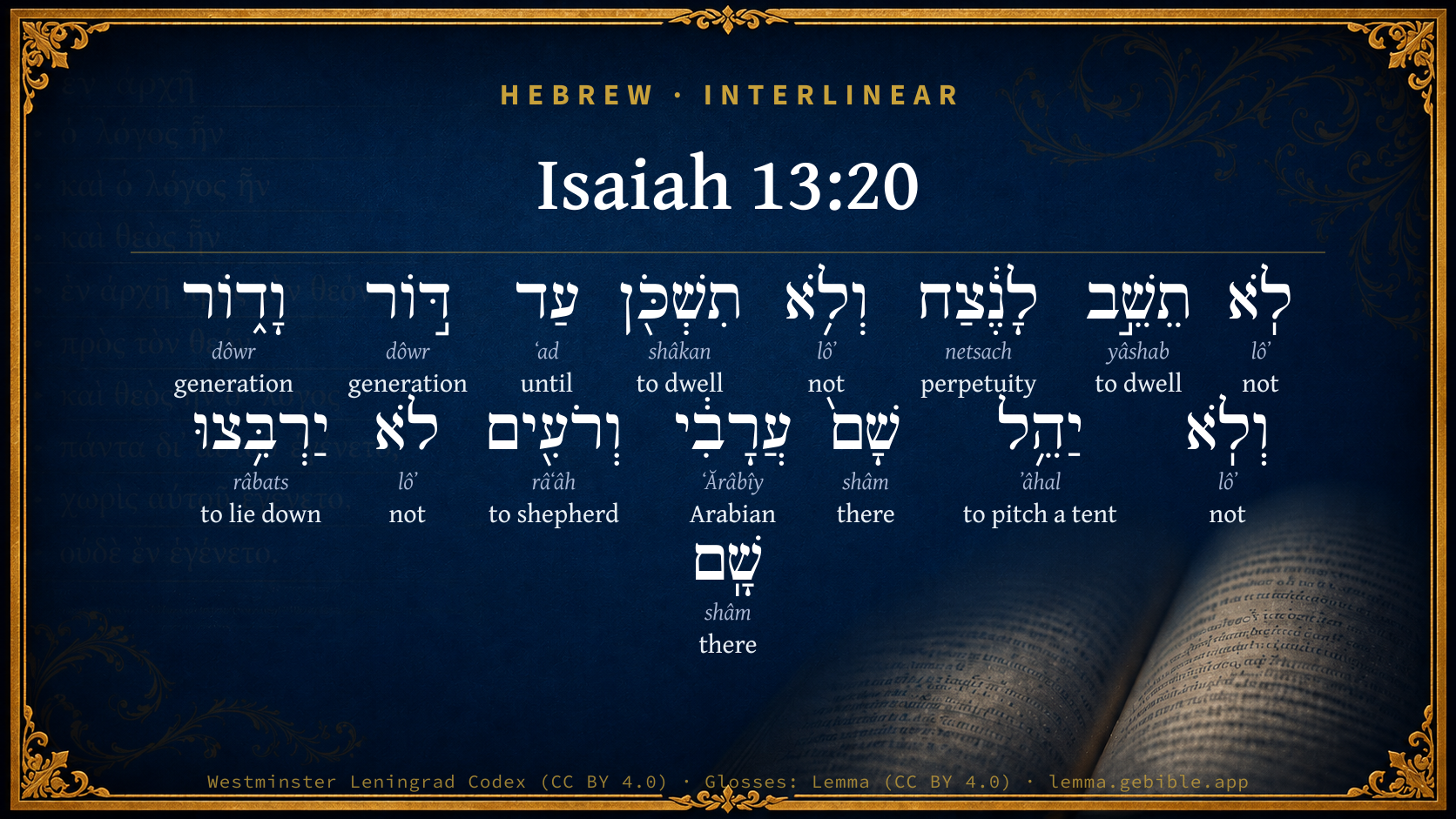
Isaiah 13:20

Hebrew (Westminster Leningrad Codex) Isaiah 13:20 appears in the Hebrew Old Testament. The text above is from the Westminster Leningrad Codex. Each word links to its Strong’s number, a concise gloss, and parsing drawn from the Open Scriptures Hebrew Bible morphology. Click any word for its full Brown-Driver-Briggs (BDB) entry.
Download image
Cite this verse

Isaiah 13:20 (World English Bible). Public Domain. Lemma interlinear Bible study tool, https://lemma.gebible.app/v/isaiah/13/20.

Show BibTeX & RIS
BibTeX
RIS
English Translation
It shall never be inhabited, neither shall it be lived in from generation to generation: neither shall the Arabian pitch tent there; neither shall shepherds make their flocks to lie down there.
World English Bible · Public Domain
Download a study sheet

One document with this verse’s original text, its word-by-word gloss line, the meaning frame, cross-references with their text, attributed commentary, and full source and license credits — printable, and it pastes into notes with its structure intact.

This verse Autodidact and up

Study sheet (.html) Plain text (.txt)

A passage Seminary Student

Up to 50 verses in one chapter. A passage sheet keeps up to 6 commentary sources and 12 cross-references per verse, in the order this page ranks them, and says so on the sheet whenever that leaves anything out. Ask for a single verse and you get the Autodidact verse sheet above.

Everything on this page stays free to read, with no account — the sheet is a download of what is already on screen, not access to it.

Want to remove ads? Support Godless Engineer
Compare translations 3

The same verse in 3 English versions, stacked beneath the original-language interlinear above. Click any original word for its lexicon entry.

Each is an independent rendering of the whole verse — the interlinear is not word-aligned to these translations.

Highlighted words mark where these versions differ — a whole-verse word diff, not a word-by-word alignment.

  • World English Bible Public Domain
    It shall never be inhabited, neither shall it be lived in from generation to generation: neither shall the Arabian pitch tent there; neither shall shepherds make their flocks to lie down there.
  • King James Version Public Domain
    It shall never be inhabited, neither shall it be dwelt in from generation to generation: neither shall the Arabian pitch tent there; neither shall the shepherds make their fold there.
  • unfoldingWord Literal Text CC BY-SA 4.0
    It will not dwell, to eternity, and one will not inhabit, to generation and generation. And an Arab will not tent there, and shepherds will not make lie down there.

unfoldingWord Literal Text — © unfoldingWord, licensed CC BY-SA 4.0. Word-aligned USFM3 via Door43 (git.door43.org/unfoldingWord/en_ult).

Versions to compare (up to 4)

3 of 4 selected

Show all 18 translations

Every available English version of this verse, each an independent rendering of the whole verse.

  • World English Bible Public Domain
    It shall never be inhabited, neither shall it be lived in from generation to generation: neither shall the Arabian pitch tent there; neither shall shepherds make their flocks to lie down there.
  • Berean Standard Bible Public Domain
    She will never be inhabited or settled from generation to generation; no nomad will pitch his tent there, no shepherd will rest his flock there.
  • Majority Standard Bible Public Domain
    She will never be inhabited or settled from generation to generation; no nomad will pitch his tent there, no shepherd will rest his flock there.
  • King James Version Public Domain
    It shall never be inhabited, neither shall it be dwelt in from generation to generation: neither shall the Arabian pitch tent there; neither shall the shepherds make their fold there.
  • American Standard Version (1901) Public Domain
    It shall never be inhabited, neither shall it be dwelt in from generation to generation: neither shall the Arabian pitch tent there; neither shall shepherds make their flocks to lie down there.
  • Revised Version (1885) Public Domain
    It shall never be inhabited, neither shall it be dwelt in from generation to generation: neither shall the Arabian pitch tent there; neither shall shepherds make their flocks to lie down there.
  • Geneva Bible (1599) Public Domain
    It shall not bee inhabited for euer, neither shall it be dwelled in from generation to generation: neither shall the Arabian pitch his tents there, neither shall the shepheardes make their foldes there.
  • Douay-Rheims (1899) Public Domain
    It shall no more be inhabited for ever, and it shall not be founded unto generation and generation: neither shall the Arabian pitch his tents there, nor shall shepherds rest there.
  • Young's Literal Translation Public Domain
    She doth not sit for ever, Nor continueth unto many generations, Nor doth Arab pitch tent there, And shepherds lie not down there.
  • Literal Standard Version CC BY-SA 4.0
    She does not sit forever, || Nor continue to many generations, || Nor does Arab pitch tent there, || And shepherds do not lie down there.
  • Unlocked Literal Bible CC BY-SA 4.0
    It will not be inhabited or lived in from generation to generation. The Arab will not pitch his tent there, nor will shepherds have their flocks rest there.
  • unfoldingWord Literal Text CC BY-SA 4.0
    It will not dwell, to eternity, and one will not inhabit, to generation and generation. And an Arab will not tent there, and shepherds will not make lie down there.
  • Darby Bible Public Domain
    It shall never be inhabited, neither shall it be dwelt in, even to generation and generation; nor shall Arabian pitch tent there, nor shepherds make fold there.
  • World Messianic Bible Public Domain
    It will never be inhabited, neither will it be lived in from generation to generation. The Arabian will not pitch a tent there, neither will shepherds make their flocks lie down there.
  • Webster's Bible Public Domain
    It shall never be inhabited, neither shall it be dwelt in from generation to generation: neither shall the Arabian pitch tent there; neither shall the shepherds make their fold there.
  • Free Bible Version CC BY-SA 4.0
    No one will ever live in Babylon again. It will be deserted—no desert nomad will set up a tent there, no shepherd will bring a flock to rest there.
  • Bible in Basic English Public Domain
    People will never be living in it again, and it will have no more men from generation to generation: the Arab will not put up his tent there; and those who keep sheep will not make it a resting-place for their flocks.
  • JPS Tanakh (1917) Public Domain
    It shall never be inhabited, neither shall it be dwelt in from generation to generation; neither shall the Arabian pitch tent there; neither shall the shepherds make their fold there.

Literal Standard Version (2020), Covenant Press — licensed CC BY-SA 4.0. Text via the HelloAO Bible API (eBible.org). Unlocked Literal Bible (unfoldingWord) — licensed CC BY-SA 4.0. Text via the HelloAO Bible API (eBible.org). unfoldingWord Literal Text — © unfoldingWord, licensed CC BY-SA 4.0. Word-aligned USFM3 via Door43 (git.door43.org/unfoldingWord/en_ult). Free Bible Version, Dr. Jonathan Gallagher — licensed CC BY-SA 4.0. Text via the HelloAO Bible API (eBible.org).

Word by word

More ways to search: Search by grammar → Find every occurrence → Compare this word →

Practice this passage: Drill this verse → Learn its vocabulary →

יַהֵ֥ל
ʼâhal
H167
“to pitch a tent”
Verb, Piel, Imperfect, 3rd Person, Masculine, Singular
Part of Speech
Verb
Stem
Piel
Form
Imperfect
Person
3rd Person
Gender
Masculine
Number
Singular
Full BDB Definition

Origin: a denominative from H168

TWOT: 32

to pitch a tent, to move a tent - (Qal) pitch or remove a tent - (Piel) to pitch one's tent
  1. לֹֽא lôʼ H3808 “not” Particle, Negative
  2. תֵשֵׁ֣ב yâshab H3427 “to dwell” Verb, Qal, Imperfect, 3rd Person, Feminine, Singular
  3. לָנֶ֔צַח netsach H5331 “to/for · perpetuity” Preposition + Noun, Common, Masculine, Singular, Absolute
  4. וְלֹ֥א lôʼ H3808 “and · not” Conjunction + Particle, Negative
  5. תִשְׁכֹּ֖ן shâkan H7931 “to dwell” Verb, Qal, Imperfect, 3rd Person, Feminine, Singular
  6. עַד ʻad H5704 “until” Preposition
  7. דּ֣וֹר dôwr H1755 “generation” Noun, Common, Masculine, Singular, Absolute
  8. וָד֑וֹר dôwr H1755 “and · generation” Conjunction + Noun, Common, Masculine, Singular, Absolute
  9. וְלֹֽא lôʼ H3808 “and · not” Conjunction + Particle, Negative
  10. שָׁם֙ shâm H8033 “there” Adverb
  11. עֲרָבִ֔י ʻĂrâbîy H6163 “Arabian” Noun, Gentilic, Masculine, Singular, Absolute
  12. וְרֹעִ֖ים râʻâh H7462 “and · shepherding” Conjunction + Verb, Qal, Participle Active, Masculine, Plural, Absolute
  13. לֹא lôʼ H3808 “not” Particle, Negative
  14. יַרְבִּ֥צוּ râbats H7257 “to lie down” Verb, Hiphil, Imperfect, 3rd Person, Masculine, Plural
  15. שָֽׁם shâm H8033 “there” Adverb

About this verse

These counts appear in no published source. They are computed here, from the morphology-tagged text and Lemma’s own curated glosses. What Lemma adds →

16
words
11
distinct lemmas
Prophets
section

Notable vocabulary

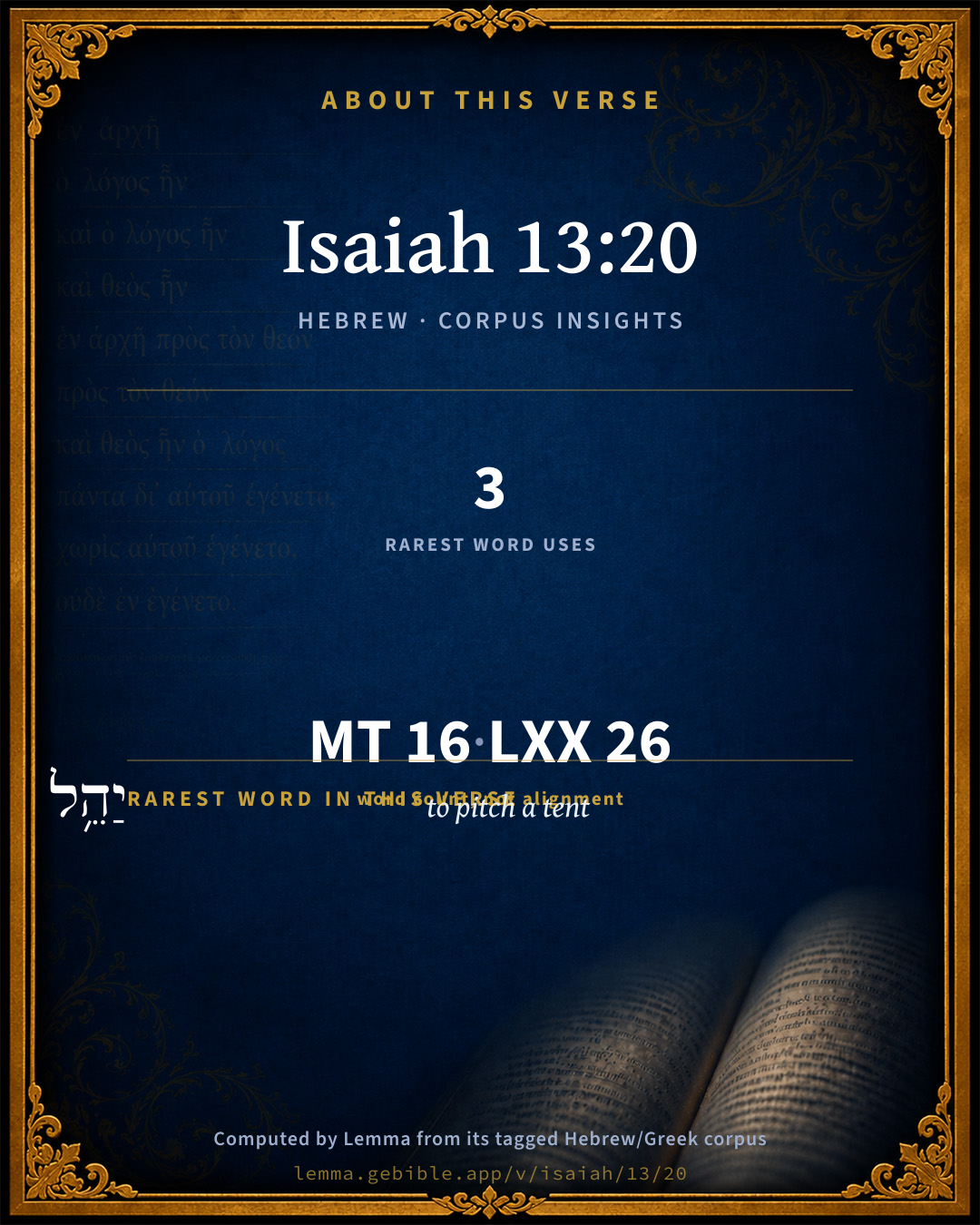
The rarest word here is יַהֵ֥ל to pitch a tent H167 — appearing just 3 times in the whole Hebrew Bible.

Shared distinctive vocabulary

יַהֵ֥ל to pitch a tent H167 occurs in 3 verses of the Hebrew Bible. Also found in:

Grammatical profile

  • 5 verbs
  • 4 nouns
  • 1 preposition
  • 2 adverbs
  • 4 particles

Verb forms

  • תֵשֵׁ֣ב Qal · Imperfect
  • תִשְׁכֹּ֖ן Qal · Imperfect
  • יַהֵ֥ל Piel · Imperfect
  • וְרֹעִ֖ים Qal · Participle Active
  • יַרְבִּ֥צוּ Hiphil · Imperfect

Repetition

Words recur within this verse — often emphatic in Hebrew:

  • דּ֣וֹר generation H1755 ×2
  • שָׁם֙ there H8033 ×2
  • לֹֽא not H3808 ×4

Hebrew & Septuagint length

In English translation the verse runs 32 words from the Hebrew and 29 from the Septuagint (LXX English) — closely comparable.

A rough comparison of the two English renderings, which tokenize alike — not a word-level alignment.

Word counts can differ between the Hebrew and the Greek without any difference in meaning — e.g. the Hebrew direct-object marker אֵת has no separate Greek word, and Greek often adds the article ὁ.

In the original languages it is 16 Hebrew tokens and 26 Greek tokens — but the two are counted differently (Hebrew bundles its prefixes and suffixes into one token; the Greek is in lemma form), so that isn’t a like-for-like length.

Cross-references

14

Topical passages linked to Isaiah 13:20 in the Treasury of Scripture Knowledge — connected by theme and wording, ordered by reader-vote popularity; previews shown in the World English Bible.

  • Isaiah 14:23 I will also make it a possession for the porcupine, and pools of water: and I will sweep it with the broom of destruction, says Yahweh of Hosts.
  • Jeremiah 51:43 Her cities are become a desolation, a dry land, and a desert, a land in which no man dwells, neither does any son of man pass thereby.
  • 2 Chronicles 17:11 Some of the Philistines brought Jehoshaphat presents, and silver for tribute; the Arabians also brought him flocks, seven thousand and seven hundred rams, and seven thousand and seven hundred male goats.
  • Isaiah 34:10–15 It shall not be quenched night nor day; the smoke of it shall go up for ever; from generation to generation it shall lie waste; none shall pass through it forever and ever.
  • Jeremiah 50:3 For out of the north there comes up a nation against her, which shall make her land desolate, and none shall dwell therein: they are fled, they are gone, both man and animal.
  • Jeremiah 50:13 Because of the wrath of Yahweh she shall not be inhabited, but she shall be wholly desolate: everyone who goes by Babylon shall be astonished, and hiss at all her plagues.
  • Jeremiah 50:21 Go up against the land of Merathaim, even against it, and against the inhabitants of Pekod: kill and utterly destroy after them, says Yahweh, and do according to all that I have commanded you.
  • Jeremiah 50:39 Therefore the wild animals of the desert with the wolves shall dwell there, and the ostriches shall dwell therein: and it shall be no more inhabited forever; neither shall it be lived in from generation to generation.
  • Jeremiah 50:45 Therefore hear the counsel of Yahweh, that he has taken against Babylon; and his purposes, that he has purposed against the land of the Chaldeans: Surely they shall drag them away, [even] the little ones of the flock; surely he shall make their habitation desolate over them.
  • Jeremiah 51:25 Behold, I am against you, destroying mountain, says Yahweh, which destroy all the earth; and I will stretch out my hand on you, and roll you down from the rocks, and will make you a burnt mountain.
  • Jeremiah 51:29 The land trembles and is in pain; for the purposes of Yahweh against Babylon do stand, to make the land of Babylon a desolation, without inhabitant.
  • Jeremiah 51:37 Babylon shall become heaps, a dwelling-place for jackals, an astonishment, and a hissing, without inhabitant.
  • Jeremiah 51:62–64 and say, Yahweh, you have spoken concerning this place, to cut it off, that none shall dwell therein, neither man nor animal, but that it shall be desolate forever.
  • Revelation 18:21–23 A mighty angel took up a stone like a great millstone and cast it into the sea, saying, "Thus with violence will Babylon, the great city, be thrown down, and will be found no more at all.

Cross-references courtesy of OpenBible.info (CC BY 4.0).

Hebrew and Greek witnesses Masoretic Hebrew ↔ Greek Septuagint

The same verse in the two great witnesses to the Old Testament, shown verse-for-verse.

These are two independent witnesses, not word-aligned to each other, and the Septuagint is shown in lemma (dictionary) form.

Hebrew Isaiah 13:20 Masoretic · Westminster Leningrad Codex

לֹֽא תֵשֵׁ֣ב לָנֶ֔צַח וְלֹ֥א תִשְׁכֹּ֖ן עַד דּ֣וֹר וָד֑וֹר וְלֹֽא יַהֵ֥ל שָׁם֙ עֲרָבִ֔י וְרֹעִ֖ים לֹא יַרְבִּ֥צוּ שָֽׁם

It shall never be inhabited, neither shall it be lived in from generation to generation: neither shall the Arabian pitch tent there; neither shall shepherds make their flocks to lie down there.

World English Bible · Public Domain

Greek LXX Isaiah 13:20 Septuagint · lemma form

οὐ καταοικέω εἰς ὁ αἰών χρόνος οὐδέ μή εἰςἔρχομαι εἰς αὐτός διά πολύς γενεά οὐδέ μή διαἔρχομαι αὐτός ἄραψ οὐδέ ποιμήν οὐ μή ἀναπαύω ἐν αὐτός

It shall never be inhabited, neither shall any enter into it for many generations: neither shall the Arabians pass through it; nor shall shepherds at all rest in it.

LXX2012 (modern English Septuagint) · Public Domain

On this verse, J. A. Alexander on Isaiah discusses the Septuagint’s reading. Read the note in Commentary ↓

Hebrew: Westminster Leningrad Codex (CC BY 4.0). Greek: Septuagint (public domain); English from LXX2012 (modern English Septuagint) (Public Domain). How the Septuagint differs from the Hebrew →

Targum (Aramaic paraphrase)

1

The Targum is the ancient Jewish Aramaic paraphrase of the Hebrew Scriptures — an interpretive translation, not the Hebrew text itself. Onkelos (literal) and Pseudo-Jonathan (expansive) render the Torah, and Jonathan the Prophets. Coverage is partial: where no permissively-licensed English translation exists for a verse, only the Aramaic is shown. This is verse-level text, not a word-by-word alignment to the Hebrew.

  1. Targum Jonathan Prophets (Joshua–Malachi)
    לָא תִתַּב לַעֲלַם וְלָא תִשְׁרֵי עַד דָר וְדָר לָא יִפְרוֹס תַּמָן עֲרָבִי מַשְׁכְּנֵיהּ וְרַעֲיָן לָא יִשְׁרוּן תַּמָן:

    It shall not be inhabited for ever; nor shall it be dwelt in from generation to generation: neither shall the Arabian pitch his tent there, neither shall the shepherds dwell there.

    Targum Jonathan — Aramaic: “Mikraot Gedolot” (public domain). English: “Sefaria Community Translation” (CC0 1.0 (public-domain dedication)); “London "Chaldee Paraphrase," 1871” (public domain). Text via Sefaria.

Commentary

Notes on Isaiah 13:20 from classic Christian and Jewish commentators (each source and its license shown beneath its notes). The classic Christian expositions comment on the surrounding passage and are grouped to its opening verse, so a note may address several verses; the Jewish commentaries on the Tanakh (Rashi and others) are per-verse, so they appear only where the commentator wrote on this verse.

Lemma curates 59 commentaries, every one of them public domain or Creative Commons licensed, each selected and text-cleaned for this edition rather than reprinted as found. About our sources →

Trapp's Complete Commentary

John Trapp

Isa 13:20 It shall never be inhabited, neither shall it be dwelt in from generation to generation: neither shall the Arabian pitch tent there; neither shall the shepherds make their fold there.

Ver. 20. Neither shall the Arabian pitch tent there.] The Scenites, {a} or vagrant shepherds of the Arabian Desert, that oft flitted for better pasture, shall shun Babylon as haunted with wild beasts, or rather with dragons and devils in the Revelation; all this is applied to, and shall be verified of, Rome. {Isa 18:1-7}

{a} Hi Babyloniae contermini.

John Trapp, A Commentary or Exposition upon All the Books of the Old and New Testament (1647–1656) — public domain. Text from a community e-Sword module.

Joseph Benson's Commentary

Isa 13:20. It shall never be inhabited — After the destruction threatened shall be fully effected. This was not done immediately upon the taking of the city by Darius the Mede and Cyrus the Persian, his nephew; but was fulfilled by degrees, as is recorded by historians, and as appears at this day. It will be satisfactory to the reader to note some of the steps by which this prophecy was accomplished. “Cyrus took the city by diverting the waters of the Euphrates, which ran through the midst of it, and entering the place at night by the dry channel. The river, being never restored afterward to its proper course, overflowed the whole country, and made it little better than a great morass: this, and the great slaughter of the inhabitants, with other bad consequences of the taking of the city, was the first step to the ruin of the place. The Persian monarchs ever regarded it with a jealous eye; they kept it under, and took care to prevent its recovering its former greatness. Darius Hystaspis, not long afterward, most severely punished it for a revolt, greatly depopulated the place, lowered the walls, and demolished the gates. Xerxes destroyed the temples, and, with the rest, the great temple of Belus. The building of Seleucia on the Tigris exhausted Babylon by its neighbourhood, as well as by the immediate loss of inhabitants taken away by Seleucus to people his new city. (Strabo, lib. 16.) A king of the Parthians soon after carried away into slavery a great number of the inhabitants, and burned and destroyed the most beautiful parts of the city. Strabo says, that in his time a great part of it was a mere desert: that the Persians had partly destroyed it, and that time, and the neglect of the Macedonians while they were masters of it, had nearly completed its destruction. Jerome (on the place) says, that in his time it was quite in ruins, and that the walls served only for the enclosure of a park or forest, for the king’s hunting. Modern travellers, who have endeavoured to find the remains of it, have given but a very unsatisfactory account of their success. Upon the whole, Babylon is so utterly annihilated, that even the place where this wonder of the world stood cannot now be determined with any certainty.” — Bishop Lowth.

Joseph Benson's Commentary on the Old and New Testaments (1811–1818) — public domain. Text from a community e-Sword module.

Tyndale Open Study Notes

Tyndale Open Resources

13:20 Babylon will never be inhabited again: Babylon, often a symbol of idolatry, immorality, imperialism, and oppression in Scripture, will one day come completely to an end (see Rev 18:2; 19:2).

Tyndale Open Study Notes — © Tyndale Open Resources, licensed CC BY-SA 4.0. Text via the HelloAO Bible API.

Geneva Bible (1599)

Geneva Bible translators

Who useth to go from country to country to find pasture for their beasts, but there shall they find none.

Geneva Bible (1599) marginal notes — public domain. Text via Bolls.life.

Jamieson, Fausset & Brown

Robert Jamieson, A. R. Fausset & David Brown

Literally fulfilled.

neither . . . Arabian pitch tent--Not only shall it not be a permanent residence, but not even a temporary resting-place. The Arabs, through dread of evil spirits, and believing the ghost of Nimrod to haunt it, will not pass the night there (compare Isa 13:21).

neither . . . shepherds--The region was once most fertile; but owing to the Euphrates being now no longer kept within its former channels, it has become a stagnant marsh, unfit for flocks; and on the wastes of its ruins (bricks and cement) no grass grows.

Jamieson, Fausset & Brown — Commentary Critical and Explanatory on the Whole Bible (1871) — public domain (CC PDM 1.0). Text via the HelloAO Bible API.

Ellicott's Commentary for English Readers

(20) Neither shall the Arabian pitch tent there . . .—The word “Arabian” is used in its widest extent, as including all the nomadic tribes of the Bedouin type east and north of Palestine as far as Babylon (2Ch_21:16; Strabo, xvi., p. 743). Here, again, we note a literal fulfilment. The Bedouins themselves, partly because the place is desolate, partly from a superstitious horror, shrink from encamping on the site of the ancient temples and palaces, and they are left to lions and other beasts of prey. On the other hand, Joseph Wolff, the missionary, describes a strange weird scene, pilgrims of the Yezidis, or devil-worshippers, dancing and howling like dervishes amid the ruins of Babylon.

A Bible Commentary for English Readers, edited by Charles John Ellicott (1878–1897) — public domain. Text from a community e-Sword module.

The Cambridge Bible for Schools and Colleges

gen. ed. J. J. S. Perowne

20. the Arabian] Cf. Jer_3:2. The word seems originally to mean “dweller in the desert,” but ultimately acquired the force of a proper name (see Jer_25:24; 2Ch_9:14, &c.). The site of Babylon will be shunned even by the wandering nomad, as an accursed and “uncanny” place.

20–22. Babylon, after its overthrow, shall be a perpetual desolation.

The Cambridge Bible for Schools and Colleges (gen. ed. J. J. S. Perowne; Cambridge University Press, 1878–1918) — public domain. Text from a community e-Sword module.

John Gill's Exposition

It shall never be inhabited,.... As it has not been since its utter destruction. Pausanias (p), who lived in the times of Adrian, says, Babylon, the greatest city that ever the sun saw, that then there was nothing left of it but a wall: what is now called Babylon is a new city, and built in another place:

neither shall it be dwelt in from generation to generation; which is the same thing repeated in other and stronger terms, for the confirmation of it:

neither shall the Arabian pitch tent there; that sort of the Arabians called Scenitae, because they dwelt in tents, and moved from place to place with their flocks, for the sake of pasture; but here there should be none for them, and therefore would not pitch their tents at it:

neither shall the shepherds make their folds there; as they had used to do in the pastures adjoining to it, which were formerly exceeding good, but now would be barren and unfruitful; and as there would be no shepherds in the city, so neither would any neighbouring ones come hither, or any from distant parts; partly because of the unfruitfulness of the place, and partly through fear of wild beasts, which had their habitation there, as follows. Pliny (q) says it was reduced to a mere desert.

(p) Arcadica sive, l. 8. p. 509. (q) Ut supra. (Nat. Hist. l. 6. c. 26.)

John Gill's Exposition of the Whole Bible (1746–1763) — public domain (CC PDM 1.0). Text via the HelloAO Bible API.

Albert Barnes' Notes on the Bible

It shall never be inhabited - This has been completely fulfilled. It is now, and has been for centuries, a scene of wide desolation, and is a heap of ruins, and there is every indication that it will continue so to be. From Rauwolff’s testimony it appears, that in the sixteenth century ‘there was not a house to be seen;’ and now the ‘eye wanders over a barren desert, in which the ruins are nearly the only indication that it had ever been inhabited. It is impossible to behold this scene and not be reminded how exactly the predictions of Isaiah and Jeremiah have been fulfilled, even in the appearance Babylon was doomed to present, “that she should never be inhabited.”’ - (Keppel’s “Narrative,” p. 234.) ‘Babylon is spurned alike by the heel of the Ottoman, the Israelites, and the sons of Ishmael.’ - (Mignan’s “Travels,” p. 108.) ‘It is a tenantless and desolate metropolis.’ - (Ibid. p. 235; see Keith “On Prophecy,” p. 221.)

Neither shall it be dwelt in ... - This is but another form of the expression, denoting that it shall be utterly desolate. The following testimonies of travelers will show how this accomplished: ‘Ruins composed, like those of Babylon, of heaps of rubbish impregnated with nitre, cannot be cultivated.’ - (Rich’s “Memoir,” p. 16.) ‘The decomposing materials of a Babylonian structure doom the earth on which they perish, to lasting sterility. On this part of the plain, both where traces of buildings are left, and where none stood, all seemed equally naked of vegetation; the whole ground appearing as if it had been washed over and over again by the coming and receding waters, until every bit of genial soil was swept away; its half-clay, half-sandy surface being left in ridgy streaks, like what is often seen on the flat shores of the sea after the retreating of the tide.’ - (Sir R. K. Porter’s “Travels,” vol. ii. p. 392.) ‘The ground is low and marshy, and presents not the slightest vestige of former buildings, of any description whatever.’ - (Buckingham’s “Travels,” vol. ii. p. 278.) ‘The ruins of Babylon are thus inundated so as to render many parts of them inaccessible, by converting the valleys among them into morasses.’ - (Rich’s “Memoir,” p. 13.)

Neither shall the Arabian pitch tent there - The Arabians dwelt chiefly in tents; and were a wandering people, or engaged in traffic which was conducted in caravans traveling from place to place. The idea here is, that Babylon, so far from being occupied as a permanent residence for any people, would be unfit even for a resting place. It would be so utterly desolate, so forsaken, and so unhealthy, that the caravan would not even stop there for a night. What a charge this from its former splendor! How different from the time when it was the place of magnificent palaces, when strangers flocked to it, and when people from all nations were collected there!

Neither shall the shepherds ... - This is an additional image of desolation. Babylon was situated in the midst of a most fertile region. It might be supposed that, though it was to be destroyed, it would still furnish pasturage for flocks. But no, says the prophet, it shall be so utterly and entirely desolate, that it shall not even afford pasturage for them. The reasons of this are:

(1) that the whole region round about Babylon was laid under water by the Euphrates after the city was taken, and became a stagnant pool, and of course an unfit place for flocks; and

(2) that Babylon was reduced to an extended scene of ruins; and on those ruins - those extended wastes of broken walls, of bricks and cement - no grass would grow.

The prophecy has been remarkably fulfilled. It is said that the Arabs cannot be persuaded to remain there even for a night. They traverse these ruins by day without fear; but at night the superstitious dread of evil spirits deters them from remaining there. ‘Captain Mignan was accompanied by six Arabs completely armed, but he “could not induce them to remain toward night, from the apprehension of evil spirits. It is impossible to eradicate this idea from the minds of these people, who are very deeply imbued with superstition ... And when the sun sunk behind the Mujelibe, and the moon would have lighted his way among the ruins, it was with infinite regret that he obeyed the summons of his guides.”’ - (Mignan’s “Travels,” as quoted by Keith, pp. 221, 222.) ‘All the people of the country assert that it is extremely dangerous to approach the mound’ (the mound in Babylon called Kasr, or Palad) ‘after nightfall, on account of the multitude of evil spirits by which it is haunted.’ - (Rich’s “Memoir on the Ruins of Babylon,” p. 27.) The Joseph Wolff, speaking of his visit to Babylon, says, ‘I inquired of them (the Yezeedes), whether the Arabs ever pitched their tents among the ruins of Babylon. No, said they, the Arabs believe that the ghost of Nimrod walks amidst them in the darkness, and no Arab would venture on so hazardous an experiment.’

Albert Barnes' Notes on the Bible (1834–1885) — public domain. Text from a community e-Sword/MySword module.

Haydock's Catholic Bible Commentary

Tents. To dwell, (Calmet) or to traffic. (Theodoret) --- Another city was built, but not so large, nor in the same place. (Worthington)

George Leo Haydock (1774–1849), Haydock's Catholic Family Bible and Commentary, 1859 edition — public domain. Excludes Psalms (Douay-Rheims chapter numbering differs from Protestant) and Deuterocanonical books (Catholic canon only).

Matthew Poole's English Annotations

It shall never be inhabited, after the destruction threatened shall be fully accomplished.

Neither shall the Arabian, who dwelt in tents, and wandered from place, where they could find pasture; but shall avoid this place, either because the land, once noted for great fruitfulness, is now become barren; or because the land is accursed by God, and abhorred by all men; or for fear of the wild beasts, as it follows.

Matthew Poole's English Annotations on the Holy Bible (1683–1685) — public domain. Text from a community e-Sword/MySword module.

Whedon's Commentary on the Bible

Daniel D. Whedon

20, 21. Never be inhabited — This is a statement of certainty of the event, not its nearness, not its occurrence immediately after the capture by Cyrus. It did not become a perfect desert for five hundred years. The prophecy is seen in space, not in definite time.

Neither… pitch tent there — The Arabian is mentioned as being the nomad of the ages past, just as he is now. It is stated by travellers that superstition or dread of evil spirits operates to make this statement still true. Some of them say that the Bedouins still have a superstitious fear of lodging near the ruins of Babylon.

Wild beasts — Tzizyim, desert animals indefinitely, or whatever inhabits dry and desolate situations. Lexicographers find much difficulty in settling the import of the word.

Owls — Or, literally, daughters of screaming. Ostriches are intended, as some think, but that is doubtful.

Satyrs — Literally, shaggy creatures; perhaps a species of goat, though Tristram (Natural History of the Bible, page 132,) thinks the “goat-god” of Egypt, with which the children of Israel became acquainted in Egypt, furnished the popular myth of the satyr — half goat and half man — and poetically the prophet Isaiah painted horrible desert places with this ideal creature. Nevertheless, he countenances another interpretation of the word, namely, a creature of the dog-faced baboon, also an object of worship with the Egyptians, as shown from their monuments, like to the mocko, or maccacus Arabacus, a baboon which is now disseminated from Central Africa as far north as to the continence of the Tigris and the Euphrates.

It is observable that our Lord, in Mat_12:43, recognised the sentiment, current even in his day, that the desert is the abode of demons or unclean spirits. Virgil also calls them saltantes satyros, dancing satyrs. The Yezides of Syria and Mesopotamia are a sect of devil worshippers.

Joseph Wolf, missionary, and traveller to Bokhara, saw pilgrims of this sect upon the ruins of Babylon performing strange and horrid rites by moonlight, dancing and howling, and reminding him of this passage. (Delitzsch.)

Daniel D. Whedon (gen. ed.), Commentary on the Old and New Testaments (1874–1909) — public domain. Text from a community e-Sword module.

The Pulpit Commentary

It shall never be inhabited. This part of the prophecy did not receive its fulfillment till many centuries had gone by. From the time of Cyrus to that of Alexander the Great, Babylon was one of the chief cities of the Persian empire. Alexander was so struck with it, and with the excellence of its situation, that he designed to make it his capital. It first began seriously to decline under the Seleucidae, who built Seleucia on the Tigris as a rival to it, and still further injured it by fixing the seat of government at Antioch. But it had still a large population in the first century after our era (Josephus, "Ant. Jud:," 18:9, and is mentioned as a place of some consequence in the time of Trajan (Die Cass., 68:27), and even in that of Severue (Die Cass., 75:9). But after this it went rapidly to decay. Under the Sassuntans it disappears from sight; and when Benjamin of Tudela, in the twelfth century, visited the spot, there was nothing to be seen of the mighty city but those ruins of the Kasr, or palace, which still arrest the traveler"s attention. The site had become, and has ever since remained, "without inhabitant." Neither shall the Arabian pitch tent there. A superstitious feeling prevents the Arabs from encamping on the mounds of Babylon, which are believed to be the haunts of evil spirits (Rich, "First Memoir on Babylon," p. 67; Ker Porter, "Travels," vol. 2. p. 371). Neither shall the shepherds make their fold there. The nitrous soil of the Babylonian mounds allows them to produce nothing but the coarsest and most unpalatable vegetation. The shepherds consequently do not feed their flocks on them.

The Pulpit Commentary (1880–1919), ed. H.D.M. Spence-Jones & Joseph S. Exell — public domain. Text from a community e-Sword module.

John Wesley's Explanatory Notes

Inhabited - After the destruction threatened shall be fully accomplished. Arabian - Who dwelt in tents, and wandered from place to place, where they could find pasture.

John Wesley, Explanatory Notes Upon the Whole Bible (1754–1765) — public domain. Text via the GEBible commentary corpus.

Keil & Delitzsch

C. F. Keil & F. Delitzsch

Babel, like the cities of the Pentapolis, had now become a perpetual desert. "She remains uninhabited for ever, and unoccupied into generation of generations; and not an Arab pitches his tent there, and shepherds do not make their folds there. And there lie beasts of the desert, and horn-owls fill their houses; and ostriches dwell there, and field-devils hop about there. And jackals howl in her castles, and wild dogs in palaces of pleasure; and her time is near to come, and her days will not be prolonged." The conclusion is similar to that of the prophecy against Edom, in Isa 34:16-17. There the certainty of the prediction, even in its most minute particulars, is firmly declared; here the nearness of the time of fulfilment. But the fulfilment did not take place so soon as the words of the prophecy might make it appear. According to Herodotus, Cyrus, the leader of the Medo-Persian army, left the city still standing, with its double ring of walls. Darius Hystaspis, who had to conquer Babylon a second time in 518 b.c., had the walls entirely destroyed, with the exception of fifty cubits. Xerxes gave the last thrust to the glory of the temple of Belus. Having been conquered by Seleucus Nicator (312), it declined just in proportion as Seleucia rose. Babylon, says Pliny, ad solitudinem rediit exhausta vicinitate Seleuciae. At the time of Strabo (born 60 b.c.) Babylon was a perfect desert; and he applies to it (16:15) the words of the poet, ἐρημία μεγάλη ̓στὶν ἡ μεγάλη πόλις. Consequently, in the passage before us the prophecy falls under the law of perspective foreshortening. But all that it foretells has been literally fulfilled. The curse that Babylon would never come to be settled in and inhabited again (a poetical expression, like Jer 17:25; Jer 33:16), proved itself an effectual one, when Alexander once thought of making Babylon the metropolis of his empire. He was carried off by an early death. Ten thousand workmen were at that time employed for two months in simply clearing away the rubbish of the foundations of the temple of Belus (the Nimrod-tower). "Not an Arab pitches his tent there" (‛Arâbi, from ‛Arâbâh, a steppe, is used here for the first time in the Old Testament, and then again in Jer 3:2; yăhēl, different from yâhēl in Isa 13:10 and Job 31:26, is a syncopated form of יאהל, tentorium figet, according to Ges. 68, Anm. 2, used instead of the customary יאהל): this was simply the natural consequence of the great field of ruins, upon which there was nothing but the most scanty vegetation. But all kinds of beasts of the desert and waste places make their homes there instead. The list commences with ziyyim (from zi, dryness, or from ziyi, an adj. relat. of the noun zi), i.e., dwellers in the desert; the reference here is not to men, but, as in most other instances, to animals, though it is impossible to determine what are the animals particularly referred to. That ochim are horned owls (Uhus) is a conjecture of Aurivillius, which decidedly commends itself. On benoth ya‛ănâh, see at Job 39:13-18. Wetzstein connects ya‛ănâh with an Arabic word for desert; it is probably more correct, however, to connect it with the Syriac יענא, greedy. The feminine plural embraces ostriches of both sexes, just as the 'iyyim (sing. אי = אוי, from 'âvâh, to howl: see Bernstein's Lex. on Kirsch's Chrestom. Syr. p. 7), i.e., jackals, are called benât āwa in Arabic, without distinction of sex (awa in this appellation is a direct reproduction of the natural voice of the animal, which is called wawi in vulgar Arabic). Tan has also been regarded since the time of Pococke and Schnurrer as the name of the jackal; and this is supported by the Syriac and Targum rendering yaruro (see Bernstein, p. 220), even more than by the Arabic name of the wolf, tinân, which only occurs here and there. אי, ibnu āwa, is the common jackal found in Hither Asia (Canis aureus vulgaris), the true type of the whole species, which is divided into at least ten varieties, and belongs to the same genus as dogs and wolves (not foxes). Tan may refer to one of these varieties, which derived its name from its distinctive peculiarity as a long-stretched animal, whether the extension was in the trunk, the snout, or the tail.

The animals mentioned, both quadrupeds (râbatz) and birds (shâcan), are really found there, on the soil of ancient Babylon. When Kerporter was drawing near to the Nimrod-tower, he saw lions sunning themselves quietly upon its walls, which came down very leisurely when alarmed by the cries of the Arabs. And as Rich heard in Bagdad, the ruins are still regarded as a rendezvous for ghosts: sâ‛ir, when contrasted with ‛attūd, signifies the full-grown shaggy buck-goat; but here se‛irim is applied to demons in the shape of goats (as in Isa 34:14). According to the Scriptures, the desert is the abode of unclean spirits, and such unclean spirits as the popular belief or mythology pictured to itself were se‛irim. Virgil, like Isaiah, calls them saltantes Satyros. It is remarkable also that Joseph Wolf, the missionary and traveller to Bochâra, saw pilgrims of the sect of Yezidis (or devil-worshippers) upon the ruins of Babylon, who performed strange and horrid rites by moonlight, and danced extraordinary dances with singular gestures and sounds. On seeing these ghost-like, howling, moonlight pilgrims, he very naturally recalled to mind the dancing se‛irim of prophecy (see Moritz Wagner's Reise nach Persien und dem Lande der Kurden, Bd. ii. p. 251). And the nightly howling and yelling of jackals (‛ânâh after rikkēd, as in Sa1 18:6-7) produces its natural effect upon every traveller there, just as in all the other ruins of the East. These are now the inhabitants of the royal 'armenoth, which the prophet calls 'almenoth with a sarcastic turn, on account of their widowhood and desolation; these are the inhabitants of the palaces of pleasure, the luxurious villas and country-seats, with their hanging gardens. The Apocalypse, in Rev 18:2, takes up this prophecy of Isaiah, and applies it to a still existing Babylon, which might have seen itself in the mirror of the Babylon of old.

Keil & Delitzsch — Biblical Commentary on the Old Testament (1861–1891) — public domain (CC PDM 1.0). Text via the HelloAO Bible API. (Old Testament only.)

J. A. Alexander on Isaiah

Joseph Addison Alexander

“It shall not be inhabited forever (i.e., it shall never again or no more be inhabited) and it shall not be dwelt in from generation to generation (literally, to generation and generation), neither shall the Arab pitch tent there, neither shall shepherds cause (their flocks) to lie there.” The conversion of a populous and fertile district into a vast pasture-ground, however rich and well frequented, implies extensive ruin, but not such ruin as is here denounced. Babylon was not even to be visited by shepherds, nor to serve as the encamping ground of wandering Arabs. The completeness of the threatened desolation will be seen by comparing these expressions with Isa 5:5; Isa 5:17; Isa 7:21; Isa 17:2, where it is predicted that the place in question should be for flocks to lie down with none to make them afraid.

So fully has this prophecy been verified that the Bedouins, according to the latest travellers, are even superstitiously afraid of passing a single night upon the site of Babylon. The simplest version of the first clause would be, ‘she shall not dwell forever, she shall not abide etc.’ And this construction is actually given by some. But the great majority of writers follow the Septuagint and Vulgate in ascribing to the active verbs a passive or intransitive sense.

Joseph Addison Alexander, The Prophecies of Isaiah (1846–1847; New York: Scribner, 1870–1878) — public domain. Text from a community e-Sword module.

Rashi

Rabbi Shlomo Yitzchaki (Rashi)

and no Arab shall pitch his tent there Heb. יַהֵל, like יַאֲהֵל. Even Arabs, who customarily dwell in tents and move their livestock from place to place, will not be pleased with Babylon, to set up their tents there, for it will not even be fit for pasture for flocks. And do not wonder about לֹא יַהֵל, which is explained like לֹא יַאֲהֵל, for there are many places in which the sound of the letter is substituted for the letter, and so (Job 35:11), “He teaches us (מַלְפֵנוּ) from the beasts of the earth,” like מְאַלְפֵנוּ, and so, (Prov. 17:4), “A liar hearkens (מֵזִין) to a destructive tongue,” like מַאֲזִין.

Rashi on the Tanakh — English translations: “The Judaica Press complete Tanach with Rashi, translated by A. J. Rosenberg” (CC BY 4.0); “Pentateuch with Rashi's commentary by M. Rosenbaum and A.M. Silbermann, 1929-1934” (public domain); “The Metsudah Tanach series, Lakewood, N.J” (CC BY 4.0); and “The Book of Joshua, Metsudah Publications, 1997” (CC BY 4.0). Text via Sefaria.

Ibn Ezra

Rabbi Abraham ibn Ezra

לא תשב It shall not be inhabited.

יהל Shall pitch his tent. יאהל ═ יהל Comp. מאזין ═ מזין listening (Prov. 17:4).

ערבי The Arabian. The word has here the same meaning as ערב Jer. 25:22 and Is. 21:3. Even the Arabian, who is accustomed to move from place to place, will not pitch his tent there.

Ibn Ezra on the Tanakh — English translations: “Sefaria Community Translation” (CC0 1.0 (public-domain dedication)); “Yalkut, Sifsei Chachomim Chumash, Metsudah Publications, 2009” (CC BY 4.0); and “Commentary of Ibn Ezra on Isaiah - trans. by M. Friedlander, 1873” (public domain). Text via Sefaria.

Lesson kit

Teaching starters — assembled from the data on this page, not authored interpretation. Every prompt links to the verse data it draws on. Edit before teaching.

Isaiah, in the Prophets, opens this verse with 16 words (11 distinct Hebrew lemmas). Its most distinctive word is ʼâhal (“to pitch a tent”). A historical commentator’s framing appears above. Read the whole chapter for the surrounding context.

Discussion questions

  1. What does “to pitch a tent” (ʼâhal) contribute to the verse as a whole?
  2. How does Genesis 13:12, which shares the word «to pitch a tent», read alongside this verse?
  3. What does the repetition of “generation” (2× in this one verse) do in this verse?
  4. The translations on this page render this verse differently — a whole-verse word diff, not a word-by-word alignment. What might account for the different wordings?
  5. «תֵשֵׁ֣ב» is a Qal Imperfect verb. How does that grammatical form shape the action described?
  6. Compare how Trapp's Complete Commentary and Joseph Benson's Commentary read this verse. Where do they agree or differ?

Things to notice

Reading settings

Reading text

Shown beneath each verse's original-language words.

Old Testament
Old Testament edition

Read the OT as the Masoretic Hebrew (MT) or the Greek Septuagint (LXX).

English shown for the Greek Septuagint (in the Hebrew ↔ Greek comparison).

Comparing translations? Open the Compare panel on any verse page to stack up to four side by side.