
Ezekiel 34:7

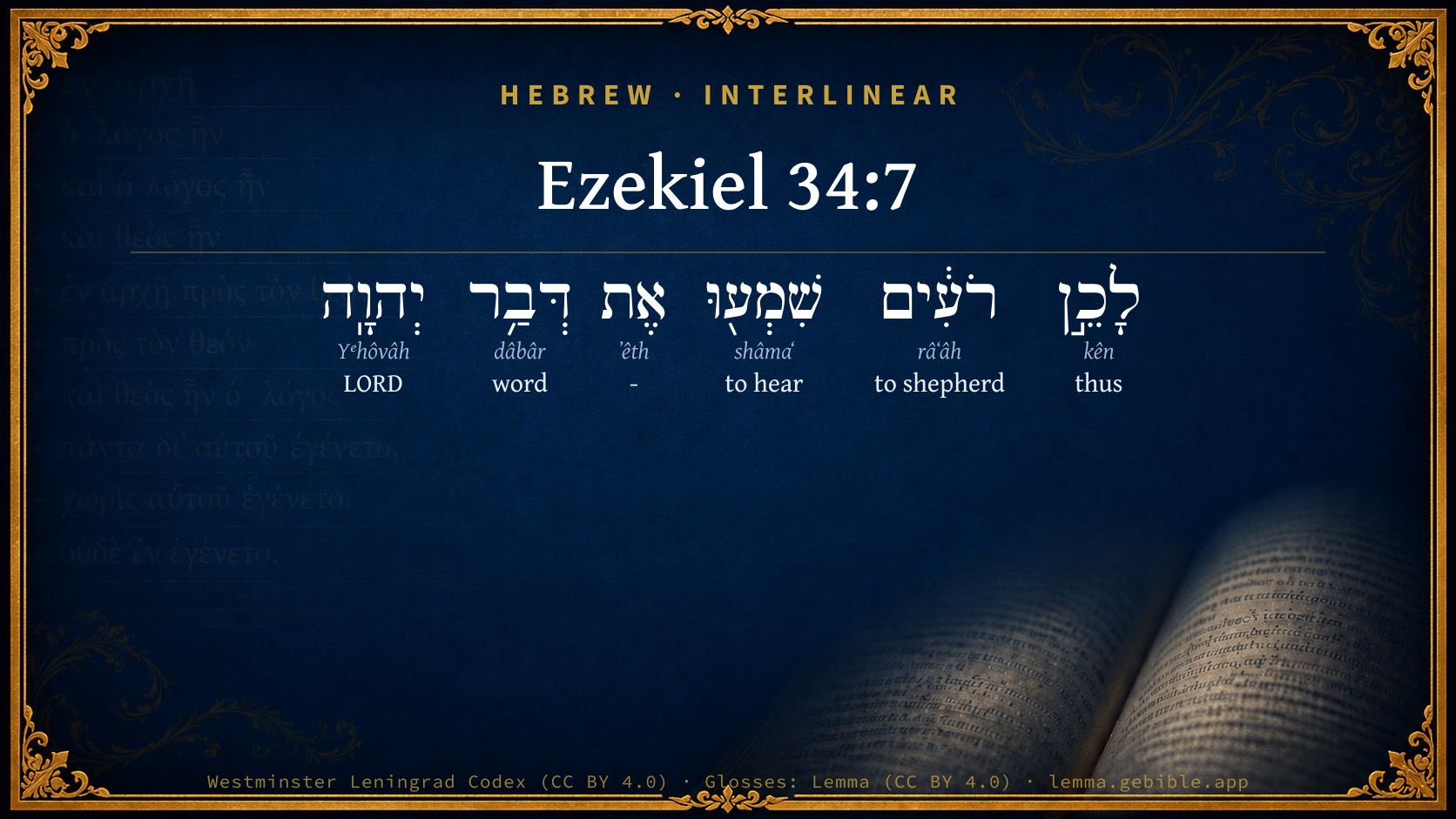
Hebrew (Westminster Leningrad Codex) Ezekiel 34:7 appears in the Hebrew Old Testament. The text above is from the Westminster Leningrad Codex. Each word links to its Strong’s number, a concise gloss, and parsing drawn from the Open Scriptures Hebrew Bible morphology. Click any word for its full Brown-Driver-Briggs (BDB) entry.
Download image
Cite this verse

Ezekiel 34:7 (World English Bible). Public Domain. Lemma interlinear Bible study tool, https://lemma.gebible.app/v/ezekiel/34/7.

Show BibTeX & RIS
BibTeX
RIS
English Translation
Therefore, you shepherds, hear the word of Yahweh:
World English Bible · Public Domain
Download a study sheet

One document with this verse’s original text, its word-by-word gloss line, the meaning frame, cross-references with their text, attributed commentary, and full source and license credits — printable, and it pastes into notes with its structure intact.

This verse Autodidact and up

Study sheet (.html) Plain text (.txt)

A passage Seminary Student

Up to 50 verses in one chapter. A passage sheet keeps up to 6 commentary sources and 12 cross-references per verse, in the order this page ranks them, and says so on the sheet whenever that leaves anything out. Ask for a single verse and you get the Autodidact verse sheet above.

Everything on this page stays free to read, with no account — the sheet is a download of what is already on screen, not access to it.

Want to remove ads? Support Godless Engineer
Compare translations 3

The same verse in 3 English versions, stacked beneath the original-language interlinear above. Click any original word for its lexicon entry.

Each is an independent rendering of the whole verse — the interlinear is not word-aligned to these translations.

Highlighted words mark where these versions differ — a whole-verse word diff, not a word-by-word alignment.

  • World English Bible Public Domain
    Therefore, you shepherds, hear the word of Yahweh:
  • King James Version Public Domain
    Therefore, ye shepherds, hear the word of the LORD;
  • unfoldingWord Literal Text CC BY-SA 4.0
    Therefore, shepherds, hear the word of Yahweh:

unfoldingWord Literal Text — © unfoldingWord, licensed CC BY-SA 4.0. Word-aligned USFM3 via Door43 (git.door43.org/unfoldingWord/en_ult).

Versions to compare (up to 4)

3 of 4 selected

Show all 18 translations

Every available English version of this verse, each an independent rendering of the whole verse.

  • World English Bible Public Domain
    Therefore, you shepherds, hear the word of Yahweh:
  • Berean Standard Bible Public Domain
    Therefore, you shepherds, hear the word of the LORD:
  • Majority Standard Bible Public Domain
    Therefore, you shepherds, hear the word of the LORD:
  • King James Version Public Domain
    Therefore, ye shepherds, hear the word of the LORD;
  • American Standard Version (1901) Public Domain
    Therefore, ye shepherds, hear the word of Jehovah:
  • Revised Version (1885) Public Domain
    Therefore, ye shepherds, hear the word of the LORD:
  • Geneva Bible (1599) Public Domain
    Therefore ye shepherds, heare the woorde of the Lord.
  • Douay-Rheims (1899) Public Domain
    Therefore, ye shepherds, hear the word of the Lord:
  • Young's Literal Translation Public Domain
    Therefore, shepherds, hear a word of Jehovah:
  • Literal Standard Version CC BY-SA 4.0
    Therefore, shepherds, hear a word of YHWH:
  • Unlocked Literal Bible CC BY-SA 4.0
    Therefore, shepherds, hear the word of Yahweh:
  • unfoldingWord Literal Text CC BY-SA 4.0
    Therefore, shepherds, hear the word of Yahweh:
  • Darby Bible Public Domain
    Therefore, ye shepherds, hear the word of Jehovah:
  • World Messianic Bible Public Domain
    “‘Therefore, you shepherds, hear the LORD’s word:
  • Webster's Bible Public Domain
    Therefore, ye shepherds, hear the word of the LORD;
  • Free Bible Version CC BY-SA 4.0
    So, you shepherds, listen to what the Lord has to say:
  • Bible in Basic English Public Domain
    For this cause, O keepers of the flock, give ear to the word of the Lord:
  • JPS Tanakh (1917) Public Domain
    Therefore, ye shepherds, hear the word of the LORD:

Literal Standard Version (2020), Covenant Press — licensed CC BY-SA 4.0. Text via the HelloAO Bible API (eBible.org). Unlocked Literal Bible (unfoldingWord) — licensed CC BY-SA 4.0. Text via the HelloAO Bible API (eBible.org). unfoldingWord Literal Text — © unfoldingWord, licensed CC BY-SA 4.0. Word-aligned USFM3 via Door43 (git.door43.org/unfoldingWord/en_ult). Free Bible Version, Dr. Jonathan Gallagher — licensed CC BY-SA 4.0. Text via the HelloAO Bible API (eBible.org).

Word by word

More ways to search: Search by grammar → Find every occurrence → Compare this word →

Practice this passage: Drill this verse → Learn its vocabulary →

רֹעִ֔ים
râʻâh
H7462
“shepherding”
Verb, Qal, Participle Active, Masculine, Plural, Absolute
Part of Speech
Verb
Stem
Qal
Form
Participle Active
Gender
Masculine
Number
Plural
State
Absolute
Full BDB Definition

Origin: a primitive root

TWOT: 2185 , 2186

to pasture, tend, graze, feed - (Qal) - to tend, pasture - to shepherd - of ruler, teacher (figuratively) - of people as flock (figuratively) - shepherd, herdsman (substantive) - to feed, graze - of cows, sheep etc (literal) - of idolater, Israel as flock (figuratively) - (Hiphil) shepherd, shepherdess - to associate with, be a friend of (meaning probable) - (Qal) to associate with - (Hithpael) to be companions - (Piel) to be a special friend
  1. לָכֵ֣ן kên H3651 “to/for · thus” Preposition + Adverb
  2. שִׁמְע֖וּ shâmaʻ H8085 “hear” Verb, Qal, Imperative, 2nd Person, Masculine, Plural
  3. אֶת ʼêth H853 “-” Particle, Direct Object
  4. דְּבַ֥ר dâbâr H1697 “word of” Noun, Common, Masculine, Singular, Construct
  5. יְהוָֽה Yᵉhôvâh H3068 “LORD” Noun, Proper

About this verse

These counts appear in no published source. They are computed here, from the morphology-tagged text and Lemma’s own curated glosses. What Lemma adds →

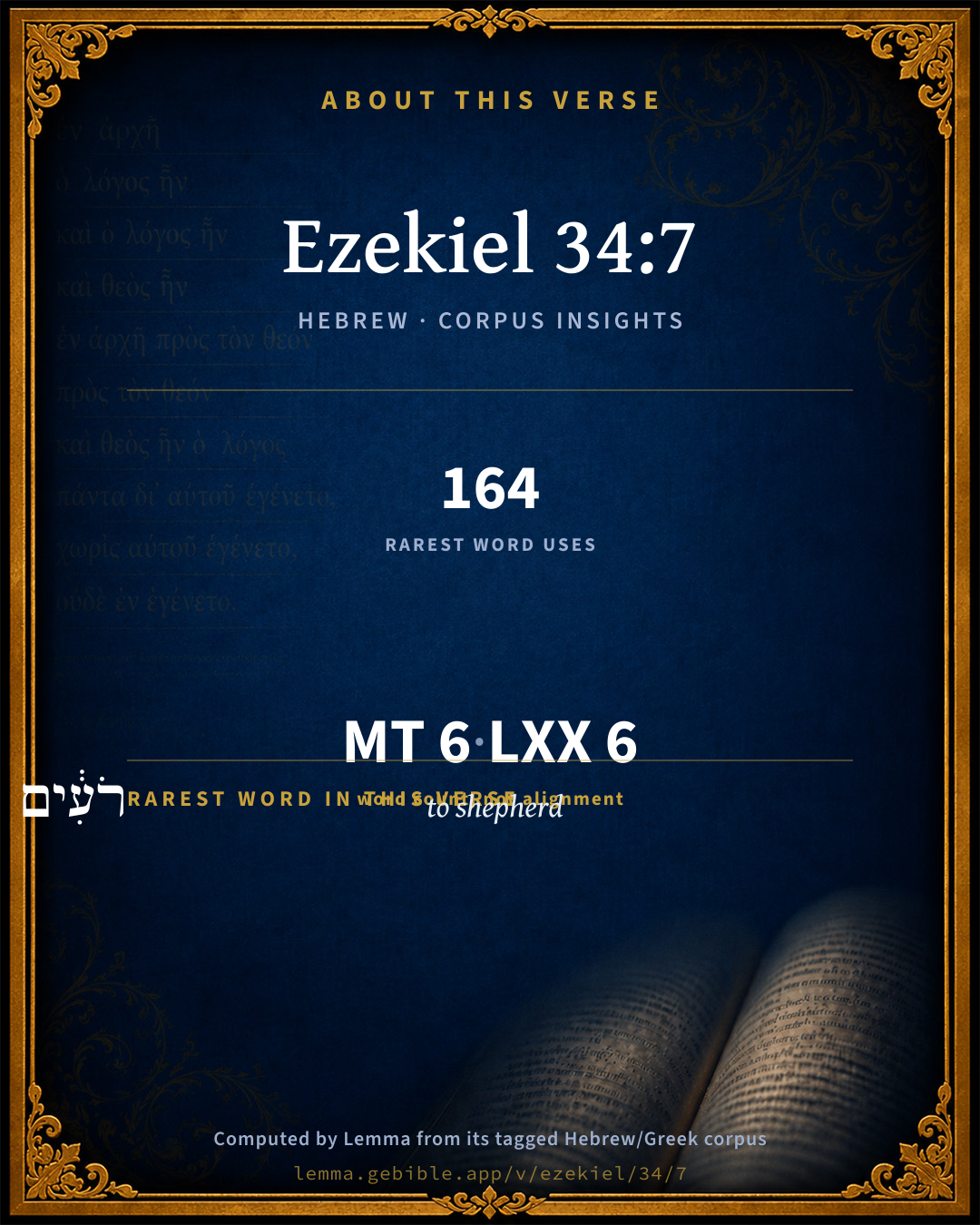
6
words
6
distinct lemmas
Prophets
section

Grammatical profile

  • 2 verbs
  • 2 nouns
  • 1 adverb
  • 1 particle

Verb forms

  • רֹעִ֔ים Qal · Participle Active
  • שִׁמְע֖וּ Qal · Imperative

Hebrew & Septuagint length

In English translation the verse runs 8 words from the Hebrew and 9 from the Septuagint (LXX English) — closely comparable.

A rough comparison of the two English renderings, which tokenize alike — not a word-level alignment.

Word counts can differ between the Hebrew and the Greek without any difference in meaning — e.g. the Hebrew direct-object marker אֵת has no separate Greek word, and Greek often adds the article ὁ.

In the original languages it is 6 Hebrew tokens and 6 Greek tokens — but the two are counted differently (Hebrew bundles its prefixes and suffixes into one token; the Greek is in lemma form), so that isn’t a like-for-like length.

Cross-references

10

Topical passages linked to Ezekiel 34:7 in the Treasury of Scripture Knowledge — connected by theme and wording, ordered by reader-vote popularity; previews shown in the World English Bible.

  • Psalms 82:1–7 God presides in the great assembly. He judges among the gods.
  • Isaiah 1:10 Hear the word of Yahweh, you rulers of Sodom! Listen to the law of our God, you people of Gomorrah!
  • Jeremiah 13:13 Then shall you tell them, Thus says Yahweh, Behold, I will fill all the inhabitants of this land, even the kings who sit on David's throne, and the priests, and the prophets, and all the inhabitants of Jerusalem, with drunkenness.
  • Jeremiah 13:18 Say you to the king and to the queen-mother, Humble yourselves, sit down; for your headdresses are come down, even the crown of your glory.
  • Jeremiah 22:2–3 Say, Hear the word of Yahweh, king of Judah, who sits on the throne of David, you, and your servants, and your people who enter in by these gates.
  • Ezekiel 34:9 therefore, you shepherds, hear the word of Yahweh:
  • Micah 3:8–9 But as for me, I am full of power by the Spirit of Yahweh, And of judgment, and of might, To declare to Jacob his disobedience, And to Israel his sin.
  • Malachi 2:1 "Now, you priests, this commandment is for you.
  • Matthew 23:13–36 "Woe to you, scribes and Pharisees, hypocrites! For you devour widows' houses, and as a pretense you make long prayers. Therefore you will receive greater condemnation.
  • Luke 11:39–54 The Lord said to him, "Now you Pharisees cleanse the outside of the cup and of the platter, but your inward part is full of extortion and wickedness.

Cross-references courtesy of OpenBible.info (CC BY 4.0).

Hebrew and Greek witnesses Masoretic Hebrew ↔ Greek Septuagint

The same verse in the two great witnesses to the Old Testament, shown verse-for-verse.

These are two independent witnesses, not word-aligned to each other, and the Septuagint is shown in lemma (dictionary) form.

Hebrew Ezekiel 34:7 Masoretic · Westminster Leningrad Codex

לָכֵ֣ן רֹעִ֔ים שִׁמְע֖וּ אֶת דְּבַ֥ר יְהוָֽה

Therefore, you shepherds, hear the word of Yahweh:

World English Bible · Public Domain

Greek LXX Ezekiel 34:7 Septuagint · lemma form

διά οὗτος ποιμήν ἀκούω λόγος κύριος

Therefore, you⌃ shepherds, hear the word of the Lord.

LXX2012 (modern English Septuagint) · Public Domain

Hebrew: Westminster Leningrad Codex (CC BY 4.0). Greek: Septuagint (public domain); English from LXX2012 (modern English Septuagint) (Public Domain). How the Septuagint differs from the Hebrew →

Targum (Aramaic paraphrase)

1

The Targum is the ancient Jewish Aramaic paraphrase of the Hebrew Scriptures — an interpretive translation, not the Hebrew text itself. Onkelos (literal) and Pseudo-Jonathan (expansive) render the Torah, and Jonathan the Prophets. Coverage is partial: where no permissively-licensed English translation exists for a verse, only the Aramaic is shown. This is verse-level text, not a word-by-word alignment to the Hebrew.

  1. Targum Jonathan Prophets (Joshua–Malachi)
    בְּכֵן פַּרְנָסִין קַבִּילוּ יַת פִּתְגָמָא דַיָי:

    (no public-domain English translation for this verse)

    Targum Jonathan — Aramaic: “Mikraot Gedolot” (public domain). English: “Sefaria Community Translation” (CC0 1.0 (public-domain dedication)); “London "Chaldee Paraphrase," 1871” (public domain). Text via Sefaria.

Commentary

Notes on Ezekiel 34:7 from classic Christian and Jewish commentators (each source and its license shown beneath its notes). The classic Christian expositions comment on the surrounding passage and are grouped to its opening verse, so a note may address several verses; the Jewish commentaries on the Tanakh (Rashi and others) are per-verse, so they appear only where the commentator wrote on this verse.

Lemma curates 59 commentaries, every one of them public domain or Creative Commons licensed, each selected and text-cleaned for this edition rather than reprinted as found. About our sources →

Matthew Henry's Commentary

Upon reading the foregoing articles of impeachment drawn up, in God's name, against the shepherds of Israel, we cannot but look upon the shepherds with a just indignation, and upon the flock with a tender compassion. God, by the prophet, here expresses both in a high degree; and the shepherds are called upon (Eze 34:7, Eze 34:9) to hear the word of the Lord, to hear this word. Let them hear how little he regards them, who made much of themselves, and how much he regards the flock, which they made nothing of; both will be humbling to them. Those that will not hear the word of the Lord giving them their direction shall be made to hear the word of the Lord reading them their doom. Now see here,

I. How much displeased God is at the shepherds. Their crimes are repeated, Eze 34:8. God's flock became a prey to the deceivers first that drew them to idolatry, and then to the destroyers that carried them into captivity; and these shepherds took no care to prevent either the one or the other, but were as if there had been no shepherds; and therefore God says (Eze 34:10), and confirms it with an oath (Eze 34:8), I am against the shepherds. They had a commission from God to feed the flock, and made use of this name in what they did, expecting he would stand by them. "No," says God, "so far from that, I am against them." Note, It is not our having the name and authority of shepherds that will engage God for us, if we do not the work enjoined us, and be not faithful to the trust reposed in us. God is against them, and they shall know it; for, 1. They shall be made to account for the manner in which they have discharged their trust: "I will require my flock at their hands, and charge it upon them that so many of them are missing." Note, Those will have a great deal to answer for in the judgment-day who take upon them the care of souls and yet take no care of them. Ministers must watch and work as those that must give account, Heb 13:17. 2. They shall be deprived officio et beneficio - both of the work and of the wages. They shall cease from feeding the flock, that is, from pretending to feed it. Note, It is just with God to take out of men's hands that power which they have abused and that trust which they have betrayed. But, if this were all their punishment, they could bear it well enough; therefore it is added, "Neither shall the shepherds feed themselves any more, for I will deliver my flock from their mouth, which, instead of protecting, they had made a prey of." Note, Those that are enriching themselves with the spoils of the public cannot expect that they shall always be suffered to do so. Nor will God always permit his people to be trampled upon by those that should support them, but will find a time to deliver them from the shepherds their false friends, as well as from the lions their open enemies.

II. How much concerned God is for the flock; he speaks as if he were the more concerned for them because he saw them thus neglected, for with him the fatherless finds mercy. Precious promises are made here upon the occasion, which were to have their accomplishment in the return of the Jews out of their captivity and their re-establishment in their own land. Let the shepherds hear this word of the Lord, and know that they have no part nor lot in the matter. But let the poor sheep hear it and take the comfort of it. Note, Though magistrates and ministers fail in doing their part, for the good of the church, yet God will not fail in doing his; he will take the flock into his own hand rather than the church shall come short of any kindness he has designed for it. The under-shepherds may prove careless, but the chief Shepherd neither slumbers nor sleeps. They may be false, but God abides faithful.

1. God will gather his sheep together that were scattered, and bring those back to the fold that had wandered from it: "I, even I, who alone can do it, will do it, and will have all the glory of it. I will both search my sheep and find them out (Eze 34:11) as a shepherd does (Eze 34:12), and bring them back as he does the stray-sheep, upon his shoulders, from all the places where they have been scattered in the cloudy and dark day." There are cloudy and dark days, windy and stormy ones, which scatter God's sheep, which send them hither and thither, to divers and distant places, in quest of secresy and safety. But, (1.) Wherever they are the eye of God will find them out; for his eyes run to and fro through the earth, in favour of them. I will seek out my sheep; and not one that belongs to the fold, though driven ever so far off, shall be lost. The Lord knows those that are his; he knows their work and where they dwell (Rev 2:13), and where they are hidden. (2.) When his time shall come his arms will fetch them home (Eze 34:13): I will bring them out from the people. God will both incline their hearts to come by his grace and will by his providence open a door for them and remove every difficulty that lies in the way. They shall not return one by one, clandestinely stealing away, but they shall return in a body: "I will gather them from the countries into which they are dispersed, not only the most considerable families of them, but every particular person. I will seek that which was lost and bring again that which was driven away," Eze 34:16. This was done when so many thousand Jews returned triumphantly out of Babylon, under the conduct of Zerubbabel, Ezra, and others. When those that have gone astray from God into the paths of sin are brought back by repentance, when those that erred come to the acknowledgment of the truth, when God's outcasts are gathered and restored, and religious assemblies, that were dispersed, rally again, upon the ceasing of persecution, and when the churches have rest and liberty, then this promise has a further accomplishment.

2. God will feed his people as the sheep of his pasture, that had been famished. God will bring the returning captives safely to their own land (Eze 34:13), will feed them upon the mountains of Israel, and that is a good pasture, and a fat pasture (Eze 34:14); there shall their feeding be, and there shall be their fold; and it is a good fold. There God will not only feed them, but cause them to lie down (Eze 34:15), which denotes a comfortable rest after they had tired themselves with their wanderings, and a constant continuing residence; they shall not be driven out again from these green pastures, as they have been, nor shall they be disturbed, but shall lie down in a sweet repose and there shall be none to make them afraid. Psa 23:2, He makes me to lie down in green pastures. Compare this with the like promise (Jer 23:3, Jer 23:4), when God restored them not only to the milk and honey of their own land, to the enjoyment of its fruits, but to the privileges of his sanctuary on Mount Zion, the chief of the mountains of Israel. When they had an altar and a temple again, and the benefit of a settled priesthood, then they were fed in a good pasture.

3. He will succour those that are hurt, will bind up that which was broken and strengthen that which was sick, will comfort those that mourn in Zion and with Zion. If ministers, who should speak peace to those who are of a sorrowful spirit, neglect their duty, yet the Holy Ghost the Comforter will be faithful to his office. But, as it follows, the fat and the strong shall be destroyed. He that has rest for disquieted saints has terror to speak to presumptuous sinners. As every valley shall be filled, so every mountain and hill shall be brought low, Luk 3:5.

Matthew Henry's Commentary on the Whole Bible (1708–1710) — public domain (CC PDM 1.0). Text via the HelloAO Bible API.

Trapp's Complete Commentary

John Trapp

Eze 34:7 Therefore, ye shepherds, hear the word of the LORD;

Ver. 7. Therefore, ye shepherds, hear the word of the Lord.] And oh that this word might ever sound aloud in the ears of all shepherds as the voice of heaven’s trumpet!

John Trapp, A Commentary or Exposition upon All the Books of the Old and New Testament (1647–1656) — public domain. Text from a community e-Sword module.

Tyndale Open Study Notes

Tyndale Open Resources

34:7-11 The Lord vowed to hold the self-serving shepherds responsible for the consequences of their actions. He would remove them from their pastoral office and rescue his flock from their clutches so that they were no longer their prey. The Lord would go looking for his scattered flock (34:12) and bring them home.

Tyndale Open Study Notes — © Tyndale Open Resources, licensed CC BY-SA 4.0. Text via the HelloAO Bible API.

Adam Clarke's Commentary

Verse 7. Therefore, ye shepherds, (ye bad and wicked shepherds,) hear the word of the Lord] In the preceding character of the good shepherd the reader will find, by reversing the particulars, the character of a bad shepherd; and therefore I may be excused from entering into farther detail.

Adam Clarke's Commentary on the Bible (1810–1826) — public domain. Text from a community e-Sword/MySword module.

John Gill's Exposition

Therefore, ye shepherds, hear the word of the Lord. Or, "ye governors", as the Targum, both civil and ecclesiastical; ye kings, princes, and magistrates; ye prophets and teachers of the people, who ought to have attended to the word of grace, to the doctrines of the Scriptures, and fed the people with them; but, since you have not, hear the word of threatening from the Lord, and the just punishment that shall be inflicted on you.

Therefore, ye shepherds, hear the word of the Lord. Or, "ye governors", as the Targum, both civil and ecclesiastical; ye kings, princes, and magistrates; ye prophets and teachers of the people, who ought to have attended to the word of grace, to the doctrines of the Scriptures, and fed the people with them; but, since you have not, hear the word of threatening from the Lord, and the just punishment that shall be inflicted on you.

Ezekiel 34:8

eze 34:8

eze 34:8

eze 34:8As I live, saith the Lord,.... It is an oath, and which he swore in his wrath, being provoked with the shepherds for their misadministration:

surely, because my flock became a prey, and my flock became meat to every beast of the field, because there was no shepherd; a prey to all the kingdoms of the people, being without a governor, as the Targum; or to false teachers, there being no spiritual pastors to take care of them:

neither did my shepherds search for my flock; that was scattered, and carried captive, and became a prey to others; even those that were of God's appointing, as the kings of Israel, their priests and prophets; for both their civil polity and ecclesiastical hierarchy were of God, though the ends thereof were not answered, or the persons put into office did not do their duty:

but the shepherds fed themselves, and fed not my flock: See Gill on Eze 34:2, Eze 34:3.

John Gill's Exposition of the Whole Bible (1746–1763) — public domain (CC PDM 1.0). Text via the HelloAO Bible API.

Matthew Poole's English Annotations

Ye shepherds; the rulers, king of Israel, princes priest and priests, and pretended prophets, hear ye. God speaks in the style and manner of one greatly incensed.

Matthew Poole's English Annotations on the Holy Bible (1683–1685) — public domain. Text from a community e-Sword/MySword module.

The Pulpit Commentary

Vers. 7-10. As I live, saith the Lord God, etc. The sentence of the Supreme Judge, of the "chief Shepherd", (1Pe_5:4) that follows, is naturally preceded by a recapitulation of the guilt of the tyrannous rulers the "idol" or sham shepherds of Zec_11:17. (comp. also Zec_10:3) Both chapters should be studied as throwing light on the teaching of the earlier prophet. It may be noted also how the thought enters into Ezekiel"s vision of the restored Israel. (Eze_45:8-10)

The Pulpit Commentary (1880–1919), ed. H.D.M. Spence-Jones & Joseph S. Exell — public domain. Text from a community e-Sword module.

unfoldingWord translationNotes

Door43 World Missions Community

General Information:

Yahweh continues giving Ezekiel his message to the leaders of Israel.

General Information:

Yahweh continues speaking of the people of Israel as if they were a flock of sheep and the leaders of Israel as if they were shepherds who have not cared for the flock. (See: Metaphor)

hear the word of Yahweh

This is an idiom that is used to introduce a special message from God. AT: "listen to Yahweh's message" (See: Idiom)

As I live

"As surely as I am alive." Yahweh uses this expression to show that what he says next is certainly true. This is a way of making a solemn promise. See how you translated this in Ezekiel 5:11. AT: "I solemnly swear" (See: Idiom)

this is the Lord Yahweh's declaration

Yahweh speaks of himself by name to express the certainty of what he is declaring. See how you translated this in Ezekiel 5:11. AT: "this is what the Lord Yahweh declares" or "this is what I, the Lord Yahweh, declare" (See: First, Second, or Third Person)

because my flock has become plunder and food for all the beasts in the fields

This can be stated in the active form. AT: "because all the beasts in the fields steal my flock and eat them" (See: Active or Passive)

plunder

things that are stolen

all the beasts in the fields

Here "all" is a generalization that refers to all the wild animals that eat sheep. AT: "all the wild animals in the fields" (See: Hyperbole and Generalization)

because there was no shepherd

"because they did not have a shepherd"

none of my shepherds sought my flock

"none of my shepherds tried to find my flock"

guarded themselves

"shepherded themselves" or "fed and cared for themselves"

did not shepherd my flock

"did not feed and care for my flock"

translationWords

declare

Lord Yahweh

unfoldingWord translationNotes — © Distant Shores Media and the Door43 World Missions Community, licensed CC BY-SA 4.0. Source: git.door43.org/Door43/en_tn.

Lesson kit

Teaching starters — assembled from the data on this page, not authored interpretation. Every prompt links to the verse data it draws on. Edit before teaching.

Ezekiel, in the Prophets, opens this verse with 6 words (6 distinct Hebrew lemmas). Its most distinctive word is râʻâh (“to shepherd”). A historical commentator’s framing appears above. Read the whole chapter for the surrounding context.

Discussion questions

  1. What does “to shepherd” (râʻâh) contribute to the verse as a whole?
  2. How does Psalms 82:1–7, which shares this passage’s theme, read alongside this verse?
  3. The translations on this page render this verse differently — a whole-verse word diff, not a word-by-word alignment. What might account for the different wordings?
  4. «רֹעִ֔ים» is a Qal Participle Active verb. How does that grammatical form shape the action described?
  5. Compare how Matthew Henry's Commentary and Trapp's Complete Commentary read this verse. Where do they agree or differ?

Things to notice

Reading settings

Reading text

Shown beneath each verse's original-language words.

Old Testament
Old Testament edition

Read the OT as the Masoretic Hebrew (MT) or the Greek Septuagint (LXX).

English shown for the Greek Septuagint (in the Hebrew ↔ Greek comparison).

Comparing translations? Open the Compare panel on any verse page to stack up to four side by side.