
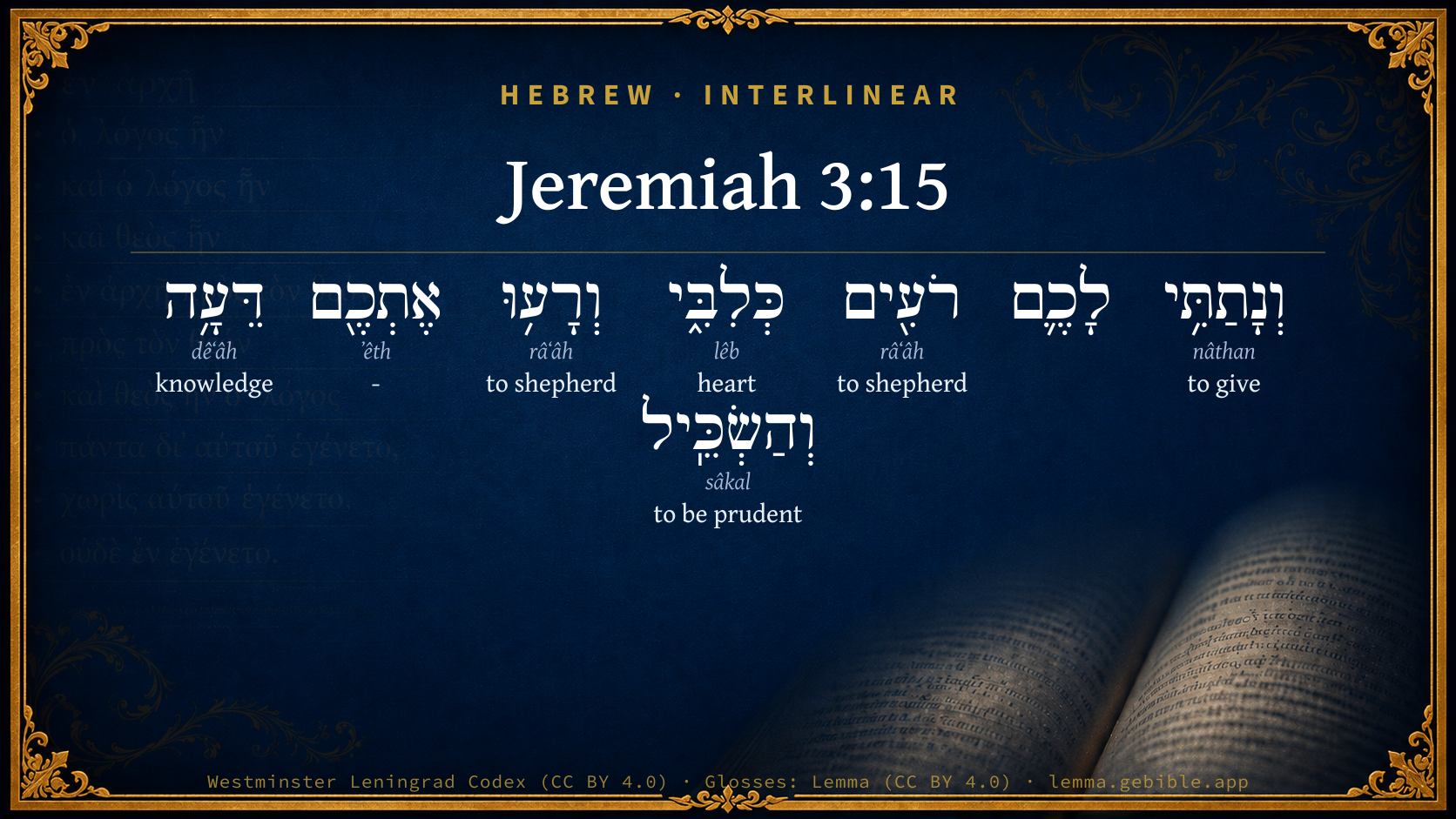
Jeremiah 3:15

Hebrew (Westminster Leningrad Codex) Jeremiah 3:15 appears in the Hebrew Old Testament. The text above is from the Westminster Leningrad Codex. Each word links to its Strong’s number, a concise gloss, and parsing drawn from the Open Scriptures Hebrew Bible morphology. Click any word for its full Brown-Driver-Briggs (BDB) entry.
Download image
Cite this verse

Jeremiah 3:15 (World English Bible). Public Domain. Lemma interlinear Bible study tool, https://lemma.gebible.app/v/jeremiah/3/15.

Show BibTeX & RIS
BibTeX
RIS
English Translation
and I will give you shepherds according to my heart, who shall feed you with knowledge and understanding.
World English Bible · Public Domain
Download a study sheet

One document with this verse’s original text, its word-by-word gloss line, the meaning frame, cross-references with their text, attributed commentary, and full source and license credits — printable, and it pastes into notes with its structure intact.

This verse Autodidact and up

Study sheet (.html) Plain text (.txt)

A passage Seminary Student

Up to 50 verses in one chapter. A passage sheet keeps up to 6 commentary sources and 12 cross-references per verse, in the order this page ranks them, and says so on the sheet whenever that leaves anything out. Ask for a single verse and you get the Autodidact verse sheet above.

Everything on this page stays free to read, with no account — the sheet is a download of what is already on screen, not access to it.

Want to remove ads? Support Godless Engineer
Compare translations 3

The same verse in 3 English versions, stacked beneath the original-language interlinear above. Click any original word for its lexicon entry.

Each is an independent rendering of the whole verse — the interlinear is not word-aligned to these translations.

Highlighted words mark where these versions differ — a whole-verse word diff, not a word-by-word alignment.

  • World English Bible Public Domain
    and I will give you shepherds according to my heart, who shall feed you with knowledge and understanding.
  • King James Version Public Domain
    And I will give you pastors according to mine heart, which shall feed you with knowledge and understanding.
  • unfoldingWord Literal Text CC BY-SA 4.0
    Then I shall give you shepherds according to my heart, and they will shepherd you knowledge and insight.

unfoldingWord Literal Text — © unfoldingWord, licensed CC BY-SA 4.0. Word-aligned USFM3 via Door43 (git.door43.org/unfoldingWord/en_ult).

Versions to compare (up to 4)

3 of 4 selected

Show all 18 translations

Every available English version of this verse, each an independent rendering of the whole verse.

  • World English Bible Public Domain
    and I will give you shepherds according to my heart, who shall feed you with knowledge and understanding.
  • Berean Standard Bible Public Domain
    Then I will give you shepherds after My own heart, who will feed you with knowledge and understanding.”
  • Majority Standard Bible Public Domain
    Then I will give you shepherds after My own heart, who will feed you with knowledge and understanding.”
  • King James Version Public Domain
    And I will give you pastors according to mine heart, which shall feed you with knowledge and understanding.
  • American Standard Version (1901) Public Domain
    and I will give you shepherds according to my heart, who shall feed you with knowledge and understanding.
  • Revised Version (1885) Public Domain
    and I will give you shepherds according to mine heart, which shall feed you with knowledge and understanding.
  • Geneva Bible (1599) Public Domain
    And I will giue you pastours according to mine heart, which shall feede you with knowledge and vnderstanding.
  • Douay-Rheims (1899) Public Domain
    And I will give you pastors according to my own heart, and they shall feed you with knowledge and doctrine.
  • Young's Literal Translation Public Domain
    And I have given to you shepherds According to Mine own heart, And they have fed you with knowledge and understanding.
  • Literal Standard Version CC BY-SA 4.0
    And I have given shepherds to you || According to My own heart, || And they have fed you with knowledge and understanding.
  • Unlocked Literal Bible CC BY-SA 4.0
    I will give you shepherds after my heart, and they will shepherd you with knowledge and insight.
  • unfoldingWord Literal Text CC BY-SA 4.0
    Then I shall give you shepherds according to my heart, and they will shepherd you knowledge and insight.
  • Darby Bible Public Domain
    And I will give you shepherds according to my heart, and they shall feed you with knowledge and understanding.
  • World Messianic Bible Public Domain
    I will give you shepherds according to my heart, who will feed you with knowledge and understanding.
  • Webster's Bible Public Domain
    And I will give you pastors according to my heart, who shall feed you with knowledge and understanding.
  • Free Bible Version CC BY-SA 4.0
    I will give you shepherds who are like me who will feed you wisely and with understanding.
  • Bible in Basic English Public Domain
    And I will give you keepers, pleasing to my heart, who will give you your food with knowledge and wisdom.
  • JPS Tanakh (1917) Public Domain
    and I will give you shepherds according to My heart, who shall feed you with knowledge and understanding.

Literal Standard Version (2020), Covenant Press — licensed CC BY-SA 4.0. Text via the HelloAO Bible API (eBible.org). Unlocked Literal Bible (unfoldingWord) — licensed CC BY-SA 4.0. Text via the HelloAO Bible API (eBible.org). unfoldingWord Literal Text — © unfoldingWord, licensed CC BY-SA 4.0. Word-aligned USFM3 via Door43 (git.door43.org/unfoldingWord/en_ult). Free Bible Version, Dr. Jonathan Gallagher — licensed CC BY-SA 4.0. Text via the HelloAO Bible API (eBible.org).

Word by word

More ways to search: Search by grammar → Find every occurrence → Compare this word →

Practice this passage: Drill this verse → Learn its vocabulary →

About this verse

These counts appear in no published source. They are computed here, from the morphology-tagged text and Lemma’s own curated glosses. What Lemma adds →

8
words
6
distinct lemmas
Prophets
section

Notable vocabulary

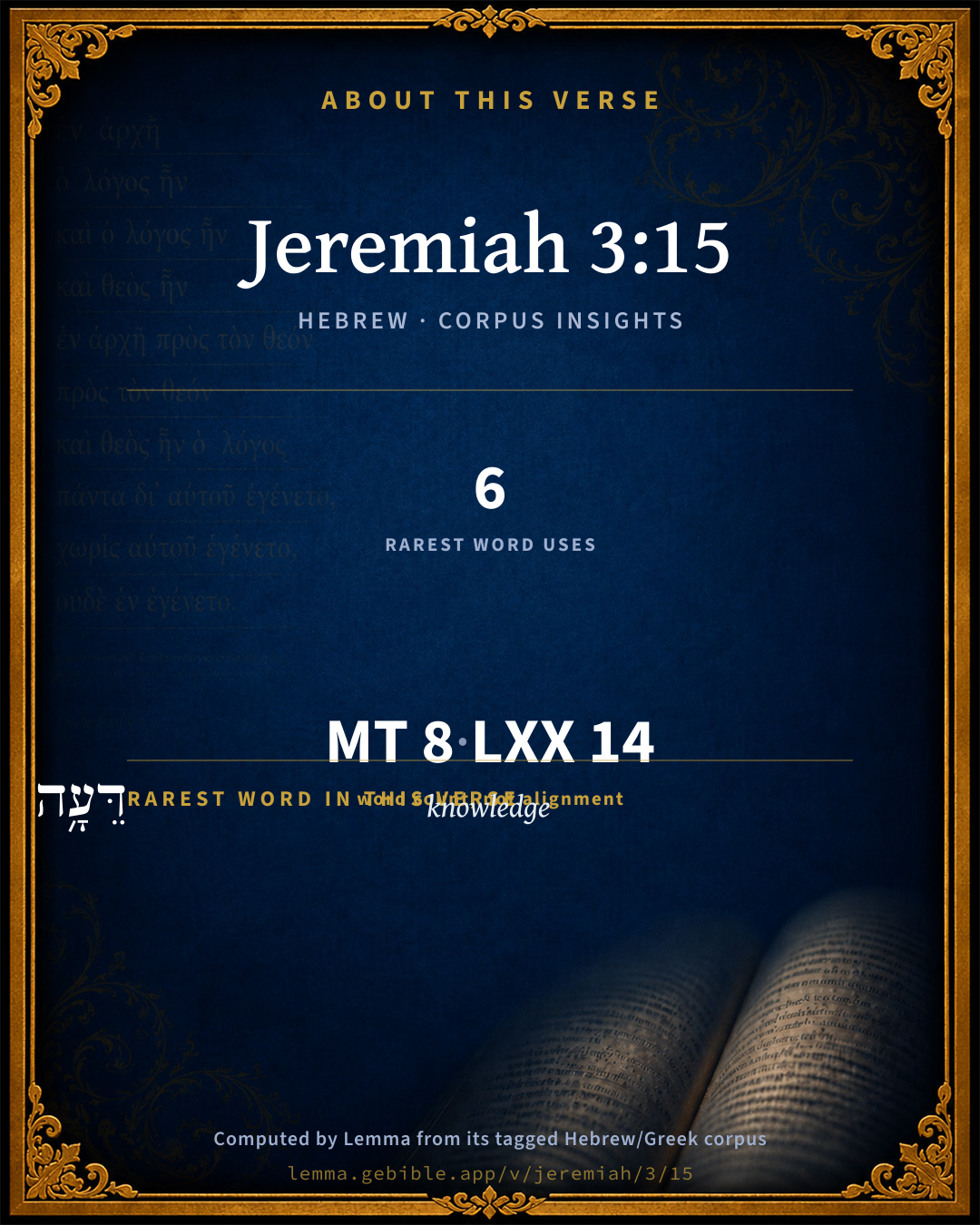
The rarest word here is דֵּעָ֥ה knowledge H1844 — appearing just 6 times in the whole Hebrew Bible.

Shared distinctive vocabulary

דֵּעָ֥ה knowledge H1844 occurs in 6 verses of the Hebrew Bible. Also found in:

Grammatical profile

  • 4 verbs
  • 2 nouns
  • 1 preposition
  • 1 particle

Verb forms

  • וְנָתַתִּ֥י Qal · Sequential Perfect
  • רֹעִ֖ים Qal · Participle Active
  • וְרָע֥וּ Qal · Sequential Perfect
  • וְהַשְׂכֵּֽיל Hiphil · Infinitive Absolute

Repetition

A word recurs within this verse — often emphatic in Hebrew:

  • רֹעִ֖ים to shepherd H7462 ×2

Hebrew & Septuagint length

In the original languages it is 8 Hebrew tokens and 14 Greek tokens — but the two are counted differently (Hebrew bundles its prefixes and suffixes into one token; the Greek is in lemma form), so that isn’t a like-for-like length.

Cross-references

18

Topical passages linked to Jeremiah 3:15 in the Treasury of Scripture Knowledge — connected by theme and wording, ordered by reader-vote popularity; previews shown in the World English Bible.

  • Jeremiah 23:4 I will set up shepherds over them, who shall feed them; and they shall fear no more, nor be dismayed, neither shall any be lacking, says Yahweh.
  • Acts 20:28 Take heed, therefore, to yourselves, and to all the flock, in which the Holy Spirit has made you overseers, to shepherd the assembly of the Lord and God which he purchased with his own blood.
  • Ephesians 4:11–12 He gave some to be apostles; and some, prophets; and some, evangelists; and some, shepherds and teachers;
  • Ezekiel 34:23 I will set up one shepherd over them, and he shall feed them, even my servant David; he shall feed them, and he shall be their shepherd.
  • John 21:15–17 So when they had eaten their breakfast, Jesus said to Simon Peter, "Simon, son of Jonah, do you love me more than these?" He said to him, "Yes, Lord; you know that I have affection for you." He said to him, "Feed my lambs."
  • Isaiah 30:20–21 Though the Lord give you the bread of adversity and the water of affliction, yet shall not your teachers be hidden anymore, but your eyes shall see your teachers;
  • Proverbs 10:21 The lips of the righteous feed many, But the foolish die for lack of understanding.
  • Luke 12:42 The Lord said, "Who then is the faithful and wise steward, whom his lord will set over his household, to give them their portion of food at the right times?
  • 1 Corinthians 3:1–2 Brothers, I couldn't speak to you as to spiritual, but as to fleshly, as to babies in Christ.
  • Ezekiel 37:24 My servant David shall be king over them; and they all shall have one shepherd: they shall also walk in my ordinances, and observe my statutes, and do them.
  • 1 Corinthians 2:6 We speak wisdom, however, among those who are full grown; yet a wisdom not of this world, nor of the rulers of this world, who are coming to nothing.
  • 1 Corinthians 2:12–13 But we received, not the spirit of the world, but the Spirit which is from God, that we might know the things that were freely given to us by God.
  • John 10:1–5 "Most assuredly, I tell you, one who doesn't enter by the door into the sheep fold, but climbs up some other way, the same is a thief and a robber.
  • Micah 5:4–5 He shall stand, and shall shepherd in the strength of Yahweh, In the majesty of the name of Yahweh his God: And they will live, for then he will be great to the ends of the earth.
  • 1 Peter 2:2 as newborn babes, long for the pure milk of the Word, that you may grow thereby,
  • 1 Peter 5:1–4 I exhort the elders among you, as a fellow elder, and a witness of the sufferings of Christ, and who will also share in the glory that will be revealed.
  • 1 Samuel 13:14 But now your kingdom shall not continue: Yahweh has sought him a man after his own heart, and Yahweh has appointed him to be prince over his people, because you have not kept that which Yahweh commanded you.
  • Hebrews 5:12–14 For when by reason of the time you ought to be teachers, you again need to have someone teach you the rudiments of the first principles of the oracles of God. You have come to need milk, and not solid food.

Cross-references courtesy of OpenBible.info (CC BY 4.0).

Hebrew and Greek witnesses Masoretic Hebrew ↔ Greek Septuagint

The same verse in the two great witnesses to the Old Testament, shown verse-for-verse.

These are two independent witnesses, not word-aligned to each other, and the Septuagint is shown in lemma (dictionary) form.

Hebrew Jeremiah 3:15 Masoretic · Westminster Leningrad Codex

וְנָתַתִּ֥י לָכֶ֛ם רֹעִ֖ים כְּלִבִּ֑י וְרָע֥וּ אֶתְכֶ֖ם דֵּעָ֥ה וְהַשְׂכֵּֽיל

and I will give you shepherds according to my heart, who shall feed you with knowledge and understanding.

World English Bible · Public Domain

Greek LXX Structure differs

In the Septuagint, Jeremiah is about an eighth shorter than the Hebrew and arranges its material differently — the Oracles Against the Nations (Hebrew chapters 46–51) appear in the middle of the Greek book, after 25:13. Because the chapter and verse boundaries do not line up, a verse-for-verse comparison with the Hebrew is not shown.

A verse-for-verse comparison isn’t shown here because the chapters and verses don’t line up. Switch to the LXX edition with the MT / LXX toggle above to read the Greek directly.

Hebrew: Westminster Leningrad Codex (CC BY 4.0). Greek: Septuagint (public domain); English from a public-domain English Septuagint. How the Septuagint differs from the Hebrew →

Targum (Aramaic paraphrase)

1

The Targum is the ancient Jewish Aramaic paraphrase of the Hebrew Scriptures — an interpretive translation, not the Hebrew text itself. Onkelos (literal) and Pseudo-Jonathan (expansive) render the Torah, and Jonathan the Prophets. Coverage is partial: where no permissively-licensed English translation exists for a verse, only the Aramaic is shown. This is verse-level text, not a word-by-word alignment to the Hebrew.

  1. Targum Jonathan Prophets (Joshua–Malachi)
    וַאֲמַנֵי עֲלֵיכוֹן פַּרְנָסִין עָבְדֵי רְעוּתִי וִיפַרְנְסוּן יַתְכוֹן בְּמַדַע וּבְחוּכְמָא:

    (no public-domain English translation for this verse)

    Targum Jonathan — Aramaic: “Mikraot Gedolot” (public domain). English: “Sefaria Community Translation” (CC0 1.0 (public-domain dedication)); “London "Chaldee Paraphrase," 1871” (public domain). Text via Sefaria.

Commentary

Notes on Jeremiah 3:15 from classic Christian and Jewish commentators (each source and its license shown beneath its notes). The classic Christian expositions comment on the surrounding passage and are grouped to its opening verse, so a note may address several verses; the Jewish commentaries on the Tanakh (Rashi and others) are per-verse, so they appear only where the commentator wrote on this verse.

Lemma curates 59 commentaries, every one of them public domain or Creative Commons licensed, each selected and text-cleaned for this edition rather than reprinted as found. About our sources →

Trapp's Complete Commentary

John Trapp

Jer 3:15 And I will give you pastors according to mine heart, which shall feed you with knowledge and understanding.

Ver. 15. And I will give you pastors according to my heart.] God gives faithful pastors oft for the sake of but a few that are there to be converted: Et vilissimus pagus est palatium eburneum, in quo est pastor et credentes aliqui, saith Luther, {a} The poorest village is an ivory palace, if there be but in it a pastor and some few believers. Such pastors as God here promiseth (and more largely describeth, Jer 23:1-40 Eze 34:1-31), are special gifts of God: "I will give you pastors." David, after he had discomfited the Amalekites, sent gifts to his friends in Judah. {1Sa 30:26} Great Alexander, when he had prevailed at the river Granicus, and was now ascended into the upper parts of Asia, sent back many gifts to assure them of his love in Macedonia. The like doth God to his Church by sending them pastors, with such two adjuncts as are here - (1.) Adherent, his own approbation; (2.) Inherent, skill to teach the people. See Eph 4:8. {See Trapp on "Eph 4:8"}

{a} Luth., tom. iii. p. 81.

John Trapp, A Commentary or Exposition upon All the Books of the Old and New Testament (1647–1656) — public domain. Text from a community e-Sword module.

The Biblical Illustrator

Joseph S. Exell

Jer_3:15

I will give you pastors according to Mine heart.

The character and teaching of Christs ministers

I. Their character. To be a pastor after Gods heart, a man must not only theoretically understand, but practically feel the truths he sets forth in his teaching. How describe the burden of a guilty conscience, if he has never felt it himself? How expatiate on the love and unfold the preciousness of a Saviour, whilst himself still out of Christ? How exhort hearers to set affections on things above, when his own thoughts are entirely absorbed by things below?

II. Their teaching. What they have found to be, by Gods blessing, useful to themselves, they will bring before their people. They will not daub the wall with untempered mortar, crying, Peace, peace, when there is no peace; but, will cry aloud and lift up their voice like a trumpet, to warn the unconverted of their danger, and convince them of their guilt. Nor will they show the disease without, at the same time, declaring the remedy. They will prove to their hearers their numberless shortcomings, in order that they may be led the more highly to prize the Saviours merits. Conclusion--

1. Seek the increase of such pastors.

2. Help to provide for such pastors. (C. Clayton, M. A.)

The duty of a pastor

I. To feed the Church with knowledge and understanding. This is by preaching the Gospel.

1. There is spiritual wisdom in understanding the mysteries of the Gospel, that we may be able to declare the whole counsel of God, and the riches and treasures of the grace of Christ unto the souls of men (Act_20:27; 1Co_2:1-4; Eph_3:7-9).

2. Authority is required. What is authority in a preaching ministry? It is a consequent of unction, and not of office.

3. Experience of the things preached.

4. Skill to divide the Word aright.

5. The knowledge and consideration of the state of the flock.

6. To be actuated by zeal for the glory of God, and compassion to the souls of men.

II. Continual prayer for the Churches over which Christ has made them overseers.

1. No man can have any evidence in his own soul, that he doth conscientiously perform any ministerial duty towards his flock, who doth not continually pray for them.

2. This is the way whereby we may bless our congregations.

3. What shall we pray for?

(1) For the success of the Word that we preach unto them.

(2) For the presence of Christ in all our assemblies.

III. To preserve the truth and doctrine of the Gospel that is committed to the Church. What is required hereunto?

1. A clear apprehension in ourselves of those doctrines and truths which we are so to defend.

2. Love of the truth.

3. Let us take heed in ourselves of any inclination to novel opinions, especially in, or about, or against such points of faith, as those wherein they who are fallen asleep, found life, comfort, and power.

4. There is skill and ability required hereunto, to discover and be able to oppose and confound the cunning sophistry of adversaries. Great prayer, watchfulness, and diligence are required, that we may be able to attend unto these things. And those who are less skilled may do well to advise with those who are more exercised in them to give them assistance.

5. That we labour diligently for the conversion of souls. (John Owen, D. D.)

The true teacher

1. There are some teachers of religion who are teachers according to Gods heart.

2. All such teachers are the gift of God.

(1) He prepares them for their office.

(2) He designates the sphere of their ministry

3. They are distinguished by the care and fidelity with which they minister to the spiritual wants of their people. (E. Cooper, M. A.)

Pastors according to Gods own heart

I. What those qualifications are which render men pastors after Gods own heart.

1. Their being sent and commissioned by God.

2. Their being thoroughly instructed in the knowledge of Gods mind and will.

3. Their being exemplary in their conversation of the goodness and purity of their own doctrine (1Ti_3:12).

(1) In word, that is, in observing a decent gravity in discourse.

(2) In conversation; a sweet and obliging deportment.

(3) In charity; a hearty goodwill to all men as we have opportunity.

(4) In spirit; that is, in an active zeal for the glory of God, and the good of souls.

(5) In faith, that is, in an immoveable constancy and fidelity to our religion, in holding fast the form of sound words, and contending earnestly for the faith once delivered to the saints.

(6) In purity, that is, in abstaining from all fleshy lusts, from worldly mindedness, intemperance, and wantonness.

II. How much such pastors do conduce to the glory, and beauty, and perfection of the Church.

1. In soundness of faith, to which there is nothing can more conduce than pious and learned pastors; who being not only purged from vicious affections, and inspired with an hearty zeal for truth; but also accomplished with parts and learning to distinguish between truth and falsehood, and to separate the innovations of false teachers from the ancient truths of Christianity, cannot but be highly instrumental to the restoring the faith of their Churches, wherever they find it corrupted and sophisticated, to its primitive lustre and simplicity.

2. In purity of worship; for the end of all Church assemblies being to worship God, and the worship of God consisting in a devout acknowledgment of the infinite perfections of His nature, by such internal and external acts, as right, reason, and revelation directs: all such as are truly devout, and sincerely affected with the Divine perfections, must look upon themselves, as greatly concerned to worship God, in such manner as is most suitable to His will and nature. And this the pastors of the Church are more peculiarly concerned in, being the guides of the public worship.

3. A Churchs glory and perfection consists also in the vigour of its discipline, in the just and vigilant administration of the power of the keys, in admonishing such as go astray, in excluding them the communion of the Church if they continue obstinate, and readmitting them upon their repentance.

4. A Churchs glory and perfection consists in unity of communion and affections, so that there be no schisms in the body, but that all its members, being incorporate in the same communion, be knit and fastened to one another by the ligaments of mutual love and charity; to which excellent effect there is nothing in the world can more conduce than learned, prudent, and pious pastors.

5. The glory and perfection of a Church consists also in sanctity of manners; to promote which, also, nothing can be more conducive than pastors according to Gods own heart.

(1) Their being commissioned from God to teach and govern His flock must give their doctrine a very great authority in the minds of all that have any reverence for God, and thereby render it more prevalent and effectual

(2) Their doctrine, supposing they are pious and learned, will be throughout holy, and in all points tending to promote the interest of piety and virtue.

(3) Their holy doctrine will be enforced by their holy examples, which will preach more effectually than their tongues. (John Scott, D. D.)

The constitution, character, and duties of the Gospel ministry

I. God is engaged by covenant to provide a perpetual public ministry for His Church.

1. A public stated ministry in the Christian Church is a Divine institution.

2. It is the ordinance of God that a public ministry should be continued in His Church unto the end of the world.

3. God hath covenanted with His Church to supply her congregations with a public ministry--And I will give you pastors.

(1) Promises, made upon the footing of a permanent relation between God and His Church, which have respect to a benefit of a permanent nature, are to be understood as securing to the Church that benefit indefinitely throughout every period of time.

(2) Many promises delivered by the prophets were designed to refer immediately to the New Testament Church; and were so applied by the apostles of our Lord. Some of these refer to the Christian ministry (Isaiah Iii. 6, 7, 10; Rom_10:14-15).

(3) The Redeemer, in whom the promises are made, and in whom they are accomplished, has solemnly engaged never to leave His Church entirely destitute of a public ministry. He walks amidst the golden candlesticks. He holds the stars in His right hand. He gives power to His witnesses.

II. God hath set distinguishing marks upon the ministry, of which He approves--Pastors according to Mine heart.

1. The pastor according to Gods heart has received a regular call to the ministry.

(1) The call of God to ecclesiastical office is inward, when there is a Divine influence experienced upon the mind, inclining and commanding the person to devote himself to the service of the Church.

(2) It is outward, when accompanied with external evidence for the satisfaction of the Church. The inward call may satisfy a mans own mind; but others must, in order to receive Him, have some external evidence.

(a) Ordination constitutes the call of God to the ministry of reconciliation in the Gospel Church (1Ti_3:1-7; Tit_1:5-9; Rom_10:15).

(b) Ordination to the holy ministry is to be performed by imposition of hands (1Ti_5:22; 1Ti_4:14; Heb_6:2; Act_13:2-3).

2. The pastor according to Gods heart has a life corresponding to the functions of his holy office.

(1) A ministry evidently impious will meet with few advocates. This evil can be tolerated only in a Church which has far departed from truth and holiness.

(2) The pious minister is constrained by the love of a crucified Saviour to diligence in his sacred office. He perceives the danger of sinners; and, anxious for their salvation, he warns them of it frequently and fervently. From house to house he visits, examines, exhorts. In afflictions, he soothes; in temptation, admonishes; in sickness, comforts; and in death, resigns their departing spirits into the hands of that God who created both him and them.

(3) The pastor, who is near the heart of God, is faithful to God and His Church. He deals plainly with sinners, uninfluenced by their frowns or their smiles.

III. The sum of pastoral duty is the edification of the Church.

1. The pastor according to Gods heart preaches to his congregation the Gospel of Christ. This is the food which he diligently provides for immortal souls.

2. The pastor of whom God approves is in duty bound, from time to time, to examine the religious state of his congregation.

3. It is the duty of the Christian pastor to administer the sacraments of the New Testament to the members of his Church.

4. It is the duty of a Christian minister to exercise authority over his flock. This is necessary to their edification, and is implied in feeding with knowledge. The power of the keys of the kingdom of heaven is in the hands of every Christian minister. (A. MLeod, D. D.)

Pastors office no sinecure

To a person who regretted, to the celebrated Dr. Johnson, that he had become a clergyman, because he considered the life of a clergyman an easy and comfortable one, the Doctor made this memorable reply: The life of a conscientious clergyman is not easy. I have always considered a clergyman as the father of a larger family than he is able to maintain. No, sir, I do not envy a clergymans life as an easy life, nor do I envy the clergyman who makes it an easy life.

The pastors obligation to feed the people

The Rev. Robert Hall of Bristol was asked what he thought of a sermon which had been delivered by a proverbially fine preacher, and which had seemed to excite a great sensation among the congregation: Very fine, sir, he replied, but a man cannot feed upon flowers.

The Biblical Illustrator, edited by Joseph S. Exell (c. 1880s–1900s) — public domain. Text from a community e-Sword module.

Joseph Benson's Commentary

Jer 3:15. I will give you pastors according to my heart — This is likewise an evangelical promise, (compare Jer 23:4,) implying that under the happy times here foretold all governors, both civil and ecclesiastical, should faithfully discharge their trust, in duly governing and instructing the people committed to their charge; and that all in authority should answer the character which God gives of David, namely, that he was a man after his own heart, whereas, at the time when Jeremiah lived, the princes, the priests, and prophets were the ringleaders in seducing the people, and enticing them to idolatry: see Jer 2:8, and Lowth. “Those are pastors after God’s own heart,” says Henry, “that make it their business to feed the flock; not to feed themselves and fleece the flock, but to do all they can for the good of those that are under their charge; that feed them with wisdom and understanding — That is, wisely and understandingly, as David fed them, in the integrity of his heart and by the skilfulness of his hands, Psa 78:72. Those that are not only pastors, or rulers, but teachers, must feed them with the word of God, which is wisdom and understanding, and is able to make us wise unto salvation.”

Joseph Benson's Commentary on the Old and New Testaments (1811–1818) — public domain. Text from a community e-Sword module.

Tyndale Open Study Notes

Tyndale Open Resources

3:15 If the people of Israel repented, the Lord wanted to give them more than just the land. He also promised to provide leaders (shepherds) who would guide them with knowledge and understanding (23:4, 31; Ezek 34:11; Acts 20:28; Eph 4:11).

Tyndale Open Study Notes — © Tyndale Open Resources, licensed CC BY-SA 4.0. Text via the HelloAO Bible API.

Jamieson, Fausset & Brown

Robert Jamieson, A. R. Fausset & David Brown

pastors--not religious, but civil rulers, as Zerubbabel, Nehemiah (Jer 23:4; Jer 2:8).

Jamieson, Fausset & Brown — Commentary Critical and Explanatory on the Whole Bible (1871) — public domain (CC PDM 1.0). Text via the HelloAO Bible API.

Adam Clarke's Commentary

Verse 15. I will give you pastors according to mine heart] The pastor means either the king or the prophet; and the pastors here promised may be either kings or prophets, or both. These shall be according to God's own heart; they shall be of his own choosing and shall be qualified by himself: and in consequence they shall feed the people with knowledge, דעה deah, that Divine truth concerning the true God and the best interests of man, which was essentially necessary to their salvation; and understanding השכיל haskeil, the full interpretation of every point, that in receiving the truth they might become wise, holy, and happy.

Adam Clarke's Commentary on the Bible (1810–1826) — public domain. Text from a community e-Sword/MySword module.

John Calvin's Commentaries

Here God promises that he would so provide for the salvation of his people after their return from exile, that they should not again perish. But the cause of God’s vengeance ought to be observed, which is expressed in the fifth chapter of Isaiah, “My people,” he says, “have been led captive, because they had no knowledge; therefore the grave has widened its soul or its throat. He then says, that the cause of the people’s ruin was, because instruction had ceased among them, and pastors had become mute dogs or robbers. Here, on the other hand, God declares that he would give them faithful pastors, who would discharge in a befitting manner their office. I, indeed, allow, that under this term are included faithful and wise magistrates; but he especially refers to prophets and priests, whose office it is in particular to reform idolatry.

We hence learn that the Church cannot continue without having faithful pastors to shew the way of salvation. The wellbeing of the Church then is secured, when God raises up true and faithful teachers to proclaim his truth: but when the Church is deprived of sound teachers, all things soon fall into ruin. For God, no doubt, intimates by this promise that he would not only be the deliverer of his people, so as to restore them from exile, but that he would be also their perpetual guardian after the people had returned to their own country. It hence follows, that the Church of God is not only begotten by means of holy and godly pastors, but that its life is also cherished, nourished, and confirmed by them to the end. As it is not enough for civil order to be once set up, except the magistrates continue in their office, so nothing is more ruinous to the Church than for God to take away faithful pastors. It cannot indeed be, that people will return to God, unless prophets be first sent: but God speaks here of a continued course of instruction, and of a well regulated government in the Church, as though he had said, “I will not only give you prophets to lead you from your wanderings to me, and to restore you to the way of salvation, but I will also continually set over you sound and faithful teachers.” But we must notice, that those who preside cannot rightly discharge their office unless they are endued with wisdom. God also intimates his paternal love, when he says, that good pastors would be dear to him. It afterwards follows —

John Calvin's Commentaries (1540-1563) — public domain. Text from the Calvin Translation Society English edition (1840s-50s) via the Christian Classics Ethereal Library (ccel.org). Calvin's coverage is partial (roughly two-thirds of the Bible); uncommented books and verses are honest gaps, never fabricated. The 19th-century editor's footnotes and remarks are omitted so the notes are faithfully Calvin's own voice.

Ellicott's Commentary for English Readers

(15) Pastors.—As in Jer_2:8, of kings and rulers, not of priests. Compare Jer_23:1-5. The phrase “according to mine heart” brings David to our thoughts (1Sa_13:14). There should be a return to the true pattern of the ideal ruler. In the “knowledge and understanding” we have an echo from Isa_11:1-4.

A Bible Commentary for English Readers, edited by Charles John Ellicott (1878–1897) — public domain. Text from a community e-Sword module.

The Cambridge Bible for Schools and Colleges

gen. ed. J. J. S. Perowne

15. shepherds] See on ch. Jer_2:8.

The Cambridge Bible for Schools and Colleges (gen. ed. J. J. S. Perowne; Cambridge University Press, 1878–1918) — public domain. Text from a community e-Sword module.

John Gill's Exposition

And I will give you pastors according to mine heart,.... Which is to be understood not of political rulers and governors, but ministers of the word; who are "pastors" or "shepherds" under Christ the great Shepherd, and are "gifts" of his to the churches, and "according to his heart"; or "conformable to his mind", as the Arabic version; whom he calls, qualifies, puts into the ministry, and sends forth; whom he holds in his right hand, and keeps as the apple of his eye; who do his will, as the Targum, and feed men according to his heart: and as this prophecy belongs to Gospel times, as appears both by what goes before and by what follows, the apostles of Christ and first ministers of the Gospel are chiefly designed; though it might have some accomplishment in Nehemiah and Ezra, Haggai, Zechariah, and Malachi, at and after the Jews return from Babylon; but a more complete one in the times mentioned: so Kimchi says, these are they that shall be with the King Messiah, according to Mic 5:5,

which shall feed you with knowledge and understanding; with things worthy to be known and understood; with the solid and substantial truths of the Gospel, and by faithfully administering the ordinances of it; and in all directing to Christ the bread of life: or, "shall rule you" (f) not in an arbitrary way, according to their own ills, but according to the laws of Christ: these words, with knowledge and understanding, may either intend the matter with which these pastors should feed the church; which is what tends to spiritual knowledge and understanding, and an increase thereof; and which is blessed of God to such a purpose, though they themselves cannot give it: or else the manner in which they should feed or rule; that is, wisely and "prudently", as the Arabic version renders it: they feed wisely and prudently when they rightly divide the word of truth, and give to every one their portion of meat in due season; and feed them in proportion to their age and capacity, give milk to babes, and meat to strong men: and they rule with wisdom and prudence when they govern according to the laws of Christ, and take care that they are put in execution; and do all things decently and in order; and, as David, feed the flock according to the integrity of their hearts, and guide them by the skilfulness of their hands, Psa 78:72.

(f) "regent", Gataker.

John Gill's Exposition of the Whole Bible (1746–1763) — public domain (CC PDM 1.0). Text via the HelloAO Bible API.

Albert Barnes' Notes on the Bible

Pastors - “Kings, rulers” (compare Jer 2:8). Not military usurpers Hos 8:4, but true servants of God, as David 1Sa 13:14.

Albert Barnes' Notes on the Bible (1834–1885) — public domain. Text from a community e-Sword/MySword module.

Haydock's Catholic Bible Commentary

Pastors. Zorobabel, &c., but more particularly Christ and his apostles.

George Leo Haydock (1774–1849), Haydock's Catholic Family Bible and Commentary, 1859 edition — public domain. Excludes Psalms (Douay-Rheims chapter numbering differs from Protestant) and Deuterocanonical books (Catholic canon only).

Matthew Poole's English Annotations

Pastors; either civil magistrates, which are sometimes so called, Mic 5:5; or rather ecclesiastical, as appears both from the reason of God’s judgments upon Israel, viz. their pastors being generally either thieves or dumb dogs; and also from the nature of their office, in the close of the verse, and thus they are called Eph 4:11.

According to mine heart; such as I will both choose for you and approve of, and that shall faithfully and skilfully declare unto you my mind; which intimates not only a single act of deliverance, but his constant preservation of them.

Which shall feed you with knowledge and understanding: this notes either the nature of their food: see Neh 8:8; Mal 2:7. Or rather the manner of their feeding: see Psa 78:72; 1Pe 5:2. See more of this promise Jer 23:4.

Matthew Poole's English Annotations on the Holy Bible (1683–1685) — public domain. Text from a community e-Sword/MySword module.

Whedon's Commentary on the Bible

Daniel D. Whedon

15. Pastors — No matter how few and poor and scattered the flock, they shall have shepherds. Under this term are included, not prophets and priests, but rulers who held to the people a parental relation, and were, under the great Shepherd, their guardians and guides.

Daniel D. Whedon (gen. ed.), Commentary on the Old and New Testaments (1874–1909) — public domain. Text from a community e-Sword module.

The Pulpit Commentary

Pastors. In Jer_23:4, the same word is rendered in the Authorized Version "shepherds," which would he less open to misunderstanding here than "pastors," civil and not spiritual authorities being intended. (see on Jer_2:8) The prophecy is, of course, not inconsistent with passages like Jer_23:5, but as the national continuance of Israel was guaranteed, it was natural to refer to the subordinate civil authorities. According to mine heart ; better, according to my mind; for here, as also in 1Sa_13:14, it is something very far from perfection which is ascribed to the chosen rulers. "Heart" is sometimes equivalent to "understanding.

God will provide pastors according to his own heart.

I THE NEED SO EMPHATICALLY IMPLIED THAT SUCH PASTORS SHOULD BE GIVEN. The shepherd"s occupation, it need hardly be said, is one that comes up again and again in the Scriptures, both in the literal sense of the word and the figurative one. And even in the literal occupation there was, doubtless, often need of men who could be described as shepherds after God"s own heart. Every shepherd who was faithful, observant, courageous, and altogether superior to the hireling spirit, was to that extent a shepherd after God"s own heart. Such a one might possibly not be after God"s own heart in other respects. Many are very watchful over the brutes committed to their charge, and utterly thoughtless about the shepherding of their own souls and of the various human beings dependent on them and influenced by them. Then passing to the figurative flocks and shepherds, there are very pathetic representations in the Scriptures of the mischief consequent on the unfaithfulness of those rulers and providers who had been set over God"s people. Take such a man as King Ahab. He was not a man after God"s own heart, and what is the result? Going out against the King of Syria, Ahab, not very hopeful of a favoring word, consults Micaiah, the faithful prophet of God: I saw all Israel scattered upon the hills, as sheep that have not a shepherd;" which was not only a warning of utter defeat, but a bitter charge against Ahab that he had been utterly faithless to his trust. (1Ki_22:17) There is so much of the sheep-nature in the human breast. How many have been troubled because there is no shepherd! (Zec_10:2) Every time the confession is uttered, "All we like sheep have gone astray," there is a hint of pastoral unfaithfulness somewhere or other. The sheep-nature in the human breast has never been better set forth than in the anxiety of the departing Moses with respect to a competent successor. (Num_27:17) Food needs to be provided. There must be a guarding against self-willed wandering away from the supplies and comforts belonging to a constant member of the flock. There are the perils from wild beasts. (1Sa_17:34) There is the work needed to bring back that which is lost. Look at Zec_11:16, where there is a hint of what the shepherd has to do visiting those that are cut off, seeking the young ones, healing the broken, bearing that which standeth still. (see also Jer_1:6 Eze 34 Joh 10)

II THE FACT THAT SUCH PASTORS WILL ASSUREDLY BE PROVIDED. Great is the requirement, and there has often been a grievous disappointment in getting it met, but assuredly it can be met. The rulers in Israel had not all been as Ahab. That same Moses, who was so anxious concerning his successor, had been himself taken from faithful oversight of another man"s sheep in order to deliver Israel from Pharaoh"s clutch, and lead him towards the green pastures and still waters of the promised land (Exodus 3). David, who had followed the ewes great with young, no doubt gently leading them when needful, gathering the lambs in his arm and carrying them in his bosom, who also had smitten the lion and the bear, was now taken to feed Jacob the people of God, and Israel his inheritance. (Psa_78:71 Isa_40:11) Not only had he been faithful as a shepherd, but he had also grown ever more conscious of the sheep-nature in himself, and the sheep like requirements of his own life, and so, looking away from his flock upwards, he beautifully says, "Jehovah is my Shepherd." He had lions following his own soul. (Psa_7:2 Psa_10:9 Psa_17:12 Psa_22:13) Those are fitted to be shepherds after God"s own heart who, feeling their own needs, make Jehovah their Shepherd. It is important to remember how David is declared as the man after God"s own heart. (1Sa_13:14 Act_7:46 Act_13:22) So God is here speaking through Jeremiah, with that confidence which comes from actual experience of the true and the brave among his own chosen. Then there is the great work of Jesus to be considered. It is very significant that in Jeremiah 23, after a reference to the unfaithful shepherds, there is a promise of faithful ones, their work being set forth more explicitly even than here; and then God goes on to speak of the righteous Branch which shall be raised to David, the King who shall reign and prosper and execute judgment and justice in the earth: he is the Governor who shall feed the Lord"s people Israel; (Mat_2:6) he is the Great Shepherd of the sheep brought again from the dead; (Heb_13:20) he who is also the Lamb in the midst of the throne, shall meet those who are gathered out of the great tribulation, and feed them, and lead them "unto living fountains of waters"; (Rev_7:17) and thus being himself the Great Shepherd, he is competent to convey to all under-shepherds the resources whereby in all wisdom they may feed the hungry with knowledge and understanding. If Jesus makes us truly righteous, then with the lips of the righteous we shall be able to feed many. The duties of a pastor after God"s own heart will appear in all their magnitude to one who is considering the pastoral work of Jesus himself. Such a one will take heed to himself, and to all the flock ever which the Holy Ghost hath made him overseer, feeding the Church of God which he hath purchased with his own blood, He will have his eye on the grievous wolves that enter in, not sparing the flock. He will carry out the spirit of the commandment which God gave to Moses at Sinai: "Neither let the flocks nor herds feed before the mount"; (Exo_34:3) by doing his best to keep all within his charge from thoughtless trifling with holy things. It is a great matter to be put in a position of spiritual pastoral responsibility; and all in such positions may joyfully remember that God will give them all needed strength. It is a sad thought for the careless pastor that it should so often be needful for the strangers to stand and feed the flocks he should feed men that to a certain extent may be reckoned unauthorized. And yet what can be done? Flocks must not die of hunger; and as the real physician is he who cures the disease, whatever his professional standing may be, so the real shepherd is he who feeds the flock, and the brand of interloper is affixed to him in vain. And so God would invite all his people to do what they can to be true shepherds. In one sense the shepherds are as many as the sheep. It is better to be ministering to the deep, undying wants of men, than just to their passing pleasures. He who strives to make himself acceptable to men by an incessant watching of their whims and prejudices is very much like the prodigal who found nothing better to do than feed the swine. It is God"s will that we should feed sheep. Y.

The Pulpit Commentary (1880–1919), ed. H.D.M. Spence-Jones & Joseph S. Exell — public domain. Text from a community e-Sword module.

Lesson kit

Teaching starters — assembled from the data on this page, not authored interpretation. Every prompt links to the verse data it draws on. Edit before teaching.

Jeremiah, in the Prophets, opens this verse with 8 words (6 distinct Hebrew lemmas). Its most distinctive word is dêʻâh (“knowledge”). A historical commentator’s framing appears above. Read the whole chapter for the surrounding context.

Discussion questions

  1. What does “knowledge” (dêʻâh) contribute to the verse as a whole?
  2. 1 Samuel 2:3 shares the word «knowledge» with this verse. How do the two illuminate each other?
  3. “to shepherd” occurs 2× in this one verse. What is the effect of the repetition?
  4. These translations render this verse differently; the difference is in the English rendering, not the original. What questions does that raise?
  5. The verb «וְנָתַתִּ֥י» is Qal Sequential Perfect. How does its form color the action?
  6. Reading how Trapp's Complete Commentary and The Biblical Illustrator read this verse, where do the two commentators agree and where do they part?

Things to notice

Reading settings

Reading text

Shown beneath each verse's original-language words.

Old Testament
Old Testament edition

Read the OT as the Masoretic Hebrew (MT) or the Greek Septuagint (LXX).

English shown for the Greek Septuagint (in the Hebrew ↔ Greek comparison).

Comparing translations? Open the Compare panel on any verse page to stack up to four side by side.