Zechariah 11:8

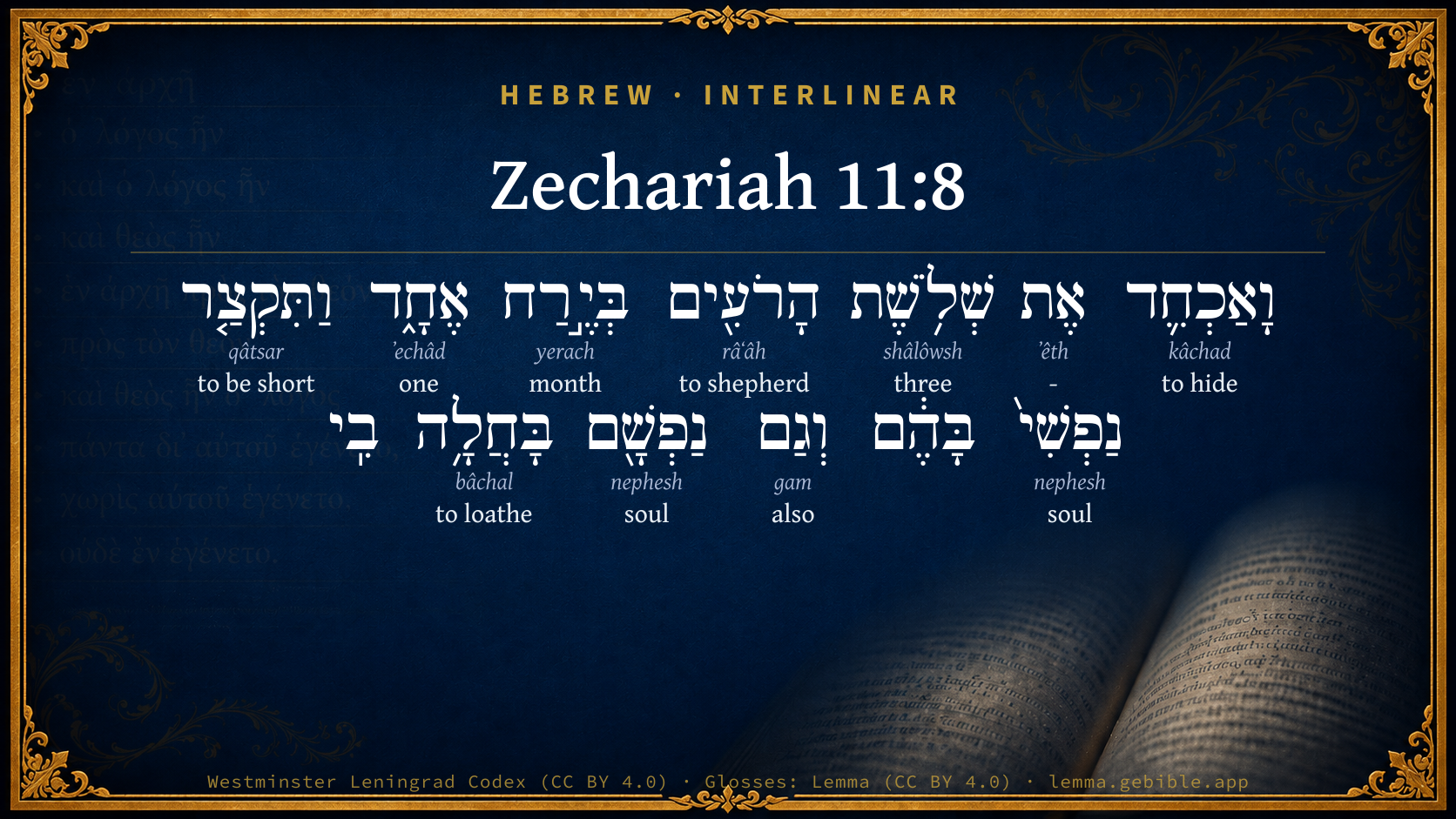
Hebrew (Westminster Leningrad Codex) Zechariah 11:8 appears in the Hebrew Old Testament. The text above is from the Westminster Leningrad Codex. Each word links to its Strong’s number, a concise gloss, and parsing drawn from the Open Scriptures Hebrew Bible morphology. Click any word for its full Brown-Driver-Briggs (BDB) entry.
Download image
Cite this verse

Zechariah 11:8 (World English Bible). Public Domain. Lemma interlinear Bible study tool, https://lemma.gebible.app/v/zechariah/11/8.

Show BibTeX & RIS
BibTeX
RIS
English Translation
I cut off the three shepherds in one month; for my soul was weary of them, and their soul also loathed me.
World English Bible · Public Domain
Download a study sheet

One document with this verse’s original text, its word-by-word gloss line, the meaning frame, cross-references with their text, attributed commentary, and full source and license credits — printable, and it pastes into notes with its structure intact.

This verse Autodidact and up

Study sheet (.html) Plain text (.txt)

A passage Seminary Student

Up to 50 verses in one chapter. A passage sheet keeps up to 6 commentary sources and 12 cross-references per verse, in the order this page ranks them, and says so on the sheet whenever that leaves anything out. Ask for a single verse and you get the Autodidact verse sheet above.

Everything on this page stays free to read, with no account — the sheet is a download of what is already on screen, not access to it.

Want to remove ads? Support Godless Engineer
Compare translations 3

The same verse in 3 English versions, stacked beneath the original-language interlinear above. Click any original word for its lexicon entry.

Each is an independent rendering of the whole verse — the interlinear is not word-aligned to these translations.

Highlighted words mark where these versions differ — a whole-verse word diff, not a word-by-word alignment.

  • World English Bible Public Domain
    I cut off the three shepherds in one month; for my soul was weary of them, and their soul also loathed me.
  • King James Version Public Domain
    Three shepherds also I cut off in one month; and my soul lothed them, and their soul also abhorred me.
  • unfoldingWord Literal Text CC BY-SA 4.0
    In one month I destroyed the three shepherds. I became impatient with them, and they also hated me.

unfoldingWord Literal Text — © unfoldingWord, licensed CC BY-SA 4.0. Word-aligned USFM3 via Door43 (git.door43.org/unfoldingWord/en_ult).

Versions to compare (up to 4)

3 of 4 selected

Show all 18 translations

Every available English version of this verse, each an independent rendering of the whole verse.

  • World English Bible Public Domain
    I cut off the three shepherds in one month; for my soul was weary of them, and their soul also loathed me.
  • Berean Standard Bible Public Domain
    And in one month I dismissed three shepherds. My soul grew impatient with the flock, and their souls also detested me.
  • Majority Standard Bible Public Domain
    And in one month I dismissed three shepherds. My soul grew impatient with the flock, and their souls also detested me.
  • King James Version Public Domain
    Three shepherds also I cut off in one month; and my soul lothed them, and their soul also abhorred me.
  • American Standard Version (1901) Public Domain
    And I cut off the three shepherds in one month; for my soul was weary of them, and their soul also loathed me.
  • Revised Version (1885) Public Domain
    And I cut off the three shepherds in one month; for my soul was weary of them, and their soul also loathed me.
  • Geneva Bible (1599) Public Domain
    Three shepherdes also I cut off in one moneth, and my soule lothed them, and their soule abhorred me.
  • Douay-Rheims (1899) Public Domain
    And I cut off three shepherds in one month, and my soul was straitened in their regard: for their soul also varied in my regard.
  • Young's Literal Translation Public Domain
    And I cut off the three shepherds in one month, and my soul is grieved with them, and also their soul hath abhorred me.
  • Literal Standard Version CC BY-SA 4.0
    And I cut off the three shepherds in one month, and my soul is grieved with them, and also their soul has abhorred me.
  • Unlocked Literal Bible CC BY-SA 4.0
    In one month I destroyed the three shepherds. I became impatient with them, and they also hated me.
  • unfoldingWord Literal Text CC BY-SA 4.0
    In one month I destroyed the three shepherds. I became impatient with them, and they also hated me.
  • Darby Bible Public Domain
    And I destroyed three shepherds in one month; and my soul was vexed with them, and their soul also loathed me.
  • World Messianic Bible Public Domain
    I cut off the three shepherds in one month; for my soul was weary of them, and their soul also loathed me.
  • Webster's Bible Public Domain
    Three shepherds also I cut off in one month; and my soul lothed them, and their soul also abhorred me.
  • Free Bible Version CC BY-SA 4.0
    In one month I dismissed three shepherds. I became impatient with them, and they also hated me.
  • Bible in Basic English Public Domain
    And in one month I put an end to the three keepers of the flock; for my soul was tired of them, and their souls were disgusted with me.
  • JPS Tanakh (1917) Public Domain
    And I cut off the three shepherds in one month; 'for My soul became impatient of them, and their soul also loathed Me.'

Literal Standard Version (2020), Covenant Press — licensed CC BY-SA 4.0. Text via the HelloAO Bible API (eBible.org). Unlocked Literal Bible (unfoldingWord) — licensed CC BY-SA 4.0. Text via the HelloAO Bible API (eBible.org). unfoldingWord Literal Text — © unfoldingWord, licensed CC BY-SA 4.0. Word-aligned USFM3 via Door43 (git.door43.org/unfoldingWord/en_ult). Free Bible Version, Dr. Jonathan Gallagher — licensed CC BY-SA 4.0. Text via the HelloAO Bible API (eBible.org).

Word by word

More ways to search: Search by grammar → Find every occurrence → Compare this word →

Practice this passage: Drill this verse → Learn its vocabulary →

בָּחֲלָ֥ה
bâchal
H973
“to loathe”
Verb, Qal, Perfect, 3rd Person, Feminine, Singular
Part of Speech
Verb
Stem
Qal
Form
Perfect
Person
3rd Person
Gender
Feminine
Number
Singular
Full BDB Definition

Origin: a primitive root

TWOT: 229

to loathe, abhor, feel loathing - (Qal) - to loathe - to gain by greed, gain hastily - (Pual) obtained by greed
  1. וָאַכְחִ֛ד kâchad H3582 “and · to hide” Conjunction + Verb, Hiphil, Sequential Imperfect, 1st Person, Common, Singular
  2. אֶת ʼêth H853 “-” Particle, Direct Object
  3. שְׁלֹ֥שֶׁת shâlôwsh H7969 “three” Adjective, Cardinal number, Masculine, Singular, Construct
  4. הָרֹעִ֖ים râʻâh H7462 “the · shepherding” Particle, Definite Article + Verb, Qal, Participle Active, Masculine, Plural, Absolute
  5. בְּיֶ֣רַח yerach H3391 “in/at · month” Preposition + Noun, Common, Masculine, Singular, Absolute
  6. אֶחָ֑ד ʼechâd H259 “one” Adjective, Cardinal number, Masculine, Singular, Absolute
  7. וַתִּקְצַ֤ר qâtsar H7114 “and · to be short” Conjunction + Verb, Qal, Sequential Imperfect, 3rd Person, Feminine, Singular
  8. נַפְשִׁי֙ nephesh H5315 “soul · my” Noun, Common, Both, Singular, Construct + Suffix, Personal, 1st Person, Common, Singular
  9. וְגַם gam H1571 “and · also” Conjunction + Particle, Accusative
  10. נַפְשָׁ֖ם nephesh H5315 “soul · their” Noun, Common, Both, Singular, Construct + Suffix, Personal, 3rd Person, Masculine, Plural

About this verse

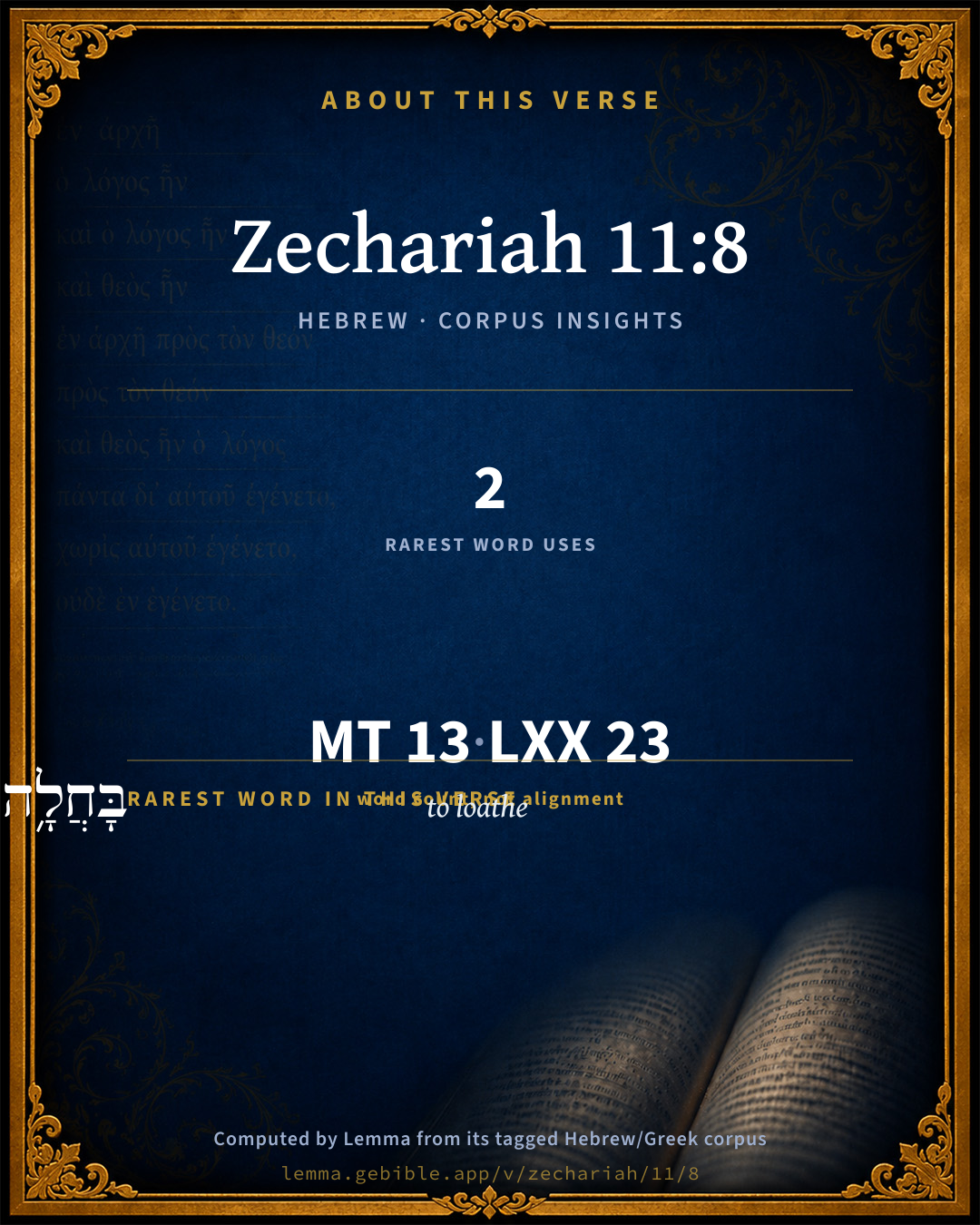
These counts appear in no published source. They are computed here, from the morphology-tagged text and Lemma’s own curated glosses. What Lemma adds →

13
words
10
distinct lemmas
Prophets
section

Notable vocabulary

The rarest word here is בָּחֲלָ֥ה to loathe H973 — appearing just 2 times in the whole Hebrew Bible.

Shared distinctive vocabulary

בָּחֲלָ֥ה to loathe H973 occurs in 2 verses of the Hebrew Bible. Also found in:

Grammatical profile

  • 4 verbs
  • 3 nouns
  • 2 adjectives
  • 2 prepositions
  • 2 particles

Verb forms

  • וָאַכְחִ֛ד Hiphil · Sequential Imperfect
  • הָרֹעִ֖ים Qal · Participle Active
  • וַתִּקְצַ֤ר Qal · Sequential Imperfect
  • בָּחֲלָ֥ה Qal · Perfect

Repetition

A word recurs within this verse — often emphatic in Hebrew:

  • נַפְשִׁי֙ soul H5315 ×2

Hebrew & Septuagint length

In English translation the verse runs 22 words from the Hebrew and 24 from the Septuagint (LXX English) — closely comparable.

A rough comparison of the two English renderings, which tokenize alike — not a word-level alignment.

Word counts can differ between the Hebrew and the Greek without any difference in meaning — e.g. the Hebrew direct-object marker אֵת has no separate Greek word, and Greek often adds the article ὁ.

In the original languages it is 13 Hebrew tokens and 23 Greek tokens — but the two are counted differently (Hebrew bundles its prefixes and suffixes into one token; the Greek is in lemma form), so that isn’t a like-for-like length.

Cross-references

20

Topical passages linked to Zechariah 11:8 in the Treasury of Scripture Knowledge — connected by theme and wording, ordered by reader-vote popularity; previews shown in the World English Bible.

  • John 7:7 The world can't hate you, but it hates me, because I testify about it, that its works are evil.
  • John 15:18 If the world hates you, you know that it has hated me before it hated you.
  • Isaiah 49:7 Thus says Yahweh, the Redeemer of Israel, [and] his Holy One, to him whom man despises, to him whom the nation abhors, to a servant of rulers: Kings shall see and arise; princes, and they shall worship; because of Yahweh who is faithful, [even] the Holy One of Israel, who has chosen you.
  • Matthew 23:34–36 Therefore, behold, I send to you prophets, wise men, and scribes. Some of them you will kill and crucify; and some of them you will scourge in your synagogues, and persecute from city to city;
  • Hosea 5:7 They are unfaithful to Yahweh; For they have borne illegitimate children. Now the new moon will devour them with their fields.
  • Luke 19:14 But his citizens hated him, and sent an envoy after him, saying, 'We don't want this man to reign over us.'
  • John 15:23–25 He who hates me, hates my Father also.
  • Leviticus 26:11 I will set my tent among you: and my soul won't abhor you.
  • Leviticus 26:30 I will destroy your high places, and cut down your incense altars, and cast your dead bodies upon the bodies of your idols; and my soul will abhor you.
  • Leviticus 26:44 Yet for all that, when they are in the land of their enemies, I will not reject them, neither will I abhor them, to destroy them utterly, and to break my covenant with them; for I am Yahweh their God;
  • Deuteronomy 32:19 Yahweh saw [it], and abhorred [them], Because of the provocation of his sons and his daughters.
  • Psalms 106:40 Therefore Yahweh burned with anger against his people. He abhorred his inheritance.
  • Jeremiah 12:8 My heritage is become to me as a lion in the forest: she has uttered her voice against me; therefore I have hated her.
  • Jeremiah 14:21 Do not abhor [us], for your name's sake; do not disgrace the throne of your glory: remember, don't break your covenant with us.
  • Hosea 9:15 "All their wickedness is in Gilgal; For there I hated them. Because of the wickedness of their deeds I will drive them out of my house! I will love them no more. All their princes are rebels.
  • Matthew 24:50–51 the lord of that servant will come in a day when he doesn't expect it, and in an hour when he doesn't know it,
  • Hebrews 10:38 But the righteous will live by faith. If he shrinks back, my soul has no pleasure in him."
  • Psalms 5:5 The arrogant shall not stand in your sight. You hate all workers of iniquity.
  • Psalms 78:9 The children of Ephraim, being armed and carrying bows, Turned back in the day of battle.
  • Luke 12:50 But I have a baptism to be baptized with, and how distressed I am until it is accomplished!

Cross-references courtesy of OpenBible.info (CC BY 4.0).

Hebrew and Greek witnesses Masoretic Hebrew ↔ Greek Septuagint

The same verse in the two great witnesses to the Old Testament, shown verse-for-verse.

These are two independent witnesses, not word-aligned to each other, and the Septuagint is shown in lemma (dictionary) form.

Hebrew Zechariah 11:8 Masoretic · Westminster Leningrad Codex

וָאַכְחִ֛ד אֶת שְׁלֹ֥שֶׁת הָרֹעִ֖ים בְּיֶ֣רַח אֶחָ֑ד וַתִּקְצַ֤ר נַפְשִׁי֙ בָּהֶ֔ם וְגַם נַפְשָׁ֖ם בָּחֲלָ֥ה בִֽי

I cut off the three shepherds in one month; for my soul was weary of them, and their soul also loathed me.

World English Bible · Public Domain

Greek LXX Zechariah 11:8 Septuagint · lemma form

καί ἐκαἴρω ὁ τρεῖς ποιμήν ἐν μήν εἷς καί βαρύνω ὁ ψυχή ἐγώ ἐπί αὐτός καί γάρ ὁ ψυχή αὐτός ἐπιὠρυόμαι ἐπί ἐγώ

And I will cut off three shepherds in one month; and my soul shall grieve over them, for their souls cried out against me.

LXX2012 (modern English Septuagint) · Public Domain

On this verse, Joseph Benson's Commentary discusses the Septuagint’s reading. Read the note in Commentary ↓

Hebrew: Westminster Leningrad Codex (CC BY 4.0). Greek: Septuagint (public domain); English from LXX2012 (modern English Septuagint) (Public Domain). How the Septuagint differs from the Hebrew →

Targum (Aramaic paraphrase)

1

The Targum is the ancient Jewish Aramaic paraphrase of the Hebrew Scriptures — an interpretive translation, not the Hebrew text itself. Onkelos (literal) and Pseudo-Jonathan (expansive) render the Torah, and Jonathan the Prophets. Coverage is partial: where no permissively-licensed English translation exists for a verse, only the Aramaic is shown. This is verse-level text, not a word-by-word alignment to the Hebrew.

  1. Targum Jonathan Prophets (Joshua–Malachi)
    וְשֵׁיצֵיתִי יַת תְּלָתָא פַּרְנָסַיָא בְּיַרְחָא חָד וְרָחֵיק מֵימְרִי יַתְהוֹן עַל דְנַפְשַׁתְהוֹן קָצַת בְּפוּלְחָנִי:

    (no public-domain English translation for this verse)

    Targum Jonathan — Aramaic: “Mikraot Gedolot” (public domain). English: “Sefaria Community Translation” (CC0 1.0 (public-domain dedication)); “London "Chaldee Paraphrase," 1871” (public domain). Text via Sefaria.

Commentary

Notes on Zechariah 11:8 from classic Christian and Jewish commentators (each source and its license shown beneath its notes). The classic Christian expositions comment on the surrounding passage and are grouped to its opening verse, so a note may address several verses; the Jewish commentaries on the Tanakh (Rashi and others) are per-verse, so they appear only where the commentator wrote on this verse.

Lemma curates 59 commentaries, every one of them public domain or Creative Commons licensed, each selected and text-cleaned for this edition rather than reprinted as found. About our sources →

Trapp's Complete Commentary

John Trapp

Zec 11:8 Three shepherds also I cut off in one month; and my soul lothed them, and their soul also abhorred me.

Ver. 8. Three shepherds also I cut off in one month] That is, in a short time I took away and displaced, even by the heathen princes, many proud princes and priests; such as were Menelaus, Jason, the Aristobuli, Hircani, Annas, Caiaphas, and others: or, I removed those three sorts of shepherds of the old law, viz. princes, prophets, and priests. Thus Theodoret and Vatablus. Diodati understands the text of the three chief empires that had tyrannized over the people, Zec 11:6; Zec 11:3; Zec 11:12; Zec 11:10. Namely, the Chaldean, Persian, and Grecian empire, which were destroyed by the Son of God, Dan 2:45. But they do best, in mine opinion, that by these three shepherds understand those three sects among the Jews at Christ’s coming in the flesh, viz. Pharisees, Sadducees, and Essenes; whereof, though the Pharisees were the best, and most exact for the outward observation of the law, yet are they in the Gospel, for their putid hypocrisy, first sharply taxed by our Saviour (after the Baptist), and then plainly rejected, and even sent to hell by a chain shot of eight links of woes, Mat 23:13-16; Mat 23:23; Mat 23:25; Mat 23:27; Mat 23:29

And my soul loathed them] Or, was taken off from them, or, was straitened for them; because I saw that they received my grace in vain, and considered not my care for their good. Theodotion and Symmachus render it, Anima mea exanimata est, I am dispirited, as it were, and even disheartened to do any more for them.

And their soul also abhorred me] And so they became God haters (θεοστυγεις), as Rom 1:30, and therefore hateful to God (στυγητοι), Tit 3:3, hateful as hell (so the word imports), yea, more and worse, for hell is but an effect of God’s justice, but wickedness is a breach of his law. The prophet here seemeth to allude to those murmurers in the wilderness, that disdainfully cried out, Our soul loatheth this light bread, Num 21:5. Let God’s servants take heed how they hang loose toward him; and lest, by disuse and discontinuance of a duty, there grow upon them an alienation of affection, a secret disrelishing and nauseating at that which we ought most deeply to affect and duly to perform. Surely, as loathing of meat and difficulty of breathing are two symptoms of a sick body, so are carelessness of hearing and irksomeness of praying two sure signs of a sick soul.

John Trapp, A Commentary or Exposition upon All the Books of the Old and New Testament (1647–1656) — public domain. Text from a community e-Sword module.

The Biblical Illustrator

Joseph S. Exell

Zec_11:8

My soul lothed them, and their soul also abhorred Me

A mutual dislike between God and man

I.

This mutual moral antagonism is manifestly abnormal. It is not conceivable that the all-wise and all-loving Maker of the universe would create beings whom He would loathe and who would abhor Him. Such an idea is opposed at once to our intuitions and our conclusions. In the pristine state of humanity, God loved man, and man loved God.

II. This mutual moral antagonism implies wrong on mans part. For Infinite Purity and Righteousness to loathe the corrupt and the wrong is not only right, but a necessity of the Divine character. He abhorreth sin; it is the abominable thing which He hates. This is His glory. But for man to abhor Him, this is the great sin, the fontal sin, the source of all other sins.

III. This mutual moral antagonism explains the sin and wretchedness of the world. Why does the world abound with falsehoods, dishonesties and oppressions, unchastities, cruelties, and impieties? Because human souls are not in supreme sympathy with the supremely good, because they are at enmity with God, because God loathes sin.

IV. This mutual moral antagonism argues the necessity for a reconciliation. The great want of the world is the reconciliation of man to the character and the friendship of God. Such a reconciliation requires no change on Gods part. His loathing is the loathing of love, love loathing the wrong and the miserable. The change must be on mans part. God was in Christ reconciling the world unto Himself. (Homilist.)

Divine rejection

A time comes in the history of incorrigible nations and incorrigible individuals when they are rejected of heaven.

I. The cause of this lamentable event. My soul loatheth them.

II. The result. The results here are threefold.

1. The cessation of Divine mercy. I will not feed you.

2. Abandonment to self-ruin. That that dieth, let it die; and that that is to be cut off, let it be cut off. The wages of sin is death. Sin, when it is finished, bringeth forth death.

3. Deliverance to mutual tormentors. And let the rest eat everyone the flesh of another. All these results were realised in a material sense in the rejection of the Jewish people. Josephus tells us that in the destruction of Jerusalem, pestilence, famine, and intestine discord ran riot amongst the God-rejected people. These material evils are but faint emblems of the spiritual evils that must be realised by every God-rejected soul.

III. The sign. And I took My staff, even Beauty, and cut it asunder, that I might break My convenant which I had made with all the people. The Divine Shepherd is represented as having two staves, or crooks; ordinary shepherds have only one. Expositors in their interpretation of these staves differ here as in most places elsewhere in this book. Some say they indicate the double care that the Divine Shepherd takes of his people; some, the different methods of treatment pursued by the Almighty Shepherd towards His people; some, that they refer to the house of of Judah and to the house of Israel, indicating that neither was to be left out in the mission of the work of the Good Shepherd; and some, that the one called Beauty--which means grace--represents the merciful dispensation, under which the Hebrew people had been placed; and the other staff called Bands, the brotherhood between Judah and Israel. One thing seems clear, that the cutting of the staff called Beauty asunder was a symbol of their rejection from all future grace and mercy. It may be stated as a general truth, that all heaven-rejected souls have signs of their miserable condition. What are the general signs?

1. Practical ignorance of God.

2. Utter subjection to the senses.

3. Complete devotion to selfish aims.

4. Insensibility of conscience. (Homilist.)

Abhorring the name of God

For the last ten years I (Gambetta) have made a pledge with myself to entirely avoid introducing the name of God into any speech of mine. You can hardly believe how difficult it has been, but I have succeeded, thank God! (Dieu merci!) Thus the name so sternly tabooed rose unconsciously to his lips at the very moment when he was congratulating himself on having overcome the habit of using it. (E. D. Pressense.)

The Biblical Illustrator, edited by Joseph S. Exell (c. 1880s–1900s) — public domain. Text from a community e-Sword module.

Joseph Benson's Commentary

Zec 11:8. Three shepherds also I cut off in one month — The prophet may be said to do what God did; either in the punishment of certain false prophets, or of certain wicked governors. Some think, that by these three shepherds were figuratively signified the chief priests, scribes, and elders of the Jews. Christ exposed these as blind guides, and thereby lessened their authority among the people, which contributed very much to the spreading of the gospel. Blayney, who thinks the common translation encumbered with insuperable difficulties, renders the clause, and I set aside the authority of the shepherds in one month. His reasons for this interpretation have certainly considerable weight, but cannot with propriety be introduced here. One argument, however, in favour of it, to which he appeals, may be noticed. It evidently suits that application of the prophecy which most commentators adopt. “Let us now see,” says he, “what happened to him, of whom Zechariah is evidently set forth as the type. Our Saviour’s teaching was in a style so far superior to that of the professed guides of the people in his days, that, stung with jealousy, they exclaimed, Perceive ye how ye prevail nothing? Ye have lost all your wonted influence; behold the world is gone after him, Joh 12:19. Even so it may be presumed the purity and disinterestedness of Zechariah’s instructions may have gained so far upon the minds of the people as to deprive the corrupt and selfish teachers of that ascendency which they once possessed.” And my soul loathed them — Or, was straitened toward them, as the Hebrew, תקצר בהם, may be literally translated, that is, I was straitened in my affections to them. I was less tender toward them than toward the poor of the flock, because they showed themselves to be averse from my person and doctrine. So the Vulgate, contracta est anima mea in eis. The LXX., however, read, βαρυνθησεται η ψυχη μου, my soul shall be burdened; and Bishop Newcome, my soul was grieved at them. The word בחלה, rendered abhorred, in the next clause, does not occur elsewhere in the Scriptures, but, according to Bishop Newcome, bears that sense in the Syriac. The LXX. render it, αι ψυκαι αυτων επωρυοντο επ’ εμε, Their souls howled, bellowed, roared, or, raised a horrible outcry against me, an expression strikingly descriptive of the fierce and vehement accusations of the Jewish chief priests, scribes, and elders against Christ, and of the violent, loud, and oft-repeated clamours of the people for his condemnation and crucifixion. Of which see Luk 23:5; Luk 23:10; Luk 23:18-24.

Joseph Benson's Commentary on the Old and New Testaments (1811–1818) — public domain. Text from a community e-Sword module.

Whedon's Commentary on the Bible

Daniel D. Whedon

8. In the carrying out of his commission the shepherd met opposition, but he overcame it.

Three shepherds… I cut off — R.V., “the three shepherds.” Who are these shepherds? Are they foreigners or native rulers? If native rulers, who are they? The shepherds of Zec_10:3, are foreign oppressors, but the shepherds of Zec_11:5, are native rulers; since the latter is in the more immediate context it seems best to take the three shepherds of this verse to be native rulers. The defenders of the pre-exilic date see here a reference to the assassination of the successors of Jeroboam II, Zechariah, Shallum, and a “third pretender” (2Ki_15:13-15). On the other hand, those who favor a late postexilic date think of the frequent changes in the high-priestly office during the years immediately preceding the Maccabean uprising. Marti thinks of Lysimachus, who was killed by a mob about 171 B.C. (2Ma_4:22); Jason, who was driven from the office in 170 and found an ignominious end in exile (2Ma_5:10); and Menelaus, who became high priest again in 170 and lost his office in 168, when the Jehovah cult was temporarily discontinued in the temple, and who died a violent death in Beroea in Syria in 163 (2Ma_13:3-8). Reference has been made to the difficulty involved in assigning the prophecy to so late a date (p. 589); certainty seems impossible.

In one month — Not to be understood literally. It is equivalent to in a short space of time. At any rate, we know of no crisis in Jewish history when three rulers, either foreign or native, either kings or high-priests, were cut off during one month.

8b might be interpreted as supplying the reason why the good shepherd cut off the three shepherds. If so, the transition from Zec_11:8 to Zec_11:9 would be very abrupt; hence it seems better to make a full stop after “in one month” and connect 8b with Zec_11:9. With great zeal the shepherd entered upon his task, but the flock failed to appreciate his efforts.

And — R.V., “for”; better, but.

My soul loathed them — R.V., “was weary of them.” The shepherd grew weary of the unappreciative flock; to it refers the pronoun them and not to the shepherds.

Their soul also abhorred me — R.V., “loathed.” The flock came to dislike the shepherd’s strict control.

Daniel D. Whedon (gen. ed.), Commentary on the Old and New Testaments (1874–1909) — public domain. Text from a community e-Sword module.

Tyndale Open Study Notes

Tyndale Open Resources

11:8 The enigmatic historical reference to three evil shepherds has prompted more than forty different attempts to identify them. None of these explanations is effective. Three symbolizes completeness. God raises up good shepherds to remove evil shepherds for the well-being of his people.

Tyndale Open Study Notes — © Tyndale Open Resources, licensed CC BY-SA 4.0. Text via the HelloAO Bible API.

Geneva Bible (1599)

Geneva Bible translators

Whereby he showeth his care and diligence that he would suffer them to have no evil rulers, because they should consider his great love.

Meaning, the people, because they would not acknowledge these great benefits of God.

Geneva Bible (1599) marginal notes — public domain. Text via Bolls.life.

Jamieson, Fausset & Brown

Robert Jamieson, A. R. Fausset & David Brown

Three shepherds . . . I cut off--literally, "to cause to disappear," to destroy so as not to leave a vestige of them. The three shepherds whom Messiah removes are John, Simon, and Eleazar, three leaders of factions in the Jewish war [DRUSIUS]. Or, as Messiah, the Antitype, was at once prophet, priest, and king, so He by the destruction of the Jewish polity destroyed these three orders for the unbelief of both the rulers and people [MOORE]. If they had accepted Messiah, they would have had all three combined in Him, and would have been themselves spiritually prophets, priests, and kings to God. Refusing Him, they lost all three, in every sense.

one month--a brief and fixed space of time (Hos 5:7). Probably alluding to the last period of the siege of Jerusalem, when all authority within the city was at an end [HENDERSON].

loathed them--literally, "was straitened" as to them; instead of being enlarged towards them in love (Co2 6:11-12). The same Hebrew as in Num 21:4, Margin. No room was left by them for the grace of God, as His favors were rejected [CALVIN]. The mutual distaste that existed between the holy Messiah and the guilty Jews is implied.

Jamieson, Fausset & Brown — Commentary Critical and Explanatory on the Whole Bible (1871) — public domain (CC PDM 1.0). Text via the HelloAO Bible API.

Adam Clarke's Commentary

Verse 8. Three shepherds also I cut off in one month] Taking this literally, some think the three shepherds mean the three Maccabees, Judas, Jonathan, and Simon; others, the three wicked high priests, Jason, Alcimus, and Menelaus; others, the three last princes of the Asmonean race, Alexander, Hyrcanus, and Antigonus.

Perhaps three orders may be intended:

1. The priesthood.

2. The dictatorship, including the Scribes, Pharisees, &c.

3. The magistracy, the great sanhedrin, and the smaller councils.

These were all annihilated by the Roman conquest.

Adam Clarke's Commentary on the Bible (1810–1826) — public domain. Text from a community e-Sword/MySword module.

John Calvin's Commentaries

At the beginning of the verse the Prophet continues the same subject, that God spared no pains in ruling the people, but patiently bore with many grievances; for it is the duty of every good and careful husband man to inspect often his flock, and to change his shepherd, when he finds him idle and inattentive to his duties. God then shows that he had exercised the greatest vigilance, for in one month he had rejected three shepherds, that is, he had within a short space of time often made choice of new shepherds, and substituted them for others, for one month is to be taken here for a short time, and the three shepherds signify many, indefinitely. When a husband man neglects his own flock, he may be deceived all the year round, should he meet with a thief or an inactive and worthless man. Since then God says, that he had changed his shepherds often in one month, he intimates what I have already said, that he took the greatest care of his flock, for he loved it, and omitted nothing necessary to defend it. And this circumstance especially aggravated the sin of the Jews, for they did not respond to so great a care on God’s part; no, not when they saw that he watched night and day for their safety.

Now the latter part of the verse is a complaint, for God begins to set forth how base had been the wickedness and ingratitude of the people, With weariness, he says, has my soul been affected by them, and their soul has hated me He speaks not now of the shepherds, and they are mistaken who so read the passage, as though God had repudiated the shepherds, because his soul w as wearied with them: on the contrary, he turns his discourse to the whole people, and begins to show how wicked they had been, who having been favored with so many benefits, could not yet endure the best of shepherds. Hence he says, that his soul had been straitened by them, for he found no room made for his favors. Paul also, treating on this subject, expostulates with the Corinthians, and says, that he was ready to pour forth his heart and to open widely his mouth, but they themselves were straitened, and he felt himself these straitenings in his own heart. (2 Corinthians 6:11.) So also God complains here and says, that he was straitened by the Jews; for he found that his blessings were not rightly received, but as it were hindered, so great was the wickedness of the people.

He expresses more clearly at the end that he was despised by them, They also have hated me. Now it was a contempt in no way excusable, when the Jews would not acknowledge how kindly and bountifully God had treated them. We now perceive the Prophet’s design: after having related how kindly God had condescended to rule the people, he now says that this labor had produced no fruit, for the door for God’s favors had been closed up. It afterwards follows-

John Calvin's Commentaries (1540-1563) — public domain. Text from the Calvin Translation Society English edition (1840s-50s) via the Christian Classics Ethereal Library (ccel.org). Calvin's coverage is partial (roughly two-thirds of the Bible); uncommented books and verses are honest gaps, never fabricated. The 19th-century editor's footnotes and remarks are omitted so the notes are faithfully Calvin's own voice.

Ellicott's Commentary for English Readers

(8) The effect of the prophet’s (i.e., God’s) feeding the flock is that He “cut off three shepherds in one month.” As in Ezekiel and Daniel (Eze_4:4-6; Dan_9:24-27, &c.), the space of time mentioned here seems to be symbolical; and taking a day for a year, one month will mean about thirty years. Some take “one month” to mean “a short time.” This interpretation will also agree with our view of the case. Some, again, take each day to represent seven years—so that thirty days would be two hundred and ten years—and explain the three shepherds as the Babylonian, Medo-Persian, and Macedonian Empires, which lasted two hundred and fifteen years, from the captivity to Babylon up to the death of Alexander the Great. But no instance can be cited in which a prophetic day is equivalent to seven years. “The three shepherds” may be, then (according to the view which we have adopted with regard to the expression “one month”), the Syro-Grecian kings (B.C. 172-141)—Antiochus Epiphanes (who died miserably in Persia), Antiochus Eupator (put to death by Demetrius I.), and Demetrius I. (overthrown by Alexander Balus). As specimens of attempts to find for the passage an historical reference, taking the expression “one month” literally, the following may be cited:—Cyril considers that kings, priests, and prophets are meant; and Pusey, “priests, judges, and lawyers,” who, having “delivered to the cross the Saviour, were all taken away in one month, Nisan, A.D. 33.” But the rejection of the good shepherd is spoken of by the prophet as posterior to the cutting off of the shepherds. Maurer would interpret the three shepherds of Zechariah (son of Jeroboam II.), his murderer, Shallum, who reigned but a month, and of a third unknown usurper, whose downfall speedily took place. But Shallum was certainly murdered by Menahem (2Ki_15:10-14), and there is no room for a third unknown usurper. Hitzig would avoid the difficulty by rendering “I removed the three shepherds which were in one month” (in support of which construction he refers, and rightly, to such passages as Exo_34:31; Isa_23:17; Eze_26:20), and takes them to be the kings Zechariah, Shallum, and Menahem, who in about the space of one month sat upon the throne of Israel. But the difficulty is really not so obviated. Shallum reigned actually “a month of days” (2Ki_15:13), and the events referred to occupied much longer.

Them.—The sheep, not the shepherds. In spite of what He did for them, they abhorred Him. Though, at first sight, it would seem more natural to refer the pronoun to “the shepherds,” we are precluded from so doing by the consideration that the fact that God loathed the shepherds, and they abhorred Him—shepherds whom He had cut off for the good of His flock—would be no reason for His refusing any more to feed the flock (Zec_11:9); whereas the flock’s disregard of all His loving-kindness towards them would afford good cause for His so doing.

A Bible Commentary for English Readers, edited by Charles John Ellicott (1878–1897) — public domain. Text from a community e-Sword module.

The Cambridge Bible for Schools and Colleges

gen. ed. J. J. S. Perowne

8. Three shepherds … in one month] This has been understood to refer either to three historical persons, e.g. Zachariah, Shallum (2Ki_15:8; 2Ki_15:13) and some third usurper, not mentioned in the history, of the same time, or Antiochus Epiphanes, Antiochus Eupator and Demetrius I., in the time of the Maccabees (though it is difficult to believe that these could have been called shepherds of Israel); or else to the three offices of king, priest and prophet. But all these references break down, and it is better to take the words generally, as describing the prompt and vigorous action of Jehovah’s shepherd in dealing with the evil shepherds (Zec_10:3), as well as in feeding the flock. “Mensis unus hic capitur pro exiguo tempore: tres autem pastores significant multos indefinite.” Calv.

and my soul lothed them] or, but, &c.: for, R. V. At this point the prophet begins to describe the failure of his good offices towards the flock, and the mutual antipathy that sprang up between him and them.

The Cambridge Bible for Schools and Colleges (gen. ed. J. J. S. Perowne; Cambridge University Press, 1878–1918) — public domain. Text from a community e-Sword module.

John Gill's Exposition

Three shepherds also I cut off in one month,.... Not Moses, Aaron, and Miriam, as is suggested in the Talmud (e); nor David, Adonijah, and Joab, who died in the space of a month; nor the three kings, Jehoash, Jehoiakim, and Zedekiah, who died by the hand of their enemies in a very little time; which is the sense of some, as Abendana observes; nor the three last prophets, Haggai, Zechariah, and Malachi, according to Aben Ezra; nor the three Maccabees, Judas, Jonathan, and Simon, as Abarbinel; rather the three sects among the Jews, the Pharisees, Sadducees, and Essenes, instead of which last some put the Herodians; and others the Scribes; though some are of opinion that the three sanhedrim or courts of judicature among the Jews are designed; but it seems best of all to interpret them of the three orders of magistrates among them, princes, prophets, and priests; and the "cutting" them "off" may denote the cessation of civil government, the sealing up of vision and prophecy, and the putting an end to sacrifice; which is much better than to interpret them of the three Roman emperors who succeeded Nero; that is, Galba, Otho, and Vitellius, who were put to death by their own subjects, within the space of a year and some days (f); and which is a term of time that can not well be thought to be expressed by a month; which either signifies in general a small space of time; or, if a certain month is meant, either it designs the month Nisan, in which Christ suffered, when of right sacrifice should have ceased, as well as then prophecy was sealed up, and there was no more of it among the Jews, nor any civil government in their hands: or else the month Ab, in which the city of Jerusalem was burnt; and so an end was put in fact to all the above offices there. It may be that a month of years is intended, as in Rev 11:2 and so Abarbinel here interprets it; though he applies it to the times of the Maccabees; but it may respect the thirty years, or thereabout, which were between the death of Christ and the destruction of Jerusalem, within which compass of time the above events were actually and manifestly fulfilled:

and my soul loathed them; because they did not perform the duties of their office; the civil magistrate did not govern according to the laws of God; the prophets did not teach sound doctrine; and the priests did not do their service aright, nor teach the people the use and end of sacrifices, and in them direct to the Messiah, as they should have done: wherefore Christ expressed his dislike of them by words in his ministry, particularly in Matthew chapter twenty three, Mat 23:1 and by deeds, causing vengeance to come upon them to the entire removal of them: or, "my soul was shortened", or "contracted in them", or "towards them" (g); his affections were lessened towards them; he loathed their ways and works, which were not good; and he rejected and cast them off as his people, and wrote a "loammi" on them; took away his Gospel from them, and abolished their civil and church state:

and their soul also abhorred me; which is the reason of the former; and so the Targum paraphrases it,

"and my Word cast them away, because their soul abhorred my worship;''

all ranks and orders of men among the Jews had Christ in abhorrence; they abhorred his person, his name, his miracles, his doctrines, his ordinances, and his people; this they did because of his mean appearance; and because of his inveighing against their traditions, superstitions, and immoralities; and this appeared by their contemptuous rejection of him as the Messiah; by their crucifixion of him; and by persecuting his disciples and followers.

(e) T. Bab. Taanith, fol. 9. 1. (f) Calmet's Dictionary, in the word "Shepherds". (g) "et abbreviata est anima mea in eis", Montanus, Cocceius, Burkius; "coarctata est", Calvin; "contractabatur, vel contrahetsese", Vatablus; "contracta est", Drusius, Grotius.

John Gill's Exposition of the Whole Bible (1746–1763) — public domain (CC PDM 1.0). Text via the HelloAO Bible API.

Albert Barnes' Notes on the Bible

And I cut off three shepherds in one month - Jerome: “I have read in some one’s commentary, that the shepherds, cut off in the indignation of the Lord, are to be understood of priests and false prophets and kings of the Jews, who, after the passion of Christ, were all cut off in one time, of whom Jeremiah speaketh, “The priests said not, Where is the Lord? and they that handle the law knew Me not; the pastors also transgressed against Me, and the prophets prophesied by Baal, and walked after things which do not profit” Jer 2:8, and again, “As the thief is ashamed when he is found, so is the house of Israel ashamed; they, their kings, their princes, and their priests and their prophets” Jer 2:26; and “they said, Come, let us devise devices against Jeremiah; for the law shall not perish from the priest, nor counsel from the wise, nor the word from the prophet” Jer 18:18.

Theodoret: “He speaks of the kings of the Jews, and prophets and priests; for by the three orders they were shepherded.” Cyril: “The true and good Shepherd having been already pointed out, it was right and necessary that the hirelings and false shepherds should be removed, the guides of the Jews in the law. The three shepherds were, I deem, those who exercised the legal priesthood, and those appointed judges of the people, and the interpreters of Scripture, that is, the lawyers. For these too fed Israel. Those who had the glory of the priesthood were of the tribe of Levi only; and of them Malachi says, “The priest’s lips shall keep knowledge, and they shall seek the law at his mouth” Mal 2:7. But those who received authority to judge were also selected, yet were appointed out of every tribe. In like way the lawyers, who were ever assessors to the judges, and adduced the words of the law in proof of every matter.

But we shall find that our Lord Jesus Christ Himself expressly pronounced woe on the Pharisees and scribes and lawyers. For He said, “Woe unto you scribes and Pharisees” Luk 11:44. And when one of the lawyers hereupon answered Him saying, “Master, so saying Thou reproachest us also,” He said, “Woe unto you also, ye lawyers! for ye lade men with burdens grievous to be borne, and ye yourselves touch not the burdens with one of your fingers” Luk 11:45-46. These “three Shepherds” then, priests and judges and lawyers o, who remained in their own orders and places, until the coming of Christ, were very justly taken away “in one month.” For since “they killed the Prince of life” Act 3:15, thereby also are they mown down, and that in the month of the first fruits, in which Emmanuel endured to be slain for us. They remained indeed administering Israel, even after the Saviour’s Cross, through the long-suffering and compassion of Almighty God calling them to repentance; but, in the sentence passed by God, they were taken away, at that time, when they delivered to the Cross the Saviour and Redeemer of all. They were taken away then in one mouth;” Nisan. a.d. 33. The three offices, King, Divine Teacher, Priest, were to be united in Christ: they might have been held under Him: those who rejected them in Him, forfeited them themselves. These then He made to disappear, effaced them from the earth.

And My soul was straightened - For them o. It is used of the divine grief at the misery of His people. “And their soul abhorred Me, nauseated Me” o. Kimchi: “When it is said, “Their soul also abhorreth Me,” the meaning is, ‘My soul did not loathe them first, but their soul first despised Me, therefore My Soul abhorred them.’” The soul which drives away God’s good Spirit, comes at last to loathe Him and the thought and mention of Him.

Albert Barnes' Notes on the Bible (1834–1885) — public domain. Text from a community e-Sword/MySword module.

Haydock's Catholic Bible Commentary

Month. That is, in a very short time. By these three shepherds probably are meant the latter princes and high priests of the Jews, whose reign was short. (Challoner) --- Ismael, Joseph, and Ananus, all obtained the dignity in one year; and as they and their predecessors were actuated by avarice, they could not fail being displeasing to God. Galba, Otho, and Vitellius were likewise cut off in little more than a year, when Vespasian succeeded, and his son took Jerusalem. (Calmet) --- The Jews pretend that Moses, Aaron, and Mary[Miriam] are here meant. (St. Jerome) --- But what reference can the prophet have to them?

George Leo Haydock (1774–1849), Haydock's Catholic Family Bible and Commentary, 1859 edition — public domain. Excludes Psalms (Douay-Rheims chapter numbering differs from Protestant) and Deuterocanonical books (Catholic canon only).

Matthew Poole's English Annotations

Three, put for many, a definite for an indefinite number.

Shepherds, negligent or greatly faulty.

I cut off; put out of office, or, by discovering their faults, made them lie hid and conceal themselves. In one month; in a little time.

My soul loathed them; hated their treachery and idleness.

Their soul also abhorred me: disgraced and turned out, they hated him; in which these shepherds had too many of the Jews that sided with them, and that bore a hatred to the true Shepherd and to his impartial executing severity on the wicked shepherds.

Matthew Poole's English Annotations on the Holy Bible (1683–1685) — public domain. Text from a community e-Sword/MySword module.

The Pulpit Commentary

In executing the office of feeding the flock, three shepherds also I out off in one month; Septuagint, "And I will take away the three shepherds in one month." The article in the Hebrew and Greek seems to point to some known shepherds, three in number, unless we take it as "threes of the shepherds." Hence expositors have sought to find historical personages to whom the term might apply. Those who assort a pre-exilian origin for this part of the prophecy, suggest the three kings, Zachariah, Shallum, and Menahem; or, as Menahem reigned ten years, some unrecorded pretender, who started up at the time. Others see some Syrian monarchs in Maccabean times; or the three offices, king, prophet, priest; or the three dynasties that oppressed Israel, viz. the Babylonian, Medo-Persian, and Macedonian. All these interpretations fail in some point; and we are reduced to see herein a reference, as Cheyne says, to "the prompt and vigorous action of Jehovah"s Shepherd in dealing with the evil shepherds, as well as in feeding the flock;" the number three being used indefinitely. Or we may find in this number an allusion to the three classes in ver. 5 the buyers, the sellers, and the pitiless shepherds. The oppressors, external and internal, are removed and cut off in one month. To the prophet"s eye all this seemed to take place in that short space of time. If anything more is intended, we may, with Keil and others, taking the month as consisting of thirty days, assume that ton days are assigned to the destruction of each shepherd, after each had fulfilled his allotted period the number ten expressing perfection or completion. And my soul loathed them; literally, but my soul was straitened for them; i.e. was impatient, weary of them. These words begin a new paragraph, and refer, not to the three shepherds, but to the sheep, the Israelites. The prophet now shows how ill the people had responded to God"s manifold care, and mingles with the past a view of their future ingratitude and disobedience which will bring upon them final ruin. God, as it were, was weary of their continual backslidings and obstinate perseverance in evil. (For the phrase, see Num_21:4 Jud_1:16:16 Job_21:4) It is the opposite to long suffering. Their soul also abhorred me. They showed their abhorrence by their devotion to idols and their disinclination for all goodness.

A mutual dislike between God and man.

"My soul loathed them, and their soul also abhorred me." It would be idle to attempt to ascertain who are intended by the "three shepherds" that were "cut off in one month," and who are here represented as abhorring God and "loathed" by him. In running through the various conflicting explanations, as given by biblical critics, we feel such a task would be utterly hopeless and a waste of time. We take the words in order to illustrate a mutual dislike between God and man. That such a mutual dislike exists is proved by the moral history of the world, the consciousness of individuals, and the testimony of the inspired Word. Between God and man there is a mutual moral antagonism. We offer four general remarks on this subject.

I THIS MUTUAL MORAL ANTAGONISM IS MANIFESTLY ABNORMAL. It is not conceivable that the all-wise and all-loving Maker of the universe would create beings whom he would loathe and who would abhor him. Such an idea is opposed at once to our intuitions and our conclusions. The Bible assures us, in language most explicit and in utterances most frequent, that mutual love, similar to that which exists between the most affectionate parents and their children, was that which existed in the pristine state of humanity. God loved man, and man loved God.

II THIS MUTUAL MORAL ANTAGONISM IMPLIES WRONG ON MAN"S PART. For Infinite Purity and Righteousness to loathe the corrupt and the wrong is not only right, but a necessity of the Divine character. He abhorreth sin; it is the "abominable thing" which he hates. This is his glory. But for man to abhor him, this is the great sin, the fontal sin, the source of all other sins. To abhor the infinitely Loving and Lovable is, indeed, a moral enormity. They "hated me without a cause.

III THIS MUTUAL MORAL ANTAGONISM EXPLAINS THE SIN AND WRETCHEDNESS OF THE WORLD. Why does the world abound with falsehoods, dishonesties, and oppressions, unchastities, cruelties, and impieties? Because human souls are not in supreme sympathy with the supremely Good, because they are at enmity with God, and not "subject to the Law of God." And why all the miseries of humanity? Because God loathes sin.

IV THIS MUTUAL MORAL ANTAGONISM ARGUES THE NECESSITY FOR A RECONCILIATION. The great want of the world is the reconciliation of man to the character and the friendship of God. Such a reconciliation requires no change on God"s part. His loathing is the loathing of love love loathing the wrong and the self made miserable. The change must be on man"s part. "God was in Christ reconciling the world unto himself." Christ is the Atonement, the Reconciliation. D.T.

Vers. 8-11. Divine rejection.

"My soul loathed them, and their soul also abhorred me. Then said I, I will not feed you: that that dieth, let it die; and that that is to be cut off, let it be cut off; and let the rest eat every one the flesh of another. And I took my staff, even Beauty, and cut it asunder, that I might break my covenant which I had made with all the people." The subject of these words is Divine rejection. A time comes in the history of incorrigible nations and incorrigible individuals when they are rejected of Heaven. David said to Solomon, "And thou, Solomon my son, know thou the God of thy father, and serve him with a perfect heart and with a willing mind; fur the Lord searcheth all hearts, and understandeth all the imaginations of the thoughts. If thou seek him, he will be found of thee; but if thou forsake him, he will cast thee off forever". (1Ch_28:9) The text gives us the cause, the result, and the sign of this lamentable event.

I THE CAUSE. "My soul loathed them, and their soul also abhorred me." A mutual moral antagonism (as we have seen) between man and God. "Can two walk together except they be agreed?" The sinners" character becomes so repugnant to the Almighty that his patience is exhausted, and their rejection is the result. "My Spirit shall not always strive with man;" "Ephraim is joined to his idols: let him alone." There is a limit to the Divine forbearance. "How often would I have gathered thy children together, even as a hen gathereth her chickens under her wings, and ye would not!" "Depart from me, I never knew you;" "Because I have called, and ye refused; I have stretched out my hand, and no man regarded; ... I also will laugh at your calamity; I will mock when your fear cometh.

II THE RESULT. The results here are threefold.

1. The cessation of Divine mercy. "I will not feed you." You are no longer my sheep; no longer will I minister to your needs.

2. Abandonment to self-ruin. "That that dieth, let it die; and that that is to be cut off, let it be cut off." "The wages of sin is death;" "Sin, when it is finished, bringeth forth death." Let the elements of moral destruction do their work.

3. Deliverance to mutual tormentors. "And let the rest eat every one the flesh of another." All these results were realized in a material sense in the rejection of the Jewish nation. Josephus tells us that in the destruction of Jerusalem pestilence, famine, and intestine discord ran riot amongst the God-rejected people. These material evils are but faint emblems of the spiritual evils that must be realized by every God-rejected soul.

III THE SIGN. "And I took my staff, even Beauty, and cut it asunder, that I might break my covenant which I had made with all the people." The Divine Shepherd is represented as having two staves, or crooks; ordinary shepherds have only one. Expositors, in their interpretation of these staves, differ here as in many places elsewhere in this book. Some say they indicate the double care that the Divine Shepherd takes of his people; some; the different methods of treatment pursued by the Almighty Shepherd towards his people; some, that they refer to the house of Judah and to the house of Israel, indicating that neither was to be left out in the mission of the work of the good Shepherd; and some that the one called "Beauty which means grace represents the merciful dispensation under which the Hebrew people had been placed; and the other staff, called "Bands," the brotherhood between Judah and Israel. One thing seems clear, that the cutting of the staff called "Beauty" asunder was a symbol of their rejection from all future grace and mercy. It may be stated, as a general truth, that all Heaven-rejected souls have signs of their miserable condition. The sign of Samson was loss of strength; "he wist not that the Lord was departed from him," until his strength was put to the test and he failed. What are the general signs?

1. Practical ignorance of God.

2. Utter subjection to the senses.

3. Complete devotion to selfish aims.

4. Insensibility of conscience.

CONCLUSION. Let us not trifle with the patience of God, lest he cast us off forever; but rather let us earnestly and perseveringly cultivate a stronger and more vital sympathy with him, and a closer identification with his loving heart and benevolent aims. D.T.

The Pulpit Commentary (1880–1919), ed. H.D.M. Spence-Jones & Joseph S. Exell — public domain. Text from a community e-Sword module.

Rashi

Rabbi Shlomo Yitzchaki (Rashi)

I cut off the three shepherds in one month They corrupted their ways until I rejected them, and I slew all three shepherds in one month. Jehu slew the entire house of Ahab, and the house of Ahaziah the king of Judah, and his brothers, and all the seed of the kingdom of David; and Athaliah slew the rest, save Joash, who hid (II Kings 10, 11).

I could not tolerate them “My soul was short with them” I rejected them. And every expression of shortness of soul denotes a distressful or disgusting matter, that a person’s thoughts cannot tolerate. His heart and his reigns are too short to contain it, as Elihu said (Job 32:18), “The spirit of my innards constrains me.”

moreover, they were too much for Me Their memory was too big for My innards, and it filled My spirit and constrained My reins. The word בָּחֲלָה was explained by our Sages in tractate Niddah (47a) as an expression of largeness. The Sages depicted the development of a woman with a metaphor: פַּגָּה, unripe figs; בֹּחַל, larger figs, and צֶמֶל, completely ripe figs. She is compared to unripe figs when she is still a child; she is compared to larger figs in the days of her youth, when she is already bigger. They brought this verse as proof of their words.

Rashi on the Tanakh — English translations: “The Judaica Press complete Tanach with Rashi, translated by A. J. Rosenberg” (CC BY 4.0); “Pentateuch with Rashi's commentary by M. Rosenbaum and A.M. Silbermann, 1929-1934” (public domain); “The Metsudah Tanach series, Lakewood, N.J” (CC BY 4.0); and “The Book of Joshua, Metsudah Publications, 1997” (CC BY 4.0). Text via Sefaria.

Lesson kit

Teaching starters — assembled from the data on this page, not authored interpretation. Every prompt links to the verse data it draws on. Edit before teaching.

Zechariah, in the Prophets, opens this verse with 13 words (10 distinct Hebrew lemmas). Its most distinctive word is bâchal (“to loathe”). A historical commentator’s framing appears above. Read the whole chapter for the surrounding context.

Discussion questions

  1. How does “to loathe” (bâchal) shape what this verse is saying?
  2. How does Proverbs 20:21, which shares the word «to loathe», read alongside this verse?
  3. What does the repetition of “soul” (2× in this one verse) do in this verse?
  4. These translations render this verse differently; the difference is in the English rendering, not the original. What questions does that raise?
  5. «וָאַכְחִ֛ד» is a Hiphil Sequential Imperfect verb. How does that grammatical form shape the action described?
  6. Compare how Trapp's Complete Commentary and The Biblical Illustrator read this verse. Where do they agree or differ?

Things to notice

Reading settings

Reading text

Shown beneath each verse's original-language words.

Old Testament
Old Testament edition

Read the OT as the Masoretic Hebrew (MT) or the Greek Septuagint (LXX).

English shown for the Greek Septuagint (in the Hebrew ↔ Greek comparison).

Comparing translations? Open the Compare panel on any verse page to stack up to four side by side.