
Proverbs 22:24

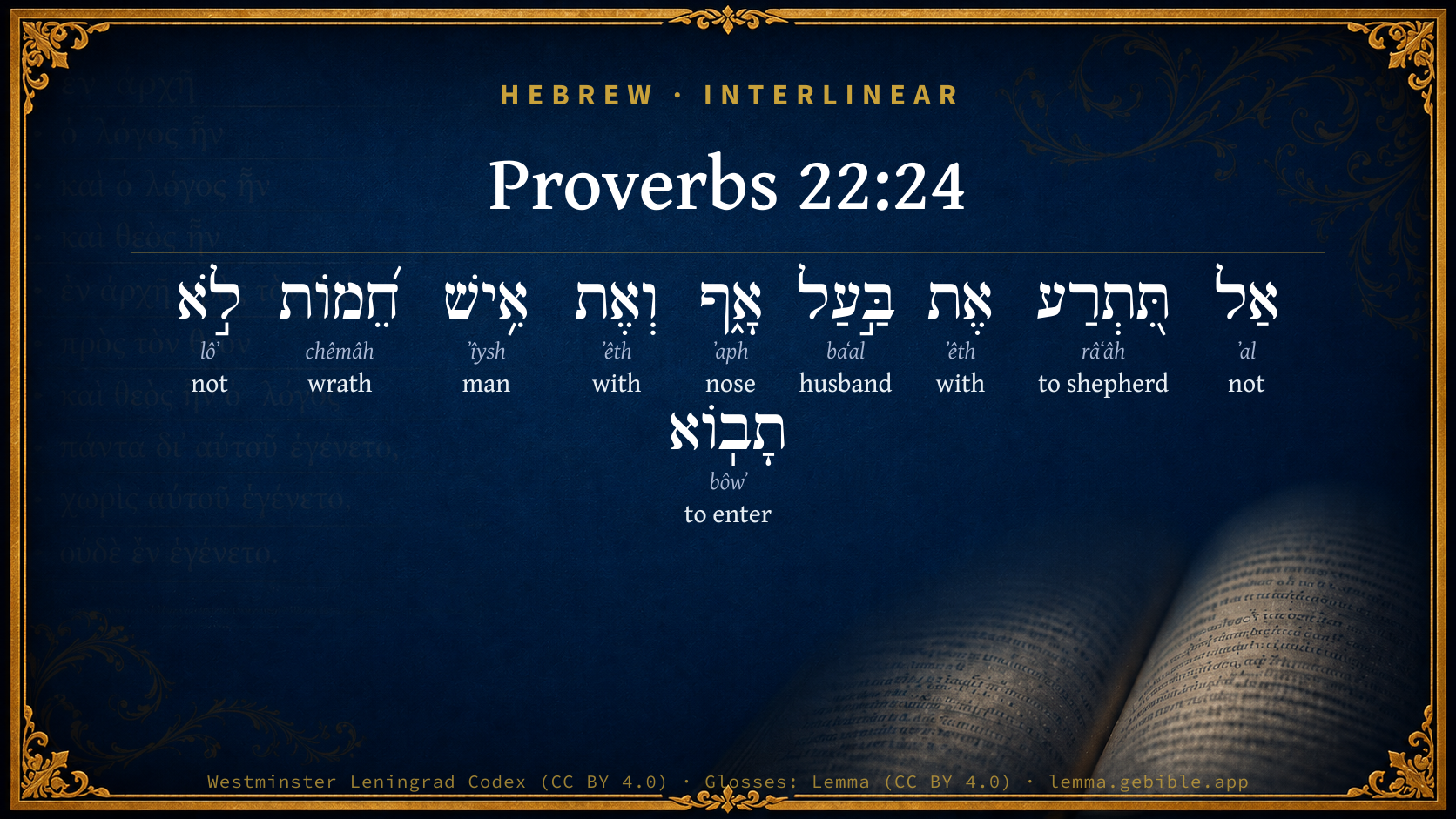
Hebrew (Westminster Leningrad Codex) Proverbs 22:24 appears in the Hebrew Old Testament. The text above is from the Westminster Leningrad Codex. Each word links to its Strong’s number, a concise gloss, and parsing drawn from the Open Scriptures Hebrew Bible morphology. Click any word for its full Brown-Driver-Briggs (BDB) entry.
Download image
Cite this verse

Proverbs 22:24 (World English Bible). Public Domain. Lemma interlinear Bible study tool, https://lemma.gebible.app/v/proverbs/22/24.

Show BibTeX & RIS
BibTeX
RIS
English Translation
Don't befriend a hot-tempered man, And don't associate with one who harbors anger:
World English Bible · Public Domain
Download a study sheet

One document with this verse’s original text, its word-by-word gloss line, the meaning frame, cross-references with their text, attributed commentary, and full source and license credits — printable, and it pastes into notes with its structure intact.

This verse Autodidact and up

Study sheet (.html) Plain text (.txt)

A passage Seminary Student

Up to 50 verses in one chapter. A passage sheet keeps up to 6 commentary sources and 12 cross-references per verse, in the order this page ranks them, and says so on the sheet whenever that leaves anything out. Ask for a single verse and you get the Autodidact verse sheet above.

Everything on this page stays free to read, with no account — the sheet is a download of what is already on screen, not access to it.

Want to remove ads? Support Godless Engineer
Compare translations 3

The same verse in 3 English versions, stacked beneath the original-language interlinear above. Click any original word for its lexicon entry.

Each is an independent rendering of the whole verse — the interlinear is not word-aligned to these translations.

Highlighted words mark where these versions differ — a whole-verse word diff, not a word-by-word alignment.

  • World English Bible Public Domain
    Don't befriend a hot-tempered man, And don't associate with one who harbors anger:
  • King James Version Public Domain
    Make no friendship with an angry man; and with a furious man thou shalt not go:
  • unfoldingWord Literal Text CC BY-SA 4.0
    Do not befriend an owner of nose, and do not go a man of heat,

unfoldingWord Literal Text — © unfoldingWord, licensed CC BY-SA 4.0. Word-aligned USFM3 via Door43 (git.door43.org/unfoldingWord/en_ult).

Versions to compare (up to 4)

3 of 4 selected

Show all 18 translations

Every available English version of this verse, each an independent rendering of the whole verse.

  • World English Bible Public Domain
    Don't befriend a hot-tempered man, And don't associate with one who harbors anger:
  • Berean Standard Bible Public Domain
    Do not make friends with an angry man, and do not associate with a hot-tempered man,
  • Majority Standard Bible Public Domain
    Do not make friends with an angry man, and do not associate with a hot-tempered man,
  • King James Version Public Domain
    Make no friendship with an angry man; and with a furious man thou shalt not go:
  • American Standard Version (1901) Public Domain
    Make no friendship with a man that is given to anger; And with a wrathful man thou shalt not go:
  • Revised Version (1885) Public Domain
    Make no friendship with a man that is given to anger; and with a wrathful man thou shalt not go:
  • Geneva Bible (1599) Public Domain
    Make no friendship with an angrie man, neither goe with the furious man,
  • Douay-Rheims (1899) Public Domain
    Be not a friend to an angry man, and do not walk with a furious man:
  • Young's Literal Translation Public Domain
    Shew not thyself friendly with an angry man, And with a man of fury go not in,
  • Literal Standard Version CC BY-SA 4.0
    Do not show yourself friendly with an angry man, || And do not go in with a man of fury,
  • Unlocked Literal Bible CC BY-SA 4.0
    Do not make a friend of someone who is ruled by anger and you must not go with one who rages,
  • unfoldingWord Literal Text CC BY-SA 4.0
    Do not befriend an owner of nose, and do not go a man of heat,
  • Darby Bible Public Domain
    Make no friendship with an angry man, and go not with a furious man;
  • World Messianic Bible Public Domain
    Don’t befriend a hot-tempered man. Don’t associate with one who harbors anger,
  • Webster's Bible Public Domain
    Make no friendship with an angry man; and with a furious man thou shalt not go:
  • Free Bible Version CC BY-SA 4.0
    Don't make friends with someone who gets upset easily; don't associate with angry people,
  • Bible in Basic English Public Domain
    Do not be friends with a man who is given to wrath; do not go in the company of an angry man:
  • JPS Tanakh (1917) Public Domain
    Make no friendship with a man that is given to anger; and with a wrathful man thou shalt not go;

Literal Standard Version (2020), Covenant Press — licensed CC BY-SA 4.0. Text via the HelloAO Bible API (eBible.org). Unlocked Literal Bible (unfoldingWord) — licensed CC BY-SA 4.0. Text via the HelloAO Bible API (eBible.org). unfoldingWord Literal Text — © unfoldingWord, licensed CC BY-SA 4.0. Word-aligned USFM3 via Door43 (git.door43.org/unfoldingWord/en_ult). Free Bible Version, Dr. Jonathan Gallagher — licensed CC BY-SA 4.0. Text via the HelloAO Bible API (eBible.org).

Word by word

More ways to search: Search by grammar → Find every occurrence → Compare this word →

Practice this passage: Drill this verse → Learn its vocabulary →

About this verse

These counts appear in no published source. They are computed here, from the morphology-tagged text and Lemma’s own curated glosses. What Lemma adds →

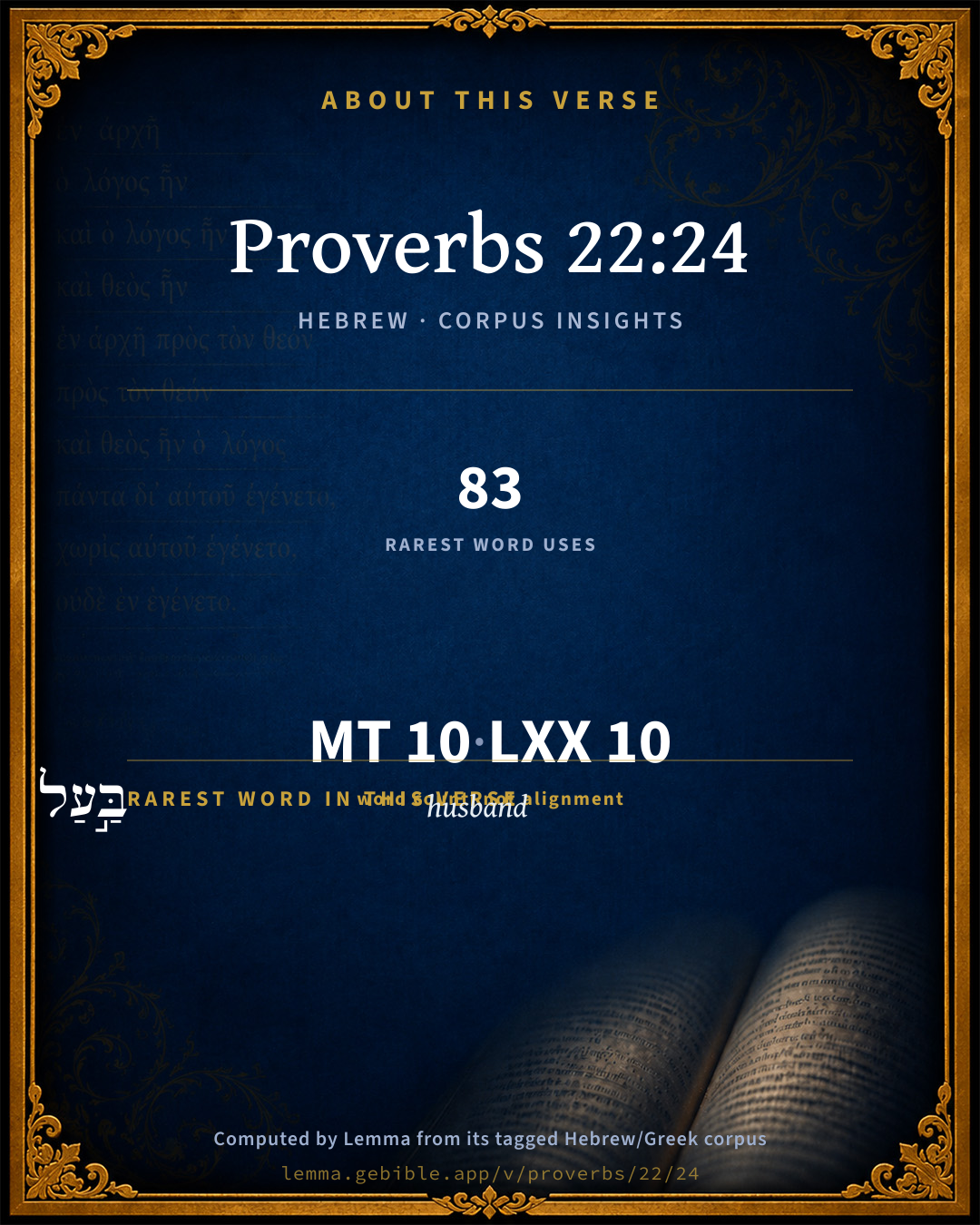
10
words
9
distinct lemmas
Wisdom
section

Grammatical profile

  • 2 verbs
  • 4 nouns
  • 2 prepositions
  • 2 particles

Verb forms

  • תִּ֭תְרַע Hithpael · Jussive
  • תָבֽוֹא Qal · Imperfect

Repetition

A word recurs within this verse — often emphatic in Hebrew:

  • אֶת with H854 ×2

Hebrew & Septuagint length

In English translation the verse runs 13 words from the Hebrew and 13 from the Septuagint (LXX English) — the same length.

A rough comparison of the two English renderings, which tokenize alike — not a word-level alignment.

Word counts can differ between the Hebrew and the Greek without any difference in meaning — e.g. the Hebrew direct-object marker אֵת has no separate Greek word, and Greek often adds the article ὁ.

In the original languages it is 10 Hebrew tokens and 10 Greek tokens — but the two are counted differently (Hebrew bundles its prefixes and suffixes into one token; the Greek is in lemma form), so that isn’t a like-for-like length.

Cross-references

3

Topical passages linked to Proverbs 22:24 in the Treasury of Scripture Knowledge — connected by theme and wording, ordered by reader-vote popularity; previews shown in the World English Bible.

  • Proverbs 29:22 An angry man stirs up strife, And a wrathful man abounds in sin.
  • 2 Corinthians 6:14–17 Don't be unequally yoked with unbelievers, for what fellowship have righteousness and iniquity? Or what communion has light with darkness?
  • Proverbs 21:24 The proud and haughty man, "scoffer" is his name; He works in the arrogance of pride.

Cross-references courtesy of OpenBible.info (CC BY 4.0).

Hebrew and Greek witnesses Masoretic Hebrew ↔ Greek Septuagint

The same verse in the two great witnesses to the Old Testament, shown verse-for-verse.

These are two independent witnesses, not word-aligned to each other, and the Septuagint is shown in lemma (dictionary) form.

Hebrew Proverbs 22:24 Masoretic · Westminster Leningrad Codex

אַל תִּ֭תְרַע אֶת בַּ֣עַל אָ֑ף וְאֶת אִ֥ישׁ חֵ֝מוֹת לֹ֣א תָבֽוֹא

Don't befriend a hot-tempered man, And don't associate with one who harbors anger:

World English Bible · Public Domain

Greek LXX Proverbs 22:24 Septuagint · lemma form

μή εἰμί ἑταῖρος ἀνήρ θυμώδης φίλος δέ ὀργίλος μή συναὐλίζω

Be not companion to a furious man; neither lodge with a passionate man:

LXX2012 (modern English Septuagint) · Public Domain

On this verse, The Cambridge Bible for Schools and Colleges discusses the Septuagint’s reading. Read the note in Commentary ↓

Hebrew: Westminster Leningrad Codex (CC BY 4.0). Greek: Septuagint (public domain); English from LXX2012 (modern English Septuagint) (Public Domain). How the Septuagint differs from the Hebrew →

Commentary

Notes on Proverbs 22:24 from classic Christian and Jewish commentators (each source and its license shown beneath its notes). The classic Christian expositions comment on the surrounding passage and are grouped to its opening verse, so a note may address several verses; the Jewish commentaries on the Tanakh (Rashi and others) are per-verse, so they appear only where the commentator wrote on this verse.

Lemma curates 59 commentaries, every one of them public domain or Creative Commons licensed, each selected and text-cleaned for this edition rather than reprinted as found. About our sources →

Trapp's Complete Commentary

John Trapp

Pro 22:24 Make no friendship with an angry man; and with a furious man thou shalt not go:

Ver. 24. Make no friendship with an angry man.] Anger is a short madness; it is a leprosy breaking out of a burning, {Lev 13:25} and renders a man unfit for civil society; for his unruly passions cause the climate where he lives to be like the torrid zone, too hot for any to live near him. The dog days continue with him all the year long; he rageth, and eateth firebrands, so that every man that will provide for his own safety must flee from him, as from a nettling, dangerous and unsociable creature, fit to live alone as dragons and wild beasts, or to be looked on only through a grate, as they; where, if they will do mischief, they may do it to themselves only: as Bajazet the great Turk, who, being taken by Tamerlane, and carried up and down in an iron cage, beat out his own brains against the bars thereof. {a}

{a} Turkish Hist.

John Trapp, A Commentary or Exposition upon All the Books of the Old and New Testament (1647–1656) — public domain. Text from a community e-Sword module.

Joseph Benson's Commentary

Pro 22:24-25. Make no friendship with an angry man — “As there is nothing more necessary than a friend, so a principal point of wisdom consists in the choice of him; concerning which, observe this rule among others, not to enter into any familiarity with a man prone to anger;” and with a furious man thou shalt not go — Shalt not associate, or be intimate; lest thou learn his ways — Lest thou be infected by his example, or provoked by his wrath to return the like to him; and get a snare to thy soul — Some mischief, which is often the effect of unbridled rage; or an occasion of, or temptation to sin, being led either to imitate him, or to neglect performing that great and important duty of a friend, the giving faithful and seasonable admonition and reproof, which thou mayest be induced to omit because of his furious temper.

Joseph Benson's Commentary on the Old and New Testaments (1811–1818) — public domain. Text from a community e-Sword module.

The Preacher's Complete Homiletical Commentary

Joseph S. Exell (gen. ed.)

MAIN HOMILETICS OF Pro_22:24-25

AN INFECTIOUS AND DANGEROUS DISEASE

I. Friendship influences habit and thus moulds character. The reason given here for avoiding the companionship of an angry man is, “lest thou learn his ways.” This subject has been treated at length in chap. Pro_13:20, page 326. There is great need when pestilence is abroad to avoid needless contact with infected persons and things. In every man there is more or less liability to disease which sometimes only needs a slight exposure to unhealthy influences to develop into a fatal activity. We are always living and moving amidst unhealthy and infectious moral influences which are hurtful to us, because of the tendency there is within us to go wrong; and it is therefore the mark of a wise man to avoid as much as possible all intimate contact with those who are manifestly under the dominion of sin. This proverb does not of course forbid such intercourse as is sought for the purpose of benefiting the vicious man.

II. A man’s anger hurts himself more than those whom it leads him to injure. We should have expected that Solomon would advise us to avoid the angry man because of the injury he might do us when under the dominion of his passion, but instead of that he commands us to shun him because of the injury we shall do ourselves if we become like him. The wise man loses sight of the lesser danger in looking at the greater, and counts as nothing the harm an angry man can do to the body of a fellow-creature, in comparison with the grievous hurt he inflicts upon his own soul. And this is manifestly a correct view, whether we look at the present influence of passion or its remoter consequences. The man who receives an unmerited insult or injury may sustain no loss of dignity, nor suffer in any way in his spirit. But he who inflicts the injury becomes a meaner man in the very act, and creates a tempest of unrest within his own breast. And a blow which deals even death to an innocent man does not necessarily deprive him of any real good, but it creates a very hell of remorse for him whose anger prompted the deed. While Abel exchanged a blighted home here for an Eden in a brighter world, Cain wandered a fugitive and a vagabond upon the earth.

OUTLINES AND SUGGSTIVE COMMENTS

Lest thou be infected by his example, or provoked by his passion to return the like to him. Either

(1) a mischief which is often the effect of unbridled rage, or

(2) an occasion of sin, either by drawing thee to an imitation or requital of his rage, or by tempting thee to unfaithfulness in performing the great office of a friend—to wit, admonition or reproof, which, by reason of his furious temper, thou either canst not or wilt not do.—Matthew Poole.

It may seem strange that we should be supposed in danger of learning what we feel to be so very disagreeable. And yet we may. As already hinted, a passionate man may have interesting and attractive qualities otherwise. Now, in proportion as we either admire or love him for these, will be the hazard of our thinking the less evil of his one defect, and trying to palliate and to smile at it. And there is no little truth in the saying, that we either are like our friends and intimates, or will soon be. But more than this. The sudden and often unreasonable heats of the passionate man are ever apt to fret and irritate our spirits, and thus to form a habit of resemblance by the very reaction upon ourselves of his hot and hasty temper.—Wardlaw.

The Preacher's Complete Homiletical Commentary (gen. ed. Joseph S. Exell; Funk & Wagnalls, c. 1892) — public domain (pre-1929). A full-Bible homiletical/sermon-outline anthology covering 65 of 66 books (2 John is absent from the source module). Text from a community e-Sword module.

Tyndale Open Study Notes

Tyndale Open Resources

22:24-25 Saying 2: An angry . . . hot-tempered person is unable to control his emotions and expresses his anger at inappropriate times.

Tyndale Open Study Notes — © Tyndale Open Resources, licensed CC BY-SA 4.0. Text via the HelloAO Bible API.

Geneva Bible (1599)

Geneva Bible translators

Have not to do with him that is not able to rule his affections: for he would hurt thee by his evil conversation.

Geneva Bible (1599) marginal notes — public domain. Text via Bolls.life.

Matthew Henry's Commentary

Here is, 1. A good caution against being intimate with a passionate man. It is the law of friendship that we accommodate ourselves to our friends and be ready to serve them, and therefore we ought to be wise and wary in the choice of a friend, that we come not under the sacred tie to any one whom it would be our folly to accommodate ourselves to. Thought we must be civil to all, yet we must be careful whom we lay in our bosoms and contract a familiarity with. And, among others, a man who is easily provoked, touchy, and apt to resent affronts, who, when he is in a passion, cares not what he says or does, but grows outrageous, such a one is not fit to be made a friend or companion, for he will be ever and anon angry with us and that will be our trouble, and he will expect that we should, like him, be angry with others, and that will be our sin. 2. Good cause given for this caution: Lest thou learn his way. Those we go with we are apt to grow like. Our corrupt hearts have so much tinder in them that it is dangerous conversing with those that throw about the sparks of their passion. We shall thereby get a snare to our souls, for a disposition to anger is a great snare to any man, and an occasion of much sin. He does not say, "Lest thou have ill language given thee or get a broken head," but, which is must worse, "Lest thou imitate him, to humour him, and so contract an ill habit."

Matthew Henry's Commentary on the Whole Bible (1708–1710) — public domain (CC PDM 1.0). Text via the HelloAO Bible API.

Jamieson, Fausset & Brown

Robert Jamieson, A. R. Fausset & David Brown

(Compare Pro 2:12-15; Pro 4:14).

Jamieson, Fausset & Brown — Commentary Critical and Explanatory on the Whole Bible (1871) — public domain (CC PDM 1.0). Text via the HelloAO Bible API.

Adam Clarke's Commentary

Verse 24. Make no friendship with an angry man] Spirit has a wonderful and unaccountable influence upon spirit. From those with whom we associate we acquire habits, and learn their ways, imbibe their spirit, show their tempers and walk in their steps. We cannot be too choice of our company, for we may soon learn ways that will be a snare to our soul.

Adam Clarke's Commentary on the Bible (1810–1826) — public domain. Text from a community e-Sword/MySword module.

The Cambridge Bible for Schools and Colleges

gen. ed. J. J. S. Perowne

24. an angry man] Better, a man that is given to anger, R.V. Lit a lord of anger. ἀνδρὶ θυμώδει, LXX.; homini iracundo, Vulg.

furious] Rather, wrathful, R.V.

The Cambridge Bible for Schools and Colleges (gen. ed. J. J. S. Perowne; Cambridge University Press, 1878–1918) — public domain. Text from a community e-Sword module.

John Gill's Exposition

Make no friendship with an angry man,.... Do not associate with him; contract not a familiarity with him; make him not a companion; take him not into an intimacy, or use him as a particular friend and acquaintance: a man should be courteous, and carry it civilly to all men; but he should take care whom he admits as his bosom friend; he should be cautious in his choice of a familiar friend, and not receive any; and, among the rest, avoid an angry and passionate man, one who is much given to passion himself, and stirs it up in others; for there can be no lasting peace and pleasure in such a man's company and conversation;

and with a furious man thou shall not go: not take a walk with him, much less a journey; or shall not be frequently together. It may be rendered, "unto a man of wraths", or of great wrath and "fury, thou shall not come"; not enter into his house, nor seek his company, and court his conversation, which rather should be shunned.

John Gill's Exposition of the Whole Bible (1746–1763) — public domain (CC PDM 1.0). Text via the HelloAO Bible API.

Matthew Poole's English Annotations

Into his company; not converse frequently and familiarly with him, as friends use to do.

Matthew Poole's English Annotations on the Holy Bible (1683–1685) — public domain. Text from a community e-Sword/MySword module.

Whedon's Commentary on the Bible

Daniel D. Whedon

24. Make no friendship (have no companionship) with an angry man — One of violent temper — a passionate man.

Daniel D. Whedon (gen. ed.), Commentary on the Old and New Testaments (1874–1909) — public domain. Text from a community e-Sword module.

The Pulpit Commentary

Vers. 24, 25. Another tetrastich. Make no friendship with an angry (irascible) man. Have no close intercourse with a man given to fits of passion. And with a furious man thou shalt not go. Avoid the society of such a one. The reason follows: Lest thou learn his ways; his manner of life and conduct. as Pro_1:15 (where see note). Anger breeds anger; impotence, impatience. St. Basil ("De Ira"), quoted by Corn. a Lapide, enjoins, "Take not your adversary as your teacher, and be not a mirror to reflect the angry man, showing his figure in thyself." And get a snare to thy soul; bring destruction on thyself. Anger unsubdued not only mars the kindliness of social life, but leads to all sorts of dangerous complications which may bring ruin and death in their train. (comp. Pro_15:18)

Vers. 24, 25. See homily on Pro_16:32. C.

The Pulpit Commentary (1880–1919), ed. H.D.M. Spence-Jones & Joseph S. Exell — public domain. Text from a community e-Sword module.

Keil & Delitzsch

C. F. Keil & F. Delitzsch

Another tetrastich follows:

24 Have no intercourse with an angry man,

And with a furious man go thou not;

25 Lest thou adopt his ways,

And bring destruction upon thy soul.

The Piel רעה, Jdg 14:20, signifies to make or choose any one as a friend or companion (רעה, רע); the Hithpa. התרעה (cf. at Pro 18:24), to take to oneself (for oneself) any one as a friend, or to converse with one; אל־תּתרע sounds like אל־תּשׁתּע, Isa 41:10, with Pathach of the closed syllable from the apocope. The angry man is called בּעל אף, as the covetous man בּעל נפשׁ, Pro 23:2, and the mischievous man בּעל מזמּות, Pro 24:8; vid., regarding בּעל at Pro 1:19 and Pro 18:9. אישׁ חמות is related superlat. to אישׁ חמה, Pro 15:18 (cf. Pro 29:22), and signifies a hot-head of the highest degree. לא תבוא is meant as warning (cf. Pro 16:10). בּוא את, or בוא עם, Psa 26:4, to come along with one, is equivalent to go into fellowship or companionship with one, which is expressed by הלך את, Pro 13:20, as בוא ב means, Jos 23:7, Jos 23:12, to enter into communion with one, venire in consuetudinem. This בוא את is not a trace of a more recent period of the language. Also תּאלף, discas, cannot be an equivalent for it: Heb. poetry has at all times made use of Aramaisms as elegancies. אלף, Arab. אלף, ילף, Arab. âlifa, signifies to be entrusted with anything = to learn (Piel אלּף, to teach, Job 15:15, and in Elihu's speeches), or also to become confidential with one (whence אלּוּף, companion, confidant, Pro 2:17); this אלף is never a Heb. prose word; the bibl. אלּוּף is only used at a later period in the sense of teacher. ארחות .reh are the ways, the conduct (Pro 2:20, etc.), or manner of life (Pro 1:19) which any one enters upon and follows out, thus manners as well as lot, condition. In the phrase "to bring destruction," לקח is used as in our phrase Schaden nehmen [to suffer injury]; the ancient language also represented the forced entrance of one into a state as a being laid hold on, e.g., Job 18:20, cf. Isa 13:8; here מוקשׁ is not merely equivalent to danger (Ewald, falsely: that thou takest not danger for thy soul), but is equivalent to destruction, sin itself is a snare (Pro 29:6); to bring a snare for oneself is equivalent to suffer from being ensnared. Whosoever comes into a near relation with a passionate, furious, man, easily accommodates himself to his manners, and, hurried forward by him and like him to outbreaks of anger, which does that which is not right before God, falls into ruinous complications.

Keil & Delitzsch — Biblical Commentary on the Old Testament (1861–1891) — public domain (CC PDM 1.0). Text via the HelloAO Bible API. (Old Testament only.)

Bridges on Proverbs

Charles Bridges

Sin is contagious. Alas! our corrupt constitution predisposes us to receive it in any form, in which it may be presented to us. The unlovely passions of a furious man rather repel than attract.†1 But sin never loses its infectious character. Friendship blinds the eye; and where there is no light in the mind, no true tenderness in the conscience, we can see hateful things done by those we love, with blunted sensibilities. Common intercourse with a furious man is like living in a house that is on fire. His unreasonable conduct stirs our own tempers. One fire kindles another. Occasional bursts of passion soon form the habit. The habit becomes the nature. Thus we learn his ways, and get a snare to our soul. (Psa 106:35-36 .) How soon does a young person, living with a proud man, get the mold of his society, and become imperious and overbearing! (Sir 13:1 .) Evil ways, especially when they fall in with our natural temperament, are much sooner learnt than good, and are much more powerful to "corrupt good manners" (1Co 15:33 ), than good manners to amend the evil. We learn anger easier than meekness. We convey disease, not health. Hence it is the rule of self-preservation, no less than the rule of God — Make no friendship with an angry man.

Footnotes:

†1 Pro 21:24; Pro 25:28 ; Pro 27:4 .

Charles Bridges, An Exposition of the Book of Proverbs (1846) — public domain. Text from a community e-Sword module.

Kretzmann's Popular Commentary

Paul E. Kretzmann

v. 24. Make no friendship with an angry man, a man of violent temper, and with a furious man thou shalt not go, one who cannot control himself.

Paul E. Kretzmann, Popular Commentary of the Bible (1921–1924) — public domain. Text from a community e-Sword module.

unfoldingWord translationNotes

Door43 World Missions Community

General Information:

These verses continue the "thirty sayings" (Proverbs 22:20).

someone who is ruled by anger

someone who is unable to control his anger (See: Metaphor)

rages

shows violent anger

you will take bait for your soul

A person who wants to be like an angry person is like an animal taking the bait in a trap. AT: "you will be like an animal that eats the bait that closes a trap and is unable to escape" (See: Metaphor)

bait for your soul

The soul is a metonym for the person's life. AT: "bait that someone has put out so he can kill you" (See: Metonymy)

translationWords

anger

unfoldingWord translationNotes — © Distant Shores Media and the Door43 World Missions Community, licensed CC BY-SA 4.0. Source: git.door43.org/Door43/en_tn.

Rashi

Rabbi Shlomo Yitzchaki (Rashi)

Do not befriend Heb. תתרע, do not befriend, an expression of friendship (רעות)

Rashi on the Tanakh — English translations: “The Judaica Press complete Tanach with Rashi, translated by A. J. Rosenberg” (CC BY 4.0); “Pentateuch with Rashi's commentary by M. Rosenbaum and A.M. Silbermann, 1929-1934” (public domain); “The Metsudah Tanach series, Lakewood, N.J” (CC BY 4.0); and “The Book of Joshua, Metsudah Publications, 1997” (CC BY 4.0). Text via Sefaria.

Lesson kit

Teaching starters — assembled from the data on this page, not authored interpretation. Every prompt links to the verse data it draws on. Edit before teaching.

Proverbs, in the Wisdom, opens this verse with 10 words (9 distinct Hebrew lemmas). Its most distinctive word is baʻal (“husband”). A historical commentator’s framing appears above. Read the whole chapter for the surrounding context.

Discussion questions

  1. The word baʻal carries the sense “husband.” How does it shape the verse?
  2. How does Proverbs 29:22, which shares this passage’s theme, read alongside this verse?
  3. What does the repetition of “with” (2× in this one verse) do in this verse?
  4. These translations render this verse differently; the difference is in the English rendering, not the original. What questions does that raise?
  5. «תִּ֭תְרַע» is a Hithpael Jussive verb. How does that grammatical form shape the action described?
  6. Compare how Trapp's Complete Commentary and Joseph Benson's Commentary read this verse. Where do they agree or differ?

Things to notice

Reading settings

Reading text

Shown beneath each verse's original-language words.

Old Testament
Old Testament edition

Read the OT as the Masoretic Hebrew (MT) or the Greek Septuagint (LXX).

English shown for the Greek Septuagint (in the Hebrew ↔ Greek comparison).

Comparing translations? Open the Compare panel on any verse page to stack up to four side by side.