
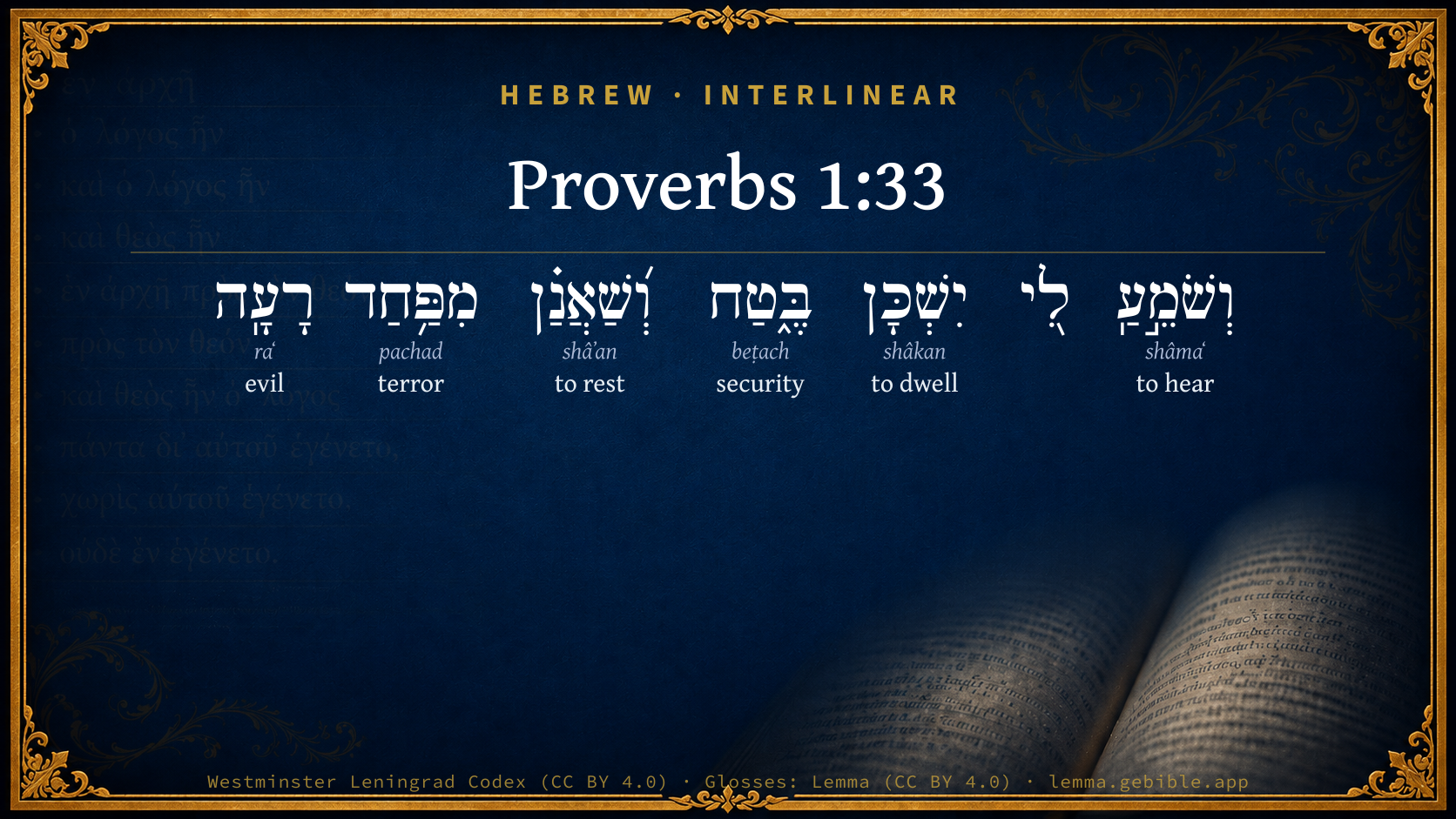
Proverbs 1:33

Hebrew (Westminster Leningrad Codex) Proverbs 1:33 appears in the Hebrew Old Testament. The text above is from the Westminster Leningrad Codex. Each word links to its Strong’s number, a concise gloss, and parsing drawn from the Open Scriptures Hebrew Bible morphology. Click any word for its full Brown-Driver-Briggs (BDB) entry.
Download image
Cite this verse

Proverbs 1:33 (World English Bible). Public Domain. Lemma interlinear Bible study tool, https://lemma.gebible.app/v/proverbs/1/33.

Show BibTeX & RIS
BibTeX
RIS
English Translation
But whoever listens to me will dwell securely, And will be at ease, without fear of harm."
World English Bible · Public Domain
Download a study sheet

One document with this verse’s original text, its word-by-word gloss line, the meaning frame, cross-references with their text, attributed commentary, and full source and license credits — printable, and it pastes into notes with its structure intact.

This verse Autodidact and up

Study sheet (.html) Plain text (.txt)

A passage Seminary Student

Up to 50 verses in one chapter. A passage sheet keeps up to 6 commentary sources and 12 cross-references per verse, in the order this page ranks them, and says so on the sheet whenever that leaves anything out. Ask for a single verse and you get the Autodidact verse sheet above.

Everything on this page stays free to read, with no account — the sheet is a download of what is already on screen, not access to it.

Want to remove ads? Support Godless Engineer
Compare translations 3

The same verse in 3 English versions, stacked beneath the original-language interlinear above. Click any original word for its lexicon entry.

Each is an independent rendering of the whole verse — the interlinear is not word-aligned to these translations.

Highlighted words mark where these versions differ — a whole-verse word diff, not a word-by-word alignment.

  • World English Bible Public Domain
    But whoever listens to me will dwell securely, And will be at ease, without fear of harm."
  • King James Version Public Domain
    But whoso hearkeneth unto me shall dwell safely, and shall be quiet from fear of evil.
  • unfoldingWord Literal Text CC BY-SA 4.0
    But the one who listens to me will dwell securely and will be at ease from the dread of evil.”

unfoldingWord Literal Text — © unfoldingWord, licensed CC BY-SA 4.0. Word-aligned USFM3 via Door43 (git.door43.org/unfoldingWord/en_ult).

Versions to compare (up to 4)

3 of 4 selected

Show all 18 translations

Every available English version of this verse, each an independent rendering of the whole verse.

  • World English Bible Public Domain
    But whoever listens to me will dwell securely, And will be at ease, without fear of harm."
  • Berean Standard Bible Public Domain
    But whoever listens to me will dwell in safety, secure from the fear of evil.”
  • Majority Standard Bible Public Domain
    But whoever listens to me will dwell in safety, secure from the fear of evil.”
  • King James Version Public Domain
    But whoso hearkeneth unto me shall dwell safely, and shall be quiet from fear of evil.
  • American Standard Version (1901) Public Domain
    But whoso hearkeneth unto me shall dwell securely, And shall be quiet without fear of evil.
  • Revised Version (1885) Public Domain
    But whoso hearkeneth unto me shall dwell securely, and shall be quiet without fear of evil.
  • Geneva Bible (1599) Public Domain
    But he that obeyeth me, shall dwell safely, and be quiet from feare of euill.
  • Douay-Rheims (1899) Public Domain
    But he that shall hear me, shall rest without terror, and shall enjoy abundance, without fear of evils.
  • Young's Literal Translation Public Domain
    And whoso is hearkening to me dwelleth confidently, And `is' quiet from fear of evil!'
  • Literal Standard Version CC BY-SA 4.0
    And whoever is listening to me dwells confidently, || And [is] quiet from fear of evil!”
  • Unlocked Literal Bible CC BY-SA 4.0
    But whoever listens to me will live in safety and will rest secure with no fear of disaster.”
  • unfoldingWord Literal Text CC BY-SA 4.0
    But the one who listens to me will dwell securely and will be at ease from the dread of evil.”
  • Darby Bible Public Domain
    But whoso hearkeneth unto me shall dwell safely, and shall be at rest from fear of evil.
  • World Messianic Bible Public Domain
    But whoever listens to me will dwell securely, and will be at ease, without fear of harm.”
  • Webster's Bible Public Domain
    But whoever hearkeneth to me shall dwell in safety, and shall be quiet from fear of evil.
  • Free Bible Version CC BY-SA 4.0
    But everyone who listens to me will be kept safe, and will live without worrying about problems.”
  • Bible in Basic English Public Domain
    But whoever gives ear to me will take his rest safely, living in peace without fear of evil.
  • JPS Tanakh (1917) Public Domain
    But whoso hearkeneth unto me shall dwell securely, and shall be quiet without fear of evil.'

Literal Standard Version (2020), Covenant Press — licensed CC BY-SA 4.0. Text via the HelloAO Bible API (eBible.org). Unlocked Literal Bible (unfoldingWord) — licensed CC BY-SA 4.0. Text via the HelloAO Bible API (eBible.org). unfoldingWord Literal Text — © unfoldingWord, licensed CC BY-SA 4.0. Word-aligned USFM3 via Door43 (git.door43.org/unfoldingWord/en_ult). Free Bible Version, Dr. Jonathan Gallagher — licensed CC BY-SA 4.0. Text via the HelloAO Bible API (eBible.org).

Word by word

More ways to search: Search by grammar → Find every occurrence → Compare this word →

Practice this passage: Drill this verse → Learn its vocabulary →

About this verse

These counts appear in no published source. They are computed here, from the morphology-tagged text and Lemma’s own curated glosses. What Lemma adds →

7
words
6
distinct lemmas
Wisdom
section

Notable vocabulary

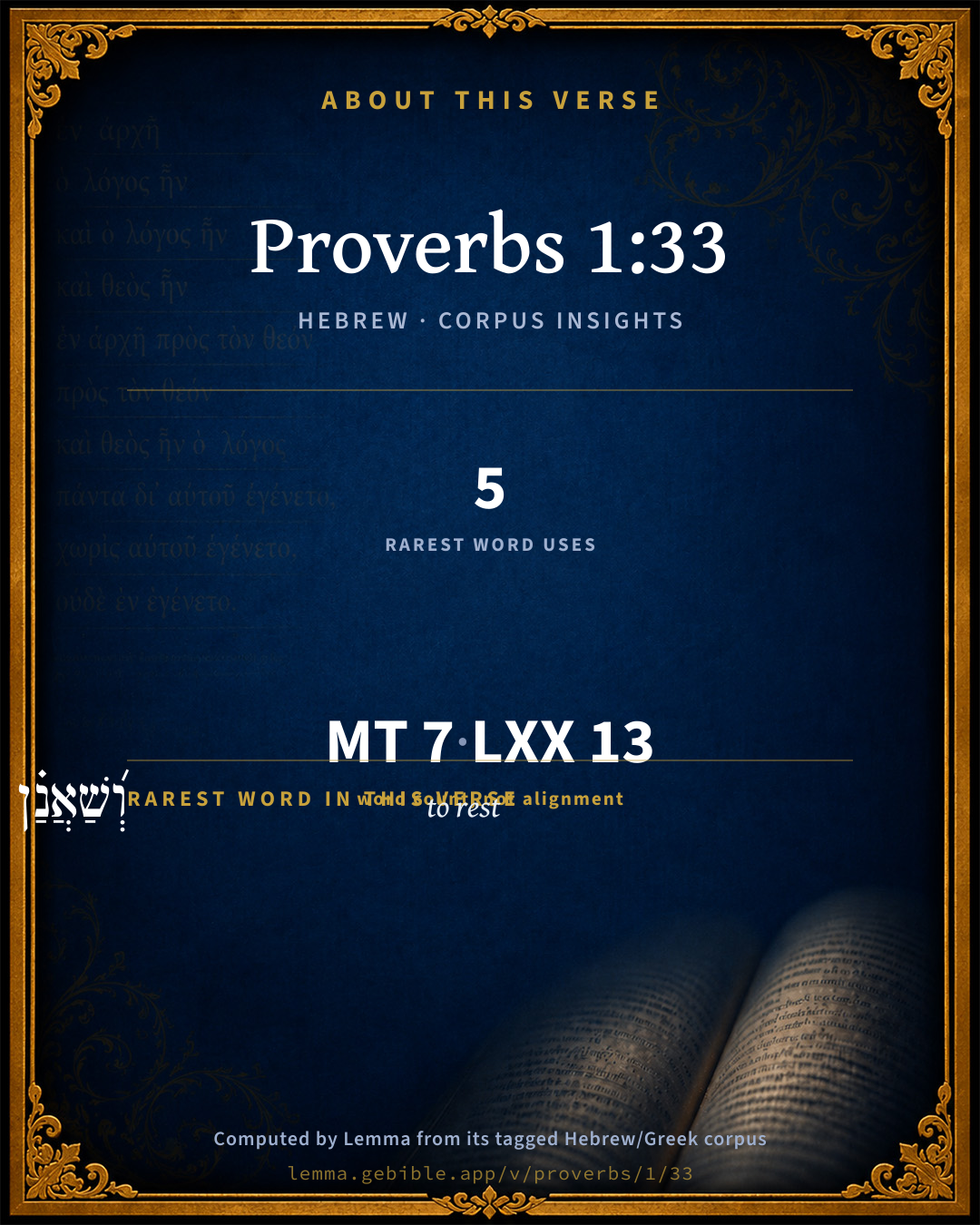
The rarest word here is וְ֝שַׁאֲנַ֗ן to rest H7599 — appearing just 5 times in the whole Hebrew Bible.

Shared distinctive vocabulary

וְ֝שַׁאֲנַ֗ן to rest H7599 occurs in 5 verses of the Hebrew Bible. Also found in:

Grammatical profile

  • 3 verbs
  • 3 nouns
  • 1 preposition

Verb forms

  • וְשֹׁמֵ֣עַֽ Qal · Participle Active
  • יִשְׁכָּן Qal · Imperfect
  • וְ֝שַׁאֲנַ֗ן Palel · Sequential Perfect

Hebrew & Septuagint length

In English translation the verse runs 17 words from the Hebrew and 17 from the Septuagint (LXX English) — the same length.

A rough comparison of the two English renderings, which tokenize alike — not a word-level alignment.

Word counts can differ between the Hebrew and the Greek without any difference in meaning — e.g. the Hebrew direct-object marker אֵת has no separate Greek word, and Greek often adds the article ὁ.

In the original languages it is 7 Hebrew tokens and 13 Greek tokens — but the two are counted differently (Hebrew bundles its prefixes and suffixes into one token; the Greek is in lemma form), so that isn’t a like-for-like length.

Cross-references

16

Topical passages linked to Proverbs 1:33 in the Treasury of Scripture Knowledge — connected by theme and wording, ordered by reader-vote popularity; previews shown in the World English Bible.

  • Psalms 25:12–13 What man is he who fears Yahweh? He shall instruct him in the way that he shall choose.
  • Psalms 112:7–8 He will not be afraid of evil news. His heart is steadfast, trusting in Yahweh.
  • Isaiah 26:3 You will keep [him] in perfect peace, [whose] mind [is] stayed [on you]; because he trusts in you.
  • John 10:27–29 My sheep hear my voice, and I know them, and they follow me.
  • Proverbs 14:26 In the fear of Yahweh is a secure fortress, And he will be a refuge for his children.
  • Proverbs 8:32–35 "Now therefore, my sons, listen to me, For blessed are those who keep my ways.
  • Luke 21:9 When you hear of wars and disturbances, don't be terrified, for these things must happen first, but the end won't come immediately."
  • Proverbs 9:11 For by me your days will be multiplied. The years of your life will be increased.
  • Luke 21:19 By your endurance you will win your lives.
  • Psalms 81:13 Oh that my people would listen to me, That Israel would walk in my ways!
  • Isaiah 55:3 Turn your ear, and come to me; hear, and your soul shall live: and I will make an everlasting covenant with you, even the sure mercies of David.
  • 1 Peter 1:5 who by the power of God are guarded through faith for a salvation ready to be revealed in the last time.
  • Matthew 17:5 While he was still speaking, behold, a bright cloud overshadowed them. Behold, a voice came out of the cloud, saying, "This is my beloved Son, in whom I am well pleased. Listen to him."
  • Proverbs 3:21–26 My son, let them not depart from your eyes. Keep sound wisdom and discretion:
  • Isaiah 48:18 Oh that you had listened to my commandments! then had your peace been as a river, and your righteousness as the waves of the sea:
  • Romans 8:35–39 Who shall separate us from the love of Christ? Could oppression, or anguish, or persecution, or famine, or nakedness, or peril, or sword?

Cross-references courtesy of OpenBible.info (CC BY 4.0).

Hebrew and Greek witnesses Masoretic Hebrew ↔ Greek Septuagint

The same verse in the two great witnesses to the Old Testament, shown verse-for-verse.

These are two independent witnesses, not word-aligned to each other, and the Septuagint is shown in lemma (dictionary) form.

Hebrew Proverbs 1:33 Masoretic · Westminster Leningrad Codex

וְשֹׁמֵ֣עַֽ לִ֭י יִשְׁכָּן בֶּ֑טַח וְ֝שַׁאֲנַ֗ן מִפַּ֥חַד רָעָֽה

But whoever listens to me will dwell securely, And will be at ease, without fear of harm."

World English Bible · Public Domain

Greek LXX Proverbs 1:33 Septuagint · lemma form

ὁ δέ ἐγώ ἀκούω κατασκηνόω ἐπί ἐλπίς καί ἡσυχάζω ἀφόβως ἀπό πᾶς κακός

But he that hearkens to me shall dwell in confidence, and shall rest securely from all evil.

LXX2012 (modern English Septuagint) · Public Domain

Hebrew: Westminster Leningrad Codex (CC BY 4.0). Greek: Septuagint (public domain); English from LXX2012 (modern English Septuagint) (Public Domain). How the Septuagint differs from the Hebrew →

Commentary

Notes on Proverbs 1:33 from classic Christian and Jewish commentators (each source and its license shown beneath its notes). The classic Christian expositions comment on the surrounding passage and are grouped to its opening verse, so a note may address several verses; the Jewish commentaries on the Tanakh (Rashi and others) are per-verse, so they appear only where the commentator wrote on this verse.

Lemma curates 59 commentaries, every one of them public domain or Creative Commons licensed, each selected and text-cleaned for this edition rather than reprinted as found. About our sources →

Trapp's Complete Commentary

John Trapp

Pro 1:33 But whoso hearkeneth unto me shall dwell safely, and shall be quiet from fear of evil.

Ver. 33. Shall be quiet from fear of evil.] Impavidum ferient ruinae. {a} "He shall not be afraid of evil tidings." {Psa 112:7} His ark is pitched within and without; tossed, it may be, but not drowned; shaken, but not shivered.

{a} Horat.

John Trapp, A Commentary or Exposition upon All the Books of the Old and New Testament (1647–1656) — public domain. Text from a community e-Sword module.

Joseph Benson's Commentary

Pro 1:33. But whoso hearkeneth unto me — Unto the counsels and instructions of wisdom, and will be ruled thereby, shall dwell safely — Hebrew, בשׂח, in security, or confidence and peace, resting himself upon the consciousness of his own integrity, and upon the promises and favour of God; and shall be quiet from the fear of evil — From sinful and tormenting cares and fears.

Joseph Benson's Commentary on the Old and New Testaments (1811–1818) — public domain. Text from a community e-Sword module.

Tyndale Open Study Notes

Tyndale Open Resources

1:33 Truly wise people are untroubled by fear. They know that God is in control, and wisdom guides them in dealing with every situation.

Tyndale Open Study Notes — © Tyndale Open Resources, licensed CC BY-SA 4.0. Text via the HelloAO Bible API.

Jamieson, Fausset & Brown

Robert Jamieson, A. R. Fausset & David Brown

dwell safely--literally, "in confidence" (Deu 12:10).

be quiet--or at ease, in real prosperity.

from fear--without fear.

Next: Proverbs Chapter 2

Jamieson, Fausset & Brown — Commentary Critical and Explanatory on the Whole Bible (1871) — public domain (CC PDM 1.0). Text via the HelloAO Bible API.

Adam Clarke's Commentary

Verse 33. But whoso hearkeneth unto me shall dwell safely] The man who hears the voice of wisdom in preference to the enticements of the wicked. He shall dwell in safety, ישכן בטח yishcan betach, he shall inhabit safety itself; he shall be completely safe and secure; and shall be quiet from the fear of evil, having a full consciousness of his own innocence and God's protection. Coverdale translates, "And have ynough without eney feare of evell." What the just man has he got honestly; and he has the blessing of God upon it. It is the reverse with the thief, the knave, the cheat, and the extortioner: Male parta pejus dilabuntur; "Ill gotten, worse spent."

Adam Clarke's Commentary on the Bible (1810–1826) — public domain. Text from a community e-Sword/MySword module.

Ellicott's Commentary for English Readers

(33) Shall dwell safely . . .—Comp. Psalms 37 throughout for similar promises.

Shall be quiet from fear of evil—Comp. Ps. cxii 7: “He shall not be afraid of any evil tidings,” &c

A Bible Commentary for English Readers, edited by Charles John Ellicott (1878–1897) — public domain. Text from a community e-Sword module.

The Cambridge Bible for Schools and Colleges

gen. ed. J. J. S. Perowne

33. from] Rather, without, R.V., timore malorum sublato, Vulg.

The Cambridge Bible for Schools and Colleges (gen. ed. J. J. S. Perowne; Cambridge University Press, 1878–1918) — public domain. Text from a community e-Sword module.

John Gill's Exposition

But whoso hearkeneth unto me,.... To Wisdom, or Christ; to the cry and call above; to the voice of his Gospel, not only externally, but internally; so as spiritually and experimentally to understand it, to distinguish it from the voice of a stranger; so as to approve of it, and receive it in the love of it, and to delight and take pleasure in it; so as to feet the power of it, and believe it; not only give an assent unto it, but by faith receive it, and appropriate the things of it to a man's self: and also to the voice of his precepts, his ordinances; so as to yield a cheerful obedience to them, from a principle of love, with a view to his glory, and without trusting to and depending upon it. Such

shall dwell safely; as they must indeed, since they dwell in God; in his heart, "the secret place of the most High"; and in his everlasting and unchangeable love, wherefore they are not consumed; and in the covenant of his grace, which is firm, and sure, and immovable; and in his power, by and in which they are kept, as in a garrison, fortress, or strong hold: and they dwell in Christ the Rock of ages, against which the gates of hell cannot prevail, and on which their souls are built; and so remain safe amidst the floods, storms, and tempests, that beat upon them; the refuge to which they flee, the strong hold to which they turn, and whither they run and are safe; the ark in which they ride safely, amidst all the waves and billows of affliction and tribulation; their place of defence, where they are safe from Satan; and are in his hands out of which none can pluck them, the Lord their righteousness, by whom Judah is saved, and under whom Israel dwells safely; being by his righteousness secure from divine justice, from the curse of the law, and from wrath to come: besides, such have the Spirit dwelling in them, who is greater the he that is in the world; who when he, the enemy, comes in upon them as a flood, the Spirit of the Lord lifts up a standard against him; angels are their guardians, encamp about them; and they are the inhabitants of a strong city, which has salvation for walls and bulwarks; and especially they will dwell safely in the other world, in those mansions and everlasting habitations in Christ's Father's house he is preparing for them; which are sure dwellings, as well as quiet resting places, as follows;

and shall be quiet from fear of evil; as they may be in the present life, under a comfortable sense of the blood, righteousness, and sacrifice of Christ: which, when applied and laid hold on by faith, speak peace to the conscience, and yield quietness of mind; so that such have no reason to be afraid of the evil one, Satan, who cannot devour and destroy them; nor of the evil of sin; for, though they may and should be afraid to commit it, yet not of being conquered by it, and coming under the dominion of it, nor of being brought by it into a state of condemnation; nor of the evil of judgments upon a wicked world; nor of death and a future judgment; nor of hell, and everlasting damnation: and hereafter such will enter into peace, and be free from all evils, natural, moral, or spiritual; and from the fear of them, being out of the reach of them all. The safety and protection of those that hearken to Christ, and believe in him, here promised, had a remarkable accomplishment in the believing Jews; who, a little before the destruction of Jerusalem, were warned to go out from thence to a place called Pella, beyond Jordan (l) as they did, and where they were safe.

(l) Euseb. Eccel. Hist. l. 3. c. 5.

Next: Proverbs Chapter 2

John Gill's Exposition of the Whole Bible (1746–1763) — public domain (CC PDM 1.0). Text via the HelloAO Bible API.

Haydock's Catholic Bible Commentary

Evils. Both the just and the wicked, (ver. 31.; Haydock) shall be treated according to their deserts, 2 Corinthians v. 10. (Worthington) --- Even in this world, the just enjoy the peace of a good conscience. (Menochius)

George Leo Haydock (1774–1849), Haydock's Catholic Family Bible and Commentary, 1859 edition — public domain. Excludes Psalms (Douay-Rheims chapter numbering differs from Protestant) and Deuterocanonical books (Catholic canon only).

Matthew Poole's English Annotations

Safely; or securely, or confidently; resting himself upon the conscience of his own integrity, and upon the promises and favour of God.

From fear of evil; from sinful and tormenting cares and fears. And as a wicked man’s mind is oft full of anxiety in the midst of all his outward prosperity and glory, so the mind of a good man is filled with peace and joy, even when his outward man is exposed to many troubles.

Matthew Poole's English Annotations on the Holy Bible (1683–1685) — public domain. Text from a community e-Sword/MySword module.

Whedon's Commentary on the Bible

Daniel D. Whedon

33. So Wisdom invites, admonishes, threatens. But she will not close her discourse with an unpleasant word. She kindly returns to the rewards of the wise and good.

Whose — Even of these beguiled and misled ones, shall now, from this time forth, hearken unto me, ceasing to do evil, and learning to do well, shall hereafter dwell securely indeed, and be delivered from the dread of impending evil. This applies in its lower sense to this life and temporal things; in its higher, to the spiritual life and eternal retributions. The principle is the same for both. The spirit of the Hhokmah (Wisdom) is truly evangelical, a type of the gospel dispensation. She calls, she urges, she entreats, she follows the wayward and wicked to their places of resort. She promises, she threatens, she is instant in season and out of season, wooing, beseeching, persuading. Comp. Mat_11:19; Luk_11:49.

EXCURSUS No. I.

Wisdom, in the Holy Scriptures, is a very comprehensive term; and, as it is of such frequent occurrence in this book, we may at the beginning, once for all, treat it somewhat at large.

חכמה, (Hhokhmah,) wisdom, is put for intelligence, sagacity, common sense in a high degree; judiciousness or discrimination, and sound and acute judgment in human affairs; great intellectual attainments; skill, ingenuity, and expertness in various arts; also superior knowledge in divine things, or in matters of religion. It is likewise used for craftiness, cunning, artfulness, and hence applied to magicians or enchanters. The fundamental idea is, superior mental endowments or attainments; hence, it may be used either in a good or a bad sense, as these endowments are applied to a good or a bad end. But it is mostly used in a good sense, and therefore stands for high intelligence, right reason, sound judgment, and all intellectual excellences. In the minds of the devout Hebrew writers these qualities were never disjoined from a knowledge of God and reverence for his character and law. Hence, as they rightly regarded this species of knowledge as by far the most important, so they considered the “fear of God,” — piety or religion — to be the first and most important part of wisdom. No man was really wise in their estimation who did not know and reverence God. Even he who was comparatively unlearned in other matters, but who possessed this essential attainment, was divinely wise; while the most learned sinner was a fool. It was thus that wisdom came to be regarded as almost synonymous with piety. The wisdom of which the royal sage treats in this book, so far as it belongs to man, includes and presupposes the knowledge of God, of our relations to him, and of the obligations growing out of those relations. Hence it so far corresponds to, and is identical with, godliness or piety; which also, as it exists in the emotions or is carried out in the life, rests upon this theoretical basis of the knowledge of God. In its adjective form, חכם, (hhakham,) it is often joined with נבון, (nabhon,) discriminating, discerning, discreet, attentive, intelligent. It is also opposed to נבל, (nabhal,) stupid, foolish, wicked, abandoned, impious. — The idea implied in the root of the latter word is that of wilting, fading, and falling away, and is transferred to folly and wickedness as a falling away from wisdom, virtue, and God; hence, becoming worthless, vile, and contemptible. This is the Piel, or intensive signification of the verb. Hhakham is also opposed to אויל, (evil,) gross, stupid, sottish, foolish.

This word implies the stupidity or insensibility which is induced by sensuality and vicious habits.

The wide circle of virtues and mental endowments which the Hebrews comprised under the words hhakham and hhokhmah is best learned from the history and character of those whose wisdom became proverbial: for instance, Solomon, the author of this book, (see Introduction,) Daniel, (see Eze_28:3, and book of Daniel,) and the Egyptians. (Act_7:22.) The wisdom of Solomon was manifested in his acute judgment, (1Ki_3:16;) in his ability to solve difficult questions and to explain abstruse subjects; in his knowledge of very many objects of nature, (1Ki_4:33, etc.;) in the multitude of verses, sentences, or aphorisms which he composed, (1Ki_4:32;) in the skill and taste which he displayed in his works of architecture; in the magnitude and success of his public and private enterprises; in the administrative ability with which he managed and enlarged his empire, and made it prosperous and respected; and in the excellence of his moral and religious teachings. (1Ki_4:29-34.) The Egyptians were famous for their science, literature, and arts. In Act_7:22 it is said that Moses was learned in all the wisdom of the Egyptians. Comp. Job_28:12, etc. The wisdom of Daniel was exhibited in his prudent statesmanship, and also in his faculty of prophesying, and interpreting dreams. Dan_5:11-12. With hhokhmah is also associated מוסר, (musar,) instruction, the radical idea of which is restraint, discipline, correction. Comp. Pro_13:18; Pro_13:24; Pro_22:1; 2Ti_3:16. The human mind, left to itself — that is, to the impulses of appetite and passion, unrestrained, undisciplined, untamed, and self-willed — runs wild in folly and wickedness. It needs checks, restraints, and corrections; and thus only attains to a chastened and cultivated intellectuality. The difference between a savage and a civilized and enlightened Christian, is largely due to the restraints and corrections which civilization, Christian principles, and Christian education, have thrown around the latter, but which are wanting to the former. The word musar is, therefore, equivalent to mental, moral, and religious cultivation. It embraces the idea of the great Teacher of the Christian dispensation, “Take my yoke upon you, and learn of me.” Mat_11:29.

Daniel D. Whedon (gen. ed.), Commentary on the Old and New Testaments (1874–1909) — public domain. Text from a community e-Sword module.

The Pulpit Commentary

Hearkeneth unto me. Wisdom, in closing her address, draws a beautiful picture of the real security and peace of the righteous, as contrasted with the false security of the wicked. As on the one side rejection of her counsels, her warnings, and invitations, carries with it punishment and irretrievable ruin; so, on the other, the hearkening to her words, and loving obedience, are rewarded by her with the choicest blessings. Shall dwell safely; that is, with confidence, without danger (absque terrore, Vulgate). The phrase, dfB k (shachan betakh), is used in Deu_33:12-18 of the safety with which the covenant people should dwell in the land that God had given them; but it is capable of a further extension of meaning beyond mere temporal security, viz. to the spiritual peace of the righteous. The psalmist also employs it to describe the confidence with which he awaits the resurrection, when he says, "My flesh also shall rest in hope or, "dwell confidently". (Psa_16:9) So here Wisdom promises that he who hearkens to her shall dwell calmly and undisturbed amidst the distractions of the world. The promise agrees with the description of Wisdom elsewhere that "her ways are ways of pleasantness, and all her paths are peace." And shall be quiet; ( nav, shaanan, perfect pilel). Wisdom regards her assurance as already accomplished, and hence the perfect in the original is used for the future. The hearers and doers of her will shall live in tranquillity; nay, they are already doing so. It is a thing not only in prospect, but in possession. From fear of evil; i.e. either without any fear of evil, fear being removed (timore sublato, Vulgate), or, as the Authorized Version expresses it, connecting the phrase more intimately with the verb from fear of evil." It is not only evil, hr (raah), in its substantial form, as calamity, they are to be free from, but even the fear of it. The tranquillity will be supreme.

The Pulpit Commentary (1880–1919), ed. H.D.M. Spence-Jones & Joseph S. Exell — public domain. Text from a community e-Sword module.

Rashi

Rabbi Shlomo Yitzchaki (Rashi)

shall dwell confidently in this world.

and shall be tranquil in the world to come.

from the fear of harm From the punishment of Gehinnom.

and shall be tranquil Heb. ושאנן and shall be tranquil and at rest. The word ושאנן is in the future tense; therefore, [the “nun”] is vowelized with a “pattah.”

Rashi on the Tanakh — English translations: “The Judaica Press complete Tanach with Rashi, translated by A. J. Rosenberg” (CC BY 4.0); “Pentateuch with Rashi's commentary by M. Rosenbaum and A.M. Silbermann, 1929-1934” (public domain); “The Metsudah Tanach series, Lakewood, N.J” (CC BY 4.0); and “The Book of Joshua, Metsudah Publications, 1997” (CC BY 4.0). Text via Sefaria.

Lesson kit

Teaching starters — assembled from the data on this page, not authored interpretation. Every prompt links to the verse data it draws on. Edit before teaching.

Proverbs, in the Wisdom, opens this verse with 7 words (6 distinct Hebrew lemmas). Its most distinctive word is shâʼan (“to rest”). A historical commentator’s framing appears above. Read the whole chapter for the surrounding context.

Discussion questions

  1. The word shâʼan carries the sense “to rest.” How does it shape the verse?
  2. Job 3:18 shares the word «to rest» with this verse. How do the two illuminate each other?
  3. These translations render this verse differently; the difference is in the English rendering, not the original. What questions does that raise?
  4. The verb «וְשֹׁמֵ֣עַֽ» is Qal Participle Active. How does its form color the action?
  5. Reading how Trapp's Complete Commentary and Joseph Benson's Commentary read this verse, where do the two commentators agree and where do they part?

Things to notice

Reading settings

Reading text

Shown beneath each verse's original-language words.

Old Testament
Old Testament edition

Read the OT as the Masoretic Hebrew (MT) or the Greek Septuagint (LXX).

English shown for the Greek Septuagint (in the Hebrew ↔ Greek comparison).

Comparing translations? Open the Compare panel on any verse page to stack up to four side by side.