
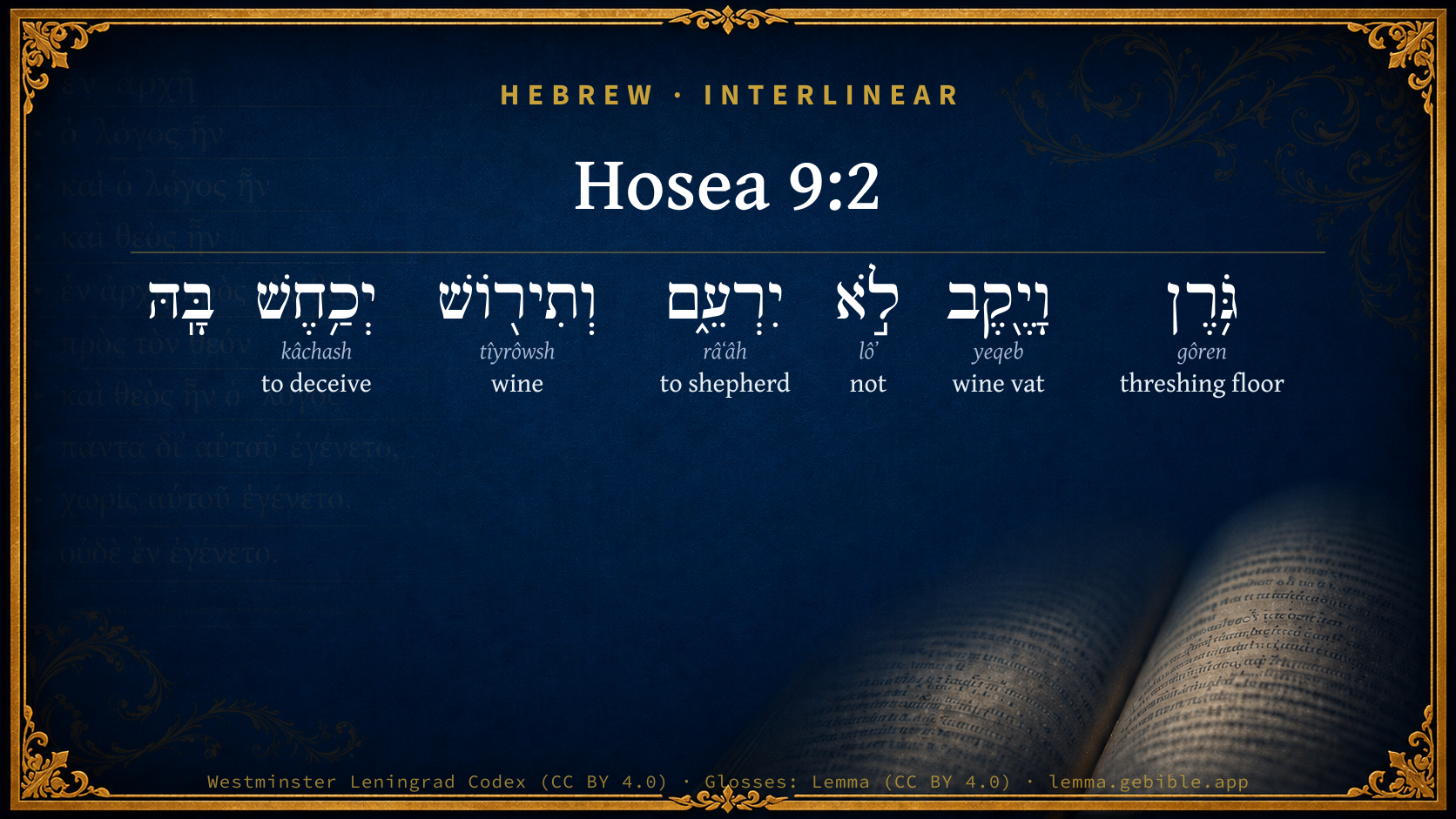
Hosea 9:2

Hebrew (Westminster Leningrad Codex) Hosea 9:2 appears in the Hebrew Old Testament. The text above is from the Westminster Leningrad Codex. Each word links to its Strong’s number, a concise gloss, and parsing drawn from the Open Scriptures Hebrew Bible morphology. Click any word for its full Brown-Driver-Briggs (BDB) entry.
Download image
Cite this verse

Hosea 9:2 (World English Bible). Public Domain. Lemma interlinear Bible study tool, https://lemma.gebible.app/v/hosea/9/2.

Show BibTeX & RIS
BibTeX
RIS
English Translation
The threshing floor and the winepress won't feed them, And the new wine will fail her.
World English Bible · Public Domain
Download a study sheet

One document with this verse’s original text, its word-by-word gloss line, the meaning frame, cross-references with their text, attributed commentary, and full source and license credits — printable, and it pastes into notes with its structure intact.

This verse Autodidact and up

Study sheet (.html) Plain text (.txt)

A passage Seminary Student

Up to 50 verses in one chapter. A passage sheet keeps up to 6 commentary sources and 12 cross-references per verse, in the order this page ranks them, and says so on the sheet whenever that leaves anything out. Ask for a single verse and you get the Autodidact verse sheet above.

Everything on this page stays free to read, with no account — the sheet is a download of what is already on screen, not access to it.

Want to remove ads? Support Godless Engineer
Compare translations 3

The same verse in 3 English versions, stacked beneath the original-language interlinear above. Click any original word for its lexicon entry.

Each is an independent rendering of the whole verse — the interlinear is not word-aligned to these translations.

Highlighted words mark where these versions differ — a whole-verse word diff, not a word-by-word alignment.

  • World English Bible Public Domain
    The threshing floor and the winepress won't feed them, And the new wine will fail her.
  • King James Version Public Domain
    The floor and the winepress shall not feed them, and the new wine shall fail in her.
  • unfoldingWord Literal Text CC BY-SA 4.0
    The threshing floor and the winepress will not feed them, and the new wine will fail her.

unfoldingWord Literal Text — © unfoldingWord, licensed CC BY-SA 4.0. Word-aligned USFM3 via Door43 (git.door43.org/unfoldingWord/en_ult).

Versions to compare (up to 4)

3 of 4 selected

Show all 18 translations

Every available English version of this verse, each an independent rendering of the whole verse.

  • World English Bible Public Domain
    The threshing floor and the winepress won't feed them, And the new wine will fail her.
  • Berean Standard Bible Public Domain
    The threshing floor and winepress will not feed them, and the new wine will fail them.
  • Majority Standard Bible Public Domain
    The threshing floor and winepress will not feed them, and the new wine will fail them.
  • King James Version Public Domain
    The floor and the winepress shall not feed them, and the new wine shall fail in her.
  • American Standard Version (1901) Public Domain
    The threshing-floor and the winepress shall not feed them, and the new wine shall fail her.
  • Revised Version (1885) Public Domain
    The threshing-floor and the winepress shall not feed them, and the new wine shall fail her.
  • Geneva Bible (1599) Public Domain
    The floore, and the wine presse shall not feede them, and the newe wine shall faile in her.
  • Douay-Rheims (1899) Public Domain
    The floor and the winepress shall not feed them, and the wine shall deceive them.
  • Young's Literal Translation Public Domain
    Floor and wine-press do not delight them, And new wine doth fail in her,
  • Literal Standard Version CC BY-SA 4.0
    Floor and winepress do not feed them, || And new wine fails in her,
  • Unlocked Literal Bible CC BY-SA 4.0
    But the threshing floor and the winepress will not feed them; the new wine will fail them.
  • unfoldingWord Literal Text CC BY-SA 4.0
    The threshing floor and the winepress will not feed them, and the new wine will fail her.
  • Darby Bible Public Domain
    The floor and the winepress shall not feed them, and the new wine shall fail her.
  • World Messianic Bible Public Domain
    The threshing floor and the wine press won’t feed them, and the new wine will fail her.
  • Webster's Bible Public Domain
    The floor and the wine-press shall not feed them, and the new wine shall fail in her.
  • Free Bible Version CC BY-SA 4.0
    Your threshing floors and winepresses will not feed you; the land will fail to produce your new wine.
  • Bible in Basic English Public Domain
    The grain-floor and the place where the grapes are crushed will not give them food; there will be no new wine for them.
  • JPS Tanakh (1917) Public Domain
    The threshing-floor and the wine-press shall not feed them, and the new wine shall fail her.

Literal Standard Version (2020), Covenant Press — licensed CC BY-SA 4.0. Text via the HelloAO Bible API (eBible.org). Unlocked Literal Bible (unfoldingWord) — licensed CC BY-SA 4.0. Text via the HelloAO Bible API (eBible.org). unfoldingWord Literal Text — © unfoldingWord, licensed CC BY-SA 4.0. Word-aligned USFM3 via Door43 (git.door43.org/unfoldingWord/en_ult). Free Bible Version, Dr. Jonathan Gallagher — licensed CC BY-SA 4.0. Text via the HelloAO Bible API (eBible.org).

Word by word

More ways to search: Search by grammar → Find every occurrence → Compare this word →

Practice this passage: Drill this verse → Learn its vocabulary →

About this verse

These counts appear in no published source. They are computed here, from the morphology-tagged text and Lemma’s own curated glosses. What Lemma adds →

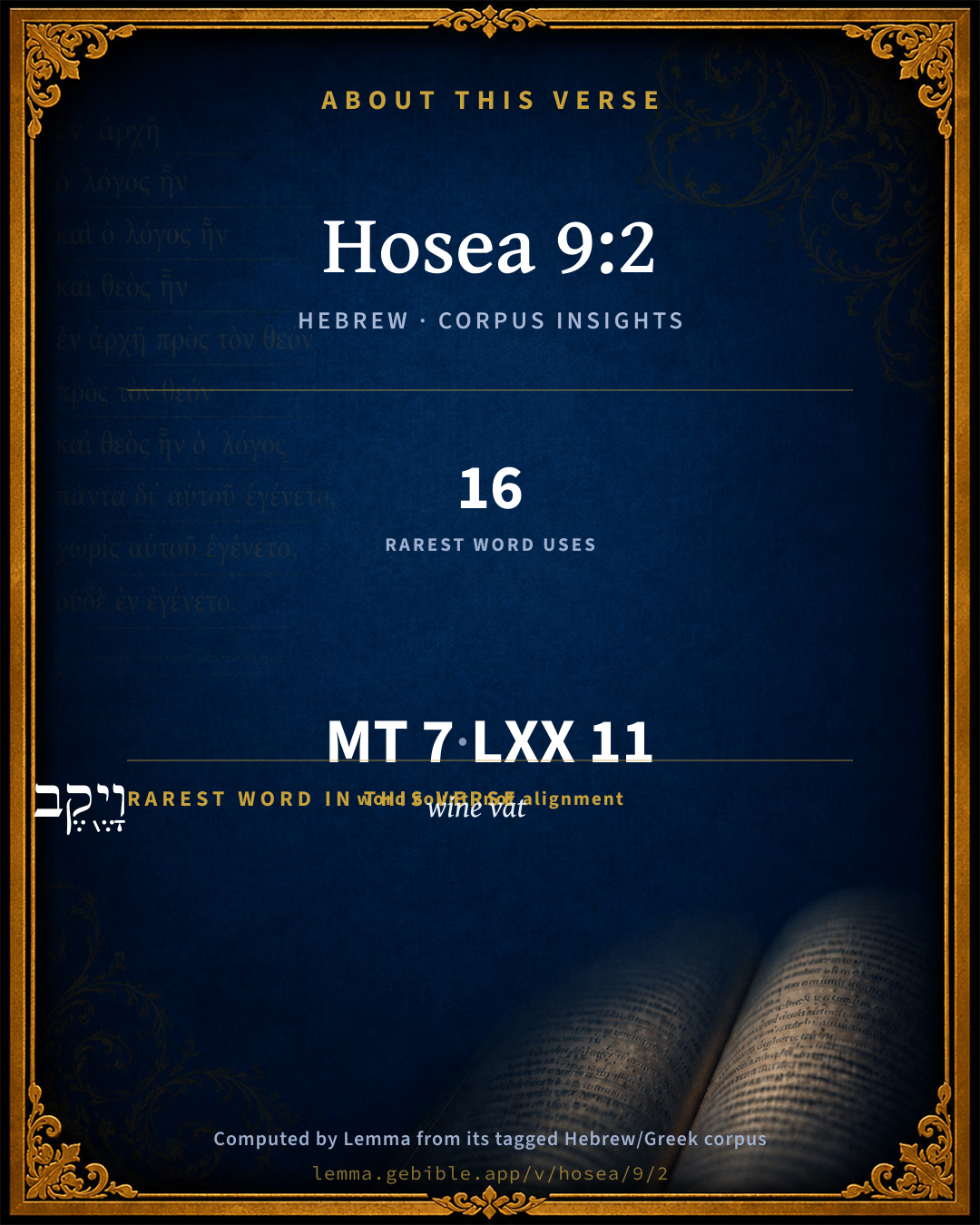
7
words
6
distinct lemmas
Prophets
section

Notable vocabulary

The rarest word here is וָיֶ֖קֶב wine vat H3342 — appearing just 16 times in the whole Hebrew Bible.

Shared distinctive vocabulary

וָיֶ֖קֶב wine vat H3342 occurs in 16 verses of the Hebrew Bible. Also found in:

Grammatical profile

  • 2 verbs
  • 3 nouns
  • 1 preposition
  • 1 particle

Verb forms

  • יִרְעֵ֑ם Qal · Imperfect
  • יְכַ֥חֶשׁ Piel · Imperfect

Hebrew & Septuagint length

In English translation the verse runs 16 words from the Hebrew and 13 from the Septuagint (LXX English) — closely comparable.

A rough comparison of the two English renderings, which tokenize alike — not a word-level alignment.

Word counts can differ between the Hebrew and the Greek without any difference in meaning — e.g. the Hebrew direct-object marker אֵת has no separate Greek word, and Greek often adds the article ὁ.

In the original languages it is 7 Hebrew tokens and 11 Greek tokens — but the two are counted differently (Hebrew bundles its prefixes and suffixes into one token; the Greek is in lemma form), so that isn’t a like-for-like length.

Cross-references

9

Topical passages linked to Hosea 9:2 in the Treasury of Scripture Knowledge — connected by theme and wording, ordered by reader-vote popularity; previews shown in the World English Bible.

  • Hosea 2:9 Therefore I will take back my grain in its time, And my new wine in its season, And will pluck away my wool and my flax which should have covered her nakedness.
  • Isaiah 24:7–12 The new wine mourns, the vine languishes, all the merry-hearted do sigh.
  • Hosea 2:12 I will lay waste her vines and her fig trees, About which she has said, 'These are my wages that my lovers have given me; And I will make them a forest,' And the animals of the field shall eat them.
  • Joel 1:3–7 Tell your children about it, And have your children tell their children, And their children, another generation.
  • Joel 1:9–13 The meal offering and the drink offering are cut off from Yahweh's house. The priests, Yahweh's ministers, mourn.
  • Amos 4:5–11 Offer a sacrifice of thanksgiving of that which is leavened, And proclaim free will offerings and brag about them: For this pleases you, you children of Israel," says the Lord Yahweh.
  • Micah 6:13–16 Therefore I also have struck you with a grievous wound. I have made you desolate because of your sins.
  • Haggai 1:9 "You looked for much, and, behold, it came to little; and when you brought it home, I blew it away. Why?" says Yahweh of Hosts, "Because of my house that lies waste, while each of you is busy with his own house.
  • Haggai 2:16 Through all that time, when one came to a heap of twenty measures, there were only ten. When one came to the wine vat to draw out fifty, there were only twenty.

Cross-references courtesy of OpenBible.info (CC BY 4.0).

Hebrew and Greek witnesses Masoretic Hebrew ↔ Greek Septuagint

The same verse in the two great witnesses to the Old Testament, shown verse-for-verse.

These are two independent witnesses, not word-aligned to each other, and the Septuagint is shown in lemma (dictionary) form.

Hebrew Hosea 9:2 Masoretic · Westminster Leningrad Codex

גֹּ֥רֶן וָיֶ֖קֶב לֹ֣א יִרְעֵ֑ם וְתִיר֖וֹשׁ יְכַ֥חֶשׁ בָּֽהּ

The threshing floor and the winepress won't feed them, And the new wine will fail her.

World English Bible · Public Domain

Greek LXX Hosea 9:2 Septuagint · lemma form

ἅλων καί ληνός οὐ γιγνώσκω αὐτός καί ὁ οἶνος ψεύδω αὐτός

The threshing floor and wine-press knew them not, and the wine disappointed them.

LXX2012 (modern English Septuagint) · Public Domain

On this verse, Whedon's Commentary on the Bible discusses the Septuagint’s reading. Read the note in Commentary ↓

Hebrew: Westminster Leningrad Codex (CC BY 4.0). Greek: Septuagint (public domain); English from LXX2012 (modern English Septuagint) (Public Domain). How the Septuagint differs from the Hebrew →

Targum (Aramaic paraphrase)

1

The Targum is the ancient Jewish Aramaic paraphrase of the Hebrew Scriptures — an interpretive translation, not the Hebrew text itself. Onkelos (literal) and Pseudo-Jonathan (expansive) render the Torah, and Jonathan the Prophets. Coverage is partial: where no permissively-licensed English translation exists for a verse, only the Aramaic is shown. This is verse-level text, not a word-by-word alignment to the Hebrew.

  1. Targum Jonathan Prophets (Joshua–Malachi)
    מֵאִידְרָא וּמִמַעֲצַרְתָּא לָא יִתְזוּנוּן וְחַמְרָא לָא יְסוֹפֵיק לְהוֹן:

    (no public-domain English translation for this verse)

    Targum Jonathan — Aramaic: “Mikraot Gedolot” (public domain). English: “Sefaria Community Translation” (CC0 1.0 (public-domain dedication)); “London "Chaldee Paraphrase," 1871” (public domain). Text via Sefaria.

Commentary

Notes on Hosea 9:2 from classic Christian and Jewish commentators (each source and its license shown beneath its notes). The classic Christian expositions comment on the surrounding passage and are grouped to its opening verse, so a note may address several verses; the Jewish commentaries on the Tanakh (Rashi and others) are per-verse, so they appear only where the commentator wrote on this verse.

Lemma curates 59 commentaries, every one of them public domain or Creative Commons licensed, each selected and text-cleaned for this edition rather than reprinted as found. About our sources →

Trapp's Complete Commentary

John Trapp

Hos 9:2 The floor and the winepress shall not feed them, and the new wine shall fail in her.

Ver. 2. The floor and the winepress shall not feed them] Culpam poena premit comes, Punishment attendeth sin at the heels. They had abused their plenty, and ascribed it to their idols; therefore shall they be cut short either in their store, as Hab 3:6; Hab 3:10; Hab 2:16, or in their strength, as Hos 4:10; Hos 8:7. {see Hos 2:8-9, with the notes} One way or other their hopes shall be frustrated, the creature shall lie to them, and not answer their expectation.

The new wine shall fail in her] Mustum mentietur ei: see the like phrase, Hab 3:17 Isa 58:11 Job 41:6 : they shall come to the grain floors and winepresses, as men come to a lottery with heads full of hopes; but depart disappointed, with their hearts full of blanks. As they have lied to God (idolatry is nothing else but a large lie), and dealt deceitfully with him in the covenant, so shall all things lie to them, and not answer their hopes. Look how a certain prince paid a false traitor, who for a sum of money had betrayed his country to him, in false coin; so shall it fare with such as falsify with God; he will blast their hopes, and curse their blessings, cut them short in the height of their expectancies, strike them in the things that their hearts are most set upon, the new wine shall lie to them, and so set them a howling, Joe 1:5.

John Trapp, A Commentary or Exposition upon All the Books of the Old and New Testament (1647–1656) — public domain. Text from a community e-Sword module.

Whedon's Commentary on the Bible

Daniel D. Whedon

2. Faithlessness to Jehovah will be punished by a withdrawal of the divine gifts (Hos_2:9).

Wine press — The Hebrew word denotes not the press in which the grapes are pressed out, but the receptacle into which flows the juice after the grapes are crushed (see on Joe_2:24). Threshing floor — where the grain is stored as well as threshed out — and winepress stand for grain and wine.

New wine — See on Hos_4:11.

Feed them — LXX., with a change of one consonant, “know them.”

Fail in her — Better R.V., “fail her,” that is, Israel. The change to a feminine pronoun would have to be explained by the representation of Israel as a harlot (Hos_4:19). It should be noted, however, that all the versions read the plural, as in the first clause. Changes from the second person (Hos_9:1) to the third person (Hos_9:2) are not uncommon in prophetic discourse. For the thought compare Amo_5:11; Isa_5:10.

The manner in which Jehovah will execute the judgment is indicated in Hos_9:3. Israel is to be removed from the land.

Egypt — See on Hos_8:13. The other power upon which Israel relies for help, Assyria (Hos_7:11; Hos_8:9), will also be a means of Israel’s destruction.

Jehovah’s land — The land in which Israel now dwells. So long as primitive religious conceptions prevailed in Israel Palestine was thought to be the land of Jehovah in much the same sense in which Moab was the land of Chemosh or Ammon the land of Milcom (Jdg_11:23-24). Outside of Israel Jehovah was powerful only as he went to the assistance of his people Israel against another people and its deity. Even to David exile from the land meant inability to worship Jehovah (1Sa_26:19; compare Jon_1:3). The eighth century prophets had a broader conception of Jehovah; he controlled other nations as well as Israel (Amo_1:3 to Amo_2:3; Amo_9:7), though they never ceased to believe that Jehovah had a peculiar interest in the Hebrews. Nevertheless, in several places passages are found which imply that the common people continued to cling to the narrower view. Thus may be explained the latter part of this verse.

Unclean things [“food”] — Not food which was per se ceremonially unclean, but food which was unclean because the land in which it was eaten was unclean (Amo_7:17; Eze_4:13); and the land was unclean because Jehovah could not properly be worshiped there (compare 2Ki_5:17).

To a people so scrupulous about the fulfillment of the ceremonial requirements one of the greatest calamities of life in exile would be the inability to continue properly the external forms of worship. This calamity the prophet brings before them in vivid colors in Hos_9:4. Whether the prophet himself shared the common notion, or whether he simply used these expressions because they would present the climax of calamity to the minds of those whom he was anxious to influence, is not made clear; that Hosea conceived of the sway of Jehovah as extending over nations outside of Israel cannot be doubted. Offer [“pour out”] wine offerings to Jehovah — Drink offerings will cease (see on Joe_1:9).

Neither shall they (the wine offerings) be pleasing unto him — Margin of R.V., which connects the words differently, reproduces more accurately the Hebrew, “neither shall their sacrifices be pleasing unto him.” This presupposes the bringing of sacrifice, only it will not be acceptable to Jehovah. But the first as well as the last clause of the verse states that certain offerings shall be discontinued. The same is implied in the whole verse; Hos_3:4, also teaches that sacrifice is to be entirely discontinued in exile. To remove this apparent contradiction scholars generally accept the emendation first suggested by Kuenen, and read, with a change of one single consonant, “neither shall they prepare for him their sacrifices.”

Their sacrifices shall be unto them as the bread of mourners — That is, unclean. The bread of mourning is the bread eaten during the seven days of mourning (Deu_26:14) and at funeral meals. Everyone coming near a dead person is unclean for seven days (Num_19:14), and everything such an unclean person touches, even his food, becomes unclean (Num_19:22); anyone eating this unclean food shares the uncleanness.

Their bread for their soul — The last word means also appetite, so R.V., “shall be for their appetite”; sometimes it is even used in the place of the pronoun — “for themselves.” Whichever rendering is adopted, the thought remains the same. Part of the bread (or food) was presented to Jehovah in the form of first fruits, offerings, or tithes, and thus it assisted in securing the divine favor; a part was used to satisfy the hunger of the owner. In the exile there will be no sanctuary, and offerings cannot be brought; the food cannot be used to secure or maintain the divine favor; it serves only to satisfy physical hunger.

House of Jehovah — Any sanctuary consecrated to Jehovah.

Daniel D. Whedon (gen. ed.), Commentary on the Old and New Testaments (1874–1909) — public domain. Text from a community e-Sword module.

Tyndale Open Study Notes

Tyndale Open Resources

9:2 As punishment for their prostitution, the Lord would so reduce the Israelites’ harvests that they would go hungry (cp. Hag 1:3-11).

Tyndale Open Study Notes — © Tyndale Open Resources, licensed CC BY-SA 4.0. Text via the HelloAO Bible API.

Geneva Bible (1599)

Geneva Bible translators

These outward things that thou seekest, shall be taken from thee.

Geneva Bible (1599) marginal notes — public domain. Text via Bolls.life.

Jamieson, Fausset & Brown

Robert Jamieson, A. R. Fausset & David Brown

(Hos 2:9, Hos 2:12).

fail--disappoint her expectation.

Jamieson, Fausset & Brown — Commentary Critical and Explanatory on the Whole Bible (1871) — public domain (CC PDM 1.0). Text via the HelloAO Bible API.

John Calvin's Commentaries

God now denounces such a punishment as the Israelites deserved. They had been drawn away, as we have said, from the pure worship of God by allurements; they hoped for more profit from superstitions. Hence God shows, that he would on this account punish them by taking away from them their wine and corn, as we have already noticed in Hosea 2: for it is the only way by which the Lord restores men to a sane mind, or at least renders them inexcusable, to deprive them of his blessings. The harlot, as long as gain is to be had, as long as she surpasses all honest and chaste matrons in her dress and mode of living, is pleased with herself and blinded by her own splendour; but when she is reduced to extreme want, when she sees herself to be the laughing-stock of all, and when she drags a miserable life in poverty, she then sighs and owns how infatuated she had been in leaving her husband. So the Lord now declares by his Prophet, that he would thus deal with the Israelites, that they might no longer please themselves with such delusions.

Hence he says, The floor and the wine-press shall not feed them, and the new wine shall disappoint them, (mentietur illis — shall lie to them;) — that is, the vineyards shall not answer their expectation. It is the same as though he said, “As these men regard only their stomach, as they deem nothing of any moment but provision, therefore the floor and the wine-press shall not feed them; I will deprive them of their support, that they may understand that they in vain worship false gods.” Let us take a common similitude: We see some boys so disingenuous as not to be moved either by disgrace or even by stripes; but as they are subject to the cravings of appetite, when the father deprives them of bread, they nearly lose all hope. Stripes do no good, all warnings are slighted; but when the boy who loves excess sees that bread is denied him, he finds out that his father’s displeasure ought to be feared. Thus God corrects men addicted to excessive indulgence; for they are so insensible, that no other remedy can do them any good.

We now, then, apprehend the meaning of the Prophet. He first reproaches the Israelites for loving a reward, for hastening after fictitious gods, that they might glut themselves with great abundance of things: but when the Lord saw that they had become stupefied in their fatness, he said, “I will deprive them of all their provisions; neither wine nor wheat shall be given them; this want will at length drive them to repentance.” We hence see how the Lord deals with men according to their disposition. And his manner of speaking ought to be noticed; he says, that neither the floor nor the wine-press shall feed them. He does not say, that the fields shall be barren; he does not say, that he would send hail or storm; but he says, that neither the floor nor the wine-press shall feed them; and further, that the new wine shall disappoint them; that is, when they shall think themselves to be blessed with all plenty, when the harvest shall appear abundant, and when they shall have already, by anticipation, swallowed up the large produce of their vineyards, all this shall come to nothing; for neither the floor nor the wine-press shall feed them; nay, the very wine which they thought to have been prepared shall disappoint them. It follows —

John Calvin's Commentaries (1540-1563) — public domain. Text from the Calvin Translation Society English edition (1840s-50s) via the Christian Classics Ethereal Library (ccel.org). Calvin's coverage is partial (roughly two-thirds of the Bible); uncommented books and verses are honest gaps, never fabricated. The 19th-century editor's footnotes and remarks are omitted so the notes are faithfully Calvin's own voice.

Ellicott's Commentary for English Readers

(2) Winepress.—Read wine-vat (with margin), into which the tîrôsh, new wine (“ grape-juice “), flowed from the winepress. (Comp. Isa_5:2.) For “fail in her” read deceive her, with LXX. and Vulgate.

A Bible Commentary for English Readers, edited by Charles John Ellicott (1878–1897) — public domain. Text from a community e-Sword module.

The Cambridge Bible for Schools and Colleges

gen. ed. J. J. S. Perowne

2. the winepress] Rather, the vat (within the press) into which the grape-juice or the oil flowed; comp. Joe_2:24.

shall fail in her] Rather, shall fall her (lit. ‘shall lie unto her’, as Hab_3:17). There is a good various reading (supported by the versions and by the Babylonian codex) ‘in them’, but the same interchange of pronouns occurs in Hos_4:19. Idolatrous Israel is personified as a harlot. Wine-drinking was, in fact, so closely connected with the customs of idolatry (comp. Jdg_9:27; Amo_2:8), that the Nazirites bound themselves by a vow of ‘total abstinence’ (Num_6:3).

The Cambridge Bible for Schools and Colleges (gen. ed. J. J. S. Perowne; Cambridge University Press, 1878–1918) — public domain. Text from a community e-Sword module.

John Gill's Exposition

The floor and the winepress shall not feed them,.... Though their expectations from their worship of idols were large, they should find themselves mistaken; for there would not be a sufficiency of corn on the floor, nor of wine in the press, to supply them with what was necessary for their sustenance; either through a blight upon their fields and vineyards, or through the invasion of an enemy, treading them down, and spoiling and foraging them: or else supposing a sufficient quantity of corn and wine got in; yet those blessings should be either turned into curses, or carried off by the enemy, that they should do then, no good; or if they enjoyed them, yet they should receive no nourishment from them; but should become lean, and look like starved and famishing creatures in the midst of plenty; by all which it would appear that their idols could neither give them a sufficiency of provisions, nor make those nourishing to them they had:

and the new wine shall fail in her; in the congregation or land of Israel: or, "shall lie to her" (s); shall not answer their expectations, but disappoint and deceive them; whereas they expected great plenty from the promising prospect of the vines, these by one means or another should be destroyed, so that they would yield but little, and balk them; see Hab 3:17.

(s) "mentietur in ea", Pagninus, Montanus, Zanchius; "mentietur isti", Junius & Tremellius, Piscator, Liveleus, Schmidt.

John Gill's Exposition of the Whole Bible (1746–1763) — public domain (CC PDM 1.0). Text via the HelloAO Bible API.

Albert Barnes' Notes on the Bible

The floor and winepress shall not feed them - God turneth away wholly from the adulterous people, and telleth others, how justly they shall be dealt with first for this. “Because she loved My reward, and despised Myself, the reward itself shall be taken away from her.” When the blessings of God have been abused to sin, He, in mercy and judgment, takes them away. He cut them off, in order to show that He alone, who now withheld them, had before given them. When they thought themselves most secure, when the grain was stored on the floor, and the grapes were in the press, then God would deprive them of them.

And the new wine shall fail in her, or shall fail her - Literally, “shall lie to her.” It may be, he would say, that as Israel had lied to his God, and had “spoken lies against Him” Hos 7:13, so, in requital, the fruits of the earth should disappoint her, and holding out hopes which never came to pass, should, as it were, lie to her, and in the bitterness of her disappointment, represent to her her own failure to her God. The prophet teaches through the workings of nature, and gives, as it were, a tongue to them .

Albert Barnes' Notes on the Bible (1834–1885) — public domain. Text from a community e-Sword/MySword module.

Haydock's Catholic Bible Commentary

Deceive. The grapes shall yield no wine. (Calmet) --- Spem mentita seges. (Horace ii. ep. 2. and 3. ode 1. and 16.)

George Leo Haydock (1774–1849), Haydock's Catholic Family Bible and Commentary, 1859 edition — public domain. Excludes Psalms (Douay-Rheims chapter numbering differs from Protestant) and Deuterocanonical books (Catholic canon only).

Matthew Poole's English Annotations

The floor; the corn which is gathered into the floor and that is threshed there, that plenty which these sottish idolaters have, and think they have it from their idols, the bread they eat. For here the floor is put for the corn, and the bread made of it.

The wine-press, by the same figure, put for the wine that is pressed out in it; though there is great plenty, and the vats overflow as well as the press full.

Shall not feed them; all this plenty shall not nourish and strengthen them. Since they think their idols give them their corn and wine, let them give also, what I will not give, a blessing on these that they may support and refresh them; they shall be lean and half-starved in their plenty unless their idols can do this for them, i.e. bless their food.

Them, who seek to idols for corn and wine, and praise their idols as givers of it. These I will blast, their provision shall be as theirs, Hag 1:6.

The new wine shall fail in her; or lie unto her, or fail her expectation. Samaria and all Israel expect a fair and full vintage, but they expect it from their idols, which are a doctrine of lies, and in this, as in all other, will lie.

Matthew Poole's English Annotations on the Holy Bible (1683–1685) — public domain. Text from a community e-Sword/MySword module.

The Pulpit Commentary

The floor and the wine-press shall not feed them, and the new wine shall fail in her. Thus Israel was not to enjoy the blessings of the harvest; the corn and oil and new wine, or corn and wine, would not prove as abundant as they expected or plenty would be succeeded by scarcity; or, rather, the people would be prevented enjoying the abundant produce of their land in consequence of being carried away captive to Assyria, as seems implied in the following verse. The floor and press whether wine-prom, or rather oil-press, as the mention of new wine follows are put for their contents by a common figure of speech. The expression, "fail in her," is literally, "lie to her," and has many parallels; as, "The labor of the olive shall fail margin, "lie," and Horace"s "fundus mendax," equivalent to "a farm that belies his hopes."

The Pulpit Commentary (1880–1919), ed. H.D.M. Spence-Jones & Joseph S. Exell — public domain. Text from a community e-Sword module.

John Wesley's Explanatory Notes

The floor - The corn which is gathered into the floor. The wine- press - The wine that is prest out in it. Shall not feed - Shall not nourish and strengthen the idolaters. Shall fail - Samaria and all Israel expect a full vintage, but they expect it from their idols, and therefore shall be disappointed.

John Wesley, Explanatory Notes Upon the Whole Bible (1754–1765) — public domain. Text via the GEBible commentary corpus.

Lesson kit

Teaching starters — assembled from the data on this page, not authored interpretation. Every prompt links to the verse data it draws on. Edit before teaching.

Hosea, in the Prophets, opens this verse with 7 words (6 distinct Hebrew lemmas). Its most distinctive word is yeqeb (“wine vat”). A historical commentator’s framing appears above. Read the whole chapter for the surrounding context.

Discussion questions

  1. How does “wine vat” (yeqeb) shape what this verse is saying?
  2. How does Numbers 18:27, which shares the word «wine vat», read alongside this verse?
  3. These translations render this verse differently. What is at stake in choosing one wording over another?
  4. «יִרְעֵ֑ם» is a Qal Imperfect verb. How does that grammatical form shape the action described?
  5. Compare how Trapp's Complete Commentary and Whedon's Commentary on the Bible read this verse. Where do they agree or differ?

Things to notice

Reading settings

Reading text

Shown beneath each verse's original-language words.

Old Testament
Old Testament edition

Read the OT as the Masoretic Hebrew (MT) or the Greek Septuagint (LXX).

English shown for the Greek Septuagint (in the Hebrew ↔ Greek comparison).

Comparing translations? Open the Compare panel on any verse page to stack up to four side by side.