Jeremiah 25:36

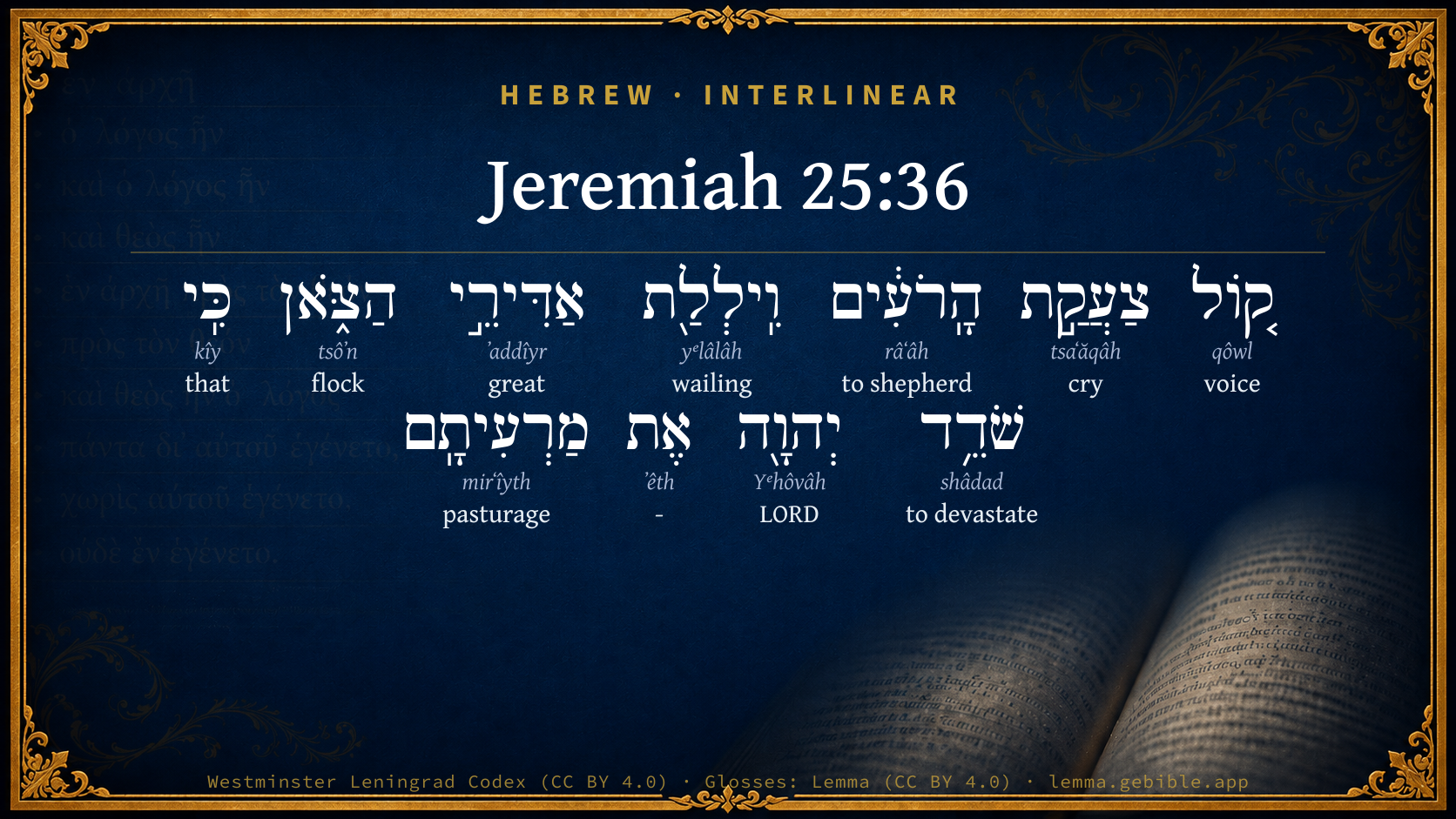
Hebrew (Westminster Leningrad Codex) Jeremiah 25:36 appears in the Hebrew Old Testament. The text above is from the Westminster Leningrad Codex. Each word links to its Strong’s number, a concise gloss, and parsing drawn from the Open Scriptures Hebrew Bible morphology. Click any word for its full Brown-Driver-Briggs (BDB) entry.
Download image
Cite this verse

Jeremiah 25:36 (World English Bible). Public Domain. Lemma interlinear Bible study tool, https://lemma.gebible.app/v/jeremiah/25/36.

Show BibTeX & RIS
BibTeX
RIS
English Translation
A voice of the cry of the shepherds, and the wailing of the principal of the flock! for Yahweh lays waste their pasture.
World English Bible · Public Domain
Download a study sheet

One document with this verse’s original text, its word-by-word gloss line, the meaning frame, cross-references with their text, attributed commentary, and full source and license credits — printable, and it pastes into notes with its structure intact.

This verse Autodidact and up

Study sheet (.html) Plain text (.txt)

A passage Seminary Student

Up to 50 verses in one chapter. A passage sheet keeps up to 6 commentary sources and 12 cross-references per verse, in the order this page ranks them, and says so on the sheet whenever that leaves anything out. Ask for a single verse and you get the Autodidact verse sheet above.

Everything on this page stays free to read, with no account — the sheet is a download of what is already on screen, not access to it.

Want to remove ads? Support Godless Engineer
Compare translations 3

The same verse in 3 English versions, stacked beneath the original-language interlinear above. Click any original word for its lexicon entry.

Each is an independent rendering of the whole verse — the interlinear is not word-aligned to these translations.

Highlighted words mark where these versions differ — a whole-verse word diff, not a word-by-word alignment.

  • World English Bible Public Domain
    A voice of the cry of the shepherds, and the wailing of the principal of the flock! for Yahweh lays waste their pasture.
  • King James Version Public Domain
    A voice of the cry of the shepherds, and an howling of the principal of the flock, shall be heard: for the LORD hath spoiled their pasture.
  • unfoldingWord Literal Text CC BY-SA 4.0
    the sound of the cry of the shepherds and the wailing of the nobles of the flock, for Yahweh is destroying their pasture.

unfoldingWord Literal Text — © unfoldingWord, licensed CC BY-SA 4.0. Word-aligned USFM3 via Door43 (git.door43.org/unfoldingWord/en_ult).

Versions to compare (up to 4)

3 of 4 selected

Show all 18 translations

Every available English version of this verse, each an independent rendering of the whole verse.

  • World English Bible Public Domain
    A voice of the cry of the shepherds, and the wailing of the principal of the flock! for Yahweh lays waste their pasture.
  • Berean Standard Bible Public Domain
    Hear the cry of the shepherds, the wailing of the leaders of the flock, for the LORD is destroying their pasture.
  • Majority Standard Bible Public Domain
    Hear the cry of the shepherds, the wailing of the leaders of the flock, for the LORD is destroying their pasture.
  • King James Version Public Domain
    A voice of the cry of the shepherds, and an howling of the principal of the flock, shall be heard: for the LORD hath spoiled their pasture.
  • American Standard Version (1901) Public Domain
    A voice of the cry of the shepherds, and the wailing of the principal of the flock! for Jehovah layeth waste their pasture.
  • Revised Version (1885) Public Domain
    A voice of the cry of the shepherds, and the howling of the principal of the flock! for the LORD layeth waste their pasture.
  • Geneva Bible (1599) Public Domain
    A voyce of the crye of the shepherdes, and an howling of the principall of the flocke shalbe heard: for the Lord hath destroyed their pasture.
  • Douay-Rheims (1899) Public Domain
    A voice of the cry of the shepherds, and a howling of the principal of the flock: because the Lord hath watsed their pastures.
  • Young's Literal Translation Public Domain
    A voice `is' of the cry of the shepherds, And a howling of the honourable of the flock, For Jehovah is spoiling their pasture.
  • Literal Standard Version CC BY-SA 4.0
    A voice of the cry of the shepherds, || And a howling of the majestic of the flock, || For YHWH is spoiling their pasture.
  • Unlocked Literal Bible CC BY-SA 4.0
    Hear the cries of the shepherds and the wails of the leaders of the flock, for Yahweh is destroying their pastures.
  • unfoldingWord Literal Text CC BY-SA 4.0
    the sound of the cry of the shepherds and the wailing of the nobles of the flock, for Yahweh is destroying their pasture.
  • Darby Bible Public Domain
    There shall be a voice of the cry of the shepherds, and a howling of the noble ones of the flock: for Jehovah layeth waste their pasture;
  • World Messianic Bible Public Domain
    A voice of the cry of the shepherds, and the wailing of the leader of the flock, for the LORD destroys their pasture.
  • Webster's Bible Public Domain
    A voice of the cry of the shepherds, and a howling of the principal of the flock, shall be heard: for the LORD hath laid waste their pasture.
  • Free Bible Version CC BY-SA 4.0
    Listen to the cries of the shepherds, the weeping of the leaders of the flock, for the Lord is destroying their pasturelands.
  • Bible in Basic English Public Domain
    A sound of the cry of the keepers of sheep, and the bitter crying of the chiefs of the flock! for the Lord has made waste their green fields.
  • JPS Tanakh (1917) Public Domain
    Hark! the cry of the shepherds, and the wailing of the leaders of the flock! For the LORD despoileth their pasture.

Literal Standard Version (2020), Covenant Press — licensed CC BY-SA 4.0. Text via the HelloAO Bible API (eBible.org). Unlocked Literal Bible (unfoldingWord) — licensed CC BY-SA 4.0. Text via the HelloAO Bible API (eBible.org). unfoldingWord Literal Text — © unfoldingWord, licensed CC BY-SA 4.0. Word-aligned USFM3 via Door43 (git.door43.org/unfoldingWord/en_ult). Free Bible Version, Dr. Jonathan Gallagher — licensed CC BY-SA 4.0. Text via the HelloAO Bible API (eBible.org).

Word by word

More ways to search: Search by grammar → Find every occurrence → Compare this word →

Practice this passage: Drill this verse → Learn its vocabulary →

וִֽילְלַ֖ת
yᵉlâlâh
H3215
“and · wailing of”
Conjunction + Noun, Common, Feminine, Singular, Construct
Part of Speech
Conjunction + Noun
Type
Common
Gender
Feminine
Number
Singular
State
Construct
Full BDB Definition

Origin: from H3214

TWOT: 868b

a howling (of distress), wailing
  1. ק֚וֹל qôwl H6963 “voice of” Noun, Common, Masculine, Singular, Construct
  2. צַעֲקַ֣ת tsaʻăqâh H6818 “cry of” Noun, Common, Feminine, Singular, Construct
  3. הָֽרֹעִ֔ים râʻâh H7462 “the · shepherding” Particle, Definite Article + Verb, Qal, Participle Active, Masculine, Plural, Absolute
  4. אַדִּירֵ֣י ʼaddîyr H117 “great of” Adjective, Adjective, Masculine, Plural, Construct
  5. הַצֹּ֑אן tsôʼn H6629 “the · flock” Particle, Definite Article + Noun, Common, Both, Singular, Absolute
  6. כִּֽי kîy H3588 “that” Conjunction
  7. שֹׁדֵ֥ד shâdad H7703 “devastating” Verb, Qal, Participle Active, Masculine, Singular, Absolute
  8. יְהוָ֖ה Yᵉhôvâh H3068 “LORD” Noun, Proper
  9. אֶת ʼêth H853 “-” Particle, Direct Object
  10. מַרְעִיתָֽם mirʻîyth H4830 “pasturage · their” Noun, Common, Feminine, Singular, Construct + Suffix, Personal, 3rd Person, Masculine, Plural

About this verse

These counts appear in no published source. They are computed here, from the morphology-tagged text and Lemma’s own curated glosses. What Lemma adds →

11
words
11
distinct lemmas
Prophets
section

Notable vocabulary

The rarest word here is וִֽילְלַ֖ת wailing H3215 — appearing just 5 times in the whole Hebrew Bible.

Shared distinctive vocabulary

וִֽילְלַ֖ת wailing H3215 occurs in 4 verses of the Hebrew Bible. Also found in:

Grammatical profile

  • 2 verbs
  • 6 nouns
  • 1 adjective
  • 1 conjunction
  • 1 particle

Verb forms

  • הָֽרֹעִ֔ים Qal · Participle Active
  • שֹׁדֵ֥ד Qal · Participle Active

Cross-references

2

Topical passages linked to Jeremiah 25:36 in the Treasury of Scripture Knowledge — connected by theme and wording, ordered by reader-vote popularity; previews shown in the World English Bible.

  • Jeremiah 4:8 For this gird you with sackcloth, lament and wail; for the fierce anger of Yahweh hasn't turned back from us.
  • Jeremiah 25:34 Wail, you shepherds, and cry; and wallow [in ashes], you principal of the flock; for the days of your slaughter and of your dispersions are fully come, and you shall fall like a goodly vessel.

Cross-references courtesy of OpenBible.info (CC BY 4.0).

Hebrew and Greek witnesses Masoretic Hebrew ↔ Greek Septuagint

The same verse in the two great witnesses to the Old Testament, shown verse-for-verse.

These are two independent witnesses, not word-aligned to each other, and the Septuagint is shown in lemma (dictionary) form.

Hebrew Jeremiah 25:36 Masoretic · Westminster Leningrad Codex

ק֚וֹל צַעֲקַ֣ת הָֽרֹעִ֔ים וִֽילְלַ֖ת אַדִּירֵ֣י הַצֹּ֑אן כִּֽי שֹׁדֵ֥ד יְהוָ֖ה אֶת מַרְעִיתָֽם

A voice of the cry of the shepherds, and the wailing of the principal of the flock! for Yahweh lays waste their pasture.

World English Bible · Public Domain

Greek LXX Structure differs

In the Septuagint, Jeremiah is about an eighth shorter than the Hebrew and arranges its material differently — the Oracles Against the Nations (Hebrew chapters 46–51) appear in the middle of the Greek book, after 25:13. Because the chapter and verse boundaries do not line up, a verse-for-verse comparison with the Hebrew is not shown.

A verse-for-verse comparison isn’t shown here because the chapters and verses don’t line up. Switch to the LXX edition with the MT / LXX toggle above to read the Greek directly.

Hebrew: Westminster Leningrad Codex (CC BY 4.0). Greek: Septuagint (public domain); English from a public-domain English Septuagint. How the Septuagint differs from the Hebrew →

Targum (Aramaic paraphrase)

1

The Targum is the ancient Jewish Aramaic paraphrase of the Hebrew Scriptures — an interpretive translation, not the Hebrew text itself. Onkelos (literal) and Pseudo-Jonathan (expansive) render the Torah, and Jonathan the Prophets. Coverage is partial: where no permissively-licensed English translation exists for a verse, only the Aramaic is shown. This is verse-level text, not a word-by-word alignment to the Hebrew.

  1. Targum Jonathan Prophets (Joshua–Malachi)
    קַל צִוְחַת מַלְכַיָא וִילְלַת תַּקִיפֵי עַמָא אֲרֵי אַבֵּז יְיָ יַת עַמְהוֹן:

    (no public-domain English translation for this verse)

    Targum Jonathan — Aramaic: “Mikraot Gedolot” (public domain). English: “Sefaria Community Translation” (CC0 1.0 (public-domain dedication)); “London "Chaldee Paraphrase," 1871” (public domain). Text via Sefaria.

Commentary

Notes on Jeremiah 25:36 from classic Christian and Jewish commentators (each source and its license shown beneath its notes). The classic Christian expositions comment on the surrounding passage and are grouped to its opening verse, so a note may address several verses; the Jewish commentaries on the Tanakh (Rashi and others) are per-verse, so they appear only where the commentator wrote on this verse.

Lemma curates 59 commentaries, every one of them public domain or Creative Commons licensed, each selected and text-cleaned for this edition rather than reprinted as found. About our sources →

Trapp's Complete Commentary

John Trapp

Jer 25:36 A voice of the cry of the shepherds, and an howling of the principal of the flock, [shall be heard]: for the LORD hath spoiled their pasture.

Ver. 36. For the Lord hath spoiled their pastures,] i.e., Their kingdoms and states, or their flocks.

John Trapp, A Commentary or Exposition upon All the Books of the Old and New Testament (1647–1656) — public domain. Text from a community e-Sword module.

Joseph Benson's Commentary

Jer 25:36-38. A voice of the cry of the shepherds — Those are great calamities indeed that strike such a terror upon great men, and put them into this mighty consternation. For the Lord hath spoiled their pasture — In which they fed their flock, and out of which they fed themselves; the spoiling of this makes them cry out thus. Carrying on the metaphor of a lion roaring, the prophet alludes to the great fright into which shepherds are put when they hear a roaring lion coming toward them, and find that neither they nor their flocks can escape. And the peaceable habitations are cut down — Those that used to be quiet and not molested, who had long dwelt in peace and safety, shall now be exposed to all the calamities of war, and shall be thereby destroyed; or, those that used to be peaceable, and not to molest any of their neighbours, nor give provocation to any, shall yet not escape. This is one of the direful effects of war, that even those that are most harmless and inoffensive, often suffer hard things. Blessed be God, there is a peaceable habitation above for all the sons of peace, which is out of the reach of fire and sword.

Joseph Benson's Commentary on the Old and New Testaments (1811–1818) — public domain. Text from a community e-Sword module.

Tyndale Open Study Notes

Tyndale Open Resources

25:36 ruining their pastures: The nations led by evil shepherds (25:34) would be destroyed because the Lord would enforce his sentence.

Tyndale Open Study Notes — © Tyndale Open Resources, licensed CC BY-SA 4.0. Text via the HelloAO Bible API.

John Calvin's Commentaries

He not merely repeats the same thing in other words, but adds also something more grievous, that God would render desolate their pastures. He pursues the same metaphor; for as he used this comparison in speaking of the king’s counsellors and the priests, so now he does the same; and what he means by pastures is the community, the people, in the city and in the country; as though he had said, that they had hitherto ruled over that land which was rich and fertile, and in which they enjoyed power and dignity, but that now they would be deprived of all these benefits. He afterwards adds, —

John Calvin's Commentaries (1540-1563) — public domain. Text from the Calvin Translation Society English edition (1840s-50s) via the Christian Classics Ethereal Library (ccel.org). Calvin's coverage is partial (roughly two-thirds of the Bible); uncommented books and verses are honest gaps, never fabricated. The 19th-century editor's footnotes and remarks are omitted so the notes are faithfully Calvin's own voice.

Ellicott's Commentary for English Readers

(36) A voice of the cry . . . shall be heard.—Here again the insertion of the words in italics is a change for the worse, and reduces the dramatic vividness of the Hebrew to the tamest prose. The prophet speaks as if he actually heard the “cry of the shepherds”—i.e., the princes—and the howling of the “principal of the flocks”—i.e., of the captains under them. The work of spoiling was begun.

A Bible Commentary for English Readers, edited by Charles John Ellicott (1878–1897) — public domain. Text from a community e-Sword module.

The Cambridge Bible for Schools and Colleges

gen. ed. J. J. S. Perowne

36. Cp. Zec_11:3.

The Cambridge Bible for Schools and Colleges (gen. ed. J. J. S. Perowne; Cambridge University Press, 1878–1918) — public domain. Text from a community e-Sword module.

John Gill's Exposition

And the peaceable habitations are cut down,.... Or, "their peaceable ones", as the Targum; the palaces and stately dwellings, in which they lived in great pomp and prosperity, in great peace, plenty, and safety, are destroyed by the enemy, and laid waste, and become desolate; yea, even those that lived peaceably and quietly, and neither were disturbed themselves, nor disturbed others, yet, as is usual in times of war, share the same fate with their neighbours, who have been more troublesome and molesting:

because of the fierce anger of the Lord; or "from before it, from the face of it"; shall be destroyed by it, that being displayed; and using enemies as instruments in the destruction of them. Sin is the cause of God's wrath and fierce anger, and his wrath and anger the cause of the destruction of men and their habitations, Whoever are the instruments.

John Gill's Exposition of the Whole Bible (1746–1763) — public domain (CC PDM 1.0). Text via the HelloAO Bible API.

Matthew Poole's English Annotations

That is, there shall be heard a great outcry of the princes and rulers, when they shall see how the Lord hath spoiled the cities in which, and their people upon which, they have lived, and amongst whom they were wont to feed securely.

Matthew Poole's English Annotations on the Holy Bible (1683–1685) — public domain. Text from a community e-Sword/MySword module.

The Pulpit Commentary

Vers. 36, 37. The prophet seems in his spirit to hear the lamentation to which in ver. 34 he summoned the "shepherds." A voice of the cry should be, Hark I the cry (omitting "shall be heard"); the clause is an exclamation. Hath spoiled; rather, is spoiling (or, laying waste). The peaceable habitations; rather, the peaceful fields (or, pastures). Are cut down; rather, are destroyed; literally, are brought to silence. (comp. Jer_9:10)

The Pulpit Commentary (1880–1919), ed. H.D.M. Spence-Jones & Joseph S. Exell — public domain. Text from a community e-Sword module.

Lesson kit

Teaching starters — assembled from the data on this page, not authored interpretation. Every prompt links to the verse data it draws on. Edit before teaching.

Jeremiah, in the Prophets, opens this verse with 11 words (11 distinct Hebrew lemmas). Its most distinctive word is yᵉlâlâh (“wailing”). A historical commentator’s framing appears above. Read the whole chapter for the surrounding context.

Discussion questions

  1. What does “wailing” (yᵉlâlâh) contribute to the verse as a whole?
  2. How does Isaiah 15:8, which shares the word «wailing», read alongside this verse?
  3. These translations render this verse differently; the difference is in the English rendering, not the original. What questions does that raise?
  4. «הָֽרֹעִ֔ים» is a Qal Participle Active verb. How does that grammatical form shape the action described?
  5. Compare how Trapp's Complete Commentary and Joseph Benson's Commentary read this verse. Where do they agree or differ?

Things to notice

Reading settings

Reading text

Shown beneath each verse's original-language words.

Old Testament
Old Testament edition

Read the OT as the Masoretic Hebrew (MT) or the Greek Septuagint (LXX).

English shown for the Greek Septuagint (in the Hebrew ↔ Greek comparison).

Comparing translations? Open the Compare panel on any verse page to stack up to four side by side.