
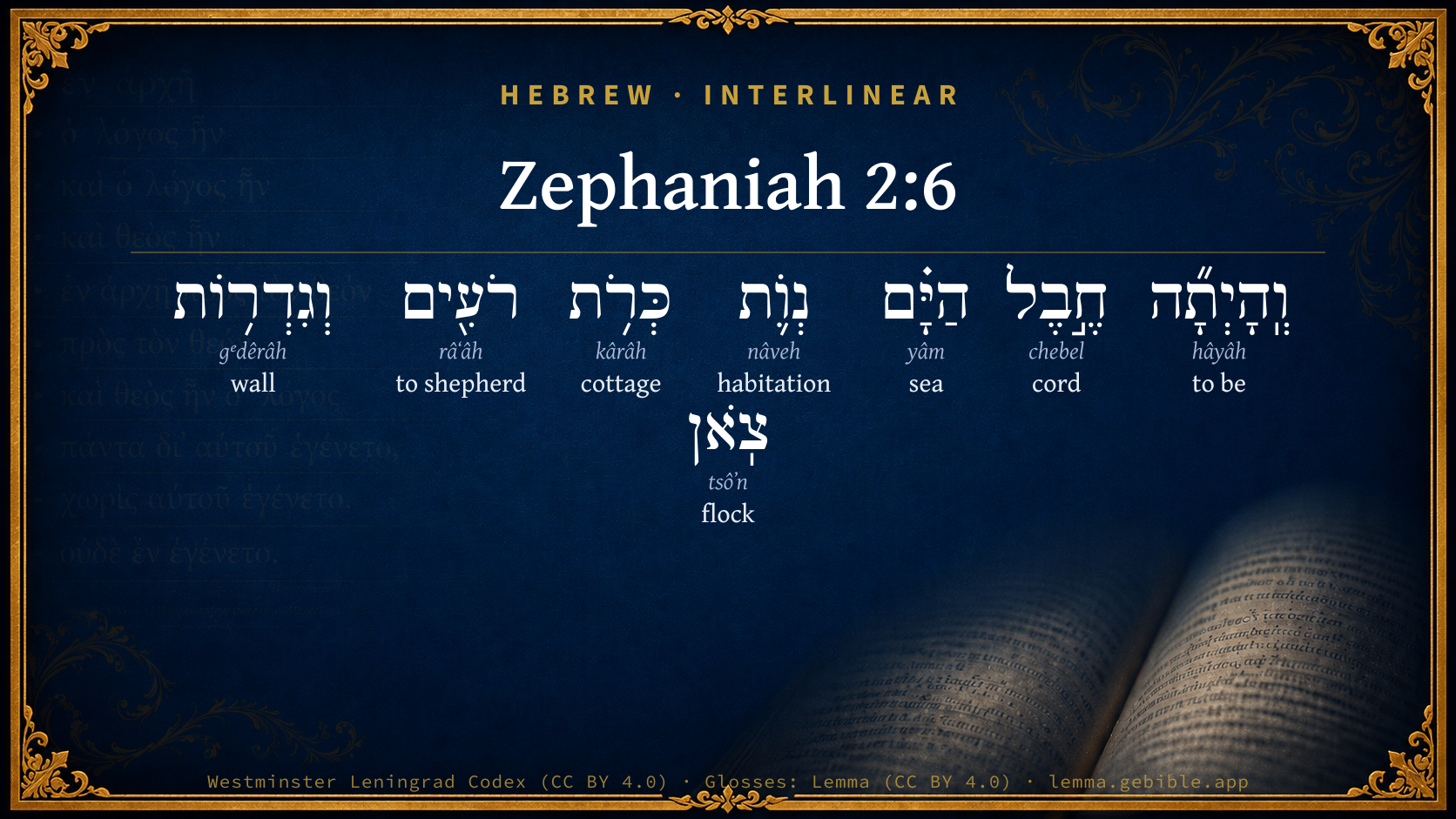
Zephaniah 2:6

Hebrew (Westminster Leningrad Codex) Zephaniah 2:6 appears in the Hebrew Old Testament. The text above is from the Westminster Leningrad Codex. Each word links to its Strong’s number, a concise gloss, and parsing drawn from the Open Scriptures Hebrew Bible morphology. Click any word for its full Brown-Driver-Briggs (BDB) entry.
Download image
Cite this verse

Zephaniah 2:6 (World English Bible). Public Domain. Lemma interlinear Bible study tool, https://lemma.gebible.app/v/zephaniah/2/6.

Show BibTeX & RIS
BibTeX
RIS
English Translation
The sea coast will be pastures, with cottages for shepherds and folds for flocks.
World English Bible · Public Domain
Highlights
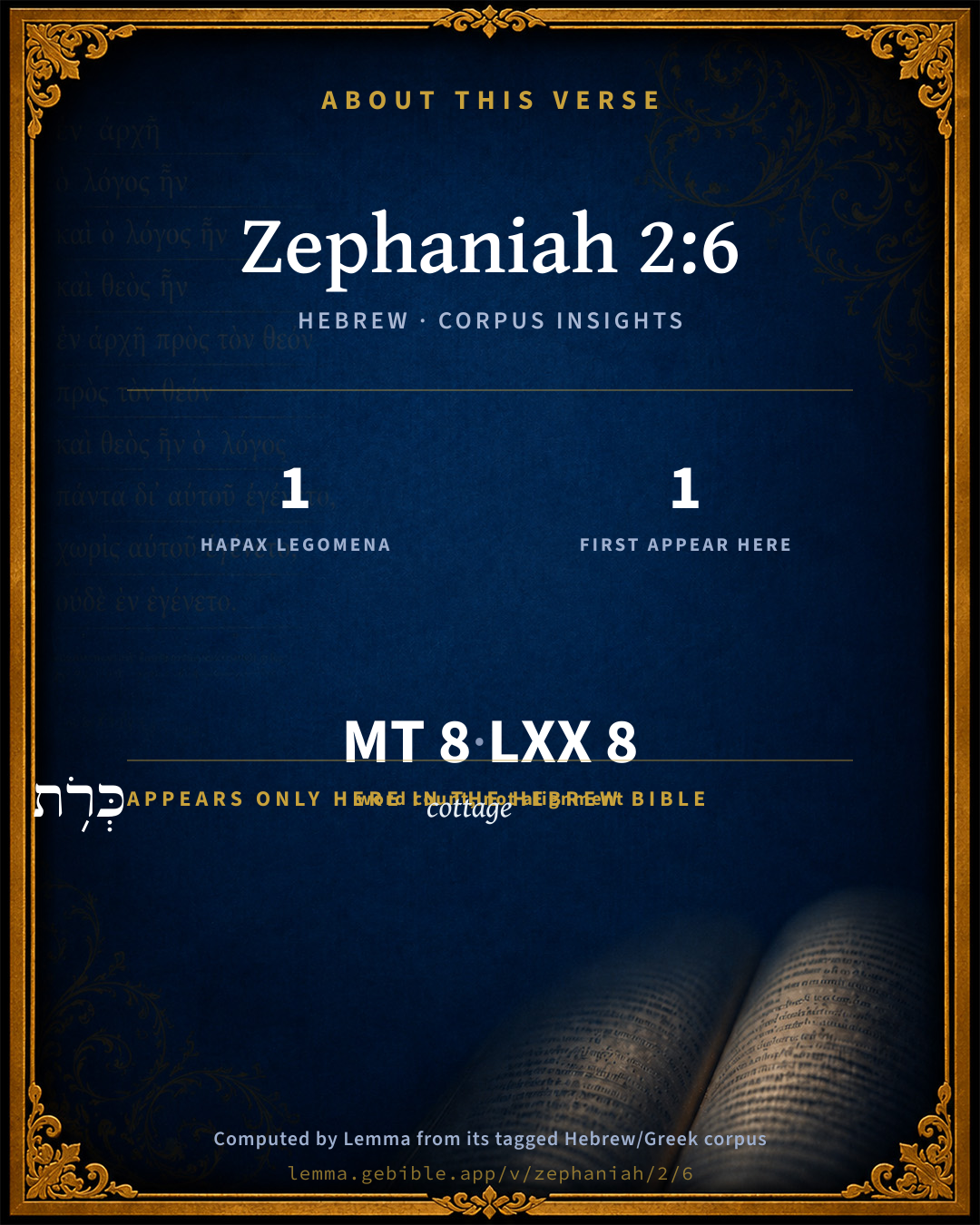
  • 1 hapax legomenon — only here in the Hebrew Bible
  • 1 first appearance in the Hebrew Bible
Full analysis ↓
Download a study sheet

One document with this verse’s original text, its word-by-word gloss line, the meaning frame, cross-references with their text, attributed commentary, and full source and license credits — printable, and it pastes into notes with its structure intact.

This verse Autodidact and up

Study sheet (.html) Plain text (.txt)

A passage Seminary Student

Up to 50 verses in one chapter. A passage sheet keeps up to 6 commentary sources and 12 cross-references per verse, in the order this page ranks them, and says so on the sheet whenever that leaves anything out. Ask for a single verse and you get the Autodidact verse sheet above.

Everything on this page stays free to read, with no account — the sheet is a download of what is already on screen, not access to it.

Want to remove ads? Support Godless Engineer
Compare translations 3

The same verse in 3 English versions, stacked beneath the original-language interlinear above. Click any original word for its lexicon entry.

Each is an independent rendering of the whole verse — the interlinear is not word-aligned to these translations.

Highlighted words mark where these versions differ — a whole-verse word diff, not a word-by-word alignment.

  • World English Bible Public Domain
    The sea coast will be pastures, with cottages for shepherds and folds for flocks.
  • King James Version Public Domain
    And the sea coast shall be dwellings and cottages for shepherds, and folds for flocks.
  • unfoldingWord Literal Text CC BY-SA 4.0
    And the region of the sea will become pastures of meadows of shepherds and pens of flocks.

unfoldingWord Literal Text — © unfoldingWord, licensed CC BY-SA 4.0. Word-aligned USFM3 via Door43 (git.door43.org/unfoldingWord/en_ult).

Versions to compare (up to 4)

3 of 4 selected

Show all 18 translations

Every available English version of this verse, each an independent rendering of the whole verse.

  • World English Bible Public Domain
    The sea coast will be pastures, with cottages for shepherds and folds for flocks.
  • Berean Standard Bible Public Domain
    So the seacoast will become a land of pastures, with wells for shepherds and folds for sheep.
  • Majority Standard Bible Public Domain
    So the seacoast will become a land of pastures, with wells for shepherds and folds for sheep.
  • King James Version Public Domain
    And the sea coast shall be dwellings and cottages for shepherds, and folds for flocks.
  • American Standard Version (1901) Public Domain
    And the sea-coast shall be pastures, with cottages for shepherds and folds for flocks.
  • Revised Version (1885) Public Domain
    And the sea coast shall be pastures, with cottages for shepherds and folds for flocks.
  • Geneva Bible (1599) Public Domain
    And the sea coast shall be dwellings and cotages for shepheardes and sheepefoldes.
  • Douay-Rheims (1899) Public Domain
    And the sea coast shall be the resting place of shepherds, and folds for cattle:
  • Young's Literal Translation Public Domain
    And the sea-coast hath been habitations, Cottages `for' shepherds, and folds `for' a flock.
  • Literal Standard Version CC BY-SA 4.0
    And the seacoast has been habitations, || Cottages [for] shepherds, and folds [for] a flock.
  • Unlocked Literal Bible CC BY-SA 4.0
    So the seacoast will become pastures for shepherds and for sheep pens.
  • unfoldingWord Literal Text CC BY-SA 4.0
    And the region of the sea will become pastures of meadows of shepherds and pens of flocks.
  • Darby Bible Public Domain
    and the sea-coast shall be cave-dwellings for shepherds, and folds for flocks.
  • World Messianic Bible Public Domain
    The sea coast will be pastures, with cottages for shepherds and folds for flocks.
  • Webster's Bible Public Domain
    And the sea coast shall be dwellings and cottages for shepherds, and folds for flocks.
  • Free Bible Version CC BY-SA 4.0
    Your seacoast will become pastures, with meadows for shepherds and sheep pens for flocks.
  • Bible in Basic English Public Domain
    And the land by the sea will be grass-land, with houses for keepers of sheep and walled places for flocks.
  • JPS Tanakh (1917) Public Domain
    And the sea-coast shall be pastures, even meadows for shepherds, and folds for flocks.

Literal Standard Version (2020), Covenant Press — licensed CC BY-SA 4.0. Text via the HelloAO Bible API (eBible.org). Unlocked Literal Bible (unfoldingWord) — licensed CC BY-SA 4.0. Text via the HelloAO Bible API (eBible.org). unfoldingWord Literal Text — © unfoldingWord, licensed CC BY-SA 4.0. Word-aligned USFM3 via Door43 (git.door43.org/unfoldingWord/en_ult). Free Bible Version, Dr. Jonathan Gallagher — licensed CC BY-SA 4.0. Text via the HelloAO Bible API (eBible.org).

Word by word

More ways to search: Search by grammar → Find every occurrence → Compare this word →

Practice this passage: Drill this verse → Learn its vocabulary →

About this verse

These counts appear in no published source. They are computed here, from the morphology-tagged text and Lemma’s own curated glosses. What Lemma adds →

8
words
8
distinct lemmas
Prophets
section

Notable vocabulary

1 hapax legomenon — a word that appears only here in the entire Hebrew Bible:

  • כְּרֹ֥ת cottage H3741

First appearance in Scripture

This word makes its first canonical appearance in the Hebrew Bible here:

  • כְּרֹ֥ת cottage H3741

Shared distinctive vocabulary

וְגִדְר֥וֹת wall H1448 occurs in 11 verses of the Hebrew Bible. Also found in:

Grammatical profile

  • 2 verbs
  • 6 nouns

Verb forms

  • וְֽהָיְתָ֞ה Qal · Sequential Perfect
  • רֹעִ֖ים Qal · Participle Active

Hebrew & Septuagint length

In English translation the verse runs 14 words from the Hebrew and 13 from the Septuagint (LXX English) — closely comparable.

A rough comparison of the two English renderings, which tokenize alike — not a word-level alignment.

Word counts can differ between the Hebrew and the Greek without any difference in meaning — e.g. the Hebrew direct-object marker אֵת has no separate Greek word, and Greek often adds the article ὁ.

In the original languages it is 8 Hebrew tokens and 8 Greek tokens — but the two are counted differently (Hebrew bundles its prefixes and suffixes into one token; the Greek is in lemma form), so that isn’t a like-for-like length.

Cross-references

4

Topical passages linked to Zephaniah 2:6 in the Treasury of Scripture Knowledge — connected by theme and wording, ordered by reader-vote popularity; previews shown in the World English Bible.

  • Isaiah 5:17 Then the lambs will graze as in their pasture, And strangers will eat the ruins of the rich.
  • Isaiah 17:2 The cities of Aroer are forsaken; they shall be for flocks, which shall lie down, and none shall make them afraid.
  • Ezekiel 25:5 I will make Rabbah a stable for camels, and the children of Ammon a couching-place for flocks: and you shall know that I am Yahweh.
  • Zephaniah 2:14–15 Herds will lie down in the midst of her, all the animals of the nations. Both the pelican and the porcupine will lodge in its capitals. Their calls will echo through the windows. Desolation will be in the thresholds, for he has laid bare the cedar beams.

Cross-references courtesy of OpenBible.info (CC BY 4.0).

Hebrew and Greek witnesses Masoretic Hebrew ↔ Greek Septuagint

The same verse in the two great witnesses to the Old Testament, shown verse-for-verse.

These are two independent witnesses, not word-aligned to each other, and the Septuagint is shown in lemma (dictionary) form.

Hebrew Zephaniah 2:6 Masoretic · Westminster Leningrad Codex

וְֽהָיְתָ֞ה חֶ֣בֶל הַיָּ֗ם נְוֺ֛ת כְּרֹ֥ת רֹעִ֖ים וְגִדְר֥וֹת צֹֽאן

The sea coast will be pastures, with cottages for shepherds and folds for flocks.

World English Bible · Public Domain

Greek LXX Zephaniah 2:6 Septuagint · lemma form

καί εἰμί κρήτη νομή ποίμνιον καί μάνδρα πρόβατον

And Crete shall be a pasture of flocks, and a fold of sheep.

LXX2012 (modern English Septuagint) · Public Domain

On this verse, Adam Clarke's Commentary discusses the Septuagint’s reading. Read the note in Commentary ↓

Hebrew: Westminster Leningrad Codex (CC BY 4.0). Greek: Septuagint (public domain); English from LXX2012 (modern English Septuagint) (Public Domain). How the Septuagint differs from the Hebrew →

Targum (Aramaic paraphrase)

1

The Targum is the ancient Jewish Aramaic paraphrase of the Hebrew Scriptures — an interpretive translation, not the Hebrew text itself. Onkelos (literal) and Pseudo-Jonathan (expansive) render the Torah, and Jonathan the Prophets. Coverage is partial: where no permissively-licensed English translation exists for a verse, only the Aramaic is shown. This is verse-level text, not a word-by-word alignment to the Hebrew.

  1. Targum Jonathan Prophets (Joshua–Malachi)
    וּתְהֵי סְפַר יַמָא דִרְוַת בֵּית מֵישְׁרֵי רָעַיָן וְחוּטְרִין דְעָן:

    (no public-domain English translation for this verse)

    Targum Jonathan — Aramaic: “Mikraot Gedolot” (public domain). English: “Sefaria Community Translation” (CC0 1.0 (public-domain dedication)); “London "Chaldee Paraphrase," 1871” (public domain). Text via Sefaria.

Commentary

Notes on Zephaniah 2:6 from classic Christian and Jewish commentators (each source and its license shown beneath its notes). The classic Christian expositions comment on the surrounding passage and are grouped to its opening verse, so a note may address several verses; the Jewish commentaries on the Tanakh (Rashi and others) are per-verse, so they appear only where the commentator wrote on this verse.

Lemma curates 59 commentaries, every one of them public domain or Creative Commons licensed, each selected and text-cleaned for this edition rather than reprinted as found. About our sources →

Ellicott's Commentary for English Readers

(6) Dwellings and cottages for shepherds.—Better, places for shepherds’ pastures. In c’rôth (best taken as plural of car, “a pasture”) there is a paronomasia on c’rêthîm of Zep_2:5. The term “sea coast” (literally, line of the sea) here, as in Zep_2:5, designates maritime Philistia. This tract of country is represented as ravaged and depopulated, so as to be serviceable only as a mere sheep-walk. Afterwards (Zep_2:7) the restored exiles of Judah make it their pasture-ground. That this predominance of the Jewish over the Philistine race actually took place is manifest. The allusion to the captivity of Judah and its termination is remarkable. “Who save He in whose hand are human wills could now foresee that Judah should, like the ten tribes, rebel, be carried captive, and yet, though like and worse than Israel in its sin, should, unlike Israel, be restored” (Pusey). In the opening words of Zep_2:7 there is perhaps another paronomasia, for chebel (“sea coast” in Zep_2:6), may also mean “an apportioned inheritance;” and the words here may be rendered, “and it shall be for an inheritance for the remnant of the house of Judah.”

A Bible Commentary for English Readers, edited by Charles John Ellicott (1878–1897) — public domain. Text from a community e-Sword module.

The Cambridge Bible for Schools and Colleges

gen. ed. J. J. S. Perowne

6. The text of Zep_2:6 is probably in disorder, as the rhythmical balance of the verse is quite obscured. The Sept. also read differently, the words the sea coast being wanting in their text. These words should probably be omitted as a marginal explanation of it, and the verse read, and it (land of the Philistines, Zep_2:5) shall be.…

dwellings and cottages for shepherds] R.V. pastures, with cottages, marg. or, caves. The word rendered “cottages” (k’rôth) is obscure. Bochart, whom Keil follows, suggested that the word was infin. of the verb “to dig,” and rendered “for digging,” supposing that the reference was to subterranean huts dug by the shepherds to escape the heat (hence R.V. marg., caves). The idea has no probability. The peculiar construction (which appears similar to that in Job_20:17, the floods, the brooks of honey) suggests that “dwellings” and “cottages” are mere variant expressions, having the same meaning. So Hitzig: shall be for meadows of pastures for shepherds. The sense of pasture is seen, Isa_30:23, though the plur. is masc. Psa_65:13, while in the present passage the word is fem. It is possible, indeed, that the word is a mere transcriptional duplicate of the preceding word, as the letters forming the two words are frequently confused. The term, however, stood in the text of the Sept., who rendered it Crete, i.e. the country of the Cherethites: and Crete shall be a pasture (n’vath) of shepherds. Either the order of words was different in the text of the Sept., or they translated in entire disregard of Shemitic grammar. The verse with the necessary omissions may read:

And it shall be dwellings (or, pastures) for shepherds—and folds for flocks.

The Cambridge Bible for Schools and Colleges (gen. ed. J. J. S. Perowne; Cambridge University Press, 1878–1918) — public domain. Text from a community e-Sword module.

Trapp's Complete Commentary

John Trapp

Zep 2:6 And the sea coast shall be dwellings [and] cottages for shepherds, and folds for flocks.

Ver. 6. And the sea coasts shall be dwellings and cottages for shepherds] It shall be waste and untilled, and therefore unfrequented by any but shepherds, who pitch their tents up and down, where they may best feed their flocks, in desert places.

And folds for flocks] God may do thus in his just judgment upon his enemies, that live in his good land, and not by his good laws; but woe be to our depopulators, that drive out men and put in cattle; that betray towns, as Rome did Carthage, with a distinction, We will save the city, but destroy the town. How dangerous it is to prove Abaddons appeareth by God’s punishing hand upon William the Conqueror’s issue in New Forest, wherein thirty-six parish churches had been demolished by him, with the removing of all the inhabitants, to make room for beasts, or dogs’ game. There his second son, Richard, was gored in hunting by a deer; Rufus, his other son, mistaken for a deer, was by chance shot through with an arrow; Henry likewise, his nephew, while he hotly pursued the chase was struck by a bough into the jaws, and, as Absalom, left hanging until he died.

John Trapp, A Commentary or Exposition upon All the Books of the Old and New Testament (1647–1656) — public domain. Text from a community e-Sword module.

Keil & Delitzsch

C. F. Keil & F. Delitzsch

The tract of land thus depopulated is to be turned into "pastures (nevōth, the construct state plural of nâveh) of the excavation of shepherds," i.e., where shepherds will make excavations or dig themselves huts under the ground as a protection from the sun. This is the simplest explanation of the variously interpreted kerōth (as an inf. of kârâh, to dig), and can be grammatically sustained. The digging of the shepherds stands for the excavations which they make. Bochart (Hieroz. i. p. 519, ed. Ros.) has already given this explanation: "Caulae s. caulis repletus erit effossionis pastorum, i.e., caulae a pastoribus effossae in cryptis subterraneis ad vitandum solis aestum." On the other hand, the derivation from the noun kērâh, in the sense of cistern, cannot be sustained; and there is no proof of it in the fact that kârâh is applied to the digging of wells. Still less is it possible to maintain the derivation from יכר (Arab. wkr), by which Ewald would support the meaning nests for kērōth, i.e., "the small houses or carts of the shepherds." And Hitzig's alteration of the text into כּרת = כּרים, pastures, so as to obtain the tautology "meadows of the pastures," is perfectly unwarranted. The word chebhel is construed in Zep 2:6 as a feminine ad sensum, with a retrospective allusion to 'erets Pelishtı̄m; whereas in Zep 2:7 it is construed, as it is everywhere else, as a masculine. Moreover, the noun chebhel, which occurs in this verse without the article, is not the subject; for, if it were, it would at least have had the article. It is rather a predicate, and the subject must be supplied from Zep 2:6 : "The Philistian tract of land by the sea will become a tract of land or possession for the remnant of the house of Judah, the portion of the people of God rescued from the judgment. Upon them, viz., these pastures, will they feed." The plural עליהם does not stand for the neuter, but is occasioned by a retrospective glance at נות רעים. The subject is, those that are left of the house of Judah. They will there feed their flocks, and lie down in the huts of Ashkelon. For the prophet adds by way of explanation, Jehovah their God will visit them. Pâqad, to visit in a good sense, i.e., to take them under His care, as is almost always the meaning when it is construed with an accusative of the person. It is only in Psa 59:6 that it is used with an acc. pers. instead of with על, in the sense of to chastise or punish. שׁוּב שׁבוּת as in Hos 6:11 and Amo 9:14. The keri שׁבית has arisen from a misinterpretation. On the fulfilment, see what follows.

Keil & Delitzsch — Biblical Commentary on the Old Testament (1861–1891) — public domain (CC PDM 1.0). Text via the HelloAO Bible API. (Old Testament only.)

Tyndale Open Study Notes

Tyndale Open Resources

2:6 pasture . . . shepherd camps and enclosures for sheep: The destruction of cities and their return to a natural state represents a severe form of punishment from God. See also Isa 7:23-25; 13:19-21; 32:9-15; Ezek 35:9.

Tyndale Open Study Notes — © Tyndale Open Resources, licensed CC BY-SA 4.0. Text via the HelloAO Bible API.

Jamieson, Fausset & Brown

Robert Jamieson, A. R. Fausset & David Brown

dwellings and cottages for shepherds--rather, "dwellings with cisterns" (that is, water-tanks dug in the earth) for shepherds. Instead of a thick population and tillage, the region shall become a pasturage for nomad shepherds' flocks. The Hebrew for "dug cisterns," Ceroth, seems a play on sounds, alluding to their name Cherethites (Zep 2:5): Their land shall become what their national name implies, a land of cisterns. MAURER translates, "Feasts for shepherds' (flocks)," that is, one wide pasturage.

Jamieson, Fausset & Brown — Commentary Critical and Explanatory on the Whole Bible (1871) — public domain (CC PDM 1.0). Text via the HelloAO Bible API.

Adam Clarke's Commentary

Verse 6. And the sea-coasts shall be dwellings] Newcome considers כרת keroth as a proper name, not cottages or folds. The Septuagint have κρητη, Crete, and so has the Syriac. Abp. Secker notes, Alibi non extat כרת, et forte notat patriam των כרתים. "The word כרת is not found elsewhere, and probably it is the name of the country of the Cherethim."

Adam Clarke's Commentary on the Bible (1810–1826) — public domain. Text from a community e-Sword/MySword module.

John Calvin's Commentaries

The Prophet confirms what he has before said respecting the future vengeance of God, which was now nigh at hand to the Moabites and other neighboring nations, who had been continually harassing the miserable Jews. Hence, he says, that that whole region would become the habitation of sheep. It is a well known event, that when any country is without inhabitants shepherds occupy it; for there is no sowing nor reaping there, but grass alone grows. Where, therefore, there is no cultivation, where no number of men are found, there shepherds find a place for their flocks, there they build sheep cots. It is, therefore, the same as though the Prophet had said, that the country would be desolate, as we find it expressed in the next verse.

He immediately adds, but for a different reason, that the coast of the sea would be a habitation to the house of Judah. And there is here a striking divergence from the flocks of shepherds to the tribe of Judah, which was as it were, the chosen flock of God. The Prophet then, after having said that the region would be waste and desolate, immediately adds, that it would be for the benefit of the chosen people; for the Lord would grant there to the Jews a safe and secure rest. But the Prophet confines this to the remnant; for the greater part, as we have already seen, were become so irreclaimable, that the gate of mercy was completely closed against them. The Prophet, at the same time, by mentioning a remnant, shows that there would always be some seed from which God would raise up a new Church; and he also encourages the faithful to entertain hope, so that their own small number might not terrify them; for when they considered themselves and found themselves surpassed by a vast multitude, they might have thought that they were of no account. Lest then they should be disheartened the Prophet says that this remnant would be the object of God’s care; for when he would visit the whole coast of the sea and other regions, he would provide there for the Jews a safe habitation and refuge.

That line then, he says, shall be for the residue of the house of Judah; feed shall they in Ashkelon, and there shall they lie down in the evening; that is, they shall find in their exile some resting-place; for we know that the Jews were not all removed to distant lands; and they who may have been hid in neighboring places were afterwards more easily gathered, when a liberty to return was permitted them. This is what the Prophet means now, when he says, that there would be a refuge in the night to the Jews among the Moabites and other neighboring nations.

A reason follows, which confirms what I have stated, for Jehovah their God, he says, will visit them. We hence see that the Prophet mitigates here the sorrow of exile and of that most grievous calamity which was nigh the Jews, by promising to them a new visitation of God; as though he had said, Though the Lord seems now to rage against you, and seems to forget his own covenant, yet he will again remember his mercy, when the suitable time shall come. And he adds, he will restore their captivity; and he added this, that he might show that his favor would prove victorious against all hindrances. The Jews might indeed have raised this objection, Why does not the Lord help us immediately; but he, on the contrary, allows our enemies to remove us into exile? The Prophet here calls upon them to exercise patience; and yet he promises, that after having been driven into exile, they should again return to their country; for the Lord would not suffer that exile to be perpetual. It now follows—

John Calvin's Commentaries (1540-1563) — public domain. Text from the Calvin Translation Society English edition (1840s-50s) via the Christian Classics Ethereal Library (ccel.org). Calvin's coverage is partial (roughly two-thirds of the Bible); uncommented books and verses are honest gaps, never fabricated. The 19th-century editor's footnotes and remarks are omitted so the notes are faithfully Calvin's own voice.

John Gill's Exposition

And the sea coast shall be dwellings [and] cottages for shepherds That tract of land which lay on the coast of the Mediterranean sea, inhabited by the Philistines, should now become so desolate, that instead of towns and cities full of merchants and sea faring persons, and houses full of inhabitants, and warehouses full of goods, there should now only be seen a few huts and cottages for shepherds to dwell in, to shelter them from the heat by day, and where they watched their flocks by night, and took their proper repose and rest. The last word is by some rendered "ditches" F9, which were dug by them to receive rainwater for their use: or rather may signify "cottages dug by shepherds" F11; in subterraneous places, whither they retired in the heat of the day, to shelter themselves from the scorching sun; and some of them were so large as to receive their flocks also; such was the cave of Polyphemus, as Bochart F12 observes, in which the cattle, namely, the sheep and goats, lay down and slept; and in Iceland such are used to secure them from the cold; where we are told F13 there are caverns in the mountains capable of sheltering a hundred sheep or more: and whither they very cordially retreat in bad weather. These holes are in such mountains as have formerly burned, and are of infinite service to them, both winter and summer; in the winter for shelter, and in the summer for very good pastures, which they find in plenty all around. Such sort of huts and cottages as these, in hot countries, Jerom seems to have respect unto, when, speaking of Tekoa, he says F14, there is not beyond it any little village, nor indeed any field cottages like to ovens (subterraneous ones, Calmet F15 calls them), which the Africans call "mapalia": these Sallust F16 describes as of an oblong figure, covered with tiles, and like the keels of ships, or ships turned bottom upwards; and, according to Pliny F17, they were movable, and carried from place to place in carts and waggons; and therefore cannot be such as before described; and so Dr. Shaw F18 says, the Bedouin Arabs now, as their great ancestors the Arabians, live in tents called "hhymas", from the shelter which they afford the inhabitants; and adds, they are the very same which the ancients call "mapalia": and folds for flocks; in which they put them to lie down in at evening. The phrases express the great desolation of the land; that towns should be depopulated, and the land lie untilled, and only be occupied by shepherds, and their flocks, who lead them from place to place, the most convenient for them. FOOTNOTES: F9 (twrk) "fossas", Tigurine version; "fossuris", Junius & Tremellius, Piscator; so Ben Melech; but disapproved of by Gussetius. p. 402. F11 "Mansiones effossionum pastorum, Drusius; caulae effossionum pastorum", i. e. "effossae a pastoribus", Bochart. F12 Hierozoic. par. 1. l. 2. c. 45. col. 467, 468. F13 Horrebow's Natural History of Iceland, c. 29. p. 46. F14 Prooem, in Amos. F15 Dictionary, in the word "Shepherds". F16 Bell. Jugurth. p. 51. F17 Nat. Hist. l. 5. c. 3. F18 Travels, p. 220. Ed. 2.

John Gill's Exposition of the Whole Bible (1746–1763) — public domain (CC PDM 1.0). Text via the HelloAO Bible API.

Albert Barnes' Notes on the Bible

The seacoast shall be dwellings and cottages - o, literally, cuttings or diggings. This is the central meaning of the word; the place of the Cherethites (the cutters off) shall be “cheroth” of shepherds, places which they dug up that their flocks might be enclosed therein. The tracts once full of fighting men, the scourge of Judah, should be so desolate of its former people, as to become a sheep-walk. Men of peace should take the place of its warriors.

So the shepherds of the Gospel with their flocks have entered into possession of war-like nations, turning them to the Gospel. They are shepherds, the chief of whom is that Good Shepherd, who laid down His Life for the sheep. And these are the sheep of whom He speaks, “Other sheep I have, which are not of this fold; them also I must bring, and they shall hear My Voice; and there shall be one fold and One Shepherd” Joh 10:16.

Albert Barnes' Notes on the Bible (1834–1885) — public domain. Text from a community e-Sword/MySword module.

Haydock's Catholic Bible Commentary

Shepherds. Merchants shall come no longer, the country being subdued by Nabuchodonosor, and by the Machabees, ver. 7. --- Alexander ruined Gaza. (Curtius iv.)

George Leo Haydock (1774–1849), Haydock's Catholic Family Bible and Commentary, 1859 edition — public domain. Excludes Psalms (Douay-Rheims chapter numbering differs from Protestant) and Deuterocanonical books (Catholic canon only).

Matthew Poole's English Annotations

This confirms the former, tells us what shall be in those parts; instead of cities full of rich citizens, there shall be cottages for shepherds watching over their flocks.

Matthew Poole's English Annotations on the Holy Bible (1683–1685) — public domain. Text from a community e-Sword/MySword module.

The Pulpit Commentary

Dwellings and cottages for shepherds; better, pastures with caves for shepherds. In the use of the word keroth, "diggings" ("cottages," Authorized Version) there is probably intended another play on the "Cherethites." Neale, "The road from Gaza to Askalon lay along the sea shore. In the winter months many parts of it are impracticable, owing to the encroachment of the sea. The surf then dashes wildly into the huge caverns worked out of the endless sand hills that line this coast. These caverns were tenanted, when we passed, by goatherds and their flocks. Thither they resort for shelter from the fierce heat of the noontide sun; and here during the night the goats are penned. There are wells and reservoirs in the vicinity which furnish water for the flocks the whole year round, and the brambles and thorn bushes that flourish near the seaside form their pasturage" ("Eight Years in Syria," 1:40, 41). Septuagint, estai Krhth nomh poimniwn , "Crete shall be a pasture of flocks."

The Pulpit Commentary (1880–1919), ed. H.D.M. Spence-Jones & Joseph S. Exell — public domain. Text from a community e-Sword module.

John Wesley's Explanatory Notes

For shepherds - Instead of cities full of rich citizens, there shall be only cottages for shepherds.

John Wesley, Explanatory Notes Upon the Whole Bible (1754–1765) — public domain. Text via the GEBible commentary corpus.

unfoldingWord translationNotes

Door43 World Missions Community

General Information:

In Zep 2:4-15, Yahweh announces his judgment on the nations that surround Judah.

So the seacoast will become pastures for shepherds and for sheep pens

This probably means that the Philistine cities are gone, and only open fields remain. However, the Hebrew meaning is unclear and is sometimes translated differently by modern versions.

sheep pens

A sheep pen is a small area surrounded by a fence to keep the sheep together.

Their people

"The people of Judah"

lie down

"lie down to sleep"

translationWords

shepherd

ewe

remnant

Judah

flocks

God

restore

unfoldingWord translationNotes — © Distant Shores Media and the Door43 World Missions Community, licensed CC BY-SA 4.0. Source: git.door43.org/Door43/en_tn.

Rashi

Rabbi Shlomo Yitzchaki (Rashi)

breakfast nooks for shepherds a temporary dwelling where the shepherds eat bread in the morning. כְּרֹת is an expression related to (II Kings 6:23) “He prepared for them a lavish feast.”

Rashi on the Tanakh — English translations: “The Judaica Press complete Tanach with Rashi, translated by A. J. Rosenberg” (CC BY 4.0); “Pentateuch with Rashi's commentary by M. Rosenbaum and A.M. Silbermann, 1929-1934” (public domain); “The Metsudah Tanach series, Lakewood, N.J” (CC BY 4.0); and “The Book of Joshua, Metsudah Publications, 1997” (CC BY 4.0). Text via Sefaria.

Lesson kit

Teaching starters — assembled from the data on this page, not authored interpretation. Every prompt links to the verse data it draws on. Edit before teaching.

Zephaniah, in the Prophets, opens this verse with 8 words (8 distinct Hebrew lemmas). Its most distinctive word is kârâh (“cottage”). A historical commentator’s framing appears above. Read the whole chapter for the surrounding context.

Discussion questions

  1. What does “cottage” (kârâh) contribute to the verse as a whole?
  2. This verse holds 1 word here found nowhere else in the Hebrew Bible. What might the rare word draw attention to?
  3. The word “cottage” first appears here in Scripture. What is being introduced at this debut?
  4. Numbers 32:16 shares the word «wall» with this verse. How do the two illuminate each other?
  5. These translations render this verse differently; the difference is in the English rendering, not the original. What questions does that raise?
  6. The verb «וְֽהָיְתָ֞ה» is Qal Sequential Perfect. How does its form color the action?
  7. Reading how Ellicott's Commentary for English Readers and The Cambridge Bible for Schools and Colleges read this verse, where do the two commentators agree and where do they part?

Things to notice

Reading settings

Reading text

Shown beneath each verse's original-language words.

Old Testament
Old Testament edition

Read the OT as the Masoretic Hebrew (MT) or the Greek Septuagint (LXX).

English shown for the Greek Septuagint (in the Hebrew ↔ Greek comparison).

Comparing translations? Open the Compare panel on any verse page to stack up to four side by side.