Jeremiah 12:10

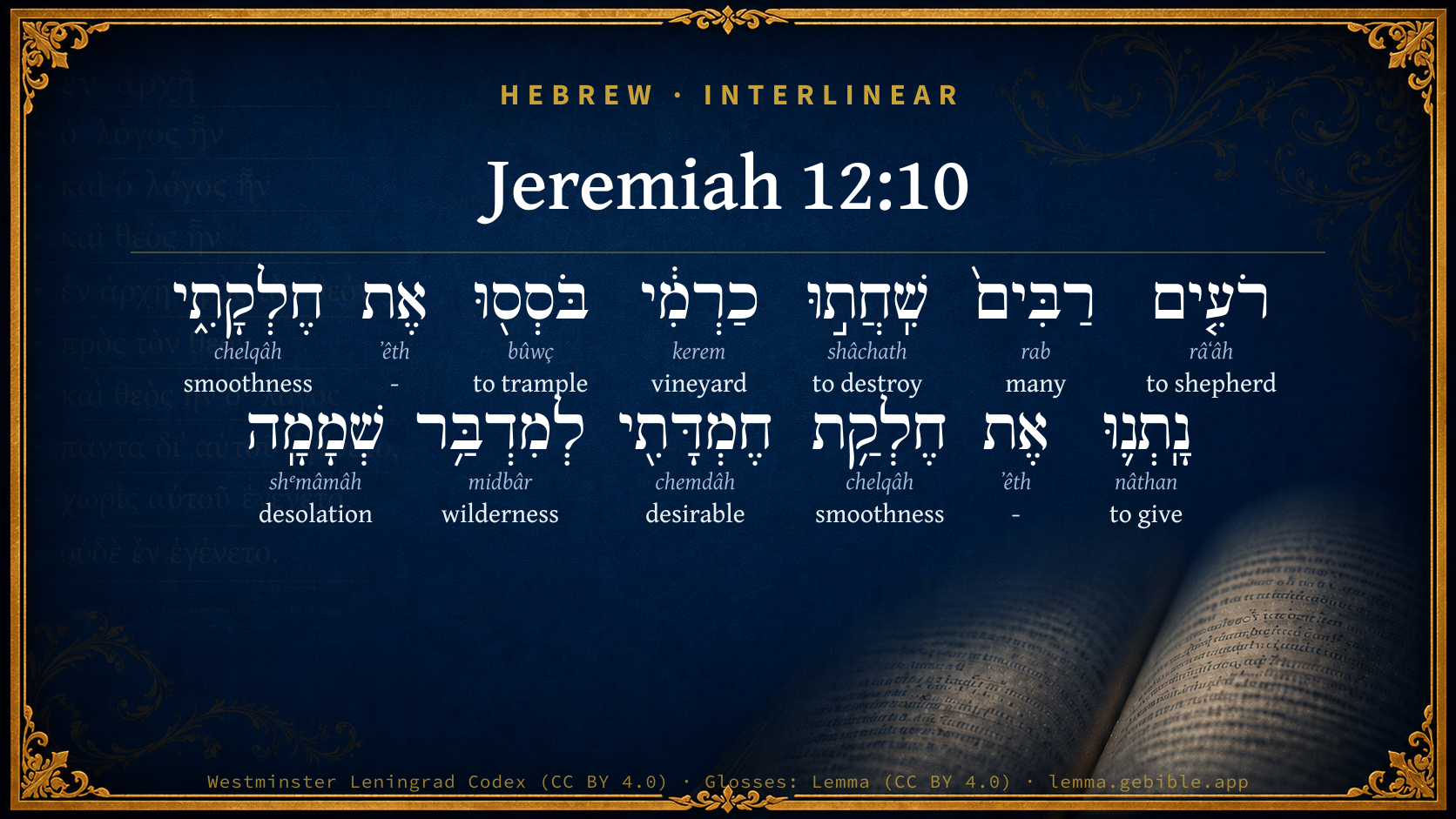
Hebrew (Westminster Leningrad Codex) Jeremiah 12:10 appears in the Hebrew Old Testament. The text above is from the Westminster Leningrad Codex. Each word links to its Strong’s number, a concise gloss, and parsing drawn from the Open Scriptures Hebrew Bible morphology. Click any word for its full Brown-Driver-Briggs (BDB) entry.
Download image
Cite this verse

Jeremiah 12:10 (World English Bible). Public Domain. Lemma interlinear Bible study tool, https://lemma.gebible.app/v/jeremiah/12/10.

Show BibTeX & RIS
BibTeX
RIS
English Translation
Many shepherds have destroyed my vineyard, they have trodden my portion under foot, they have made my pleasant portion a desolate wilderness.
World English Bible · Public Domain
Download a study sheet

One document with this verse’s original text, its word-by-word gloss line, the meaning frame, cross-references with their text, attributed commentary, and full source and license credits — printable, and it pastes into notes with its structure intact.

This verse Autodidact and up

Study sheet (.html) Plain text (.txt)

A passage Seminary Student

Up to 50 verses in one chapter. A passage sheet keeps up to 6 commentary sources and 12 cross-references per verse, in the order this page ranks them, and says so on the sheet whenever that leaves anything out. Ask for a single verse and you get the Autodidact verse sheet above.

Everything on this page stays free to read, with no account — the sheet is a download of what is already on screen, not access to it.

Want to remove ads? Support Godless Engineer
Compare translations 3

The same verse in 3 English versions, stacked beneath the original-language interlinear above. Click any original word for its lexicon entry.

Each is an independent rendering of the whole verse — the interlinear is not word-aligned to these translations.

Highlighted words mark where these versions differ — a whole-verse word diff, not a word-by-word alignment.

  • World English Bible Public Domain
    Many shepherds have destroyed my vineyard, they have trodden my portion under foot, they have made my pleasant portion a desolate wilderness.
  • King James Version Public Domain
    Many pastors have destroyed my vineyard, they have trodden my portion under foot, they have made my pleasant portion a desolate wilderness.
  • unfoldingWord Literal Text CC BY-SA 4.0
    Many shepherds have ruined my vineyard; they have tread down my portion; they have made my pleasant portion a wilderness of desolation.

unfoldingWord Literal Text — © unfoldingWord, licensed CC BY-SA 4.0. Word-aligned USFM3 via Door43 (git.door43.org/unfoldingWord/en_ult).

Versions to compare (up to 4)

3 of 4 selected

Show all 18 translations

Every available English version of this verse, each an independent rendering of the whole verse.

  • World English Bible Public Domain
    Many shepherds have destroyed my vineyard, they have trodden my portion under foot, they have made my pleasant portion a desolate wilderness.
  • Berean Standard Bible Public Domain
    Many shepherds have destroyed My vineyard; they have trampled My plot of ground. They have turned My pleasant field into a desolate wasteland.
  • Majority Standard Bible Public Domain
    Many shepherds have destroyed My vineyard; they have trampled My plot of ground. They have turned My pleasant field into a desolate wasteland.
  • King James Version Public Domain
    Many pastors have destroyed my vineyard, they have trodden my portion under foot, they have made my pleasant portion a desolate wilderness.
  • American Standard Version (1901) Public Domain
    Many shepherds have destroyed my vineyard, they have trodden my portion under foot, they have made my pleasant portion a desolate wilderness.
  • Revised Version (1885) Public Domain
    Many shepherds have destroyed my vineyard, they have trodden my portion under foot, they have made my pleasant portion a desolate wilderness.
  • Geneva Bible (1599) Public Domain
    Many pastors haue destroyed my vineyarde, and troden my portion vnder foote: of my pleasant portion they haue made a desolate wildernesse.
  • Douay-Rheims (1899) Public Domain
    Many pastors have destroyed my vineyard, they have trodden my portion under foot: they have changed my delightful portion into a desolate wilderness.
  • Young's Literal Translation Public Domain
    Many shepherds did destroy My vineyard, They have trodden down My portion, They have made My desirable portion Become a wilderness -- a desolation.
  • Literal Standard Version CC BY-SA 4.0
    Many shepherds destroyed My vineyard, || They have trodden down My portion, || They have made My desirable portion || Become a wilderness—a desolation.
  • Unlocked Literal Bible CC BY-SA 4.0
    Many shepherds have destroyed my vineyard. They have stomped all over my portion of land; they turned my delightful portion into a wilderness, a desolation.
  • unfoldingWord Literal Text CC BY-SA 4.0
    Many shepherds have ruined my vineyard; they have tread down my portion; they have made my pleasant portion a wilderness of desolation.
  • Darby Bible Public Domain
    Many shepherds have destroyed my vineyard, they have trodden my portion under foot, they have made my pleasant portion a desolate wilderness:
  • World Messianic Bible Public Domain
    Many shepherds have destroyed my vineyard. They have trodden my portion under foot. They have made my pleasant portion a desolate wilderness.
  • Webster's Bible Public Domain
    Many pastors have destroyed my vineyard, they have trodden my portion under foot, they have made my pleasant portion a desolate wilderness.
  • Free Bible Version CC BY-SA 4.0
    Many shepherds have come and destroyed my vineyard; they have trampled down the crops in my field. They have turned my pleasant land into an empty wasteland.
  • Bible in Basic English Public Domain
    The keepers of sheep have been the destruction of my vine-garden, crushing my heritage under their feet; they have made my fair heritage an unplanted waste;
  • JPS Tanakh (1917) Public Domain
    Many shepherds have destroyed My vineyard, they have trodden My portion under foot, they have made My pleasant portion a desolate wilderness.

Literal Standard Version (2020), Covenant Press — licensed CC BY-SA 4.0. Text via the HelloAO Bible API (eBible.org). Unlocked Literal Bible (unfoldingWord) — licensed CC BY-SA 4.0. Text via the HelloAO Bible API (eBible.org). unfoldingWord Literal Text — © unfoldingWord, licensed CC BY-SA 4.0. Word-aligned USFM3 via Door43 (git.door43.org/unfoldingWord/en_ult). Free Bible Version, Dr. Jonathan Gallagher — licensed CC BY-SA 4.0. Text via the HelloAO Bible API (eBible.org).

Word by word

More ways to search: Search by grammar → Find every occurrence → Compare this word →

Practice this passage: Drill this verse → Learn its vocabulary →

בֹּסְס֖וּ
bûwç
H947
“to trample”
Verb, Polel, Perfect, 3rd Person, Common, Plural
Part of Speech
Verb
Stem
Polel
Form
Perfect
Person
3rd Person
Gender
Common
Number
Plural
Full BDB Definition

Origin: a primitive root

TWOT: 216

to tread down, reject, trample down - (Qal) - to tread down, trample (of warriors) - of rejection (figuratively) - (Polel) - to tread down (in bad sense) - to desecrate - (Hithpolel) - to tread - to kick out - of infants' blind movements - of Jerusalem (figuratively) - (Hophal) to be trodden down
  1. רֹעִ֤ים râʻâh H7462 “shepherding” Verb, Qal, Participle Active, Masculine, Plural, Absolute
  2. רַבִּים֙ rab H7227 “many” Adjective, Adjective, Masculine, Plural, Absolute
  3. שִֽׁחֲת֣וּ shâchath H7843 “to destroy” Verb, Piel, Perfect, 3rd Person, Common, Plural
  4. כַרְמִ֔י kerem H3754 “vineyard · my” Noun, Common, Both, Singular, Construct + Suffix, Personal, 1st Person, Common, Singular
  5. אֶת ʼêth H853 “-” Particle, Direct Object
  6. חֶלְקָתִ֑י chelqâh H2513 “smoothness · my” Noun, Common, Feminine, Singular, Construct + Suffix, Personal, 1st Person, Common, Singular
  7. נָֽתְנ֛וּ nâthan H5414 “to give” Verb, Qal, Perfect, 3rd Person, Common, Plural
  8. אֶת ʼêth H853 “-” Particle, Direct Object
  9. חֶלְקַ֥ת chelqâh H2513 “smoothness of” Noun, Common, Feminine, Singular, Construct
  10. חֶמְדָּתִ֖י chemdâh H2532 “desirable · my” Noun, Common, Feminine, Singular, Construct + Suffix, Personal, 1st Person, Common, Singular
  11. לְמִדְבַּ֥ר midbâr H4057 “to/for · wilderness of” Preposition + Noun, Common, Masculine, Singular, Construct
  12. שְׁמָמָֽה shᵉmâmâh H8077 “desolation” Noun, Common, Feminine, Singular, Absolute

About this verse

These counts appear in no published source. They are computed here, from the morphology-tagged text and Lemma’s own curated glosses. What Lemma adds →

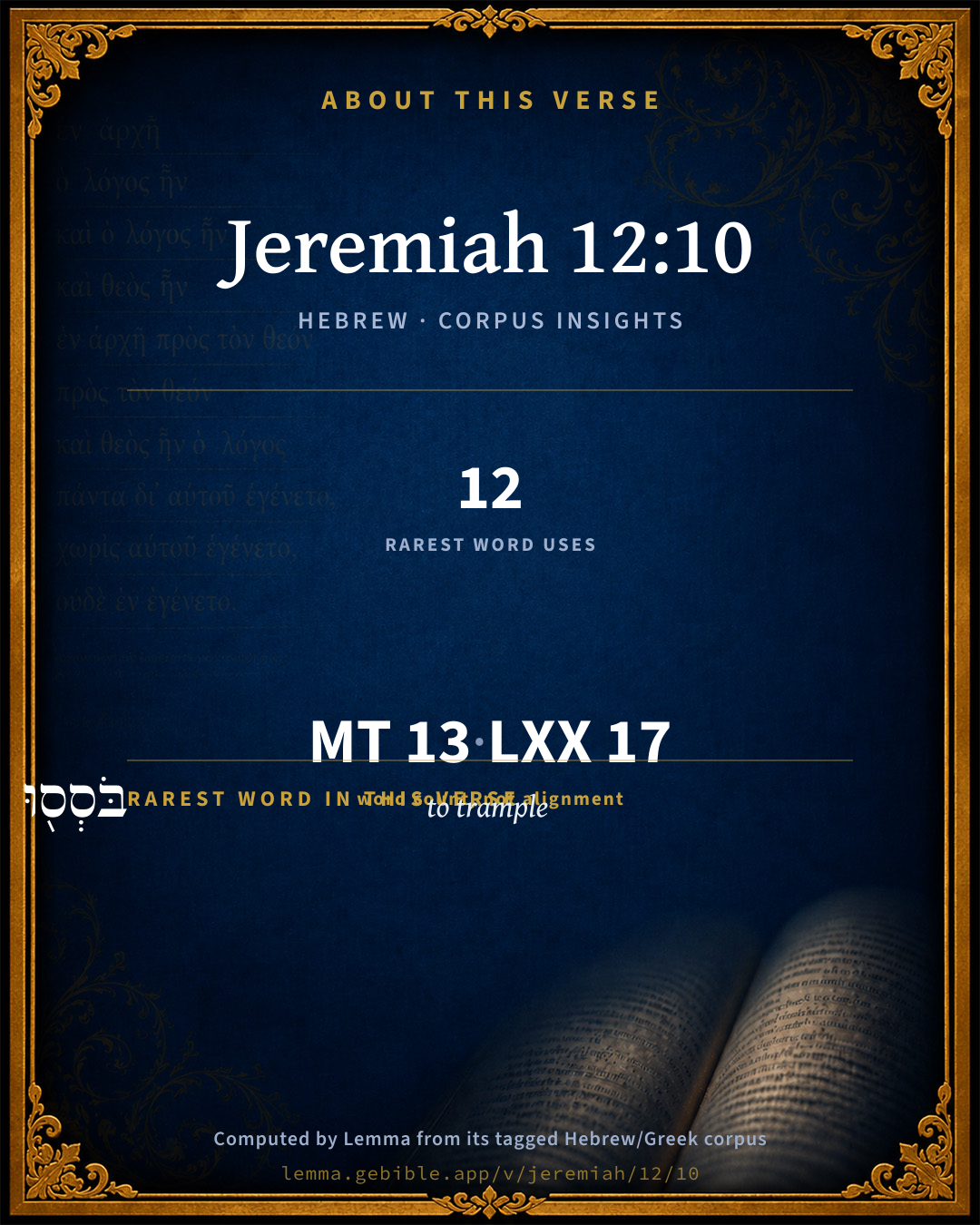
13
words
11
distinct lemmas
Prophets
section

Notable vocabulary

The rarest word here is בֹּסְס֖וּ to trample H947 — appearing just 12 times in the whole Hebrew Bible.

Shared distinctive vocabulary

בֹּסְס֖וּ to trample H947 occurs in 12 verses of the Hebrew Bible. Also found in:

Grammatical profile

  • 4 verbs
  • 6 nouns
  • 1 adjective
  • 2 particles

Verb forms

  • רֹעִ֤ים Qal · Participle Active
  • שִֽׁחֲת֣וּ Piel · Perfect
  • בֹּסְס֖וּ Polel · Perfect
  • נָֽתְנ֛וּ Qal · Perfect

Repetition

A word recurs within this verse — often emphatic in Hebrew:

  • חֶלְקָתִ֑י smoothness H2513 ×2

Hebrew & Septuagint length

In the original languages it is 13 Hebrew tokens and 17 Greek tokens — but the two are counted differently (Hebrew bundles its prefixes and suffixes into one token; the Greek is in lemma form), so that isn’t a like-for-like length.

Cross-references

13

Topical passages linked to Jeremiah 12:10 in the Treasury of Scripture Knowledge — connected by theme and wording, ordered by reader-vote popularity; previews shown in the World English Bible.

  • Isaiah 5:1–7 Let me sing for my well beloved a song of my beloved about his vineyard. My beloved had a vineyard on a very fruitful hill.
  • Isaiah 63:18 Your holy people possessed [it] but a little while: our adversaries have trodden down your sanctuary.
  • Jeremiah 23:1 Woe to the shepherds who destroy and scatter the sheep of my pasture! says Yahweh.
  • Psalms 80:8–16 You brought a vine out of Egypt. You drove out the nations, and planted it.
  • Jeremiah 3:19 But I said, How I will put you among the children, and give you a pleasant land, a goodly heritage of the hosts of the nations! and I said, You shall call me My Father, and shall not turn away from following me.
  • Jeremiah 6:3 Shepherds with their flocks shall come to her; they shall pitch their tents against her round about; they shall feed everyone in his place.
  • Luke 20:9–16 He began to tell the people this parable. "A man planted a vineyard, and rented it out to some farmers, and went into another country for a long time.
  • Isaiah 43:28 Therefore I will profane the princes of the sanctuary; and I will make Jacob a curse, and Israel a reviling.
  • Jeremiah 25:9 behold, I will send and take all the families of the north, says Yahweh, and [I will send] to Nebuchadrezzar the king of Babylon, my servant, and will bring them against this land, and against the inhabitants of it, and against all these nations round about; and I will utterly destroy them, and make them an astonishment, and a hissing, and perpetual desolations.
  • Jeremiah 39:3 that all the princes of the king of Babylon came in, and sat in the middle gate, [to wit], Nergal Sharezer, Samgar-nebo, Sarsechim, Rabsaris, Nergal Sharezer, Rabmag, with all the rest of the princes of the king of Babylon.
  • Lamentations 1:10–11 The adversary has spread out his hand on all her pleasant things: For she has seen that the nations are entered into her sanctuary, Concerning whom you did command that they should not enter into your assembly.
  • Luke 21:14 Settle it therefore in your hearts not to meditate beforehand how to answer,
  • Revelation 11:2 Leave out the court which is outside of the temple, and don't measure it, for it has been given to the gentiles. They will tread the holy city under foot for forty-two months.

Cross-references courtesy of OpenBible.info (CC BY 4.0).

Hebrew and Greek witnesses Masoretic Hebrew ↔ Greek Septuagint

The same verse in the two great witnesses to the Old Testament, shown verse-for-verse.

These are two independent witnesses, not word-aligned to each other, and the Septuagint is shown in lemma (dictionary) form.

Hebrew Jeremiah 12:10 Masoretic · Westminster Leningrad Codex

רֹעִ֤ים רַבִּים֙ שִֽׁחֲת֣וּ כַרְמִ֔י בֹּסְס֖וּ אֶת חֶלְקָתִ֑י נָֽתְנ֛וּ אֶת חֶלְקַ֥ת חֶמְדָּתִ֖י לְמִדְבַּ֥ר שְׁמָמָֽה

Many shepherds have destroyed my vineyard, they have trodden my portion under foot, they have made my pleasant portion a desolate wilderness.

World English Bible · Public Domain

Greek LXX Structure differs

In the Septuagint, Jeremiah is about an eighth shorter than the Hebrew and arranges its material differently — the Oracles Against the Nations (Hebrew chapters 46–51) appear in the middle of the Greek book, after 25:13. Because the chapter and verse boundaries do not line up, a verse-for-verse comparison with the Hebrew is not shown.

A verse-for-verse comparison isn’t shown here because the chapters and verses don’t line up. Switch to the LXX edition with the MT / LXX toggle above to read the Greek directly.

Hebrew: Westminster Leningrad Codex (CC BY 4.0). Greek: Septuagint (public domain); English from a public-domain English Septuagint. How the Septuagint differs from the Hebrew →

Targum (Aramaic paraphrase)

1

The Targum is the ancient Jewish Aramaic paraphrase of the Hebrew Scriptures — an interpretive translation, not the Hebrew text itself. Onkelos (literal) and Pseudo-Jonathan (expansive) render the Torah, and Jonathan the Prophets. Coverage is partial: where no permissively-licensed English translation exists for a verse, only the Aramaic is shown. This is verse-level text, not a word-by-word alignment to the Hebrew.

  1. Targum Jonathan Prophets (Joshua–Malachi)
    מַלְכִין סַגִיאִין קְטִלוּ עַמִי דוֹשִׁישׁוּ יַת אַחְסַנְתִּי יְהָבִין יַת אַחְסָנַת חֶמְדָתִי לְמִדְבַּר צָדוּ:

    (no public-domain English translation for this verse)

    Targum Jonathan — Aramaic: “Mikraot Gedolot” (public domain). English: “Sefaria Community Translation” (CC0 1.0 (public-domain dedication)); “London "Chaldee Paraphrase," 1871” (public domain). Text via Sefaria.

Commentary

Notes on Jeremiah 12:10 from classic Christian and Jewish commentators (each source and its license shown beneath its notes). The classic Christian expositions comment on the surrounding passage and are grouped to its opening verse, so a note may address several verses; the Jewish commentaries on the Tanakh (Rashi and others) are per-verse, so they appear only where the commentator wrote on this verse.

Lemma curates 59 commentaries, every one of them public domain or Creative Commons licensed, each selected and text-cleaned for this edition rather than reprinted as found. About our sources →

Trapp's Complete Commentary

John Trapp

Jer 12:10 Many pastors have destroyed my vineyard, they have trodden my portion under foot, they have made my pleasant portion a desolate wilderness.

Ver. 10. Many pastors have destroyed my vineyard.] Those who before were called beasts, {Jer 12:9} are here called pastors - viz., Nebuchadnezzar’s captains. See Jer 6:3.

John Trapp, A Commentary or Exposition upon All the Books of the Old and New Testament (1647–1656) — public domain. Text from a community e-Sword module.

Joseph Benson's Commentary

Jer 12:10-11. Many pastures have destroyed my vineyard — Many eaters, or devourers, as Dr. Waterland translates רעים רבים, by which the Chaldee Paraphrast understands the generals of the Chaldean army, an interpretation which seems to be justified by the two following verses: though some explain it of the rulers of the Jews, who, by their wicked government, and equally wicked example, had ruined their country. God calls Judea his vineyard and pleasant portion, because of the care he took to cultivate and improve it, and of the fruit he might justly have expected from it: see note on Jer 11:16. Being desolate, it mourneth unto me — Unto God; that is, lying in a neglected and doleful condition, it becomes a sad spectacle to me, and makes a sort of silent complaint, begging to be restored to its former prosperity. Because no man layeth it to heart — The principal cause of this great judgment is, that the people do not see and acknowledge my hand in the calamities they feel, nor humble themselves under them, but remain in general unaffected, stupid, and obstinate.

Joseph Benson's Commentary on the Old and New Testaments (1811–1818) — public domain. Text from a community e-Sword module.

Tyndale Open Study Notes

Tyndale Open Resources

12:10-13 The corrupt rulers of Judah had already desolated the land by leading the people into sin (e.g., 2 Kgs 16:8-19; 21:16; 23:33-35); the invading army would simply complete the task.

12:10 A vineyard is a frequent metaphor for God’s people (e.g., Isa 5:1-10; Matt 21:33-45; John 15:1-8).

Tyndale Open Study Notes — © Tyndale Open Resources, licensed CC BY-SA 4.0. Text via the HelloAO Bible API.

Geneva Bible (1599)

Geneva Bible translators

He prophecieth of the destruction of Jerusalem, by the captains of Nebuchadnezzar, whom he calleth pastors.

Geneva Bible (1599) marginal notes — public domain. Text via Bolls.life.

Jamieson, Fausset & Brown

Robert Jamieson, A. R. Fausset & David Brown

pastors--the Babylonian leaders (compare Jer 12:12; Jer 6:3).

my vineyard-- (Isa 5:1, Isa 5:5).

trodden my portion-- (Isa 63:18).

Jamieson, Fausset & Brown — Commentary Critical and Explanatory on the Whole Bible (1871) — public domain (CC PDM 1.0). Text via the HelloAO Bible API.

Adam Clarke's Commentary

Verse 10. Many pastors have destroyed my vineyard] My people have had many kinds of enemies which have fed upon their richest pastures; the Philistines, the Moabites, Ammonites, Assyrians, Egyptians. and now the Chaldeans.

Adam Clarke's Commentary on the Bible (1810–1826) — public domain. Text from a community e-Sword/MySword module.

John Calvin's Commentaries

He explains by another comparison what we have just observed; he calls those pastors or shepherds whom he had before compared to wild beasts; for by saying, “Come ye, all the wild beasts of the wood,” he doubtless meant the same as those of whom he now speaks; and yet he calls them pastors. But he touched the Jews to the quick, for they could not bear him to discharge the office of a pastor towards them. God ought to have been the pastor of his chosen people; but they were wild beasts. “Forsaken them have I,” he says, “for they were wholly unworthy. What now then? Other pastors shall come, but those of a very different character, being fiercer and more cruel than wolves or any savage wild beasts.” Though then the Prophet blends various comparisons, we yet see that he handles the same subject; we also see why he thus changes his expressions, for there is a meaning in every word he uses. It is indeed certain that those also are called pastors who would come as leaders or chiefs from Assyria and Chaldea; but there is no doubt here an implied antithesis, such as I have referred to, as though he had said, “I have hitherto been a shepherd to you, and was wining to continue to be so perpetually; but as ye can no longer bear me, other shepherds shall come, who will treat you according to their own will and disposition.”

John Calvin's Commentaries (1540-1563) — public domain. Text from the Calvin Translation Society English edition (1840s-50s) via the Christian Classics Ethereal Library (ccel.org). Calvin's coverage is partial (roughly two-thirds of the Bible); uncommented books and verses are honest gaps, never fabricated. The 19th-century editor's footnotes and remarks are omitted so the notes are faithfully Calvin's own voice.

Ellicott's Commentary for English Readers

(10) Many pastors have destroyed my vineyard.—The use of the word “pastors,” with all its modern spiritual associations, instead of “shepherds” (Jeremiah is the only book in the Old Testament, it may be noted, in which the word occurs), is peculiarly unhappy in this passage, where the “pastors” are reckless and destructive. Here the image (as in Jer_6:3) is that of the shepherds of a wild, nomadic tribe (who represent the Chaldean and other invaders), breaking down the fence of the vineyard, and taking in their flocks to browse upon the tender shoots of the vine. The thought is the same as that of the “boar out of the wood” of Psa_80:13, but the “shepherds” are introduced to bring in the thought of the organisation and systematic plan of destruction.

A Bible Commentary for English Readers, edited by Charles John Ellicott (1878–1897) — public domain. Text from a community e-Sword module.

The Cambridge Bible for Schools and Colleges

gen. ed. J. J. S. Perowne

10. shepherds] See on Jer_6:3.

vineyard] For this figure cp. Isa_5:1 ff.

have trodden my portion under foot] The figure is that of the destruction of vineyards by wandering hordes and their flocks.

The Cambridge Bible for Schools and Colleges (gen. ed. J. J. S. Perowne; Cambridge University Press, 1878–1918) — public domain. Text from a community e-Sword module.

John Gill's Exposition

Many pastors have destroyed my vineyard,.... This is a metaphor which is often used of the people of Israel and Judah; see Psa 80:8, the pastors that destroyed them are not their own governors, civil or religious, but Heathen princes, Nebuchadnezzar and his generals. So the Targum paraphrases it,

"many kings slay my people;''

so Kimchi and Ben Melech.

They have trodden my portion under foot; the people of the Jews, that were his portion, and before called his heritage; whom the Chaldeans subdued, and reduced to extreme servitude and bondage; and were as the dirt under their feet, greatly oppressed and despised.

They have made my pleasant portion a desolate wilderness; by pulling down stately edifices, unwalling of towers, and destroying men; so that there were none to manure the fields, to dress the vineyards, and keep gardens and orchards in good case; but all were come to ruin and what before was a delightful paradise was now like an heath or desert.

John Gill's Exposition of the Whole Bible (1746–1763) — public domain (CC PDM 1.0). Text via the HelloAO Bible API.

Albert Barnes' Notes on the Bible

Nebuchadnezzar and his confederate kings trampled Judah under foot, as heedless of the ruin they were inflicting as the shepherds would be who led their flocks to browse in spring upon the tender shoots of the vine.

Albert Barnes' Notes on the Bible (1834–1885) — public domain. Text from a community e-Sword/MySword module.

Haydock's Catholic Bible Commentary

Pastors; princes of my people, as well (Haydock) as of the Chaldeans, chap. vi. 3.

George Leo Haydock (1774–1849), Haydock's Catholic Family Bible and Commentary, 1859 edition — public domain. Excludes Psalms (Douay-Rheims chapter numbering differs from Protestant) and Deuterocanonical books (Catholic canon only).

Matthew Poole's English Annotations

By

pastors most here think civil persons, not ecclesiastical officers, are meant; but they are divided, some interpreting it of the rulers and princes of Nebuchadnezzar’s army, who took Jerusalem, and destroyed Judah, called God’s vineyard, Isa 5:1,2; others understanding it of the rulers of the Jews, who by their wicked government, and as wicked example, had ruined their country, and caused God to turn the country which he had chosen for his portion, and declared such a pleasure in, into a wilderness, and such a wilderness as was not. only thinly inhabited, but wholly desolate.

Matthew Poole's English Annotations on the Holy Bible (1683–1685) — public domain. Text from a community e-Sword/MySword module.

Whedon's Commentary on the Bible

Daniel D. Whedon

10. Many pastors — Rather, shepherds. Pastor, in the sense of shepherd, is never found in any book of the Old Testament except Jeremiah. The enclosure of the vineyard is broken down, letting in the shepherds with their flocks to browse upon the tender vines.

Daniel D. Whedon (gen. ed.), Commentary on the Old and New Testaments (1874–1909) — public domain. Text from a community e-Sword module.

The Pulpit Commentary

Another simpler and more natural image, expressing the same idea, as these in Ver. 9. The favorite way of representing Jehovah"s relation to his people is that of a vine-proprietor to his vineyard. (see on Jer_2:21) How would a vineyard be ruined if a band of shepherds were to drive their flocks among the tender vine-shoots! The many pastors (or, shepherds) are clearly Nebuchadnezzar and his generals. (Jer_6:3) My pleasant portion. Jehovah is the "portion" of his people; his people and its land are the "portion" of Jehovah. (see on Jer_10:16) The epithet "pleasant" expresses the emotion of the surprised speaker.

Shepherds where they ought not to be.

The words of this verse suggest a degradation of the vineyard, which may have been accomplished in one of two ways. The prophet may have been indicating the miseries of his country by a scene from real life, a literal spoiling of a vineyard by the literal flocks of careless or unscrupulous shepherds. Either a vineyard becomes neglected by its owner, and so lays itself open to the inroads of a roaming flock, or the shepherd comes, and, regardless of all right, breaks his way in by sheer force. In a land where there were both vineyards and flocks, nothing was more likely than that the oppression of the weak by the strong should be illustrated in some such way. And when we pass to the figure, recollecting that Israel was reckoned as a flock and its rulers as shepherds, then we begin to discern how these rulers are once more to be blamed. Neglect is the least thing to be laid at their door; they are chargeable with even more than neglect, even with high-handedness and utter lack of regard for neighborly rights. These rulers are charged in other places for their want of fidelity in making due provision for the flock; here, while they make a sort of provision, they do it in a way which indicates how little they think of the real interests of their sheep.

1. There is presented to us here a picture of two occupations, two possessions, both right in themselves. It is not the robber who desolates this vineyard, the man to whom violence is an ordinary element. It is the shepherd, the marl whose work is every whir as useful and commendable in its way as that of the vinedresser. God made the surface of his earth for his creatures, animate and inanimate, and there is an appointed and sufficient place for all. There are pasture-grounds where the sheep may grow and by its wool provide clothing for men, and there are the tillage-grounds whence come the corn, the oil, the wine, which are equally for the sustenance and pleasure of men.

2. The mischief which may be done by a selfish occupation with ones own interests. In one sense the shepherd could not be too careful about his own interest. He had food to search for, his flock to keep together, wanderers to restore, wild beasts to drive away. This was all very difficult, but the difficulty should have taught him to look sympathetically at the interests of others. The vine-dresser would have in his own way as hard and anxious a life as the shepherd. There are difficulties enough in human existence from things which cannot be helped. Why should they be added to by the thoughtlessness of those who can be thoughtful if only they care to be, unselfish if only they care to be? A shepherd with the heart of a brother in him would be doubly careful when he came near a vineyard. It was easy for his heedless sheep to do a damage which, once done, no amount of regret could undo.

3. Heedlessness of the interests of others works to our own serious damage in the end. The position of these kings of Israel and Judah had to be set forth by more than one image. Their people had to be looked at in the aspect of a flock and of a vineyard, and so indeed each one of us has to look at his own life in more aspects than one. A narrow, one-sided view is ruinous; it may have temporary advantages, but they are soon gone, and then the full folly of short-sightedness will appear. These kings lived a self-indulgent life, and gathered round them a favored few, whom they enriched and pampered in like manner. Meanwhile the land was suffering from oppression and injustice, and these great ones advancing to an overthrow, the completeness of which would be intensified by the remembrance of past follies. That is the truly prudent man who is always looking beneath the surface and beyond the present. To find an easy, ready-to-hand way out of present difficulties may be the surest way of making future difficulties altogether unmanageable. Y.

The Pulpit Commentary (1880–1919), ed. H.D.M. Spence-Jones & Joseph S. Exell — public domain. Text from a community e-Sword module.

John Wesley's Explanatory Notes

A wilderness - They have caused God to turn the country which he had chosen for his portion, into a wilderness.

John Wesley, Explanatory Notes Upon the Whole Bible (1754–1765) — public domain. Text via the GEBible commentary corpus.

unfoldingWord translationNotes

Door43 World Missions Community

Many shepherds have destroyed my vineyard

Here Yahweh speaks of his land and his people being destroyed by armies as if they were a vineyard that shepherds had destroyed. AT: "My people and my land are like a vineyard that many shepherds have destroyed" (See: Metaphor)

Many shepherds have destroyed

Here the word "shepherds" refers to their sheep. AT: "Many shepherds have allowed their sheep to destroy" (See: Metonymy)

They have stomped all over

"They have crushed under their feet"

my portion of land

"the ground I planted" or "my field"

All the land has been made desolate

This can be stated in active form. AT: "All the land is desolate" (See: Active or Passive)

takes it to heart

This is an idiom. AT: "cares" or "pays any attention" (See: Idiom)

translationWords

shepherd

vineyard

turn

delight

desert

desolate

mourn

heart

unfoldingWord translationNotes — © Distant Shores Media and the Door43 World Missions Community, licensed CC BY-SA 4.0. Source: git.door43.org/Door43/en_tn.

Rashi

Rabbi Shlomo Yitzchaki (Rashi)

Many shepherds The commanders of the troops of Nebuchadnezzar’s army, as it is stated above (6:3): “Shepherds and their flocks shall come to her.”

they have trampled Heb. בססו, an expression of trampling. Cf. (Zech. 10:5) “And they shall be like mighty men trampling (בוסים) the mire of the streets.”

My field Heb. חלקתי, (campagne in French), countryside.

Rashi on the Tanakh — English translations: “The Judaica Press complete Tanach with Rashi, translated by A. J. Rosenberg” (CC BY 4.0); “Pentateuch with Rashi's commentary by M. Rosenbaum and A.M. Silbermann, 1929-1934” (public domain); “The Metsudah Tanach series, Lakewood, N.J” (CC BY 4.0); and “The Book of Joshua, Metsudah Publications, 1997” (CC BY 4.0). Text via Sefaria.

Lesson kit

Teaching starters — assembled from the data on this page, not authored interpretation. Every prompt links to the verse data it draws on. Edit before teaching.

Jeremiah, in the Prophets, opens this verse with 13 words (11 distinct Hebrew lemmas). Its most distinctive word is bûwç (“to trample”). A historical commentator’s framing appears above. Read the whole chapter for the surrounding context.

Discussion questions

  1. What does “to trample” (bûwç) contribute to the verse as a whole?
  2. How does Psalms 44:5, which shares the word «to trample», read alongside this verse?
  3. What does the repetition of “smoothness” (2× in this one verse) do in this verse?
  4. These translations render this verse differently. What is at stake in choosing one wording over another?
  5. «רֹעִ֤ים» is a Qal Participle Active verb. How does that grammatical form shape the action described?
  6. Compare how Trapp's Complete Commentary and Joseph Benson's Commentary read this verse. Where do they agree or differ?

Things to notice

Reading settings

Reading text

Shown beneath each verse's original-language words.

Old Testament
Old Testament edition

Read the OT as the Masoretic Hebrew (MT) or the Greek Septuagint (LXX).

English shown for the Greek Septuagint (in the Hebrew ↔ Greek comparison).

Comparing translations? Open the Compare panel on any verse page to stack up to four side by side.