Song of Solomon 6:2

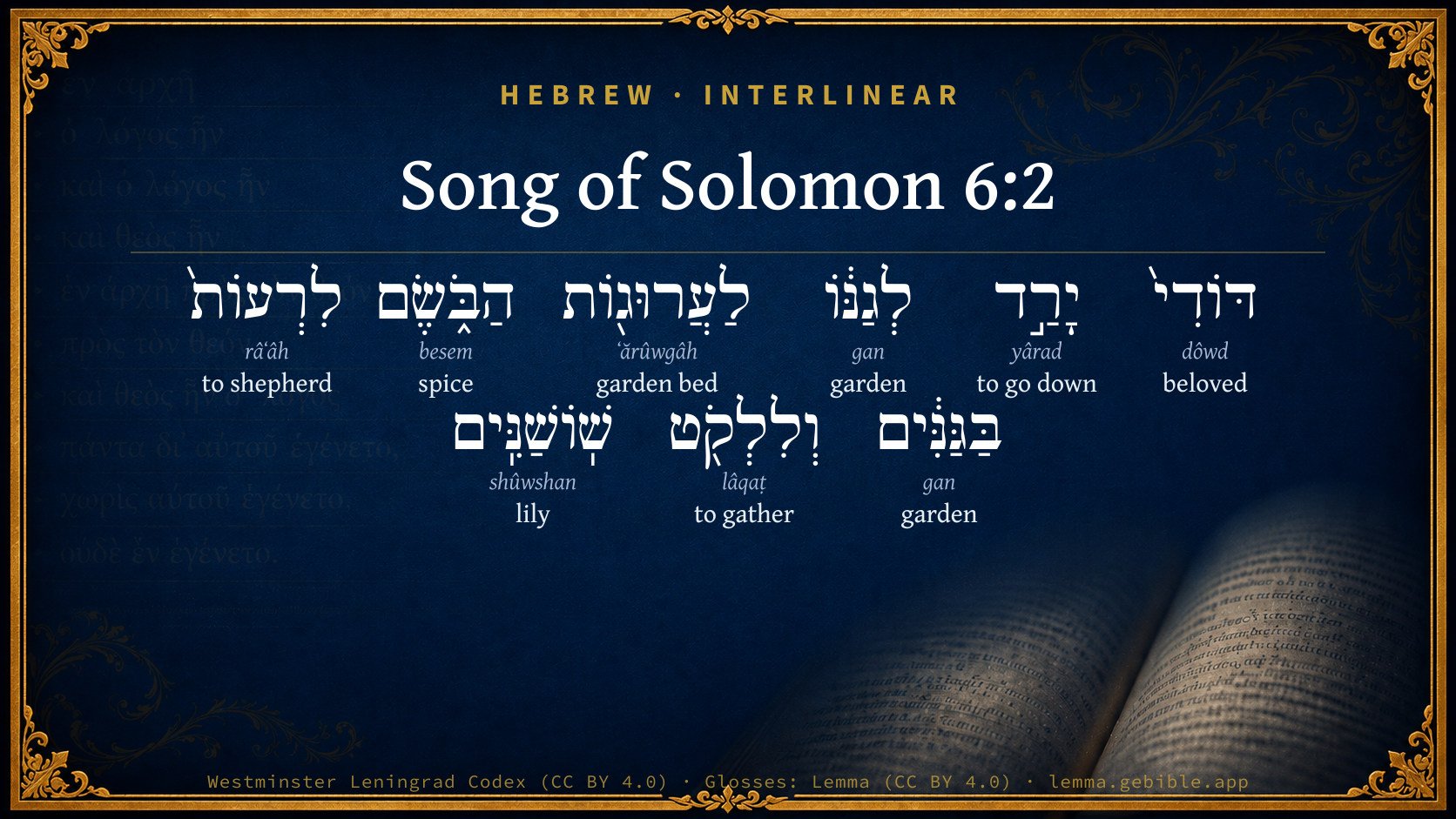
Hebrew (Westminster Leningrad Codex) Song of Solomon 6:2 appears in the Hebrew Old Testament. The text above is from the Westminster Leningrad Codex. Each word links to its Strong’s number, a concise gloss, and parsing drawn from the Open Scriptures Hebrew Bible morphology. Click any word for its full Brown-Driver-Briggs (BDB) entry.
Download image
Cite this verse

Song of Solomon 6:2 (World English Bible). Public Domain. Lemma interlinear Bible study tool, https://lemma.gebible.app/v/song-of-solomon/6/2.

Show BibTeX & RIS
BibTeX
RIS
English Translation
My beloved has gone down to his garden, To the beds of spices, To feed in the gardens, and to gather lilies.
World English Bible · Public Domain
Download a study sheet

One document with this verse’s original text, its word-by-word gloss line, the meaning frame, cross-references with their text, attributed commentary, and full source and license credits — printable, and it pastes into notes with its structure intact.

This verse Autodidact and up

Study sheet (.html) Plain text (.txt)

A passage Seminary Student

Up to 50 verses in one chapter. A passage sheet keeps up to 6 commentary sources and 12 cross-references per verse, in the order this page ranks them, and says so on the sheet whenever that leaves anything out. Ask for a single verse and you get the Autodidact verse sheet above.

Everything on this page stays free to read, with no account — the sheet is a download of what is already on screen, not access to it.

Want to remove ads? Support Godless Engineer
Compare translations 3

The same verse in 3 English versions, stacked beneath the original-language interlinear above. Click any original word for its lexicon entry.

Each is an independent rendering of the whole verse — the interlinear is not word-aligned to these translations.

Highlighted words mark where these versions differ — a whole-verse word diff, not a word-by-word alignment.

  • World English Bible Public Domain
    My beloved has gone down to his garden, To the beds of spices, To feed in the gardens, and to gather lilies.
  • King James Version Public Domain
    My beloved is gone down into his garden, to the beds of spices, to feed in the gardens, and to gather lilies.
  • unfoldingWord Literal Text CC BY-SA 4.0
    My beloved went down to his garden, to the beds of spices, in order to graze in the gardens and in order to glean lilies.

unfoldingWord Literal Text — © unfoldingWord, licensed CC BY-SA 4.0. Word-aligned USFM3 via Door43 (git.door43.org/unfoldingWord/en_ult).

Versions to compare (up to 4)

3 of 4 selected

Show all 18 translations

Every available English version of this verse, each an independent rendering of the whole verse.

  • World English Bible Public Domain
    My beloved has gone down to his garden, To the beds of spices, To feed in the gardens, and to gather lilies.
  • Berean Standard Bible Public Domain
    My beloved has gone down to his garden, to the beds of spices, to pasture his flock in the gardens and to gather lilies.
  • Majority Standard Bible Public Domain
    My beloved has gone down to his garden, to the beds of spices, to pasture his flock in the gardens and to gather lilies.
  • King James Version Public Domain
    My beloved is gone down into his garden, to the beds of spices, to feed in the gardens, and to gather lilies.
  • American Standard Version (1901) Public Domain
    My beloved is gone down to his garden, To the beds of spices, To feed in the gardens, and to gather lilies.
  • Revised Version (1885) Public Domain
    My beloved is gone down to his garden, to the beds of spices, to feed in the gardens, and to gather lilies.
  • Geneva Bible (1599) Public Domain
    I am my welbeloueds, and my welbeloued is mine, who feedeth among the lilies.
  • Douay-Rheims (1899) Public Domain
    I to my beloved, and my beloved to me, who feedeth among the lilies.
  • Young's Literal Translation Public Domain
    My beloved went down to his garden, To the beds of the spice, To delight himself in the gardens, and to gather lilies.
  • Literal Standard Version CC BY-SA 4.0
    My beloved went down to his garden, || To the beds of the spice, || To delight himself in the gardens, and to gather lilies.
  • Unlocked Literal Bible CC BY-SA 4.0
    My beloved has gone down to his garden, to the beds of spices, to graze in the garden and to gather lilies.
  • unfoldingWord Literal Text CC BY-SA 4.0
    My beloved went down to his garden, to the beds of spices, in order to graze in the gardens and in order to glean lilies.
  • Darby Bible Public Domain
    My beloved is gone down into his garden, to the beds of spices, To feed in the gardens and to gather lilies.
  • World Messianic Bible Public Domain
    My beloved has gone down to his garden, to the beds of spices, to pasture his flock in the gardens, and to gather lilies.
  • Webster's Bible Public Domain
    My beloved is gone down into his garden, to the beds of spices, to feed in the gardens, and to gather lilies.
  • Free Bible Version CC BY-SA 4.0
    My love has gone down to his garden, to his flowerbeds of spices. He enjoys feeding in the gardens and plucks lilies.
  • Bible in Basic English Public Domain
    My loved one is gone down into his garden, to the beds of spices, to take food in the gardens, and to get lilies.
  • JPS Tanakh (1917) Public Domain
    'My beloved is gone down into his garden, to the beds of spices, to feed in the gardens, and to gather lilies.

Literal Standard Version (2020), Covenant Press — licensed CC BY-SA 4.0. Text via the HelloAO Bible API (eBible.org). Unlocked Literal Bible (unfoldingWord) — licensed CC BY-SA 4.0. Text via the HelloAO Bible API (eBible.org). unfoldingWord Literal Text — © unfoldingWord, licensed CC BY-SA 4.0. Word-aligned USFM3 via Door43 (git.door43.org/unfoldingWord/en_ult). Free Bible Version, Dr. Jonathan Gallagher — licensed CC BY-SA 4.0. Text via the HelloAO Bible API (eBible.org).

Word by word

More ways to search: Search by grammar → Find every occurrence → Compare this word →

Practice this passage: Drill this verse → Learn its vocabulary →

לַעֲרוּג֖וֹת
ʻărûwgâh
H6170
“to/for · garden beds of”
Preposition + Noun, Common, Feminine, Plural, Construct
Part of Speech
Preposition + Noun
Type
Common
Gender
Feminine
Number
Plural
State
Construct
Full BDB Definition

Origin: pass. part. of H6165

TWOT: 1691a

garden terrace or bed
  1. דּוֹדִי֙ dôwd H1730 “beloved · my” Noun, Common, Masculine, Singular, Construct + Suffix, Personal, 1st Person, Common, Singular
  2. יָרַ֣ד yârad H3381 “to go down” Verb, Qal, Perfect, 3rd Person, Masculine, Singular
  3. לְגַנּ֔וֹ gan H1588 “to/for · garden · his” Preposition + Noun, Common, Both, Singular, Construct + Suffix, Personal, 3rd Person, Masculine, Singular
  4. הַבֹּ֑שֶׂם besem H1314 “the · spice” Particle, Definite Article + Noun, Common, Masculine, Singular, Absolute
  5. לִרְעוֹת֙ râʻâh H7462 “to shepherd” Preposition + Verb, Qal, Infinitive Construct
  6. בַּגַּנִּ֔ים gan H1588 “in/at the · gardens” Preposition, Determined + Noun, Common, Both, Plural, Absolute
  7. וְלִלְקֹ֖ט lâqaṭ H3950 “and · to gather” Conjunction + Preposition + Verb, Qal, Infinitive Construct
  8. שֽׁוֹשַׁנִּֽים shûwshan H7799 “lilies” Noun, Common, Both, Plural, Absolute

About this verse

These counts appear in no published source. They are computed here, from the morphology-tagged text and Lemma’s own curated glosses. What Lemma adds →

9
words
8
distinct lemmas
Wisdom
section

Notable vocabulary

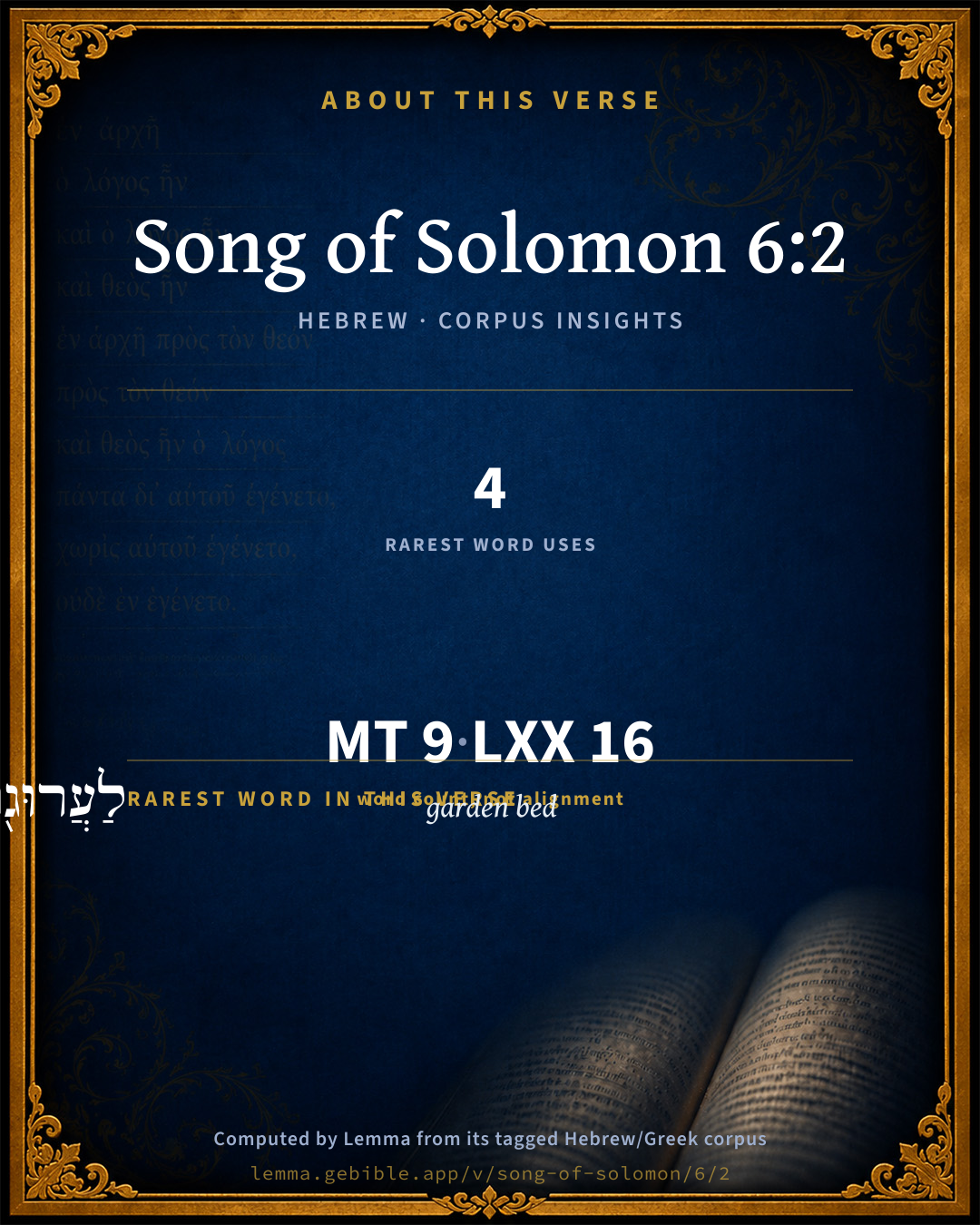
The rarest word here is לַעֲרוּג֖וֹת garden bed H6170 — appearing just 4 times in the whole Hebrew Bible.

Shared distinctive vocabulary

לַעֲרוּג֖וֹת garden bed H6170 occurs in 4 verses of the Hebrew Bible. Also found in:

Grammatical profile

  • 3 verbs
  • 6 nouns

Verb forms

  • יָרַ֣ד Qal · Perfect
  • לִרְעוֹת֙ Qal · Infinitive Construct
  • וְלִלְקֹ֖ט Qal · Infinitive Construct

Repetition

A word recurs within this verse — often emphatic in Hebrew:

  • לְגַנּ֔וֹ garden H1588 ×2

Hebrew & Septuagint length

In English translation the verse runs 22 words from the Hebrew and 14 from the Septuagint (LXX English) — the Septuagint runs noticeably shorter here. See the side-by-side →

A rough comparison of the two English renderings, which tokenize alike — not a word-level alignment.

Word counts can differ between the Hebrew and the Greek without any difference in meaning — e.g. the Hebrew direct-object marker אֵת has no separate Greek word, and Greek often adds the article ὁ.

In the original languages it is 9 Hebrew tokens and 16 Greek tokens — but the two are counted differently (Hebrew bundles its prefixes and suffixes into one token; the Greek is in lemma form), so that isn’t a like-for-like length.

Cross-references

19

Topical passages linked to Song of Solomon 6:2 in the Treasury of Scripture Knowledge — connected by theme and wording, ordered by reader-vote popularity; previews shown in the World English Bible.

  • Song of Solomon 5:13 His cheeks are like a bed of spices with towers of perfumes. His lips are like lilies, dropping liquid myrrh.
  • Song of Solomon 1:7–8 Tell me, you whom my soul loves, Where you graze your flock, Where you rest them at noon; For why should I be as one who is veiled Beside the flocks of your companions? Lover
  • Song of Solomon 2:1–2 I am a rose of Sharon, A lily of the valleys.
  • Song of Solomon 4:12–5:1 A locked up garden is my sister, my bride; A locked up spring, A sealed fountain.
  • Song of Solomon 6:11 I went down into the nut tree grove, To see the green plants of the valley, To see whether the vine budded, And the pomegranates were in flower.
  • Isaiah 40:11 He will feed his flock like a shepherd, he will gather the lambs in his arm, and carry them in his bosom, [and] will gently lead those who have their young.
  • Isaiah 57:1 The righteous perishes, and no man lays it to heart; and merciful men are taken away, none considering that the righteous is taken away from the evil [to come].
  • Isaiah 58:11 and Yahweh will guide you continually, and satisfy your soul in dry places, and make strong your bones; and you shall be like a watered garden, and like a spring of water, whose waters don't fail.
  • Isaiah 61:11 For as the earth brings forth its bud, and as the garden causes the things that are sown in it to spring forth; so the Lord Yahweh will cause righteousness and praise to spring forth before all the nations.
  • Ezekiel 34:23 I will set up one shepherd over them, and he shall feed them, even my servant David; he shall feed them, and he shall be their shepherd.
  • Zephaniah 3:17 Yahweh, your God, is in the midst of you, a mighty one who will save. He will rejoice over you with joy. He will rest in his love. He will rejoice over you with singing.
  • Matthew 18:20 For where two or three are gathered together in my name, there I am in the midst of them."
  • Matthew 28:20 teaching them to observe all things that I commanded you. Behold, I am with you always, even to the end of the age." Amen.
  • John 4:34–35 Jesus said to them, "My food is to do the will of him who sent me, and to accomplish his work.
  • John 14:3 If I go and prepare a place for you, I will come again, and will receive you to myself; that where I am, you may be there also.
  • John 17:24 Father, I desire that they also whom you have given me be with me where I am, that they may see my glory, which you have given me, for you loved me before the foundation of the world.
  • Philippians 1:21–23 For to me to live is Christ, and to die is gain.
  • 1 Thessalonians 4:13–14 But we don't want you to be ignorant, brothers, concerning those who have fallen asleep, so that you don't grieve like the rest, who have no hope.
  • Revelation 7:17 for the Lamb who is in the midst of the throne shepherds them, and leads them to springs of waters of life. And God will wipe away every tear from their eyes."

Cross-references courtesy of OpenBible.info (CC BY 4.0).

Hebrew and Greek witnesses Masoretic Hebrew ↔ Greek Septuagint

The same verse in the two great witnesses to the Old Testament, shown verse-for-verse.

Here the Septuagint runs noticeably shorter than the Hebrew — LXX2012 (modern English Septuagint) 14 words vs World English Bible 22. A rough length comparison of the two English translations, not a word-level alignment — read both below.

These are two independent witnesses, not word-aligned to each other, and the Septuagint is shown in lemma (dictionary) form.

Hebrew Song of Solomon 6:2 Masoretic · Westminster Leningrad Codex

דּוֹדִי֙ יָרַ֣ד לְגַנּ֔וֹ לַעֲרוּג֖וֹת הַבֹּ֑שֶׂם לִרְעוֹת֙ בַּגַּנִּ֔ים וְלִלְקֹ֖ט שֽׁוֹשַׁנִּֽים

My beloved has gone down to his garden, To the beds of spices, To feed in the gardens, and to gather lilies.

World English Bible · Public Domain

Greek LXX Song of Solomon 6:2 Septuagint · lemma form

ἀδελφιδός ἐγώ καταβαίνω εἰς κῆπος αὐτός εἰς φιάλη ὁ ἄρωμα ποιμαίνω ἐν κῆπος καί συνλέγω κρίνον

I am my kinsman's, and my kinsman is mine, who feeds among the lilies.

LXX2012 (modern English Septuagint) · Public Domain

Hebrew: Westminster Leningrad Codex (CC BY 4.0). Greek: Septuagint (public domain); English from LXX2012 (modern English Septuagint) (Public Domain). How the Septuagint differs from the Hebrew →

Commentary

Notes on Song of Solomon 6:2 from classic Christian and Jewish commentators (each source and its license shown beneath its notes). The classic Christian expositions comment on the surrounding passage and are grouped to its opening verse, so a note may address several verses; the Jewish commentaries on the Tanakh (Rashi and others) are per-verse, so they appear only where the commentator wrote on this verse.

Lemma curates 59 commentaries, every one of them public domain or Creative Commons licensed, each selected and text-cleaned for this edition rather than reprinted as found. About our sources →

Trapp's Complete Commentary

John Trapp

Son 6:2 My beloved is gone down into his garden, to the beds of spices, to feed in the gardens, and to gather lilies.

Ver. 2. My beloved is gone down into his garden.] Now she can tell where Christ is, and inform others who before was to seek of him, and sought infor mation from others. Post tenebras lux is the Church’s motto. "Though I sit in darkness, the Lord shall give me light"; he will, with the temptation, give the issue - a way to get out of it, as the moon wades out of a cloud, as the seed gets up from under a clod. And see how forward she is to share; her friends shall know all that she can tell them. There is no envy in spiritual things, because they may be divided in solidum. in the whole. One may have as much as another, and all alike. Yea, God’s people know that the "manifestation of the Spirit is given them to profit withal," {1Co 12:7} and that it is not pouring out, but want of pouring out, that dries up the streams of grace, as that of off. {2Ki 4:6} What is meant by Christ’s garden? {See Trapp on "Son 4:16"} He is said to go down to it, in allusion to the situation of Jerusalem, which was on a hill, their gardens being below in the fruitful valleys. Christ came down to his Church; he "descended into the lower parts of the earth"; that is, into his mother’s womb; {Eph 4:9 Psa 139:15} yea, he "emptied himself" {a} of all his excellencies, and took upon him the form of a servant, yea, of an evil servant that was to be beaten. Yea, more, he "humbled himself, and became obedient unto death, even the death of the cross." {Php 2:9} Oh, humble Saviour, whither wilt thou descend? Facinus vincire civem Romanum. {b} It was much for the Son of God to be bound, more to be beaten, most of all to be slain. Quid dicam in crucem tolli, &c. Well might the apostle say, "He humbled himself"

To the beds of spices,] i.e., To the particular churches, or to the companies of believers. These beds or rows of renewed souls, Christ, as a good gardener, treadeth out, soweth, planteth, watereth, fenceth, filleth with sundry gifts and graces.

To feed in the gardens, and to gather lilies.] Like as men go to their gardens, either to make merry, as we say, or to gather fruits. So Christ here, either to "eat his pleasant fruits," {Son 4:16} his people’s holy performances, better to him than any Ambrosia, and then to "gather his lilies," to transplant them into heaven. Pascitnr Christus, quando suorum virtutes videt, saith one. Lilia decerpit, quando optimum quemque ex hac vita traducit: Christ "feedeth in the gardens," when he beholdeth the virtues of his people. He "gathereth lilies" when he translateth good souls into his kingdom above.

{a} εκενωσεν εαυτον, ex omni ad nihilum seipsum redegit. - Beza.

{b} Cicero.

John Trapp, A Commentary or Exposition upon All the Books of the Old and New Testament (1647–1656) — public domain. Text from a community e-Sword module.

The Biblical Illustrator

Joseph S. Exell

Son_6:2-3

My Beloved has gone down into His garden, to the beds of spices.

Communion

The exquisite pastoral from which our text is taken is peculiarly fitted for Sacramental meditation--because its design is to set forth the mutual love of Christ and His disciples; and because His disciples, in approaching the Sacrament, should be in frames of mind fitted to appreciate, its exquisite imagery.

I. Christian duty. The Church is here represented as Christs garden, into which He then descends to delight Himself with the gracious fruits of the believers spiritual life. And our lesson of duty is, that the Sacrament we should experience and exhibit such spiritual affections as seem unto Christ precious--fruits to be eaten--lilies to be gathered I Consider these graces:--

1. Faith. This is the foundation of all religious life. Now this grace Christ delights in, for it greatly honours and glorifies Him. In its ascription of salvation to Him alone it virtually places the mediatorial crown upon His head.

2. Love,--the souls crowning grace, or a grand composite of all graces. For, in strict speech; they are all modifications of love. Penitence is love grieving--faith is love resting--obedience is love working--hope is love waiting. So that love toward man and toward God is at once the law fulfilled, and holiness perfected. And in this Christ delights.

II. The Christians privilege. Regarding the believer as the subject it represents his soul as greatly rejoicing in the Sacrament, gathering in Christs garden the heavenly fruit. These fruits are the gracious gifts imparted by the Saviour. Consider a few of them. Take them as they are presented in Christs discourse in that guest-chamber.

1. Peace. Quiet, tranquillity, spiritual and immortal rest I And for this we come to Christ in the Sacrament. Behold a garden walled up to heaven. And through its open portal the soul passes leaning on the Beloved, to bathe heart and spirit in the everlasting fulness of Gods glorious peace!

2. Joy. These things have I spoken unto you, that My joy might remain with you, and that your joy might be full. And what glorious, joy imparting words they were! And this is better than peace; for that is but a passive rest, this is a reigning rapture. (C. Wadsworth.)

The Biblical Illustrator, edited by Joseph S. Exell (c. 1880s–1900s) — public domain. Text from a community e-Sword module.

The Preacher's Complete Homiletical Commentary

Joseph S. Exell (gen. ed.)

THE INQUIRY ANSWERED

Son_6:2

SHULAMITE, to the Daughters

My Beloved is gone down into his garden,

To the beds of spices;

To feed in the gardens,

And to gather lilies.

Shulamite continues her Narrative and Song. Relates her answer to the inquiring women. Suddenly recollects herself, and at once and unhesitatingly declares whither her Beloved is gone. ‘He is gone down to his garden.’ Literally, Solomon’s garden in a valley below Jerusalem, on the South East. The allusion, however, probably to the Bride herself, already called ‘his garden,’ which he had been invited by her to enter and ‘eat his pleasant fruits’ (chap. Son_4:16). A delicate hint that the Bridegroom was expected to be with his Bride, and to find his chief enjoyment in her society. So Pro_5:15-20. Christ the Bridegroom of His Church to be found in the assemblies of His people (Mat_18:20; Psa_132:13-14). Walks among the golden candlesticks (Rev_2:1). Never absent from His Church in general, though apparently and for a time from individual believers. Observe—

(1) By commending Christ to others we often find Him ourselves.

(2) The spiritual darkness of a believer often broken in upon by a ray of light which at once removes his difficulty and sorrow. Hagar’s eyes had but to be opened to see the fountain by her side. ‘Mary!’ suddenly and in a moment turned her sorrow into joy.

(3) Historically, Christ’s body, after His crucifixion, found in Joseph’s garden, and His Spirit in the paradise of God. The Bride’s answer suggestive of what constitutes

The Saviour’s Joy.

1. The fellowship of His believing people on earth. The Church His ‘garden.’ Separate congregations and individual believers His ‘gardens. Christ goes down ‘into His garden,’ ‘to feed in the gardens.’ Indicated in His call to the Church at Laodicea: ‘I stand at the door and knock; if any man hear My voice, I will come in unto him, and will sup with him, and he with Me’ (Rev_3:20). ‘The Lord’s portion is His people.’ ‘He will rest in His love; He will joy over thee with singing’ (Zep_3:17). The name given by Him to His Church: ‘Hephzibah,’ or ‘my delight is in her.’ ‘The Lord taketh pleasure in His people.’ ‘He walketh in the midst of thy camp.’ ‘I will walk in you.’ Christ delights in His Church and people as a man in his garden of fruits, flowers, and spices. Hence the responsibility resting on them to be such that Christ may find in them the enjoyment which He seeks. No unclean thing to be in Israel’s camp. The garden to be kept clean and orderly for the proprietor’s pleasure. Believers to keep their hearts and lives for Christ’s sake as well as their own. The Church to purge out the old leaven of malice and wickedness. To put away from among them the wicked person. To keep the ordinances as delivered to them. To see that all things are done decently and in order (1Co_5:7; 1Co_5:13; 1Co_11:2; 1Co_14:40). Believers to see that they are bearing not only fruit, but much fruit. All the fruits of the Spirit to be produced in them—love, joy, peace, &c. (Gal_5:22). ‘I looked that it should bring forth grapes.’ ‘My soul desired the first ripe fruit.’ His complaint that Israel was an empty (or yieding) vine, bringing forth fruit only to himself (Isa_5:4; Mic_7:1; Hos_10:1). Christ leaves His heritage, and ‘gives the dearly beloved of His soul into the hand of her enemies, when it becomes to Him as a ‘speckled bird’ (Jer_12:7-11). A lukewarm Church or Christian He can only spue out of His mouth (Rev_3:16). Believers to see that no root of bitterness springing up trouble them, and defile the garden of Christ. Spices, as well as fruits, to be growing in Christ’s garden. His people and Churches to be ‘beds of spices’—fragrant and attractive, as well as useful.

2. The presence of His people in heaven. ‘He goes down into His garden to gather lilies. Heaven a place of

Gathered Lilies.

Lilies, his believing people (chap. Son_2:2). Gathered out of His garden on earth for His presence in heaven. Christ first transforms thorns into lilies, then transfers the lilies to Paradise. A world lying in wickedness not a place for His lilies to remain longer than is necessary. Every departed saint a gathered lily. The lilies enjoyed by Christ while growing in His garden below; still more when blooming in the Paradise above. The lilies gathered in fulfilment of His own promise (Joh_14:2). Preserved safe with Himself till His return, when He brings them with Him (1Th_4:14; 1Th_3:13; 2Th_1:10). Heaven delightful and attractive as the place of gathered lilies. ‘The spirits of just men made perfect.’ Those who have washed their robes and made them white in the blood of the Lamb. Believers depart to be with Christ. ‘To-day shalt thou be with Me in Paradise.’ Absent from the body, present with the Lord. Lazarus carried by the angels into Abraham’s bosom. Christ’s lilies in heaven without a spot in them. ‘Without fault before the throne of God.’ Presented as a chaste virgin to Christ. Faultless before the presence of His glory. A glorious Church, not having spot, or wrinkle, or any such thing. Holy and without blame before Him in love. All like Himself, seeing Him as He is. The former things passed away. The blessedness of heaven is, that it is free from all moral defilement. The happiness of the glorified, not so much that there is no more sorrow, as that there is no more sin. Christ’s people lily-like here; much more hereafter. No remains of the thorn in heaven. The flesh carried to the grave, but no farther. The lilies gathered for Christ’s own enjoyment as well as that of His people. Each departed believer an accession to the joy of heaven and of heaven’s King. Christ’s heaven to have the hundred and forty and four thousand of His redeemed around Him on Mount Zion, praising the Father in the midst of the General Assembly and Church of the Firstborn the (Heb_2:12; Heb_12:23). Hence—

(1) A reason why believers should gladly leave this world.

(2) A ground of sweet consolation in regard to friends who fall asleep in Jesus.

(3) Believers not to grudge Christ the lilies which He gathers.

The Preacher's Complete Homiletical Commentary (gen. ed. Joseph S. Exell; Funk & Wagnalls, c. 1892) — public domain (pre-1929). A full-Bible homiletical/sermon-outline anthology covering 65 of 66 books (2 John is absent from the source module). Text from a community e-Sword module.

Adam Clarke's Commentary

Verse 2. My beloved is gone down into his garden] The answer of the bride to her companions.

Adam Clarke's Commentary on the Bible (1810–1826) — public domain. Text from a community e-Sword/MySword module.

The Cambridge Bible for Schools and Colleges

gen. ed. J. J. S. Perowne

2. The bride gives them an evasive answer, becoming jealous perhaps of their eager interest. She simply says he has gone forth to his usual haunts. Budde would strike out Son_6:1-3, on the ground that the garden, the beds of spices, and the lilies are figures for the bride’s person, as similar natural objects are in Son_4:12 f., Son_5:13, Son_2:16, Son_5:1. Here they cannot be that, since the bride is confessedly describing an absent lover, and they must consequently on his theory be put in by someone who did not understand the other references. But this curious reversion to the allegorical interpretation of the Song in a physical sense, by the opponents of allegorical interpretation in a spiritual sense, must be rejected. In all the passages referred to, save Son_2:16, which must be taken literally, the simile or metaphor is fully stated; the bride is like so and so, or her cheeks are so and so. No one, consequently, could possibly misunderstand them. Here the absence of any indication of simile makes the literal interpretation necessary, and so understood these verses have a perfectly natural and appropriate meaning. The similes referred to are taken in the first instance from surrounding nature, and when the Shulammite’s lover disappears it would be among these surroundings he would disappear. Taken simply as they stand, the words mean that he has gone back for a time to his ordinary occupations, and she thinks of him as gathering a garland for her as he had often done before. Further, the expression lilqôt shôshannîm is in favour of this view. ‘To pluck lilies’ would be a very strange expression if lilies meant ‘lips’ here.

to feed] i.e. ‘to feed the flock.’

The Cambridge Bible for Schools and Colleges (gen. ed. J. J. S. Perowne; Cambridge University Press, 1878–1918) — public domain. Text from a community e-Sword module.

Haydock's Catholic Bible Commentary

Beloved. She speaks thus, when she finds him, and runs to his embraces, having found what trouble her neglect had occasioned. (Calmet)

George Leo Haydock (1774–1849), Haydock's Catholic Family Bible and Commentary, 1859 edition — public domain. Excludes Psalms (Douay-Rheims chapter numbering differs from Protestant) and Deuterocanonical books (Catholic canon only).

Matthew Poole's English Annotations

The spouse had hitherto been at a loss for her Beloved, but having diligently sought him, and inflamed both her own and others’ affections with love to him by her just commendations, now at last she meets with a gracious answer from God, directing her where to find him, which also comes very seasonably, not only for her own relief and comfort, but also for the benefit of others, who inquired after him. The

garden seems to signify the church catholic, and the gardens, as it follows here, as also the beds, may note the particular assemblies of the faithful, in which Christ affordeth his presence and his blessing.

Beds of spices; in which the gifts and graces of God’s Spirit, which are fitly compared to spices or aromatical flowers, do appear and grow.

To feed; to refresh and delight himself, or to gather the flowers and fruits of it, as men use to do in their gardens.

To gather lilies; which may note either,

1. Particular believers, whom Christ gathereth to himself in his church, who are compared to lilies, Son 2:2. Or,

2. The prayers and praises tendered to him by his people in the public congregations, and all their gracious dispositions and actions.

Matthew Poole's English Annotations on the Holy Bible (1683–1685) — public domain. Text from a community e-Sword/MySword module.

Whedon's Commentary on the Bible

Daniel D. Whedon

2. Into his garden — This reply is made with the utmost composure, as if she divined their plan, but was entirely easy and assured of herself. The verse might be introduced by an “Oh,” pronounced so as to depreciate the question. “As if he thought his stay here might not be the best thing, he has returned to his pleasant business at home.”

To feed in the gardens — Better, to enjoy the good of the gardens.

Daniel D. Whedon (gen. ed.), Commentary on the Old and New Testaments (1874–1909) — public domain. Text from a community e-Sword module.

The Pulpit Commentary

Vers. 2, 3. My beloved is gone down to his garden, to the beds of spices, to feed in the gardens, and to gather lilies. I am my beloved"s, and my beloved is mine: he feedeth his flock among the lilies. In Ecc_2:5, 6 Solomon says, "I planted me vineyards; I made me gardens and parks, and I planted trees in them of all kinds of fruit; I made me pools of water, to water therefrom the forest where trees were reared." Rev_7:17 it is said, "The Lamb which is in the midst of the throne shall be their Shepherd, and shall guide them unto fountains of water of life: and God shall wipe away every tear from their eyes." We can scarcely doubt that the meaning is The bridegroom is not gone far; he is where he is congenially employed; where his pure and lovely nature finds that which is like itself beauty and fragrance and innocence. It is his resort, and it corresponds with his perfection. Delitzsch thinks "thoughtfulness and depth of feeling are intended". (cf. Psa_92:5) "His thoughts are very deep." But it would seem more fitting, in the lips of the bride, that she should dwell on the aspects of her beloved which correspond with her own feelings. She is one of the lilies. The king is coming into his garden, and I am ready to receive him. The shepherd among his flock. They are all like lilies, pure and beautiful. The bride has nothing but chaste thoughts of her husband: because she knows that he is hers, and she is his. Surely such language is not inaptly applied to spiritual uses. Tennyson"s lovely poem, "St. Agnes" Eve," has caught the spirit of Shulamith. A few of his lines will illustrate this"The shadows of the convent towers Slant down the snowy sward, Still creeping with the creeping hours That lead me to my Lord. Make thou my spirit pure and clear As are the frosty skies, Or this first snowdrop of the year That in my bosom lies. He lifts me to the golden doors; The flashes come and go; All Heaven bursts her starry floors, And strews her lights below, And deepens on and up! the gates Roll back, and far within For me the heavenly Bridegroom waits, To make me pure of sin. The sabbaths of eternity, One sabbath deep and wide, A light upon the shining sea The Bridegroom with his bride.

The Pulpit Commentary (1880–1919), ed. H.D.M. Spence-Jones & Joseph S. Exell — public domain. Text from a community e-Sword module.

John Wesley's Explanatory Notes

Is gone - The spouse had hitherto been at a loss for her beloved, but having diligently sought him, now at last she meets with a gracious answer from God, directing her where to find him. The garden may signify the church catholic, and the gardens, as it follows, as also the beds, the particular assemblies of the faithful, in which Christ affords his presence. Spices - In which the gifts and graces of God's spirit, fitly compared to spices, grow. To feed - To refresh and delight himself. Lillies - Which may denote either, particular believers, whom Christ gathers to himself in his church; or, the prayers and praises of his people in the publick congregations.

John Wesley, Explanatory Notes Upon the Whole Bible (1754–1765) — public domain. Text via the GEBible commentary corpus.

unfoldingWord translationNotes

Door43 World Missions Community

My beloved has gone down to his garden

The word "garden" is a metaphor for the woman. The man is finally able to fully enjoy the woman as they make love. See the explanation of this metaphor in Song of Songs 5:1. (See: Metaphor and Euphemism)

my beloved

This phrase refers to the man whom the woman loves. In some languages it may be more natural for her to refer to him as "my lover." See how you translated this in Song of Songs 1:13. AT: "my dear one" or "my lover"

beds of spices

gardens or parts of gardens where people grow spices. See how you translated this in Song of Songs 5:13. (See: Metaphor)

to graze in the garden and to gather lilies

These words are metaphors for the man enjoying her body. (See: Metaphor)

graze

"feeds" or "eats grass." The woman speaks of the man as if he were "a gazelle or a young stag" (Song of Songs 2:17) that eats plants among the lilies. Grazing is probably a metaphor for lovemaking (Song of Songs 2:1-2). See how you translated "he grazes" in Song of Songs 2:16. (See: Metaphor)

to gather lilies

"to pick lilies"

lilies

sweet-smelling flowers that grow in places where there is much water. Translate as the plural of "lily" in Song of Songs 2:1.

I am my beloved's, and my beloved is mine

See how you translated the similar phrase "My beloved is mine, and I am his" in Song of Songs 2:16.

he grazes among the lilies with pleasure

See how you translated this in Song of Songs 2:16.

unfoldingWord translationNotes — © Distant Shores Media and the Door43 World Missions Community, licensed CC BY-SA 4.0. Source: git.door43.org/Door43/en_tn.

Rashi

Rabbi Shlomo Yitzchaki (Rashi)

My beloved has gone down to his garden He commanded us to build His Temple, and He will be there with us.

to the spice beds to the place where the incense is burned.

to graze in the gardens And further, He went down to pasture His flocks in the gardens where they were scattered, i.e., those who did not come up from the exile. He causes His Shechinah to rest upon them in the synagogues and in the study halls.

and to gather roses He listens and hearkens to those who speak of His Torah, to collect their merits and to inscribe them in a memorial book before Him, as it is stated (Mal. 3: 16): “Then the God-fearing men spoke...[and a book of remembrance was written before Him...]” Now, concerning your request to seek with us and to build with us, “I am my Beloved’s,” but you are not His, and you shall not build with us, as it is stated (Ezra 4:3): “It is not for you and for us to build a House for our God,” and Scripture states further (Neh. 2:20): “and you have no portion or right or memorial in Jerusalem.”

Rashi on the Tanakh — English translations: “The Judaica Press complete Tanach with Rashi, translated by A. J. Rosenberg” (CC BY 4.0); “Pentateuch with Rashi's commentary by M. Rosenbaum and A.M. Silbermann, 1929-1934” (public domain); “The Metsudah Tanach series, Lakewood, N.J” (CC BY 4.0); and “The Book of Joshua, Metsudah Publications, 1997” (CC BY 4.0). Text via Sefaria.

Lesson kit

Teaching starters — assembled from the data on this page, not authored interpretation. Every prompt links to the verse data it draws on. Edit before teaching.

Song of Solomon, in the Wisdom, opens this verse with 9 words (8 distinct Hebrew lemmas). Its most distinctive word is ʻărûwgâh (“garden bed”). The Greek Septuagint runs shorter here. A historical commentator’s framing appears above. Read the whole chapter for the surrounding context.

Discussion questions

  1. How does “garden bed” (ʻărûwgâh) shape what this verse is saying?
  2. How does Song of Solomon 5:13, which shares the word «garden bed», read alongside this verse?
  3. What does the repetition of “garden” (2× in this one verse) do in this verse?
  4. The Septuagint runs shorter here than the Hebrew. What might account for the difference?
  5. These translations render this verse differently; the difference is in the English rendering, not the original. What questions does that raise?
  6. «יָרַ֣ד» is a Qal Perfect verb. How does that grammatical form shape the action described?
  7. Compare how Trapp's Complete Commentary and The Biblical Illustrator read this verse. Where do they agree or differ?

Things to notice

Reading settings

Reading text

Shown beneath each verse's original-language words.

Old Testament
Old Testament edition

Read the OT as the Masoretic Hebrew (MT) or the Greek Septuagint (LXX).

English shown for the Greek Septuagint (in the Hebrew ↔ Greek comparison).

Comparing translations? Open the Compare panel on any verse page to stack up to four side by side.