Jeremiah 10:21

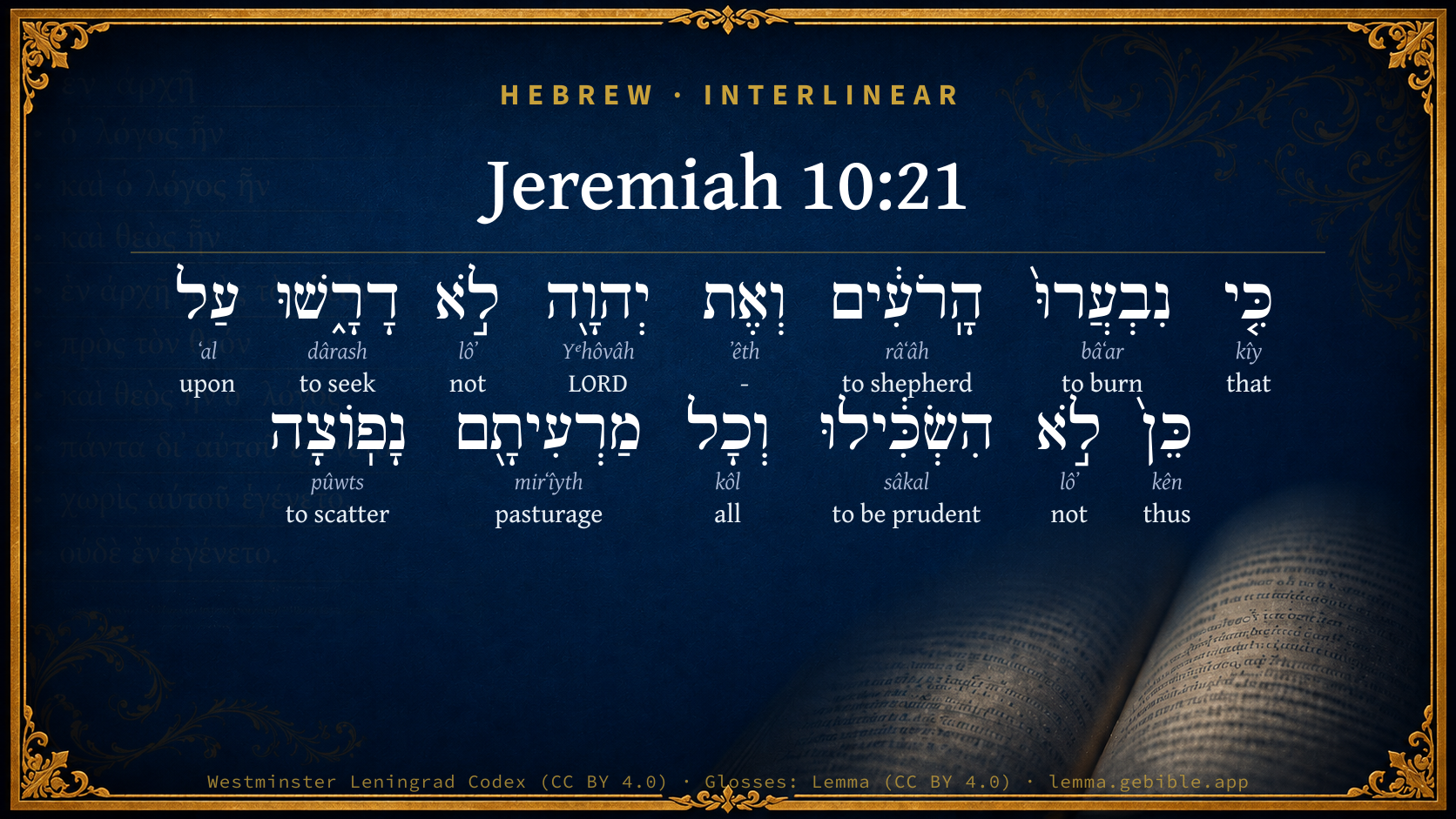
Hebrew (Westminster Leningrad Codex) Jeremiah 10:21 appears in the Hebrew Old Testament. The text above is from the Westminster Leningrad Codex. Each word links to its Strong’s number, a concise gloss, and parsing drawn from the Open Scriptures Hebrew Bible morphology. Click any word for its full Brown-Driver-Briggs (BDB) entry.
Download image
Cite this verse

Jeremiah 10:21 (World English Bible). Public Domain. Lemma interlinear Bible study tool, https://lemma.gebible.app/v/jeremiah/10/21.

Show BibTeX & RIS
BibTeX
RIS
English Translation
For the shepherds are become brutish, and have not inquired of Yahweh: therefore they have not prospered, and all their flocks are scattered.
World English Bible · Public Domain
Download a study sheet

One document with this verse’s original text, its word-by-word gloss line, the meaning frame, cross-references with their text, attributed commentary, and full source and license credits — printable, and it pastes into notes with its structure intact.

This verse Autodidact and up

Study sheet (.html) Plain text (.txt)

A passage Seminary Student

Up to 50 verses in one chapter. A passage sheet keeps up to 6 commentary sources and 12 cross-references per verse, in the order this page ranks them, and says so on the sheet whenever that leaves anything out. Ask for a single verse and you get the Autodidact verse sheet above.

Everything on this page stays free to read, with no account — the sheet is a download of what is already on screen, not access to it.

Want to remove ads? Support Godless Engineer
Compare translations 3

The same verse in 3 English versions, stacked beneath the original-language interlinear above. Click any original word for its lexicon entry.

Each is an independent rendering of the whole verse — the interlinear is not word-aligned to these translations.

Highlighted words mark where these versions differ — a whole-verse word diff, not a word-by-word alignment.

  • World English Bible Public Domain
    For the shepherds are become brutish, and have not inquired of Yahweh: therefore they have not prospered, and all their flocks are scattered.
  • King James Version Public Domain
    For the pastors are become brutish, and have not sought the LORD: therefore they shall not prosper, and all their flocks shall be scattered.
  • unfoldingWord Literal Text CC BY-SA 4.0
    For the shepherds are stupid and they do not seek Yahweh, therefore they have not prospered, and all their flock is scattered.

unfoldingWord Literal Text — © unfoldingWord, licensed CC BY-SA 4.0. Word-aligned USFM3 via Door43 (git.door43.org/unfoldingWord/en_ult).

Versions to compare (up to 4)

3 of 4 selected

Show all 18 translations

Every available English version of this verse, each an independent rendering of the whole verse.

  • World English Bible Public Domain
    For the shepherds are become brutish, and have not inquired of Yahweh: therefore they have not prospered, and all their flocks are scattered.
  • Berean Standard Bible Public Domain
    For the shepherds have become senseless; they do not seek the LORD. Therefore they have not prospered, and all their flock is scattered.
  • Majority Standard Bible Public Domain
    For the shepherds have become senseless; they do not seek the LORD. Therefore they have not prospered, and all their flock is scattered.
  • King James Version Public Domain
    For the pastors are become brutish, and have not sought the LORD: therefore they shall not prosper, and all their flocks shall be scattered.
  • American Standard Version (1901) Public Domain
    For the shepherds are become brutish, and have not inquired of Jehovah: therefore they have not prospered, and all their flocks are scattered.
  • Revised Version (1885) Public Domain
    For the shepherds are become brutish, and have not inquired of the LORD: therefore they have not prospered, and all their flocks are scattered.
  • Geneva Bible (1599) Public Domain
    For the Pastours are become beasts, and haue not sought the Lord: therefore haue they none vnderstanding: and all the flockes of their pastures are scattered.
  • Douay-Rheims (1899) Public Domain
    Because the pastors have done foolishly, and have not sought the Lord: therefore have they not understood, and all their flock is scattered.
  • Young's Literal Translation Public Domain
    For the shepherds have become brutish, And Jehovah they have not sought, Therefore they have not acted wisely, And all their flock is scattered.
  • Literal Standard Version CC BY-SA 4.0
    For the shepherds have become brutish, || And they have not sought YHWH, || Therefore they have not acted wisely, || And all their flock is scattered.
  • Unlocked Literal Bible CC BY-SA 4.0
    For the shepherds are stupid and they do not seek Yahweh; so they have not prospered, and all their flock has been scattered.
  • unfoldingWord Literal Text CC BY-SA 4.0
    For the shepherds are stupid and they do not seek Yahweh, therefore they have not prospered, and all their flock is scattered.
  • Darby Bible Public Domain
    For the shepherds are become brutish, and have not sought Jehovah; therefore have they not acted wisely, and all their flock is scattered.
  • World Messianic Bible Public Domain
    For the shepherds have become brutish, and have not inquired of the LORD. Therefore they have not prospered, and all their flocks have scattered.
  • Webster's Bible Public Domain
    For the pastors have become brutish, and have not sought the LORD: therefore they shall not prosper, and all their flocks shall be scattered.
  • Free Bible Version CC BY-SA 4.0
    The “shepherds” have become stupid—they don't ask the Lord for advice. That's why they have failed, and all their flock has been scattered.
  • Bible in Basic English Public Domain
    For the keepers of the sheep have become like beasts, not looking to the Lord for directions: so they have not done wisely and all their flocks have been put to flight.
  • JPS Tanakh (1917) Public Domain
    For the shepherds are become brutish, and have not inquired of the LORD; therefore they have not prospered, and all their flocks are scattered.

Literal Standard Version (2020), Covenant Press — licensed CC BY-SA 4.0. Text via the HelloAO Bible API (eBible.org). Unlocked Literal Bible (unfoldingWord) — licensed CC BY-SA 4.0. Text via the HelloAO Bible API (eBible.org). unfoldingWord Literal Text — © unfoldingWord, licensed CC BY-SA 4.0. Word-aligned USFM3 via Door43 (git.door43.org/unfoldingWord/en_ult). Free Bible Version, Dr. Jonathan Gallagher — licensed CC BY-SA 4.0. Text via the HelloAO Bible API (eBible.org).

Word by word

More ways to search: Search by grammar → Find every occurrence → Compare this word →

Practice this passage: Drill this verse → Learn its vocabulary →

מַרְעִיתָ֖ם
mirʻîyth
H4830
“pasturage · their”
Noun, Common, Feminine, Singular, Construct + Suffix, Personal, 3rd Person, Masculine, Plural
Part of Speech
Noun
Type
Common
Gender
Feminine
Number
Singular
State
Construct
Full BDB Definition

Origin: from H7462 in the sense of feeding

TWOT: 2185c

pasturing, pasturage, shepherding - pasturing, shepherding - pasturage - flock (metonymy)
  1. כִּ֤י kîy H3588 “that” Conjunction
  2. נִבְעֲרוּ֙ bâʻar H1197 “to burn” Verb, Niphal, Perfect, 3rd Person, Common, Plural
  3. הָֽרֹעִ֔ים râʻâh H7462 “the · shepherding” Particle, Definite Article + Verb, Qal, Participle Active, Masculine, Plural, Absolute
  4. וְאֶת ʼêth H853 “and · -” Conjunction + Particle, Direct Object
  5. יְהוָ֖ה Yᵉhôvâh H3068 “LORD” Noun, Proper
  6. לֹ֣א lôʼ H3808 “not” Particle, Negative
  7. דָרָ֑שׁוּ dârash H1875 “to seek” Verb, Qal, Perfect, 3rd Person, Common, Plural
  8. עַל ʻal H5921 “upon” Preposition
  9. כֵּן֙ kên H3651 “thus” Particle, Demonstrative
  10. לֹ֣א lôʼ H3808 “not” Particle, Negative
  11. הִשְׂכִּ֔ילוּ sâkal H7919 “to be prudent” Verb, Hiphil, Perfect, 3rd Person, Common, Plural
  12. וְכָל kôl H3605 “and · all of” Conjunction + Noun, Common, Masculine, Singular, Construct
  13. נָפֽוֹצָה pûwts H6327 “to scatter” Verb, Niphal, Perfect, 3rd Person, Feminine, Singular

About this verse

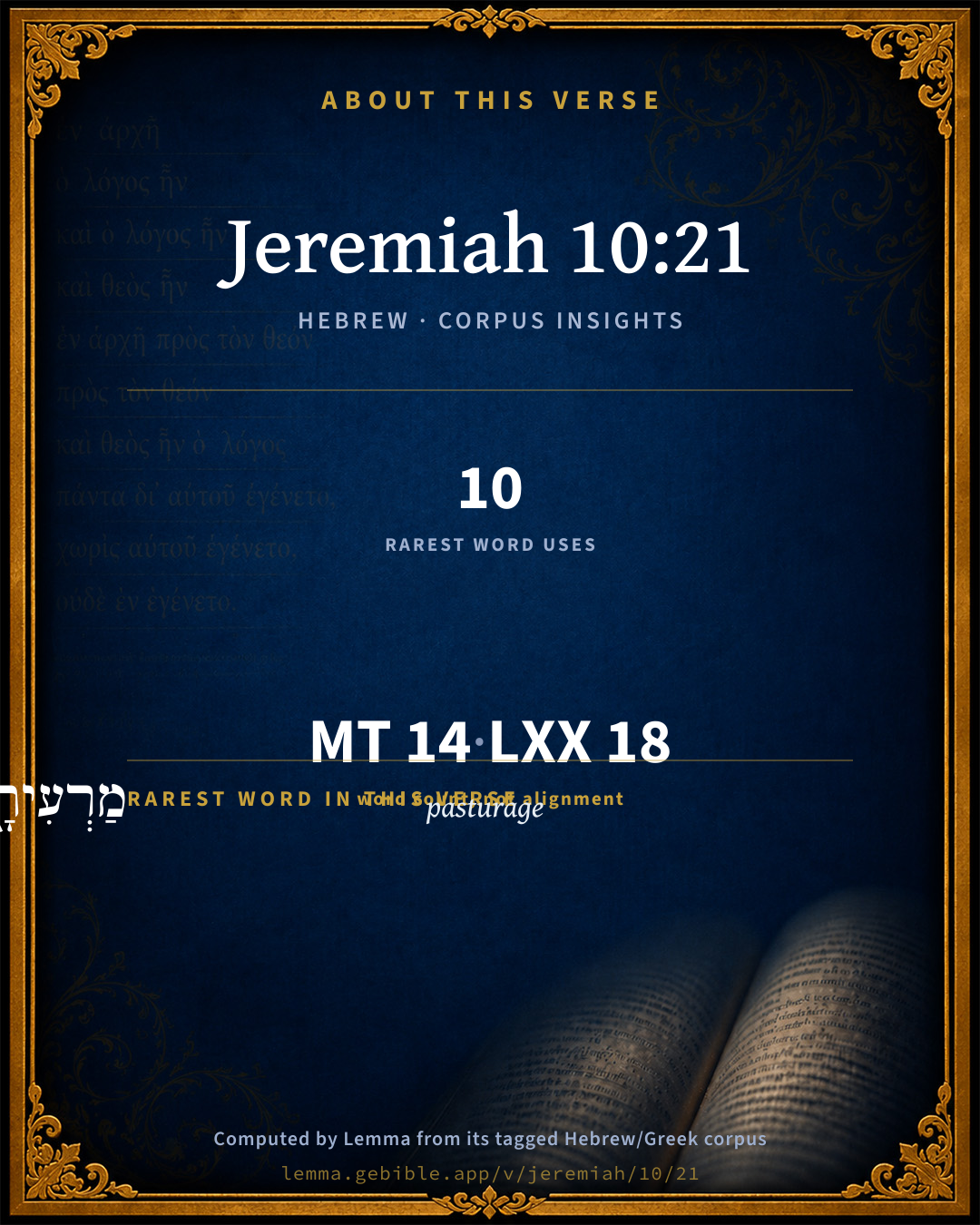
These counts appear in no published source. They are computed here, from the morphology-tagged text and Lemma’s own curated glosses. What Lemma adds →

14
words
13
distinct lemmas
Prophets
section

Notable vocabulary

The rarest word here is מַרְעִיתָ֖ם pasturage H4830 — appearing just 10 times in the whole Hebrew Bible.

Shared distinctive vocabulary

מַרְעִיתָ֖ם pasturage H4830 occurs in 10 verses of the Hebrew Bible. Also found in:

Grammatical profile

  • 5 verbs
  • 3 nouns
  • 1 preposition
  • 1 conjunction
  • 4 particles

Verb forms

  • נִבְעֲרוּ֙ Niphal · Perfect
  • הָֽרֹעִ֔ים Qal · Participle Active
  • דָרָ֑שׁוּ Qal · Perfect
  • הִשְׂכִּ֔ילוּ Hiphil · Perfect
  • נָפֽוֹצָה Niphal · Perfect

Repetition

A word recurs within this verse — often emphatic in Hebrew:

Hebrew & Septuagint length

In the original languages it is 14 Hebrew tokens and 18 Greek tokens — but the two are counted differently (Hebrew bundles its prefixes and suffixes into one token; the Greek is in lemma form), so that isn’t a like-for-like length.

Cross-references

17

Topical passages linked to Jeremiah 10:21 in the Treasury of Scripture Knowledge — connected by theme and wording, ordered by reader-vote popularity; previews shown in the World English Bible.

  • Jeremiah 12:10 Many shepherds have destroyed my vineyard, they have trodden my portion under foot, they have made my pleasant portion a desolate wilderness.
  • Ezekiel 34:2–10 Son of man, prophesy against the shepherds of Israel, prophesy, and tell them, even to the shepherds, Thus says the Lord Yahweh: Woe to the shepherds of Israel who feed themselves! Shouldn't the shepherds feed the sheep?
  • Jeremiah 23:1–2 Woe to the shepherds who destroy and scatter the sheep of my pasture! says Yahweh.
  • Isaiah 56:10–12 His watchmen are blind, they are all without knowledge; they are all mute dogs, they can't bark; dreaming, lying down, loving to slumber.
  • Jeremiah 2:8 The priests didn't say, Where is Yahweh? and those who handle the law didn't know me: the rulers also transgressed against me, and the prophets prophesied by Baal, and walked after things that do not profit.
  • Jeremiah 8:9 The wise men are disappointed, they are dismayed and taken: behold, they have rejected the word of Yahweh; and what manner of wisdom is in them?
  • Jeremiah 10:8 But they are together brutish and foolish: the instruction of idols! it is but a stock.
  • Jeremiah 23:9–32 Concerning the prophets. My heart within me is broken, all my bones shake; I am like a drunken man, and like a man whom wine has overcome, because of Yahweh, and because of his holy words.
  • Ezekiel 22:25–30 There is a conspiracy of her prophets in the midst of it, like a roaring lion ravening the prey: they have devoured souls; they take treasure and precious things; they have made her widows many in the midst of it.
  • Ezekiel 34:12 As a shepherd seeks out his flock in the day that he is among his sheep that are scattered abroad, so will I seek out my sheep; and I will deliver them out of all places where they have been scattered in the cloudy and dark day.
  • Zechariah 10:3 My anger is kindled against the shepherds, And I will punish the male goats; For Yahweh of Hosts has visited his flock, the house of Judah, And will make them as his horse in the battle that he is proud of.
  • Zechariah 13:7 "Awake, sword, against my shepherd, And against the man who is close to me," says Yahweh of Hosts. Strike the shepherd, and the sheep will be scattered; And I will turn my hand against the little ones.
  • John 10:12–13 He who is a hired hand, and not a shepherd, who doesn't own the sheep, sees the wolf coming, leaves the sheep, and flees. The wolf snatches the sheep, and scatters them.
  • Jeremiah 5:31 the prophets prophesy falsely, and the priests bear rule by their means; and my people love to have it so: and what will you do in the end of it?
  • Jeremiah 10:14 Every man is become brutish [and is] without knowledge; every goldsmith is disappointed by his engraved image; for his molten image is falsehood, and there is no breath in them.
  • Jeremiah 49:32 Their camels shall be a booty, and the multitude of their cattle a spoil: and I will scatter to all winds those who have the corners [of their hair] cut off; and I will bring their calamity from every side of them, says Yahweh.
  • Jeremiah 50:17 Israel is a hunted sheep; the lions have driven him away: first, the king of Assyria devoured him; and now at last Nebuchadrezzar king of Babylon has broken his bones.

Cross-references courtesy of OpenBible.info (CC BY 4.0).

Hebrew and Greek witnesses Masoretic Hebrew ↔ Greek Septuagint

The same verse in the two great witnesses to the Old Testament, shown verse-for-verse.

These are two independent witnesses, not word-aligned to each other, and the Septuagint is shown in lemma (dictionary) form.

Hebrew Jeremiah 10:21 Masoretic · Westminster Leningrad Codex

כִּ֤י נִבְעֲרוּ֙ הָֽרֹעִ֔ים וְאֶת יְהוָ֖ה לֹ֣א דָרָ֑שׁוּ עַל כֵּן֙ לֹ֣א הִשְׂכִּ֔ילוּ וְכָל מַרְעִיתָ֖ם נָפֽוֹצָה

For the shepherds are become brutish, and have not inquired of Yahweh: therefore they have not prospered, and all their flocks are scattered.

World English Bible · Public Domain

Greek LXX Structure differs

In the Septuagint, Jeremiah is about an eighth shorter than the Hebrew and arranges its material differently — the Oracles Against the Nations (Hebrew chapters 46–51) appear in the middle of the Greek book, after 25:13. Because the chapter and verse boundaries do not line up, a verse-for-verse comparison with the Hebrew is not shown.

A verse-for-verse comparison isn’t shown here because the chapters and verses don’t line up. Switch to the LXX edition with the MT / LXX toggle above to read the Greek directly.

On this verse, Ellicott's Commentary for English Readers discusses the Septuagint’s reading. Read the note in Commentary ↓

Hebrew: Westminster Leningrad Codex (CC BY 4.0). Greek: Septuagint (public domain); English from a public-domain English Septuagint. How the Septuagint differs from the Hebrew →

Targum (Aramaic paraphrase)

1

The Targum is the ancient Jewish Aramaic paraphrase of the Hebrew Scriptures — an interpretive translation, not the Hebrew text itself. Onkelos (literal) and Pseudo-Jonathan (expansive) render the Torah, and Jonathan the Prophets. Coverage is partial: where no permissively-licensed English translation exists for a verse, only the Aramaic is shown. This is verse-level text, not a word-by-word alignment to the Hebrew.

  1. Targum Jonathan Prophets (Joshua–Malachi)
    אֲרֵי אִטַפָּשׁוּ מַלְכַיָא וְאוּלְפַן מַן קֳדָם יְיָ לָא תְבָעוּ עַל כֵּן לָא יִצְלְחוּן וְכָל עַמְהוֹן יִתְבַּדְרוּן:

    (no public-domain English translation for this verse)

    Targum Jonathan — Aramaic: “Mikraot Gedolot” (public domain). English: “Sefaria Community Translation” (CC0 1.0 (public-domain dedication)); “London "Chaldee Paraphrase," 1871” (public domain). Text via Sefaria.

Commentary

Notes on Jeremiah 10:21 from classic Christian and Jewish commentators (each source and its license shown beneath its notes). The classic Christian expositions comment on the surrounding passage and are grouped to its opening verse, so a note may address several verses; the Jewish commentaries on the Tanakh (Rashi and others) are per-verse, so they appear only where the commentator wrote on this verse.

Lemma curates 59 commentaries, every one of them public domain or Creative Commons licensed, each selected and text-cleaned for this edition rather than reprinted as found. About our sources →

Trapp's Complete Commentary

John Trapp

Jer 10:21 For the pastors are become brutish, and have not sought the LORD: therefore they shall not prosper, and all their flocks shall be scattered.

Ver. 21. For the pastors are become brutish.] The corrupt prophets and priests, who seduced the people from the truth, were persons that made no conscience of prayer; hence all went to wrack and ruin.

John Trapp, A Commentary or Exposition upon All the Books of the Old and New Testament (1647–1656) — public domain. Text from a community e-Sword module.

Joseph Benson's Commentary

Jer 10:21-22. For the pastors are become brutish — The prophet pursues the foregoing metaphor, and says, that the reason why the tents are destroyed, is because the shepherds, meaning the governors, both civil and ecclesiastical, had, like so many brute creatures, forgotten God and their duty to him, and thereby engaged the people committed to their charge in idolatry, and in all manner of wickedness, which had ended in ruin to themselves and their flocks. And have not sought the Lord — Have neither made their peace with him nor addressed their prayers to him; they have had no eye to him and his providence in their management of affairs, have neither acknowledged the judgment nor expected the deliverance to come from his hand. Observe well, reader, those are brutish people that do not seek the Lord, that live without prayer and without God in the world: they are unworthy of the name of rational beings. But the state of a people is indeed deplorable when their pastors, that should feed them with knowledge and understanding, are themselves thus brutish. And what is the consequence? Therefore they shall not prosper — None of their attempts for the public safety shall succeed. How, indeed, can those expect to prosper who do not take God along with them in their ways? And when the pastors are brutish, what else can be expected but that all their flocks should be scattered? for if the blind lead the blind both will fall into the ditch. Behold, the noise of the bruit is come — The word bruit here signifies noise, or rumour, which is the meaning of the Hebrew, שׁמועה. This is explained in the following clause to be that of the tumultuary invasion of the country by the Chaldeans from the north, of which notice had been repeatedly given. Blaney translates the verse, Hark! a noise! Behold, it advanceth, even a great commotion from the north country. To make the cities of Judah a desolation, a dwelling-place for dragons.

Joseph Benson's Commentary on the Old and New Testaments (1811–1818) — public domain. Text from a community e-Sword module.

Tyndale Open Study Notes

Tyndale Open Resources

10:21 The shepherds (priests and prophets; see 5:29-31) had turned their backs on the wisdom from the Lord that had been preserved in priestly memory and in the prophetic messages, both verbal and written. The divine decree predicted the utter failure of these leaders, as well as the resultant scattering of the people.

Tyndale Open Study Notes — © Tyndale Open Resources, licensed CC BY-SA 4.0. Text via the HelloAO Bible API.

Geneva Bible (1599)

Geneva Bible translators

The governors and ministers.

Geneva Bible (1599) marginal notes — public domain. Text via Bolls.life.

Jamieson, Fausset & Brown

Robert Jamieson, A. R. Fausset & David Brown

pastors--the rulers, civil and religious. This verse gives the cause of the impending calamity.

Jamieson, Fausset & Brown — Commentary Critical and Explanatory on the Whole Bible (1871) — public domain (CC PDM 1.0). Text via the HelloAO Bible API.

Adam Clarke's Commentary

Verse 21. The pastors are become brutish] The king and his counsellors, who, by refusing to pay the promised tribute to Nebuchadnezzar, had kindled a new war.

Adam Clarke's Commentary on the Bible (1810–1826) — public domain. Text from a community e-Sword/MySword module.

John Calvin's Commentaries

In the first place, he assigns a cause for the dreadful devastation of which he had spoken, and that was, because the shepherds were without thought and understanding. He still, as we see, goes on with his metaphor. Some confine this to the kings of Israel; but I do not agree with them: for I include under the name shepherds, the priests and the prophets as wen as the king and his counsellors. But Jeremiah did not mean to exempt the people from fault, when He, in an especial manner, accused the shepherds; but he only mentioned the origin and the primary cause of evils, — that the kings, the prophets, and the priests were blind, and thus destroyed the flock of God. We have observed elsewhere the same mode of speaking; and yet the prophets did not intend to extenuate the vices of the people, nor to absolve the lower orders. But as it mostly happens that the lower ranks, and those in humble stations, rely much on the chief men who occupy places of authority, it was necessary that the prophets should notice this evil: and we also know how nmch pride and arrogance there is in kings and priests, and in all those who elljoy any honor or dignity; for they think themselves exempt from the restraint of laws, and will not be reproved, as though they were sacred persons. It was, therefore, for this reason, that the Prophet reproved such with so much vehemence and severity. Hence, he says, The shepherds are infatuated

The people, indeed, at that time repudiated the prophets, as the case is now under the Papacy. For even when the truth of God is dearly and perspicuously set forth, there are many who set up this shield, — that they believe their bishops, prelates, and kings, and others of a similar kind. When, therefore, Jeremiah saw that the pure truth of God was subverted by vain splendor, he found it necessary to expose the disguise, and, so to speak, to pull off the mask. It was, then, for this reason, that he said that the shepherds were infatuated. If the prophets were under this necessity, what ought to be done by us at this day, when we see that all those who unblushingly boast that they are the representatives of the Church are sheer impostors, and draw miserable souls into destruction? What else, I pray, ought to be done by us, but what we learn was done by the prophets? And how foolishly and childishly do the Papal bishops prattle, when they would have themselves exempted from all reproofs, because power and government is in their own hands! For they cannot surely assume to themselves more than what belonged formerly to the Levitical priests; for God had chosen them, and all the priests under the law might have justly boasted that they were appointed by divine authority: yet we see that they were reproved, and were said to be infatuated. The Pope and his bishops have not been appointed by God, nor have they any evidence of their calling. Though, then, they arrogate all things to themselves, and seem to do so by divine right, yet they cannot be deemed superior to the ancient priests: they must, therefore, become subject to the judgment which God denounces here by the mouth of his Prophet.

He gives a reason why they were infatuated, because they sought not Jehovah We hence see, on the other hand, that true wisdom is to seek God. When, therefore, there is no care taken to seek God, however acute men may be, they must necessarily be altogether infatuated: and it was for this reason that Jeremiah called them who had not sought God foolish or fatuitous. This passage teaches us, that the only way of governing rightly is, when they who rule strive to give glory to God, and regard him in all their thoughts and actions: but when they act otherwise, they must necessarily play the feel and become infatuated, however wise they may appear to be.

Hence he says, they have not prospered The verb שכל, shical, means to understand, and also to prosper. I see no reason for rendering it here, “they have not understood” or acted wisely; for it seems frigid, nor do I see what sense can be elicited. But the Prophet may be considered to have justly said, that neither the kings and their counsellors, nor the priests and the prophets ruled with any success, because they sought not God; and that as they had no care for true religion, they were become infatuated. And what follows confirms this view, And all that was in their pastures, etc.; for the Prophet seems here to add to his general statement a particular thing, and thus to prove that the government was unhappily conducted, being under the curse of God, because true religion had been neglected. He then adds this special thing, — that the pastures had been deserted, that is, that the flock in the pastures had been wholly scattered. It follows —

John Calvin's Commentaries (1540-1563) — public domain. Text from the Calvin Translation Society English edition (1840s-50s) via the Christian Classics Ethereal Library (ccel.org). Calvin's coverage is partial (roughly two-thirds of the Bible); uncommented books and verses are honest gaps, never fabricated. The 19th-century editor's footnotes and remarks are omitted so the notes are faithfully Calvin's own voice.

Ellicott's Commentary for English Readers

(21) The pastors.—The “shepherds,” used, as in Jer_2:8; Jer_3:15, and elsewhere, of rulers generally, rather than of priests as such.

Therefore they shall not prosper.—Better, therefore they have not done wisely. This is the primary meaning of the word (that of prosperity, as the result of prudence, the secondary), and is adopted by the LXX., Vulg., and most other versions.

All their flocks.—Literally, all their pasture, the place, or the act, of pasturing, taken practically for the sheep that fed on it.

A Bible Commentary for English Readers, edited by Charles John Ellicott (1878–1897) — public domain. Text from a community e-Sword module.

The Cambridge Bible for Schools and Colleges

gen. ed. J. J. S. Perowne

21. shepherds] See on Jer_2:8.

The Cambridge Bible for Schools and Colleges (gen. ed. J. J. S. Perowne; Cambridge University Press, 1878–1918) — public domain. Text from a community e-Sword module.

John Gill's Exposition

For the pastors are become brutish,.... The "kings" of Judah, so the Targum, Jarchi, and Kimchi, as Jehoiakim and Zedekiah; though it need not be restrained to these only, but may include all inferior civil magistrates, and even all ecclesiastical rulers, who were the shepherds of the people; but these being like the brute beasts, and without understanding of civil and religious things, and not knowing how to govern the people either in a political or ecclesiastical way, were the cause of their ruin.

And have not sought the Lord; this is an instance of their brutishness and stupidity, and opens the source of all their mistakes and misfortunes; they did not seek the Lord for counsel, by whom kings reign well, and princes decree justice; nor doctrine from the Lord, as the Targum, as the priests and prophets should have done, in order to instruct the people, and feed them with knowledge and understanding; nor did either of them seek the glory of God in what they did, but their own interest, worldly advantage, or applause:

therefore they shall not prosper; in their kingdom, and in the several offices and stations in which they were. Some render the words, "therefore they do not act prudently" (b); not consulting the Lord, nor warning the people, nor giving them notice of approaching danger:

and all their flocks shall be scattered; the people of the Jews that were under their government, civil or ecclesiastical, should be dispersed in several nations, and especially in Chaldee; wherefore it follows:

(b) "non egerunt prudenter", Vatablus, Tigurine version; "non intellexerunt", Pagninus, Montanus.

John Gill's Exposition of the Whole Bible (1746–1763) — public domain (CC PDM 1.0). Text via the HelloAO Bible API.

Matthew Poole's English Annotations

The pastors are become brutish; not that the prophet takes off all blame from the people, but that he layeth it chiefly upon the rulers of church and state; for so is pastor taken frequently. See Jer 23:1-3,

And have not sought the Lord; not sought unto him, and taken him into their counsels.

Therefore they shall not prosper: the prophet gives the reason why nothing went well with them, namely, because there was no regard had to godliness, without which we cannot expect a blessing upon any thing.

All their flocks shall be scattered, i.e. all that have been committed to their care shall be carried unto Babylon, and divers of them dispersed abroad into several countries for their sakes.

Matthew Poole's English Annotations on the Holy Bible (1683–1685) — public domain. Text from a community e-Sword/MySword module.

Whedon's Commentary on the Bible

Daniel D. Whedon

21. Pastors are… brutish — Compare Jer_2:8, etc.

Shall not prosper — Rather, have not dealt wisely, and hence their flocks shall be scattered.

Daniel D. Whedon (gen. ed.), Commentary on the Old and New Testaments (1874–1909) — public domain. Text from a community e-Sword module.

The Pulpit Commentary

The pastors; i.e. the civil authorities. (see on Jer_2:8) They shall not prosper; rather, they have not prospered; or, better still, they have not acted wisely, the notion of prospering being rather suggested than expressed. (the same word is used in Isa_59:13)

The Pulpit Commentary (1880–1919), ed. H.D.M. Spence-Jones & Joseph S. Exell — public domain. Text from a community e-Sword module.

John Wesley's Explanatory Notes

The pastors - The rulers of church and state.

John Wesley, Explanatory Notes Upon the Whole Bible (1754–1765) — public domain. Text via the GEBible commentary corpus.

unfoldingWord translationNotes

Door43 World Missions Community

For the shepherds are stupid ... all their flock has been scattered

Here the leaders of Israel are spoken of as if they were shepherds and the people of Israel are spoken of as if they were flocks of sheep. AT: "For the shepherds of our people are stupid ... all the people of their flock have been scattered" (See: Metaphor)

all their flock has been scattered

This can be stated in active form. AT: "and their enemies have scattered all their flock" (See: Active or Passive)

See! It is coming, a great earthquake is coming

Here the marching enemy armies are spoken of as if they were an earthquake. The word "See!" is used here as an idiom to draw the listener's attention to what is said next. AT: "Look! The enemy army is coming, they sound like a great earthquake as they are marching" (See: Metaphor and Idiom)

jackals

a type of fierce wild dog

translationWords

shepherd

flocks

report

kingdom of Judah

ruin

unfoldingWord translationNotes — © Distant Shores Media and the Door43 World Missions Community, licensed CC BY-SA 4.0. Source: git.door43.org/Door43/en_tn.

Rashi

Rabbi Shlomo Yitzchaki (Rashi)

For the shepherds The kings.

they have not prospered They have not prospered in their kingdom. Comp. (Prov. 17:8) “To all that he turns, he will prosper (ישכיל).

their flocks Heb. מרעיתם, lit. their pasture, the flocks of their pasture.

Rashi on the Tanakh — English translations: “The Judaica Press complete Tanach with Rashi, translated by A. J. Rosenberg” (CC BY 4.0); “Pentateuch with Rashi's commentary by M. Rosenbaum and A.M. Silbermann, 1929-1934” (public domain); “The Metsudah Tanach series, Lakewood, N.J” (CC BY 4.0); and “The Book of Joshua, Metsudah Publications, 1997” (CC BY 4.0). Text via Sefaria.

Lesson kit

Teaching starters — assembled from the data on this page, not authored interpretation. Every prompt links to the verse data it draws on. Edit before teaching.

Jeremiah, in the Prophets, opens this verse with 14 words (13 distinct Hebrew lemmas). Its most distinctive word is mirʻîyth (“pasturage”). A historical commentator’s framing appears above. Read the whole chapter for the surrounding context.

Discussion questions

  1. How does “pasturage” (mirʻîyth) shape what this verse is saying?
  2. How does Psalms 74:1, which shares the word «pasturage», read alongside this verse?
  3. What does the repetition of “not” (2× in this one verse) do in this verse?
  4. These translations render this verse differently. What is at stake in choosing one wording over another?
  5. «נִבְעֲרוּ֙» is a Niphal Perfect verb. How does that grammatical form shape the action described?
  6. Compare how Trapp's Complete Commentary and Joseph Benson's Commentary read this verse. Where do they agree or differ?

Things to notice

Reading settings

Reading text

Shown beneath each verse's original-language words.

Old Testament
Old Testament edition

Read the OT as the Masoretic Hebrew (MT) or the Greek Septuagint (LXX).

English shown for the Greek Septuagint (in the Hebrew ↔ Greek comparison).

Comparing translations? Open the Compare panel on any verse page to stack up to four side by side.