
Jeremiah 49:19

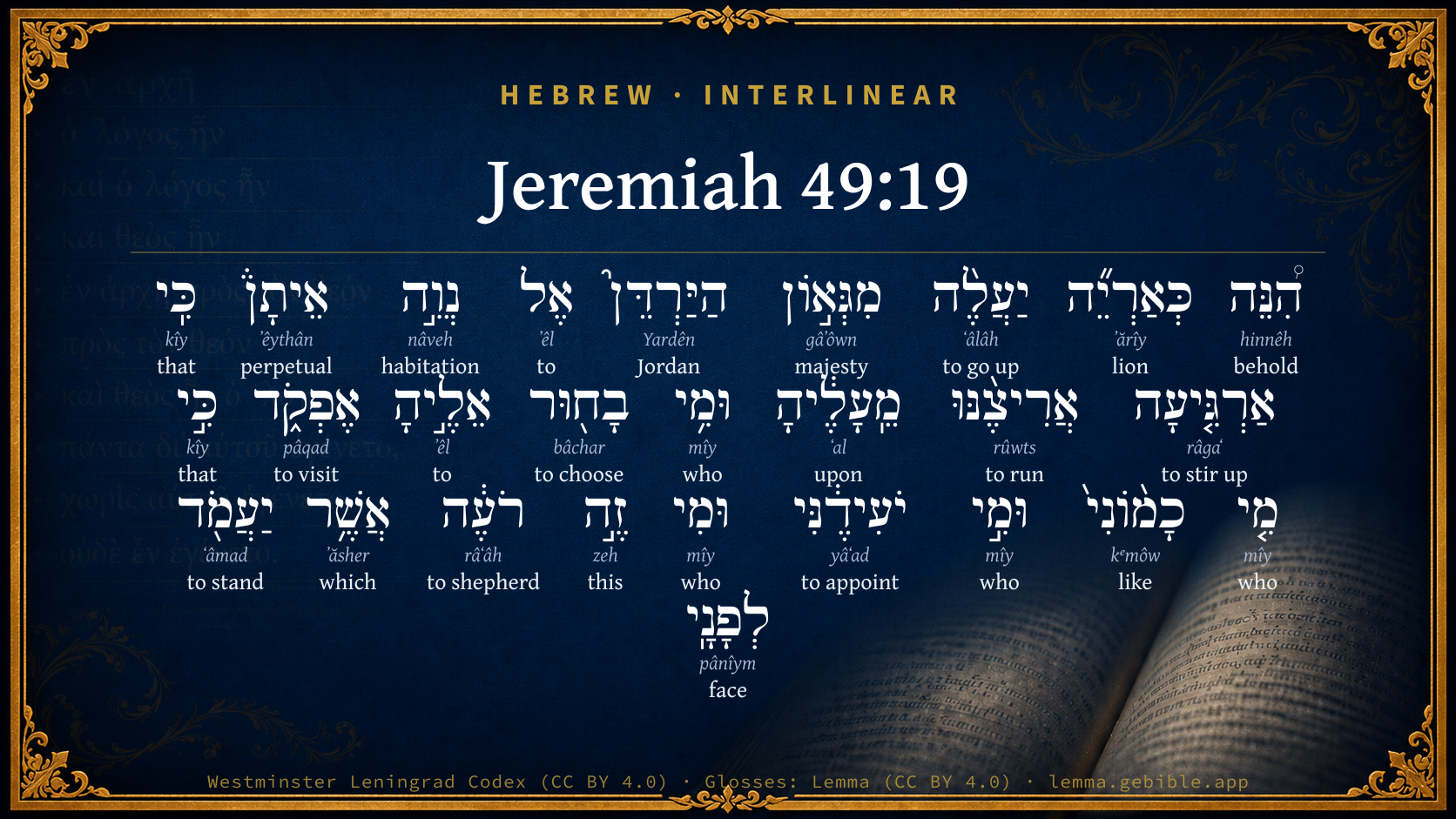
Hebrew (Westminster Leningrad Codex) Jeremiah 49:19 appears in the Hebrew Old Testament. The text above is from the Westminster Leningrad Codex. Each word links to its Strong’s number, a concise gloss, and parsing drawn from the Open Scriptures Hebrew Bible morphology. Click any word for its full Brown-Driver-Briggs (BDB) entry.
Download image
Cite this verse

Jeremiah 49:19 (World English Bible). Public Domain. Lemma interlinear Bible study tool, https://lemma.gebible.app/v/jeremiah/49/19.

Show BibTeX & RIS
BibTeX
RIS
English Translation
Behold, he shall come up like a lion from the pride of the Jordan against the strong habitation: for I will suddenly make them run away from it; and whoever is chosen, him will I appoint over it: for who is like me? and who will appoint me a time? and who is the shepherd who will stand before me?
World English Bible · Public Domain
Download a study sheet

One document with this verse’s original text, its word-by-word gloss line, the meaning frame, cross-references with their text, attributed commentary, and full source and license credits — printable, and it pastes into notes with its structure intact.

This verse Autodidact and up

Study sheet (.html) Plain text (.txt)

A passage Seminary Student

Up to 50 verses in one chapter. A passage sheet keeps up to 6 commentary sources and 12 cross-references per verse, in the order this page ranks them, and says so on the sheet whenever that leaves anything out. Ask for a single verse and you get the Autodidact verse sheet above.

Everything on this page stays free to read, with no account — the sheet is a download of what is already on screen, not access to it.

Want to remove ads? Support Godless Engineer
Compare translations 3

The same verse in 3 English versions, stacked beneath the original-language interlinear above. Click any original word for its lexicon entry.

Each is an independent rendering of the whole verse — the interlinear is not word-aligned to these translations.

Highlighted words mark where these versions differ — a whole-verse word diff, not a word-by-word alignment.

  • World English Bible Public Domain
    Behold, he shall come up like a lion from the pride of the Jordan against the strong habitation: for I will suddenly make them run away from it; and whoever is chosen, him will I appoint over it: for who is like me? and who will appoint me a time? and who is the shepherd who will stand before me?
  • King James Version Public Domain
    Behold, he shall come up like a lion from the swelling of Jordan against the habitation of the strong: but I will suddenly make him run away from her: and who is a chosen man, that I may appoint over her? for who is like me? and who will appoint me the time? and who is that shepherd that will stand before me?
  • unfoldingWord Literal Text CC BY-SA 4.0
    See, he will go up like a lion from the forests of the Jordan to the green pasturelands. For I will quickly make Edom run from it, and I will put someone who will be chosen in charge of it. For who is like me, and who will summon me? What shepherd is able to resist me?”

unfoldingWord Literal Text — © unfoldingWord, licensed CC BY-SA 4.0. Word-aligned USFM3 via Door43 (git.door43.org/unfoldingWord/en_ult).

Versions to compare (up to 4)

3 of 4 selected

Show all 18 translations

Every available English version of this verse, each an independent rendering of the whole verse.

  • World English Bible Public Domain
    Behold, he shall come up like a lion from the pride of the Jordan against the strong habitation: for I will suddenly make them run away from it; and whoever is chosen, him will I appoint over it: for who is like me? and who will appoint me a time? and who is the shepherd who will stand before me?
  • Berean Standard Bible Public Domain
    Behold, one will come up like a lion from the thickets of the Jordan to the watered pasture. For in an instant I will chase Edom from her land. Who is the chosen one I will appoint for this? For who is like Me, and who can challenge Me? What shepherd can stand against Me?”
  • Majority Standard Bible Public Domain
    Behold, one will come up like a lion from the thickets of the Jordan to the watered pasture. For in an instant I will chase Edom from her land. Who is the chosen one I will appoint for this? For who is like Me, and who can challenge Me? What shepherd can stand against Me?”
  • King James Version Public Domain
    Behold, he shall come up like a lion from the swelling of Jordan against the habitation of the strong: but I will suddenly make him run away from her: and who is a chosen man, that I may appoint over her? for who is like me? and who will appoint me the time? and who is that shepherd that will stand before me?
  • American Standard Version (1901) Public Domain
    Behold, he shall come up like a lion from the pride of the Jordan against the strong habitation: for I will suddenly make them run away from it; and whoso is chosen, him will I appoint over it: for who is like me? and who will appoint me a time? and who is the shepherd that will stand before me?
  • Revised Version (1885) Public Domain
    Behold, he shall come up like a lion from the pride of Jordan against the strong habitation: but I will suddenly make him run away from her; and whoso is chosen, him will I appoint over her: for who is like me? and who will appoint me a time? and who is the shepherd that will stand before me?
  • Geneva Bible (1599) Public Domain
    Beholde, hee shall come vp like a lyon from the swelling of Iorden vnto the strong dwelling place: for I will make Israel to rest, euen I will make him to haste away from her, and who is a chosen man that I may appoynt against her? for who is like mee? and who will appoint me the time? and who is the shepheard that will stande before me?
  • Douay-Rheims (1899) Public Domain
    Behold one shall come up as a lion from the swelling of the Jordan, against the strong and beautiful: for I will make him run suddenly upon her: and who shall be the chosen one whom I may appoint over her? for who is like to m? and who shall abide me? and who is that shepherd that can withstand my countenance?
  • Young's Literal Translation Public Domain
    Lo, as a lion he cometh up, Because of the rising of the Jordan, Unto the enduring habitation, But I cause to rest, I cause him to run from off her, And who is chosen? concerning her I lay a charge, For who is like Me? and who conveneth Me? And who `is' this shepherd who standeth before Me?
  • Literal Standard Version CC BY-SA 4.0
    Behold, he comes up as a lion, || Because of the rising of the Jordan, || To the enduring habitation, || But I cause to rest, || I cause him to run from off her, || And who is chosen? I lay a charge concerning her, || For who is like Me? And who convenes Me? And who [is] this shepherd who stands before Me?
  • Unlocked Literal Bible CC BY-SA 4.0
    See, he will go up like a lion from the forests of the Jordan to the green pasturelands. For I will quickly make Edom run from it, and I will put someone who will be chosen in charge of it. For who is like me, and who will summon me? What shepherd is able to resist me?”
  • unfoldingWord Literal Text CC BY-SA 4.0
    See, he will go up like a lion from the forests of the Jordan to the green pasturelands. For I will quickly make Edom run from it, and I will put someone who will be chosen in charge of it. For who is like me, and who will summon me? What shepherd is able to resist me?”
  • Darby Bible Public Domain
    Behold, he shall come up like a lion from the swelling of the Jordan against the strong habitation; for I will make them suddenly run away from it; and who is a chosen [man] whom I shall appoint over her? For who is like me? and who will assign me a time? and who is that shepherd that will stand before me?
  • World Messianic Bible Public Domain
    “Behold, he will come up like a lion from the pride of the Jordan against the strong habitation; for I will suddenly make them run away from it, and whoever is chosen, I will appoint him over it. For who is like me? Who will appoint me a time? Who is the shepherd who will stand before me?”
  • Webster's Bible Public Domain
    Behold, he shall come up like a lion from the swelling of Jordan against the habitation of the strong: but I will suddenly make him run away from her: and who is a chosen man, that I may appoint over her? for who is like me? and who will appoint me the time? and who is that shepherd that will stand before me?
  • Free Bible Version CC BY-SA 4.0
    Watch out! I'm going to come like a lion from the tangled undergrowth beside the Jordan to attack the animals grazing the green pasture. In fact I'm going to chase the Edomites from their land very quickly. Who will I choose to conquer them? Who is like me? Who can challenge me? Which leader could oppose me?
  • Bible in Basic English Public Domain
    See, he will come up like a lion from the thick growth of Jordan against the resting-place of Teman: but I will suddenly make him go in flight from her; and I will put over her the man of my selection: for who is like me? and who will put forward his cause against me? and what keeper of sheep will be able to keep his place before me?
  • JPS Tanakh (1917) Public Domain
    Behold, he shall come up like a lion from the thickets of the Jordan against the strong habitation; for I will suddenly make him run away from it, and whoso is chosen, him will I appoint over it; for who is like Me? and who will appoint Me a time? and who is that shepherd that will stand before Me?

Literal Standard Version (2020), Covenant Press — licensed CC BY-SA 4.0. Text via the HelloAO Bible API (eBible.org). Unlocked Literal Bible (unfoldingWord) — licensed CC BY-SA 4.0. Text via the HelloAO Bible API (eBible.org). unfoldingWord Literal Text — © unfoldingWord, licensed CC BY-SA 4.0. Word-aligned USFM3 via Door43 (git.door43.org/unfoldingWord/en_ult). Free Bible Version, Dr. Jonathan Gallagher — licensed CC BY-SA 4.0. Text via the HelloAO Bible API (eBible.org).

Word by word

More ways to search: Search by grammar → Find every occurrence → Compare this word →

Practice this passage: Drill this verse → Learn its vocabulary →

אֵיתָן֒
ʼêythân
H386
“perpetual”
Adjective, Adjective, Masculine, Singular, Absolute
Part of Speech
Adjective
Type
Adjective
Gender
Masculine
Number
Singular
State
Absolute
Full BDB Definition

Origin: from an unused root (meaning to continue)

TWOT: 935a

perpetual, constant, perennial, ever-flowing - ever-flowing (of a stream) - permanence, permanent, enduring (figuratively)
  1. הִ֠נֵּה hinnêh H2009 “behold” Particle, Demonstrative
  2. כְּאַרְיֵ֞ה ʼărîy H738 “like/as · lion” Preposition + Noun, Common, Masculine, Singular, Absolute
  3. יַעֲלֶ֨ה ʻâlâh H5927 “to go up” Verb, Qal, Imperfect, 3rd Person, Masculine, Singular
  4. מִגְּא֣וֹן gâʼôwn H1347 “from · majesty of” Preposition + Noun, Common, Masculine, Singular, Construct
  5. הַיַּרְדֵּן֮ Yardên H3383 “the · Jordan” Particle, Definite Article + Noun, Proper
  6. אֶל ʼêl H413 “to” Preposition
  7. נְוֵ֣ה nâveh H5116 “habitation of” Noun, Common, Both, Singular, Construct
  8. כִּֽי kîy H3588 “that” Conjunction
  9. אַרְגִּ֤יעָה râgaʻ H7280 “to stir up” Verb, Hiphil, Cohortative, 1st Person, Common, Singular
  10. אֲרִיצֶ֨נּוּ rûwts H7323 “to run · him” Verb, Hiphil, Imperfect, 1st Person, Common, Singular + Suffix, Personal, 3rd Person, Masculine, Singular
  11. מֵֽעָלֶ֔יהָ ʻal H5921 “from · upon · her” Preposition + Preposition + Suffix, Personal, 3rd Person, Feminine, Singular
  12. וּמִ֥י mîy H4310 “and · who” Conjunction + Particle, Interrogative
  13. בָח֖וּר bâchar H977 “chosen” Verb, Qal Passive, Participle Passive, Masculine, Singular, Absolute
  14. אֵלֶ֣יהָ ʼêl H413 “to · her” Preposition + Suffix, Personal, 3rd Person, Feminine, Singular
  15. אֶפְקֹ֑ד pâqad H6485 “to visit” Verb, Qal, Imperfect, 1st Person, Common, Singular
  16. כִּ֣י kîy H3588 “that” Conjunction
  17. מִ֤י mîy H4310 “who” Particle, Interrogative
  18. כָמ֨וֹנִי֙ kᵉmôw H3644 “like · me” Preposition + Suffix, Personal, 1st Person, Common, Singular
  19. וּמִ֣י mîy H4310 “and · who” Conjunction + Particle, Interrogative
  20. יֹעִידֶ֔נִּי yâʻad H3259 “to appoint · me” Verb, Hiphil, Imperfect, 3rd Person, Masculine, Singular + Suffix, Personal, 1st Person, Common, Singular
  21. וּמִי mîy H4310 “and · who” Conjunction + Particle, Interrogative
  22. זֶ֣ה zeh H2088 “this” Pronoun, Demonstrative, Masculine, Singular
  23. רֹעֶ֔ה râʻâh H7462 “shepherding” Verb, Qal, Participle Active, Masculine, Singular, Absolute
  24. אֲשֶׁ֥ר ʼăsher H834 “which” Particle, Relative
  25. יַעֲמֹ֖ד ʻâmad H5975 “to stand” Verb, Qal, Imperfect, 3rd Person, Masculine, Singular
  26. לְפָנָֽי pânîym H6440 “to/for · face(s) · my” Preposition + Noun, Common, Both, Plural, Construct + Suffix, Personal, 1st Person, Common, Singular

About this verse

These counts appear in no published source. They are computed here, from the morphology-tagged text and Lemma’s own curated glosses. What Lemma adds →

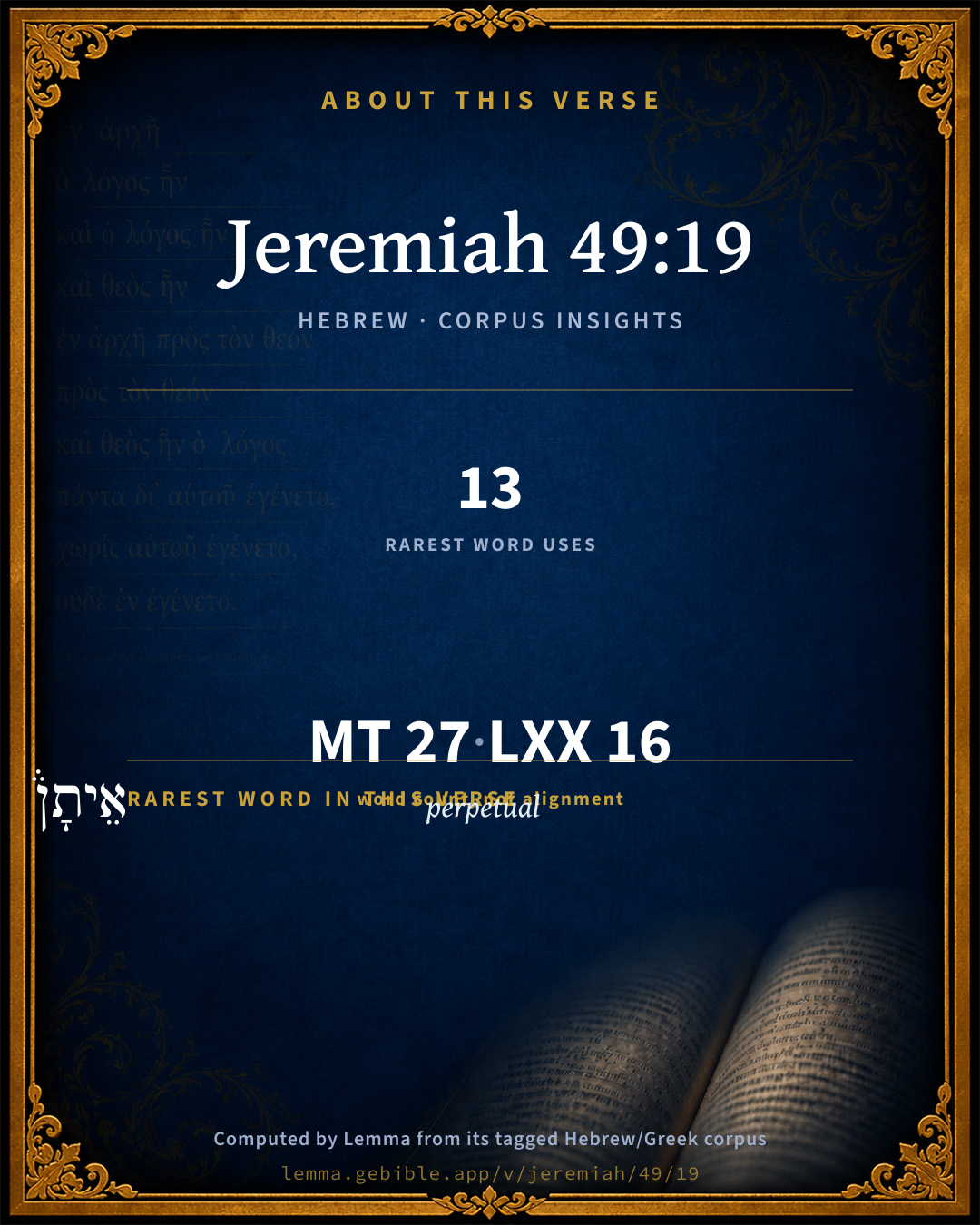
27
words
22
distinct lemmas
Prophets
section

Notable vocabulary

The rarest word here is אֵיתָן֒ perpetual H386 — appearing just 13 times in the whole Hebrew Bible.

Shared distinctive vocabulary

אֵיתָן֒ perpetual H386 occurs in 13 verses of the Hebrew Bible. Also found in:

Grammatical profile

  • 8 verbs
  • 5 nouns
  • 1 adjective
  • 1 pronoun
  • 4 prepositions
  • 2 conjunctions
  • 6 particles

Verb forms

  • יַעֲלֶ֨ה Qal · Imperfect
  • אַרְגִּ֤יעָה Hiphil · Cohortative
  • אֲרִיצֶ֨נּוּ Hiphil · Imperfect
  • בָח֖וּר Qal Passive · Participle Passive
  • אֶפְקֹ֑ד Qal · Imperfect
  • יֹעִידֶ֔נִּי Hiphil · Imperfect
  • רֹעֶ֔ה Qal · Participle Active
  • יַעֲמֹ֖ד Qal · Imperfect

Repetition

Words recur within this verse — often emphatic in Hebrew:

  • וּמִ֥י who H4310 ×4
  • אֶל to H413 ×2
  • כִּֽי that H3588 ×2

Hebrew & Septuagint length

In the original languages it is 27 Hebrew tokens and 16 Greek tokens — but the two are counted differently (Hebrew bundles its prefixes and suffixes into one token; the Greek is in lemma form), so that isn’t a like-for-like length.

Cross-references

22

Topical passages linked to Jeremiah 49:19 in the Treasury of Scripture Knowledge — connected by theme and wording, ordered by reader-vote popularity; previews shown in the World English Bible.

  • Jeremiah 12:5 If you have run with the footmen, and they have wearied you, then how can you contend with horses? and though in a land of peace you are secure, yet how will you do in the pride of the Jordan?
  • Jeremiah 30:21 Their prince shall be of themselves, and their ruler shall proceed from the midst of them; and I will cause him to draw near, and he shall approach to me: for who is he who has had boldness to approach to me? says Yahweh.
  • Exodus 15:11 Who is like you, Yahweh, among the gods? Who is like you, glorious in holiness, Fearful in praises, doing wonders?
  • Joshua 3:15 and when those who bore the ark were come to the Jordan, and the feet of the priests who bore the ark were dipped in the brink of the water (for the Jordan overflows all its banks all the time of harvest),
  • Job 9:19 If it is a matter of strength, behold, he is mighty! If of justice, 'Who,' says he, 'will summon me?'
  • Job 41:10 None is so fierce that he dare stir him up. Who then is he who can stand before me?
  • Jeremiah 50:44–46 Behold, [the enemy] shall come up like a lion from the pride of the Jordan against the strong habitation: for I will suddenly make them run away from it; and whoever is chosen, him will I appoint over it: for who is like me? and who will appoint me a time? and who is the shepherd who can stand before me?
  • 1 Chronicles 12:15 These are those who went over the Jordan in the first month, when it had overflowed all its banks; and they put to flight all them of the valleys, both toward the east, and toward the west.
  • Job 9:21 I am blameless. I don't regard myself. I despise my life.
  • Job 23:3–7 Oh that I knew where I might find him! That I might come even to his seat!
  • Job 40:2–8 "Shall he who argues contend with the Almighty? He who argues with God, let him answer it."
  • Job 42:3–5 You asked, 'Who is this who hides counsel without knowledge?' Therefore I have uttered that which I did not understand, Things too wonderful for me, which I didn't know.
  • Psalms 76:7 You, even you, are to be feared. Who can stand in your sight when you are angry?
  • Psalms 89:6 For who in the skies can be compared to Yahweh? Who among the sons of the heavenly beings is like Yahweh,
  • Psalms 89:8 Yahweh, God of hosts, who is a mighty one, like you? Yah, your faithfulness is around you.
  • Psalms 113:5–6 Who is like Yahweh, our God, Who has his seat on high,
  • Psalms 143:2 Don't enter into judgment with your servant, For in your sight no man living is righteous.
  • Isaiah 40:25 To whom then will you liken me, that I should be equal [to him]? says the Holy One.
  • Jeremiah 4:7 A lion is gone up from his thicket, and a destroyer of nations; he is on his way, he is gone forth from his place, to make your land desolate, that your cities be laid waste, without inhabitant.
  • Nahum 1:6 Who can stand before his indignation? Who can endure the fierceness of his anger? His wrath is poured out like fire, and the rocks are broken apart by him.
  • Zechariah 11:3 A voice of the wailing of the shepherds! For their glory is destroyed: a voice of the roaring of young lions! For the pride of the Jordan is ruined.
  • Revelation 6:17 for the great day of his wrath has come; and who is able to stand?"

Cross-references courtesy of OpenBible.info (CC BY 4.0).

Hebrew and Greek witnesses Masoretic Hebrew ↔ Greek Septuagint

The same verse in the two great witnesses to the Old Testament, shown verse-for-verse.

These are two independent witnesses, not word-aligned to each other, and the Septuagint is shown in lemma (dictionary) form.

Hebrew Jeremiah 49:19 Masoretic · Westminster Leningrad Codex

הִ֠נֵּה כְּאַרְיֵ֞ה יַעֲלֶ֨ה מִגְּא֣וֹן הַיַּרְדֵּן֮ אֶל נְוֵ֣ה אֵיתָן֒ כִּֽי אַרְגִּ֤יעָה אֲרִיצֶ֨נּוּ מֵֽעָלֶ֔יהָ וּמִ֥י בָח֖וּר אֵלֶ֣יהָ אֶפְקֹ֑ד כִּ֣י מִ֤י כָמ֨וֹנִי֙ וּמִ֣י יֹעִידֶ֔נִּי וּמִי זֶ֣ה רֹעֶ֔ה אֲשֶׁ֥ר יַעֲמֹ֖ד לְפָנָֽי

Behold, he shall come up like a lion from the pride of the Jordan against the strong habitation: for I will suddenly make them run away from it; and whoever is chosen, him will I appoint over it: for who is like me? and who will appoint me a time? and who is the shepherd who will stand before me?

World English Bible · Public Domain

Greek LXX Structure differs

In the Septuagint, Jeremiah is about an eighth shorter than the Hebrew and arranges its material differently — the Oracles Against the Nations (Hebrew chapters 46–51) appear in the middle of the Greek book, after 25:13. Because the chapter and verse boundaries do not line up, a verse-for-verse comparison with the Hebrew is not shown.

A verse-for-verse comparison isn’t shown here because the chapters and verses don’t line up. Switch to the LXX edition with the MT / LXX toggle above to read the Greek directly.

On this verse, The Pulpit Commentary discusses the Septuagint’s reading. Read the note in Commentary ↓

Hebrew: Westminster Leningrad Codex (CC BY 4.0). Greek: Septuagint (public domain); English from a public-domain English Septuagint. How the Septuagint differs from the Hebrew →

Targum (Aramaic paraphrase)

1

The Targum is the ancient Jewish Aramaic paraphrase of the Hebrew Scriptures — an interpretive translation, not the Hebrew text itself. Onkelos (literal) and Pseudo-Jonathan (expansive) render the Torah, and Jonathan the Prophets. Coverage is partial: where no permissively-licensed English translation exists for a verse, only the Aramaic is shown. This is verse-level text, not a word-by-word alignment to the Hebrew.

  1. Targum Jonathan Prophets (Joshua–Malachi)
    הָא מְלַךְ בְּמַשְׁרִיתֵיהּ יִסַק עֲלֵיהוֹן כְּאַרְיָא דְסָלֵיק מֵרוּם יַרְדְנָא (וַהֲוָה) לְדִיר רַעֲיָן אֲרֵי בִּזְמַן אַיְתִינוּן עֲלָהּ וְשַׁלְטוֹנִין אַמְנֵי עֲלָהּ אֲרֵי מַן כְּוָתִי וּמַן דִיעַרְעִינַנִי וְלֵית מְלַךְ דְאִית לֵיהּ תְּקוֹף קָדָמָי:

    (no public-domain English translation for this verse)

    Targum Jonathan — Aramaic: “Mikraot Gedolot” (public domain). English: “Sefaria Community Translation” (CC0 1.0 (public-domain dedication)); “London "Chaldee Paraphrase," 1871” (public domain). Text via Sefaria.

Commentary

Notes on Jeremiah 49:19 from classic Christian and Jewish commentators (each source and its license shown beneath its notes). The classic Christian expositions comment on the surrounding passage and are grouped to its opening verse, so a note may address several verses; the Jewish commentaries on the Tanakh (Rashi and others) are per-verse, so they appear only where the commentator wrote on this verse.

Lemma curates 59 commentaries, every one of them public domain or Creative Commons licensed, each selected and text-cleaned for this edition rather than reprinted as found. About our sources →

John Gill's Exposition

Behold, he shall come up like a lion from the swelling of Jordan,.... The Targum rightly interprets it of a king and his army, paraphrasing the words thus,

"behold, a king with his army shall come up against them, as a lion comes up from the height of Jordan;''

not the king of Edom that should come up against Judea, or to defend himself against those that invaded him; but Nebuchadnezzar and his army that should come up against the Edomites from the land of Judea, where Jordan was, having first subdued that; or should come with that strength, fury, and fierceness, as a lion when forced out of its covert near the river Jordan, by the overflowing of its banks, and obliged to betake himself to higher grounds; who, being enraged, roars and tears in pieces all in his way. Monsieur Thevenot (w) says, that Jordan is beset on both sides with little, thick, and pleasant woods; and Mr. Maundrell (x) observes, that

"there is a first and outermost bank to the river, about a furlong, upon a level, before you come to the second bank, to which it may be supposed the river did, and still does, overflow; and the second bank is so beset with bushes and trees, such as tamarisk, willows, and oleanders, &c. that you can see no water till you have made your way through them. In this thicket anciently (and the same is reported of at this day) several sorts of wild beasts were wont to harbour themselves, whose being washed out of the covert, by the over flowings of the river, gave occasion to the allusion, Jer 49:19.''

So Jerom (y) speaks of lions, in his time, taking up their abode by the river Jordan, near which were desert places, reeds, and sedges:

against the habitation of the strong; the land of Edom, a country well fortified, in which mighty men dwelt; particularly Mount Seir, where their king was, and which was "the fold of the mighty"; either of the mighty shepherd, as it may be rendered (z); or of the strong place (a); but what is this to a lion?

but I will make him suddenly run away from her; that is, either the mighty shepherd, the king of Edom, from his fold, upon the approach of the lion, the king of Babylon; or else, as it may be rendered, "and I will cause him to run upon it (b) suddenly": that is, cause the king of Babylon to come speedily into the land of Edom, and seize upon it, overrun it, prevail over it, and be master of it, as Jarchi interprets it:

and who is a chosen man that I may appoint over her? a choice person in Nebuchadnezzar's army, fit to be made a deputy governor over the land of Edom:

for who is like me? for wisdom and power; able to do whatever I please, and to furnish those with proper abilities to perform and accomplish whatever I give them in charge and commission to do:

and who will appoint me the time? set a time to dispute the matter with me, or engage in war against me?

and who is that shepherd that will stand before me? or king, as the Targum and Ben Melech; any king, prince, or potentate, who, both in Scripture and in other writings, are often called shepherds; the king of Edom is particularly pointed at, whose habitation or fold is before observed: alas! what could such a shepherd do? or how could he stand before the almighty God, or any lion he should send?

(w) Travels, par. 1. B. 2. ch. 41. p. 193. (x) Journey from Aleppo to Jerusalem, p. 82. Ed. 7. (y) Comment. in Zech. xi. 3. (z) "ad caulam fortis", i.e. "pastoris validi et fortis", Schmidt. (a) "Sub. loci robusti", Vatablus; so Ben Melech. (b) "nam momento currere faciam cum (nempe Nebuchadanosarem) supra eam", De Dieu, Gataker.

John Gill's Exposition of the Whole Bible (1746–1763) — public domain (CC PDM 1.0). Text via the HelloAO Bible API.

Trapp's Complete Commentary

John Trapp

Jer 49:19 Behold, he shall come up like a lion from the swelling of Jordan against the habitation of the strong: but I will suddenly make him run away from her: and who [is] a chosen [man, that] I may appoint over her? for who [is] like me? and who will appoint me the time? and who [is] that shepherd that will stand before me?

Ver. 19. Behold, he shall come up.] Nebuchadnezzar shall.

Like a lion from the swelling of Jordan.] As lions at such a time are forced to quit their dens near Jordan.

Against the habitation of the strong,] i.e., Against Idumaea.

But I will suddenly make him run away from her.] As having soon conquered her; or rather, I will suddenly make him overrun it - i.e., get above it, and become master of it.

And who is a chosen man, that I may appoint over her?] Or, For I will give charge to him that is a choice one against her, i.e., to Nebuchadnezzar.

For who is that shepherd that will stand before me?] q.d., There is no standing before God, and his lion sent by him.

John Trapp, A Commentary or Exposition upon All the Books of the Old and New Testament (1647–1656) — public domain. Text from a community e-Sword module.

Tyndale Open Study Notes

Tyndale Open Resources

49:19 In divine judgment, the Lord would use the Babylonians to come like a lion . . . leaping on the sheep as they chased Edom’s leaders out of the land. • The Lord’s rhetorical questions implied the answer, “No one can challenge the Lord; he is the only Almighty ruler.”

Tyndale Open Study Notes — © Tyndale Open Resources, licensed CC BY-SA 4.0. Text via the HelloAO Bible API.

Geneva Bible (1599)

Geneva Bible translators

To wit, Nebuchadnezzar after he hath overcome Judah, which is meant by the swelling of Jordan, shall come against mount Seir and Edom.

That is, the Israelites, whom the Edomites kept as prisoners, to haste away from thence.

The captain and governor of the army, meaning, Nebuchadnezzar.

Geneva Bible (1599) marginal notes — public domain. Text via Bolls.life.

Jamieson, Fausset & Brown

Robert Jamieson, A. R. Fausset & David Brown

he--Nebuchadnezzar, or Nebuzara-dan; the name would at once suggest itself to the minds of the hearers (Jer 48:40; Jer 46:18).

swelling--as a lion which the overflow of the Jordan forced out of his lair on the banks, to ascend the neighboring heights [CALVIN]. See as to the translation, "pride of the Jordan," see on Jer 12:5.

habitation of . . . strong--the fastnesses of Idumea (compare Num 24:21). MAURER translates, "An ever verdant (literally, 'perennial') pasturage," that is, Idumea heretofore having enjoyed uninterrupted tranquillity; so in Jer 49:20 the image is retained, the Idumeans being compared to "a flock," and their king to "a shepherd," in this verse, and the enemy to "a lion" (compare Jer 50:17-19). English Version accords more with the Hebrew.

suddenly--"in the twinkling of an eye," as the Hebrew implies.

. . . her--I will make Nebuzara-dan enter Idumea, and then, having in the twinkling of an eye effected the conquest, go away speedily: elsewhere. Instead of "but," translate, "for." GROTIUS translates, "run upon her," or "to her," instead of "run away from her." MAURER understands it, "I will make him (the Idumean) run away from her" (that is, from his own land); the similar change of reference of the pronouns (Jer 50:44) favors this.

who is a chosen man, &c.--God calls the choicest warriors to Him, to set "over" the work of devastating Idumea. God will surely execute His purpose, for He can call forth from all sides the agents He chooses.

who is like me?-- (Exo 15:11).

who will appoint me the time?--namely, for entering into a trial in judgment with Me (see Margin). Image from law courts (Job 9:19).

shepherd--leader of the Idumeans; following up the previous image, "a lion"; no Idumean shepherd shall withstand the lion sent by Jehovah (Job 41:10), or save the Idumean flock.

Jamieson, Fausset & Brown — Commentary Critical and Explanatory on the Whole Bible (1871) — public domain (CC PDM 1.0). Text via the HelloAO Bible API.

Adam Clarke's Commentary

Verse 19. Behold, he shall come up like a lion] See the note on Jer 12:5. The similitude used here is well illustrated by Dr. Blayney: "When I shall occasion a like commotion in her (Idumea) as a fierce and strong lion may be supposed to do in the sheep-folds, then I will cause him (the man of whom it is said in the preceding verse that he should not dwell in it) to run away from her as the affrighted shepherds and their flocks run from the lion."

A chosen man] Nebuchadnezzar. That is, God has chosen this man, and given him a commission against Idumea.

Adam Clarke's Commentary on the Bible (1810–1826) — public domain. Text from a community e-Sword/MySword module.

John Calvin's Commentaries

The Prophet here confirms what he had said, that such would be the violence of the Chaldean army, that the Idumeans would not be able to resist it. He then says, that the Chaldeans would come like lions, who ascend in great fury when compelled to change the place of their habitation; for so I explain what is said of the elevation of Jordan. The explanations are various; but the one I approve is, that Jeremiah compares the Chaldeans to lions, who every year, or at least when there was a great inundation, sought hiding-places on mountains or on elevated grounds, because they could not lie down on the plains. The elevation of Jordan is then to be taken for its swelling, that is, when it overflowed. We learn from many passages that the lions lodged around Jordan. As then they dwelt in the low plains, when the river swelled, they changed the place of their habitation. But this could not be without their rage being excited; for we know how savage these wild beasts are. Jeremiah had also a regard to the situation of Idumea, which was more elevated than Jordan and the country around it. He says the same also, in the next chapter, of the Babylonians. But it may be that he alluded in this place to what was common among the Idumeans, and this is probable.

The meaning then is, as I think, that as lions ascended to higher grounds when Jordan swelled and overflowed, so the Chaldeans would come to the Idumeans, and invade the country like furious wild beasts. This is one thing. Then he adds, to the habitation of strength Jerome’s rendering is, “to valiant beauty;” the word is so explained almost everywhere, but it is to be taken here for a strong dwelling. He alludes to the situation of that land, for it seemed impregnable, because it was surrounded, as it has appeared elsewhere, by mountains. The situation of Babylon was different, it being surrounded by the various streams of the Euphrates.

What follows is obscure, when I shall have made him to rest, I will make him to run from her. Some explain the particle כי, ki, differently. It is indeed a causative, but is often taken, as it is well known, as an adverb of time. But the meaning of the Prophet is ambiguous, and some have imagined that the chosen people are spoken of, as though the Prophet meant, that when the Lord gave rest to his people, he would then cause them to flee from the land of Edom. But this exposition is wholly inadmissible; and I wonder how they came to make such a mistake; for the Prophet, I have no doubt, means here that the Idumeans had a long time been at ease, but that a sudden calamity would come which would scatter them here and there, and force them to seek safety by flight; and this is the best meaning that we can elicit: When, therefore, I shall have made her to rest, or, from the time I shall have made her to rest, I will make him to flee from her; as though he had said, “I have hitherto suffered this nation to rest in its abundance, and thus to remain quiet; but I will suddenly disperse the inhabitants here and there, and they shall see their own land occupied by their enemies.” In short, there is here a comparison between two conditions; for the Idumeans had long remained in their own dregs, for there was no one who caused them any trouble. God had then granted them a continual quietness; but now he declares that he would make all of them to flee, and that suddenly. And it was necessary that this should be distinctly expressed, that the Idumeans might not in future trust in their tranquil state, as hypocrites do, who usually abuse God’s indulgence, and think, when he bears long with them, that they have escaped every danger. Lest then such confidence should deceive the Idumeans, the Prophet says that they would have to flee after having been long in a state of tranquillity.

The words may at the same time be explained otherwise; for רגע, rego, means to rend, to cut, to break; and it may be so taken here, “When I shall have made a rent;” for the Idumeans, as it has been stated, were fortified by defences on every side. God now intimates that he would make an irruption, which he compares to rending; and this explanation is not unsuitable.

It afterwards follows, And who is the chosen one, that I may set him over her? God now summons all the strong ones, that he might set them over Idumea, not as pastors or such as might care for the welfare of the land and provide for its safety, but such as would oppress it with tyrannical cruelty: Who then is the chosen one? At the same time God shews that all men of war are in his hand and at his disposal; as though he had said, “If the Idumeans think that they surpass all others in courage and strength, they are greatly mistaken; for I will find those who possess more courage, for I have ready at hand chosen men to set over them whenever I please, who will easily subdue the Idumeans, however superior they may think themselves to be in martial valor.” Then God does not here ask a question as of a doubtful matter, Who is the chosen one, that I may set him over her? but he shews that it would be no difficult thing for him to destroy the Idumeaus, because he would send for the chosen one from any part of the world he pleased, and set him over Idumea, not as a pastor, as I have said, but as a cruel tyrant.

He then adds, For who is as I am? He confirms the last clause; for God extols his own power, which is wont to be despised by the unbelieving. The sentence indeed seems to be a common truth, Who is as I am? for all allow this from the least to the greatest. The Prophet appears then to have announced something trite and ordinary by saying, that none is like God; for even the worst of men acknowledge this, and the least child confesses it, and it is the dictate of nature. But were any one duly to consider how great is the pride of men, he would find that this truth is not so common; for there is hardly one in a hundred who concedes to God what justly belongs to him. For when he comes forth either to promise salvation or to announce punishment, how little is any one moved? nay, they who hold this principle, that God can do all things, are yet carried away, when the least hinderance occurs, to vain imaginations, and at length become wholly lost. When any one is persuaded that God ought to be feared, if any occasion for a false confidence be presented, what he had at first entertained in his mind will be choked, and then wholly extinguished. In short, if we carefully consider how contemptibly men think of God, we shall understand that this truth is not in vain often repeated in Scripture, that God has none like him. For when any one dares to exalt himself against God, he immediately strikes all with terror; and yet the power of God is regarded as nothing. We see that even the faithful themselves deem the least thing stronger than God; nay, they hesitate not to set up flies and insects, so to speak, in opposition to God, and even to make them equal to him. This is indeed very shameful, and yet it is what has usually prevailed perpetually in all ages.

We now, then, understand why God declares here as a great matter and as it were incredible, that there is none like him And hence also we learn what the last clause means, when it is asked, Where is the chosen one whom I may set over her? for he follows up the subject by saying, There is no one like me. By these words he shews that the whole world is under his power.

He now adds, and who will protest against me? Some read, “Who will prescribe to me the time?” But they who thus render the words, obscure the meaning of the Prophet. The Prophet, I doubt not, means, that there is no one who will dare to dispute with God; or were any one to attempt this, it would be ridiculous, because God could with one breath dissipate all contentions which men might raise. When therefore he says, Who will protest against me? it is the same as though he said, “Who will make himself a party against me?” as it is commonly said. Who then will oppose himself to me? or, Who will dare to contend with me? or, Who will dare to dispute in judgment with me? I have therefore given this rendering, and who will protest against me? and this seems clearly to express the meaning of the Prophet.

He afterwards says, and who is this pastor that stands before my face? By the word pastor, he alludes to the comparison of a lion; for he thus compares the Idumeans to sheep. Though they were very ferocious, yet here their weakness is referred to. As, then, a sheep cannot defend itself against a lion, so the Prophet shews that the Idumeans would not possess sufficient courage to resist the attacks of the Chaldeans. In short, the Prophet means, that though the Idumeans had many protectors, yet there would be no one able to stand against God when he came forth armed to destroy that nation. The sum of what is said is, that there would be no one, by right or by strength, equal to God, to defend the Idumeans; for he said first, Who will protest against me? and then, What shepherd will stand against me? We now perceive the meaning of the Prophet, that as the Idumeans had to carry on war with God, it could not possibly be but that they must perish, for though they might get aids on every side, yet they could not, either by right or by strength, withstand God. It follows —

John Calvin's Commentaries (1540-1563) — public domain. Text from the Calvin Translation Society English edition (1840s-50s) via the Christian Classics Ethereal Library (ccel.org). Calvin's coverage is partial (roughly two-thirds of the Bible); uncommented books and verses are honest gaps, never fabricated. The 19th-century editor's footnotes and remarks are omitted so the notes are faithfully Calvin's own voice.

Ellicott's Commentary for English Readers

(19) Like a lion from the swelling of Jordan.—Better, as in Jer_12:5, the pride of Jordan—i.e., the thick jungle-forests which were the glory of its banks.

Against the habitation of the strong.—Better, against the evergreen pasturage. The word for “habitation” is that used in Jer_6:2 for the place where shepherds encamp, the other substantive conveys the idea of permanence rather than strength, and the image by which the prophet paints the Chaldæan invasion is that of a lion (comp. Jer_5:6) making its way through the jungle, and rushing upon the flocks and herds in one of the meadow tracts along the course of the Jordan.

But I will suddenly make him run away from her.—Literally, I will wink, I will make him . . . The pronouns are obscure in the Hebrew as in the English, but the meaning seems to be, “I will, as in the twinkling of an eye, drive him (Edom) away from it” (his pasturage, or habitation).

And who is a chosen man, that I may appoint over her?—Better, who is a chosen one, and I will appoint him . . .? The word translated “chosen one” is commonly associated with the idea of youth, the flower of a nation’s strength, its chosen champions. Commentators for the most part apply it to Nebuchadnezzar as being, in the full vigour of his strength, the chosen ruler whom Jehovah would appoint over Edom. The interrogative form, however, and the implied negative answer to the questions that follow suggest a different interpretation. “Who,” the prophet asks in a tone of scorn, as though Jehovah spoke by him, “is a chosen champion of Edom? and I will appoint him.” The implied answer is that Edom has no such champion. Compare the taunting words uttered by Jehu (2Ki_10:2-3)—“Look even out the best and meetest of your master’s sons”—and Rabshakeh (2Ki_18:23).

Who is like me? and who will appoint me the time?—The questions follow rapidly one on another in the same tone. To “appoint a time” was the technical phrase, as in Job_9:19, for the notice by which a prosecutor summoned the accused to trial. “Who,” Jehovah asks, “will thus summon Me, and before what tribunal?” “What shepherd (i.e., what ruler) will stand before Me to defend his flock against My power?”

A Bible Commentary for English Readers, edited by Charles John Ellicott (1878–1897) — public domain. Text from a community e-Sword module.

The Cambridge Bible for Schools and Colleges

gen. ed. J. J. S. Perowne

19. he shall come up] viz. the enemy who is to prevail over Edom.

like a lion] Cp. Jer_4:7.

pride] better than mg. swelling. See on ch. Jer_12:5.

against the strong habitation] mg. unto the permanent pastures. See on Jer_23:3. We may either explain here, homestead whose surroundings have made it appear lasting, or (emending MT. with Du. and Co.) pasture of rams, or of sheep.

but I will suddenly … appoint over her] obscure. Co. (cp. mg.) emends to “so will I suddenly drive them away, and their choice rams will I visit,” i.e. their flocks shall be seized, as the end of the v. suggests. The flock is the people and the shepherd their ruler. Cp. Jer_25:34 ff.

appoint me a time] i.e. claim the power of protesting against God’s decision. Cp. Job_9:19.

19–21. These vv. recur with variations in Jer_50:44-46.

The Cambridge Bible for Schools and Colleges (gen. ed. J. J. S. Perowne; Cambridge University Press, 1878–1918) — public domain. Text from a community e-Sword module.

Haydock's Catholic Bible Commentary

Swelling. Literally, "pride;" (Haydock) or those banks which the Jordan reaches, when it overflows. They are lined with woods, from which lions rush to devour the sheep. (Calmet) --- Strong "one’s dwelling." (Hebrew) (Haydock) (Zacharias xi. 3.) --- Over her. What sort of men come to the attack? or, who shall dare resist them? (Calmet)

George Leo Haydock (1774–1849), Haydock's Catholic Family Bible and Commentary, 1859 edition — public domain. Excludes Psalms (Douay-Rheims chapter numbering differs from Protestant) and Deuterocanonical books (Catholic canon only).

Matthew Poole's English Annotations

This verse is very variously interpreted; some by

he understand the Jews, some understand Nebuchadnezzar, some understand the Edomites; I think the last is most probable to be here meant, because of the next words. The Edomites shall come out against the Chaldeans like a lion, as lions lurking about Jordan when it overfloweth come out to take their prey.

But I will suddenly make him run away from her: these words are variously understood, those who by he in the former part of the verse understand Nebuchadnezzar, interpret the running here mentioned of his running over the whole country of Edom; to me it appeareth a much more probable sense to interpret it of the Edomites running away from Nebuchadnezzar out of their own country, which seems to be understood by her; all that makes a difficulty is the particle from, which yet makes the sense good enough, if by her we understand the Edomites’ own land. In the Hebrew it is, I will break them, or I will quiet them, and make them to run. Who is a chosen man, that I may appoint over her? whom shall I set over Edom? Into whose hands shall I give that country, that he may rule over it?

For who is like me? for I can do whatsoever I please.

And who will appoint me a time to plead with men? so Job 9:19; or a time to fight?

Who is that shepherd that will stand before me? what is that king or potentate of the earth that will stand before me?

Matthew Poole's English Annotations on the Holy Bible (1683–1685) — public domain. Text from a community e-Sword/MySword module.

Whedon's Commentary on the Bible

Daniel D. Whedon

19. He shall come up like a lion — This verse is bold, effective, and perfectly intelligible in its general imagery. There are, however, in it difficulties both lexical and grammatical, which have led to different translations. These, for the most part, arise not from the words themselves, but from their relations to each other and to the whole. Without discussing minutely the various points involved, we must be content with indicating the translation which seems to us to stand most fully commended, and at the same time gives a sense most appropriate and serviceable: Behold, he shall come up like a lion from the pride of Jordan against the enduring habitation; but in a moment I will drive him away from it, and will appoint over it him who is chosen; for who is like me, and who will summon me (to trial)? And what shepherd shall stand before me?

Daniel D. Whedon (gen. ed.), Commentary on the Old and New Testaments (1874–1909) — public domain. Text from a community e-Sword module.

The Pulpit Commentary

Vers. 19-22. Figures descriptive of the unique physical qualities of the destined conqueror of Edom. Both figures have been used before. (see Jer_4:7 Jer_48:40)

He shall some. The subject is withheld, as in Jer_46:18 (see note); Jer_48:40. The swelling of Jordan; rather, the pride of Jordan; i.e. the luxuriant thickets on its banks. See on Jer_12:5, where the phrase first occurs. Against the habitation of the strong; rather, to the evergreen pasture. The word rendered "evergreen" is one of those which are the despair of interpreters, from their fulness of meaning. The root-meaning is simply "continuance," whether it be continuance of strength (Mic_6:2, Hebrew) or of the flow of a stream, (Deu_21:4 Amo_5:24) or, as here, of the perennial verdure of a well watered pasturage. But I will suddenly make him run away from her. Make whom? The lion? Such is the natural inference from the Authorized Version, but the context absolutely forbids it. It seems useless to mention the crowd of explanations which have been offered of this "obscure and much-vexed passage," as old Matthew Poole calls it, since in Jer_50:44 we have precisely the same phrase, but with another suffix, which clears up the meaning. We may, therefore, either read (with the Septuagint and the Syriac Version), "For I will suddenly make them run away from it" (viz. the pasture), or keep the old reading "him" for "them," and explain "him" as meaning the Edomites. The expression used for "suddenly" is very forcible; we might render, with Ewald, "in the twinkling of an eye." And who is a chosen man, etc.? A still more difficult clause. If the text is correct, which cannot be assumed as certain, we should probably render, with Ewald, "and will appoint over it i.e. the land of Edom him who is chosen," viz. Nebuchadnezzar. Who will appoint me the time? The same phrase is rendered in Job_9:19, "Who shall set me a time to plead?" (comp. the Latin phrase dicur dicere). To drag a defendant before the tribunal implies equality of rank. One might venture to do this with Nebuchadnezzar, if he were not the representative of One still mightier. Finally, Who is that shepherd that will stand before me? The land of Edom has been likened to a pasture; it is natural that the ruler should be now described as a shepherd (comp. Jer_29:3-4)

The Pulpit Commentary (1880–1919), ed. H.D.M. Spence-Jones & Joseph S. Exell — public domain. Text from a community e-Sword module.

John Wesley's Explanatory Notes

Behold - The Edomites shall come up fiercely against Nebuchadrezzar, but will suddenly flee, yea even from their own country. Appoint - Into whose hands shall I give that country. For who - For I can do whatsoever I please. Will appoint - And who will appoint me a time to plead with men? Who is - Where is that king or potentate that will stand before me?

John Wesley, Explanatory Notes Upon the Whole Bible (1754–1765) — public domain. Text via the GEBible commentary corpus.

unfoldingWord translationNotes

Door43 World Missions Community

General Information:

Yahweh continues speaking about what will happen to Edom.

See

"Look" or "Listen" or "Pay attention to what I am about to tell you."

he will go up like a lion from the forests of the Jordan to the green pasturelands

This simile means that when Yahweh punishes the people of Edom, it will be fierce and unexpected like when a lion attacks sheep. This can be stated in first person. AT: "When I punish the people of Edom, it will be fierce and unexpected like when a lion comes out of forest and attacks sheep in the pasture" (See: Simile and First, Second, or Third Person)

pasturelands

This is land covered with grass where animals feed on the grass.

Edom run from it

Here "Edom" represents the people. "It" refers to the land. AT: "the people of Edom will run from their land" (See: Metonymy)

who will be chosen

This can be stated in active form. AT: "whom I will choose" (See: Active or Passive)

For who is like me, and who will summon me?

Yahweh uses the question to emphasize that no one is like him. This question can be translated as a statement. AT: "For no one is like me, no one can summon me." (See: Rhetorical Question)

who will summon me

"who will challenge me" or "who will call me to account"

What shepherd is able to resist me?

Yahweh uses the question to show no one can defeat him. Here "shepherd" is a metaphor for "king" or "ruler." This question can be translated as a statement. AT: "No king is able to resist me!" (See: Rhetorical Question and Metaphor)

translationWords

lions

Jordan River

shepherd

unfoldingWord translationNotes — © Distant Shores Media and the Door43 World Missions Community, licensed CC BY-SA 4.0. Source: git.door43.org/Door43/en_tn.

Rashi

Rabbi Shlomo Yitzchaki (Rashi)

as a lion that ascends from the heights of the Jordan, which is a place frequented by lions, as Jonathan renders, so shall the enemy ascend upon the strong dwelling place.

for I will bring the moment Heb. ארגיעה.

I will hasten him away from her Suddenly and successfully he shall destroy her and return in a brief movement to his place. But I say that אריצנוּ מעליה means: I will hasten him over her, that he shall overpower her and be over her. Cf. “Above (ממעל) the expanse” (Gen. 1: 7); “Above (ממעל) for Him” (Isa. 6:2); “Over (מֵעַל) his garments” (I Sam. 17:39).

and he who is chosen He whom I have chosen to wreak My vengeance, I will appoint over her.

and who will appoint Me a time For bartle, to wage war with Me?

a shepherd A king.

Rashi on the Tanakh — English translations: “The Judaica Press complete Tanach with Rashi, translated by A. J. Rosenberg” (CC BY 4.0); “Pentateuch with Rashi's commentary by M. Rosenbaum and A.M. Silbermann, 1929-1934” (public domain); “The Metsudah Tanach series, Lakewood, N.J” (CC BY 4.0); and “The Book of Joshua, Metsudah Publications, 1997” (CC BY 4.0). Text via Sefaria.

Lesson kit

Teaching starters — assembled from the data on this page, not authored interpretation. Every prompt links to the verse data it draws on. Edit before teaching.

Jeremiah, in the Prophets, opens this verse with 27 words (22 distinct Hebrew lemmas). Its most distinctive word is ʼêythân (“perpetual”). A historical commentator’s framing appears above. Read the whole chapter for the surrounding context.

Discussion questions

  1. What does “perpetual” (ʼêythân) contribute to the verse as a whole?
  2. Genesis 49:24 shares the word «perpetual» with this verse. How do the two illuminate each other?
  3. “who” occurs 4× in this one verse. What is the effect of the repetition?
  4. These translations render this verse differently. What is at stake in choosing one wording over another?
  5. The verb «יַעֲלֶ֨ה» is Qal Imperfect. How does its form color the action?
  6. Reading how John Gill's Exposition and Trapp's Complete Commentary read this verse, where do the two commentators agree and where do they part?

Things to notice

Reading settings

Reading text

Shown beneath each verse's original-language words.

Old Testament
Old Testament edition

Read the OT as the Masoretic Hebrew (MT) or the Greek Septuagint (LXX).

English shown for the Greek Septuagint (in the Hebrew ↔ Greek comparison).

Comparing translations? Open the Compare panel on any verse page to stack up to four side by side.