
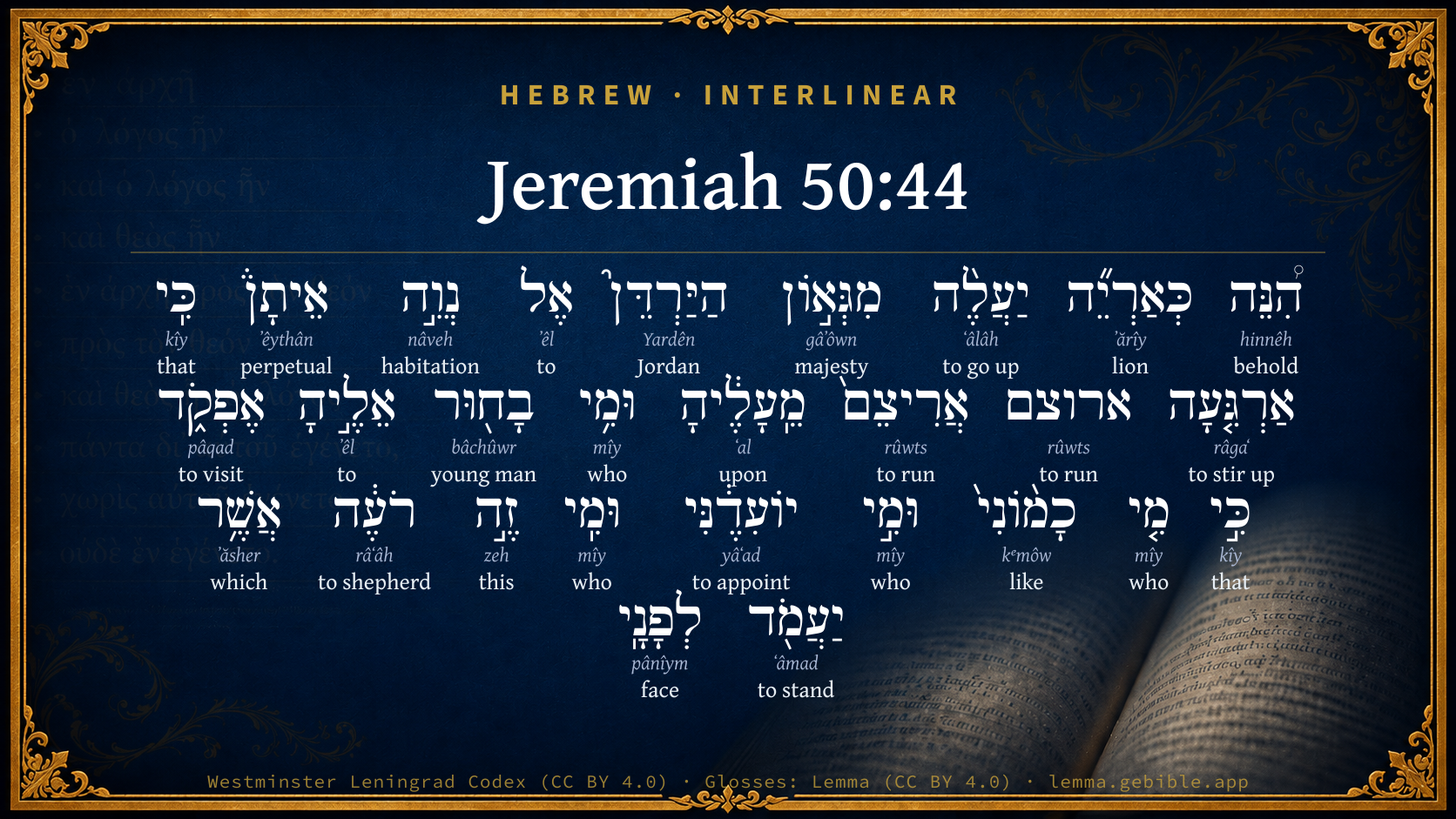
Jeremiah 50:44

Hebrew (Westminster Leningrad Codex) Jeremiah 50:44 appears in the Hebrew Old Testament. The text above is from the Westminster Leningrad Codex. Each word links to its Strong’s number, a concise gloss, and parsing drawn from the Open Scriptures Hebrew Bible morphology. Click any word for its full Brown-Driver-Briggs (BDB) entry.
Download image
Cite this verse

Jeremiah 50:44 (World English Bible). Public Domain. Lemma interlinear Bible study tool, https://lemma.gebible.app/v/jeremiah/50/44.

Show BibTeX & RIS
BibTeX
RIS
English Translation
Behold, [the enemy] shall come up like a lion from the pride of the Jordan against the strong habitation: for I will suddenly make them run away from it; and whoever is chosen, him will I appoint over it: for who is like me? and who will appoint me a time? and who is the shepherd who can stand before me?
World English Bible · Public Domain
Download a study sheet

One document with this verse’s original text, its word-by-word gloss line, the meaning frame, cross-references with their text, attributed commentary, and full source and license credits — printable, and it pastes into notes with its structure intact.

This verse Autodidact and up

Study sheet (.html) Plain text (.txt)

A passage Seminary Student

Up to 50 verses in one chapter. A passage sheet keeps up to 6 commentary sources and 12 cross-references per verse, in the order this page ranks them, and says so on the sheet whenever that leaves anything out. Ask for a single verse and you get the Autodidact verse sheet above.

Everything on this page stays free to read, with no account — the sheet is a download of what is already on screen, not access to it.

Want to remove ads? Support Godless Engineer
Compare translations 3

The same verse in 3 English versions, stacked beneath the original-language interlinear above. Click any original word for its lexicon entry.

Each is an independent rendering of the whole verse — the interlinear is not word-aligned to these translations.

Highlighted words mark where these versions differ — a whole-verse word diff, not a word-by-word alignment.

  • World English Bible Public Domain
    Behold, [the enemy] shall come up like a lion from the pride of the Jordan against the strong habitation: for I will suddenly make them run away from it; and whoever is chosen, him will I appoint over it: for who is like me? and who will appoint me a time? and who is the shepherd who can stand before me?
  • King James Version Public Domain
    Behold, he shall come up like a lion from the swelling of Jordan unto the habitation of the strong: but I will make them suddenly run away from her: and who is a chosen man, that I may appoint over her? for who is like me? and who will appoint me the time? and who is that shepherd that will stand before me?
  • unfoldingWord Literal Text CC BY-SA 4.0
    Behold! He goes up like a lion from the heights of the Jordan to the enduring grazing place For I will quickly cause them to run from it, and I will put someone who will be chosen in charge of it. For who is like me, and who will summon me? What shepherd is able to resist me?

unfoldingWord Literal Text — © unfoldingWord, licensed CC BY-SA 4.0. Word-aligned USFM3 via Door43 (git.door43.org/unfoldingWord/en_ult).

Versions to compare (up to 4)

3 of 4 selected

Show all 18 translations

Every available English version of this verse, each an independent rendering of the whole verse.

  • World English Bible Public Domain
    Behold, [the enemy] shall come up like a lion from the pride of the Jordan against the strong habitation: for I will suddenly make them run away from it; and whoever is chosen, him will I appoint over it: for who is like me? and who will appoint me a time? and who is the shepherd who can stand before me?
  • Berean Standard Bible Public Domain
    Behold, one will come up like a lion from the thickets of the Jordan to the watered pasture. For in an instant I will chase Babylon from her land. Who is the chosen one I will appoint for this? For who is like Me, and who can challenge Me? What shepherd can stand against Me?”
  • Majority Standard Bible Public Domain
    Behold, one will come up like a lion from the thickets of the Jordan to the watered pasture. For in an instant I will chase Babylon from her land. Who is the chosen one I will appoint for this? For who is like Me, and who can challenge Me? What shepherd can stand against Me?”
  • King James Version Public Domain
    Behold, he shall come up like a lion from the swelling of Jordan unto the habitation of the strong: but I will make them suddenly run away from her: and who is a chosen man, that I may appoint over her? for who is like me? and who will appoint me the time? and who is that shepherd that will stand before me?
  • American Standard Version (1901) Public Domain
    Behold, `the enemy' shall come up like a lion from the pride of the Jordan against the strong habitation: for I will suddenly make them run away from it; and whoso is chosen, him will I appoint over it: for who is like me? and who will appoint me a time? and who is the shepherd that can stand before me?
  • Revised Version (1885) Public Domain
    Behold, he shall come up like a lion from the pride of Jordan against the strong habitation: but I will suddenly make them run away from her; and whoso is chosen, him will I appoint over her: for who is like me? and who will appoint me a time? and who is the shepherd that will stand before me?
  • Geneva Bible (1599) Public Domain
    Beholde, hee shall come vp like a lyon from the swelling of Iorden vnto the strong habitation: for I will make Israel to rest, and I will make them to haste away from her: and who is a chosen man that I may appoynt against her? for who is like me, and who will appoynt me the time? and who is the shepheard that will stande before me?
  • Douay-Rheims (1899) Public Domain
    Behold he shall come up like a lion from the swelling of the Jordan to the strong and beautiful: for I will make him run suddenly upon her: and who shall be the chosen one whom I may appoint over her? for who is like to me? and who shall bear up against me? and who is that shepherd that can withstand my countenance?
  • Young's Literal Translation Public Domain
    Lo, as a lion he cometh up, Because of the rising of the Jordan, Unto the enduring habitation, But I cause to rest, I cause them to run from off her. And who is chosen? on her I lay a charge, For who `is' like Me? And who doth convene Me? And who `is' this shepherd who standeth before Me?
  • Literal Standard Version CC BY-SA 4.0
    Behold, he comes up as a lion, || Because of the rising of the Jordan, || To the enduring habitation, || But I cause to rest, I cause them to run from off her. And who is chosen? I lay a charge on her, || For who [is] like Me? And who convenes Me? And who [is] this shepherd who stands before Me?
  • Unlocked Literal Bible CC BY-SA 4.0
    Behold! He goes up like a lion from the heights of the Jordan to the enduring grazing place For I will quickly cause them to run from it, and I will put someone who will be chosen in charge of it. For who is like me, and who will summon me? What shepherd is able to resist me?
  • unfoldingWord Literal Text CC BY-SA 4.0
    Behold! He goes up like a lion from the heights of the Jordan to the enduring grazing place For I will quickly cause them to run from it, and I will put someone who will be chosen in charge of it. For who is like me, and who will summon me? What shepherd is able to resist me?
  • Darby Bible Public Domain
    Behold, he shall come up like a lion from the swelling of the Jordan against the strong habitation; for I will make him suddenly run away from it; and who is a chosen [man] whom I may appoint over her? For who is like me? and who will assign me a time? and who is that shepherd that will stand before me?
  • World Messianic Bible Public Domain
    Behold, the enemy will come up like a lion from the thickets of the Jordan against the strong habitation; for I will suddenly make them run away from it. Whoever is chosen, I will appoint him over it, for who is like me? Who will appoint me a time? Who is the shepherd who can stand before me?”
  • Webster's Bible Public Domain
    Behold, he shall come up like a lion from the swelling of Jordan to the habitation of the strong: but I will make them suddenly run away from her: and who is a chosen man, that I may appoint over her? for who is like me? and who will appoint me the time? and who is that shepherd that will stand before me?
  • Free Bible Version CC BY-SA 4.0
    Watch out! I'm going to come like a lion from the tangled undergrowth beside the Jordan to attack the animals grazing the green pasture. In fact I'm going to chase the Babylonians from their land very quickly. Who will I choose to conquer them? Who is like me? Who can challenge me? Which leader could oppose me?
  • Bible in Basic English Public Domain
    See, he will come up like a lion from the thick growth of Jordan against the resting-place of Teman: but I will suddenly make them go in flight from her; and I will put over her the man of my selection: for who is like me? and who will put forward his cause against me? and what keeper of sheep will keep his place before me?
  • JPS Tanakh (1917) Public Domain
    Behold, he shall come up like a lion from the thickets of the Jordan against the strong habitation; for I will suddenly make them run away from it, and whoso is chosen, him will I appoint over it; for who is like Me? and who will appoint Me a time? and who is that shepherd that will stand before Me?

Literal Standard Version (2020), Covenant Press — licensed CC BY-SA 4.0. Text via the HelloAO Bible API (eBible.org). Unlocked Literal Bible (unfoldingWord) — licensed CC BY-SA 4.0. Text via the HelloAO Bible API (eBible.org). unfoldingWord Literal Text — © unfoldingWord, licensed CC BY-SA 4.0. Word-aligned USFM3 via Door43 (git.door43.org/unfoldingWord/en_ult). Free Bible Version, Dr. Jonathan Gallagher — licensed CC BY-SA 4.0. Text via the HelloAO Bible API (eBible.org).

Word by word

More ways to search: Search by grammar → Find every occurrence → Compare this word →

Practice this passage: Drill this verse → Learn its vocabulary →

אֵיתָן֒
ʼêythân
H386
“perpetual”
Adjective, Adjective, Masculine, Singular, Absolute
Part of Speech
Adjective
Type
Adjective
Gender
Masculine
Number
Singular
State
Absolute
Full BDB Definition

Origin: from an unused root (meaning to continue)

TWOT: 935a

perpetual, constant, perennial, ever-flowing - ever-flowing (of a stream) - permanence, permanent, enduring (figuratively)
  1. הִ֠נֵּה hinnêh H2009 “behold” Particle, Demonstrative
  2. כְּאַרְיֵ֞ה ʼărîy H738 “like/as · lion” Preposition + Noun, Common, Masculine, Singular, Absolute
  3. יַעֲלֶ֨ה ʻâlâh H5927 “to go up” Verb, Qal, Imperfect, 3rd Person, Masculine, Singular
  4. מִגְּא֣וֹן gâʼôwn H1347 “from · majesty of” Preposition + Noun, Common, Masculine, Singular, Construct
  5. הַיַּרְדֵּן֮ Yardên H3383 “the · Jordan” Particle, Definite Article + Noun, Proper
  6. אֶל ʼêl H413 “to” Preposition
  7. נְוֵ֣ה nâveh H5116 “habitation of” Noun, Common, Both, Singular, Construct
  8. כִּֽי kîy H3588 “that” Conjunction
  9. אַרְגִּ֤עָה râgaʻ H7280 “to stir up” Verb, Hiphil, Cohortative, 1st Person, Common, Singular
  10. ארוצם rûwts H7323 “to run · them” Verb, Qal, Imperfect, 1st Person, Common, Singular + Suffix, Personal, 3rd Person, Masculine, Plural
  11. אֲרִיצֵם֙ rûwts H7323 “to run · them” Verb, Hiphil, Imperfect, 1st Person, Common, Singular + Suffix, Personal, 3rd Person, Masculine, Plural
  12. מֵֽעָלֶ֔יהָ ʻal H5921 “from · upon · her” Preposition + Preposition + Suffix, Personal, 3rd Person, Feminine, Singular
  13. וּמִ֥י mîy H4310 “and · who” Conjunction + Particle, Interrogative
  14. בָח֖וּר bâchûwr H970 “young man” Verb, Qal, Participle Passive, Masculine, Singular, Absolute
  15. אֵלֶ֣יהָ ʼêl H413 “to · her” Preposition + Suffix, Personal, 3rd Person, Feminine, Singular
  16. אֶפְקֹ֑ד pâqad H6485 “to visit” Verb, Qal, Imperfect, 1st Person, Common, Singular
  17. כִּ֣י kîy H3588 “that” Conjunction
  18. מִ֤י mîy H4310 “who” Particle, Interrogative
  19. כָמ֨וֹנִי֙ kᵉmôw H3644 “like · me” Preposition + Suffix, Personal, 1st Person, Common, Singular
  20. וּמִ֣י mîy H4310 “and · who” Conjunction + Particle, Interrogative
  21. יוֹעִדֶ֔נִּי yâʻad H3259 “to appoint · me” Verb, Hiphil, Imperfect, 3rd Person, Masculine, Singular + Suffix, Personal, 1st Person, Common, Singular
  22. וּמִֽי mîy H4310 “and · who” Conjunction + Particle, Interrogative
  23. זֶ֣ה zeh H2088 “this” Pronoun, Demonstrative, Masculine, Singular
  24. רֹעֶ֔ה râʻâh H7462 “shepherding” Verb, Qal, Participle Active, Masculine, Singular, Absolute
  25. אֲשֶׁ֥ר ʼăsher H834 “which” Particle, Relative
  26. יַעֲמֹ֖ד ʻâmad H5975 “to stand” Verb, Qal, Imperfect, 3rd Person, Masculine, Singular
  27. לְפָנָֽי pânîym H6440 “to/for · face(s) · my” Preposition + Noun, Common, Both, Plural, Construct + Suffix, Personal, 1st Person, Common, Singular

About this verse

These counts appear in no published source. They are computed here, from the morphology-tagged text and Lemma’s own curated glosses. What Lemma adds →

28
words
22
distinct lemmas
Prophets
section

Notable vocabulary

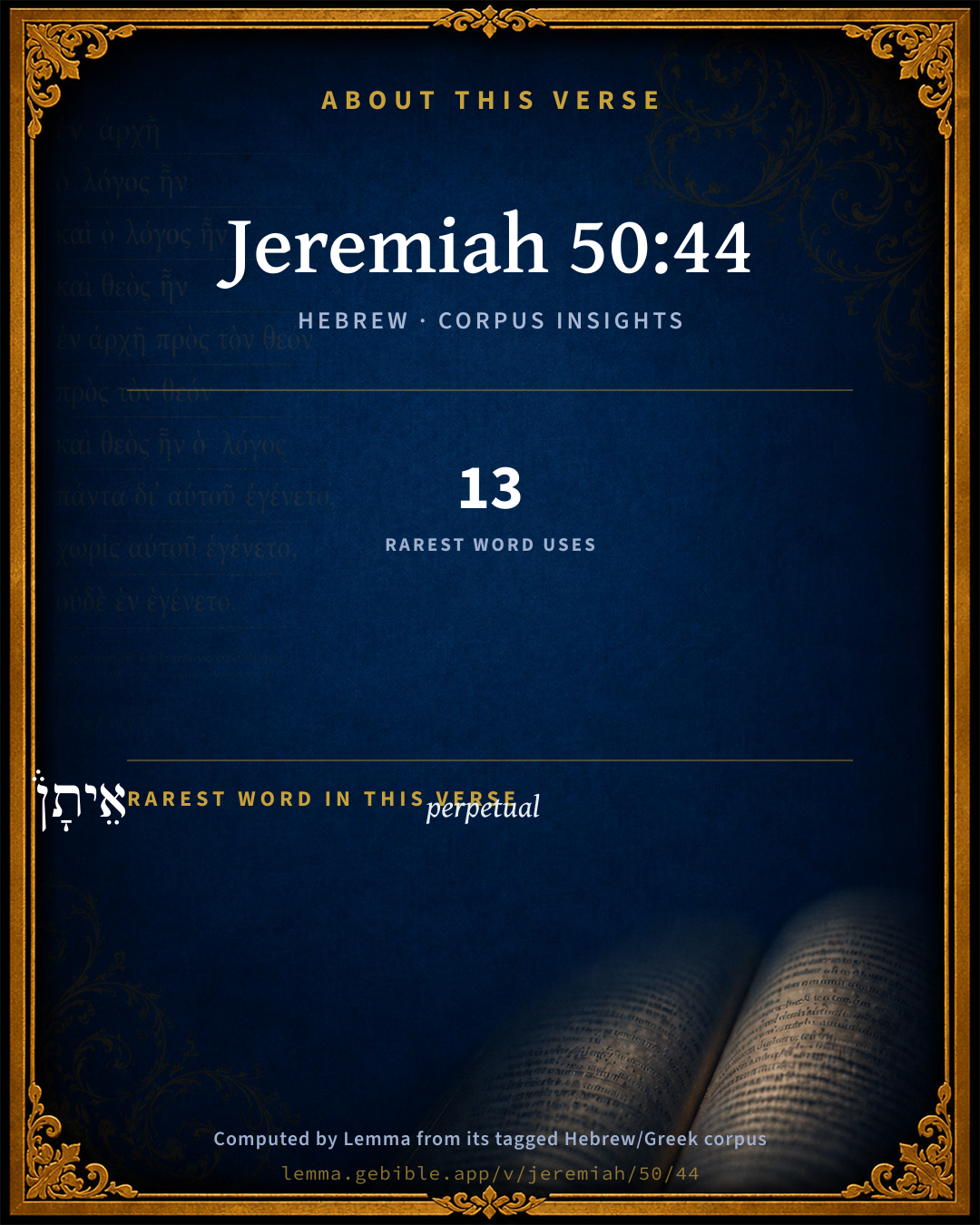
The rarest word here is אֵיתָן֒ perpetual H386 — appearing just 13 times in the whole Hebrew Bible.

Shared distinctive vocabulary

אֵיתָן֒ perpetual H386 occurs in 13 verses of the Hebrew Bible. Also found in:

Grammatical profile

  • 9 verbs
  • 5 nouns
  • 1 adjective
  • 1 pronoun
  • 4 prepositions
  • 2 conjunctions
  • 6 particles

Verb forms

  • יַעֲלֶ֨ה Qal · Imperfect
  • אַרְגִּ֤עָה Hiphil · Cohortative
  • ארוצם Qal · Imperfect
  • אֲרִיצֵם֙ Hiphil · Imperfect
  • בָח֖וּר Qal · Participle Passive
  • אֶפְקֹ֑ד Qal · Imperfect
  • יוֹעִדֶ֔נִּי Hiphil · Imperfect
  • רֹעֶ֔ה Qal · Participle Active
  • יַעֲמֹ֖ד Qal · Imperfect

Repetition

Words recur within this verse — often emphatic in Hebrew:

  • ארוצם to run H7323 ×2
  • וּמִ֥י who H4310 ×4
  • אֶל to H413 ×2
  • כִּֽי that H3588 ×2

Cross-references

13

Topical passages linked to Jeremiah 50:44 in the Treasury of Scripture Knowledge — connected by theme and wording, ordered by reader-vote popularity; previews shown in the World English Bible.

  • Jeremiah 49:19–21 Behold, he shall come up like a lion from the pride of the Jordan against the strong habitation: for I will suddenly make them run away from it; and whoever is chosen, him will I appoint over it: for who is like me? and who will appoint me a time? and who is the shepherd who will stand before me?
  • Exodus 15:11 Who is like you, Yahweh, among the gods? Who is like you, glorious in holiness, Fearful in praises, doing wonders?
  • Psalms 89:6 For who in the skies can be compared to Yahweh? Who among the sons of the heavenly beings is like Yahweh,
  • Isaiah 40:25 To whom then will you liken me, that I should be equal [to him]? says the Holy One.
  • Isaiah 41:25 I have raised up one from the north, and he has come; from the rising of the sun one who calls on my name: and he shall come on rulers as on mortar, and as the potter treads clay.
  • Isaiah 43:10 You are my witnesses, says Yahweh, and my servant whom I have chosen; that you may know and believe me, and understand that I am he: before me there was no God formed, neither shall there be after me.
  • Isaiah 46:9 Remember the former things of old: for I am God, and there is none else; [I am] God, and there is none like me;
  • Isaiah 46:11 calling a ravenous bird from the east, the man of my counsel from a far country; yes, I have spoken, I will also bring it to pass; I have purposed, I will also do it.
  • Numbers 16:5 and he spoke to Korah and to all his company, saying, In the morning Yahweh will show who are his, and who is holy, and will cause him to come near to him: even him whom he shall choose will he cause to come near to him.
  • Job 41:10–11 None is so fierce that he dare stir him up. Who then is he who can stand before me?
  • Psalms 89:8 Yahweh, God of hosts, who is a mighty one, like you? Yah, your faithfulness is around you.
  • Isaiah 40:18 To whom then will you liken God? or what likeness will you compare to him?
  • Jeremiah 25:38 He has left his covert, as the lion; for their land is become an astonishment because of the fierceness of the oppressing [sword], and because of his fierce anger.

Cross-references courtesy of OpenBible.info (CC BY 4.0).

Hebrew and Greek witnesses Masoretic Hebrew ↔ Greek Septuagint

The same verse in the two great witnesses to the Old Testament, shown verse-for-verse.

These are two independent witnesses, not word-aligned to each other, and the Septuagint is shown in lemma (dictionary) form.

Hebrew Jeremiah 50:44 Masoretic · Westminster Leningrad Codex

הִ֠נֵּה כְּאַרְיֵ֞ה יַעֲלֶ֨ה מִגְּא֣וֹן הַיַּרְדֵּן֮ אֶל נְוֵ֣ה אֵיתָן֒ כִּֽי אַרְגִּ֤עָה ארוצם אֲרִיצֵם֙ מֵֽעָלֶ֔יהָ וּמִ֥י בָח֖וּר אֵלֶ֣יהָ אֶפְקֹ֑ד כִּ֣י מִ֤י כָמ֨וֹנִי֙ וּמִ֣י יוֹעִדֶ֔נִּי וּמִֽי זֶ֣ה רֹעֶ֔ה אֲשֶׁ֥ר יַעֲמֹ֖ד לְפָנָֽי

Behold, [the enemy] shall come up like a lion from the pride of the Jordan against the strong habitation: for I will suddenly make them run away from it; and whoever is chosen, him will I appoint over it: for who is like me? and who will appoint me a time? and who is the shepherd who can stand before me?

World English Bible · Public Domain

Greek LXX Structure differs

In the Septuagint, Jeremiah is about an eighth shorter than the Hebrew and arranges its material differently — the Oracles Against the Nations (Hebrew chapters 46–51) appear in the middle of the Greek book, after 25:13. Because the chapter and verse boundaries do not line up, a verse-for-verse comparison with the Hebrew is not shown.

A verse-for-verse comparison isn’t shown here because the chapters and verses don’t line up. Switch to the LXX edition with the MT / LXX toggle above to read the Greek directly.

Hebrew: Westminster Leningrad Codex (CC BY 4.0). Greek: Septuagint (public domain); English from a public-domain English Septuagint. How the Septuagint differs from the Hebrew →

Targum (Aramaic paraphrase)

1

The Targum is the ancient Jewish Aramaic paraphrase of the Hebrew Scriptures — an interpretive translation, not the Hebrew text itself. Onkelos (literal) and Pseudo-Jonathan (expansive) render the Torah, and Jonathan the Prophets. Coverage is partial: where no permissively-licensed English translation exists for a verse, only the Aramaic is shown. This is verse-level text, not a word-by-word alignment to the Hebrew.

  1. Targum Jonathan Prophets (Joshua–Malachi)
    הָא מְלַךְ בְּמַשִׁרְיָתֵיהּ יִסַק עֲלֵיהוֹן כְּאַרְיָא דְסָלֵיק מֵרוּם יַרְדְנָא וַהֲוֵי לְדִיר רָעֲיָן אֲרֵי בִזְמַן דְאַיְתִינוּן עֲלָהּ וְשִׁלְטוֹנִין אֲמַנֵי עֲלָהּ אֲרֵי מַן כְּוָתִי וּמַן דִיעַרְעִינַנִי וְלֵית מְלַךְ דְאִית לֵיהּ תְּקוֹף קֳדָמַי:

    (no public-domain English translation for this verse)

    Targum Jonathan — Aramaic: “Mikraot Gedolot” (public domain). English: “Sefaria Community Translation” (CC0 1.0 (public-domain dedication)); “London "Chaldee Paraphrase," 1871” (public domain). Text via Sefaria.

Commentary

Notes on Jeremiah 50:44 from classic Christian and Jewish commentators (each source and its license shown beneath its notes). The classic Christian expositions comment on the surrounding passage and are grouped to its opening verse, so a note may address several verses; the Jewish commentaries on the Tanakh (Rashi and others) are per-verse, so they appear only where the commentator wrote on this verse.

Lemma curates 59 commentaries, every one of them public domain or Creative Commons licensed, each selected and text-cleaned for this edition rather than reprinted as found. About our sources →

Trapp's Complete Commentary

John Trapp

Jer 50:44 Behold, he shall come up like a lion from the swelling of Jordan unto the habitation of the strong: but I will make them suddenly run away from her: and who [is] a chosen [man, that] I may appoint over her? for who [is] like me? and who will appoint me the time? and who [is] that shepherd that will stand before me?

Ver. 44. Behold, he shall come up.] See Jer 49:19.

John Trapp, A Commentary or Exposition upon All the Books of the Old and New Testament (1647–1656) — public domain. Text from a community e-Sword module.

Tyndale Open Study Notes

Tyndale Open Resources

50:44-46 These verses essentially repeat 49:19-21, with Babylon in place of Edom.

Tyndale Open Study Notes — © Tyndale Open Resources, licensed CC BY-SA 4.0. Text via the HelloAO Bible API.

Geneva Bible (1599)

Geneva Bible translators

Read Jer. 49:19.

Geneva Bible (1599) marginal notes — public domain. Text via Bolls.life.

Jamieson, Fausset & Brown

Robert Jamieson, A. R. Fausset & David Brown

Repeated mainly from Jer 49:19-21. The identity of God's principle in His dealing with Edom, and in that with Babylon, is implied by the similarity of language as to both.

Jamieson, Fausset & Brown — Commentary Critical and Explanatory on the Whole Bible (1871) — public domain (CC PDM 1.0). Text via the HelloAO Bible API.

Adam Clarke's Commentary

Verse 44. Behold, he shall came up like a lion] The same words as in Jer 49:19, &c., where see the note. See Clarke on Jer 49:19.

Adam Clarke's Commentary on the Bible (1810–1826) — public domain. Text from a community e-Sword/MySword module.

John Calvin's Commentaries

We have explained nearly the same words in the last chapter; for the Prophet not only used the same similitude respecting the Humans, but also added all the words which are found here; nay, the Prophet brings forward nothing new to the end of the chapter, but only repeats what we have seen before.

He first compares either Darius or Cyrus to a lion, who, at, the overflowing of Jordan, removes to another place. This passage, like the former, is indeed variously explained. Some read, “for the pride of Jordan.” But as it appears from other places that lions had their dens near the banks of Jordan, I have no doubt but that the Prophet here compares Cyrus to, a lion, forced to leave his own lair because of the inundation of that river. We know how savage a beast is the lion; but, when he is forced to change his dwelling and to move to another place, his fury rages the more. It is the same, then, as though he had said, that not any sort of lion would attack the Babylonians, but a lion furious through rage. He then adds, to the strong habitation When he spoke of the Idumeans, the allusion might have been to their country, which was elevated, and they had also mountains as their fortresses. But as Babylon was also strongly fortified, and nearly impregnable on account of fire various streams of the Euphrates, what the Prophet says is also suitable, that a lion would come, though there were hindrances which might impede his course; for when a lion rambles, being not hungry nor forced by any necessity, he can turn here and there as he pleases; but when rage drives and constrains him, he will then surmount all obstacles. So also the Prophet says, that how confident soever Babylon might be in its fortresses, yet Cyrus would break through them, for he would be like a lion, who, at the overflowing of Jordan, removes elsewhere, as he can no longer find his wonted dwelling.

We now perceive the meaning of the words, — that the Babylonians would have to do, not with an idle but a terrible enemy, and with one who would surmount all obstacles, as when fury excites a lion when necessity drives him as it were headlong.

What follows is obscure. Some render the words thus, “When I shall make Israel to rest, then I will make them to flee from her.” In the former place (Jeremiah 49:19), we read “him,” in the singular, אריצנו, aritsnu; but here the Prophet uses the plural number, “them,” אריצם, aritsem; it is yet certain that the meaning is the same. Some, at the same time, apply this to the Jews, that God would remove them from Babylon, purposing to give them rest, that is, by dwelling securely in their own country; but as there is no mention made here of his people, this view is forced and far-fetched. I omit other explanations, for the meaning of the Prophet seems to me to be simply this, When I shall make an irruption, or, after I shall have made them rest, I will make them to flee He speaks, as I think, of the Chaldeans; and the particle כי, ki, is to be taken as an adverb of time, when, or after. It is, indeed, often a causative, but it has sometimes this meaning.

Now, these two clauses may be thus explained: When I shall make an irruption, or, when I shall have made them rest; for רגע, rego, means both to break and to rest. It is here in the active or causative conjugation, in Hiphil. If, then, we read, “After I shall have made them to rest,” the sense will be that the: Babylonians had been long tranquil, as there was no one who infested them or disturbed their peace; and we know that men having long rested in their idleness and sloth, become almost stupefied, so that they are touched with no fear. God then shows that the Babylonians were greatly mistaken, if they thought that the rest which they had previously enjoyed would be perpetual; for he would make them to flee from the city, though they had been long there in a tranquil state. The other sense is by no means unsuitable, “When I shall break,” or make an irruption, then all will flee away, that is, leave the city, which was before like a paradise. There is still no doubt but that the Prophet here denounces on the Babylonians a sudden overthrow, which would drive the people here and there in all directions.

It now follows, Who is the chosen one whom I shall set over her? God here in a manner deliberates as to the person whom he should make the leader of the war against the Chaldeans; and by these words he intimates that there would be ready for him the best general, and one especially active and also excelling in the art of war. And we know that even the unwilling are made to serve God, when he employs the ungodly as his scourges. In short, God shows that though the Babylonians might have brave leaders and most skillful in war, there yet would be prepared leaders, to whom he would commit the office of taking that city. And thus he teaches us at the same time that men are ruled by his hand, so that he chooses them according to his will and directs them to any work he pleases, Who is the chosen one, he says, whom I shall set over her?

And he adds, and who is like me? Here the Prophet shows that the Babylonians in vain trusted in their own defenses; for after having tried all things, they would find that whatever was set up against God and his invincible power, would be mere smoke. This sentence often occurs; and however common it may appear, yet, if we examine ourselves, we shall find that the Holy Spirit does not so often enforce it without reason; for after we have confessed that none is equal to God or can add to his power, — as soon as any trial assails us, this confession vanishes, and we tremble as though God was nothing, and had no power to bring us help. Diffidence, then, which often creeps in when we are in difficulties or dangers, sufficiently shows that we do not attribute to God the praise due to his power. He does not then exclaim here, as in other places, without reason, Who is like me? as though he had said, that the Babylonians would foolishly seek auxiliaries here and there; for when they had made the utmost exertions, whatever they might think the most useful would all vanish away, so that they would be destitute of all remedies.

He adds, And who will protest against me? Some give this frigid version, Who will prescribe to me the time? but they wholly pervert the meaning of the Prophet; for God in this place declares, that men would in vain contend or litigate with him. It is the same as if he had said, “Though all men were to rise up against, me, yet I will not allow them to litigate with me; and this they would also do in vain.” In short, God intimates that men would in vain clamor against his judgments, for he would nevertheless perform what he has decreed. He does not yet claim for himself that absolute power about which the sophists prattle, while they separate it from justice; but he intimates that the causes are not always manifest to men when he executes his judgments; for it is not without reason that the Scripture testifies that God’s judgments are a deep abyss; but by such an expression it is not meant that anything in God’s judgments is confused or in disorder, what then? even that God works in an extraordinary manner, and that hence his judgments are sometimes hidden from men.

Then God briefly shows, that though the Babylonians were to dispute, and start many objections, all this would be useless, because he would execute what he had decreed, and that without debating.

Let us then learn from these words, that when God’s works have the appearance of being unreasonable, we ought humbly to admire them, and never to judge them according to our computation; for God is not to be judged by us. Therefore, as I have already said, we are then only wise, when we humbly adore him in all his works, without disputing with him; for when we adduce all possible things, he will close our mouth with one word, and check all our presumption; nay, he will ever overcome us by being silent, for his justice will always overthrow whatever may come to our minds. But we must bear in mind what I have stated, that God never so acts by his absolute power as to separate it from his justice; for this would be as it were to wound himself; for these things are undivided, his power and justice, though justice often does not appeal however this may be, his sole and simple will is to us the rule of all justice.

It follows, And who is that shepherd who will stand before me? He alludes to the similitude he had used, for he compared himself before to a lion. he says now, “Since I shall go against Babylon like a lion, what shepherd will dare to oppose me?” We see that there is to be understood a contrast, between a lion and a shepherd; for God would be like a lion to destroy Babylon; hence, by pastor, he denotes any adversary who might come forth to defend the Chaldean flock. It follows, —

John Calvin's Commentaries (1540-1563) — public domain. Text from the Calvin Translation Society English edition (1840s-50s) via the Christian Classics Ethereal Library (ccel.org). Calvin's coverage is partial (roughly two-thirds of the Bible); uncommented books and verses are honest gaps, never fabricated. The 19th-century editor's footnotes and remarks are omitted so the notes are faithfully Calvin's own voice.

The Cambridge Bible for Schools and Colleges

gen. ed. J. J. S. Perowne

44. like a lion] no longer Nebuchadnezzar (Jer_49:19) but Cyrus.

44–46. Adapted from Jer_49:19-21 (where see notes), what is there said of Edom being here applied to Babylon.

The Cambridge Bible for Schools and Colleges (gen. ed. J. J. S. Perowne; Cambridge University Press, 1878–1918) — public domain. Text from a community e-Sword module.

John Gill's Exposition

Behold, he shall come up like a lion from the swelling of Jordan,.... What is said of Nebuchadnezzar coming up against Edom is here said of Cyrus coming up against Babylon; for of a king it is to be understood; as the Targum,

"behold, a king with his army shall come up against them, as a lion from the height of Jordan;''

see Jer 49:19;

unto the habitation of the strong; to Babylon; where dwelt the king, his nobles, and his mighty men:

but I will make them suddenly run away from her; as they did from her king Belshazzar, when Gobrias and Gadates entered the royal palace, and seized upon him (a);

and who is a chosen man, that I may appoint over her? or, "a young man" (b)? such an one Cyrus was, who, by divine appointment, became master and governor of Babylon:

and who will appoint me the time? to enter the lists with me, and litigate the point with me in a court of judicature, or contend with me in battle:

and who is that shepherd that will stand before me? or king? not Belshazzar, he could not stand before the Lord: so the Targum,

"there is no king that hath strength before me;''

that is, to withstand him, or hinder what he has appointed and ordered to be done; See Gill on Jer 49:19.

(a) lbid. (b) "quis juvenis?" Cocceius, Schmidt.

John Gill's Exposition of the Whole Bible (1746–1763) — public domain (CC PDM 1.0). Text via the HelloAO Bible API.

Albert Barnes' Notes on the Bible

A similar application to Babylon of what was said of Edom (marginal reference).

Albert Barnes' Notes on the Bible (1834–1885) — public domain. Text from a community e-Sword/MySword module.

Haydock's Catholic Bible Commentary

And beautiful. Hebrew, "habitation." (Haydock) --- He will rush into the fold, chap. xlix. 19. (Calmet) --- The king of Babylon had ruined many. Others shall destroy him, rushing on like the Jordan. (Worthington)

George Leo Haydock (1774–1849), Haydock's Catholic Family Bible and Commentary, 1859 edition — public domain. Excludes Psalms (Douay-Rheims chapter numbering differs from Protestant) and Deuterocanonical books (Catholic canon only).

unfoldingWord translationNotes

Door43 World Missions Community

General Information:

This verse is almost identical to Jeremiah 49:19. See how you translated that verse.

Behold!

The word "Behold" here tells the reader to pay attention to what follows. AT: "Pay attention!"

He goes up like a lion from the heights of the Jordan to the enduring grazing place

This simile means that when Yahweh punishes the people of Babylon, it will be fierce and unexpected like when a lion attacks sheep. This can be stated in the first person. AT: "When I punish the people of Babylon, it will be fierce and unexpected like when a lion comes out of mountains and attacks sheep in the pasture" (See: Simile and First, Second, or Third Person)

the enduring grazing place

This is land covered with grass where animals feed on the grass.

I will quickly cause them to run from it

Here "them" refers to the Babylonian people; the word "it" refers to the invasion.

who will be chosen

This can be stated in active form. AT: "whom I will choose" (See: Active or Passive)

For who is like me, and who will summon me?

Yahweh uses this question to emphasize that no one is like him. AT: "For no one is like me, no one can summon me." (See: Rhetorical Question)

who will summon me

"who will challenge me" or "who will call me to account"

What shepherd is able to resist me?

Yahweh uses this question to show no one can defeat him. Here "shepherd" is a metaphor for "king" or "ruler." AT: "No king is able to resist me." (See: Rhetorical Question and Metaphor)

translationWords

lions

Jordan River

shepherd

unfoldingWord translationNotes — © Distant Shores Media and the Door43 World Missions Community, licensed CC BY-SA 4.0. Source: git.door43.org/Door43/en_tn.

Rashi

Rabbi Shlomo Yitzchaki (Rashi)

Behold, as a lion that ascends from the heights of the Jordan, so will the spoiler come to the strong dwelling. So did Jonathan paraphrase: Behold a king with his camp shall ascend upon them like a lion that ascends from the height of the Jordan. We learn that the height of the Jordan is a place of lions. Also, in this manner Jonathan renders: “How will you do in the heights of the Jordan” (12:5): Against the wild beasts of the heights of the Jordan.

when I bring the moment Heb. ארגיעה, when I bring the time.

over her Heb. מעליה.

and who will appoint Me a time for war?

Rashi on the Tanakh — English translations: “The Judaica Press complete Tanach with Rashi, translated by A. J. Rosenberg” (CC BY 4.0); “Pentateuch with Rashi's commentary by M. Rosenbaum and A.M. Silbermann, 1929-1934” (public domain); “The Metsudah Tanach series, Lakewood, N.J” (CC BY 4.0); and “The Book of Joshua, Metsudah Publications, 1997” (CC BY 4.0). Text via Sefaria.

Lesson kit

Teaching starters — assembled from the data on this page, not authored interpretation. Every prompt links to the verse data it draws on. Edit before teaching.

Jeremiah, in the Prophets, opens this verse with 28 words (22 distinct Hebrew lemmas). Its most distinctive word is ʼêythân (“perpetual”). A historical commentator’s framing appears above. Read the whole chapter for the surrounding context.

Discussion questions

  1. How does “perpetual” (ʼêythân) shape what this verse is saying?
  2. Genesis 49:24 shares the word «perpetual» with this verse. How do the two illuminate each other?
  3. “to run” occurs 2× in this one verse. What is the effect of the repetition?
  4. The translations on this page render this verse differently — a whole-verse word diff, not a word-by-word alignment. What might account for the different wordings?
  5. The verb «יַעֲלֶ֨ה» is Qal Imperfect. How does its form color the action?
  6. Reading how Trapp's Complete Commentary and Tyndale Open Study Notes read this verse, where do the two commentators agree and where do they part?

Things to notice

Reading settings

Reading text

Shown beneath each verse's original-language words.

Old Testament
Old Testament edition

Read the OT as the Masoretic Hebrew (MT) or the Greek Septuagint (LXX).

English shown for the Greek Septuagint (in the Hebrew ↔ Greek comparison).

Comparing translations? Open the Compare panel on any verse page to stack up to four side by side.