
Song of Solomon 4:5

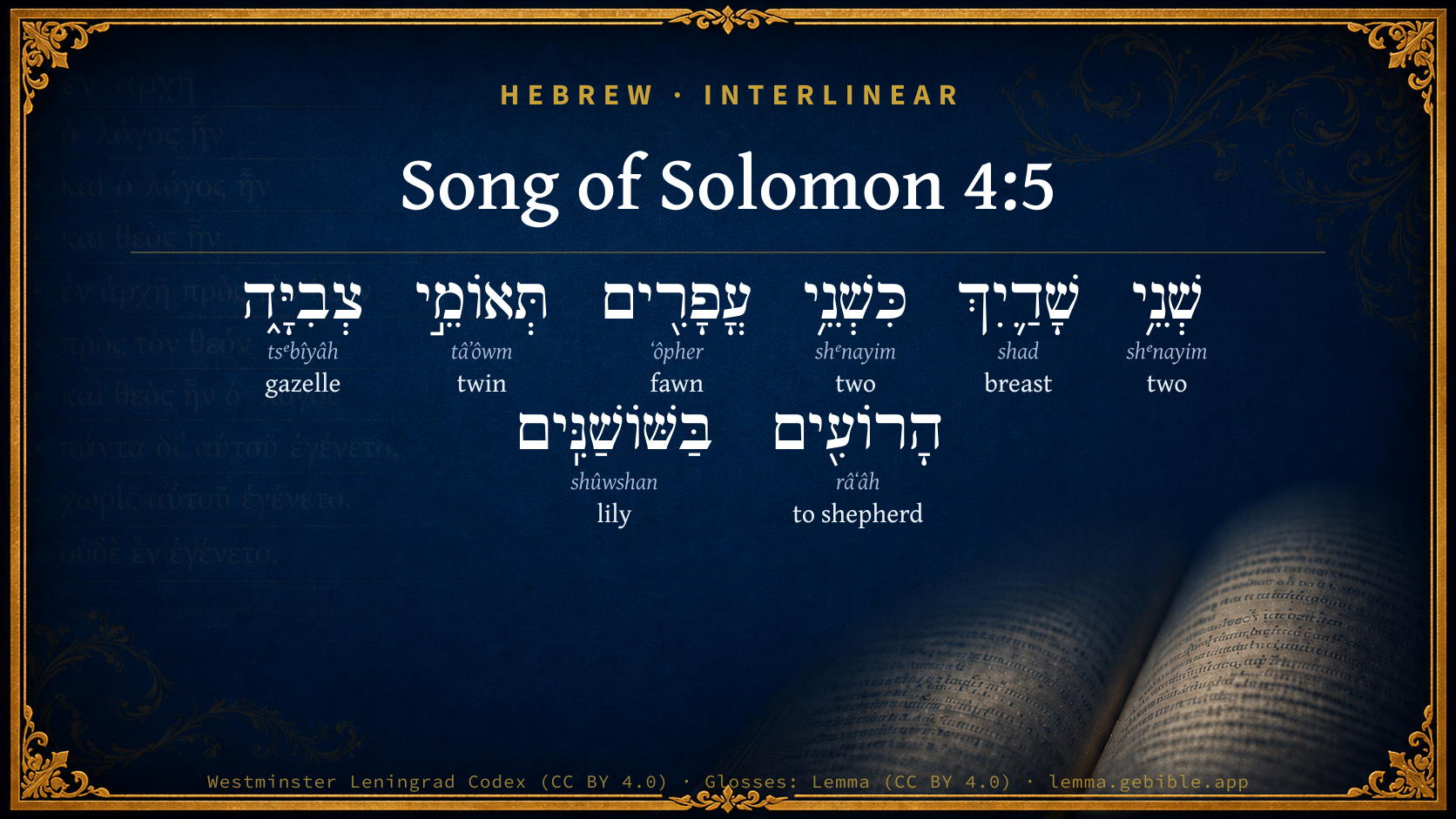
Hebrew (Westminster Leningrad Codex) Song of Solomon 4:5 appears in the Hebrew Old Testament. The text above is from the Westminster Leningrad Codex. Each word links to its Strong’s number, a concise gloss, and parsing drawn from the Open Scriptures Hebrew Bible morphology. Click any word for its full Brown-Driver-Briggs (BDB) entry.
Download image
Cite this verse

Song of Solomon 4:5 (World English Bible). Public Domain. Lemma interlinear Bible study tool, https://lemma.gebible.app/v/song-of-solomon/4/5.

Show BibTeX & RIS
BibTeX
RIS
English Translation
Your two breasts are like two fawns That are twins of a roe, Which feed among the lilies.
World English Bible · Public Domain
Highlights
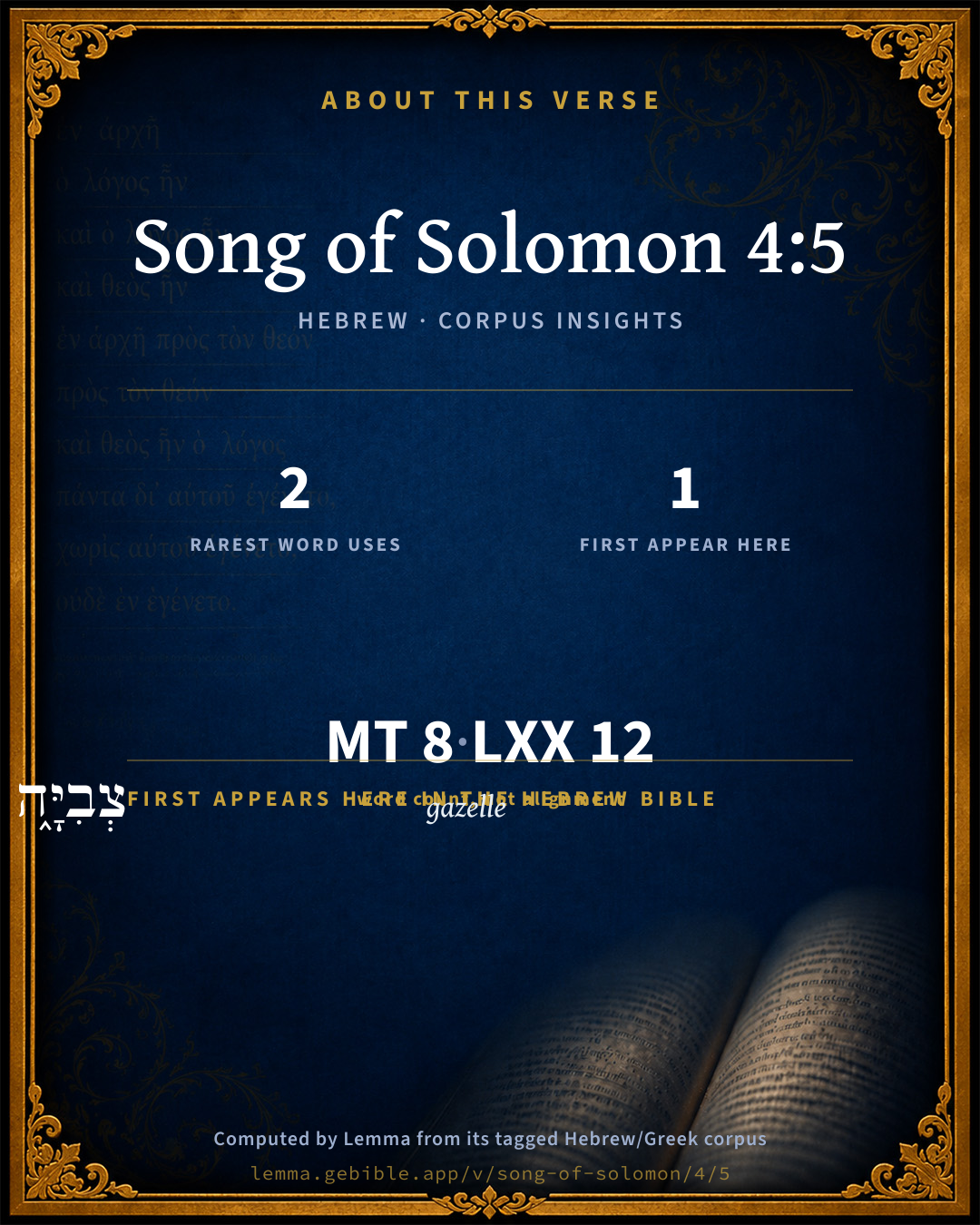
  • 1 first appearance in the Hebrew Bible
Full analysis ↓
Download a study sheet

One document with this verse’s original text, its word-by-word gloss line, the meaning frame, cross-references with their text, attributed commentary, and full source and license credits — printable, and it pastes into notes with its structure intact.

This verse Autodidact and up

Study sheet (.html) Plain text (.txt)

A passage Seminary Student

Up to 50 verses in one chapter. A passage sheet keeps up to 6 commentary sources and 12 cross-references per verse, in the order this page ranks them, and says so on the sheet whenever that leaves anything out. Ask for a single verse and you get the Autodidact verse sheet above.

Everything on this page stays free to read, with no account — the sheet is a download of what is already on screen, not access to it.

Want to remove ads? Support Godless Engineer
Compare translations 3

The same verse in 3 English versions, stacked beneath the original-language interlinear above. Click any original word for its lexicon entry.

Each is an independent rendering of the whole verse — the interlinear is not word-aligned to these translations.

Highlighted words mark where these versions differ — a whole-verse word diff, not a word-by-word alignment.

  • World English Bible Public Domain
    Your two breasts are like two fawns That are twins of a roe, Which feed among the lilies.
  • King James Version Public Domain
    Thy two breasts are like two young roes that are twins, which feed among the lilies.
  • unfoldingWord Literal Text CC BY-SA 4.0
    Your two breasts like two fawns, twins of a female gazelle, the ones pasturing among the lilies.

unfoldingWord Literal Text — © unfoldingWord, licensed CC BY-SA 4.0. Word-aligned USFM3 via Door43 (git.door43.org/unfoldingWord/en_ult).

Versions to compare (up to 4)

3 of 4 selected

Show all 18 translations

Every available English version of this verse, each an independent rendering of the whole verse.

  • World English Bible Public Domain
    Your two breasts are like two fawns That are twins of a roe, Which feed among the lilies.
  • Berean Standard Bible Public Domain
    Your breasts are like two fawns, twins of a gazelle grazing among the lilies.
  • Majority Standard Bible Public Domain
    Your breasts are like two fawns, twins of a gazelle grazing among the lilies.
  • King James Version Public Domain
    Thy two breasts are like two young roes that are twins, which feed among the lilies.
  • American Standard Version (1901) Public Domain
    Thy two breasts are like two fawns That are twins of a roe, Which feed among the lilies.
  • Revised Version (1885) Public Domain
    Thy two breasts are like two fawns that are twins of a roe, which feed among the lilies.
  • Geneva Bible (1599) Public Domain
    Thy two breastes are as two young roes that are twinnes, feeding among the lilies.
  • Douay-Rheims (1899) Public Domain
    Thy two breasts like two young roes that are twins, which feed among the lilies.
  • Young's Literal Translation Public Domain
    Thy two breasts `are' as two fawns, Twins of a roe, that are feeding among lilies.
  • Literal Standard Version CC BY-SA 4.0
    Your two breasts [are] as two fawns, || Twins of a roe, that are feeding among lilies.
  • Unlocked Literal Bible CC BY-SA 4.0
    Your two breasts are like two fawns, twins of a gazelle, grazing among the lilies.
  • unfoldingWord Literal Text CC BY-SA 4.0
    Your two breasts like two fawns, twins of a female gazelle, the ones pasturing among the lilies.
  • Darby Bible Public Domain
    Thy two breasts are like two fawns, twins of a gazelle, Which feed among the lilies.
  • World Messianic Bible Public Domain
    Your two breasts are like two fawns that are twins of a roe, which feed among the lilies.
  • Webster's Bible Public Domain
    Thy two breasts are like two young roes that are twins, which feed among the lilies.
  • Free Bible Version CC BY-SA 4.0
    Your breasts are like two fawns, two gazelles feeding among the lilies.
  • Bible in Basic English Public Domain
    Your two breasts are like two young roes of the same birth, which take their food among the lilies.
  • JPS Tanakh (1917) Public Domain
    Thy two breasts are like two fawns that are twins of a gazelle, which feed among the lilies.

Literal Standard Version (2020), Covenant Press — licensed CC BY-SA 4.0. Text via the HelloAO Bible API (eBible.org). Unlocked Literal Bible (unfoldingWord) — licensed CC BY-SA 4.0. Text via the HelloAO Bible API (eBible.org). unfoldingWord Literal Text — © unfoldingWord, licensed CC BY-SA 4.0. Word-aligned USFM3 via Door43 (git.door43.org/unfoldingWord/en_ult). Free Bible Version, Dr. Jonathan Gallagher — licensed CC BY-SA 4.0. Text via the HelloAO Bible API (eBible.org).

Word by word

More ways to search: Search by grammar → Find every occurrence → Compare this word →

Practice this passage: Drill this verse → Learn its vocabulary →

About this verse

These counts appear in no published source. They are computed here, from the morphology-tagged text and Lemma’s own curated glosses. What Lemma adds →

8
words
7
distinct lemmas
Wisdom
section

Notable vocabulary

The rarest word here is צְבִיָּ֑ה gazelle H6646 — appearing just 2 times in the whole Hebrew Bible.

First appearance in Scripture

This word makes its first canonical appearance in the Hebrew Bible here:

  • צְבִיָּ֑ה gazelle H6646

Shared distinctive vocabulary

צְבִיָּ֑ה gazelle H6646 occurs in 2 verses of the Hebrew Bible. Also found in:

Grammatical profile

  • 1 verb
  • 5 nouns
  • 2 adjectives

Verb forms

  • הָרוֹעִ֖ים Qal · Participle Active

Repetition

A word recurs within this verse — often emphatic in Hebrew:

  • שְׁנֵ֥י two H8147 ×2

Hebrew & Septuagint length

In English translation the verse runs 18 words from the Hebrew and 13 from the Septuagint (LXX English) — closely comparable.

A rough comparison of the two English renderings, which tokenize alike — not a word-level alignment.

Word counts can differ between the Hebrew and the Greek without any difference in meaning — e.g. the Hebrew direct-object marker אֵת has no separate Greek word, and Greek often adds the article ὁ.

In the original languages it is 8 Hebrew tokens and 12 Greek tokens — but the two are counted differently (Hebrew bundles its prefixes and suffixes into one token; the Greek is in lemma form), so that isn’t a like-for-like length.

Cross-references

10

Topical passages linked to Song of Solomon 4:5 in the Treasury of Scripture Knowledge — connected by theme and wording, ordered by reader-vote popularity; previews shown in the World English Bible.

  • Song of Solomon 2:16 My beloved is mine, and I am his. He browses among the lilies.
  • Song of Solomon 6:3 I am my beloved's, and my beloved is mine. He browses among the lilies,
  • Song of Solomon 7:3 Your two breasts are like two fawns, That are twins of a roe.
  • Proverbs 5:19 A loving doe and a graceful deer-- Let her breasts satisfy you at all times. Be captivated always with her love.
  • Song of Solomon 8:10 I am a wall, and my breasts like towers, Then I was in his eyes like one who found peace.
  • 1 Peter 2:2 as newborn babes, long for the pure milk of the Word, that you may grow thereby,
  • Song of Solomon 1:13 My beloved is to me a sachet of myrrh, That lies between my breasts.
  • Song of Solomon 7:7 This, your stature, is like a palm tree, Your breasts like its fruit.
  • Song of Solomon 8:1 Oh that you were like my brother, Who sucked the breasts of my mother! If I found you outside, I would kiss you; Yes, and no one would despise me.
  • Isaiah 66:10–12 Rejoice you with Jerusalem, and be glad for her, all you who love her: rejoice for joy with her, all you who mourn over her;

Cross-references courtesy of OpenBible.info (CC BY 4.0).

Hebrew and Greek witnesses Masoretic Hebrew ↔ Greek Septuagint

The same verse in the two great witnesses to the Old Testament, shown verse-for-verse.

These are two independent witnesses, not word-aligned to each other, and the Septuagint is shown in lemma (dictionary) form.

Hebrew Song of Solomon 4:5 Masoretic · Westminster Leningrad Codex

שְׁנֵ֥י שָׁדַ֛יִךְ כִּשְׁנֵ֥י עֳפָרִ֖ים תְּאוֹמֵ֣י צְבִיָּ֑ה הָרוֹעִ֖ים בַּשּׁוֹשַׁנִּֽים

Your two breasts are like two fawns That are twins of a roe, Which feed among the lilies.

World English Bible · Public Domain

Greek LXX Song of Solomon 4:5 Septuagint · lemma form

δύο μαστός σύ ὡς δύο νεβρός δίδυμος δορκάς ὁ νέμω ἐν κρίνον

Your two breasts are as two twin fawns, that feed among the lilies.

LXX2012 (modern English Septuagint) · Public Domain

Hebrew: Westminster Leningrad Codex (CC BY 4.0). Greek: Septuagint (public domain); English from LXX2012 (modern English Septuagint) (Public Domain). How the Septuagint differs from the Hebrew →

Commentary

Notes on Song of Solomon 4:5 from classic Christian and Jewish commentators (each source and its license shown beneath its notes). The classic Christian expositions comment on the surrounding passage and are grouped to its opening verse, so a note may address several verses; the Jewish commentaries on the Tanakh (Rashi and others) are per-verse, so they appear only where the commentator wrote on this verse.

Lemma curates 59 commentaries, every one of them public domain or Creative Commons licensed, each selected and text-cleaned for this edition rather than reprinted as found. About our sources →

Trapp's Complete Commentary

John Trapp

Son 4:5 Thy two breasts [are] like two young roes that are twins, which feed among the lilies.

Ver. 5. Thy two breasts are like two young roes, &c.] From the neck he descendeth to the breasts, and by these descriptions of beauty in all parts (for the rest are to be understood, though not here specified) is signified, that the spirit of regeneration worketh upon the whole man in all manner of virtue. Holiness in the heart, as the candle in the lantern, appears in the body, and every member thereof. Spirit, soul, and body are sanctified throughout, {1Th 5:23} like as the most holy place, the sanctuary, and the outer court of Solomon’s temple, were filled with the cloud. The Church’s breasts here are said to be fair, full, and equally matched. Hereby some understand the two testaments, those "breasts of consolation," {Isa 66:11} fair and full, strutting with "sincere milk," that her children may all suck and be satisfied - viz., batten, grow up, and increase with the increase of God, to a full stature in Christ. {1Pe 2:2} These breasts are also suitable and equal, as twins. The two testaments are so in sundry respects; for, as the Old Testament hath four sorts of books - viz., legal, historic, wisdom, prophetic, so hath the New in a due proportion. Answerable to the legal are the evangelical; to the historical are the Acts of the Apostles; to the wisdom or dogmatic are the epistles - wherein, as St Paul principally presseth faith, so St Peter hope, and St John charity - and to the prophetical, Apocalyps, ut sic mira sit conformitas, saith Bonaventure, non solum in continentia sensuum, sed in quadriformitate partium, so that there is a wondrous conformity of one testament to another, not only in the similarity of sense, but in the quadriformity also of parts. And this was mystically set forth, saith he, by Ezekiel in his vision of the wheel with four faces, and this wheel within a wheel, implying the Old Testament in the New, and the New Testament in the Old.

John Trapp, A Commentary or Exposition upon All the Books of the Old and New Testament (1647–1656) — public domain. Text from a community e-Sword module.

Tyndale Open Study Notes

Tyndale Open Resources

4:5 Your breasts are like two fawns . . . grazing among the lilies: The comparison can be seen in terms of physical softness, firmness, beauty, and roundness.

Tyndale Open Study Notes — © Tyndale Open Resources, licensed CC BY-SA 4.0. Text via the HelloAO Bible API.

Geneva Bible (1599)

Geneva Bible translators

Wherein are knowledge and zeal two precious jewels.

Geneva Bible (1599) marginal notes — public domain. Text via Bolls.life.

Adam Clarke's Commentary

Verse 5. Thy two breasts are like two young roes] I have met with many attempts to support this similitude, or rather to show that there is a similitude; but I judge them unworthy of citation. The poet speaks the language of nature; and in a case of this kind, where the impassioned lover attempts to describe the different perfections of his bride, language often fails him, and his comparisons and similitudes are often without strict correctness. In love songs we have heard ladies' necks compared to that of the swan, not only for its whiteness, but also for its length! The description here shows more of nature than of art, which I consider a high recommendation.

Feed among the lilies.] It may be the nipples especially, which the poet compares to the two young roes; and the lilies may refer to the whiteness of the breasts themselves.

Adam Clarke's Commentary on the Bible (1810–1826) — public domain. Text from a community e-Sword/MySword module.

The Cambridge Bible for Schools and Colleges

gen. ed. J. J. S. Perowne

5. two young roes, &c.] two fawns that are twins of a gazelle.

which feed among the lilies] pasturing among the lilies. Probably the comparison is meant to be limited merely to the twin fawns, and the feeding among the lilies is simply a familiar and somewhat conventional background (cp. Son_2:16 and Son_6:2-3), intended to complete the picture of the fawns in their native haunts.

The Cambridge Bible for Schools and Colleges (gen. ed. J. J. S. Perowne; Cambridge University Press, 1878–1918) — public domain. Text from a community e-Sword module.

Haydock's Catholic Bible Commentary

Roes. This comparison does not seem happy: but exactitude is not required. (Calmet) --- Indeed if we were to take all in the literal sense, a very grotesque figure would arise, with a head like Carmel, a nose like a tower, &c., which shews that the tropological or allegorical sense must be adopted. (Du Hamel) --- The two Testaments given for our instruction, (chap. i. 2.) or the charity towards God and our neighbour, may be meant. (Theodoret)

George Leo Haydock (1774–1849), Haydock's Catholic Family Bible and Commentary, 1859 edition — public domain. Excludes Psalms (Douay-Rheims chapter numbering differs from Protestant) and Deuterocanonical books (Catholic canon only).

Matthew Poole's English Annotations

Thy two breasts; another part in which beauty consists, Eze 16:7. By which some understand the two testaments, or the two sacraments; but these are rather Christ’s than the church’s breasts. Others, the church’s fervent love to Christ, and to all the saints, for the breasts signify love, Pro 5:9; Son 1:13. Others, her fruitfulness, both in good works, and in bringing up children unto Christ, like a nurse with her breasts. But the following similitude seemeth not to respect the use of the breasts, or the love which is signified or manifested by them, but their comeliness. And therefore this is generally to be understood of the church’s beauty in all parts, as hath been said.

Among the lilies, i.e. in the fields where lilies grew, as is evident, both from Mat 6:28, where they are called the lilies of the field, and from other scriptures, and from the testimony of other writers. The lilies being white and swelling, and the roes of a reddish colour, and their bodies being hid from sight by the lilies, their heads only appearing above them, bear some resemblance to the red nipples appearing in the top of the lily white breasts. But we must remember that this book is a sacred pastoral, and the Bridegroom is represented as a shepherd, and the bride as a country maid; and therefore such similitudes are used as are agreeable to persons of that quality, and such are usual in profane writers of this kind, as the learned have observed. They are compared to

roes for their loveliness, of which see Pro 5:19; to young ones for their smallness, which in breasts is a beauty; to twins for their exact likeness.

Matthew Poole's English Annotations on the Holy Bible (1683–1685) — public domain. Text from a community e-Sword/MySword module.

Whedon's Commentary on the Bible

Daniel D. Whedon

5. Roes… which feed — The red kids feeding upon the white lilies, which, springing up in profusion, carpet their pasture-ground, form a true and natural comparison, given in the style of warm oriental poetry.

Daniel D. Whedon (gen. ed.), Commentary on the Old and New Testaments (1874–1909) — public domain. Text from a community e-Sword module.

The Pulpit Commentary

Thy two breasts are like two fawns that are twins of a roe, which feed among the lilies. This is a beautiful and yet perfectly delicate figure, describing the lovely equality and perfect shape and sweet freshness of the maiden"s bosom. The meadow covered with lilies suggests beauty and fragrance. Thus the loveliness of the bride is set forth in seven comparisons, her perfections being sevenfold. "A twin pair of the young of the gazelle, lying in a bed covered with lilies, representing the fragrant delicacy and elegance of a chaste virgin besom, veiled by the folds of a dress redolent of sweet odour". (cf. Son_1:13) The bridegroom, having thus delighted himself in praise of his bride"s loveliness, then proceeds to declare his desire for her sweet society, but he is interrupted by the bride.

The Pulpit Commentary (1880–1919), ed. H.D.M. Spence-Jones & Joseph S. Exell — public domain. Text from a community e-Sword module.

John Wesley's Explanatory Notes

Lillies - In the fields where lillies grow.

John Wesley, Explanatory Notes Upon the Whole Bible (1754–1765) — public domain. Text via the GEBible commentary corpus.

Rashi

Rabbi Shlomo Yitzchaki (Rashi)

Your two breasts which nourish you. This refers to Moses and Aaron

are like two fawns, the twins of a gazelle It is customary for a gazelle to bear twins so that they are both identical, this one to that one. Another explanation: Your two breasts symbolize the Tablets. the twins of a gazelle exactly corresponding in one measure; the five commandments on this one (side of the Tablets, correspond to) the five commandments on the other (side of the Tablets), each commandment corresponding to a commandment. “I [am the Lord your God]” corresponds to “You shall not murder,” for the murderer diminishes the semblance of the Holy One, blessed be He. “You shall not have [any other gods before Me]” corresponds to “You shall not commit adultery,” for one who commits idolatry is like an adulterous woman, who takes strangers instead of her husband. “You shall not hear [the name of the Lord your God in vain]” corresponds to “You shall not steal,” for one who steals will ultimately swear falsely. “Remember [the Sabbath day to keep it holy]” corresponds to “You shall not bear [false witness against your neighbor],” for one who profanes the Sabbath testifies falsely against his Creator, saying that He did not rest on the Sabbath of Creation. “Honor [your father and mother]” corresponds to “You shall not covet,” for one who covets is destined to beget a son who slights him and honors one who is not his father.

who graze their flocks among the roses and lead them in a tranquil and straight path.

Rashi on the Tanakh — English translations: “The Judaica Press complete Tanach with Rashi, translated by A. J. Rosenberg” (CC BY 4.0); “Pentateuch with Rashi's commentary by M. Rosenbaum and A.M. Silbermann, 1929-1934” (public domain); “The Metsudah Tanach series, Lakewood, N.J” (CC BY 4.0); and “The Book of Joshua, Metsudah Publications, 1997” (CC BY 4.0). Text via Sefaria.

Lesson kit

Teaching starters — assembled from the data on this page, not authored interpretation. Every prompt links to the verse data it draws on. Edit before teaching.

Song of Solomon, in the Wisdom, opens this verse with 8 words (7 distinct Hebrew lemmas). Its most distinctive word is tsᵉbîyâh (“gazelle”). A historical commentator’s framing appears above. Read the whole chapter for the surrounding context.

Discussion questions

  1. How does “gazelle” (tsᵉbîyâh) shape what this verse is saying?
  2. The word “gazelle” first appears here in Scripture. What is being introduced at this debut?
  3. Song of Solomon 7:3 shares the word «gazelle» with this verse. How do the two illuminate each other?
  4. “two” occurs 2× in this one verse. What is the effect of the repetition?
  5. These translations render this verse differently. What is at stake in choosing one wording over another?
  6. The verb «הָרוֹעִ֖ים» is Qal Participle Active. How does its form color the action?
  7. Reading how Trapp's Complete Commentary and Tyndale Open Study Notes read this verse, where do the two commentators agree and where do they part?

Things to notice

Reading settings

Reading text

Shown beneath each verse's original-language words.

Old Testament
Old Testament edition

Read the OT as the Masoretic Hebrew (MT) or the Greek Septuagint (LXX).

English shown for the Greek Septuagint (in the Hebrew ↔ Greek comparison).

Comparing translations? Open the Compare panel on any verse page to stack up to four side by side.