Isaiah 11:7

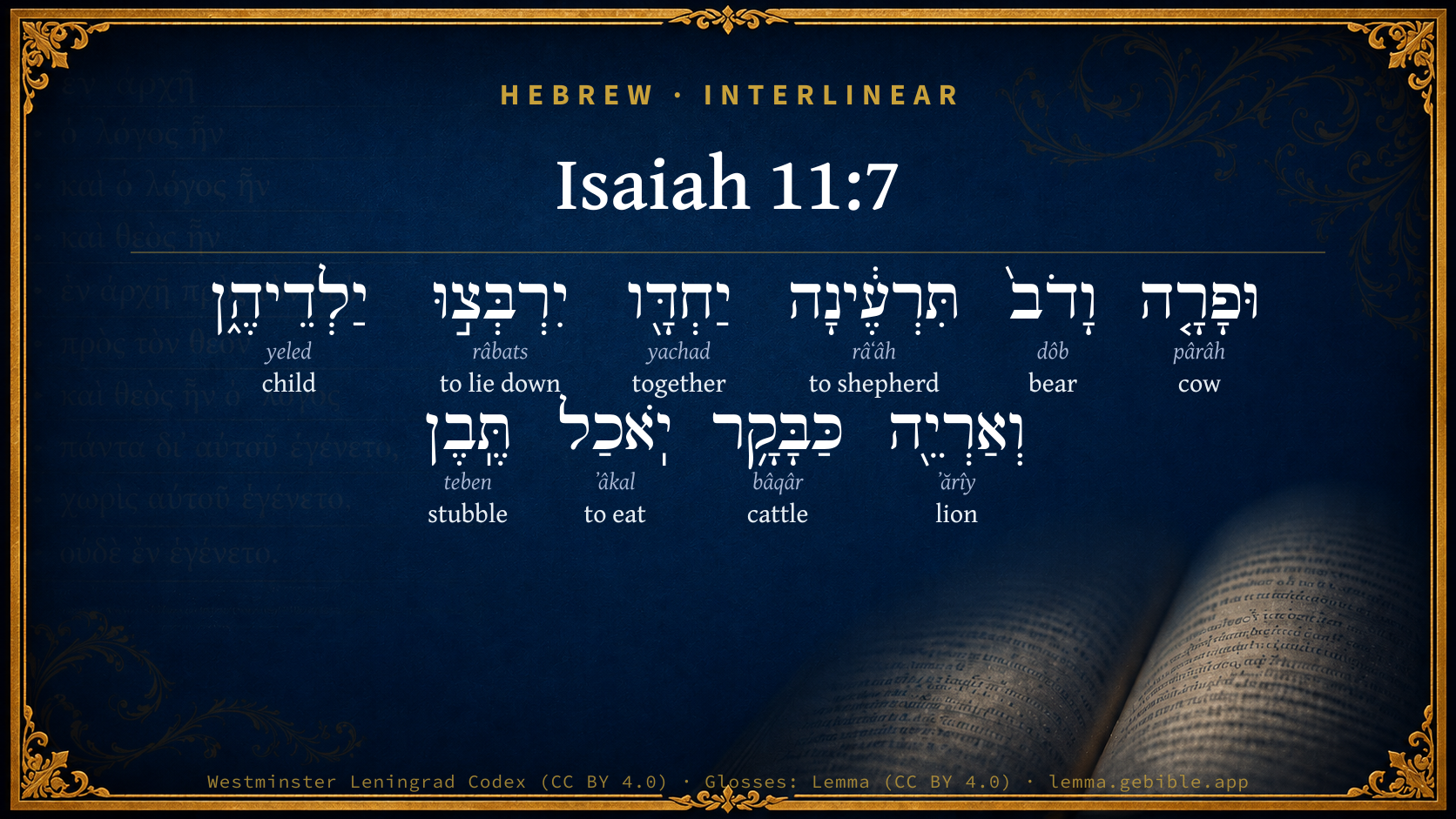
Hebrew (Westminster Leningrad Codex) Isaiah 11:7 appears in the Hebrew Old Testament. The text above is from the Westminster Leningrad Codex. Each word links to its Strong’s number, a concise gloss, and parsing drawn from the Open Scriptures Hebrew Bible morphology. Click any word for its full Brown-Driver-Briggs (BDB) entry.
Download image
Cite this verse

Isaiah 11:7 (World English Bible). Public Domain. Lemma interlinear Bible study tool, https://lemma.gebible.app/v/isaiah/11/7.

Show BibTeX & RIS
BibTeX
RIS
English Translation
The cow and the bear shall feed; their young ones shall lie down together; and the lion shall eat straw like the ox.
World English Bible · Public Domain
Download a study sheet

One document with this verse’s original text, its word-by-word gloss line, the meaning frame, cross-references with their text, attributed commentary, and full source and license credits — printable, and it pastes into notes with its structure intact.

This verse Autodidact and up

Study sheet (.html) Plain text (.txt)

A passage Seminary Student

Up to 50 verses in one chapter. A passage sheet keeps up to 6 commentary sources and 12 cross-references per verse, in the order this page ranks them, and says so on the sheet whenever that leaves anything out. Ask for a single verse and you get the Autodidact verse sheet above.

Everything on this page stays free to read, with no account — the sheet is a download of what is already on screen, not access to it.

Want to remove ads? Support Godless Engineer
Compare translations 3

The same verse in 3 English versions, stacked beneath the original-language interlinear above. Click any original word for its lexicon entry.

Each is an independent rendering of the whole verse — the interlinear is not word-aligned to these translations.

Highlighted words mark where these versions differ — a whole-verse word diff, not a word-by-word alignment.

  • World English Bible Public Domain
    The cow and the bear shall feed; their young ones shall lie down together; and the lion shall eat straw like the ox.
  • King James Version Public Domain
    And the cow and the bear shall feed; their young ones shall lie down together: and the lion shall eat straw like the ox.
  • unfoldingWord Literal Text CC BY-SA 4.0
    And the cow and the bear will graze together; their young will lie down, and the lion will eat straw like the ox.

unfoldingWord Literal Text — © unfoldingWord, licensed CC BY-SA 4.0. Word-aligned USFM3 via Door43 (git.door43.org/unfoldingWord/en_ult).

Versions to compare (up to 4)

3 of 4 selected

Show all 18 translations

Every available English version of this verse, each an independent rendering of the whole verse.

  • World English Bible Public Domain
    The cow and the bear shall feed; their young ones shall lie down together; and the lion shall eat straw like the ox.
  • Berean Standard Bible Public Domain
    The cow will graze with the bear, their young will lie down together, and the lion will eat straw like the ox.
  • Majority Standard Bible Public Domain
    The cow will graze with the bear, their young will lie down together, and the lion will eat straw like the ox.
  • King James Version Public Domain
    And the cow and the bear shall feed; their young ones shall lie down together: and the lion shall eat straw like the ox.
  • American Standard Version (1901) Public Domain
    And the cow and the bear shall feed; their young ones shall lie down together; and the lion shall eat straw like the ox.
  • Revised Version (1885) Public Domain
    And the cow and the bear shall feed; their young ones shall lie down together: and the lion shall eat straw like the ox.
  • Geneva Bible (1599) Public Domain
    And the kow and the beare shall feede: their yong ones shall lie together: and the lyon shall eate strawe like the bullocke.
  • Douay-Rheims (1899) Public Domain
    The calf and the bear shall feed: their young ones shall rest together: and the lion shall eat straw like the ox.
  • Young's Literal Translation Public Domain
    And cow and bear do feed, Together lie down their young ones, And a lion as an ox eateth straw.
  • Literal Standard Version CC BY-SA 4.0
    And cow and bear feed, || Together their young ones lie down, || And a lion eats straw as an ox.
  • Unlocked Literal Bible CC BY-SA 4.0
    The cow and the bear will graze together, and their young will lie down together. The lion will eat straw like the ox.
  • unfoldingWord Literal Text CC BY-SA 4.0
    And the cow and the bear will graze together; their young will lie down, and the lion will eat straw like the ox.
  • Darby Bible Public Domain
    And the cow and the she-bear shall feed; their young ones shall lie down together; and the lion shall eat straw like the ox.
  • World Messianic Bible Public Domain
    The cow and the bear will graze. Their young ones will lie down together. The lion will eat straw like the ox.
  • Webster's Bible Public Domain
    And the cow and the bear shall feed; their young ones shall lie down together: and the lion shall eat straw like the ox.
  • Free Bible Version CC BY-SA 4.0
    Cows and bears will graze side by side; young lions will eat straw like cattle.
  • Bible in Basic English Public Domain
    And the cow and the bear will be friends while their young ones are sleeping together.
  • JPS Tanakh (1917) Public Domain
    And the cow and the bear shall feed; their young ones shall lie down together; and the lion shall eat straw like the ox.

Literal Standard Version (2020), Covenant Press — licensed CC BY-SA 4.0. Text via the HelloAO Bible API (eBible.org). Unlocked Literal Bible (unfoldingWord) — licensed CC BY-SA 4.0. Text via the HelloAO Bible API (eBible.org). unfoldingWord Literal Text — © unfoldingWord, licensed CC BY-SA 4.0. Word-aligned USFM3 via Door43 (git.door43.org/unfoldingWord/en_ult). Free Bible Version, Dr. Jonathan Gallagher — licensed CC BY-SA 4.0. Text via the HelloAO Bible API (eBible.org).

Word by word

More ways to search: Search by grammar → Find every occurrence → Compare this word →

Practice this passage: Drill this verse → Learn its vocabulary →

וָדֹב֙
dôb
H1677
“and · bear”
Conjunction + Noun, Common, Masculine, Singular, Absolute
Part of Speech
Conjunction + Noun
Type
Common
Gender
Masculine
Number
Singular
State
Absolute
Full BDB Definition

Origin: from H1680

TWOT: 396a

bear
  1. וּפָרָ֤ה pârâh H6510 “and · cow” Conjunction + Noun, Common, Feminine, Singular, Absolute
  2. תִּרְעֶ֔ינָה râʻâh H7462 “to shepherd” Verb, Qal, Imperfect, 3rd Person, Feminine, Plural
  3. יַחְדָּ֖ו yachad H3162 “together” Adverb
  4. יִרְבְּצ֣וּ râbats H7257 “to lie down” Verb, Qal, Imperfect, 3rd Person, Masculine, Plural
  5. יַלְדֵיהֶ֑ן yeled H3206 “children · their” Noun, Common, Masculine, Plural, Construct + Suffix, Personal, 3rd Person, Feminine, Plural
  6. וְאַרְיֵ֖ה ʼărîy H738 “and · lion” Conjunction + Noun, Common, Masculine, Singular, Absolute
  7. כַּבָּקָ֥ר bâqâr H1241 “like/as the · cattle” Preposition, Determined + Noun, Common, Both, Singular, Absolute
  8. יֹֽאכַל ʼâkal H398 “to eat” Verb, Qal, Imperfect, 3rd Person, Masculine, Singular
  9. תֶּֽבֶן teben H8401 “stubble” Noun, Common, Masculine, Singular, Absolute

About this verse

These counts appear in no published source. They are computed here, from the morphology-tagged text and Lemma’s own curated glosses. What Lemma adds →

10
words
10
distinct lemmas
Prophets
section

Notable vocabulary

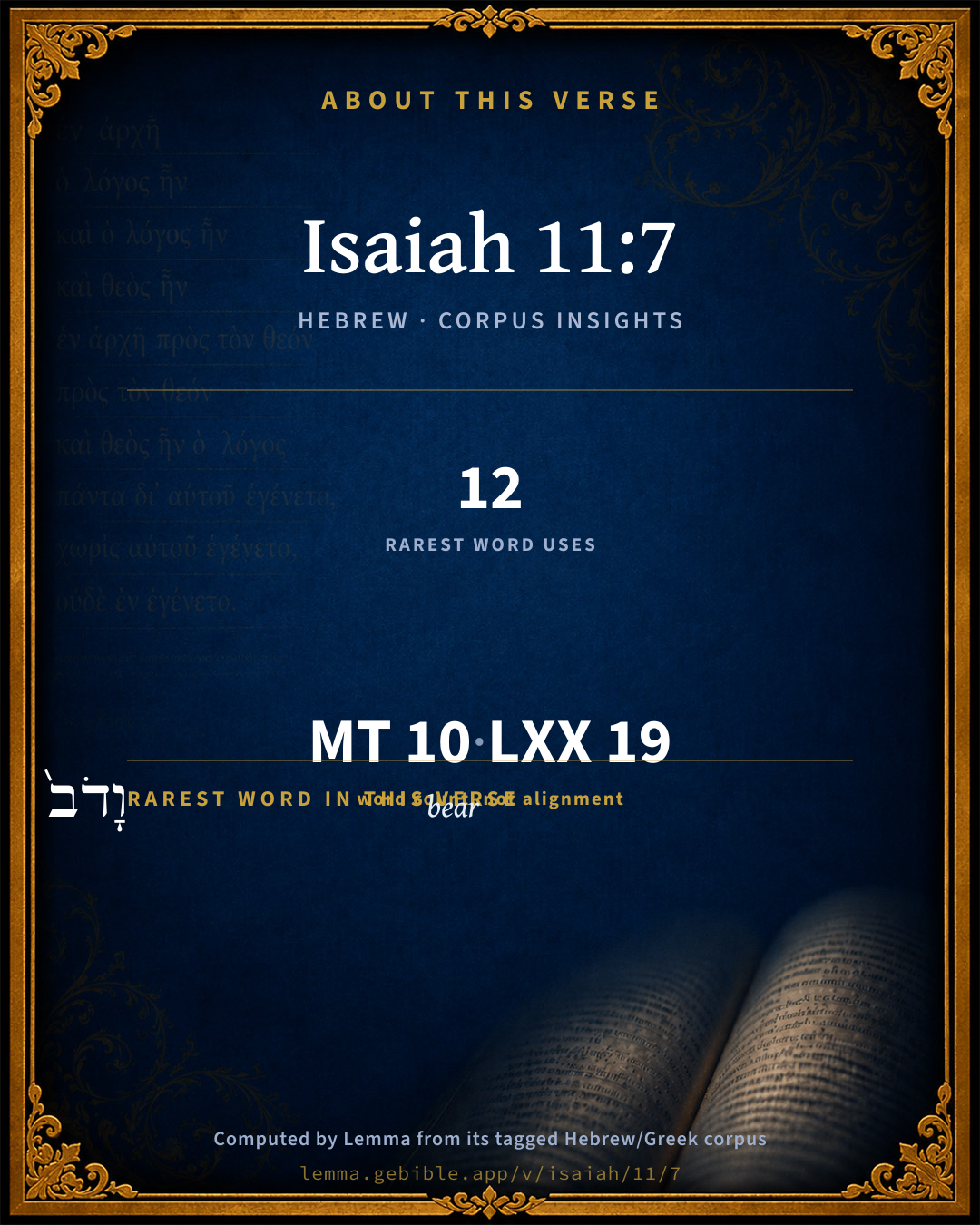
The rarest word here is וָדֹב֙ bear H1677 — appearing just 12 times in the whole Hebrew Bible.

Shared distinctive vocabulary

וָדֹב֙ bear H1677 occurs in 12 verses of the Hebrew Bible. Also found in:

Grammatical profile

  • 3 verbs
  • 6 nouns
  • 1 adverb

Verb forms

  • תִּרְעֶ֔ינָה Qal · Imperfect
  • יִרְבְּצ֣וּ Qal · Imperfect
  • יֹֽאכַל Qal · Imperfect

Hebrew & Septuagint length

In English translation the verse runs 23 words from the Hebrew and 23 from the Septuagint (LXX English) — the same length.

A rough comparison of the two English renderings, which tokenize alike — not a word-level alignment.

Word counts can differ between the Hebrew and the Greek without any difference in meaning — e.g. the Hebrew direct-object marker אֵת has no separate Greek word, and Greek often adds the article ὁ.

In the original languages it is 10 Hebrew tokens and 19 Greek tokens — but the two are counted differently (Hebrew bundles its prefixes and suffixes into one token; the Greek is in lemma form), so that isn’t a like-for-like length.

Hebrew and Greek witnesses Masoretic Hebrew ↔ Greek Septuagint

The same verse in the two great witnesses to the Old Testament, shown verse-for-verse.

These are two independent witnesses, not word-aligned to each other, and the Septuagint is shown in lemma (dictionary) form.

Hebrew Isaiah 11:7 Masoretic · Westminster Leningrad Codex

וּפָרָ֤ה וָדֹב֙ תִּרְעֶ֔ינָה יַחְדָּ֖ו יִרְבְּצ֣וּ יַלְדֵיהֶ֑ן וְאַרְיֵ֖ה כַּבָּקָ֥ר יֹֽאכַל תֶּֽבֶן

The cow and the bear shall feed; their young ones shall lie down together; and the lion shall eat straw like the ox.

World English Bible · Public Domain

Greek LXX Isaiah 11:7 Septuagint · lemma form

καί βοῦς καί ἄρκος ἅμα βόσκω καί ἅμα ὁ παιδίον αὐτός εἰμί καί λέων καί βοῦς ἅμα ἐσθίω ἄχυρον

And the ox and bear shall feed together; and their young shall be together: and the lion shall eat straw like the ox.

LXX2012 (modern English Septuagint) · Public Domain

On this verse, Adam Clarke's Commentary discusses the Septuagint’s reading. Read the note in Commentary ↓

Hebrew: Westminster Leningrad Codex (CC BY 4.0). Greek: Septuagint (public domain); English from LXX2012 (modern English Septuagint) (Public Domain). How the Septuagint differs from the Hebrew →

Targum (Aramaic paraphrase)

1

The Targum is the ancient Jewish Aramaic paraphrase of the Hebrew Scriptures — an interpretive translation, not the Hebrew text itself. Onkelos (literal) and Pseudo-Jonathan (expansive) render the Torah, and Jonathan the Prophets. Coverage is partial: where no permissively-licensed English translation exists for a verse, only the Aramaic is shown. This is verse-level text, not a word-by-word alignment to the Hebrew.

  1. Targum Jonathan Prophets (Joshua–Malachi)
    וְתוֹרָא וְדִיבָא יִרְעֲיָן כַּחֲדָא יִשְׁרוֹן בְּנֵיהוֹן וְאַרְיָא כְּתוֹרָא יֵכוּל תִּבְנָא:

    And the cow and the bear shall feed together, their young ones shall lie down together; and the lion shall eat straw like the ox.

    Targum Jonathan — Aramaic: “Mikraot Gedolot” (public domain). English: “Sefaria Community Translation” (CC0 1.0 (public-domain dedication)); “London "Chaldee Paraphrase," 1871” (public domain). Text via Sefaria.

Commentary

Notes on Isaiah 11:7 from classic Christian and Jewish commentators (each source and its license shown beneath its notes). The classic Christian expositions comment on the surrounding passage and are grouped to its opening verse, so a note may address several verses; the Jewish commentaries on the Tanakh (Rashi and others) are per-verse, so they appear only where the commentator wrote on this verse.

Lemma curates 59 commentaries, every one of them public domain or Creative Commons licensed, each selected and text-cleaned for this edition rather than reprinted as found. About our sources →

Trapp's Complete Commentary

John Trapp

Isa 11:7 And the cow and the bear shall feed; their young ones shall lie down together: and the lion shall eat straw like the ox.

Ver. 7. And the cow and the bear shall feed.] An allegorical description of greatest confidence and innocence, saith Junius. Bears are angry and vindictive creatures; so are the best by nature, {Tit 3:3} till tamed and domesticated by God’s distinguishing grace. As for those semiperfectae vertutis homines, as an ancient calls them, temporaries and hypocrites, who do only the outward works of duty, without the inward principle, it may be said of them, as the civil law doth of those mixed beasts, elephants, camels, &c., Operam praestant, natura fera est, they do the work of tame beasts, yet have the nature of wild ones.

Their young ones shall lie down together.] Heb., Their children, i.e., say some, {a} children after parents shall do thus, and their children after them from age to age; not revolting any more to barbarism.

And the lion shall eat straw.] Not men and other sensitive creatures, as now. {b} This, say the Chiliasts after some Rabbis, shall be literally fulfilled in that golden age of Christ’s personal reign upon earth; a mere fancy, first vented by Papias, a man of some holiness, but ingenii pertenuis, of very little judgment, saith Eusebius.

{a} Arcularius.

{b} Conversi non vivent ex rapto: sed legitime partis reculis contenti erunt. Eusebius, Ecclesiastical History l. 3. c. 39. 1:295,297.

John Trapp, A Commentary or Exposition upon All the Books of the Old and New Testament (1647–1656) — public domain. Text from a community e-Sword module.

Jamieson, Fausset & Brown

Robert Jamieson, A. R. Fausset & David Brown

feed--namely, "together"; taken from the second clause.

straw--no longer flesh and blood.

Jamieson, Fausset & Brown — Commentary Critical and Explanatory on the Whole Bible (1871) — public domain (CC PDM 1.0). Text via the HelloAO Bible API.

Adam Clarke's Commentary

Verse 7. In this verse a word is omitted in the text, יחדו yachdav, together; which ought to be repeated in the second hemistich, being quite necessary to the sense. It is accordingly twice expressed by the Septuagint and Syriac.

Adam Clarke's Commentary on the Bible (1810–1826) — public domain. Text from a community e-Sword/MySword module.

The Cambridge Bible for Schools and Colleges

gen. ed. J. J. S. Perowne

7. Cf. Isa_65:25. shall feed] Better, shall graze, unless we are to supply “alike” as in Isa_65:25. Some critics prefer to read “shall associate together,” with a small alteration of the text.

The Cambridge Bible for Schools and Colleges (gen. ed. J. J. S. Perowne; Cambridge University Press, 1878–1918) — public domain. Text from a community e-Sword module.

John Gill's Exposition

And the cow and the bear shall feed,.... That is, together, in one church state, at one table, or in one pasture, upon the wholesome food of the Gospel, the salutary doctrines of Christ; who though before of different dispositions, the one tame and gentle, useful and profitable, dispensing the milk of the divine word, and gracious experience; the other cruel and voracious, barbarous and inhuman, worrying the lambs and sheep of Christ; but now of the same nature, and having no ill will to one another, and being without fear of each other:

their young ones shall lie down together; those like the calf and the young bear, shall lie in the green pastures of Gospel ordinances, and do no injury, the latter to the former, being of one mind, and agreeing in doctrine and practice:

and the lion shall eat straw like the ox; kings shall be nursing fathers to the church, and feed on the same Gospel provisions; and there shall be a great agreement between them who were before comparable to lions for their strength, power, and cruelty, and ministers of the Gospel, who are compared to oxen, for their strength and laboriousness, Co1 9:9 "straw" here denotes true doctrine, though elsewhere false, see Co1 3:12.

See Gill (Editor's note) on "Isa 11:6" .

John Gill's Exposition of the Whole Bible (1746–1763) — public domain (CC PDM 1.0). Text via the HelloAO Bible API.

Albert Barnes' Notes on the Bible

And the cow and the bear shall feed - That is, together. Animals that by nature do not dwell together, where by nature the one would be the prey of the other, shall dwell together - animage of safety and peace.

And the lion shall eat straw like the ox - A representation of the change that will take place under the reign of the Messiah in the natural disposition of men, and in the aspect of society; as great as if the lion were to lose his natural appetite for blood, and to live on the usual food of the ox. This cannot be taken literally, for such an interpretation would suppose a change in the physical organization of the lion - of his appetites, his teeth, his digestive organs - a change which it would be absurd to suppose will ever exist. It would in fact make him a different being. And it is clear, therefore, that the whole passage is to be interpreted in “moral” sense, as denoting great and important changes in society, and in the hearts of men.

Albert Barnes' Notes on the Bible (1834–1885) — public domain. Text from a community e-Sword/MySword module.

Matthew Poole's English Annotations

Shall feed together, as it follows, without any danger or fear.

The lion shall eat straw, the grass and fruits of the earth, as they did at first, Gen 1:29,30, and shall not devour other living creatures, as now they do.

Matthew Poole's English Annotations on the Holy Bible (1683–1685) — public domain. Text from a community e-Sword/MySword module.

Whedon's Commentary on the Bible

Daniel D. Whedon

7. Shall feed — Or, graze.

Eat straw — “No hay is made in Palestine.” — VAN LENNEP’S Bible Lands, p. 83. The fodder for cattle, horses, and camels in that country is straw broken and mashed at the threshing floors. This is fed in connexion with barley. (Van Lennep.) The doctrine allegorized here cannot safely be carried (as by Gill and others) beyond the general one of the greatest possible moral change wrought by Messiah’s reign.

Daniel D. Whedon (gen. ed.), Commentary on the Old and New Testaments (1874–1909) — public domain. Text from a community e-Sword module.

The Pulpit Commentary

The lion shall eat straw. (comp. Isa_65:25) There is nothing impossible in this. Cats are fond of some kinds of vegetable food.

The Pulpit Commentary (1880–1919), ed. H.D.M. Spence-Jones & Joseph S. Exell — public domain. Text from a community e-Sword module.

John Wesley's Explanatory Notes

Feed - Together, without any danger or fear. Straw - The grass of the earth, as they did at first, and shall not devour other living creatures.

John Wesley, Explanatory Notes Upon the Whole Bible (1754–1765) — public domain. Text via the GEBible commentary corpus.

J. A. Alexander on Isaiah

Joseph Addison Alexander

“And the cow and the bear shall feed, together shall their young lie down, and the lion like the ox shall eat straw.” The lion’s eating straw implies not only cohabitation with domestic cattle, but a change of his carnivorous habits. It denotes a total change of habit, and indeed of nature, and is therefore a fit emblem for the revolution which the gospel, in proportion to its influence, effects in the condition of society, with some allusion possibly, as before suggested, to the ultimate deliverance of the inferior creation from that bondage of corruption, to which, for man’s sake, it is now subjected.

Joseph Addison Alexander, The Prophecies of Isaiah (1846–1847; New York: Scribner, 1870–1878) — public domain. Text from a community e-Sword module.

Ibn Ezra

Rabbi Abraham ibn Ezra

פרה The large cattle; the younger of the breed is called עגל (ver. 6). Some assert that the female of cattle is stronger than the male.

Shall eat straw. As if his nature had changed, and he would no more, in seeking prey, inflict suffering upon others.

Ibn Ezra on the Tanakh — English translations: “Sefaria Community Translation” (CC0 1.0 (public-domain dedication)); “Yalkut, Sifsei Chachomim Chumash, Metsudah Publications, 2009” (CC BY 4.0); and “Commentary of Ibn Ezra on Isaiah - trans. by M. Friedlander, 1873” (public domain). Text via Sefaria.

Lesson kit

Teaching starters — assembled from the data on this page, not authored interpretation. Every prompt links to the verse data it draws on. Edit before teaching.

Isaiah, in the Prophets, opens this verse with 10 words (10 distinct Hebrew lemmas). Its most distinctive word is dôb (“bear”). A historical commentator’s framing appears above. Read the whole chapter for the surrounding context.

Discussion questions

  1. How does “bear” (dôb) shape what this verse is saying?
  2. 1 Samuel 17:34 shares the word «bear» with this verse. How do the two illuminate each other?
  3. The translations on this page render this verse differently — a whole-verse word diff, not a word-by-word alignment. What might account for the different wordings?
  4. The verb «תִּרְעֶ֔ינָה» is Qal Imperfect. How does its form color the action?
  5. Reading how Trapp's Complete Commentary and Jamieson, Fausset & Brown read this verse, where do the two commentators agree and where do they part?

Things to notice

Reading settings

Reading text

Shown beneath each verse's original-language words.

Old Testament
Old Testament edition

Read the OT as the Masoretic Hebrew (MT) or the Greek Septuagint (LXX).

English shown for the Greek Septuagint (in the Hebrew ↔ Greek comparison).

Comparing translations? Open the Compare panel on any verse page to stack up to four side by side.