
Song of Solomon 6:3

Hebrew (Westminster Leningrad Codex) Song of Solomon 6:3 appears in the Hebrew Old Testament. The text above is from the Westminster Leningrad Codex. Each word links to its Strong’s number, a concise gloss, and parsing drawn from the Open Scriptures Hebrew Bible morphology. Click any word for its full Brown-Driver-Briggs (BDB) entry.
Download image
Cite this verse

Song of Solomon 6:3 (World English Bible). Public Domain. Lemma interlinear Bible study tool, https://lemma.gebible.app/v/song-of-solomon/6/3.

Show BibTeX & RIS
BibTeX
RIS
English Translation
I am my beloved's, and my beloved is mine. He browses among the lilies,
World English Bible · Public Domain
Download a study sheet

One document with this verse’s original text, its word-by-word gloss line, the meaning frame, cross-references with their text, attributed commentary, and full source and license credits — printable, and it pastes into notes with its structure intact.

This verse Autodidact and up

Study sheet (.html) Plain text (.txt)

A passage Seminary Student

Up to 50 verses in one chapter. A passage sheet keeps up to 6 commentary sources and 12 cross-references per verse, in the order this page ranks them, and says so on the sheet whenever that leaves anything out. Ask for a single verse and you get the Autodidact verse sheet above.

Everything on this page stays free to read, with no account — the sheet is a download of what is already on screen, not access to it.

Want to remove ads? Support Godless Engineer
Compare translations 3

The same verse in 3 English versions, stacked beneath the original-language interlinear above. Click any original word for its lexicon entry.

Each is an independent rendering of the whole verse — the interlinear is not word-aligned to these translations.

Highlighted words mark where these versions differ — a whole-verse word diff, not a word-by-word alignment.

  • World English Bible Public Domain
    I am my beloved's, and my beloved is mine. He browses among the lilies,
  • King James Version Public Domain
    I am my beloved's, and my beloved is mine: he feedeth among the lilies.
  • unfoldingWord Literal Text CC BY-SA 4.0
    I to my beloved, and my beloved to me; he grazes among the lilies.

unfoldingWord Literal Text — © unfoldingWord, licensed CC BY-SA 4.0. Word-aligned USFM3 via Door43 (git.door43.org/unfoldingWord/en_ult).

Versions to compare (up to 4)

3 of 4 selected

Show all 18 translations

Every available English version of this verse, each an independent rendering of the whole verse.

  • World English Bible Public Domain
    I am my beloved's, and my beloved is mine. He browses among the lilies,
  • Berean Standard Bible Public Domain
    I belong to my beloved and he belongs to me; he pastures his flock among the lilies.
  • Majority Standard Bible Public Domain
    I belong to my beloved and he belongs to me; he pastures his flock among the lilies.
  • King James Version Public Domain
    I am my beloved's, and my beloved is mine: he feedeth among the lilies.
  • American Standard Version (1901) Public Domain
    I am my beloved's, and my beloved is mine; He feedeth `his flock' among the lilies,
  • Revised Version (1885) Public Domain
    I am my beloved’s, and my beloved is mine: he feedeth his flock among the lilies.
  • Geneva Bible (1599) Public Domain
    Thou art beautifull, my loue, as Tirzah, comely as Ierusale, terrible as an army with baners.
  • Douay-Rheims (1899) Public Domain
    Thou art beautiful, O my love, sweet and comely as Jerusalem: terrible as an army set in array.
  • Young's Literal Translation Public Domain
    I `am' my beloved's, and my beloved `is' mine, Who is delighting himself among the lilies.
  • Literal Standard Version CC BY-SA 4.0
    I [am] my beloved’s, and my beloved [is] mine, || Who is delighting himself among the lilies.
  • Unlocked Literal Bible CC BY-SA 4.0
    I am my beloved's, and my beloved is mine; he grazes among the lilies with pleasure.
  • unfoldingWord Literal Text CC BY-SA 4.0
    I to my beloved, and my beloved to me; he grazes among the lilies.
  • Darby Bible Public Domain
    I am my beloved's, and my beloved is mine: He feedeth [his flock] among the lilies.
  • World Messianic Bible Public Domain
    I am my beloved’s, and my beloved is mine. He browses among the lilies.
  • Webster's Bible Public Domain
    I am my beloved's, and my beloved is mine: he feedeth among the lilies.
  • Free Bible Version CC BY-SA 4.0
    I am my love's, and my love is mine! He is the one who feeds among the lilies.
  • Bible in Basic English Public Domain
    I am for my loved one, and my loved one is for me; he takes food among the lilies.
  • JPS Tanakh (1917) Public Domain
    I am my beloved's, and my beloved is mine, that feedeth among the lilies.'

Literal Standard Version (2020), Covenant Press — licensed CC BY-SA 4.0. Text via the HelloAO Bible API (eBible.org). Unlocked Literal Bible (unfoldingWord) — licensed CC BY-SA 4.0. Text via the HelloAO Bible API (eBible.org). unfoldingWord Literal Text — © unfoldingWord, licensed CC BY-SA 4.0. Word-aligned USFM3 via Door43 (git.door43.org/unfoldingWord/en_ult). Free Bible Version, Dr. Jonathan Gallagher — licensed CC BY-SA 4.0. Text via the HelloAO Bible API (eBible.org).

Word by word

More ways to search: Search by grammar → Find every occurrence → Compare this word →

Practice this passage: Drill this verse → Learn its vocabulary →

About this verse

These counts appear in no published source. They are computed here, from the morphology-tagged text and Lemma’s own curated glosses. What Lemma adds →

6
words
4
distinct lemmas
Wisdom
section

Notable vocabulary

The rarest word here is בַּשׁוֹשַׁנִּֽים lily H7799 — appearing just 15 times in the whole Hebrew Bible.

Shared distinctive vocabulary

בַּשׁוֹשַׁנִּֽים lily H7799 occurs in 15 verses of the Hebrew Bible. Also found in:

Grammatical profile

  • 1 verb
  • 3 nouns
  • 1 pronoun
  • 1 preposition

Verb forms

  • הָרֹעֶ֖ה Qal · Participle Active

Repetition

A word recurs within this verse — often emphatic in Hebrew:

  • לְדוֹדִי֙ beloved H1730 ×2

Hebrew & Septuagint length

In English translation the verse runs 14 words from the Hebrew and 16 from the Septuagint (LXX English) — closely comparable.

A rough comparison of the two English renderings, which tokenize alike — not a word-level alignment.

Word counts can differ between the Hebrew and the Greek without any difference in meaning — e.g. the Hebrew direct-object marker אֵת has no separate Greek word, and Greek often adds the article ὁ.

Cross-references

4

Topical passages linked to Song of Solomon 6:3 in the Treasury of Scripture Knowledge — connected by theme and wording, ordered by reader-vote popularity; previews shown in the World English Bible.

  • Song of Solomon 2:16 My beloved is mine, and I am his. He browses among the lilies.
  • Song of Solomon 7:10 I am my beloved's. His desire is toward me.
  • Hebrews 8:10 "For this is the covenant that I will make with the house of Israel. After those days," says the Lord; "I will put my laws into their mind, I will also write them on their heart. I will be to them a God, And they will be to me a people.
  • Revelation 21:2–4 I saw the holy city, New Jerusalem, coming down out of heaven from God, made ready like a bride adorned for her husband.

Cross-references courtesy of OpenBible.info (CC BY 4.0).

Hebrew and Greek witnesses Masoretic Hebrew ↔ Greek Septuagint

The same verse in the two great witnesses to the Old Testament, shown verse-for-verse.

These are two independent witnesses, not word-aligned to each other, and the Septuagint is shown in lemma (dictionary) form.

Hebrew Song of Solomon 6:3 Masoretic · Westminster Leningrad Codex

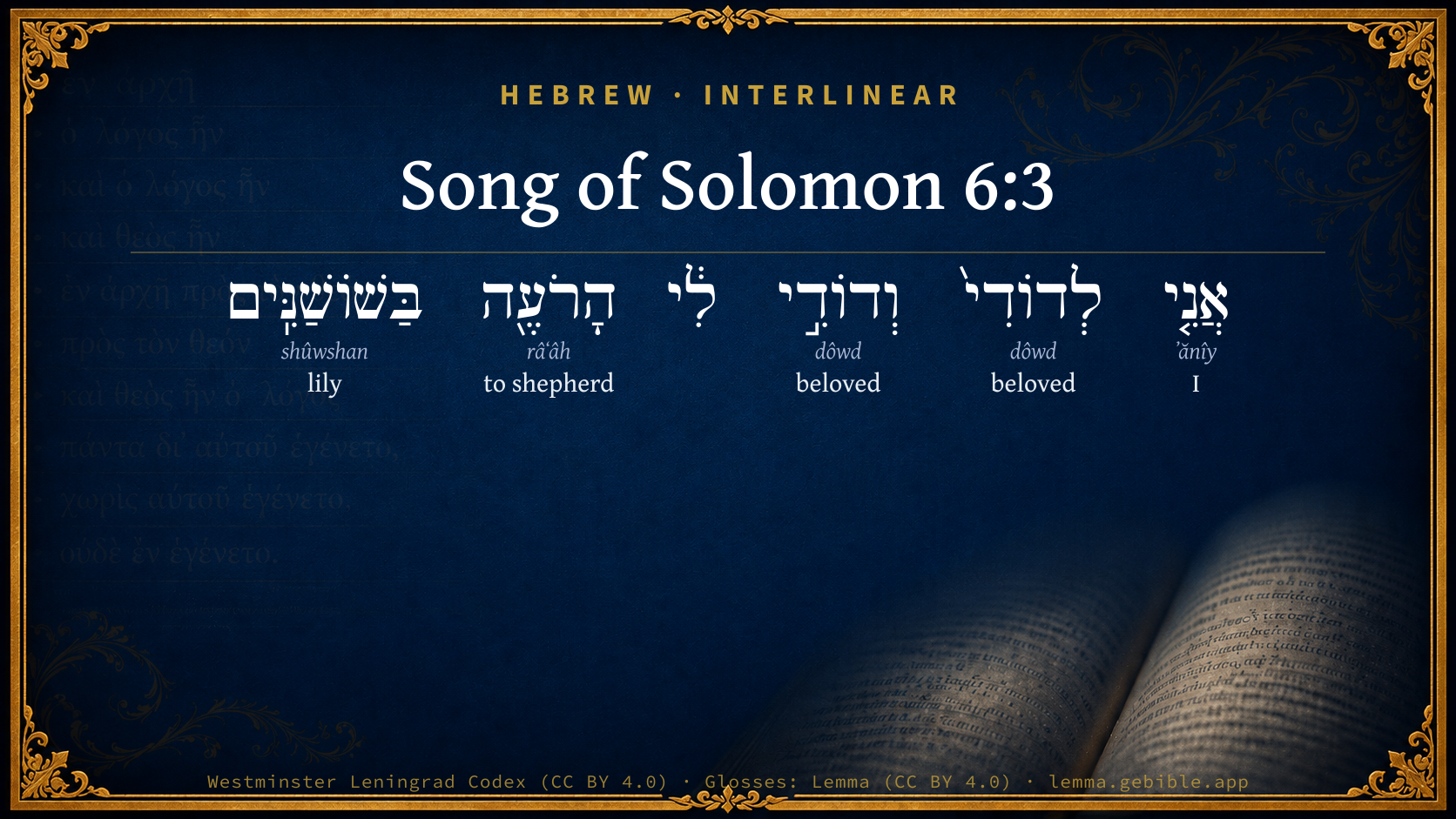
אֲנִ֤י לְדוֹדִי֙ וְדוֹדִ֣י לִ֔י הָרֹעֶ֖ה בַּשׁוֹשַׁנִּֽים

I am my beloved's, and my beloved is mine. He browses among the lilies,

World English Bible · Public Domain

Greek LXX Song of Solomon 6:3 Septuagint · lemma form

ἐγώ ὁ ἀδελφιδός ἐγώ καί ἀδελφιδός ἐγώ ἐγώ ὁ ποιμαίνω ἐν ὁ κρίνον

You are fair, my companion, as Pleasure, beautiful as Jerusalem, terrible as armies set in array.

LXX2012 (modern English Septuagint) · Public Domain

Hebrew: Westminster Leningrad Codex (CC BY 4.0). Greek: Septuagint (public domain); English from LXX2012 (modern English Septuagint) (Public Domain). How the Septuagint differs from the Hebrew →

Commentary

Notes on Song of Solomon 6:3 from classic Christian and Jewish commentators (each source and its license shown beneath its notes). The classic Christian expositions comment on the surrounding passage and are grouped to its opening verse, so a note may address several verses; the Jewish commentaries on the Tanakh (Rashi and others) are per-verse, so they appear only where the commentator wrote on this verse.

Lemma curates 59 commentaries, every one of them public domain or Creative Commons licensed, each selected and text-cleaned for this edition rather than reprinted as found. About our sources →

Trapp's Complete Commentary

John Trapp

Son 6:3 I [am] my beloved’s, and my beloved [is] mine: he feedeth among the lilies.

Ver. 3. I am my beloved’s, &c.] Or, I am for my beloved, and he is for me; i.e., for me only. He resteth in his love, and I in mine. We will seek no further. And here her faith reviveth who in her late temptation and desertion was in a mist, and could not read her own graces, {a} {See Trapp on "Son 2:16"} It reviveth, I say, and fetcheth out Christ, that had hid himself, as that brave woman did. {Mar 7:24-25}

{a} Flamma redardescit, quae modo nulla fuit. - Ovid.

John Trapp, A Commentary or Exposition upon All the Books of the Old and New Testament (1647–1656) — public domain. Text from a community e-Sword module.

The Biblical Illustrator

Joseph S. Exell

Son_6:3

He feedeth among the lilies.

Feeding among the lilies

The literal reference is simple and obvious. The bride represents her husband as going down to the garden where the fruits grew among the flowers--where what was good for food was associated with what was fair to the eyes and pleasant to all the senses. The plain of Sharon, the lower slopes of Lebanon, the shores of Galilee, and even the bare craggy terraces of the hill country of Judaea are illumined with gorgeous gleams of white, and scarlet, and golden lilies, whose glory is the most peculiar of all the common aspects of the country. The bulbous roots of many of them, containing a reserve of nourishment for unfavourable times, and guarding as in a secure citadel the principle of life, specially adapt these lilies for growing in the most unpromising looking places. And not only are they enabled themselves to extract nourishment from the driest soil and atmosphere, but they also create around them, by the shadow of their leaves and blossoms, and by the moisture which they attract, conditions suitable for the growth of other plants less richly endowed; take species under their protection whose forms are tougher and whose constitution is hardier, but which have no reserved stores like them for times and spots of scarcity. Nowhere is the herbage so luxuriant as under the shadow of these beautiful and graceful flowers. Such spots are therefore the favourite feeding-places of flocks and herds. They seek them out as the traveller in the desert seeks out the oasis; and they are as sure to find sweet and tender grass where the lilies are growing, as the traveller is to find a well where the palm-grove flourishes. The idea the text conveys is that as the roedeer or the gazelle feeds on the grass which grows among the lilies on the mountains, so is the bridegroom satisfied with the sterling useful qualities that are betokened by the beauties of mind and heart of the bride. Her fair exterior, her beautiful face indicate the possession of solid and substantial endowments beneath. In the shadow of the lily-like charms of her person, he finds not only what pleases his eye, but also what satisfies his mind and heart. The believer says of Jesus, I am my Beloveds, and my Beloved is mine: He feedeth among the lilies,--eats of the fruits that grow among the flowers of the garden of my heart. I am filled with His fulness, and He sees in me of the travail of His soul and is satisfied. But separating the passage from its literal and symbolical reference in the text, it is susceptible of a wide signification. The Creator may be said to feed among the lilies, in the enjoyment which He receives from the beauties of creation. We can see no end in the existence of all this inaccessible beauty except to gratify the love of beauty in the heart of God Himself. And to this Divine feeling, He who was the express image of the Fathers person gave frequent expression on earth. The whole life of Jesus was a feeding among the lilies, which illuminated His thoughts of God and His lessons for man. They helped to develop the nature which grew in wisdom as in stature by the aid of the same influences which develop ours. His soul fed upon those visions of the beauty of holiness, and those high impulses and deep emotions which the beauty of nature produced. He saw the spiritual in them behind the physical; and their perishing beauty was to Him but the veil which concealed the holy of holies of a nobler and more enduring beauty, a shadow glassed in the unstable element of time, of the steadfast light of God in heaven. The Jews of old fed among the lilies, for their land was pre-eminently the Flowery Land. Dr. Tristram calls it the garden of Eden run wild. Every traveller is struck with the immense profusion, variety, and brilliancy of the flowers. And as with the Land, so with the Book. The Bible is the book of flowers: its language is the language of flowers: it is full of the highest poetry and truest philosophy of these fair creations. The sweetest and most satisfying promises of God come to us in the midst of the most beautiful poetry; the plainest and simplest precepts are set forth in glowing images; the highest revelations reach us in lessons of the lowly lilies that grow beside our door. The whole of human life is a feeding among lilies. All our food and clothing and fuel come to us through beautiful forms and colours. In this respect how different are the manufactories of nature from those of man! In human works beauty is often eliminated and only what is useful is preserved; but in nature the useful and the beautiful always keep pace with one another. In the most carefully weeded field the eye, wearied with the monotony of the green stalks and the shimmering of the freckled glumes in the sunshine, is refreshed here and there with the blaze of scarlet poppy, and the azure gleam of the corn-bluebottle, and the mimic sunshine of the yellow corn-marigold. The wild mint perfumes its roots, and the white corn-spurry and scarlet pimpernel lend to it all the tender grace of their hue and shape. The corn itself feeds among the lilies; it draws its nourishment from soil and atmosphere in the company of a bright sisterhood of flowers which crown its sober usefulness with a garland of beauty. And is not this feature common to all of nature that is associated with man? The green grass of the meadows and pastures is never allowed to grow in dull uniformity: nature spreads her golden buttercups and snow-white daisies and purple prunellas over it, so that the beasts of the field feed among the lilies. How beautiful are the white and crimson blossoms of the clover, and the slender scented spikes of the vernal grass, which feed the bee with honey and load the air with a delicious fragrance, ere they yield their succulent herbage to the browsing cattle, or fill the barns of the farmer with their tedded hay! God has ordained that in everything man should feed among the lilies; that the useful should be produced by or among the beautiful. The arms of our orchard trees are clasped with bracelets of emerald moss, and their trunks are adorned with brooches of golden lichens; and thus bedecked, they, Hebe-like, offer to us, year after year, the fruit they have produced,--the rich harvest of their life. And these mosses and lichens are to our fruit trees what the poppies and marigolds are to our corn,--the lilies among which we gather our food. This association of beauty with mans food is designed for a wise and gracious purpose. As flowers on a dinner-table east the shadow of their own loveliness upon all the viands around them, and change what is the mere gratification of a physical appetite into the fulfilment of a heaven-born longing, so the lilies among which we feed redeem that feeding from its grossness and link the man that feeds upon bread with the angels that feed upon every word of God. They show that eating is not an end, but a means to a higher, nobler end, and connect the means by which our lower nature is supported with the means by which our higher, spiritual nature is trained and educated. And what a purifying and refining influence have these lilies upon us! Their purity shames our impurity, their grace our ungraciousness, their meekness our pride, their lavish fragrance our thanklessness. How greatly, too, is our feeling of confidence in God increased as we feed among the lilies! If He has provided these superfluous things for us, it is a pledge and a guarantee that He will provide the things that are necessary. As the blossom on the individual plant is a prophecy that fruit will be produced, so the appearance of the lilies among the corn is an assurance that bread will be given to us, and we shall not want any good thing. If God so clothe the grass of the field, which to-day shines in the glow of the sun, and to-morrow shrivels in the flame of the oven, how much more will He clothe the creatures whom He has made in His own image! But more than all, the lilies among which we feed speak to us of our immortality. The corn is the meat that perisheth; but the beauty of the lilies and the lessons of Divine wisdom which they teach is the meat that endureth unto everlasting life. By the food of garden and field our decaying bodies are sustained; by the lilies our never-dying souls are nourished. While feeding among the lilies there is thus provision made for our twofold nature: we have in every feast a reminder that man does not live by bread alone, but by every word that cometh out of the mouth of God, and that is expressed on earth in every bright hue and beautiful form around us. Rightly viewed the corn exists for the sake of the lilies. They stand among the corn like the priests of old among the people, clothed in priestly garments of glory and beauty. They are the ministers of God serving at His altar, appealing to the higher faculties of man, and bearing their witness to the Divine love that formed them; and thus, though they themselves die in succession, like the sons of Aaron, their priesthood abideth for ever. The grass withereth, and the flower thereof fadeth; but the Word of the Lord, that speaks in and through them, endureth for ever. The lilies fade and pass away; but the truth which they teach and the character which they help to form are enduring as the soul itself, and shall be wrought into its very texture, and bloom in its beauty in the paradise above. (H. Macmillan, D. D.)

The Biblical Illustrator, edited by Joseph S. Exell (c. 1880s–1900s) — public domain. Text from a community e-Sword module.

The Preacher's Complete Homiletical Commentary

Joseph S. Exell (gen. ed.)

RENEWED SELF-DEDICATION

Son_6:3

SHULAMITE

I am my beloved’s

And my beloved is mine:

He feedeth among the lilies.

Shulamite repeats in presence of the Daughters the declaration of her devotedness to and interest in her beloved which she had formerly made to himself (chap. Son_2:16). The declaration possibly now also made in his presence, at the conclusion of her narrative. Perhaps the whole sung in his presence at the Feast, or he himself comes now in view. The language of exultation and joy, as well as of devotedness and love. Observe—

(1) Faith and love in a believer never dead, though sometimes in a swoon. True faith like wood rather than iron—if it sink, it will rise again. A believer’s falls not final. ‘I have prayed for thee that thy faith fail not’ (Luk_22:32).

2. Withdrawals on the part of Christ no proof of abated love (Joh_13:1; Isa_54:8). The covenant of grace too firmly established to be broken by the infirmities of the flesh. That covenant steadfast, because of grace and not of works. Christ betroths believers to Himself in faithfulness for ever, because in righteousness and judgment, in loving kindness and in mercies (Hos_2:19-20). The the way transgressors always hard; but transgression unable to cast out of the covenant of grace as it did out of the covenant of works. God’s faithfulness not affected by His people’s falls. The gifts and calling of God without repentance or change of mind on His part. He pardons His people’s sins though He takes vengeance on their inventions. Rebukes not only consistent with covenant love, but a necessary part of it. The Bridegroom bears with the Bride’s ill manners in the wilderness, though He wisely expresses His displeasure. Withdraws the joy of salvation for a time, though not the salvation itself.

3. The chastened and penitent believer restored to the full consciousness of his interest in Christ, and with that to joy and comfort. Joy unspeakable in a conscious interest in Christ and full surrender to Him.

4. Good for a believer frequently to recal his covenant relationship to Christ, his self-surrender to Him, and his interest in Him. Paul’s comfort in prison,—‘I know whom I have believed; and I am persuaded that He is able to keep that which I have committed unto Him against that day’ (2Ti_1:12).

5. Surrender of ourselves to Christ, and acceptance of Him, the two sides of a saving faith. ‘I am His,’ indissolubly connected with ‘He is mine.’ The two confirmatory of each other. Interest in Christ necessarily follows surrender to Christ. The consciousness of the one bound up with the consciousness of the other. Those fleeing to Christ and closing with Him may safely conclude that Christ is theirs.

6. The order of the two first clauses of the text changed from what it was before. The bride’s declaration of self-surrender now first, as having been placed in suspicion by her recent coolness. So Peter, after his threefold denial, must make a threefold declaration of his love. Renewed and open declaration of our faith and love necessary to full restoration to former enjoyment.

7. Christ’s presence, both on earth and in heaven, among His lily-like people. ‘He feedeth among the lilies.’ His presence promised to His Church till the end of the world, when faith is changed to sight. Christ both feeds others and has joy Himself in His Church and its ordinances. To enjoy His presence and His care we must be among the lilies. ‘Not forsaking the assembling of yourselves together, as the manner of some is.’ No mark of Christ’s sheep to ‘separate’ ourselves from the flock. The happiness of believers to find themselves among Christ’s people and in the enjoyment of His ordinances. ‘All my springs are in thee.’

8. The text historically verified in the disciples after Christ’s resurrection. ‘Then were the disciples glad when they saw the Lord.’ The language of Shulamite that of Mary at Jesus’s feet—‘Raboonl,’—‘My Master!’ That of Thomas with his finger on the nail-prints,—‘My Lord and my God!’ That of penitent Peter,—‘Thou knowest all things: Thou knowest that I love Thee.’

The Preacher's Complete Homiletical Commentary (gen. ed. Joseph S. Exell; Funk & Wagnalls, c. 1892) — public domain (pre-1929). A full-Bible homiletical/sermon-outline anthology covering 65 of 66 books (2 John is absent from the source module). Text from a community e-Sword module.

Geneva Bible (1599)

Geneva Bible translators

Which was a fair and strong city, 1 Kings 14:17.

Geneva Bible (1599) marginal notes — public domain. Text via Bolls.life.

The Cambridge Bible for Schools and Colleges

gen. ed. J. J. S. Perowne

3. Here she expresses her jealous feeling. They are not to search for him with her. That is her business alone, they have no claim to be even thus interested in him. She fears she has overshot the mark in the praises she has uttered concerning her beloved. She has held him up for their admiration, but seeing how great it is, she snatches him back as it were, lest she should lose him. ‘I alone am his and he is mine, he who is feeding his flock among the lilies.’

The Cambridge Bible for Schools and Colleges (gen. ed. J. J. S. Perowne; Cambridge University Press, 1878–1918) — public domain. Text from a community e-Sword module.

Haydock's Catholic Bible Commentary

Thou. Christ again commends his Church, which is well composed of distinct orders, some governing, others retired from the world, and the rest exercising works of mercy, amid its troubles, who altogether form a complete army, terrible to all her enemies. (Worthington) --- Jerusalem. Which was then one of the finest cities in the east. (Calmet) The Catholic Church resembles the heavenly Jerusalem. (Theodoret) --- Terrible. So great is the power of love, (Romans viii. 35.) in the martyrs, and of the Church, against infidels! (Calmet) --- She is lovely to Christ, and terrible to the wicked. Even her spouse is wounded by her glance. (Menochius)

George Leo Haydock (1774–1849), Haydock's Catholic Family Bible and Commentary, 1859 edition — public domain. Excludes Psalms (Douay-Rheims chapter numbering differs from Protestant) and Deuterocanonical books (Catholic canon only).

Whedon's Commentary on the Bible

Daniel D. Whedon

3. See Son_2:16. Supply, For all that. The connective though, is to be supplied: “Though he feedeth his flock among the lilies.” This is now uttered for the king to hear, and his ear can catch it, as, “with condescension covering every kingly grace,” he approaches to see if he may win a new victory over a fresh young heart by blandishments that never yet have failed.

Daniel D. Whedon (gen. ed.), Commentary on the Old and New Testaments (1874–1909) — public domain. Text from a community e-Sword module.

Rashi

Rabbi Shlomo Yitzchaki (Rashi)

who grazes among the roses who pastures his flocks in a calm and goodly pasture.

Rashi on the Tanakh — English translations: “The Judaica Press complete Tanach with Rashi, translated by A. J. Rosenberg” (CC BY 4.0); “Pentateuch with Rashi's commentary by M. Rosenbaum and A.M. Silbermann, 1929-1934” (public domain); “The Metsudah Tanach series, Lakewood, N.J” (CC BY 4.0); and “The Book of Joshua, Metsudah Publications, 1997” (CC BY 4.0). Text via Sefaria.

Lesson kit

Teaching starters — assembled from the data on this page, not authored interpretation. Every prompt links to the verse data it draws on. Edit before teaching.

Song of Solomon, in the Wisdom, opens this verse with 6 words (4 distinct Hebrew lemmas). Its most distinctive word is shûwshan (“lily”). A historical commentator’s framing appears above. Read the whole chapter for the surrounding context.

Discussion questions

  1. How does “lily” (shûwshan) shape what this verse is saying?
  2. 1 Kings 7:19 shares the word «lily» with this verse. How do the two illuminate each other?
  3. “beloved” occurs 2× in this one verse. What is the effect of the repetition?
  4. These translations render this verse differently. What is at stake in choosing one wording over another?
  5. The verb «הָרֹעֶ֖ה» is Qal Participle Active. How does its form color the action?
  6. Reading how Trapp's Complete Commentary and The Biblical Illustrator read this verse, where do the two commentators agree and where do they part?

Things to notice

  • These translations choose different wording for 7 words in this verse.
  • “beloved” occurs 2× in this single verse.
  • 4 distinct Hebrew lemmas span 6 words in this verse.

Reading settings

Reading text

Shown beneath each verse's original-language words.

Old Testament
Old Testament edition

Read the OT as the Masoretic Hebrew (MT) or the Greek Septuagint (LXX).

English shown for the Greek Septuagint (in the Hebrew ↔ Greek comparison).

Comparing translations? Open the Compare panel on any verse page to stack up to four side by side.