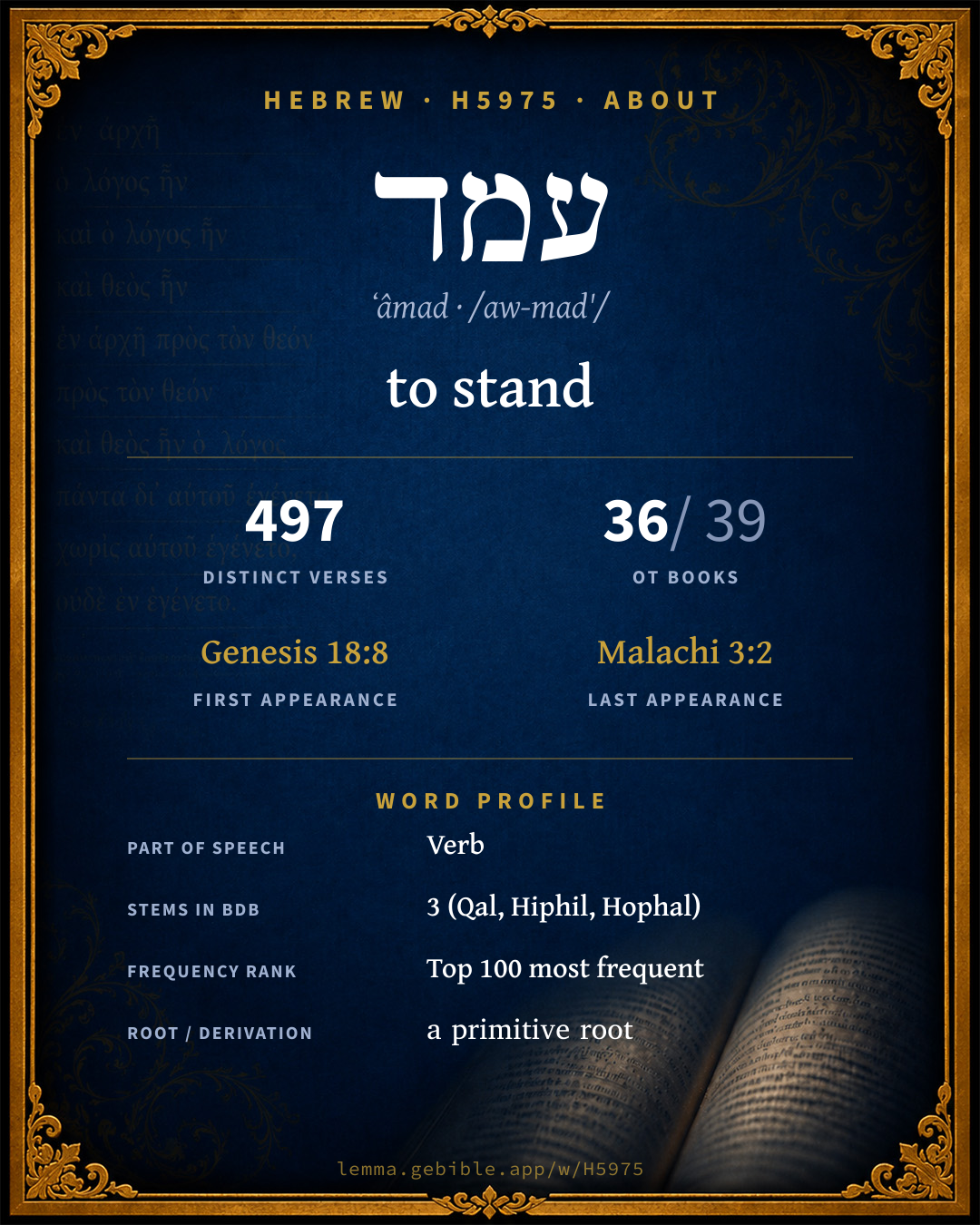
עָמַד
to stand
also: remain, endure, take one's stand fuller range ↓
Full lexicon entry — Brown-Driver-Briggs (BDB)
From Brown-Driver-Briggs (BDB)
Where this word appears
See every Qal verb in the Hebrew Bible →
Grammar key — what these labels mean
Part of speech
- Verb
- An action or state-of-being word.
- Noun
- A naming word — a person, place, thing, or idea.
Noun type
- Common
- A common noun — a general class of person, place, or thing (“king,” “city,” “water”), not a specific name.
Stem
- Qal
- The basic, simple active stem — the plain form of the verb (“he wrote”). Here: ‘stand’
- Hiphil
- The causative active stem (“he caused / brought about”). Here: ‘station’
- Hophal
- The passive counterpart of the Hiphil (“he was caused to…”).
Form
- Sequential Imperfect
- An imperfect with prefixed waw — the standard past-narrative form (waw-consecutive imperfect).
- Participle Active
- A verbal adjective expressing ongoing or characteristic action (“writing / one who writes”).
- Imperfect
- An incomplete, ongoing, or future action (“he will / would write”).
- Perfect
- A completed action or state — Hebrew marks aspect (completeness) more than strict tense (“he wrote”).
- Infinitive Construct
- A bound verbal noun, frequently with prepositions (“to write / in writing”).
- Sequential Perfect
- A perfect with prefixed waw continuing a preceding imperfect or command (waw-consecutive perfect).
- Imperative
- A direct command (“write!”).
- Jussive
- A third- or second-person volitional form expressing wish or command (“let him write”).
- Cohortative
- A first-person volitional form expressing wish or resolve (“let me / let us write”).
- Infinitive Absolute
- An unbound verbal noun, often intensifying or standing in for a finite verb.
- Participle Passive
- A verbal adjective expressing action received (“written”).
State
- Absolute
- The independent form of a noun, not bound to a following word.
- Construct
- A noun bound to a following noun in a possessive / “of” relationship (the construct chain).
Person
- 3rd Person
- The one spoken about (“he / she / it / they”).
- 2nd Person
- The one addressed (“you”).
- 1st Person
- The speaker (“I / we”).
Gender
- Masculine
- Grammatically masculine.
- Common
- Either gender — not distinguished for this form.
- Feminine
- Grammatically feminine.
Number
- Singular
- One.
- Plural
- More than one (in Hebrew, generally three or more).
Every verse where H5975 appears in the Book of 2 Kings — 26 distinct verses. Click any verse to open its interlinear word-by-word view. Verse text shown in the World English Bible for context — . Each verse’s Hebrew form is shown with its reference; the English is not keyword-highlighted, since the data carries no word-level English alignment. Use “Compare translations” on any verse to read it across multiple English versions. This concordance covers the Hebrew Bible; Septuagint (Greek Old Testament) occurrences are not indexed here.
2 Kings
- 2 Kings 2:7 וַ/יַּעַמְד֥וּ עָמְד֥וּ conj + Qal wimpf 3mp Qal pf 3cp Fifty men of the sons of the prophets went, and stood over against them afar off: and they two stood by the Jordan.
- 2 Kings 2:13 וַֽ/יַּעֲמֹ֖ד conj + Qal wimpf 3ms He took up also the mantle of Elijah that fell from him, and went back, and stood by the bank of the Jordan.
- 2 Kings 3:14 עָמַ֣דְתִּי Qal pf 1cs Elisha said, As Yahweh of Hosts lives, before whom I stand, surely, were it not that I regard the presence of Jehoshaphat the king of Judah, I would not look toward you, nor see you.
- 2 Kings 3:21 וַ/יַּעַמְד֖וּ conj + Qal wimpf 3mp Now when all the Moabites heard that the kings had come up to fight against them, they gathered themselves together, all who were able to put on armor, and upward, and stood on the border.
- 2 Kings 4:6 וַֽ/יַּעֲמֹ֖ד conj + Qal wimpf 3ms It happened, when the vessels were full, that she said to her son, Bring me yet a vessel. He said to her, There isn't another vessel. The oil stayed.
- 2 Kings 4:12 וַֽ/תַּעֲמֹ֖ד conj + Qal wimpf 3fs He said to Gehazi his servant, Call this Shunammite. When he had called her, she stood before him.
- 2 Kings 4:15 וַֽ/תַּעֲמֹ֖ד conj + Qal wimpf 3fs He said, Call her. When he had called her, she stood in the door.
- 2 Kings 5:9 וַ/יַּעֲמֹ֥ד conj + Qal wimpf 3ms So Naaman came with his horses and with his chariots, and stood at the door of the house of Elisha.
- 2 Kings 5:11 וְ/עָמַד֙ conj + Qal wpf 3ms But Naaman was angry, and went away, and said, Behold, I thought, He will surely come out to me, and stand, and call on the name of Yahweh his God, and wave his hand over the place, and recover the leper.
- 2 Kings 5:15 וַ/יַּעֲמֹ֣ד conj + Qal wimpf 3ms He returned to the man of God, he and all his company, and came, and stood before him; and he said, See now, I know that there is no God in all the earth, but in Israel: now therefore, please take a present from your servant.
- 2 Kings 5:16 עָמַ֥דְתִּי Qal pf 1cs But he said, As Yahweh lives, before whom I stand, I will receive none. He urged him to take it; but he refused.
- 2 Kings 5:25 וַ/יַּעֲמֹ֣ד conj + Qal wimpf 3ms But he went in, and stood before his master. Elisha said to him, Whence come you, Gehazi? He said, Your servant went no where.
- 2 Kings 6:31 יַעֲמֹ֞ד Qal impf 3ms Then he said, God do so to me, and more also, if the head of Elisha the son of Shaphat shall stand on him this day.
- 2 Kings 8:9 וַ/יַּעֲמֹ֣ד conj + Qal wimpf 3ms So Hazael went to meet him, and took a present with him, even of every good thing of Damascus, forty camels' burden, and came and stood before him, and said, Your son Benhadad king of Syria has sent me to you, saying, Shall I recover of this sickness?
- 2 Kings 8:11 וַ/יַּעֲמֵ֥ד conj + Hiphil wimpf 3ms He settled his gaze steadfastly [on him], until he was ashamed: and the man of God wept.
- 2 Kings 9:17 עֹמֵ֨ד Qal ptcp.act ms Now the watchman was standing on the tower in Jezreel, and he spied the company of Jehu as he came, and said, I see a company. Joram said, Take a horseman, and send to meet them, and let him say, Is it peace?
- 2 Kings 10:4 עָמְד֖וּ נַעֲמֹ֥ד Qal pf 3cp Qal impf 1cp But they were exceedingly afraid, and said, Behold, the two kings didn't stand before him: how then shall we stand?
- 2 Kings 10:9 וַֽ/יַּעֲמֹ֔ד conj + Qal wimpf 3ms It happened in the morning, that he went out, and stood, and said to all the people, You are righteous: behold, I conspired against my master, and killed him; but who struck all these?
- 2 Kings 11:11 וַ/יַּעַמְד֨וּ conj + Qal wimpf 3mp The guard stood, every man with his weapons in his hand, from the right side of the house to the left side of the house, along by the altar and the house, by the king round about.
- 2 Kings 11:14 עֹמֵ֨ד Qal ptcp.act ms and she looked, and, behold, the king stood by the pillar, as the manner was, and the captains and the trumpets by the king; and all the people of the land rejoiced, and blew trumpets. Then Athaliah tore her clothes, and cried, Treason! treason!
- 2 Kings 13:6 עָמְדָ֖ה Qal pf 3fs Nevertheless they didn't depart from the sins of the house of Jeroboam, with which he made Israel to sin, but walked therein: and there remained the Asherah also in Samaria.)
- 2 Kings 13:18 וַֽ/יַּעֲמֹֽד conj + Qal wimpf 3ms He said, Take the arrows; and he took them. He said to the king of Israel, Smite on the ground; and he struck thrice, and stayed.
- 2 Kings 15:20 עָ֥מַד Qal pf 3ms Menahem exacted the money of Israel, even of all the mighty men of wealth, of each man fifty shekels of silver, to give to the king of Assyria. So the king of Assyria turned back, and didn't stay there in the land.
- 2 Kings 18:17 וַ/יַּֽעַמְדוּ֙ conj + Qal wimpf 3mp The king of Assyria sent Tartan and Rabsaris and Rabshakeh from Lachish to king Hezekiah with a great army to Jerusalem. They went up and came to Jerusalem. When they were come up, they came and stood by the conduit of the upper pool, which is in the highway of the fuller's field.
- 2 Kings 18:28 וַֽ/יַּעֲמֹד֙ conj + Qal wimpf 3ms Then Rabshakeh stood, and cried with a loud voice in the Jews' language, and spoke, saying, Hear you the word of the great king, the king of Assyria.
- 2 Kings 23:3 וַ/יַּעֲמֹ֣ד וַ/יַּעֲמֹ֥ד conj + Qal wimpf 3ms conj + Qal wimpf 3ms The king stood by the pillar, and made a covenant before Yahweh, to walk after Yahweh, and to keep his commandments, and his testimonies, and his statutes, with all [his] heart, and all [his] soul, to confirm the words of this covenant that were written in this book: and all the people stood to the covenant.
About this entry
At a glance — auto-summarized from this page’s data, not written by a person. Every figure links to its source below. This summary describes the numbers; it doesn’t interpret them.
The Hebrew verb עמד centers on the idea of “to stand.” Its earliest occurrence is Genesis 18:8. It turns up in 497 verses across 36 books, a common footprint. Across 3 stems, its meaning turns on the binyan (Qal, Hiphil). It shares a root with מעמד, מעמד and עמד. For the data behind this summary, explore the sense tree and the renderings breakdown below.
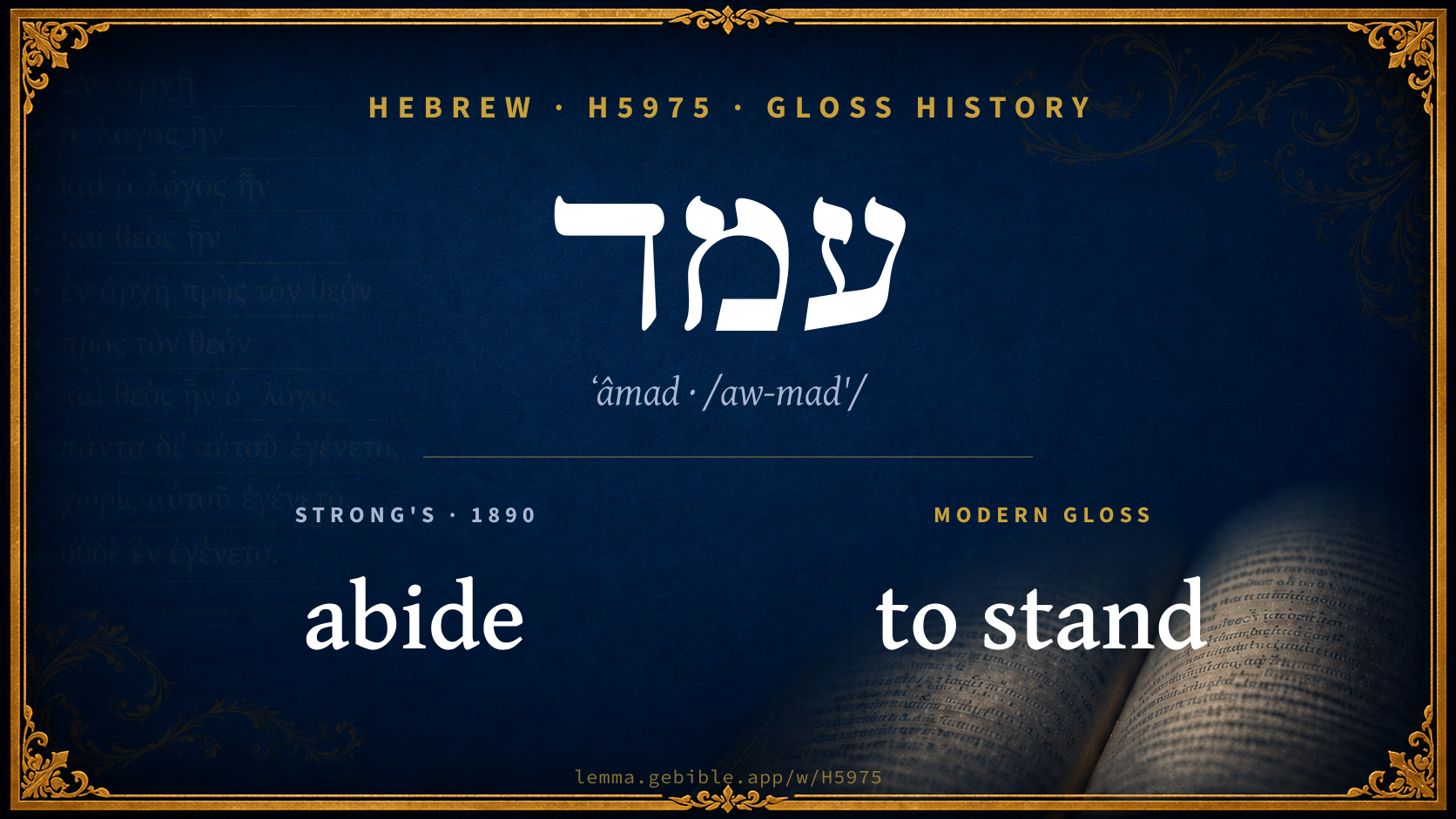
Gloss history
Strong's 1890 vs modern scholarship
About this word
Strong's H5975 catalogs a Hebrew word from the Hebrew Old Testament.
These counts are not copied from any lexicon or concordance. They are computed here, from the morphology-tagged Hebrew Old Testament. What Lemma adds →
- 497
- distinct verses
- The word appears in 497 distinct verses.
- 36 / 39
- OT books
- The word appears in 36 of 39 Old Testament books.
- #94
- by frequency
- Top 100 most frequent Hebrew words (rank 94 of 8,640 Hebrew words by occurrence).
View all 497 occurrences in the concordance →
Most concentrated in
- 2 Chronicles 50 verses 10%
- Daniel 38 verses 8%
- Ezekiel 32 verses 6%
By section of the Old Testament
By traditional corpus
Conventional, traditional groupings — biblical authorship is debated, so this is a traditional corpus grouping, not an authorship claim. Each share is this word’s portion of its verses in that division of the Hebrew canon. Each figure is a share of the word’s 497 distinct verses.
- Prophets (Nevi'im) 215 verses · 43%
- Writings (Ketuvim) 198 verses · 40%
- Torah (Pentateuch) 84 verses · 17%
How translations render this word
Counts come from each version’s own published word-to-Strong’s tagging or interlinear alignment — an approximate guide to how each version renders this word, not a word-level alignment the data otherwise carries. Because each total is that version’s own tagged count, the per-version totals vary from one another and need not match the appearance or distinct-verse counts above. These counts may also differ from a printed concordance because Lemma counts each distinctly tagged rendering and does not collapse phrase taggings into a single head-word total. This is a fixed set of word-tagged versions (KJV, ASV, BSB, ULT) and does not change with the reading translation you choose elsewhere. Each version’s license is shown beside its name below (and on Sources).
- King James Version: Stood 122×, Stand 47×, Set 15×
- American Standard Version: Stood 106×, Stand 43×, He stood 13×
- Berean Standard Bible: Stood 77×, Stand 45×, Standing 27×
- unfoldingWord Literal Text: Stood 73×, Stand 69×, And 32×
King James Version Public Domain
Renders H5975 across 520 tagged occurrences — most commonly:
Plus other, less common renderings. Plus 134 renderings that appear only once — usually multi-word phrases or single function words the recovered tagging swept in, not distinct renderings. Not rendered by a distinct English word in 1 further occurrence.
American Standard Version Public Domain
Renders H5975 across 518 tagged occurrences — most commonly:
Plus other, less common renderings. Plus 160 renderings that appear only once — usually multi-word phrases or single function words the recovered tagging swept in, not distinct renderings.
Berean Standard Bible Public Domain
Renders H5975 across 506 tagged occurrences — most commonly:
Plus other, less common renderings. Plus 176 renderings that appear only once — usually multi-word phrases or single function words the recovered tagging swept in, not distinct renderings. Not rendered by a distinct English word in 16 further occurrences.
unfoldingWord Literal Text CC BY-SA 4.0
Renders H5975 across 599 tagged occurrences — most commonly:
Plus other, less common renderings. Plus 121 renderings that appear only once — usually multi-word phrases or single function words the recovered tagging swept in, not distinct renderings.
53 senses and sub-senses in the full BDB
Hebrew verbs can shift meaning by stem (binyan): Qal is the basic action, Niphal is often passive or reflexive, Piel often intensifies or makes it factitive, and Hiphil is typically causative. The senses below are grouped under the stem BDB assigns to each. This entry also uses Hophal (the passive of Hiphil).
What do BDB’s symbols mean?
BDB uses these scholarly abbreviations:
| Symbol | Meaning |
|---|---|
| 𝔊 | the Septuagint (the ancient Greek translation, LXX) |
| 𝔙 | the Vulgate (the Latin translation) |
| 𝔖 | the Syriac version (the Peshitta) |
| 𝔗 | the Targum (the Aramaic translation) |
| ψ | the Psalms |
| √ | root (the underlying root or stem) |
| ‖ | parallel passage (a synonymous or contrasted parallel) |
| † | the dagger: every passage where the word occurs is cited |
The 53 senses and sub-senses the full Brown-Driver-Briggs lexicon distinguishes for this word, in lexicon order (not ranked by frequency), with BDB’s own verbatim wording and sub-sense lettering. Shown in Hebrew script with BDB’s own scholarly abbreviations. The condensed entry is in the Lexicon Entry tab. See also the Forms in the corpus table below.
Qal
- Pf. ע׳ Gn 19:27 +, 3 fs. עָֽמְדָה 2 K 13:6 +, etc.; Impf. יַעֲמֹד Ex 21:21, יַעֲמוֹד Na 1:6 +, יַעֲמָד־ 1 S 16:22 +; 1 s. אֶעֱמֹ֑דָה Hb 2:1, וָאֶעֱמֹד 2 S 1:10; 3 mpl. יַעַמְדוּ Je 32:14 +, יַעֲמֹ֑דוּ Ez 1:21 +; f. יַעֲמֹדְנָה Dn 8:22; 2 mpl. וַתַּעַמְדוּן Dt 4:11, etc.; Imv. עֲמֹד 1 S 9:27 +, עֲמָד־ 2 S 1:9; fs. עִמְדִי Is 47:12; Je 48:19, etc.; Inf. abs. עָמֹד Est 9:16; cstr. עֲמֹד Ex 18:23 +, sf. עָמְדִי Je 18:20, עֲמָדְךָ Ob 11, etc.; Pt. עֹמֵד Is 3:13 +, f. עֹמֶ֫דֶת Hg 2:5 +, etc.;— e.g. Genesis 19:27
- 1.
- a. stand, be in a standing attitude: c. עַל by, 1 S 26:13; 2 S 2:25; 2 K 2:7 +, so pt. Gn 18:8 (J), 41:1, 17 (E) +, עַל on, Ex 3:5 (E), Dt 27:12 +; c. ב loc. Ex 32:26; Nu 22:24, 26 (all JE), +; c. אֶל loc. 1 K 20:38 (+ לְ pers.), Je 48:19; Ez 21:26; 27:29; c. אֶל pers. 1 S 17:51; 2 K 5:25; c. אֵצֶל Gn 41:3 (E), Ez 9:2; 10:6; Ne 8:4; c. לִפְנֵי Gn 18:22; 1 K 3:16; 8:22 +; before י׳, for intercession Gn 19:27 (J), Dt 4:10; Je 15:1; 18:20, etc.; take one’s stand and do a thing 1 S 17:8; 1 K 8:55; 2 K 18:28 = Is 36:13 +; sq. inf. 1 K 8:11 = 2 Ch 5:14 +. e.g. 1 Samuel 26:13
- b. stand forth (to speak, etc.) 2 K 10:9 +. e.g. 2 Kings 10:9
- c. take a stand against (עַל), in opposition to, Ju 6:31; Ezr 10:15 (but stand over, = have charge of, according to KueGes. Abh. 247 f.) 2 Ch 26:18; cf. עַל־דַּם Lv 19:16 (H) against the blood of, i.e. seek one’s blood, life; c. יָ֑חַד Is 50:8 together, i.e. against each other. e.g. Judges 6:31
- d. present oneself before (לִפְנֵי) Gn 43:15 (J), Ex 9:10 (E), Nu 27:2, 21 (P), 1 S 16:21 +; before י׳ (in sanctuary) Dt 19:17; Je 7:10 cf. 18:20 Lv 9:5 (P); so in heaven 1 K 22:21 = 2 Ch 18:20; c. ב loc. of child at birth Ho 13:13, in palace (as retainer, courtier) Dn 1:4. e.g. Genesis 43:15
- e. c. לִפְנֵי attend upon, be (come) servant of 1 S 16:22 (v. Dr), 1 K 1:2 +; servant of י׳ 1 K 17:1; 18:15 2 K 3:14; 5:16 Je 15:19; priests (לְשָֽׁרְתוֹ) לִפְנֵי י׳ Dt 10:8; Ju 20:28; Ez 44:15; 2 Ch 29:11; of Levites, stand before congreg. for menial duties Ez 44:11; Nu 16:9 (P). e.g. 1 Samuel 16:22
- f. stand afar מֵרָחוֹק Ex 20:18, 21 (E), Is 59:14 ψ 38:12, בְּר׳ ψ 10:1; מִנֶּגֶד מֵר׳ 2 K 2:7; stand aloof, מִנֶּגֶד Ob 11 ψ 38:12. e.g. Exodus 20:15
- g. stand (silent) Jb 32:16. e.g. Job 32:16
- h. stand (appealingly) Jb 30:20 (but read עָמַדְתָּ, of God, Me Hi Du). e.g. Job 30:20
- i. stand, subj. רֶגֶל Zc 14:4 (עַל loc.), ψ 122:2 (ב loc.) so 26:12 (fig.). e.g. Zechariah 14:4
- j. stand, of water, עַל־הָרִים ψ 104:6. Vid. also preps. אֶל, אֵצֶל, עַל, מִמַּעַל, עִם, etc. e.g. Psalms 104:6
- 2.
- a. stand still, stop, cease moving, of moon Jos 10:13 (JE; ‖ וַיִּדֹּם), sun v 13, both, Hb 3:11; of pers. 1 S 9:27 (opp. עָבַר), 2 S 2:28 (opp. רָדַף), עִמְדוּ עֲמֹ֫דוּ Na 2:9 +; stop flowing (of oil) 2 K 4:6; remain standing, c. תַּחְתֵּינוּ Ju 7:21; 1 S 14:9 etc.; of eruption in skin = remain unchanged Lv 13:23, 28; so (without ת׳) 13:5, 37 (all P). e.g. Joshua 10:13
- b. = be inactive 2 Ch 20:17 (opp. לְהִלָּחֵם, + הִתְיַצְּבוּ). e.g. 2 Chronicles 20:17
- c. = be attentive Jb 37:14. e.g. Job 37:14
- d. stop, cease doing a thing 2 K 13:18; c. מִן Gn 29:35; 30:9 (both J), Jon 1:15. e.g. 2 Kings 13:18
- 3.
- a. tarry, delay Gn 45:9 (E), Jos 10:19 (JE; opp. רָדַף), 1 S 20:38 (opp. מְהֵרָה, חוּשָׁה), +. e.g. Genesis 45:9
- b. remain, c. ב loc. 2 K 15:20; Dt 10:10; c. עִמָּדִי Dt 5:28 (opp. שׁוּב); + inf. purpose Est 7:7. e.g. 2 Kings 15:20
- c. continue, abide Lv 13:5; Je 32:14; Is 66:22 ψ 102:27 Ec 2:9; = dwell Ex 8:18 (J; עַל loc.); לָעַד ψ 19:10; 111:3, 10; 112:3, 9; לְעוֹלָם ψ 33:11 Ec 1:4; בְּתוֹךְ Hg 2:5; of plan = be established ψ 33:11 (earlier קוּם, as Is 14:24), so Est 3:4; Dn 11:17 b; = maintain itself (earlier קוּם Jos 2:11) Ec 2:9; לֹא יַעֲמָד־בִּי כֹחַ Dn 10:17. e.g. Leviticus 13:5
- d. endure Ex 18:23 (E), Ez 22:14 (‖ חָזַק). e.g. Exodus 18:23
- e. be steadfast Dt 25:8; Ru 2:7. e.g. Deuteronomy 25:8
- f. persist Ec 8:3. e.g. Ecclesiastes 8:3
- 4. make a stand, hold one’s ground, Am 2:15; 2 K 10:4; Mal 3:2 +; c. לִפְנֵי Ju 2:14; 2 K 10:4; Est 9:2 +, בִּפְנֵי Jos 10:8; 21:44 (Ginsb; van d. H. Baer v 42), 23:9 (all D); c. עַל, for one’s life Est 8:11; 9:16. e.g. Amos 2:15
- 5. stand upright:
- a. remain standing 2 K 13:6; of head 6:31 remain upright upon him (עָלָיו); of house (fig. of endurance) Jb 8:15, Pr 12:7. e.g. 2 Kings 13:6
- b. stand up, opp. sit, Ne 8:5; Jb 29:8 (+ קוּם); opp. lie prostrate Ez 2:1 (עַל־רַגְלֶיךָ), so 37:10 (id.), Dn 10:11, v 11 (עַל־עָמְדֶ֑ךָ), Est 8:4; of revival after death Dn 12:13 (late for קוּם). e.g. Nehemiah 8:5
- c. stand up, rise, of water Jos 3:13 (+ apposs. נֵד אֶחָד), v 16 (+ קָמוּ + id.; both JE). e.g. Joshua 3:13
- d. be erect, upright, of boards Ex 26:15; 36:20 (P). e.g. Exodus 26:15
- 6.
- a. arise, appear, come on the scene (= קוּם; late) Ezr 2:63 = Ne 7:65, ψ 106:30 (cf. Ecclus 47:1, 12), especially Dn 8:22(×2), 23; 11:2, 3, 4; 12:1, cf. 11:7 (כַּנּוֹ), v 20, 21 (עַל־כַּנּוֹ); c. תַּחַת instead of Ec 4:15; of war 1 Ch 20:4, deliverance Est 4:14. e.g. Ezra 2:63
- b. stand forth, appear = come into being Is 48:13 ψ 33:9; 119:90. e.g. Isaiah 48:13
- c. rise up as foe (earlier קום Am 7:9; Gn 4:8), c. עַל against 1 Ch 21:1; 2 Ch 20:23; Dn 8:25; 11:14, c. לְנֶגְדִּי against 10:13. e.g. Amos 7:9
- 7. rare usages are:
- a. ע׳ אֶת־ stand with, as attendant, servitor Gn 45:1 (E), Nu 1:5 (P). e.g. Genesis 45:1
- b. take one’s stand in covenant, בַּבְּרִית 2 K 23:3. e.g. 2 Kings 23:3
- c. stand עַל־חֶרֶב Ez 33:26 (resort to the sword). e.g. Ezekiel 33:26
- d. stand בְּסוֹד י׳ Je 23:18, 22 (v. סוֹד). e.g. Jeremiah 23:18
- e. be appointed Ezr 10:14. e.g. Ezra 10:14
- f. stand before (לִפְנֵי) beast Lv 18:23 (carnal intercourse) e.g. Leviticus 18:23
- g. grow flat, insipid (Gie), taste of wine Je 48:11 (fig. of Moab), or remain unchanged (so most, in that case cf. 3 b).—עָמְדִי Dn 11:1b is crpt., read prob. עָמַדְתִּי, or עָמַד (מִיכָאֵל subj.), join then to 10:21 and del. 11:1a; so Bev Behrm MartiKau. e.g. Jeremiah 48:11
Hiphil
- (cf. DrIntr. (6) 535) Pf. 3 ms. הֶעֱמִיד 1 K 12:32 +, 2 ms. הֶעֱמַדְתָּה ψ 30:8, וְהַעֲמַדְתָּ֫ Nu 3:6 +, etc.; Impf. יַעֲמִיד Pr 29:4 +, וַיַּעֲמֵד 2 K 8:1 +; 3 fs. sf. וַתַּעֲמִדֵנִי Ez 2:2; 3:24, 1 pl. וַנַּעֲמִיד Ne 4:3, etc.; Imv. הַעֲמֵד Is 21:6; sf. הַעֲמִידֶהָ Ez 24:11; Inf. abs. הַעֲמֵיד Ne 7:3; cstr. הַעֲמִיד 1 K 15:4 +; Pt. מַעֲמִיד 2 Ch 18:34 (but v.Hoph.);— e.g. 1 Kings 12:32
- 1. station, set, c. acc. Ju 16:25 (בֵּין); for duty Nu 11:24 (E; סְבִיבֹת), 1 K 12:32 (ב loc.), 2 Ch 19:5 (id.), Ne 13:11 (עַל־עָמְדָם), Is 21:6 + (Ne 4:7a read perhaps Qal, so PerlesAnal. 65), c. עַל against Ne 4:3. e.g. Judges 16:25
- 2. cause to stand firm ψ 18:34 = 2 S 22:34 (c. עַל loc.); maintain (opp. overthrow) Ex 9:16 (J), 1 K 15:4, cf. Pr 29:4. e.g. Psalms 18:34
- 3. cause to stand up, set up, erect, c. acc. + עַל־רַגְלַי Ez 2:2; 3:24, so עַל־עָמְדִי Dn 8:18; temple Ezr 2:68 (על loc.), cf. 2 Ch 24:13 (על loc., of repairs); especially doors Ne 3:1 + 7 times Ne; Asherim 2 Ch 33:19, cf. 25:14. e.g. Ezekiel 2:2
- 4. + לִפְנֵי present one before king Gn 47:7 (P), י׳ (in sanctuary) Lv 14:11 + 3 times P, + (of goat) Lv 16:7, priest Lv 27:8 + 4 times P, + (of beast) Lv 27:11. e.g. Genesis 47:7
- 5. appoint Ne 7:3; 1 Ch 15:17 + (late); c. עַל over Ne 13:9 +, c. inf. purpose 6:7 +, c. 2 acc. 1 Ch 15:16; = assign (land) to (ל) 2 Ch 33:8 (‖ 2 K 21:8 נָתַן); appoint courses of priests 8:14; 31:2, cf. Ne 13:30; ordain commandments, עַל pers. Ne 10:33, cf. 2 Ch 30:5; establish עַד־הָעוֹלָם 1 Ch 17:14 (ב loc.), cf. 2 Ch 9:8 ψ 148:6; c. acc. of covenant ψ 105:10 = 1 Ch 16:17 (ל pers. + ל rei); c. חָזוֹן vision Dn 11:14 (= fulfil, earlier הֵקִים). e.g. Nehemiah 7:3
- 6. other meanings:
- a. ע׳ אֶת־פָּנָיו 2 K 8:11 have a fixed look. e.g. 2 Kings 8:11
- b. c. acc. רַגְלַי + ב loc. ψ 31:9 (fig.). e.g. Psalms 31:9
- c. make to stand (in a covt.; v. ‖ 2 K 23:3) 2 Ch 34:32. e.g. 2 Kings 23:3
- d. restore waste places Ezr 9:9. e.g. Ezra 9:9
- e. + לְפָנֶיהָ Est 4:5, i.e. make servant to. e.g. Esther 4:5
- f. cause wind to arise ψ 107:25. e.g. Psalms 107:25
- g. = raise an army Dn 11:11, 13.—2 Ch 18:34 v. Hoph.; ψ 30:8 v. עֹז; Ez 29:7 v. מָעַד. e.g. Daniel 11:11
Hophal
- Impf. 3 ms. יָעֳמַד־ Lv 16:10 be presented (of goat), + לִפְנֵי י׳; Pt. הָיָה מָעֳמָד 1 K 22:35 he was caused to stand, i.e. propped up, in (ב) his chariot, so read also ‖ 2 Ch 18:34 (as 𝔊), for MT מַעֲמִיד.—On Pf. הָעֳמַדְתִּי v. עֹז ψ 30:8. e.g. Leviticus 16:10
Senses from the full Brown-Driver-Briggs lexicon (Brown, Driver, Briggs; Oxford 1906 — public domain), digitized via Sefaria, supplemented by the OpenScriptures HebrewLexicon (CC BY 4.0). Full attribution on Sources.
Word origin
take one’s stand, stand (NH id.; Ph. עמד; Assyrian emêdu, stand, set up; Arabic عَمَدَ prop up, support, and deriv.; Ethiopic ዐምድ: pillar; 𝔗 עַמּוּדָא pillar, Syriac ܥܰܡܽܘܕܳܐ, Palm. עמודא, cf. also n.pr. תימעמד; Sab. עמד pillar, according to CISiv. 91 (or other deriv. from √ עמד DHMZMG xxxvii (1883), 5), pl. אעמדן pillars DHMEpigr. Denkm. aus Abess. 80);—
— Brown-Driver-Briggs (Oxford 1906, public domain), digitized via Sefaria, supplemented by the OpenScriptures HebrewLexicon (CC BY 4.0). See Sources.
Origin: a primitive root
Jastrow Dictionary
A second Hebrew/Aramaic lexicon for comparison, covering Aramaic and post-biblical (Talmudic, Targumic, Midrashic) usage that the biblical-Hebrew BDB does not. Matched by lemma rather than by Strong’s number, so a lemma may carry more than one Jastrow headword (shown separately below), and the entries cover usage well beyond the Bible.
עָמַך II
- (b. h.)
- 1. to stand, stand up, rise; to remain, endure; to be ready. Ber. V, 1 אין עוֹמְדִין להתפלל וכ׳ you must not stand up (make ready) for prayer, &c., v. כּוֹבֶד. Ib. I, 2 שכן דרך … לַעֲמוֹד וכ׳ for princes generally rise at three hours. Ib. 3 (expl. ובקומך, Deut. VI, 7) בשעה שבני אדם עוֹמְדִים at the time when people get up (in the morning). Kidd. 71ᵃ עוֹמֵד בחצי ימיו a middle-aged man. Y. Snh. VIII, 26ᵇ ע׳ בדין stood before court. B. Mets. 47ᵇ מי שאינו עומד בדיבורו who does not stand by (keep) his promise. Kil. IV, 4 העומד that part of the fence which is unimpaired, opp. פרוץ. Neg. I, 3, sq. העומד the leprous spot which remained in its place (Lev. XIII, 28). B. Bath. 60ᵇ יכולין לעמוד בה, v. גְּזֵרָה. Ex. R. s. 2 בקש משה שיַעַמְדּוּ וכו׳ Moses prayed that from him should rise priests and kings; a. v. fr.—Esp. uses: ע׳ על a) to understand. Y. Shek. I, 45ᵈ, v. אוֹפִי; a. e.—b) to insist upon. Meg. 28ᵃ לא עָמַדְתִּי על מדותי, v. מִדָּה. Kidd. l. c. מְעַמֵּד על מדותיו Pi. (Rashi מַעֲמִיד Hif.)—c) to be reduced to. Y. Ber. II, 5ᶜ ע׳ על חמשים it came down to fifty; a. fr. e.g. Deuteronomy 6:7
- 2. (of liquids) to settle, become consistent. Ab. Zar. 35ᵇ חלב טהור עומד milk of a clean animal curdles (can be made into cheese or butter).
- 3. (of blades) to become dull (without being notched). Bets. 28ᵇ סכין שעָמְדָה מותר וכ׳ a slaughtering knife which has become dull may be sharpened on the Holy Day.
- 4. עוֹמֵד ל־ standing ready, designated for. Pes. 13ᵇ, a. fr. כל העומד לזרוק וכ׳ whatever is ready to be sprinkled, is considered as if it had been sprinkled. Keth. 51ᵃ top; a. fr.
- 5. ע׳ ב־ to resist. Cant. R. to VII, 8 כל … לעמוד בזנות he who can resister the temptation of lust; כאילו עומד בשתיהן as if he resisted both; a. e.
- to cause to stand, to place; to restore, preserve; to beget, produce. Y. R. Hash. I, 57ᵇ top הַעֲמִידוּ בימה put the dais up (to hold court). Tam. V, 6 היה מַעֲמִיד וכ׳ made the unclean priests stand in the eastern gate. Yeb. 62ᵇ הם הם הֶעֱמִידוּ תורה וכ׳ it was they who preserved the law (tradition) in those days. Ab. I, 1 הַעֲמִידוּ תלמידים הרבה rear many scholars. Num. R. s. 14 ה׳ בנים begot children. Koh. R. to I, 4 מה היא עומדת מַעֲמֶדֶת what does ʿomadeth (ib.) mean? She (the earth) preserves, v. תַּפְקִיד. Gen. R. s. 90 שכל ארץ וארץ מעמדת פירותיה each ground preserves its own fruits (when put into the ground). Ib. דברים שהן מַעֲמִידִין substances which conserve, v. קִטְמִית; a. fr.—2) to change the standing of; to enlarge; to reduce. Meg. 15ᵇ שתי אמות היה והֶעֱמִידוֹ על וכ׳ it was two cubits long, and he extended it to twelve. Macc. 24ᵃ (of the 613 laws of the Torah) בא דוד והֶעֱמִידָן על וכ׳ David came and brought them down to eleven (Ps. XV); בא עמוס והעמידן על אחת Amos came and reduced them to one (Am. V, 4).—3) ה׳ (על) עצמו to contain, check one’s self. Snh. 72ᵃ אין אדם מעמיד עצמו על ממונו no one will restrain himself from defending his property. Ib. 93ᵇ מַעֲמִידִין על עצמם בשעה וכ׳ they restrained themselves when they had a human need.—4) (of liquids) to make consistent, curdle. Ab. Zar. II, 5 מעמידין אותן בקיבת נבלה they make the cheese by putting into the milk rennet from an animal not ritually slaughtered. Orl. I, 7 המעמיד בשרף הערלה if one curdles milk by means of a resinous substance (an acid) from an ‘uncircumcised’ tree (v. עָרְלָה); a. e.—5) ה׳ על חזקתו to let a thing stand on the basis of its presumptive condition, to assume that the ordinary condition has not changed. Nidd. 2ᵃ הַעֲמֵד אשה על חזקתה assume that the woman has not changed her presumptive condition (of cleanness); העמד דבר על חזקתו assume everything to remain unchanged (until a change is proven). Keth. 75ᵇ; a. fr.—6) ה׳ על מדותיו (sub. עצמו), v. supra. e.g. Amos 5:4
- 1. (sub. (sub. עצמו) to insist. Kidd. 71ᵃ, v. supra.
- 2. to place; part. pass. מְעוּמָּד, q. v.
*עֲמַד
- , to stay, dwell, v. עֲמַר II.
- to place; part. pass. מְעַמַּד. Targ. Y. Gen. XXVIII, 13, v. עֲתַר.
עֹמֶד
- preced.) stand. Tanḥ. Vayiḳra 8 עמוד במקום עוֹמְדְּךָ stay where thou standest.
עָמָד I
- (v. עָמַד II,
- 2. urin-soaked dung. Gen. R. s. 39 בית הע׳, v. דָּהוֹן.
A Dictionary of the Targumim, the Talmud Babli and Yerushalmi, and the Midrashic Literature (Marcus Jastrow; London, Luzac, 1903) — Public Domain. Digitized via Sefaria. Digitized via Sefaria. Full attribution on Sources.
Forms in the corpus
The 334 distinct written forms H5975 takes in the Hebrew Bible, most frequent first — each parse links to that stem’s occurrences in the concordance. Hebrew forms include their vowel points and cantillation, so a single lemma takes many written forms.
The 60 most common forms are shown; 274 rarer forms follow in the full concordance.
Same root — word family
Other BDB entries built from the same root as H5975, grouped by Strong’s listed origin. These share a root / origin per the lexicon — not necessarily a shared meaning. Each links to that word’s own entry.
Derived from this word
- מעמד maʻămâd H4612 service
- מעמד moʻŏmâd H4613 foothold
- עמד ʻômed H5977 standing place
- עמדה ʻemdâh H5979 standing ground
- עמוד ʻammûwd H5982 pillar
Compare all same-root words → Showing 4 of 6 — not the complete family. They share a root, not necessarily a meaning.
Septuagint verse parallels
This word appears in 453 verses that also exist in the Greek Old Testament (Septuagint), out of the 497 Hebrew verses it occurs in. You can read those verses in Greek by switching the Old Testament edition to the Septuagint.
Read these verses in the Septuagint
- Genesis 18:8
- Exodus 3:5
- Leviticus 9:5
- Numbers 1:5
- Deuteronomy 1:38
- Joshua 3:8
- Judges 2:14
- Ruth 2:7
- 1 Samuel 6:14
- 2 Samuel 1:9
- 1 Kings 1:2
- 2 Kings 2:7
This is a verse-level parallel only — the same verses exist in both the Hebrew and Greek Old Testaments. No word-level Hebrew↔Greek correspondence is claimed: the data carries no such alignment, so no Greek word is shown as this Hebrew word’s translation. Coverage is not total — the Septuagint omits the deuterocanon and renumbers the Psalms, so some Hebrew verses have no direct Greek parallel.