
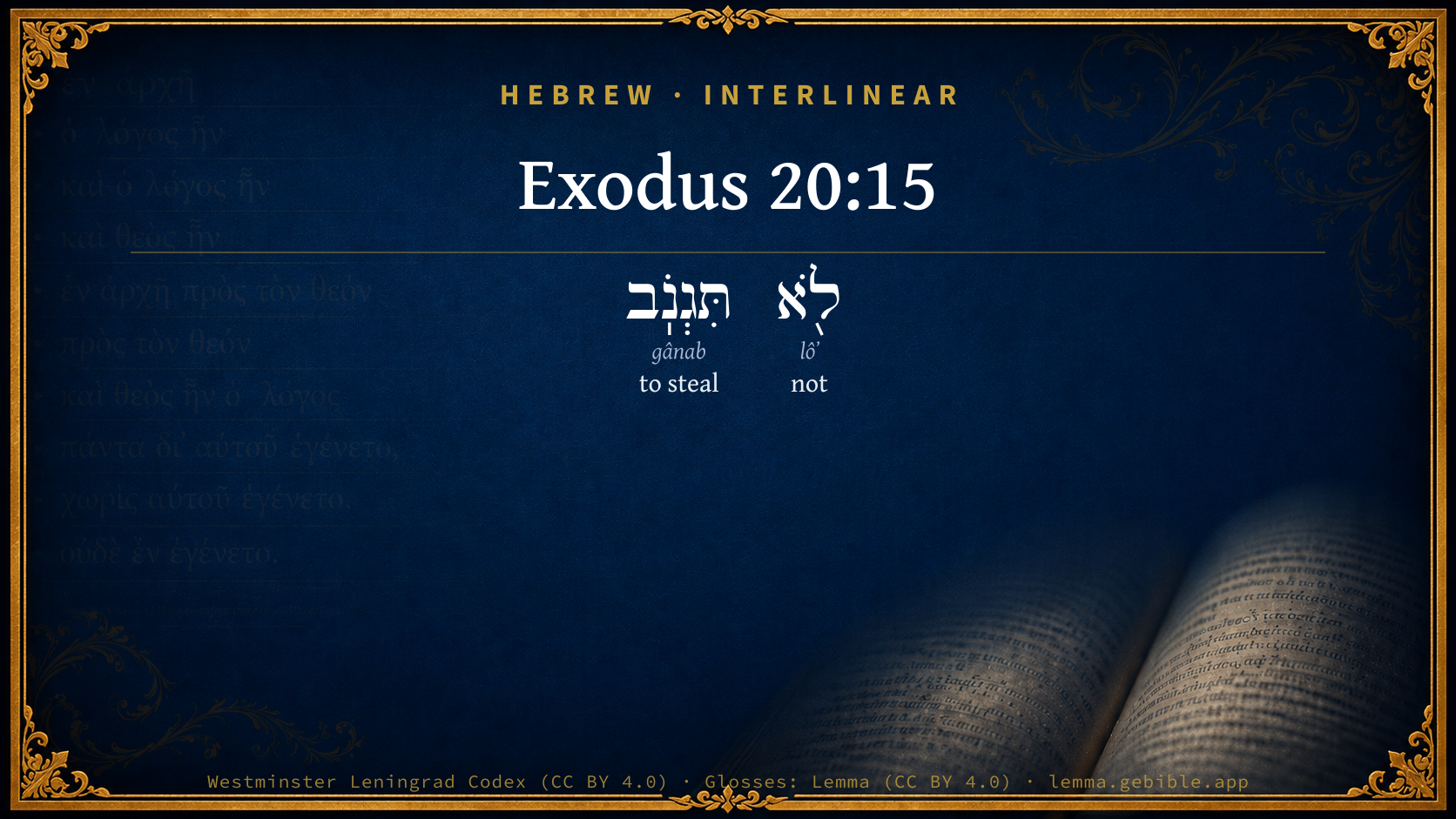
Exodus 20:15

Hebrew (Westminster Leningrad Codex) Exodus 20:15 appears in the Hebrew Old Testament. The text above is from the Westminster Leningrad Codex. Each word links to its Strong’s number, a concise gloss, and parsing drawn from the Open Scriptures Hebrew Bible morphology. Click any word for its full Brown-Driver-Briggs (BDB) entry.
Download image
Cite this verse

Exodus 20:15 (World English Bible). Public Domain. Lemma interlinear Bible study tool, https://lemma.gebible.app/v/exodus/20/15.

Show BibTeX & RIS
BibTeX
RIS
English Translation
"You shall not steal.
World English Bible · Public Domain
Download a study sheet

One document with this verse’s original text, its word-by-word gloss line, the meaning frame, cross-references with their text, attributed commentary, and full source and license credits — printable, and it pastes into notes with its structure intact.

This verse Autodidact and up

Study sheet (.html) Plain text (.txt)

A passage Seminary Student

Up to 50 verses in one chapter. A passage sheet keeps up to 6 commentary sources and 12 cross-references per verse, in the order this page ranks them, and says so on the sheet whenever that leaves anything out. Ask for a single verse and you get the Autodidact verse sheet above.

Everything on this page stays free to read, with no account — the sheet is a download of what is already on screen, not access to it.

Want to remove ads? Support Godless Engineer
Compare translations 3

The same verse in 3 English versions, stacked beneath the original-language interlinear above. Click any original word for its lexicon entry.

Each is an independent rendering of the whole verse — the interlinear is not word-aligned to these translations.

Highlighted words mark where these versions differ — a whole-verse word diff, not a word-by-word alignment.

  • World English Bible Public Domain
    "You shall not steal.
  • King James Version Public Domain
    Thou shalt not steal.
  • unfoldingWord Literal Text CC BY-SA 4.0
    You shall not steal.

unfoldingWord Literal Text — © unfoldingWord, licensed CC BY-SA 4.0. Word-aligned USFM3 via Door43 (git.door43.org/unfoldingWord/en_ult).

Versions to compare (up to 4)

3 of 4 selected

Show all 18 translations

Every available English version of this verse, each an independent rendering of the whole verse.

  • World English Bible Public Domain
    "You shall not steal.
  • Berean Standard Bible Public Domain
    You shall not steal.
  • Majority Standard Bible Public Domain
    You shall not steal.
  • King James Version Public Domain
    Thou shalt not steal.
  • American Standard Version (1901) Public Domain
    Thou shalt not steal.
  • Revised Version (1885) Public Domain
    Thou shalt not steal.
  • Geneva Bible (1599) Public Domain
    Thou shalt not steale.
  • Douay-Rheims (1899) Public Domain
    Thou shalt not steal.
  • Young's Literal Translation Public Domain
    `Thou dost not steal.
  • Literal Standard Version CC BY-SA 4.0
    You do not steal.
  • Unlocked Literal Bible CC BY-SA 4.0
    You must not steal from anyone.
  • unfoldingWord Literal Text CC BY-SA 4.0
    You shall not steal.
  • Darby Bible Public Domain
    Thou shalt not steal.
  • World Messianic Bible Public Domain
    “You shall not steal.
  • Webster's Bible Public Domain
    Thou shalt not steal.
  • Free Bible Version CC BY-SA 4.0
    You must not steal.
  • Bible in Basic English Public Domain
    Do not take the property of another.
  • JPS Tanakh (1917) Public Domain
    (20-13) Thou shalt not steal.

Literal Standard Version (2020), Covenant Press — licensed CC BY-SA 4.0. Text via the HelloAO Bible API (eBible.org). Unlocked Literal Bible (unfoldingWord) — licensed CC BY-SA 4.0. Text via the HelloAO Bible API (eBible.org). unfoldingWord Literal Text — © unfoldingWord, licensed CC BY-SA 4.0. Word-aligned USFM3 via Door43 (git.door43.org/unfoldingWord/en_ult). Free Bible Version, Dr. Jonathan Gallagher — licensed CC BY-SA 4.0. Text via the HelloAO Bible API (eBible.org).

Word by word

More ways to search: Search by grammar → Find every occurrence → Compare this word →

Practice this passage: Drill this verse → Learn its vocabulary →

תִּגְנֹֽב
gânab
H1589
“to steal”
Verb, Qal, Imperfect, 2nd Person, Masculine, Singular
Part of Speech
Verb
Stem
Qal
Form
Imperfect
Person
2nd Person
Gender
Masculine
Number
Singular
Full BDB Definition

Origin: a primitive root

TWOT: 364

to steal, steal away, carry away - (Qal) to steal - (Niphal) to be stolen - (Piel) to steal away - (Pual) to be stolen away, be brought by stealth - (Hithpael) to go by stealth, steal away
  1. לֹ֖א lôʼ H3808 “not” Particle, Negative

About this verse

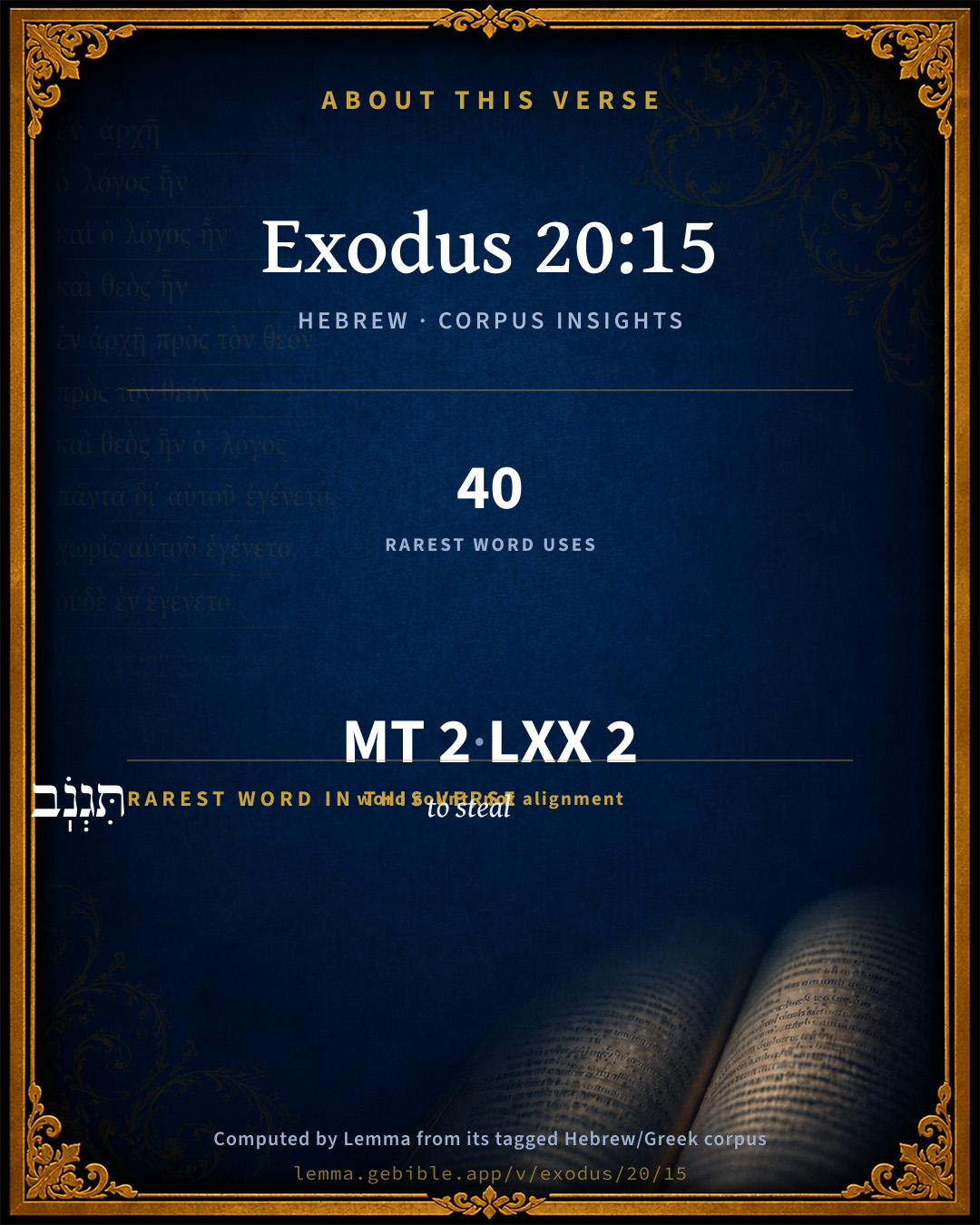
These counts appear in no published source. They are computed here, from the morphology-tagged text and Lemma’s own curated glosses. What Lemma adds →

2
words
2
distinct lemmas
Pentateuch
section

Shared distinctive vocabulary

תִּגְנֹֽב to steal H1589 occurs in 36 verses of the Hebrew Bible. Also found in:

Grammatical profile

  • 1 verb
  • 1 particle

Verb forms

  • תִּגְנֹֽב Qal · Imperfect

Hebrew & Septuagint length

In English translation the verse runs 4 words from the Hebrew and 4 from the Septuagint (LXX English) — the same length.

A rough comparison of the two English renderings, which tokenize alike — not a word-level alignment.

Word counts can differ between the Hebrew and the Greek without any difference in meaning — e.g. the Hebrew direct-object marker אֵת has no separate Greek word, and Greek often adds the article ὁ.

In the original languages it is 2 Hebrew tokens and 2 Greek tokens — but the two are counted differently (Hebrew bundles its prefixes and suffixes into one token; the Greek is in lemma form), so that isn’t a like-for-like length.

Cross-references

24

Topical passages linked to Exodus 20:15 in the Treasury of Scripture Knowledge — connected by theme and wording, ordered by reader-vote popularity; previews shown in the World English Bible.

  • Romans 13:9 For the commandments, "You shall not commit adultery," "You shall not murder," "You shall not steal," "You shall not give false testimony," "You shall not covet," and whatever other commandments there are, are all summed up in this saying, namely, "You shall love your neighbor as yourself."
  • Ephesians 4:28 Let him who stole steal no more; but rather let him labor, working with his hands the thing that is good, that he may have something to give to him who has need.
  • Leviticus 19:11 "'You shall not steal; neither shall you deal falsely, nor lie to one another.
  • Leviticus 19:13 "'You shall not oppress your neighbor, nor rob him. The wages of a hired servant shall not remain with you all night until the morning.
  • Matthew 19:18 He said to him, "Which ones?" Jesus said, "'You shall not murder.' 'You shall not commit adultery.' 'You shall not steal.' 'You shall not offer false testimony.'
  • 1 Corinthians 6:10 nor thieves, nor covetous, nor drunkards, nor slanderers, nor extortioners, will inherit the Kingdom of God.
  • Leviticus 6:1–7 Yahweh spoke to Moses, saying,
  • Proverbs 1:13–15 We'll find all valuable wealth. We'll fill our houses with spoil.
  • Leviticus 19:35–37 "'You shall do no unrighteousness in judgment, in measures of length, of weight, or of quantity.
  • Deuteronomy 24:7 If a man be found stealing any of his brothers of the children of Israel, and he deal with him as a slave, or sell him; then that thief shall die: so shall you put away the evil from the midst of you.
  • Proverbs 11:1 A false balance is an abomination to Yahweh, But accurate weights are his delight.
  • Amos 8:4–6 Hear this, you who desire to swallow up the needy, And cause the poor of the land to fail,
  • John 12:6 Now he said this, not because he cared for the poor, but because he was a thief, and having the money box, used to steal what was put into it.
  • Deuteronomy 25:13–16 You shall not have in your bag diverse weights, a great and a small.
  • Amos 3:10 "Indeed they don't know to do right," says Yahweh, "Who hoard plunder and loot in their palaces."
  • Micah 7:3 Their hands are on that which is evil to do it diligently. The ruler and judge ask for a bribe; And the powerful man dictates the evil desire of his soul. Thus they conspire together.
  • Zechariah 5:3–4 Then he said to me, "This is the curse that goes out over the surface of the whole land; for everyone who steals shall be cut off according to it on the one side; and everyone who swears falsely shall be cut off according to it on the other side.
  • Matthew 21:13 He said to them, "It is written, 'My house shall be called a house of prayer,' but you have made it a den of robbers!"
  • Luke 3:13–14 He said to them, "Collect no more than that which is appointed to you."
  • 1 Thessalonians 4:6 that no one should take advantage of and wrong a brother or sister in this matter; because the Lord is an avenger in all these things, as also we forewarned you and testified.
  • Exodus 21:16 "Anyone who kidnaps someone and sells him, or if he is found in his hand, he shall surely be put to death.
  • Job 20:19–22 For he has oppressed and forsaken the poor. He has violently taken away a house, and he shall not build it up.
  • Matthew 15:19 For out of the heart come forth evil thoughts, murders, adulteries, sexual sins, thefts, false testimony, and blasphemies.
  • Micah 6:10–11 Are there yet treasures of wickedness in the house of the wicked, And a short ephah that is accursed?

Cross-references courtesy of OpenBible.info (CC BY 4.0).

Hebrew and Greek witnesses Masoretic Hebrew ↔ Greek Septuagint

The same verse in the two great witnesses to the Old Testament, shown verse-for-verse.

These are two independent witnesses, not word-aligned to each other, and the Septuagint is shown in lemma (dictionary) form.

Hebrew Exodus 20:15 Masoretic · Westminster Leningrad Codex

לֹ֖א תִּגְנֹֽב

"You shall not steal.

World English Bible · Public Domain

Greek LXX Exodus 20:15 Septuagint · lemma form

οὐ φονεύω

You shall not kill.

LXX2012 (modern English Septuagint) · Public Domain

On this verse, John Gill's Exposition discusses the Septuagint’s reading. Read the note in Commentary ↓

Hebrew: Westminster Leningrad Codex (CC BY 4.0). Greek: Septuagint (public domain); English from LXX2012 (modern English Septuagint) (Public Domain). How the Septuagint differs from the Hebrew →

Targum (Aramaic paraphrase)

2

The Targum is the ancient Jewish Aramaic paraphrase of the Hebrew Scriptures — an interpretive translation, not the Hebrew text itself. Onkelos (literal) and Pseudo-Jonathan (expansive) render the Torah, and Jonathan the Prophets. Coverage is partial: where no permissively-licensed English translation exists for a verse, only the Aramaic is shown. This is verse-level text, not a word-by-word alignment to the Hebrew.

  1. Targum Onkelos Torah (Genesis–Deuteronomy)
    וְכָל עַמָא חָזָן יָת קָלַיָא וְיָת בָּעוֹרַיָא וְיָת קַל שׁוֹפָרָא וְיָת טוּרָא תָּנֵן וַחֲזָא עַמָא וְזָעוּ וְקָמוּ מֵרָחִיק:

    (no public-domain English translation for this verse)

    Targum Onkelos — Aramaic: “Onkelos Genesis” (public domain); “Onkelos Exodus” (public domain); “Onkelos Leviticus” (public domain); “Onkelos Numbers” (public domain); “Onkelos Deuteronomy” (public domain). English: “Sefaria Community Translation” (CC0 1.0 (public-domain dedication)); “J.W. Etheridge. The Targums of Onkelos and Jonathan Ben Uzziel on the Pentateuch. London: Longmans, Green, 1862” (public domain). Text via Sefaria.

  2. Targum Pseudo-Jonathan Torah (Genesis–Deuteronomy)
    וְכָל עַמָּא חַמְיַין יַת קָלַיָיא הֵיךְ הֲווֹ מִתְהַפְּכִין בְּשָׁמְעֲהוֹן דְּכָל חַד וְחַד וְהֵיךְ הֲווֹ נַפְקִין מִן גּוֹ בְּעוּרַיָא וְיַת קַל שׁוֹפְרָא הֵיךְ הֲוָה מְחֵי מֵיתַיָא וְיַת טוּרָא תָּנֵין וְחָמוּן כָּל עַמָּא וּרְתָעַן וְקָמוּ תְּרֵיסַר מִילִין מֵרָחִיק

    And all the people saw the thunders, and were turned back, every one as he heard them coming forth from the midst of the lights, and the voice of the trumpet as it will raise the dead, and the mountain smoking; and all the people saw and drew back, and stood twelve miles off.

    Targum Pseudo-Jonathan — Aramaic: “Targum Jonathan on Genesis” (public domain); “Targum Jonathan on Exodus” (public domain); “Targum Jonathan on Leviticus” (public domain); “Targum Jonathan on Numbers” (public domain); “Targum Jonathan on Deuteronomy” (public domain). English: “The Targum of Jonathan ben Uzziel, trans. J. W. Etheridge, London, 1862” (public domain). Text via Sefaria.

Commentary

Notes on Exodus 20:15 from classic Christian and Jewish commentators (each source and its license shown beneath its notes). The classic Christian expositions comment on the surrounding passage and are grouped to its opening verse, so a note may address several verses; the Jewish commentaries on the Tanakh (Rashi and others) are per-verse, so they appear only where the commentator wrote on this verse.

Lemma curates 59 commentaries, every one of them public domain or Creative Commons licensed, each selected and text-cleaned for this edition rather than reprinted as found. About our sources →

Trapp's Complete Commentary

John Trapp

Exo 20:15 Thou shalt not steal.

Ver. 15. Thou shalt not steal,] i.e., Not rob or wrong another, either by force or fraud {a} {1Th 4:6} {See Trapp on "1Th 4:6"} Basil chargeth the devil as a thief of the truth, in that he had decked his crows with her feathers. And it was of the devil surely that she had learned her answer, who, being charged by her mistress for stealing her linens, and other things which she found in her trunk, said, that she stole them not: and when she was asked, How came they to be laid and locked up there? did not you do this? No, said she, it was not I, but sin that dwelleth in me. {b} {See Trapp (for summary of Law) on "Exo 20:17"}

{a} επιβολη και επιβουλη. - Naz.

{b} Light for Smoke, p. 85.

John Trapp, A Commentary or Exposition upon All the Books of the Old and New Testament (1647–1656) — public domain. Text from a community e-Sword module.

The Biblical Illustrator

Joseph S. Exell

Exo_20:15

Thou shalt not steal.

The Eighth Commandment

I. In this Commandment the institution of property is recognized and sanctioned by the authority of God. The institution of property is necessary--

1. For increasing the produce of the earth;

2. For preserving the produce of the earth to maturity;

3. For the cultivation and development of the nature of man;

4. For the intellectual development of man.

II. The institution of property imposes upon all men the duty of industry in their callings; the duty of maintaining independence; the duty of avoiding any, even the least, invasion of the rights of others; the duty of self-restraint in expenditure, as well as of honesty in acquisition.

III. If property is a Divine institution, founded on a Divine idea, protected by Divine sanction, then in the use of it God should be remembered, and those whom God has entrusted to our pity and our care. (R. W. Dale, D. D.)

The Eighth Commandment

To steal, I am sorry to say, is a universal temptation, common to all sorts of people. It often springs from the sense of necessity: this it is which, as you remember, gives such tragic power to Victor Hugos Les Miserables, whose hero, Jean Valjean, stole a loaf of bread. Again the temptation to steal springs from indolence, or, to use a good, or rather bad, old French-Latin word, laziness; for there are not a few persons who, instead of getting an honest living by working, prefer to get it by what they call their wits, resorting to all sorts of shifts and tricks, which are really stealings. Again, the temptation to steal springs from dissolute or what is called fast living; how many of the embezzlements which so often startle the community spring from the fact that the embezzlers had entered on careers of personal debauchery! Again, the temptation to steal springs from the love of display; how many of the defalcations which land our citizens in prison or in Canada are owing to their passion for equipage, for furniture, for jewelry, for fashion! Again, and chiefly, the temptation to steal springs from the haste to become rich; how true it is that the love of money is a root of all kinds of evil! Let us first glance at the case of private stealings. For example: there is the taking advantage of the ignorant in a bargain. Again, there is the taking advantage of the necessitous, when they lie prostrate and helpless, demanding from them, for instance, extortionate interest for the use of money, exorbitant rent for premises or tools, or extravagant prices for commodities. Again, there is the refusing, I will not say lawful wages, but I do say fair wages--that is, just compensation to servants, whether in the family, the farm, the factory, the store, or the bank; for every man born into this world is entitled, by the very fact of his existence upon this footstool of God, to a living. Again, there is the delay in the payment of debts when due. Again, there is the contracting of debts beyond any reasonable possibility of paying them, the indulgence in venturesome speculations, the living beyond income--these, and such as these, morally surveyed, are stealings. Again, there is the practice of endorsing, or going security. It is right for you to help your friend when he is in trouble; but it is not right for you to help him, however much in trouble, if your endorsement of his note is going to cost some other friend of yours his comfortable home. To aid one man by endorsing him may result in stealing from many men. Again, there is the habit of begging for endorsements; for example: tempting one to misrepresent, on the one hand, the amount of assets, and, on the other hand, the amount of liabilities; contracting liabilities without the knowledge of the endorser; keeping up appearances when insolvent; in brief, offering a premium for the use of your name. Again, there is the evading of government taxes and custom-house duties by making defective or ambiguous returns--a mode of stealing which, I regret to say, is not altogether unfashionable among people of position. Once more, there is the lazy subsistence or dependence on charity (and there is a great deal more of this than we at first recognize); the dependence on friends to eke us out, when, if we had been a little less slothful in diligence as well as a little more fervent in spirit, we might not have needed their aid; the sluggard, I take it, is quite a prince among thieves. Let me now speak of the case of official stealings, no matter what the office is, whether public or private, whether in a bank, or in a store, or in an institution, or under the government. Office is in its very nature a trust; and as such it is a sacred thing. And to betray a trust is the worst, because the meanest, kind of stealing. And now let me pass from official stealings to what I may call associated or corporate stealings. There is something in the very nature of the organization of a company which somehow tends to the extinction of personal responsibility. It is well understood that many a man will, as a member of a corporation--no matter what kind, whether a trust company, like a bank or a charitable institution, or an executive company, like a railroad or a telegraph organization--do things as a manager of that company which he would scorn himself for doing as a private individual on his own personal responsibility. In fact, it has become an aphorism that corporations have no souls. And monopolies, or corporations granted the exclusive privilege of manufacturing or selling certain articles of commerce:--what are they but oftentimes organized robberies of society, thefts of your purse and my purse? But there are other kinds of property besides those which we call real and personal, which may also be stolen. For example: There is the stealing of time; and time, you know, or will know, is money. When a man comes and takes up twice the time that is necessary in arranging with me for his own advantage, or even the advantage of a good institution, he steals my time, and in stealing my time, he steals my patience as well as my money. Again, there is the petty larceny of writing a letter of inquiry for your own advantage, and omitting to enclose a postage stamp; for he that is faithful in a very little is faithful also in much; and he that is unrighteous in a very little is unrighteous also in much. Again, there is the stealing of anothers time and opportunity and serenity when you keep him waiting and fuming through your own failure to keep your engagement with him punctually. Again, there is the theft of plagiarism, the stealing of ideas, the withholding of credit or praise when credit or praise is due. Again, there is the stealing of reputation or character. Lastly, irreligion is the typical specimen of perfect theft. For while man in relation to his fellow-man has right to own property on his own account, yet man in his relation to his God is but a trustee. Steal not, then, O friend, from a greater than thy neighbour, even thy Divine Master! Language fails you when you undertake to denounce a defaulter against man. But where is your language when you think of a defaulter against Almighty God? (G. D. Boardman.)

Property sacred

I. Property as a sacred right. A mans right in justly-acquired property is a reflection of Gods rights in all His works. All property is the outgrowth of life, the results in houses, harvests, machinery, manufactures, commerce, and art of creative power. But that creative power is the gift of God, and therefore both its rights and responsibilities have their foundation and standard in God Himself. The property belongs to the man, but the man belongs to God. Thus the honest gains of toil, skill, judgment, self-denial, and good fortune are a mans own by a Divine right of which the civil right is the echo.

II. Property as a sacred trust. The same fact which makes property sacred gives birth to sacred responsibilities. As in old feudal days lands were given by the king on certain conditions of service, so now Gods gifts have always duties attached to them. Sacredly given, they are to be sacredly used.

Application:--

1. As to our use of our money. Is it not significant that God claimed tithes? Not to pay a tenth of His income into the temple treasury God considered a sacrilege in a Jew. Do we give a tenth to God?

2. Our use of ourselves. Wealth is more than money. It comprises all that God gives us, our talents, our influence, our whole self. He who might do good, who might heal and comfort and bless if he would, and yet does not, is guilty of unfaithfulness. (W. Senior, B. A.)

The Eighth Commandment

I. We may cause injury to others through lending and borrowing.

II. We shall do wrong to our fellow-men by inflicting injury on property that is open, through kindness of the owners, to the public, as gardens, private picture-galleries, etc. It is mean, dishonourable, to do hurt to such property.

III. Through incurring of debts or obligation to our fellow-men.

IV. The wrongs done in mercantile pursuits. This is done--

1. By selling to customers goods of inferior value.

2. By inferior weights.

3. By the adulteration of merchandise.

4. By false pretences. The placing the best strawberries or apples on top of the measure, etc.

V. Breaches of trust.

VI. Gambling. Property is a trust. You have no right to squander your own, or to lead another to squander what he has in trust. (W. Ormiston, D. D.)

The law of property

I. Consider, first, what it means--the rights of property.

1. In a country like this, long occupied and thickly peopled, almost everything belongs to somebody; and most of us possess a few things that we call our own, either earned or inherited, or otherwise received. In a new country the first-comers enter upon unoccupied ground, and each, while making his own claim, recognizes the claims of others. The relations of property are expressed by the possessive pronouns, and it is remarked that these are found in all languages. On what, then, is this right of property grounded? Not on social compact, not on the law of the land, not on the principle of utility, but on the will of God revealed in the constitution of our nature, and in the teaching of His Word. All acquired property is the product of labour, or the fruits of labour; and why do men labour? Is it not for the means of living? If, then, the constitution of our nature is such that we must labour for the means of living, it must be the will of Him who made us that we should receive and possess the fruits of our labour (see Pro_16:26; Eph_4:28; 2Th_3:10).

2. The principle of possession excludes the principle of communism. If the fruit of my labour is mine, the fruit of another mans labour is his to do as he will with it. Communism has always ended in disaster; and always must. It is a tissue of mistakes. It is wrong in its original inference that the principle of property is the cause of destitution, whereas the real cause is selfishness and sin; it is wrong in its ruling idea that all should share and share alike, a notion which would tax industrious people for the benefit of idlers, and rob the skilful for the advantage of the incompetent; it is wrong in its proposed method, for force is no remedy, and the circumstances of men can only be mended by mending the men themselves; and it is wrong in its cherished hopes, for if by some fatal success the communists should break down the present social system and suppress private wealth, the result would be to take all heart of enterprise out of the worlds workers, to dry up the waters of progress at their source, and to crush the human race under a final incubus of intolerable woe. Not in the suppression of property, but in a wise understanding of its uses, and in a right direction of its powers, lies the redress of human wrongs, with the hope of a good time coming.

II. What it ensures--the use of property.

1. Property has economical uses. It increases, protects, and stores, the produce of the earth.

2. Property has also its moral uses.

(1) Its steady stimulation of labour is alone a mighty helper of our manhood. It is where men have to work that they acquire robustness of frame, alertness of mind, and firmness of moral fibre.

(2) The way in which a man acquires property, and the way in which he uses it--resisting temptation to get it unlawfully, and making it a field for exercise of all the virtues; or dealing oppositely, so as to win it by fraud, and use it for vice--these things make all the difference between a hero and a scoundrel, between a son of God and a child of the devil.

III. What it forbids--the violation of property.

1. There are robberies over and above those which policemen investigate. Private gambling. Betting. Extravagance and petty theft on the part of domestic servants.

2. Fraud, or the withholding of a mans due. Trade practices.

IV. What it involves--the responsibilities of property. We are Gods stewards. (W. J. Woods, B. A.)

The Eighth Commandment

I. What it forbids.

II. What it requires.

1. It requires restitution of whatever we have, at any time, unjustly taken or detained. For, that being in right not our own, but anothers; keeping it is continuing and carrying on the injustice.

2. This Commandment also requires industry; without which, the generality of persons cannot maintain themselves honestly.

3. To observe it well, frugality must be joined with industry, else it will be all labour in vain.

4. This Commandment requires in the last place, that we neither deny ourselves, or those who belong to us, what is fit for our and their station, which is one kind of robbery; nor omit to relieve the poor according to our ability, which is another kind. For whatever we enjoy of worldly plenty is given us in trust, that we should take our own share with moderation, and distribute out the remainder with liberality. (Abp. Secker.)

The Eighth Commandment

I. Whence doth theft arise?

1. The internal causes are:

(1) Unbelief. A man hath an high distrust of Gods providence: can God furnish a table in the wilderness? So saith the unbeliever, can God spread a table for me? no, He cannot. Therefore he is resolved he will spread a table for himself, but it shall be at other mens cost, and both first and second course shall be served in with stolen goods.

(2) Covetousness. The Greek word for covetousness signifies an immoderate desire of getting; this is the root of theft. A man covets more than his own, and this itch of covetousness makes him scratch what he can from another.

2. The external cause of theft is, Satans solicitation: Judas was a thief; how came he to be a thief? Satan entered into him. The devil is the great master-thief, he robbed us of our coat of innocency, and he persuades men to take up his trade; he tells men how bravely they shall live by thieving, and how they may catch an estate.

II. How many sorts of thefts are there?

1. There is stealing from God; and so they are thieves, who rob any part of Gods day from Him.

2. There is a stealing from others.

(1) A stealing away their souls; and so heretics are thieves, by robbing men of the truth, they rob them of their souls.

(2) A stealing away their money and goods from them; and under this head of stealing away others money, there may be several arraigned for thieves. The highway thief who takes a purse contrary to the letter of this Commandment. The house-thief, who purloins and filches out of his masters cash, or steals his wares and drugs. The house-thief is a hypocrite, as well as a thief; he hath demure looks, and pretends he is helping his master, when he only helps to rob him. The thief that shrouds himself under law, as the unjust attorney or lawgiver, who prevaricates and deals falsely with his client. This is to steal from the client. The church-thief or pluralist, who holds several benefices, but seldom or never preacheth to the people; he gets the golden fleece, but lets his flock starve. The shop-thief; he steals in selling, who useth false weights and measures, and so steals from others what is their due. The usurer who takes of others even to extortion; he seems to help another by letting him have money in his necessity, but gets him into bonds, and sucks out his very blood and marrow. The feoffe in trust, who hath the orphans estate committed to him; he is deputed to be his guardian, and manage his estate for him, and he curtails the estate, and gets a fleece out of it for himself, and wrongs the orphan. This is a thief; this is worse than taking a purse, because he betrays his trust, which is the highest piece of treachery and injustice. The borrower, who borrows money from others, with an intention never to pay them again. The receiver of stolen goods. The root would die if it were not watered, and thievery would cease if it were not encouraged by the receiver.

III. What are the aggravations of this sin of stealing?

1. To steal when one has no need. To be a rich thief.

2. To steal sacrilegiously. To devour things set apart to holy uses.

3. To commit the sin of theft against checks of conscience, and examples of Gods justice: this is like the dye to the wool, it doth dye the sin of a crimson colour.

4. To rob the widow and orphan; ye shall not afflict any widow or fatherless child; it is a crying sin; if they cry unto Me, I will surely hear them.

5. To rob the poor. (T. Watson.)

The Eighth Commandment

I. Stealing by forgetfulness. People with these bad memories borrow things from their neighbours and friends, and forget to return them. Now, to the persons who lend those things, it is just as bad as if a thief should come into their house and steal them. Umbrellas, and books, and things of that kind are most likely to suffer in this way.

II. Cunning, is another branch of it. Did you ever see a counterfeit bank-note? It passes for a good note, though it is not worth a straw. And gold and silver coin are counterfeited in the same manner. The people who make them think themselves very cunning. But they are not a bit better than thieves. But a great many other things may be counterfeited as well as money. When God shall come to reckon with them at last, they will find that the real name for what they called smartness was stealing. This is the name by which God calls it.

III. Those who break the Eighth Commandment by deceit. For instance, a lady goes into a shop to buy a dress. She finds one of the colour she wants. If she could be sure that the colours would not fade she would take it. She says to the shopkeeper, Will these colours stand? Oh, yes, madam, they are the very best colours to wear. They will stand as long as the dress lasts. The lady buys the dress on this assurance, though all the while the shopkeeper knows the colours will not stand at all. In this way he steals the ladys money.

IV. Those who break the Commandment by extortion.

V. Those who break the Commandment by violence and fraud. We must resist little temptations. Everything must have a beginning. I remember reading once about a man who was going to be hung for robbery and murder. On the scaffold, he said he began to steal by taking a farthing from his mothers pocket while she was asleep. Many children begin to steal at the sugar-bowl or the cake-basket. To take the smallest thing that does not belong to us, without permission, is stealing. And, then, there is another thing to do: we must pray to God to keep us from temptation. (R. Newton, D. D.)

True honesty

There is an anecdote told of a brave general of the American Revolution, that he one day overheard the remark of a grandson, that he hoped to be middling honest. The old gentleman stopped, turned short upon the speaker, and broke out: What is that I hear? Middling honest! let me never hear again such a word from your lips. Strictly honest is the only thing you ought ever to think of being.

Praying better than stealing

Some poor families lived near a large wood-wharf. In one of the cabins was a man who, when he was sober, took pretty good care of his family; but the public-house would get his earnings, and then they suffered. In consequence of a drunken frolic he fell sick. The cold crept into his cabin, and but one stick was left in his cellar. One night he called his eldest boy, John, to the bedside, and whispered something in his ear. Cant do it, father, said John aloud. Cant--why not? asked his father, angrily. Because I learned at Sabbath-school , Thou shalt not steal, answered John. And did you not learn, Mind your parents, too? Yes, father, answered the boy. Well, then, mind and do what I tell you. The boy did not know how to argue with his father, for his father wanted him to go in the night and steal some sticks from the wood-wharf; so John said to his father: I can pray to-night for some wood; its better than stealing I know. And when he crept up into the loft where his straw bed was, he did go to God in prayer. He prayed the Lords Prayer, which his Sabbath-school teacher taught him, only he put something in about the wood, for he knew God could give wood as well as daily bread. The next noon, when he came home from school, what do you think he caught sight of, the first thing after turning the corner? A load of wood before the door, his door. Yes, there it was. His mother told him the overseers of the poor sent it; but he did not know who they were. He believed it was God; and so it was.

What is stealing

Two old men were once arguing upon the question of venial sin. Their faces one could not forget. One said, Well, after all you have to say, you will not tell me that the theft of a pin and a guinea are the same. The other said, When you tell me the difference between a pin and a guinea to God, I will give you an answer. It at once settled the point; and there was no more said about venial sin.

The rights of property defended

It must be acknowledged that the sufferings and crimes which are incident to the institution of property are so grave as sometimes to provoke the inquiry whether, after all, the institution itself can be defended. Selfishness, covetousness, dishonesty, fierce and angry contention, are among the worst vices of which men can be guilty; and it may almost seem as though we might escape from them all by abolishing the rights of property. What are the grounds, then, on which the maintenance of these rights, in some form or another, can be defended? Archdeacon Paley, in one of the chapters of his Moral Philosophy, has illustrated some of the advantages of the institution of property, with his usual clearness and felicity. He shows that it both increases the produce of the earth, and preserves it to maturity. Houses, ships, furniture, clothes, machinery, pictures, statues, books, require a great amount of labour to produce them; the stimulus to production would be altogether destroyed if after they were produced they belonged to nobody, and if people who had done no work were as free to use them as those by whose self-denial and labour they were produced. No mines would be worked, no fields would be cleared, no waste land would be brought into cultivation, no marshes would be drained, unless the men who did the work had the hope either of owning the property which they created, or of receiving in some other form compensation for their labour. The material wealth of the world would almost disappear, and the poorest and most wretched would have even less than they have now, if the rights of property were abolished. But there are other grounds on which the institution may be defended. The rights of property are essential not only to the creation and preservation of material wealth, but to the cultivation and development of the nature of man. It is only because corn belongs to the farmer, and coal to the mine proprietor, and bread to the baker, and meat to the butcher, it is only because clothes belong to the tailor, and houses to the builder, and because the law protects every one of them in the possession of his property until he is willing to part with it, that men work in order that they may get coal, and corn, and bread, and meat, and clothes, and house room. The Indian would sit idle in his cabin if the game he hunted did not become his own. Excessive physical labour is no doubt a great evil; but the evils of indolence are still greater. There are parts of the world where it is hardly necessary for men to work at all in order to get the bare necessaries of life, and the result is a miserable want of physical vigour and a portentous development of vice. We were made to work. It is by work that muscle is created and the whole body kept free from disease. Work as a rule is good for health, and good for morality and happiness too. Moreover, the institution of property supplies a most powerful motive to intellectual exertion. We want food, clothing, and a thousand other things; but they belong to people who will not part with them, except for the results of our own work. Inventive genius is stimulated to improve the processes of manufacture; administrative skill is exercised in lessening the cost of production; merchants watch the rise and fall of the markets in remote countries, estimate the effect of good and bad seasons and of political events on the probable price of commodities. There is not a counting house however small, there is not a workshop in a back court, where business can be carried on without thought. The institution of property secures an amount and variety of intellectual activity for which, perhaps, we have never given it credit. It has also very important relations to the moral life of man. The whole organization of the world is intended to discipline our moral nature; and the very variety of the sins to which the existence of property gives occasion, illustrates the variety of the virtues which it is intended to exercise. (R. W. Dale, D. D.)

Dishonesty in trade

If a manufacturer charges you twenty pounds for a hundred yards of cloth and sends you only half the quantity, he as really steals ten pounds as though he broke open your cash box and took out a ten pound note. If he engages to send you cloth of a certain quality and charges you for it, and then sends you cloth which is worth in the market only two-thirds the price, he is just as much a thief as though he stood behind you in a crowd and robbed you of your purse. No one disputes this. The same principle holds in every business transaction. To give short weight or short measure, is to steal. To supply an article of inferior quality to that which it is understood that the buyer expects, is to steal. To take a Government contract and send to Weedon or Portsmouth articles which you know will be worthless, or which you know are of a worse kind than it was understood that you would furnish, is to steal. To take advantage of your superior knowledge in order to pass off on any man articles for which he would never give the price that he pays for them but for his confidence in your integrity, is to steal. To start a company and to induce people to take shares in it by false representations of the amount of the subscribed capital and of its probable success, is to steal. If a workman who is paid to work ten hours, takes advantage of the absence of the master or foreman to smoke a pipe and read a newspaper for one hour out of the ten, he steals one-tenth of his days wages. He does the very thing that a shopkeeper would do who gave him fourteen ounces of butter or sugar instead of a pound, or nine yards of calico when the bill charged ten. An assistant in a shop, who instead of caring for his masters interests as if they were his own, puts no heart into his work, exercises no ingenuity, treats customers carelessly instead of courteously, and so diminishes the chances of their coming again, gets his salary on false pretences, does not give the kind of service which he knows his employer expects, and which he would expect if he were an employer himself. (R. W. Dale, D. D.)

An example of honesty

Speaking of the early American prairie settlements, a modern historian says: Theft was almost unknown; the pioneers brought with them the same rigid notions of honesty which they had previously maintained. A man in Maucoupin County left his waggon, loaded with corn, stuck in the prairie mud for two weeks near a frequented road. When he returned he found some of his corn gone, but there was money enough tied in the sacks to pay for what was taken.

Honesty

In Abraham Lincolns youthful days he was storekeepers clerk. Once after he had sold a woman a little bill of goods and received the money, he found, on looking over the account again, that she had given him six and a quarter cents too much. The money burned in his hands until he had locked the shop and started on a walk of several miles in the night to make restitution before he slept. On another occasion, after weighing and delivering a pound of tea, he found a small weight on the scales. He immediately weighed out the quantity of tea of which he had innocently defrauded the customer and went in search of her, his sensitive conscience not permitting any delay.

The Biblical Illustrator, edited by Joseph S. Exell (c. 1880s–1900s) — public domain. Text from a community e-Sword module.

Joseph Benson's Commentary

Exo 20:15. Thou shalt not steal — This command forbids us to rob ourselves of what we have, by sinful spending, or of the use and comfort of it, by sinful sparing; and to rob others by invading our neighbour’s rights, taking his goods, or house, or field, forcibly or clandestinely, overreaching in bargains, not restoring what is borrowed or found, withholding just debts, rents, or wages; and, which is worst of all, to rob the public in the coin or revenue, or that which is dedicated to the service of religion.

Joseph Benson's Commentary on the Old and New Testaments (1811–1818) — public domain. Text from a community e-Sword module.

Whedon's Commentary on the Bible

Daniel D. Whedon

THE EIGHTH COMMANDMENT, Exo_20:15.

15. Thou shalt not steal — Next to the rights of life and person stands the right of property. The crime of theft may include, besides the secret removal of another’s property, all acts which in any way impinge upon the property interests of one’s neighbour. Clarke specifies rapine, theft, petty larceny, highway robbery, and private stealing, and national and commercial wrongs, and adds that “the taking advantage of a seller’s or buyer’s ignorance, to give the one less and make the other pay more for a commodity than its worth, is a breach of this sacred law.” Manifestly, all theories of “socialism” and “anarchy” which tend directly or indirectly to take from man the products of his own genius, enterprise, and toil, or to appropriate them to purposes other than those which he may rightfully desire, are fundamentally inconsistent with this law. In like manner are all monopolies and combinations which conflict with the liberty and rights of individuals, and so oppress the poor labourer, to be condemned under this prohibition of the decalogue. He who loves his neighbour as himself, and does unto others as he would have others do unto him, will not allow himself to be a partaker in such wrongs.

Daniel D. Whedon (gen. ed.), Commentary on the Old and New Testaments (1874–1909) — public domain. Text from a community e-Sword module.

The Preacher's Complete Homiletical Commentary

Joseph S. Exell (gen. ed.)

MAIN HOMILETICS OF THE PARAGRAPH.—Exo_20:15

THE EIGHTH COMMANDMENT: VARIETIES IN THEFT

Man is not to regard himself as an individual unit—as living for himself alone—but as forming part of the great aggregate of humanity. The promotion of his true welfare is the promotion of the welfare of the whole community of which he forms a part. He who wrongs the community wrongs himself; and also he who wrongs himself wrongs the community. A man by stealing thinks to enrich himself; but he is certainly impoverishing himself in the long run, as well as doing injury to his neighbour, so that the man who is a faithful keeper of the law obtains a reflex blessing. In seeking his neighbour’s good a man is promoting his own highest welfare.

I. We must not rob ourselves. It might be supposed that selfishness would prevent us violating this precept, but selfishness overleaps itself, and is suicidal. The selfish are those who are self-spoliators. The selfish man robs himself of happiness at least; and in most cases hinders himself from becoming truly wealthy. Matthew Henry very pithily observes—“This command forbids us to rob ourselves of what we have by sinful spending, or of the use and comfort of it by sinful sparing.” The prodigal robbed himself by sinful spending and was reduced to starvation. We must not rob ourselves either by wasting our money or our time, or by misusing our privileges, or by abusing Divine gifts, or by letting pride and prejudice prevent us receiving gospel blessings. There are duties which a man owes to himself. There is a sense in which a man must live to himself.

II. We must not rob our neighbours. Human laws very generally enforce this Divine law, “Thou shalt not steal,” as a precept to be observed with regard to material property. Human governments have instinctively recognised the Divinity, and the necessity to social welfare, of a great part of the Mosaic Decalogue; and on what principle some are regarded as Divine and as perpetually binding, and others as not so, we fail to perceive! Material stealing is a crime universally abhorred. How comes it to pass that intellectual stealing is not more generally reprobated? Great changes would take place in the literary world if over every desk of the writer, and if over every pulpit of the preacher were written, and were duly observed the words, “Thou shalt not steal.” We may repeat the question, Thou that preachest a man should not steal, dost thou steal? Dost thou attempt to shine in borrowed plumage? Dost thou unblushingly appropriate the intellectual wealth of others? There is also moral theft. Every man who lowers the moral tone is stealing. Every man who undermines public virtue is stealing. There are many thieves who are regarded as honest men. There are thieves everywhere, but we shrink from calling things and men by their right names. A periphrastic mode of utterance may mean national decline, as well as the advance of civilisation.

III. We must not rob God. “Will a man rob God? Yet ye have robbed Me. But ye say, Wherein have we robbed Thee? In tithes and offerings. Ye are cursed with a curse; for ye have robbed Me, even this whole nation.” We rob God more frequently than we rob men. There are those who are regarded as honest by their fellows who have robbed God. A man has no right to steal himself from God. The creature is the Creator’s property, and the creature who does not use himself for the Creator’s glory is guilty of stealing. And in thus robbing God we rob ourselves much more. We must be honest to ourselves, honest to our neighbours; and perfect honesty is only secured when we are honest to our God. Godward honesty will make manward dishonesty an impossibility. Then masters will not steal from servants, nor servants from masters. Then justice will be rightly administered. Then kings will rule in the fear of God. Then nations will not steal from nations. Oh, for the bright day when all shall seek to understand and to obey the comprehensive and farreaching command, “Thou shalt not steal!”—W. Burrows, B.A.

ILLUSTRATIONS

BY

THE REV. WILLIAM ADAMSON

Theft-Tests! Exo_20:15. Years ago, in Edinburgh, lived a “gang of body-snatchers.” It was common for gipsies to steal children from their homes. The Arabs of East Africa are designated “men-stealers;” while some white traders under the Southern Cross are termed kidnappers. All these are regarded as heinous breakers of the Eighth Commandment. But this “eighth of God’s moral offspring” may be slain and set at defiance by others. Very recently a man of eminence stole a rare volume from the Metropolitan Library, though he would have cut off his hands rather than steal the money it was worth. He steals, who robs God of the honour due unto His Name; and so does she who plunders her own soul of those precious moments given for solemn preparations for eternity. The self-plunderer thus seriously breaks God’s law; how much more, then, the robber of God? To withhold part of the price of our obligations to God is the most aggravated form of theft.

“Higher yet this sin extends;

For it steals the spirit’s love

From the very best of Friends—

Robbing e’en the God above.”

Theft-Trouble! Exo_20:15. Phœbe was tempted along with other girls to gather plums in a neighbouring orchard. On bringing home some of the fruit, her mother mildly reproved her, and said that she ought not to have gathered the plums without leave, because it was sin: God had commanded her not to steal. The child, not being sensible of the evil before, seemed greatly surprised, and bursting into tears cried, “I cannot touch these plums.” The other children did not seem much concerned, but there was no pacifying Phœbe. She returned the plums to the owner; yet still she was full of grief. To every inquiry, her reply was, “Oh, it was sin”—sin against God. Phœbe never forgot to old age the solemn lesson, “It was sin.”

“I must not nurse within my soul

One spark of sin’s unhallowed fire;

Or yield my heart to the control

Of aught that speaks a wrong desire.”

The Preacher's Complete Homiletical Commentary (gen. ed. Joseph S. Exell; Funk & Wagnalls, c. 1892) — public domain (pre-1929). A full-Bible homiletical/sermon-outline anthology covering 65 of 66 books (2 John is absent from the source module). Text from a community e-Sword module.

Tyndale Open Study Notes

Tyndale Open Resources

20:15 Stealing is another way of saying that I have an absolute right to my own way, whether I have earned it or not. From the divine side, the prohibition says that God values us even down to our possessions.

Tyndale Open Study Notes — © Tyndale Open Resources, licensed CC BY-SA 4.0. Text via the HelloAO Bible API.

Geneva Bible (1599)

Geneva Bible translators

But study to save his goods.

Geneva Bible (1599) marginal notes — public domain. Text via Bolls.life.

Adam Clarke's Commentary

THE EIGHTH COMMANDMENT

Against stealing and dishonesty.

Verse 15. Thou shalt not steal.] All rapine and theft are forbidden by this precept; as well national and commercial wrongs as petty larceny, highway robberies, and private stealing: even the taking advantage of a seller's or buyer's ignorance, to give the one less and make the other pay more for a commodity than its worth, is a breach of this sacred law. All withholding of rights and doing of wrongs are against the spirit of it. But the word is principally applicable to clandestine stealing, though it may undoubtedly include all political injustice and private wrongs. And consequently all kidnapping, crimping, and slave-dealing are prohibited here, whether practised by individuals or by the state. Crimes are not lessened in their demerit by the number, or political importance of those who commit them. A state that enacts bad laws is as criminal before God as the individual who breaks good ones.

It has been supposed that under the eighth commandment, injuries done to character, the depriving a man of his reputation or good name, are included, hence those words of one of our poets: -

Good name in man or woman

Is the immediate jewel of their souls.

Who steals my purse steals trash, --

But he that filches from me my good name,

Robs me of that which not enriches him,

And makes me poor indeed.

Adam Clarke's Commentary on the Bible (1810–1826) — public domain. Text from a community e-Sword/MySword module.

Ellicott's Commentary for English Readers

(15) Thou shalt not steal.—Our third duty towards our neighbour is to respect his right to his property. The framers of Utopias, both ancient and modern, have imagined communities in which private property should not exist. But such a condition of things has never yet been realised in practice. In the laws of all known States private property has been recognised, and social order has been, in a great measure, based upon it. Here, again, law has but embodied natural instinct. The savage who hammers out a flint knife by repeated blows with a pebble, labouring long, and undergoing pain in the process, feels that the implement which he has made is his own, and that his right to it is indisputable. If he is deprived of it by force or fraud, he is wronged. The eighth commandment forbids this wrong, and requires us to respect the property of others no less than their person and their domestic peace and honour.

A Bible Commentary for English Readers, edited by Charles John Ellicott (1878–1897) — public domain. Text from a community e-Sword module.

The Cambridge Bible for Schools and Colleges

gen. ed. J. J. S. Perowne

15. The eighth commandment. The rights of private property to be respected. Cf. in H Lev_19:11. For penalties for stealing, see Exo_21:16, Exo_22:1.

It is hardly necessary to quote from the prophets passages illustrative of these duties: but Hos_4:2, Jer_7:9 are particularly worth referring to.

The Cambridge Bible for Schools and Colleges (gen. ed. J. J. S. Perowne; Cambridge University Press, 1878–1918) — public domain. Text from a community e-Sword module.

John Gill's Exposition

Thou shall not covet thy neighbour's house,.... This is the tenth and last commandment, and is an explanation of several of the past; showing that the law of God not only forbids external acts of sin, but the inward and first motions of the mind to it, which are not known, and would not be thought to be sinful, were it not for this law; nor are they known by this law until the Spirit of God by it convinces men of them, in whose light they see them to be sinful; even not only the schemes and contrivances of sin in the mind, the imaginations of it, thoughts dwelling upon it with pleasure, but even the first risings of sin in the heart; and such motions of it which are not assented unto, and unawares spring up from the corruption of nature, and are sudden craving desires after unlawful things, even these are forbidden by this law; which shows the spirituality of the law of God, and the impossibility of its being perfectly kept by fallen men. The apostle has reference to it, Rom 7:7. Several particulars are here mentioned not to be coveted, as instances and examples instead of others. Thus, for instance, "a neighbour's house" is not to be coveted; "nor his field", as the Septuagint version here adds, agreeably to Deu 5:21, a man is not secretly to wish and desire that such a man's house or land were his, since this arises from a discontent of mind with respect to his own habitation and possessions; and a man should be content with such things as he has, and not covet another's, which is not without sin:

thou shalt not covet thy neighbour's wife: and wish she was thine, and lust after her; this is a breach of the seventh command, and serves to explain and illustrate that. This clause stands first in the Septuagint version, as it does in Deu 5:21,

nor his manservant, nor maidservant, nor his ox, nor his ass, nor any thing that is thy neighbours'; which, with the first clause, serve to explain the eighth command, showing that we are not only forbid to take away what is another man's property, any of the goods here mentioned, or any other, but we are not secretly to desire them, and wish they were in our possession; since it discovers uneasiness and dissatisfaction with our own lot and portion, and is coveting another man's property, which is coveting an evil covetousness.

John Gill's Exposition of the Whole Bible (1746–1763) — public domain (CC PDM 1.0). Text via the HelloAO Bible API.

Haydock's Catholic Bible Commentary

Steal; by which name fraud of every description is condemned. Some have erroneously restrained this prohibition to the stealing of men for slaves, chap. xxi. 16. (Calmet)

George Leo Haydock (1774–1849), Haydock's Catholic Family Bible and Commentary, 1859 edition — public domain. Excludes Psalms (Douay-Rheims chapter numbering differs from Protestant) and Deuterocanonical books (Catholic canon only).

Matthew Poole's English Annotations

i.e. Either by deceit or violence, or without his knowledge and consent, take away another man’s goods, Eph 4:28; but, on the contrary, shalt preserve and increase them, as need requires, and occasion is offered.

Matthew Poole's English Annotations on the Holy Bible (1683–1685) — public domain. Text from a community e-Sword/MySword module.

The Pulpit Commentary

Thou shalt not steal. By these words the right of property received formal acknowledgment, and a protest was made by anticipation against the maxim of modern socialists propriete, c"est le vol." Instinctively man feels that some things become his, especially by toil expended on them, and that, by parity of reasoning, some things become his neighbour"s. Our third duty towards our neighbour is to respect his rights in these. Society, in every community that has hitherto existed, has recognised private pro-petty; and social order may be said to be built upon it. Government exists mainly for the security of men"s lives and properties; and anarchy would supervene if either could be with impunity attacked. Theft has always been punished in every state; and even the Spartan youth was not acquitted of blame unless he could plead that the State had stopped his supplies of food, and bid him forage for himself.

The eighth commandment

Guards the sanctity of property. Consider:

I PROPERTY AND THE RIGHTS OF PROPERTY. Property is that which gives expression to individual and family life. In some sort it is an extension of the bodily organism, an added possibility of self-revelation in the sphere of sense. Social usage allows a man"s right, or the right of a corporation, to absolute possession of certain things. Primarily, probably, such right is founded on the right of the labourer to the product of his labour; a man"s own is what he has made his own. Such limit, however, has come to be enlarged on grounds of general utility; we may say generally that a man"s property is that which social usage allows him to consider such.

II OFFENCES AGAINST PROPERTY.

1. Stealing. Appropriating a man"s property against the will of the owner. All condemn the thief, he is condemned even by his own conscience; however much he may steal from others he can never think it right for them to steal from him! There are, however, various kinds of diluted theft which are equally offences against the eighth commandment, though not so strongly stigmatised by society.

2. Cognate offences. Property in the old times consisted mainly of land, crops, and cattle. The principle involved in the eighth commandment illustrated, as applied to them, by a number of cases in Exo 21:, Exo_21:22., all such acts as result in loss to one"s neighbours, provided that loss was not inevitable, are condemned by it. Circumstances, nowadays, are somewhat different, but the principle of honesty still applies. Take a few instances:

(1) Acts of petty dishonesty.

(a) When in a bargain one party takes advantage of the ignorance of the other; e.g. , a collector finds some rarity in the possession of a man who does not know its value, and secures it far below its proper price.

(b) Borrowing without definite intention to return; e.g. , books, money, or other property.

(c) Leaving bills unpaid for a needlessly long time. In such case, even though paid eventually, the creditor is defrauded of the profit which he might have made by the use of his money.

(2) Mischievous actions; e.g. , marking books or scribbling in them. Cutting initials in trees and buildings. No man has any right to depreciate by his actions the value of another man"s property.

(3) Culpable negligence. Must be as careful with the property of others as with our own property. A pure accident is not a pure accident if it would not have happened had the property been our own.

III COMPENSATION FOR OFFENCES AGAINST PROPERTY. Cf. Exo_22:9. Not enough to make good the original value, the law of restitution requires double and, in some cases, fivefold or fourfold. Such a law:

1. Emphasises the importance of strict honesty. In view of it possible offenders will be more cautious as to how they offend. Should it be enforced now-a-days; how many struggling tradesmen and mechanics might find themselves rescued from the verge of bankruptcy! How might charity in a thousand places spring up to banish and destroy suspicion!

2. Secures something like adequate atonement. Defraud a man of anything, and you defraud him of more than the value of that thing. His loss occasions further loss; loss of time, loss of temper, anxiety, inconvenience, for all which the sufferer is entitled to a recompense. Fourfold restitution may sound generous, yet even that may be less than just.

Conclusion. Honesty is by no means such a common virtue as some suppose. It behoves us to examine ourselves as to how far our conduct may bear strict scrutiny. Are there none to whom we should make restitution? If so, let us be thankful if we can make it. There are losses which we occasion others, dues which we owe to God and man, yet which now, it may be, we can never make good no remedy now exists for the lasting evil they have occasioned. There are debts we can still pay, there are others which we can never pay; who has not need to join in the petition in the Lord"s Prayer, "Forgive us our debts"? G.

The Pulpit Commentary (1880–1919), ed. H.D.M. Spence-Jones & Joseph S. Exell — public domain. Text from a community e-Sword module.

John Wesley's Explanatory Notes

Thou shalt not steal - This command forbids us to rob ourselves of what we have, by sinful spending, or of the use and comfort of it by sinful sparing; and to rob others by invading our neighbour's rights, taking his goods, or house, or field, forcibly or clandestinely, over-reaching in bargains, not restoring what is borrowed or found, with-holding just debts, rents or wages; and, which is worst of all, to rob the public in the coin or revenue, or that which is dedicated to the service of religion.

John Wesley, Explanatory Notes Upon the Whole Bible (1754–1765) — public domain. Text via the GEBible commentary corpus.

unfoldingWord translationNotes

Door43 World Missions Community

must not give false testimony

"must not speak a false report" or "must not tell lies about someone"

must not covet

"must not strongly want to have" or "must not want to take"

translationWords

corrupt witness

neighbor

envy

servant

cow

donkey

unfoldingWord translationNotes — © Distant Shores Media and the Door43 World Missions Community, licensed CC BY-SA 4.0. Source: git.door43.org/Door43/en_tn.

Rashi

Rabbi Shlomo Yitzchaki (Rashi)

וכל העם ראים AND ALL THE PEOPLE SAW — This statement teaches us that there was not a blind person amongst them. And whence may we learn that there was not a dumb person amongst them? Because it states (Exodus 19:8) “And all the people answered”. And whence may we learn that there was not a deaf person amongst them? Because it states (Exodus 24:7) “We will do and we will hear” (Mekhilta).

ראים את הקולת [THEY] SAW THE SOUNDS — they saw that which should be heard (Mekhilta) — something which is impossible to see on any other occasion.

את הקולת THE SOUNDS which issued from the mouth of the Almighty.

וינעו THEY MOVED — The root נוע denotes trembling (Mekhilta).

ויעמדו מרחק AND THEY STOOD AFAR OFF — they moved back startled twelve miles, a distance equal to the length of their camp, and ministering angels came and assisted them — to bring them back, as it is said, (Psalms 68:13) “The angels of the God of Hosts made them move on, move on” (Shabbat 88b).

Rashi on the Tanakh — English translations: “The Judaica Press complete Tanach with Rashi, translated by A. J. Rosenberg” (CC BY 4.0); “Pentateuch with Rashi's commentary by M. Rosenbaum and A.M. Silbermann, 1929-1934” (public domain); “The Metsudah Tanach series, Lakewood, N.J” (CC BY 4.0); and “The Book of Joshua, Metsudah Publications, 1997” (CC BY 4.0). Text via Sefaria.

Ramban (Nachmanides)

Rabbi Moshe ben Nachman (Ramban / Nachmanides)

AND ALL THE PEOPLE PERCEIVED THE THUNDERINGS… 16. AND THEY SAID UNTO MOSES. In the opinion of the commentators, this happened after the Giving of the Torah. It is with reference to this that Scripture says, And ye came near unto me, even all the heads of your tribes, and your elders, and ye said: Behold, the Eternal our G-d hath shown us His Glory, etc. If we hear the Voice of the Eternal our G-d any more, then we shall die. But such is not my opinion, for it says here, but let not G-d speak with us, and it does not say “any more.” Besides, Moses said here to the people, Fear not, and there it is said, They have well said all that they have spoken. Moreover, here it is told that they feared only the thunderings, the lightnings, and the smoking mountain, and there it is said that they feared the speaking of the Divine Presence, for they said, For who is there of all flesh, that hath heard the Voice of the living G-d, speaking out of the midst of the fire, as we have, and lived?, Verse 23. Again, here it is said, And Moses drew near unto the thick darkness, but it does not say that “he entered into it.” [If the events narrated in this section of the Torah happened after the Revelation, it should have said that he came “into the midst of the cloud,” as it says further on in 24:18.]The correct interpretation regarding this section of the Torah and the [entire] order of events pertaining to the Revelation appears to me to be as follows: And all the people perceived… And they said unto Moses — all this happened before the Revelation. Now at first, [in Chapter 19], Scripture mentioned in sequence all the words of G-d that were commanded to Moses regarding the setting of a boundary to Mount Sinai and the admonition given to the people. This is followed [at the beginning of Chapter 20] by the Ten Commandments, and now Scripture refers back and mentions the words of the people to Moses, relating that from the moment they had perceived the thunderings and the lightnings, they moved backwards and stood afar off, further away from the boundary of the mountain that Moses had set for them.The order of events [on the day of the Revelation] was thus as follows: In the morning, there were thunderings and lightnings and the loud voice of the horn, Verse 16. but the Divine Presence had not yet come down on the mountain, something like it is written, And a great and strong wind rent the mountains, and broke in pieces the rocks before the Eternal; but the Eternal was not in the wind. And the people that were in the camp — i.e., in their place of encampment — trembled., Verse 16. But Moses encouraged them and brought them forth towards G-d… and they stood at the nether part of the mount. While they were standing there at the nether part of the mount in anticipation, the Eternal descended upon the mount in fire and the smoke thereof ascended, Verse 18. unto the heart of heaven, with darkness, cloud, and thick darkness. The mountain itself trembled, Verse 18. and quivered as mountains do in an earthquake called zalzalah,. or even more than that. And so it is written, What aileth thee… ye mountains, that ye skip like rams; ye hills, like young sheep? This is not a figure of speech, just as the preceding verse — The sea saw it, and fled; the Jordan turned backwards, Verse 3. — is not a mere figure of speech. Meanwhile, the voice of the horn waxed louder and louder. Then the people saw what was happening, and they moved backwards and stood further away from the boundary [that Moses had set for them]. They all said to Moses that G-d should not speak with them at all lest they die, for by reason of the vision, their pains came upon them and they retained no strength, and if they would hear the Divine utterance, they would die. Moses, however, encouraged them, and he said to them, Fear not. And they heard him, and the people stood from afar off at their positions, for in spite of all his words, they did not want to come near the boundary [he had set for them]. And Moses drew near unto the thick darkness but did not come into it, and then G-d uttered the Ten Commandments. Now following the Ten Commandments, Scripture did not mention here what the elders said to Moses, for it wanted to explain the commandments and the ordinances in succession. But in the Book of Deuteronomy, Moses mentioned that after the Ten Commandments [were given], all the heads of the tribes and their elders approached him and said to him, “If we hear the Voice of the Eternal our G-d any more, then we shall die, for we have estimated our powers [and found] that we could not stand any more the burden of the word of the Eternal G-d.” They had thought that G-d wanted to relate to them all the commandments [of the Torah], and therefore they said, Go thou near, and hear all that the Eternal our G-d may say; and thou shalt speak unto us all that the Eternal our G-d may speak unto thee; and we will hear it, and do it., Verse 24. And the Holy One, blessed be He, agreed to their words, and He said, They have well said all that they have spoken, Verse 25. for such was His desire to proclaim to them only the Ten Commandments, and their fear appeared correct to Him.

VAYANU’U.’ In the opinion of our Rabbis, the term nu’a here can only denote reeling to and fro, and so it says, The earth ‘no’a tanu’a’ (reeleth to and fro) like a drunken man. If so, the verse is stating [two things]: that the people were shaken up, and that out of their fear, they retreated farther backwards and stood afar off. But in the opinion of “the masters of the plain meaning of Scripture,” vayanu’u means that “‘they moved’ backwards from their place and stood from afar,” the usage of the word being similar to: ‘na’ (a fugitive) and a wanderer shalt thou be in the earth, and so also: ‘vay’ni’eim’ (and He made them wander) in the wilderness.

Ramban (Nachmanides) on the Tanakh — English translation: “Commentary on the Torah by Ramban (Nachmanides). Translated and annotated by Charles B. Chavel. New York, Shilo Pub. House, 1971-1976” (CC BY 4.0). Text via Sefaria.

Lesson kit

Teaching starters — assembled from the data on this page, not authored interpretation. Every prompt links to the verse data it draws on. Edit before teaching.

Exodus, in the Pentateuch, opens this verse with 2 words (2 distinct Hebrew lemmas). Its most distinctive word is gânab (“to steal”). A historical commentator’s framing appears above. Read the whole chapter for the surrounding context.

Discussion questions

  1. What does “to steal” (gânab) contribute to the verse as a whole?
  2. Genesis 30:33 shares the word «to steal» with this verse. How do the two illuminate each other?
  3. The translations on this page render this verse differently — a whole-verse word diff, not a word-by-word alignment. What might account for the different wordings?
  4. The verb «תִּגְנֹֽב» is Qal Imperfect. How does its form color the action?
  5. Reading how Trapp's Complete Commentary and The Biblical Illustrator read this verse, where do the two commentators agree and where do they part?

Things to notice

Reading settings

Reading text

Shown beneath each verse's original-language words.

Old Testament
Old Testament edition

Read the OT as the Masoretic Hebrew (MT) or the Greek Septuagint (LXX).

English shown for the Greek Septuagint (in the Hebrew ↔ Greek comparison).

Comparing translations? Open the Compare panel on any verse page to stack up to four side by side.