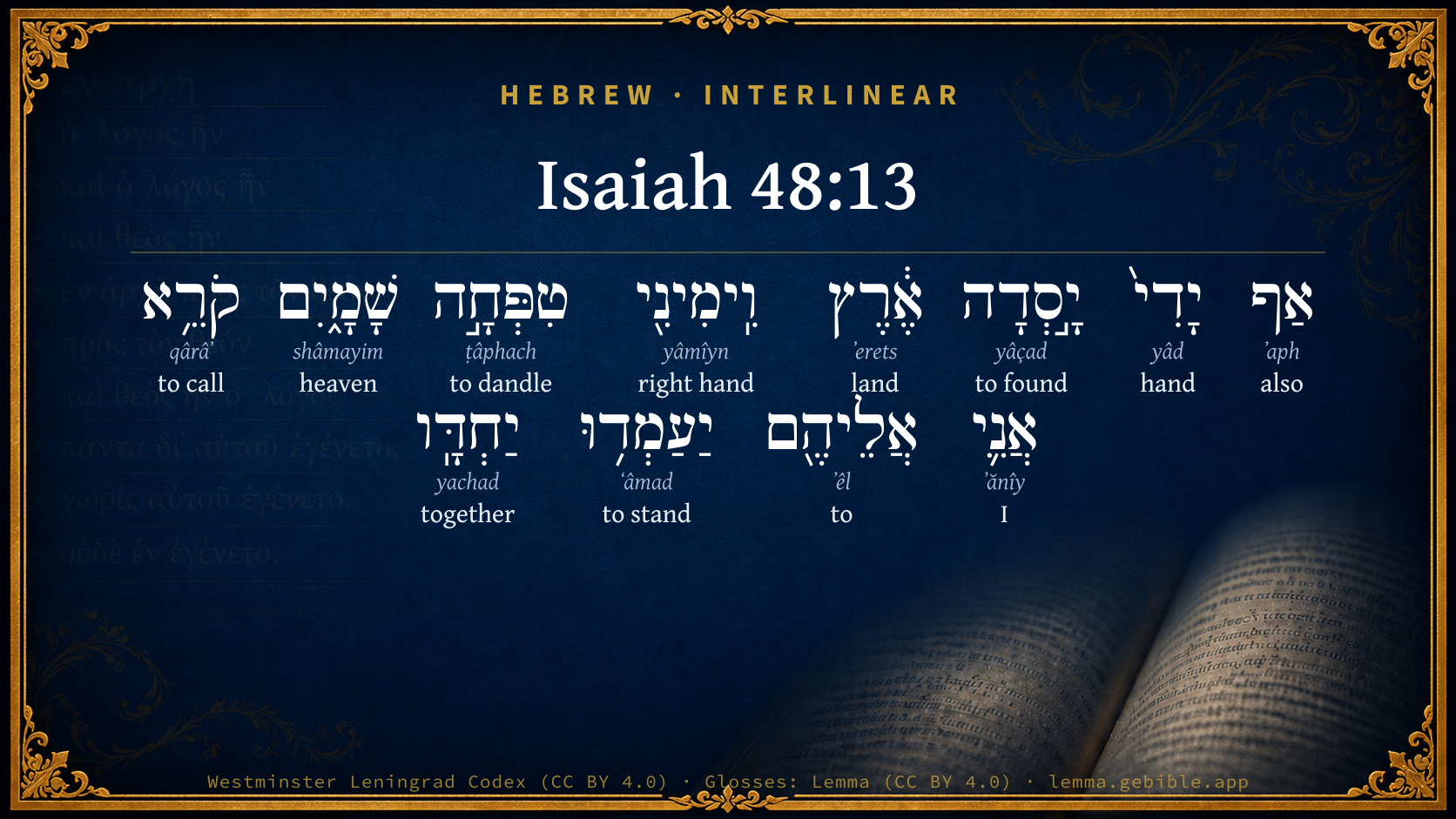
Isaiah 48:13

Hebrew (Westminster Leningrad Codex) Isaiah 48:13 appears in the Hebrew Old Testament. The text above is from the Westminster Leningrad Codex. Each word links to its Strong’s number, a concise gloss, and parsing drawn from the Open Scriptures Hebrew Bible morphology. Click any word for its full Brown-Driver-Briggs (BDB) entry.
Download image
Cite this verse

Isaiah 48:13 (World English Bible). Public Domain. Lemma interlinear Bible study tool, https://lemma.gebible.app/v/isaiah/48/13.

Show BibTeX & RIS
BibTeX
RIS
English Translation
Yes, my hand has laid the foundation of the earth, and my right hand has spread out the heavens: when I call to them, they stand up together.
World English Bible · Public Domain
Highlights
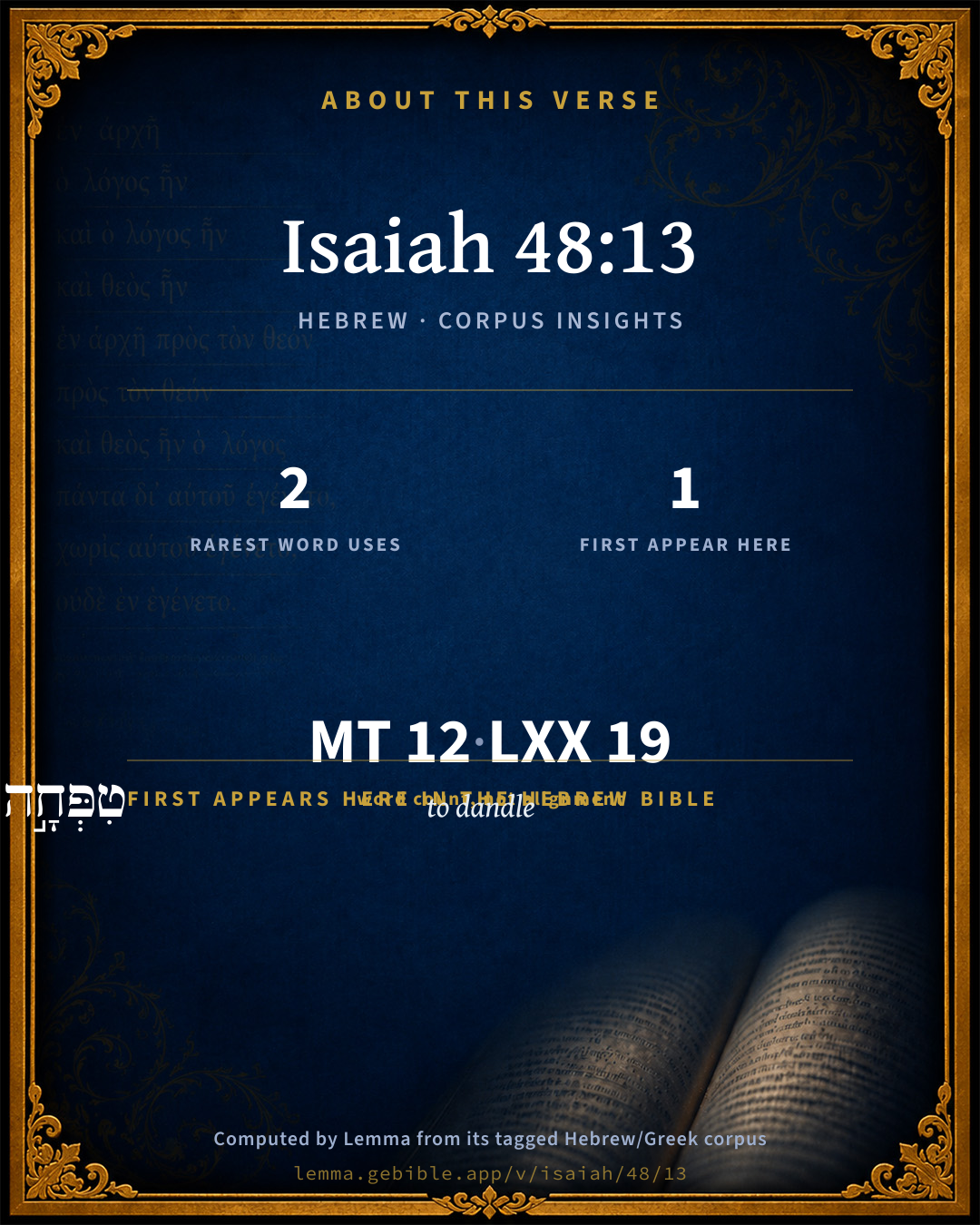
  • 1 first appearance in the Hebrew Bible
Full analysis ↓
Download a study sheet

One document with this verse’s original text, its word-by-word gloss line, the meaning frame, cross-references with their text, attributed commentary, and full source and license credits — printable, and it pastes into notes with its structure intact.

This verse Autodidact and up

Study sheet (.html) Plain text (.txt)

A passage Seminary Student

Up to 50 verses in one chapter. A passage sheet keeps up to 6 commentary sources and 12 cross-references per verse, in the order this page ranks them, and says so on the sheet whenever that leaves anything out. Ask for a single verse and you get the Autodidact verse sheet above.

Everything on this page stays free to read, with no account — the sheet is a download of what is already on screen, not access to it.

Want to remove ads? Support Godless Engineer
Compare translations 3

The same verse in 3 English versions, stacked beneath the original-language interlinear above. Click any original word for its lexicon entry.

Each is an independent rendering of the whole verse — the interlinear is not word-aligned to these translations.

Highlighted words mark where these versions differ — a whole-verse word diff, not a word-by-word alignment.

  • World English Bible Public Domain
    Yes, my hand has laid the foundation of the earth, and my right hand has spread out the heavens: when I call to them, they stand up together.
  • King James Version Public Domain
    Mine hand also hath laid the foundation of the earth, and my right hand hath spanned the heavens: when I call unto them, they stand up together.
  • unfoldingWord Literal Text CC BY-SA 4.0
    Indeed, my hand founded the earth, and my right hand spread out the heavens. I am calling to them; they stand together. q1

unfoldingWord Literal Text — © unfoldingWord, licensed CC BY-SA 4.0. Word-aligned USFM3 via Door43 (git.door43.org/unfoldingWord/en_ult).

Versions to compare (up to 4)

3 of 4 selected

Show all 18 translations

Every available English version of this verse, each an independent rendering of the whole verse.

  • World English Bible Public Domain
    Yes, my hand has laid the foundation of the earth, and my right hand has spread out the heavens: when I call to them, they stand up together.
  • Berean Standard Bible Public Domain
    Surely My own hand founded the earth, and My right hand spread out the heavens; when I summon them, they stand up together.
  • Majority Standard Bible Public Domain
    Surely My own hand founded the earth, and My right hand spread out the heavens; when I summon them, they stand up together.
  • King James Version Public Domain
    Mine hand also hath laid the foundation of the earth, and my right hand hath spanned the heavens: when I call unto them, they stand up together.
  • American Standard Version (1901) Public Domain
    Yea, my hand hath laid the foundation of the earth, and my right hand hath spread out the heavens: when I call unto them, they stand up together.
  • Revised Version (1885) Public Domain
    Yea, mine hand hath laid the foundation of the earth, and my right hand hath spread out the heavens: when I call unto them, they stand up together.
  • Geneva Bible (1599) Public Domain
    Surely mine hand hath laid the foundation of the earth, and my right hand hath spanned the heaues: when I cal them, they stand vp together.
  • Douay-Rheims (1899) Public Domain
    My hand also hath founded the earth, and my right hand hath measured the heavens: I shall call them, and they shall stand together.
  • Young's Literal Translation Public Domain
    Also, My hand hath founded earth, And My right hand stretched out the heavens, I am calling unto them, they stand together.
  • Literal Standard Version CC BY-SA 4.0
    Also, My hand has founded earth, || And My right hand stretched out the heavens, || I am calling to them, they stand together.
  • Unlocked Literal Bible CC BY-SA 4.0
    Yes, my hand laid the foundation of the earth, and my right hand spread out the heavens; when I call to them, they stand up together.
  • unfoldingWord Literal Text CC BY-SA 4.0
    Indeed, my hand founded the earth, and my right hand spread out the heavens. I am calling to them; they stand together. q1
  • Darby Bible Public Domain
    Yea, my hand hath laid the foundation of the earth, and my right hand hath spread abroad the heavens: I call unto them, they stand up together.
  • World Messianic Bible Public Domain
    Yes, my hand has laid the foundation of the earth, and my right hand has spread out the heavens. when I call to them, they stand up together.
  • Webster's Bible Public Domain
    My hand also hath laid the foundation of the earth, and my right hand hath spanned the heavens: when I call to them, they stand up together.
  • Free Bible Version CC BY-SA 4.0
    I laid the foundations of the earth with my own hands; I personally spread out the heavens. When I call the stars, they all take their positions.
  • Bible in Basic English Public Domain
    Yes, by my hand was the earth placed on its base, and by my right hand the heavens were stretched out; at my word they take up their places.
  • JPS Tanakh (1917) Public Domain
    Yea, My hand hath laid the foundation of the earth, and My right hand hath spread out the heavens; when I call unto them, they stand up together.

Literal Standard Version (2020), Covenant Press — licensed CC BY-SA 4.0. Text via the HelloAO Bible API (eBible.org). Unlocked Literal Bible (unfoldingWord) — licensed CC BY-SA 4.0. Text via the HelloAO Bible API (eBible.org). unfoldingWord Literal Text — © unfoldingWord, licensed CC BY-SA 4.0. Word-aligned USFM3 via Door43 (git.door43.org/unfoldingWord/en_ult). Free Bible Version, Dr. Jonathan Gallagher — licensed CC BY-SA 4.0. Text via the HelloAO Bible API (eBible.org).

Word by word

More ways to search: Search by grammar → Find every occurrence → Compare this word →

Practice this passage: Drill this verse → Learn its vocabulary →

טִפְּחָ֣ה
ṭâphach
H2946
“to dandle”
Verb, Piel, Perfect, 3rd Person, Feminine, Singular
Part of Speech
Verb
Stem
Piel
Form
Perfect
Person
3rd Person
Gender
Feminine
Number
Singular
Full BDB Definition

Origin: a primitive root

TWOT: 821

to extend, spread, trip, take quick little steps - (Piel) - to spread out - to carry on the palms, dandle - to rear children
  1. אַף ʼaph H637 “also” Particle, Accusative
  2. יָדִי֙ yâd H3027 “hand · my” Noun, Common, Both, Singular, Construct + Suffix, Personal, 1st Person, Common, Singular
  3. יָ֣סְדָה yâçad H3245 “to found” Verb, Qal, Perfect, 3rd Person, Feminine, Singular
  4. אֶ֔רֶץ ʼerets H776 “land” Noun, Common, Both, Singular, Absolute
  5. וִֽימִינִ֖י yâmîyn H3225 “and · right hand · my” Conjunction + Noun, Common, Feminine, Singular, Construct + Suffix, Personal, 1st Person, Common, Singular
  6. שָׁמָ֑יִם shâmayim H8064 “heaven(s)” Noun, Common, Masculine, Plural, Absolute
  7. קֹרֵ֥א qârâʼ H7121 “calling” Verb, Qal, Participle Active, Masculine, Singular, Absolute
  8. אֲנִ֛י ʼănîy H589 “I” Pronoun, Personal, 1st Person, Common, Singular
  9. אֲלֵיהֶ֖ם ʼêl H413 “to · them” Preposition + Suffix, Personal, 3rd Person, Masculine, Plural
  10. יַעַמְד֥וּ ʻâmad H5975 “to stand” Verb, Qal, Imperfect, 3rd Person, Masculine, Plural
  11. יַחְדָּֽו yachad H3162 “together” Adverb

About this verse

These counts appear in no published source. They are computed here, from the morphology-tagged text and Lemma’s own curated glosses. What Lemma adds →

12
words
12
distinct lemmas
Prophets
section

Notable vocabulary

The rarest word here is טִפְּחָ֣ה to dandle H2946 — appearing just 2 times in the whole Hebrew Bible.

First appearance in Scripture

This word makes its first canonical appearance in the Hebrew Bible here:

  • טִפְּחָ֣ה to dandle H2946

Shared distinctive vocabulary

טִפְּחָ֣ה to dandle H2946 occurs in 2 verses of the Hebrew Bible. Also found in:

Grammatical profile

  • 4 verbs
  • 4 nouns
  • 1 pronoun
  • 1 preposition
  • 1 adverb
  • 1 particle

Verb forms

  • יָ֣סְדָה Qal · Perfect
  • טִפְּחָ֣ה Piel · Perfect
  • קֹרֵ֥א Qal · Participle Active
  • יַעַמְד֥וּ Qal · Imperfect

Hebrew & Septuagint length

In English translation the verse runs 28 words from the Hebrew and 24 from the Septuagint (LXX English) — closely comparable.

A rough comparison of the two English renderings, which tokenize alike — not a word-level alignment.

Word counts can differ between the Hebrew and the Greek without any difference in meaning — e.g. the Hebrew direct-object marker אֵת has no separate Greek word, and Greek often adds the article ὁ.

In the original languages it is 12 Hebrew tokens and 19 Greek tokens — but the two are counted differently (Hebrew bundles its prefixes and suffixes into one token; the Greek is in lemma form), so that isn’t a like-for-like length.

Cross-references

12

Topical passages linked to Isaiah 48:13 in the Treasury of Scripture Knowledge — connected by theme and wording, ordered by reader-vote popularity; previews shown in the World English Bible.

  • Psalms 102:25 Of old, you laid the foundation of the earth. The heavens are the work of your hands.
  • Hebrews 1:10–12 And, "You, Lord, in the beginning, laid the foundation of the earth. The heavens are the works of your hands.
  • Exodus 20:11 for in six days Yahweh made heaven and earth, the sea, and all that is in them, and rested the seventh day; therefore Yahweh blessed the Sabbath day, and made it holy.
  • Isaiah 45:18 For thus says Yahweh who created the heavens, the God who formed the earth and made it, who established it and didn't create it a waste, who formed it to be inhabited: I am Yahweh; and there is no one else.
  • Isaiah 40:26 Lift up your eyes on high, and see who has created these, who brings out their host by number; he calls them all by name; by the greatness of his might, and because he is strong in power, not one is lacking.
  • Isaiah 42:5 Thus says God Yahweh, he who created the heavens, and stretched them forth; he who spread abroad the earth and that which comes out of it; he who gives breath to the people on it, and spirit to those who walk therein:
  • Psalms 119:89–91 Yahweh, your word is settled in heaven forever.
  • Isaiah 40:12 Who has measured the waters in the hollow of his hand, and meted out the sky with the span, and comprehended the dust of the earth in a measure, and weighed the mountains in scales, and the hills in a balance?
  • Psalms 148:5–8 Let them praise the name of Yahweh, For he commanded, and they were created.
  • Isaiah 40:22 [It is] he who sits above the circle of the earth, and the inhabitants of it are as grasshoppers; who stretches out the heavens as a curtain, and spreads them out as a tent to dwell in;
  • Psalms 147:4 He counts the number of the stars. He calls them all by their names.
  • Job 37:18 Can you, with him, spread out the sky, Which is strong as a cast metal mirror?

Cross-references courtesy of OpenBible.info (CC BY 4.0).

Hebrew and Greek witnesses Masoretic Hebrew ↔ Greek Septuagint

The same verse in the two great witnesses to the Old Testament, shown verse-for-verse.

These are two independent witnesses, not word-aligned to each other, and the Septuagint is shown in lemma (dictionary) form.

Hebrew Isaiah 48:13 Masoretic · Westminster Leningrad Codex

אַף יָדִי֙ יָ֣סְדָה אֶ֔רֶץ וִֽימִינִ֖י טִפְּחָ֣ה שָׁמָ֑יִם קֹרֵ֥א אֲנִ֛י אֲלֵיהֶ֖ם יַעַמְד֥וּ יַחְדָּֽו

Yes, my hand has laid the foundation of the earth, and my right hand has spread out the heavens: when I call to them, they stand up together.

World English Bible · Public Domain

Greek LXX Isaiah 48:13 Septuagint · lemma form

καί ὁ χείρ ἐγώ θεμελιόω ὁ γῆ καί ὁ δεξιός ἐγώ στερεόω ὁ οὐρανός καλέω αὐτός καί ἵστημι ἅμα

My hand also has founded the earth, and my right hand has fixed the sky: I will call them, and they shall stand together.

LXX2012 (modern English Septuagint) · Public Domain

Hebrew: Westminster Leningrad Codex (CC BY 4.0). Greek: Septuagint (public domain); English from LXX2012 (modern English Septuagint) (Public Domain). How the Septuagint differs from the Hebrew →

Targum (Aramaic paraphrase)

1

The Targum is the ancient Jewish Aramaic paraphrase of the Hebrew Scriptures — an interpretive translation, not the Hebrew text itself. Onkelos (literal) and Pseudo-Jonathan (expansive) render the Torah, and Jonathan the Prophets. Coverage is partial: where no permissively-licensed English translation exists for a verse, only the Aramaic is shown. This is verse-level text, not a word-by-word alignment to the Hebrew.

  1. Targum Jonathan Prophets (Joshua–Malachi)
    אַף בְּמֵימְרִי שַׁכְלֵילִית אַרְעָא וּבִגְבוּרְתִּי תָּלֵית שְׁמַיָא קְרֵית אֲנָא לְהוֹן קָמוּ כַּחֲדָא:

    Yea, by my WORD I have laid the foundation of the earth, and by my might I have suspended the heavens: when I call unto them, they stand up together.

    Targum Jonathan — Aramaic: “Mikraot Gedolot” (public domain). English: “Sefaria Community Translation” (CC0 1.0 (public-domain dedication)); “London "Chaldee Paraphrase," 1871” (public domain). Text via Sefaria.

Commentary

Notes on Isaiah 48:13 from classic Christian and Jewish commentators (each source and its license shown beneath its notes). The classic Christian expositions comment on the surrounding passage and are grouped to its opening verse, so a note may address several verses; the Jewish commentaries on the Tanakh (Rashi and others) are per-verse, so they appear only where the commentator wrote on this verse.

Lemma curates 59 commentaries, every one of them public domain or Creative Commons licensed, each selected and text-cleaned for this edition rather than reprinted as found. About our sources →

Trapp's Complete Commentary

John Trapp

Isa 48:13 Mine hand also hath laid the foundation of the earth, and my right hand hath spanned the heavens: [when] I call unto them, they stand up together.

Ver. 13. My hand hath also laid the foundation of the earth.] My left hand, say the Rabbis, as "my right hand spanned the heavens"; that is, meted them out as a workman doth his work. {a} God did but "call unto them" both, "and they stood up together." Vain therefore and needless was the disputation of the Samerites and the Hillelites among the Jews, whether was first created the heaven or the earth?

{a} Oecolamp., in loc.

John Trapp, A Commentary or Exposition upon All the Books of the Old and New Testament (1647–1656) — public domain. Text from a community e-Sword module.

The Biblical Illustrator

Joseph S. Exell

Isa_48:13

Mine hand also hath laid the foundation of the earth

The Creator

I.

THE FOUNDATION OF THE EARTH.

II. THE OVER-ARCHING HEAVENS.

III. THE DIVINE PURPOSE IN THESE GREAT WORKS.

1. The heavens have been Gods grand lesson-books for the instruction and elevation of His children (Psa_19:1-14.).

2. The earth has been the scene of revelations of His character which we cannot believe to be surpassed by any vouchsafed to any other portion of His universe; His judgments on sin; His manifestations of mercy; His tabernacling amongst men in the person of His Son; the death on the Cross for the redemption of lost humanity; the nobleness, sincerity, patience, unselfishness, forgiveness of God manifested in the spiritual education of His children.

3. The long process of sin and redemption shall at length have a glorious consummation. (W. Seward.)

The Biblical Illustrator, edited by Joseph S. Exell (c. 1880s–1900s) — public domain. Text from a community e-Sword module.

The Preacher's Complete Homiletical Commentary

Joseph S. Exell (gen. ed.)

THE CREATOR

Isa_48:13. Mine hand also hath laid the foundation, &c.

It seems to be an axiom of modern philosophy that all human knowledge has been progressive, from the roughest fanciful guesses to the safely applied science of our days. Assuming this, we can only account for the recognition of the Oneness of the Creator and the Unity of Creation, not only in the age of Isaiah, but in that of Moses and in that of the Patriarchs, by attributing it to God’s own revelation of Himself to man. This verse brings to mind the sublimely simple and authoritative declaration with which that revelation opens, and it claims our attention in the same calm way to the terrestrial and celestial manifestations of the Divine handiwork.

I. THE FOUNDATION OF THE EARTH.

The solid earth has been regarded in all ages as the type of all that is “sure and firm set.” But how does its enormous axis remain unbent? Why does not its crust fall in upon the attracting centre, or why do not the resisting forces shatter it? Because matter and forces have been balanced and adapted by Infinite Wisdom and Power (see Isa_40:12; Job_38:4-7). But it is not merely a dead weight and bulk. There is incessant physical and chemical action from the outermost aerial limit to the inmost metallic core. Change, decay, renewal, progress, are incessantly busy upon it. Individuals, races, and types all yield place to more advanced successors. The writer of the Book of Job saw the mountains falling and coming to naught, and the rivers wearing the stones. Close research reveals even land and sea changing positions. “The mountains depart and the hills are removed.” Earthquake, volcano, ice, storm, flood, all contribute to the constant ruin—

“The hills are shadows, and they flow

From form to form, and nothing stands:

They melt like mist, the solid lands,

Like clouds they shape themselves and go.”

Yet the earth, the platform of all these changes, continues stedfast and intact: through all seeming change there is real establishment. Day follows night; spring follows winter. Mountain ridges always lift up their crests on the continents; rivers flow down to the seas; varied life peoples the plains, the forests, the air, the waters. New dynasties, civilisations, faiths replace the old. And there is continuous progress; from “chaos and old night” to light and order; thence to beauty and life; thence on to consciousness, sensation, will, thought, soul, worship.

It requires a stronger foundation to keep principles firm, while details change, than if all change were impossible. Strongest, when all changes are dominated into orderly measured advancement, “With ebb and flow conditioning their march.” The conditions are met by the declaration that God’s hand “hath laid the foundation of the earth,” of life, of human society (Psa_119:90-91).

II. THE OVER-ARCHING HEAVENS.

“My right hand hath spanned the heavens.” The mind is utterly lost in the attempt to realise a personal Being as ordering and dominating only the earth’s changes throughout all time. What, then, of One who not only “sitteth upon the circle of the earth,” of which “the inhabitants are as grasshoppers;” but who “stretcheth out the heavens as a curtain, and spreadeth them abroad as a tent to dwell in;” who extends them from system to system throughout the space depths, and rules them from eternity to eternity? Thought dies in trying to realise only unoccupied immensity, much more in grappling with the interaction of interminable forces on the atoms of numberless worlds ranging in streams and galaxies throughout it, or scattered in solitary grandeur. “End is there none,” exclaim the angels in the poem of Richter, “whereof we ever heard, neither is there beginning.” Philosophy on such grounds declares a personal God unthinkable. But this is only a testimony to the weakness and limitation of thought, and disqualifies it at once as the sole judge of Divine truth and Divine possibility.

The demonstrated unity of material and action throughout space and time establish the existence of one everlasting directive Mind. Otherwise Night and Nothingness have evolved all the living wonder within us and around us, which is more “unthinkable” yet, than that one guiding Being, who

“Lives through all life, extends through all extent,

Spreads undivided, operates unspent.”

Telescopy reveals this infinity of worlds as to number. God here declares that His right hand grasps them all. The universality of gravitation and the teachings of the spectroscope emphasise the unity of Matter, Force, and Law. The microscope reveals that bountiful Wisdom which extends to creatures beneath our visual ken. Logical and mathematical deductions from observed physical and chemical phenomena are taken to prove that the infinitesimal atoms are the originators of all forces, and that all things thus appear to create themselves. Either, then, every atom is a deity, and these free and powerful agents must at some distant epoch have conferred and agreed upon their future action under all possible conditions, with a view to the successive ends to be produced, and each must ever since have kept infallibly faithful thereto, or there is One God, wise enough and powerful enough to “call unto them,” and to cause them to “stand up together.” This is the view which has stood the test of the ages. “To us there is but one God, the Father, of whom are all things” (1Co_8:6; H. E. I. 353–359, 1491–1494).

There is no part of nature, not even the whirling nebula, the flying comet, or the solitary wandering meteorite, in which law and force are not. Therefore no point of space is without God. And nothing has leaked out from the hollow of His hand. The infinitely great and the infinitely little have not. In spite of all the apparent contradictions of life and of history, man has not. The believer realises that he has not, and will not. In the midst of darkness and perplexity we may well remember that our restless, pain-fraught circumstances never shall. We may remind the sinner that he has not and cannot. Even “hell is naked before God, and destruction hath no covering.” This truth may be ignored for a while, but rocks and mountains shall be powerless to hide it one day. God’s grasp will soon tighten itself irresistibly. Shall it prove the embrace of the all-loving Father, or of the consuming unquenchable fire?

III. THE DIVINE PURPOSE IN THESE GREAT WORKS.

God has founded the earth and His right hand spans the heavens. He has not done His marvellous work without well-determined purpose. But “who hath known the mind of the Lord?” The soul can gather hints. Upon the laying of earth’s corner-stone, “the morning stars sang together, and all the sons of God shouted for joy.” Why? Could it be at the forecast of all the sin, the misery, and death of which its surface was to become the theatre, and upon which the heavens continue to look down? Has any human heart ever experienced that high degree of happiness and satisfaction here, which could have inspired by anticipation their rapturous strains? Or can we believe that they arose in response to any such cheerless vision as that final future to which science looks as the most hopeful prospect she dares to cherish from the long interaction of her all-potent all-promising atoms? Sir William Thompson has expressed it for us:—“That the sun, with all his planets fused into his mass, shall roll a black ball through infinite space.” That is, that life having worn itself out in the weary struggle from form to form, shall at last fruitlessly inherit only the blackness of darkness for ever. Their visions were brighter than these, or no joyous shouts would have applauded the work of creation. But whatever were their visions, these are facts:—

1. The heavens have been God’s grand lesson-books for the instruction and elevation of His children (Psalms 8, 19)

2. The earth has been the scene of revelations of His character, which we cannot believe to be surpassed by any vouchsafed to any other portion of His universe: His judgments on sin; His manifestations of mercy; His tabernacling amongst men in the person of His Son; the death on the cross for the redemption of lost humanity; the nobleness, sincerity, patience, unselfishness, and forgiveness of God manifested in the spiritual education of His children.

3. The long process of sin and redemption shall at length have a glorious consummation. “The righteous shall shine forth as the sun in the kingdom of their Father.” God works in nature by stern and relentless agents; and sin, pain, and death will be found one day to have borne necessary parts in elaborating the new creation, which shall know them again no more for ever. Whether the same grand laws working in the same matter shall continue to evolve ever-new phases of order, life, and beauty out of “the infinite resource of the divine mind,” or whether matter and laws themselves along with us shall be gloriously changed, we know not. Nevertheless we, according to His promise, look for new heavens and a new earth wherein dwelleth righteousness.—William Seward.

The Preacher's Complete Homiletical Commentary (gen. ed. Joseph S. Exell; Funk & Wagnalls, c. 1892) — public domain (pre-1929). A full-Bible homiletical/sermon-outline anthology covering 65 of 66 books (2 John is absent from the source module). Text from a community e-Sword module.

Geneva Bible (1599)

Geneva Bible translators

To obey me, and to do whatsoever I command them.

Geneva Bible (1599) marginal notes — public domain. Text via Bolls.life.

Jamieson, Fausset & Brown

Robert Jamieson, A. R. Fausset & David Brown

spanned--measured out (Isa 40:12).

when I call . . . stand up together-- (Isa 40:26; Jer 33:25). But it is not their creation so much which is meant, as that, like ministers of God, the heavens and the earth are prepared at His command to execute His decrees (Psa 119:91) [ROSENMULLER].

Jamieson, Fausset & Brown — Commentary Critical and Explanatory on the Whole Bible (1871) — public domain (CC PDM 1.0). Text via the HelloAO Bible API.

The Cambridge Bible for Schools and Colleges

gen. ed. J. J. S. Perowne

13. Cf. ch. Isa_40:12; Isa_40:22; Isa_40:26; Psa_102:25. For hath spanned render hath spread out (as R.V.). The verb is Aramaic, and does not occur elsewhere in the O.T.

when I call … they stand up] Psa_33:9.

The Cambridge Bible for Schools and Colleges (gen. ed. J. J. S. Perowne; Cambridge University Press, 1878–1918) — public domain. Text from a community e-Sword module.

John Gill's Exposition

Mine hand also hath laid the foundation of the earth,.... Which is ascribed to the Wisdom, Word, and Son of God, Pro 3:19. This Aben Ezra and Kimchi interpret of the left hand (k), seeing the work of the heavens is ascribed to the right hand in the following clause; the earth being less honourable than the heavens:

and my right hand hath spanned the heavens; stretched them out as a curtain or canopy over the earth, and measured them out with a span, as easily as a man measures anything with his hand; see Isa 40:12,

when I call unto them, they stand up together; or, "I called them, and they stood up together", as the Targum; and so may refer to the first creation of them, when at the word of God, and by his almighty fiat, they rose into being at once, Psa 33:9. Kimchi observes, that the houses of Hillell and Shaminai were divided about this matter, which were created first, the heavens or the earth; at which R. Simeon ben Jochai wondered, since, according to the text, they were both created together (l); though this may be understood of the consistence and permanency of the heavens and the earth, being upheld by the Lord, and by the word of his power, and of the ready obedience of the heavenly bodies to do his will, who, like servants, rise up at once at the word of his command; see Isa 40:26.

(k) Vid. T. Bab. Menachot, fol. 36. 2. (l) Vid. T. Bab. Chagigah, fol. 12. 1.

John Gill's Exposition of the Whole Bible (1746–1763) — public domain (CC PDM 1.0). Text via the HelloAO Bible API.

Albert Barnes' Notes on the Bible

Mine hand also hath laid ... - I am the Creator of all things, and I have all power, and am abundantly able to deliver you from all your foes.

And my right hand hath spanned the heavens - Margin, ‘The palm of my right hand hath spread out.’ The sense is, that he by his right hand had spanned, or measured the heavens. The phrase is designed to show his greatness and his power (see the notes at Isa 40:12).

When I call unto them - (See the note at Isa 40:26). The sense here is, that he who had power thus to command the hosts of heaven, and to secure their perfect obedience by his word, had power also to defend his people, and to deliver them from their foes, and conduct them in safety to their own land.

Albert Barnes' Notes on the Bible (1834–1885) — public domain. Text from a community e-Sword/MySword module.

Matthew Poole's English Annotations

Hath spanned; or, doth span, i. e. mete out the heavens with a span, as the phrase is, Isa 40:12, although that be expressed there in other Hebrew words. Or, hath spread them out with its palm, or like a palm, when the hand is stretched out.

When I call unto them, they stand up together; either they stood up and arose out of nothing, when I commanded them to do so; or they are still continually in readiness to execute my commands.

Matthew Poole's English Annotations on the Holy Bible (1683–1685) — public domain. Text from a community e-Sword/MySword module.

The Pulpit Commentary

Mine hand also hath laid the foundation of the earth. (Isa_40:12, Isa_40:22, Isa_40:26, 28 42:5 44:24 45:12, 18) As the Maker of heaven and earth, God is entitled to the attention and obedience of all the dwellers in heaven and earth. My right hand hath spanned the heavens; i.e. measured them, as with a span (Isa_41:12) fixed their limits and dimensions. When I call unto them, they stand up together. (Isa_40:26) Heaven and earth, and all things that are in them, except man, are prompt to perform God"s will, and rise up at once at his call to show their readiness. The metaphor is drawn from the conduct of intelligent agents.

The Pulpit Commentary (1880–1919), ed. H.D.M. Spence-Jones & Joseph S. Exell — public domain. Text from a community e-Sword module.

John Wesley's Explanatory Notes

Stand up - They are still continually in readiness to execute my commands.

John Wesley, Explanatory Notes Upon the Whole Bible (1754–1765) — public domain. Text via the GEBible commentary corpus.

J. A. Alexander on Isaiah

Joseph Addison Alexander

“Also my hand founded the earth, and my right hand spanned the heavens.” The force of ‘also’ seems to be this: ‘not only am I an Eternal Being, but the Creator of the heavens.’ Hand and right hand is merely a poetical or rhetorical variation. In the last clause of the verse the English Version has ‘when I call’. But in Hebrew usage, the pronoun and participle thus combined are employed to express present and continuous action, ‘I (am) calling,’ (i.e., I habitually call). The words must either be referred to the constant exertion of creative power in the conservation of the universe, or to the authority of the Creator over His creatures as His instruments and servants. “I call to them (summon them), and they will stand up together” (i.e., all without exception). This agrees well with the usage of the phrase ‘to stand before’, as expressing the attendance of the servant on his master). (See for example 1Ki 17:1) The same two ideas of creation and service are connected in Psa 119:90-91. The exclusive reference of the whole verse to creation, on the other hand, is favored by the analogy of Rom 4:17 and Col 1:17. For the different expressions here used, see above, Isa 40:22; Isa 42:5; Isa 44:24; Isa 45:12.

Joseph Addison Alexander, The Prophecies of Isaiah (1846–1847; New York: Scribner, 1870–1878) — public domain. Text from a community e-Sword module.

Ibn Ezra

Rabbi Abraham ibn Ezra

ידי Mine hand. My left hand.

It is a figurative expression; the right hand is used in connection with the heavens, because they are higher in rank than the earth.

אף has in this verse the same meaning as כי for.—It is true that I am the first and last, because I created every thing.

טפחה Hath put round, Comp. טפחתי I have swaddled (Lam. 2:22). Others explain it: Hath measured with the handbreadth יעמדו יחדיו —.(טֶפַח) They stand up together. From this phrase some of the commentators derive their opinion, that heaven and earth were created simultaneously, not consecutively. The literal meaning, however, is: I have made them, and when I call them to do My will and desire they stand both before Me like servants; comp. למשפטיך עמדו they stand up according to Thy ordinances (Ps. 119:91). For else how should God call them, when not yet existing.

Ibn Ezra on the Tanakh — English translations: “Sefaria Community Translation” (CC0 1.0 (public-domain dedication)); “Yalkut, Sifsei Chachomim Chumash, Metsudah Publications, 2009” (CC BY 4.0); and “Commentary of Ibn Ezra on Isaiah - trans. by M. Friedlander, 1873” (public domain). Text via Sefaria.

Lesson kit

Teaching starters — assembled from the data on this page, not authored interpretation. Every prompt links to the verse data it draws on. Edit before teaching.

Isaiah, in the Prophets, opens this verse with 12 words (12 distinct Hebrew lemmas). Its most distinctive word is ṭâphach (“to dandle”). A historical commentator’s framing appears above. Read the whole chapter for the surrounding context.

Discussion questions

  1. How does “to dandle” (ṭâphach) shape what this verse is saying?
  2. This is the first place “to dandle” appears in Scripture (first appears here). What does its debut here establish?
  3. How does Lamentations 2:22, which shares the word «to dandle», read alongside this verse?
  4. These translations render this verse differently. What is at stake in choosing one wording over another?
  5. «יָ֣סְדָה» is a Qal Perfect verb. How does that grammatical form shape the action described?
  6. Compare how Trapp's Complete Commentary and The Biblical Illustrator read this verse. Where do they agree or differ?

Things to notice

Reading settings

Reading text

Shown beneath each verse's original-language words.

Old Testament
Old Testament edition

Read the OT as the Masoretic Hebrew (MT) or the Greek Septuagint (LXX).

English shown for the Greek Septuagint (in the Hebrew ↔ Greek comparison).

Comparing translations? Open the Compare panel on any verse page to stack up to four side by side.