2 Kings 13:18

Hebrew (Westminster Leningrad Codex) 2 Kings 13:18 appears in the Hebrew Old Testament. The text above is from the Westminster Leningrad Codex. Each word links to its Strong’s number, a concise gloss, and parsing drawn from the Open Scriptures Hebrew Bible morphology. Click any word for its full Brown-Driver-Briggs (BDB) entry.
Download image
Cite this verse

2 Kings 13:18 (World English Bible). Public Domain. Lemma interlinear Bible study tool, https://lemma.gebible.app/v/2-kings/13/18.

Show BibTeX & RIS
BibTeX
RIS
English Translation
He said, Take the arrows; and he took them. He said to the king of Israel, Smite on the ground; and he struck thrice, and stayed.
World English Bible · Public Domain
Download a study sheet

One document with this verse’s original text, its word-by-word gloss line, the meaning frame, cross-references with their text, attributed commentary, and full source and license credits — printable, and it pastes into notes with its structure intact.

This verse Autodidact and up

Study sheet (.html) Plain text (.txt)

A passage Seminary Student

Up to 50 verses in one chapter. A passage sheet keeps up to 6 commentary sources and 12 cross-references per verse, in the order this page ranks them, and says so on the sheet whenever that leaves anything out. Ask for a single verse and you get the Autodidact verse sheet above.

Everything on this page stays free to read, with no account — the sheet is a download of what is already on screen, not access to it.

Want to remove ads? Support Godless Engineer
Compare translations 3

The same verse in 3 English versions, stacked beneath the original-language interlinear above. Click any original word for its lexicon entry.

Each is an independent rendering of the whole verse — the interlinear is not word-aligned to these translations.

Highlighted words mark where these versions differ — a whole-verse word diff, not a word-by-word alignment.

  • World English Bible Public Domain
    He said, Take the arrows; and he took them. He said to the king of Israel, Smite on the ground; and he struck thrice, and stayed.
  • King James Version Public Domain
    And he said, Take the arrows. And he took them. And he said unto the king of Israel, Smite upon the ground. And he smote thrice, and stayed.
  • unfoldingWord Literal Text CC BY-SA 4.0
    And he said, “Take the arrows.” And he took. And he said to the king of Israel, “Strike on the ground.” And he struck three times, and he stopped.

unfoldingWord Literal Text — © unfoldingWord, licensed CC BY-SA 4.0. Word-aligned USFM3 via Door43 (git.door43.org/unfoldingWord/en_ult).

Versions to compare (up to 4)

3 of 4 selected

Show all 18 translations

Every available English version of this verse, each an independent rendering of the whole verse.

  • World English Bible Public Domain
    He said, Take the arrows; and he took them. He said to the king of Israel, Smite on the ground; and he struck thrice, and stayed.
  • Berean Standard Bible Public Domain
    Then Elisha said, “Take the arrows!” So he took them, and Elisha said to the king of Israel, “Strike the ground!” So he struck the ground three times and stopped.
  • Majority Standard Bible Public Domain
    Then Elisha said, “Take the arrows!” So he took them, and Elisha said to the king of Israel, “Strike the ground!” So he struck the ground three times and stopped.
  • King James Version Public Domain
    And he said, Take the arrows. And he took them. And he said unto the king of Israel, Smite upon the ground. And he smote thrice, and stayed.
  • American Standard Version (1901) Public Domain
    And he said, Take the arrows; and he took them. And he said unto the king of Israel, Smite upon the ground; and he smote thrice, and stayed.
  • Revised Version (1885) Public Domain
    And he said, Take the arrows: and he took them. And he said unto the king of Israel, Smite upon the ground: and he smote thrice, and stayed.
  • Geneva Bible (1599) Public Domain
    Againe he said, Take the arrowes. And he tooke them. And he sayde vnto the King of Israel, Smite the ground. And he smote thrise, and ceased.
  • Douay-Rheims (1899) Public Domain
    And he said: Take the arrows. And when he had taken them, he said to him: Strike with an arrow upon the ground. And he struck three times and stood still.
  • Young's Literal Translation Public Domain
    And he saith, `Take the arrows,' and he taketh; and he saith to the king of Israel, `Smite to the earth;' and he smiteth three times, and stayeth.
  • Literal Standard Version CC BY-SA 4.0
    And he says, “Take the arrows,” and he takes; and he says to the king of Israel, “Strike to the earth”; and he strikes three times, and stays.
  • Unlocked Literal Bible CC BY-SA 4.0
    Then Elisha said, “Take the arrows,” so Joash took them. He said to the king of Israel, “Strike the ground with them,” and he struck the ground three times, then stopped.
  • unfoldingWord Literal Text CC BY-SA 4.0
    And he said, “Take the arrows.” And he took. And he said to the king of Israel, “Strike on the ground.” And he struck three times, and he stopped.
  • Darby Bible Public Domain
    And he said, Take the arrows. And he took [them]. And he said to the king of Israel, Smite upon the ground. And he smote thrice, and stayed.
  • World Messianic Bible Public Domain
    He said, “Take the arrows;” and he took them. He said to the king of Israel, “Strike the ground;” and he struck three times, and stopped.
  • Webster's Bible Public Domain
    And he said, Take the arrows. And he took them. And he said to the king of Israel, Smite upon the ground. And he smote thrice, and ceased.
  • Free Bible Version CC BY-SA 4.0
    Then Elisha said, “Pick up the arrows!” So he picked them up. Elisha told the king of Israel, “Hit the ground with them!” He hit the ground three times, and then stopped.
  • Bible in Basic English Public Domain
    And he said, Take the arrows: and he took them. And he said to the king of Israel, Send them down into the earth; and he did so three times and no more.
  • JPS Tanakh (1917) Public Domain
    And he said: 'Take the arrows'; and he took them. And he said unto the king of Israel: 'Smite upon the ground'; and he smote thrice, and stayed.

Literal Standard Version (2020), Covenant Press — licensed CC BY-SA 4.0. Text via the HelloAO Bible API (eBible.org). Unlocked Literal Bible (unfoldingWord) — licensed CC BY-SA 4.0. Text via the HelloAO Bible API (eBible.org). unfoldingWord Literal Text — © unfoldingWord, licensed CC BY-SA 4.0. Word-aligned USFM3 via Door43 (git.door43.org/unfoldingWord/en_ult). Free Bible Version, Dr. Jonathan Gallagher — licensed CC BY-SA 4.0. Text via the HelloAO Bible API (eBible.org).

Word by word

More ways to search: Search by grammar → Find every occurrence → Compare this word →

Practice this passage: Drill this verse → Learn its vocabulary →

הַחִצִּ֖ים
chitstsîy
H2678
“the · arrows”
Particle, Definite Article + Noun, Common, Masculine, Plural, Absolute
Part of Speech
Particle + Noun
Type
Common
Gender
Masculine
Number
Plural
State
Absolute
Full BDB Definition

Origin: prolongation from H2671

TWOT: 719c , 721b

arrow
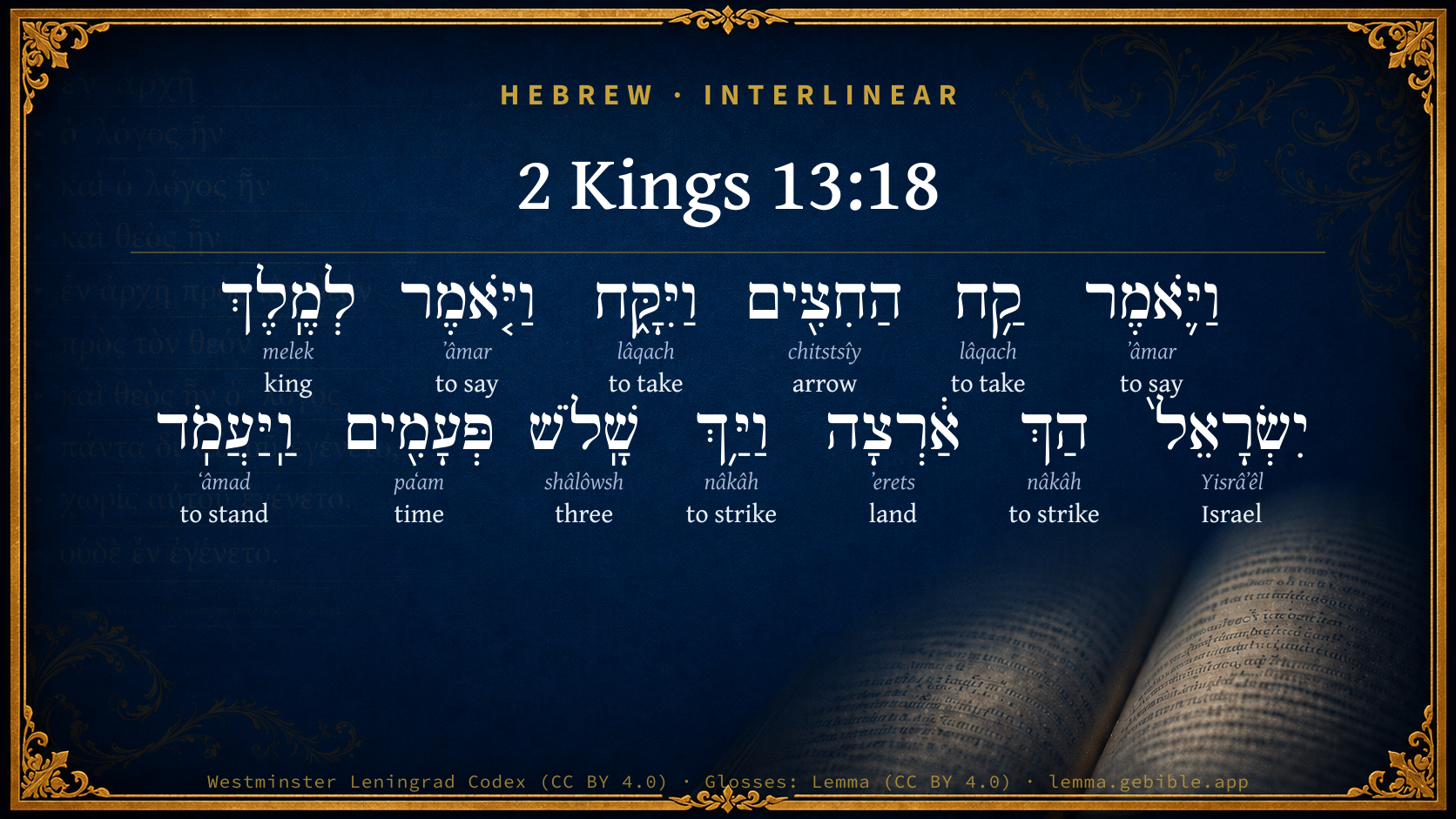
  1. וַיֹּ֛אמֶר ʼâmar H559 “and · to say” Conjunction + Verb, Qal, Sequential Imperfect, 3rd Person, Masculine, Singular
  2. קַ֥ח lâqach H3947 “take” Verb, Qal, Imperative, 2nd Person, Masculine, Singular
  3. וַיִּקָּ֑ח lâqach H3947 “and · to take” Conjunction + Verb, Qal, Sequential Imperfect, 3rd Person, Masculine, Singular
  4. וַיֹּ֤אמֶר ʼâmar H559 “and · to say” Conjunction + Verb, Qal, Sequential Imperfect, 3rd Person, Masculine, Singular
  5. לְמֶֽלֶךְ melek H4428 “to/for · king of” Preposition + Noun, Common, Masculine, Singular, Construct
  6. יִשְׂרָאֵל֙ Yisrâʼêl H3478 “Israel” Noun, Proper
  7. הַךְ nâkâh H5221 “strike” Verb, Hiphil, Imperative, 2nd Person, Masculine, Singular
  8. אַ֔רְצָה ʼerets H776 “land · toward” Noun, Common, Both, Singular, Absolute + Suffix, Demonstrative
  9. וַיַּ֥ךְ nâkâh H5221 “and · to strike” Conjunction + Verb, Hiphil, Sequential Imperfect, 3rd Person, Masculine, Singular
  10. שָֽׁלֹשׁ shâlôwsh H7969 “three” Adjective, Cardinal number, Feminine, Singular, Absolute
  11. פְּעָמִ֖ים paʻam H6471 “times” Noun, Common, Feminine, Plural, Absolute
  12. וַֽיַּעֲמֹֽד ʻâmad H5975 “and · to stand” Conjunction + Verb, Qal, Sequential Imperfect, 3rd Person, Masculine, Singular

About this verse

These counts appear in no published source. They are computed here, from the morphology-tagged text and Lemma’s own curated glosses. What Lemma adds →

13
words
10
distinct lemmas
Historical
section

Notable vocabulary

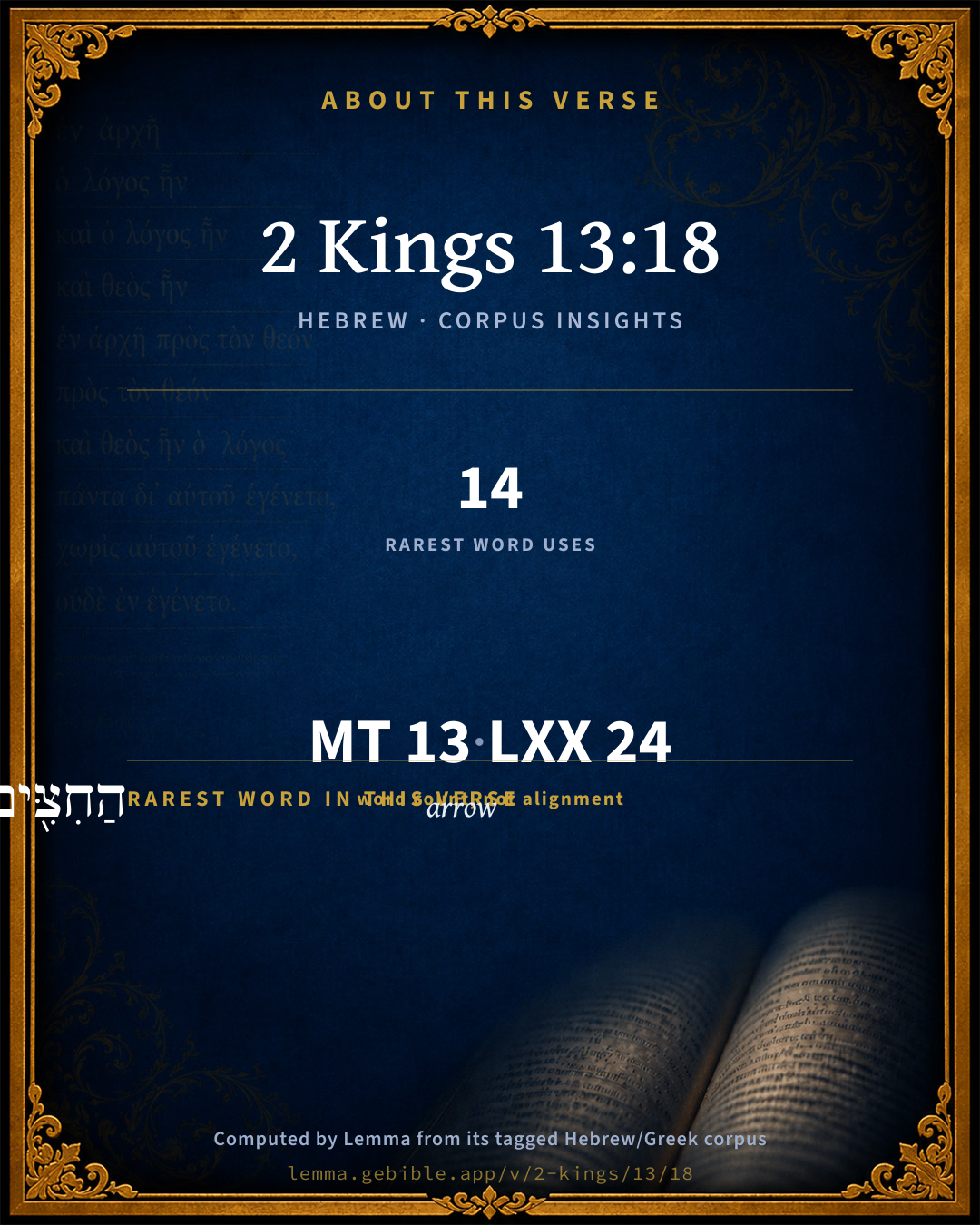
The rarest word here is הַחִצִּ֖ים arrow H2678 — appearing just 14 times in the whole Hebrew Bible.

Shared distinctive vocabulary

הַחִצִּ֖ים arrow H2678 occurs in 10 verses of the Hebrew Bible. Also found in:

Grammatical profile

  • 7 verbs
  • 5 nouns
  • 1 adjective

Verb forms

  • וַיֹּ֛אמֶר Qal · Sequential Imperfect
  • קַ֥ח Qal · Imperative
  • וַיִּקָּ֑ח Qal · Sequential Imperfect
  • וַיֹּ֤אמֶר Qal · Sequential Imperfect
  • הַךְ Hiphil · Imperative
  • וַיַּ֥ךְ Hiphil · Sequential Imperfect
  • וַֽיַּעֲמֹֽד Qal · Sequential Imperfect

Repetition

Words recur within this verse — often emphatic in Hebrew:

  • וַיֹּ֛אמֶר to say H559 ×2
  • קַ֥ח to take H3947 ×2
  • הַךְ to strike H5221 ×2

Hebrew & Septuagint length

In English translation the verse runs 26 words from the Hebrew and 33 from the Septuagint (LXX English) — closely comparable.

A rough comparison of the two English renderings, which tokenize alike — not a word-level alignment.

Word counts can differ between the Hebrew and the Greek without any difference in meaning — e.g. the Hebrew direct-object marker אֵת has no separate Greek word, and Greek often adds the article ὁ.

In the original languages it is 13 Hebrew tokens and 24 Greek tokens — but the two are counted differently (Hebrew bundles its prefixes and suffixes into one token; the Greek is in lemma form), so that isn’t a like-for-like length.

Cross-references

6

Topical passages linked to 2 Kings 13:18 in the Treasury of Scripture Knowledge — connected by theme and wording, ordered by reader-vote popularity; previews shown in the World English Bible.

  • 2 Kings 4:6 It happened, when the vessels were full, that she said to her son, Bring me yet a vessel. He said to her, There isn't another vessel. The oil stayed.
  • Exodus 17:11 It happened, when Moses held up his hand, that Israel prevailed; and when he let down his hand, Amalek prevailed.
  • Isaiah 20:2–4 at that time Yahweh spoke by Isaiah the son of Amoz, saying, Go, and loose the sackcloth from off your loins, and put your shoe from off your foot. He did so, walking naked and barefoot.
  • Ezekiel 4:1–10 You also, son of man, take a tile, and lay it before you, and portray on it a city, even Jerusalem:
  • Ezekiel 5:1–4 You, son of man, take a sharp sword; [as] a barber's razor shall you take it to you, and shall cause it to pass on your head and on your beard: then take balances to weigh, and divide the hair.
  • Ezekiel 12:1–7 The word of Yahweh also came to me, saying,

Cross-references courtesy of OpenBible.info (CC BY 4.0).

Hebrew and Greek witnesses Masoretic Hebrew ↔ Greek Septuagint

The same verse in the two great witnesses to the Old Testament, shown verse-for-verse.

These are two independent witnesses, not word-aligned to each other, and the Septuagint is shown in lemma (dictionary) form.

Hebrew 2 Kings 13:18 Masoretic · Westminster Leningrad Codex

וַיֹּ֛אמֶר קַ֥ח הַחִצִּ֖ים וַיִּקָּ֑ח וַיֹּ֤אמֶר לְמֶֽלֶךְ יִשְׂרָאֵל֙ הַךְ אַ֔רְצָה וַיַּ֥ךְ שָֽׁלֹשׁ פְּעָמִ֖ים וַֽיַּעֲמֹֽד

He said, Take the arrows; and he took them. He said to the king of Israel, Smite on the ground; and he struck thrice, and stayed.

World English Bible · Public Domain

Greek LXX 2 Kings 13:18 Septuagint · lemma form

καί εἶπον αὐτός ελισαιε λαμβάνω τόξον καί λαμβάνω καί εἶπον ὁ βασιλεύς ἰσραήλ πατάσσω εἰς ὁ γῆ καί πατάσσω ὁ βασιλεύς τρίς καί ἵστημι

And Elisaie said to him, Take bow and arrows. And he took them. And he said to the king of Israel, Strike upon the ground. And the king struck three times, and stayed.

LXX2012 (modern English Septuagint) · Public Domain

On this verse, Ellicott's Commentary for English Readers discusses the Septuagint’s reading. Read the note in Commentary ↓

Hebrew: Westminster Leningrad Codex (CC BY 4.0). Greek: Septuagint (public domain); English from LXX2012 (modern English Septuagint) (Public Domain). How the Septuagint differs from the Hebrew →

Targum (Aramaic paraphrase)

1

The Targum is the ancient Jewish Aramaic paraphrase of the Hebrew Scriptures — an interpretive translation, not the Hebrew text itself. Onkelos (literal) and Pseudo-Jonathan (expansive) render the Torah, and Jonathan the Prophets. Coverage is partial: where no permissively-licensed English translation exists for a verse, only the Aramaic is shown. This is verse-level text, not a word-by-word alignment to the Hebrew.

  1. Targum Jonathan Prophets (Joshua–Malachi)
    וַאֲמַר סַב גִרְרַיָא וּנְסִיב וַאֲמַר לְמַלְכָּא דְיִשְׂרָאֵל מְחֵי לְאַרְעָא וּמְחָא תְּלַת זִמְנִין וּפְסַק:

    (no public-domain English translation for this verse)

    Targum Jonathan — Aramaic: “Mikraot Gedolot” (public domain). English: “Sefaria Community Translation” (CC0 1.0 (public-domain dedication)); “London "Chaldee Paraphrase," 1871” (public domain). Text via Sefaria.

Commentary

Notes on 2 Kings 13:18 from classic Christian and Jewish commentators (each source and its license shown beneath its notes). The classic Christian expositions comment on the surrounding passage and are grouped to its opening verse, so a note may address several verses; the Jewish commentaries on the Tanakh (Rashi and others) are per-verse, so they appear only where the commentator wrote on this verse.

Lemma curates 59 commentaries, every one of them public domain or Creative Commons licensed, each selected and text-cleaned for this edition rather than reprinted as found. About our sources →

Trapp's Complete Commentary

John Trapp

2Ki 13:18 And he said, Take the arrows. And he took [them]. And he said unto the king of Israel, Smite upon the ground. And he smote thrice, and stayed.

Ver. 18. And he took them.] He is very morigerous to the prophet, as expecting good from him; only he stayed striking before he should, and that was to his loss. He should have continued smiting till the prophet had said, Enough.

John Trapp, A Commentary or Exposition upon All the Books of the Old and New Testament (1647–1656) — public domain. Text from a community e-Sword module.

Joseph Benson's Commentary

2Ki 13:18-19. Smite upon the ground — The former sign portended victory: and this was to declare the number of the victories. He smote thrice, and stayed — Through his inattention to, or unbelief of, the sign just given, concerning war with, victory over, and deliverance from Syria, or through indifference about that deliverance. The man of God was wroth with him — Whether Joash, before this interview with Elisha, was acquainted or not with the nature of those parabolic actions, whereby the prophets were accustomed to represent future events, he could not but perceive, by the comment which Elisha made upon the first arrow, which he calls the arrow of deliverance, that his shooting was a symbolical action, and intended to prefigure his victories over that nation; and, therefore, he might easily understand that this second action, of striking the ground with the arrow, was to portend the number of victories he was to obtain. And if, added to this, we may suppose, with the generality of interpreters, that the prophet had apprized him beforehand that such was the symbolical intent of what he now put him upon, that the oftener he smote upon the ground, the more would be the victories which his arms should obtain; and that thus, in some measure, his success in the war was put into his own power; the king’s conduct was utterly inexcusable, if, diffident of the prophet’s promise, and considering the great strength of the kings of Syria, more than the power of God, he stopped his hand after he had smote thrice, supposing that the prediction would never have been fulfilled, had he gone on and smote upon the earth oftener. Upon the whole, therefore, the prophet had just reason to be offended at the king for not believing God, who had done so many signal miracles in favour of the Israelites; for not believing him, who, according to his own acknowledgment, had been a constant defender of the state, and now, in his dying hours, was full of good wishes and intentions for his country. See Dodd, Le Clerc, and Patrick.

Joseph Benson's Commentary on the Old and New Testaments (1811–1818) — public domain. Text from a community e-Sword module.

Tyndale Open Study Notes

Tyndale Open Resources

13:18-19 Jehoash failed to act on his knowledge that the arrows signified victory over Aram (13:17). By striking the ground only three times, he unwittingly limited his own success against the Arameans; final victory came only later in the days of his son Jeroboam II (14:25-28).

Tyndale Open Study Notes — © Tyndale Open Resources, licensed CC BY-SA 4.0. Text via the HelloAO Bible API.

Adam Clarke's Commentary

Verse 18. Smite upon the ground] As he was ordered to take his arrows, the smiting on the ground must mean shooting arrows into it.

He smote thrice, and stayed.] The prophet knew that this shooting was emblematical: probably the king was not aware of what depended on the frequency of the action; and perhaps it was of the Lord that he smote only thrice, as he had determined to give Israel those three victories only over the Syrians. Elisha's being wroth because there were only three instead of five or six shots does not prove that God was wroth, or that he had intended to give the Syrians five or six overthrows.

Adam Clarke's Commentary on the Bible (1810–1826) — public domain. Text from a community e-Sword/MySword module.

Ellicott's Commentary for English Readers

(18) And he said.—LXX., “and Elisha said unto him,” which, as Thenius remarks, is more appropriate here, in introducing the account of the second symbolic action.

The arrows—i.e., the bundle of arrows.

Smite upon the ground.—Rather, smite (or, strike) earthwards; as if striking an enemy to the earth.

He smote thrice.—Three being a sacred number.

A Bible Commentary for English Readers, edited by Charles John Ellicott (1878–1897) — public domain. Text from a community e-Sword module.

The Cambridge Bible for Schools and Colleges

gen. ed. J. J. S. Perowne

18. Take the arrows] By the previous symbolical act, the prophet has directed the king to go eastward with courage against the enemy, assured that the Lord will be with his arrows, and will regard them as His own. He now proceeds to test the zeal of Joash.

Smite upon the ground] The Hebrew indicates the direction of the blows ‘towards the ground’. It appears as though the prophet wished blows to be aimed as if intended to strike down a foe. So the sense is equivalent to ‘strike (some one) down to the ground’. It does not seem that there was to be any shooting of the arrows in this second figurative action, but only a series of blows made with them as they were grasped, and aimed at some imaginary enemy who was to be brought down.

And he smote thrice, and stayed] On ‘stayed’ in this sense of ‘ceased’ cf. on 2Ki_4:6 above. The act, which was intended to be an index of his earnestness, is very feebly performed, and so the promise is curtailed: ‘now thou shalt smite Syria but thrice’.

The Cambridge Bible for Schools and Colleges (gen. ed. J. J. S. Perowne; Cambridge University Press, 1878–1918) — public domain. Text from a community e-Sword module.

John Gill's Exposition

And Elisha died, and they buried him,.... In Samaria. Epiphanius says (n), in Sebastopolis of Samaria, Samaria itself was called Sebaste in later times; though the Jews say (o) he was buried in Mount Carmel, in the cave of Elijah; according to the Jewish chronology (p), he died in the tenth year of Joash, and he prophesied more than sixty years; sixty six, as Abarbinel, since he began to prophesy in the nineteenth year of Jehoshaphat; and, according to Clemens (q) of Alexandria, when he was forty years of age; but it seems rather, as Kimchi observes, that he died in the beginning of the reign of Joash, and even before his father's death, when he was a partner with him in the throne, and before any salvation or deliverance from the Syrians was wrought:

and the bands of the Moabites invaded the land at the coming in of the year; at the spring of the year, when there was fruit on the earth, those troops of robbers came to plunder and spoil; several of the Jewish writers observe, that in the word for "coming", is instead of and so may be rendered "in that year", in that selfsame year that Elisha died; and so read the Syriac, Arabic, and the Vulgate Latin versions.

(n) De Vitis Prophet. c. 6. (o) Cippi Heb. p. 46. (p) Seder Olam Rabba, c. 19. (q) Stromat. l. 1. p. 326.

John Gill's Exposition of the Whole Bible (1746–1763) — public domain (CC PDM 1.0). Text via the HelloAO Bible API.

Albert Barnes' Notes on the Bible

Smite upon the ground - Some prefer to render - “Shoot to the ground;” i. e. “Shoot arrows from the window into the ground outside, as if thou wert shooting against an enemy.”

Albert Barnes' Notes on the Bible (1834–1885) — public domain. Text from a community e-Sword/MySword module.

Haydock's Catholic Bible Commentary

Still. This shewed a degree of remission. (Haydock) --- It was natural for the king to conclude, that the more he struck the earth, the greater would be his success; (Calmet) and the prophet had, perhaps, insinuated as much. (Menochius)

George Leo Haydock (1774–1849), Haydock's Catholic Family Bible and Commentary, 1859 edition — public domain. Excludes Psalms (Douay-Rheims chapter numbering differs from Protestant) and Deuterocanonical books (Catholic canon only).

Matthew Poole's English Annotations

Smite upon the ground: the former sign portended victory, and this was to declare the number of the victories.

Matthew Poole's English Annotations on the Holy Bible (1683–1685) — public domain. Text from a community e-Sword/MySword module.

The Pulpit Commentary

And he said, Take the arrows. And he took them. Elisha bade the king take into his band the remainder of the arrows which the quiver contained. This the king did, and held them in a bunch, as archers do when they have no quiver. And he said unto the King of Israel, Smite upon the ground. It is disputed what this means The LXX translate Pataxon eijv thn ghn "Strike upon the ground;" and so Ewald, De Wette, and Thenius, who regard the order as one to strike with the arrows against the ground (i.e. the floor) or in the direction of the ground. Keil and Bahr, on the contrary, think that the order was to shoot the arrows down from the window and hit the earth with them. But some contrast seems to be intended between the "shoot" (hry) of ver. 19 and the "strike" ( of the present passage. Ewald"s explanation is thus to be preferred. And he smote thrice, and stayed. Joash struck with the arrows against the floor three times, and then paused, thinking he had done enough. He did not enter into the spirit of the symbolical act, which represented the smiting and slaying of enemies. Perhaps he had not much faith in the virtue of the symbolism, which he may even, with the arrogance of a proud and worldly minded man, have thought childish.

The Pulpit Commentary (1880–1919), ed. H.D.M. Spence-Jones & Joseph S. Exell — public domain. Text from a community e-Sword module.

John Wesley's Explanatory Notes

Smite - The former sign portended victory, this was to declare the number of the victories.

John Wesley, Explanatory Notes Upon the Whole Bible (1754–1765) — public domain. Text via the GEBible commentary corpus.

Lesson kit

Teaching starters — assembled from the data on this page, not authored interpretation. Every prompt links to the verse data it draws on. Edit before teaching.

2 Kings, in the Historical, opens this verse with 13 words (10 distinct Hebrew lemmas). Its most distinctive word is chitstsîy (“arrow”). A historical commentator’s framing appears above. Read the whole chapter for the surrounding context.

Discussion questions

  1. How does “arrow” (chitstsîy) shape what this verse is saying?
  2. How does 1 Samuel 20:20, which shares the word «arrow», read alongside this verse?
  3. What does the repetition of “to say” (2× in this one verse) do in this verse?
  4. These translations render this verse differently; the difference is in the English rendering, not the original. What questions does that raise?
  5. «וַיֹּ֛אמֶר» is a Qal Sequential Imperfect verb. How does that grammatical form shape the action described?
  6. Compare how Trapp's Complete Commentary and Joseph Benson's Commentary read this verse. Where do they agree or differ?

Things to notice

Reading settings

Reading text

Shown beneath each verse's original-language words.

Old Testament
Old Testament edition

Read the OT as the Masoretic Hebrew (MT) or the Greek Septuagint (LXX).

English shown for the Greek Septuagint (in the Hebrew ↔ Greek comparison).

Comparing translations? Open the Compare panel on any verse page to stack up to four side by side.