Leviticus 18:23

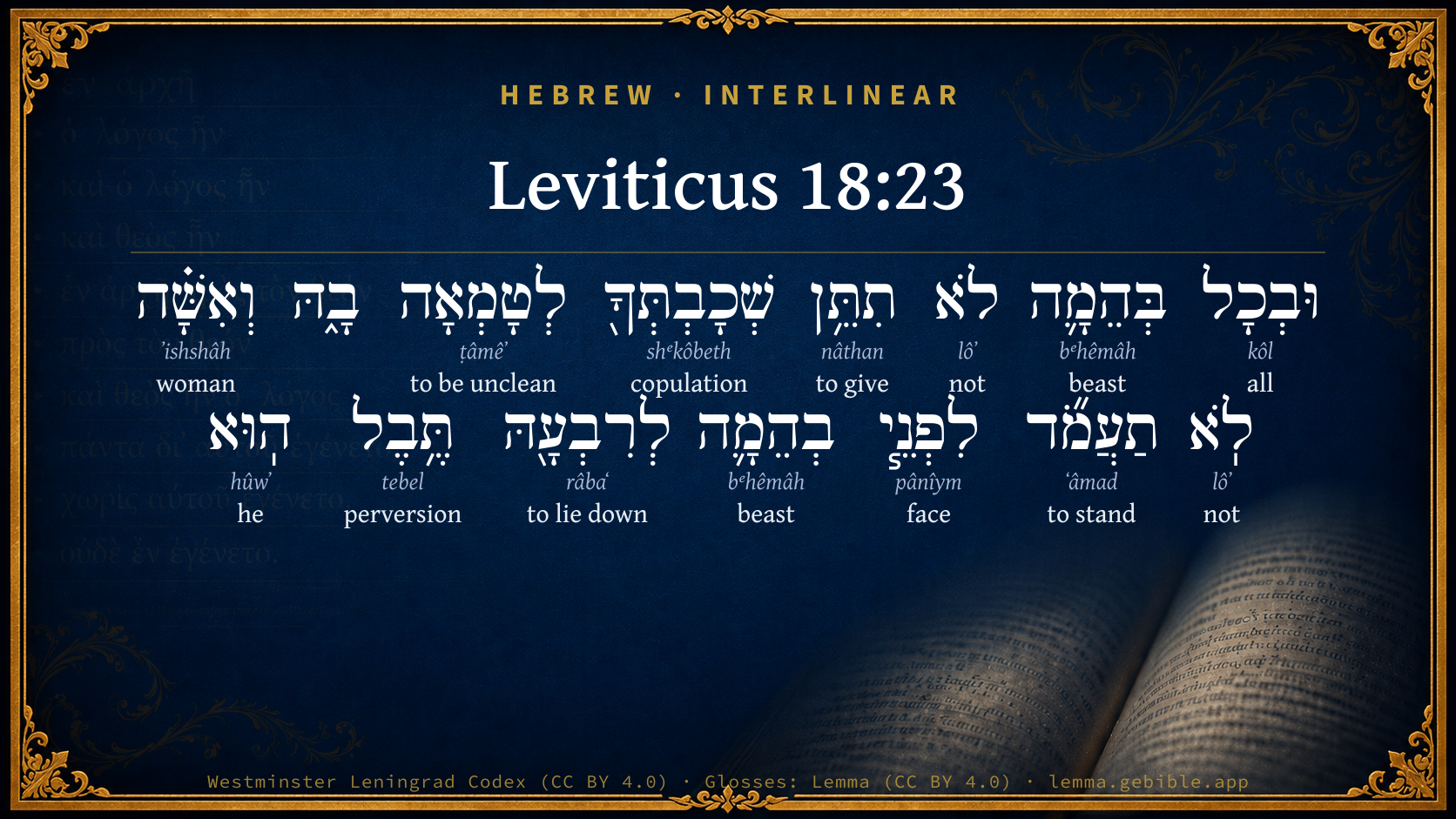
Hebrew (Westminster Leningrad Codex) Leviticus 18:23 appears in the Hebrew Old Testament. The text above is from the Westminster Leningrad Codex. Each word links to its Strong’s number, a concise gloss, and parsing drawn from the Open Scriptures Hebrew Bible morphology. Click any word for its full Brown-Driver-Briggs (BDB) entry.
Download image
Cite this verse

Leviticus 18:23 (World English Bible). Public Domain. Lemma interlinear Bible study tool, https://lemma.gebible.app/v/leviticus/18/23.

Show BibTeX & RIS
BibTeX
RIS
English Translation
"'You shall not lie with any animal to defile yourself with it; neither shall any woman give herself to an animal, to lie down with it: it is a perversion.
World English Bible · Public Domain
Highlights
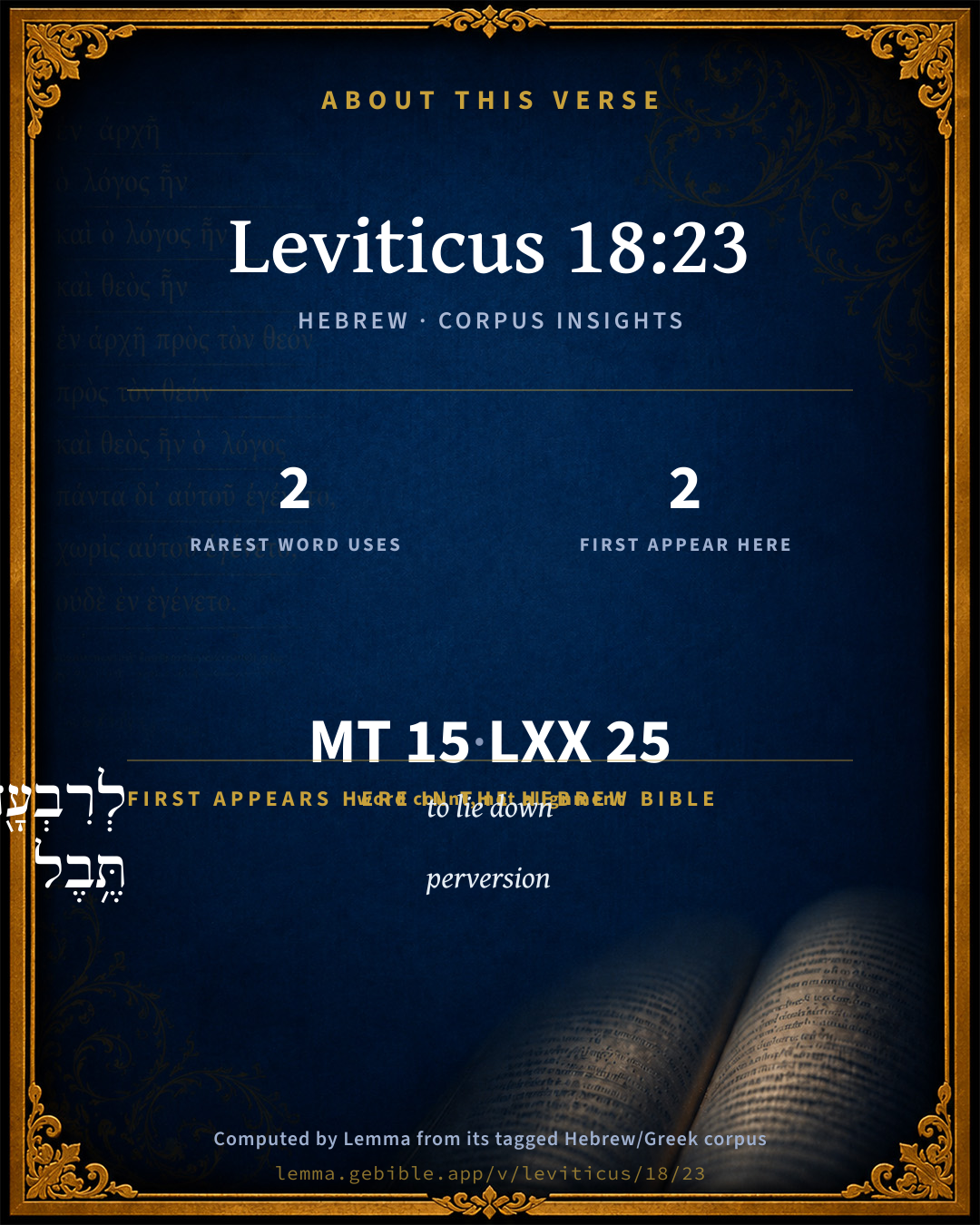
  • 2 first appearances in the Hebrew Bible
Full analysis ↓
Download a study sheet

One document with this verse’s original text, its word-by-word gloss line, the meaning frame, cross-references with their text, attributed commentary, and full source and license credits — printable, and it pastes into notes with its structure intact.

This verse Autodidact and up

Study sheet (.html) Plain text (.txt)

A passage Seminary Student

Up to 50 verses in one chapter. A passage sheet keeps up to 6 commentary sources and 12 cross-references per verse, in the order this page ranks them, and says so on the sheet whenever that leaves anything out. Ask for a single verse and you get the Autodidact verse sheet above.

Everything on this page stays free to read, with no account — the sheet is a download of what is already on screen, not access to it.

Want to remove ads? Support Godless Engineer
Compare translations 3

The same verse in 3 English versions, stacked beneath the original-language interlinear above. Click any original word for its lexicon entry.

Each is an independent rendering of the whole verse — the interlinear is not word-aligned to these translations.

Highlighted words mark where these versions differ — a whole-verse word diff, not a word-by-word alignment.

  • World English Bible Public Domain
    "'You shall not lie with any animal to defile yourself with it; neither shall any woman give herself to an animal, to lie down with it: it is a perversion.
  • King James Version Public Domain
    Neither shalt thou lie with any beast to defile thyself therewith: neither shall any woman stand before a beast to lie down thereto: it is confusion.
  • unfoldingWord Literal Text CC BY-SA 4.0
    And with any animal you shall not give your lying to become unclean by it. And a woman shall not stand to the face of an animal to mate with it. It perversion.

unfoldingWord Literal Text — © unfoldingWord, licensed CC BY-SA 4.0. Word-aligned USFM3 via Door43 (git.door43.org/unfoldingWord/en_ult).

Versions to compare (up to 4)

3 of 4 selected

Show all 18 translations

Every available English version of this verse, each an independent rendering of the whole verse.

  • World English Bible Public Domain
    "'You shall not lie with any animal to defile yourself with it; neither shall any woman give herself to an animal, to lie down with it: it is a perversion.
  • Berean Standard Bible Public Domain
    You must not lie carnally with any animal, thus defiling yourself with it; a woman must not stand before an animal to mate with it; that is a perversion.
  • Majority Standard Bible Public Domain
    You must not lie carnally with any animal, thus defiling yourself with it; a woman must not stand before an animal to mate with it; that is a perversion.
  • King James Version Public Domain
    Neither shalt thou lie with any beast to defile thyself therewith: neither shall any woman stand before a beast to lie down thereto: it is confusion.
  • American Standard Version (1901) Public Domain
    And thou shalt not lie with any beast to defile thyself therewith; neither shall any woman stand before a beast, to lie down thereto: it is confusion.
  • Revised Version (1885) Public Domain
    And thou shalt not lie with any beast to defile thyself therewith: neither shall any woman stand before a beast, to lie down thereto: it is confusion.
  • Geneva Bible (1599) Public Domain
    Thou shalt not also lie with any beast to bee defiled therewith, neither shall any woman stand before a beast, to lie downe thereto: for it is abomination.
  • Douay-Rheims (1899) Public Domain
    Thou shalt not copulate with any beast, neither shalt thou be defiled with it. A woman shall not lie down to a beast, nor copulate with it: because it is a heinous crime.
  • Young's Literal Translation Public Domain
    `And with any beast thou dost not give thy copulation, for uncleanness with it; and a woman doth not stand before a beast to lie down with it; confusion it `is'.
  • Literal Standard Version CC BY-SA 4.0
    And you do not commit your intercourse with any beast, to become unclean with it; and a woman does not stand before a beast to mate with it; it [is] perversion.
  • Unlocked Literal Bible CC BY-SA 4.0
    Do not sleep with any animal and defile yourself with it. No woman must consider sleeping with any animal. This would be perversion.
  • unfoldingWord Literal Text CC BY-SA 4.0
    And with any animal you shall not give your lying to become unclean by it. And a woman shall not stand to the face of an animal to mate with it. It perversion.
  • Darby Bible Public Domain
    And thou shalt lie with no beast to become unclean therewith; and a woman shall not stand before a beast to lie down with it: it is confusion.
  • World Messianic Bible Public Domain
    “‘You shall not lie with any animal to defile yourself with it. No woman may give herself to an animal, to lie down with it: it is a perversion.
  • Webster's Bible Public Domain
    Neither shalt thou lie with any beast to defile thyself therewith: neither shall any woman stand before a beast to lie down thereto: it is confusion.
  • Free Bible Version CC BY-SA 4.0
    Don't have sex with any animal. This would pollute you and make you unclean.
  • Bible in Basic English Public Domain
    And you may not have sex relations with a beast, making yourself unclean with it; and a woman may not give herself to a beast: it is an unnatural act.
  • JPS Tanakh (1917) Public Domain
    And thou shalt not lie with any beast to defile thyself therewith; neither shall any woman stand before a beast, to lie down thereto; it is perversion.

Literal Standard Version (2020), Covenant Press — licensed CC BY-SA 4.0. Text via the HelloAO Bible API (eBible.org). Unlocked Literal Bible (unfoldingWord) — licensed CC BY-SA 4.0. Text via the HelloAO Bible API (eBible.org). unfoldingWord Literal Text — © unfoldingWord, licensed CC BY-SA 4.0. Word-aligned USFM3 via Door43 (git.door43.org/unfoldingWord/en_ult). Free Bible Version, Dr. Jonathan Gallagher — licensed CC BY-SA 4.0. Text via the HelloAO Bible API (eBible.org).

Word by word

More ways to search: Search by grammar → Find every occurrence → Compare this word →

Practice this passage: Drill this verse → Learn its vocabulary →

תֶּ֥בֶל
tebel
H8397
“perversion”
Noun, Common, Masculine, Singular, Absolute
Part of Speech
Noun
Type
Common
Gender
Masculine
Number
Singular
State
Absolute
Full BDB Definition

Origin: apparently from H1101

TWOT: 248d

confusion (violation of nature or divine order) - perversion (in sexual sin)
  1. וּבְכָל kôl H3605 “and · in/at · all of” Conjunction + Preposition + Noun, Common, Masculine, Singular, Construct
  2. בְּהֵמָ֛ה bᵉhêmâh H929 “beast” Noun, Common, Feminine, Singular, Absolute
  3. לֹא lôʼ H3808 “not” Particle, Negative
  4. תִתֵּ֥ן nâthan H5414 “to give” Verb, Qal, Imperfect, 2nd Person, Masculine, Singular
  5. שְׁכָבְתְּךָ֖ shᵉkôbeth H7903 “copulation · your” Noun, Common, Feminine, Singular, Construct + Suffix, Personal, 2nd Person, Masculine, Singular
  6. לְטָמְאָה ṭâmêʼ H2930 “to be unclean” Preposition + Verb, Qal, Infinitive Construct
  7. וְאִשָּׁ֗ה ʼishshâh H802 “and · woman” Conjunction + Noun, Common, Feminine, Singular, Absolute
  8. לֹֽא lôʼ H3808 “not” Particle, Negative
  9. תַעֲמֹ֞ד ʻâmad H5975 “to stand” Verb, Qal, Imperfect, 3rd Person, Feminine, Singular
  10. לִפְנֵ֧י pânîym H6440 “to/for · face(s) of” Preposition + Noun, Common, Both, Plural, Construct
  11. בְהֵמָ֛ה bᵉhêmâh H929 “beast” Noun, Common, Feminine, Singular, Absolute
  12. לְרִבְעָ֖הּ râbaʻ H7250 “to lie down · her” Preposition + Verb, Qal, Infinitive Construct + Suffix, Personal, 3rd Person, Feminine, Singular
  13. הֽוּא hûwʼ H1931 “he” Pronoun, Personal, 3rd Person, Masculine, Singular

About this verse

These counts appear in no published source. They are computed here, from the morphology-tagged text and Lemma’s own curated glosses. What Lemma adds →

15
words
12
distinct lemmas
Pentateuch
section

Notable vocabulary

The rarest word here is תֶּ֥בֶל perversion H8397 — appearing just 2 times in the whole Hebrew Bible.

First appearance in Scripture

These words make their first canonical appearance in the Hebrew Bible here:

  • לְרִבְעָ֖הּ to lie down H7250
  • תֶּ֥בֶל perversion H8397

Shared distinctive vocabulary

תֶּ֥בֶל perversion H8397 occurs in 2 verses of the Hebrew Bible. Also found in:

Grammatical profile

  • 4 verbs
  • 7 nouns
  • 1 pronoun
  • 1 preposition
  • 2 particles

Verb forms

  • תִתֵּ֥ן Qal · Imperfect
  • לְטָמְאָה Qal · Infinitive Construct
  • תַעֲמֹ֞ד Qal · Imperfect
  • לְרִבְעָ֖הּ Qal · Infinitive Construct

Repetition

Words recur within this verse — often emphatic in Hebrew:

  • בְּהֵמָ֛ה beast H929 ×2
  • לֹא not H3808 ×2

Hebrew & Septuagint length

In English translation the verse runs 30 words from the Hebrew and 33 from the Septuagint (LXX English) — closely comparable.

A rough comparison of the two English renderings, which tokenize alike — not a word-level alignment.

Word counts can differ between the Hebrew and the Greek without any difference in meaning — e.g. the Hebrew direct-object marker אֵת has no separate Greek word, and Greek often adds the article ὁ.

In the original languages it is 15 Hebrew tokens and 25 Greek tokens — but the two are counted differently (Hebrew bundles its prefixes and suffixes into one token; the Greek is in lemma form), so that isn’t a like-for-like length.

Cross-references

4

Topical passages linked to Leviticus 18:23 in the Treasury of Scripture Knowledge — connected by theme and wording, ordered by reader-vote popularity; previews shown in the World English Bible.

  • Exodus 22:19 "Whoever has sex with an animal shall surely be put to death.
  • Leviticus 20:15–16 "'If a man lies with an animal, he shall surely be put to death; and you shall kill the animal.
  • Leviticus 20:12 "'If a man lies with his daughter-in-law, both of them shall surely be put to death: they have committed a perversion; their blood shall be upon them.
  • Deuteronomy 27:21 Cursed be he who lies with any manner of animal. All the people shall say, Amen.

Cross-references courtesy of OpenBible.info (CC BY 4.0).

Hebrew and Greek witnesses Masoretic Hebrew ↔ Greek Septuagint

The same verse in the two great witnesses to the Old Testament, shown verse-for-verse.

These are two independent witnesses, not word-aligned to each other, and the Septuagint is shown in lemma (dictionary) form.

Hebrew Leviticus 18:23 Masoretic · Westminster Leningrad Codex

וּבְכָל בְּהֵמָ֛ה לֹא תִתֵּ֥ן שְׁכָבְתְּךָ֖ לְטָמְאָה בָ֑הּ וְאִשָּׁ֗ה לֹֽא תַעֲמֹ֞ד לִפְנֵ֧י בְהֵמָ֛ה לְרִבְעָ֖הּ תֶּ֥בֶל הֽוּא

"'You shall not lie with any animal to defile yourself with it; neither shall any woman give herself to an animal, to lie down with it: it is a perversion.

World English Bible · Public Domain

Greek LXX Leviticus 18:23 Septuagint · lemma form

καί πρός πᾶς τετράπους οὐ δίδωμι ὁ κοίτη σύ εἰς σπερματισμός ἐκμιαίνω πρός αὐτός καί γυνή οὐ ἵστημι πρός πᾶς τετράπους βιβάζω μυσερός γάρ εἰμί

Neither shall you lie with any quadruped for copulation, to be polluted with it: neither shall a woman present herself before any quadruped to have connexion with it; for it is an abomination.

LXX2012 (modern English Septuagint) · Public Domain

Hebrew: Westminster Leningrad Codex (CC BY 4.0). Greek: Septuagint (public domain); English from LXX2012 (modern English Septuagint) (Public Domain). How the Septuagint differs from the Hebrew →

Targum (Aramaic paraphrase)

2

The Targum is the ancient Jewish Aramaic paraphrase of the Hebrew Scriptures — an interpretive translation, not the Hebrew text itself. Onkelos (literal) and Pseudo-Jonathan (expansive) render the Torah, and Jonathan the Prophets. Coverage is partial: where no permissively-licensed English translation exists for a verse, only the Aramaic is shown. This is verse-level text, not a word-by-word alignment to the Hebrew.

  1. Targum Onkelos Torah (Genesis–Deuteronomy)
    וּבְכָל בְּעִירָא לָא תִתֵּן שְׁכֻבְתָּךְ לְאִסְתָּאָבָא בָהּ וְאִתְּתָא לָא תְקוּם קֳדָם בְּעִירָא לְמִשְׁלַט בָּהּ תִּבְלָא הוּא

    (no public-domain English translation for this verse)

    Targum Onkelos — Aramaic: “Onkelos Genesis” (public domain); “Onkelos Exodus” (public domain); “Onkelos Leviticus” (public domain); “Onkelos Numbers” (public domain); “Onkelos Deuteronomy” (public domain). English: “Sefaria Community Translation” (CC0 1.0 (public-domain dedication)); “J.W. Etheridge. The Targums of Onkelos and Jonathan Ben Uzziel on the Pentateuch. London: Longmans, Green, 1862” (public domain). Text via Sefaria.

  2. Targum Pseudo-Jonathan Torah (Genesis–Deuteronomy)
    וּבְכָל בְּעִירָא לָא תִתֵּן תַּשְׁמִישָׁךְ לְאִסְתָּאֲבָא בָּהּ וְאִתְּתָא לָא תִקְרַב קֳדָם בְּעִירָא לְאִתְהַנְיָא מִינֵיהּ תִּבְלָא הוּא

    Neither shalt thou lie with any beast to corrupt thyseIf therewith nor shall any woman approach before a beast for evil pleasure; it is confusion.

    Targum Pseudo-Jonathan — Aramaic: “Targum Jonathan on Genesis” (public domain); “Targum Jonathan on Exodus” (public domain); “Targum Jonathan on Leviticus” (public domain); “Targum Jonathan on Numbers” (public domain); “Targum Jonathan on Deuteronomy” (public domain). English: “The Targum of Jonathan ben Uzziel, trans. J. W. Etheridge, London, 1862” (public domain). Text via Sefaria.

Commentary

Notes on Leviticus 18:23 from classic Christian and Jewish commentators (each source and its license shown beneath its notes). The classic Christian expositions comment on the surrounding passage and are grouped to its opening verse, so a note may address several verses; the Jewish commentaries on the Tanakh (Rashi and others) are per-verse, so they appear only where the commentator wrote on this verse.

Lemma curates 59 commentaries, every one of them public domain or Creative Commons licensed, each selected and text-cleaned for this edition rather than reprinted as found. About our sources →

Trapp's Complete Commentary

John Trapp

Lev 18:23 Neither shalt thou lie with any beast to defile thyself therewith: neither shall any woman stand before a beast to lie down thereto: it [is] confusion.

Ver. 23. Neither shalt thou lie with any beast.] See what a foul sink of sin man’s nature is! Who would think that any such surpassing wickedness - so {a} Aristotle calls bestiality - should ever enter into man’s heart? But "there, as in the sea, is that Leviathan," the devil, and there are "creeping things," abominable and ugly lusts, "innumerable." {b}

{a} υπερβαλλουσα τις κακια η θηριστης.

{b} 2. Mag. Mor., cap. 5.

John Trapp, A Commentary or Exposition upon All the Books of the Old and New Testament (1647–1656) — public domain. Text from a community e-Sword module.

Tyndale Open Study Notes

Tyndale Open Resources

18:23 Like homosexuality, bestiality is a violation of the natural order (see study note on 18:22). • The phrase perverse act referred not only to a violation, but to a confusion of the order God created because it broke down clear boundaries that he had established.

Tyndale Open Study Notes — © Tyndale Open Resources, licensed CC BY-SA 4.0. Text via the HelloAO Bible API.

Geneva Bible (1599)

Geneva Bible translators

Or, confusion.

Geneva Bible (1599) marginal notes — public domain. Text via Bolls.life.

Adam Clarke's Commentary

Verse 23. With any beast] This abomination is also punishable with death by the laws of this country.

Any woman stand before a beast] That this was often done in Egypt there can be no doubt; and we have already seen, from the testimony of Herodotus, that a fact of this kind actually took place while he was in Egypt. See Clarke on Le 17:7, and "Le 20:16".

Adam Clarke's Commentary on the Bible (1810–1826) — public domain. Text from a community e-Sword/MySword module.

Ellicott's Commentary for English Readers

(23) Any beast.—The necessity for the prohibition of this shocking crime, for which the Mosaic law enacts the penalty of death (see Lev_20:15-16; Exo_22:18), will appear all the more important when it is borne in mind that this degrading practice actually formed a part of the religious worship of the Egyptians in connection with the goat deities.

A Bible Commentary for English Readers, edited by Charles John Ellicott (1878–1897) — public domain. Text from a community e-Sword module.

John Gill's Exposition

Neither shall thou lie with any beast, to defile thyself therewith,.... A female one, as Aben Ezra notes, as a mare, cow, or ewe, or any other beast, small or great, as Ben Gersom, or whether tame or wild, as Maimonides (b); and even fowls are comprehended, as the same writers observe:

neither shall any woman stand before a beast to lie down thereto: that is, stand before a beast, and by a lascivious and obscene behaviour solicit the beast to a congress with her, and then lie down after the manner of four-footed beasts, as the word signifies, that it may have carnal copulation with her: for a man to lie with a beast is most shocking and detestable, but for a woman to solicit such an unnatural mixture is most horrible and astonishing: perhaps reference may be had to a most shocking practice among the Egyptians, from among whom the Israelites were lately come, and whose doings they were not to imitate, Lev 18:3; and which may account for this law, as Bishop Patrick observes: at Mendes, in Egypt, a goat was worshipped, as has been remarked Lev 18:7; and where the women used to lie with such creatures, as Strabo (c) and Aelianus (d) from Pindar have related; yea, Herodotus (e) reports, of his own knowledge, that a goat had carnal copulation with a woman openly, in the view of all, in his time; and though that creature is a most lascivious and lustful one, yet, as Bochart (f) from Plutarch has observed, when it is provoked by many and beautiful women, is not inclined and ready to come into their embraces, but shows some abhorrence of it: nature in brutes, as that learned man observes, is often more prevalent in them than in mankind:

it is confusion; a mixing of the seed of man and beast together, a blending of different kinds of creatures, a perverting the order of nature, and introducing the utmost confusion of beings, from whence monsters in nature may arise.

(b) Hilchot Issure Biah, c. 1. sect. 16. (c) Geograph. l. 17. p. 551. (d) De Animal. l. 7. c. 19. (e) Euterpe, sive, l. 2. c. 46. (f) Hierozoic. par. 1. l. 2. c. 53. col. 642.

John Gill's Exposition of the Whole Bible (1746–1763) — public domain (CC PDM 1.0). Text via the HelloAO Bible API.

Haydock's Catholic Bible Commentary

Crime. Hebrew, "confusion." The Egyptians did so with goats, as part of their religion. See chap. xx. 16. and An. Univ. Hist. We need not, however, infer from this law, that the crime was common among the Jews, as Voltaire would insinuate. (Haydock) --- Nothing but monsters can proceed from such wickedness. (Menochius)

George Leo Haydock (1774–1849), Haydock's Catholic Family Bible and Commentary, 1859 edition — public domain. Excludes Psalms (Douay-Rheims chapter numbering differs from Protestant) and Deuterocanonical books (Catholic canon only).

Matthew Poole's English Annotations

A horrible confusion of the natures which God hath distinguished, and of the order which God hath appointed, and an overthrow of. all bounds of religion, honesty, sobriety, and modesty.

Matthew Poole's English Annotations on the Holy Bible (1683–1685) — public domain. Text from a community e-Sword/MySword module.

Whedon's Commentary on the Bible

Daniel D. Whedon

23. With any beast — Let him who denies the inherent depravity of man study this prohibition. This prohibition implies the sacredness and dignity of human nature, inasmuch as the abomination was punished by death. In Egypt women publicly submitted themselves to goats. Nor has unregenerate nature entirely outgrown its dreadful downward tendency. In modern Egypt men lie even with female crocodiles. (Sonnini, R. 11, p. 330.) The heathen generally have no moral abhorrence for this crime. The Revised Statutes of Massachusetts, a foremost Christian State, contains this law: “Whoever commits the abominable and detestable crime against nature, either with mankind or with any beast, shall be punished in the State prison not exceeding twenty years.”

Confusion — Hebrew tebhel, pollution or profanation.

Daniel D. Whedon (gen. ed.), Commentary on the Old and New Testaments (1874–1909) — public domain. Text from a community e-Sword module.

The Pulpit Commentary

The fifth prohibition (see Herod., 2:16). The penalty is death. (Lev_20:15)

The Pulpit Commentary (1880–1919), ed. H.D.M. Spence-Jones & Joseph S. Exell — public domain. Text from a community e-Sword module.

Rashi

Rabbi Shlomo Yitzchaki (Rashi)

תבל הוא THIS IS CONFUSION — תבל is an expression used for unchastity, incest and adultery. Similar is (Jeremiah 10:25) “Mine anger because of their depravity (תבליתם)". Another explanation of תבל הוא: it is an expression denoting the mingling (root בלל) and fusion of the human seed and the animal seed.

Rashi on the Tanakh — English translations: “The Judaica Press complete Tanach with Rashi, translated by A. J. Rosenberg” (CC BY 4.0); “Pentateuch with Rashi's commentary by M. Rosenbaum and A.M. Silbermann, 1929-1934” (public domain); “The Metsudah Tanach series, Lakewood, N.J” (CC BY 4.0); and “The Book of Joshua, Metsudah Publications, 1997” (CC BY 4.0). Text via Sefaria.

Lesson kit

Teaching starters — assembled from the data on this page, not authored interpretation. Every prompt links to the verse data it draws on. Edit before teaching.

Leviticus, in the Pentateuch, opens this verse with 15 words (12 distinct Hebrew lemmas). Its most distinctive word is tebel (“perversion”). A historical commentator’s framing appears above. Read the whole chapter for the surrounding context.

Discussion questions

  1. What does “perversion” (tebel) contribute to the verse as a whole?
  2. 2 words here appear for the first time in Scripture. What is being introduced at this debut?
  3. Leviticus 20:12 shares the word «perversion» with this verse. How do the two illuminate each other?
  4. “beast” occurs 2× in this one verse. What is the effect of the repetition?
  5. These translations render this verse differently; the difference is in the English rendering, not the original. What questions does that raise?
  6. The verb «תִתֵּ֥ן» is Qal Imperfect. How does its form color the action?
  7. Reading how Trapp's Complete Commentary and Tyndale Open Study Notes read this verse, where do the two commentators agree and where do they part?

Things to notice

Reading settings

Reading text

Shown beneath each verse's original-language words.

Old Testament
Old Testament edition

Read the OT as the Masoretic Hebrew (MT) or the Greek Septuagint (LXX).

English shown for the Greek Septuagint (in the Hebrew ↔ Greek comparison).

Comparing translations? Open the Compare panel on any verse page to stack up to four side by side.