2 Samuel 1:9

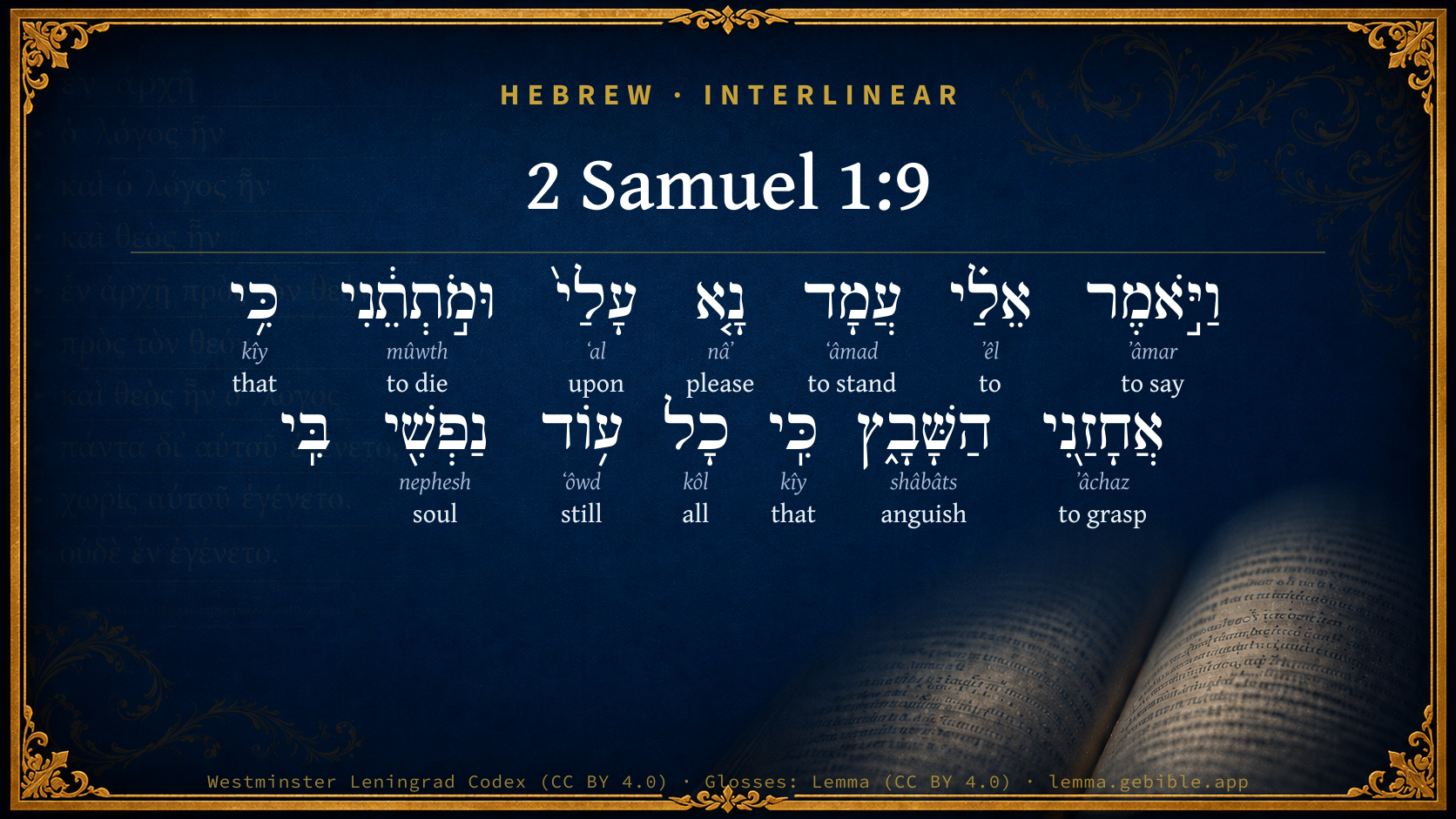
Hebrew (Westminster Leningrad Codex) 2 Samuel 1:9 appears in the Hebrew Old Testament. The text above is from the Westminster Leningrad Codex. Each word links to its Strong’s number, a concise gloss, and parsing drawn from the Open Scriptures Hebrew Bible morphology. Click any word for its full Brown-Driver-Briggs (BDB) entry.
Download image
Cite this verse

2 Samuel 1:9 (World English Bible). Public Domain. Lemma interlinear Bible study tool, https://lemma.gebible.app/v/2-samuel/1/9.

Show BibTeX & RIS
BibTeX
RIS
English Translation
He said to me, Stand, I pray you, beside me, and kill me; for anguish has taken hold of me, because my life is yet whole in me.
World English Bible · Public Domain
Highlights
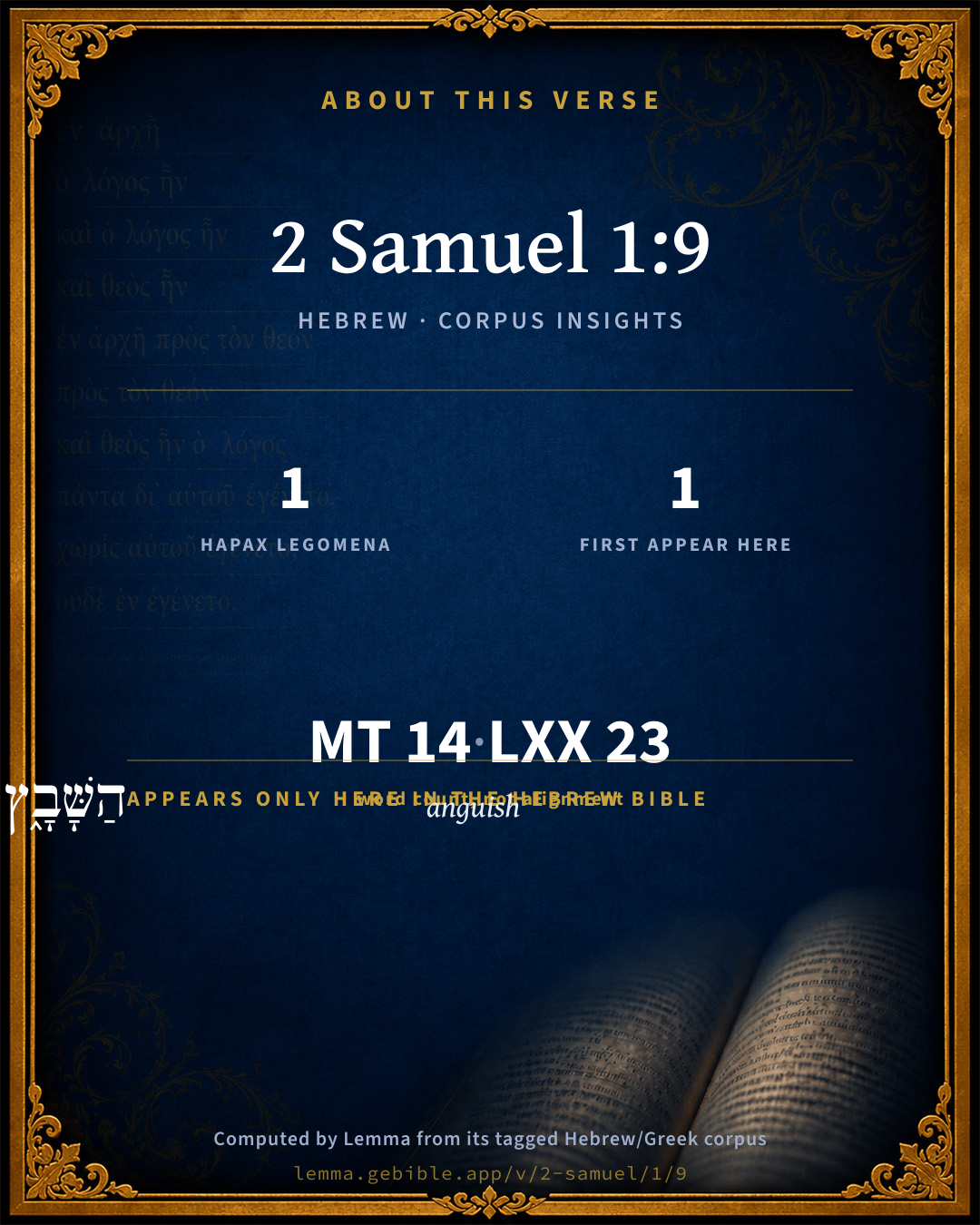
  • 1 hapax legomenon — only here in the Hebrew Bible
  • 1 first appearance in the Hebrew Bible
Full analysis ↓
Download a study sheet

One document with this verse’s original text, its word-by-word gloss line, the meaning frame, cross-references with their text, attributed commentary, and full source and license credits — printable, and it pastes into notes with its structure intact.

This verse Autodidact and up

Study sheet (.html) Plain text (.txt)

A passage Seminary Student

Up to 50 verses in one chapter. A passage sheet keeps up to 6 commentary sources and 12 cross-references per verse, in the order this page ranks them, and says so on the sheet whenever that leaves anything out. Ask for a single verse and you get the Autodidact verse sheet above.

Everything on this page stays free to read, with no account — the sheet is a download of what is already on screen, not access to it.

Want to remove ads? Support Godless Engineer
Compare translations 3

The same verse in 3 English versions, stacked beneath the original-language interlinear above. Click any original word for its lexicon entry.

Each is an independent rendering of the whole verse — the interlinear is not word-aligned to these translations.

Highlighted words mark where these versions differ — a whole-verse word diff, not a word-by-word alignment.

  • World English Bible Public Domain
    He said to me, Stand, I pray you, beside me, and kill me; for anguish has taken hold of me, because my life is yet whole in me.
  • King James Version Public Domain
    He said unto me again, Stand, I pray thee, upon me, and slay me: for anguish is come upon me, because my life is yet whole in me.
  • unfoldingWord Literal Text CC BY-SA 4.0
    And he said to me, ‘Please stand over me and kill me, for agony has seized me, for my life still whole in me.’

unfoldingWord Literal Text — © unfoldingWord, licensed CC BY-SA 4.0. Word-aligned USFM3 via Door43 (git.door43.org/unfoldingWord/en_ult).

Versions to compare (up to 4)

3 of 4 selected

Show all 18 translations

Every available English version of this verse, each an independent rendering of the whole verse.

  • World English Bible Public Domain
    He said to me, Stand, I pray you, beside me, and kill me; for anguish has taken hold of me, because my life is yet whole in me.
  • Berean Standard Bible Public Domain
    Then he begged me, ‘Stand over me and kill me, for agony has seized me, but my life still lingers.’
  • Majority Standard Bible Public Domain
    Then he begged me, ‘Stand over me and kill me, for agony has seized me, but my life still lingers.’
  • King James Version Public Domain
    He said unto me again, Stand, I pray thee, upon me, and slay me: for anguish is come upon me, because my life is yet whole in me.
  • American Standard Version (1901) Public Domain
    And he said unto me, Stand, I pray thee, beside me, and slay me; for anguish hath taken hold of me, because my life is yet whole in me.
  • Revised Version (1885) Public Domain
    And he said unto me, Stand, I pray thee, beside me, and slay me, for anguish hath taken hold of me; because my life is yet whole in me.
  • Geneva Bible (1599) Public Domain
    Then saide hee vnto me, I pray thee come vpon mee, and slay me: for anguish is come vpon me, because my life is yet whole in me.
  • Douay-Rheims (1899) Public Domain
    And he said to me: Stand over me, and kill me: for anguish is come upon me, and as yet my whole life is in me.
  • Young's Literal Translation Public Domain
    `And he saith unto me, Stand, I pray thee, over me, and put me to death, for seized me hath the arrow, for all my soul `is' still in me.
  • Literal Standard Version CC BY-SA 4.0
    And he says to me, Please stand over me and put me to death, for the arrow has seized me, for all my soul [is] still in me.
  • Unlocked Literal Bible CC BY-SA 4.0
    He said to me, 'Please stand over me and kill me, for great suffering has taken hold of me, but life is still in me.'
  • unfoldingWord Literal Text CC BY-SA 4.0
    And he said to me, ‘Please stand over me and kill me, for agony has seized me, for my life still whole in me.’
  • Darby Bible Public Domain
    He said to me again, Stand, I pray thee, over me, and slay me; for anguish has seized me; for my life is yet whole in me.
  • World Messianic Bible Public Domain
    He said to me, ‘Please stand beside me, and kill me, for anguish has taken hold of me because my life lingers in me.’
  • Webster's Bible Public Domain
    He said to me again, Stand, I pray thee, upon me, and slay me: for anguish is come upon me, because my life is yet whole in me.
  • Free Bible Version CC BY-SA 4.0
    Then he told me, ‘Please come over here and kill me! I'm in terrible agony but life is still hanging on.’
  • Bible in Basic English Public Domain
    Then he said to me, Come here to my side, and put me to death, for the pain of death has me in its grip but my life is still strong in me.
  • JPS Tanakh (1917) Public Domain
    And he said unto me: Stand, I pray thee, beside me, and slay me, for the agony hath taken hold of me; because my life is just yet in me.

Literal Standard Version (2020), Covenant Press — licensed CC BY-SA 4.0. Text via the HelloAO Bible API (eBible.org). Unlocked Literal Bible (unfoldingWord) — licensed CC BY-SA 4.0. Text via the HelloAO Bible API (eBible.org). unfoldingWord Literal Text — © unfoldingWord, licensed CC BY-SA 4.0. Word-aligned USFM3 via Door43 (git.door43.org/unfoldingWord/en_ult). Free Bible Version, Dr. Jonathan Gallagher — licensed CC BY-SA 4.0. Text via the HelloAO Bible API (eBible.org).

Word by word

More ways to search: Search by grammar → Find every occurrence → Compare this word →

Practice this passage: Drill this verse → Learn its vocabulary →

הַשָּׁבָ֑ץ
shâbâts
H7661
“the · anguish”
Particle, Definite Article + Noun, Common, Masculine, Singular, Absolute
Part of Speech
Particle + Noun
Type
Common
Gender
Masculine
Number
Singular
State
Absolute
Full BDB Definition

Origin: from H7660

TWOT: 2320a

cramp, agony, anguish - meaning dubious
  1. וַיֹּ֣אמֶר ʼâmar H559 “and · to say” Conjunction + Verb, Qal, Sequential Imperfect, 3rd Person, Masculine, Singular
  2. אֵלַ֗י ʼêl H413 “to · me” Preposition + Suffix, Personal, 1st Person, Common, Singular
  3. עֲמָד ʻâmad H5975 “stand” Verb, Qal, Imperative, 2nd Person, Masculine, Singular
  4. נָ֤א nâʼ H4994 “please” Particle, Exhortation
  5. עָלַי֙ ʻal H5921 “upon · me” Preposition + Suffix, Personal, 1st Person, Common, Singular
  6. וּמֹ֣תְתֵ֔נִי mûwth H4191 “and · die · me” Conjunction + Verb, Polel, Imperative, 2nd Person, Masculine, Singular + Suffix, Personal, 1st Person, Common, Singular
  7. כִּ֥י kîy H3588 “that” Conjunction
  8. אֲחָזַ֖נִי ʼâchaz H270 “to grasp · me” Verb, Qal, Perfect, 3rd Person, Masculine, Singular + Suffix, Personal, 1st Person, Common, Singular
  9. כִּֽי kîy H3588 “that” Conjunction
  10. כָל kôl H3605 “all of” Noun, Common, Masculine, Singular, Construct
  11. ע֥וֹד ʻôwd H5750 “still” Adverb
  12. נַפְשִׁ֖י nephesh H5315 “soul · my” Noun, Common, Both, Singular, Construct + Suffix, Personal, 1st Person, Common, Singular

About this verse

These counts appear in no published source. They are computed here, from the morphology-tagged text and Lemma’s own curated glosses. What Lemma adds →

14
words
12
distinct lemmas
Historical
section

Notable vocabulary

1 hapax legomenon — a word that appears only here in the entire Hebrew Bible:

  • הַשָּׁבָ֑ץ anguish H7661

First appearance in Scripture

This word makes its first canonical appearance in the Hebrew Bible here:

  • הַשָּׁבָ֑ץ anguish H7661

Grammatical profile

  • 4 verbs
  • 3 nouns
  • 3 prepositions
  • 2 conjunctions
  • 1 adverb
  • 1 particle

Verb forms

  • וַיֹּ֣אמֶר Qal · Sequential Imperfect
  • עֲמָד Qal · Imperative
  • וּמֹ֣תְתֵ֔נִי Polel · Imperative
  • אֲחָזַ֖נִי Qal · Perfect

Repetition

A word recurs within this verse — often emphatic in Hebrew:

  • כִּ֥י that H3588 ×2

Hebrew & Septuagint length

In English translation the verse runs 28 words from the Hebrew and 29 from the Septuagint (LXX English) — closely comparable.

A rough comparison of the two English renderings, which tokenize alike — not a word-level alignment.

Word counts can differ between the Hebrew and the Greek without any difference in meaning — e.g. the Hebrew direct-object marker אֵת has no separate Greek word, and Greek often adds the article ὁ.

In the original languages it is 14 Hebrew tokens and 23 Greek tokens — but the two are counted differently (Hebrew bundles its prefixes and suffixes into one token; the Greek is in lemma form), so that isn’t a like-for-like length.

Hebrew and Greek witnesses Masoretic Hebrew ↔ Greek Septuagint

The same verse in the two great witnesses to the Old Testament, shown verse-for-verse.

These are two independent witnesses, not word-aligned to each other, and the Septuagint is shown in lemma (dictionary) form.

Hebrew 2 Samuel 1:9 Masoretic · Westminster Leningrad Codex

וַיֹּ֣אמֶר אֵלַ֗י עֲמָד נָ֤א עָלַי֙ וּמֹ֣תְתֵ֔נִי כִּ֥י אֲחָזַ֖נִי הַשָּׁבָ֑ץ כִּֽי כָל ע֥וֹד נַפְשִׁ֖י בִּֽי

He said to me, Stand, I pray you, beside me, and kill me; for anguish has taken hold of me, because my life is yet whole in me.

World English Bible · Public Domain

Greek LXX 2 Samuel 1:9 Septuagint · lemma form

καί εἶπον πρός ἐγώ ἵστημι δή ἐπιἄνω ἐγώ καί θανατόω ἐγώ ὅτι καταἔχω ἐγώ σκότος δεινός ὅτι πᾶς ὁ ψυχή ἐγώ ἐν ἐγώ

And he said to me, Stand, I pray you, over me, and kill me, for a dreadful darkness has come upon me, for all my life is in me.

LXX2012 (modern English Septuagint) · Public Domain

On this verse, The Cambridge Bible for Schools and Colleges discusses the Septuagint’s reading. Read the note in Commentary ↓

Hebrew: Westminster Leningrad Codex (CC BY 4.0). Greek: Septuagint (public domain); English from LXX2012 (modern English Septuagint) (Public Domain). How the Septuagint differs from the Hebrew →

Targum (Aramaic paraphrase)

1

The Targum is the ancient Jewish Aramaic paraphrase of the Hebrew Scriptures — an interpretive translation, not the Hebrew text itself. Onkelos (literal) and Pseudo-Jonathan (expansive) render the Torah, and Jonathan the Prophets. Coverage is partial: where no permissively-licensed English translation exists for a verse, only the Aramaic is shown. This is verse-level text, not a word-by-word alignment to the Hebrew.

  1. Targum Jonathan Prophets (Joshua–Malachi)
    וַאֲמַר לִי קוּם כְּעַן עֲלַי וּקְטוֹלָנִי אֲרֵי אַחֲדַנִי רְתִיתָא אֲרֵי כָל עוֹד נַפְשִׁי בִּי:

    (no public-domain English translation for this verse)

    Targum Jonathan — Aramaic: “Mikraot Gedolot” (public domain). English: “Sefaria Community Translation” (CC0 1.0 (public-domain dedication)); “London "Chaldee Paraphrase," 1871” (public domain). Text via Sefaria.

Commentary

Notes on 2 Samuel 1:9 from classic Christian and Jewish commentators (each source and its license shown beneath its notes). The classic Christian expositions comment on the surrounding passage and are grouped to its opening verse, so a note may address several verses; the Jewish commentaries on the Tanakh (Rashi and others) are per-verse, so they appear only where the commentator wrote on this verse.

Lemma curates 59 commentaries, every one of them public domain or Creative Commons licensed, each selected and text-cleaned for this edition rather than reprinted as found. About our sources →

Trapp's Complete Commentary

John Trapp

2Sa 1:9 He said unto me again, Stand, I pray thee, upon me, and slay me: for anguish is come upon me, because my life [is] yet whole in me.

Ver. 9. For anguish {a} is come upon me.] Or, My chlamys ocellata, coat of mail, hindereth me, that I cannot die. Life may prove a mischief to a man; we should therefore set the less by it. Bernard saith it would be little better to us than hell, were it not for the hopes we have of heaven.

{a} σκοτος δεινον. - Sept.

John Trapp, A Commentary or Exposition upon All the Books of the Old and New Testament (1647–1656) — public domain. Text from a community e-Sword module.

Joseph Benson's Commentary

2Sa 1:9. For anguish is come upon me — The Hebrew word שׁבצ shabats, here rendered anguish, seems to be wrongly translated in this place. It is rendered ocellata chlamys, by Buxtorf, a wrought, embroidered, or speckled coat of mail: a translation which is countenanced by Exo 28:4, and Psalm 14:14, where words of the same derivation are rendered broidered coat and raiment of needle-work. The sense of the sentence seems to be, my coat of mail hinders the spear from entering far enough to produce instant death, though my wound is mortal. Thus it is understood by many interpreters. This Amalekite pretended therefore that Saul desired him to draw out the spear from his wound, and to run it through his body with force where the coat of mail would give it a passage.

Joseph Benson's Commentary on the Old and New Testaments (1811–1818) — public domain. Text from a community e-Sword module.

Tyndale Open Study Notes

Tyndale Open Resources

1:9 Then he begged me: This is the Amalekite’s third lie; instead, Saul was probably already dead (cp. 1 Sam 31:4-6).

Tyndale Open Study Notes — © Tyndale Open Resources, licensed CC BY-SA 4.0. Text via the HelloAO Bible API.

Geneva Bible (1599)

Geneva Bible translators

Hebrew, stand upon.

I am sorry, because I am yet alive.

Geneva Bible (1599) marginal notes — public domain. Text via Bolls.life.

Ellicott's Commentary for English Readers

(9) Anguish is come upon me.—The word for “anguish” occurs only here, and probably does not have either of the meanings given to it in the text and margin of our version. The Rabbis explain it of cramp, others of giddiness, and the ancient versions differ as to its sense. It indicates probably some effect of his wound which incapacitated him for further combat.

A Bible Commentary for English Readers, edited by Charles John Ellicott (1878–1897) — public domain. Text from a community e-Sword module.

The Cambridge Bible for Schools and Colleges

gen. ed. J. J. S. Perowne

9. Stand … upon me] Rather, Stand by me, or, Rise up against me, and similarly in 2Sa_1:10. Saul is represented in 2Sa_1:6 as still upright, not as lying prostrate on the ground.

anguish] The Heb. word occurs nowhere else, and its sense is doubtful. The Targum renders it agony; the LXX. terrible darkness; the Vulg. distress (angustiae). Probably it means giddiness or cramp, which made it impossible for him to defend himself any longer. The marg. renderings, my coat of mail, or, my embroidered coat, are improbable.

because my life is yet whole in me] A second reason for the request to slay him. He feared that he might fall alive into the hands of the Philistines. Cp. 1Sa_31:4.

The Cambridge Bible for Schools and Colleges (gen. ed. J. J. S. Perowne; Cambridge University Press, 1878–1918) — public domain. Text from a community e-Sword module.

John Gill's Exposition

And he said unto me again, stand, I pray thee, upon me, and slay me,.... Which it can hardly be thought Saul would say; since he might as well have died by the hands of the uncircumcised Philistines, which he endeavoured to avoid, as by the hands of an Amalekite:

for anguish is come upon me; or trembling, as the Targum, not through fear of death, but through fear of falling into the hands of the Philistines, and of being ill used by them. Some render the words, "my embroidered coat", or "breastplate", or "coat of mail", holds me (g), or hinders me from being pierced through with the sword or spear; so Ben Gersom (h):

because my life is yet whole in me: for though he had been wounded by the archers, yet he did not apprehend he had received any mortal wound, but his life was whole in him; and therefore feared he should fall into their hands alive, and be ill treated by them.

(g) "tunica scutulata", Braunius; "ocellata chlamys", Junius & Tremellius, Piscator; "thorax villosus seu pelliceus", Texelii Phoenix, p. 210. (h) Vid. Braunium de Vest. Sacredot. Heb. l. 1. c. 17. sect. 9.

John Gill's Exposition of the Whole Bible (1746–1763) — public domain (CC PDM 1.0). Text via the HelloAO Bible API.

Albert Barnes' Notes on the Bible

Anguish - The Hebrew word used here occurs nowhere else, and is of doubtful meaning (compare the margin). The rabbis interpret it as a cramp or giddiness.

Albert Barnes' Notes on the Bible (1834–1885) — public domain. Text from a community e-Sword/MySword module.

Haydock's Catholic Bible Commentary

Anguish. Hebrew, "the coat of mail withholds me." Septuagint, "horrid darkness encompasses me." Shabah, signifies a coat of mail, made of cloth, very thick, and boiled in vinegar, to render it more impenetrable. The Greeks emperors and the French formerly wore them much, instead of iron. (Calmet) --- Protestant [version] however agrees with us. --- In me. I have yet received no mortal wound. (Haydock)

George Leo Haydock (1774–1849), Haydock's Catholic Family Bible and Commentary, 1859 edition — public domain. Excludes Psalms (Douay-Rheims chapter numbering differs from Protestant) and Deuterocanonical books (Catholic canon only).

Matthew Poole's English Annotations

Stand upon me, i.e. lean upon me by thy weight and force, that the spear may come through me; or, stay by me, i.e. stop thy flight, and tarry so long with me till thou hast killed me.

Anguish is come upon me, i.e. I am in great pain of body, and anguish of mind. Or thus, my coat of mail, or embroidered coat, hath hindered me, that the spear could not pierce into me. Thus divers both Hebrew and other learned expositors understand it.

My life is yet whole in me; I am heart-whole, and not likely to die, as well as not willing to live.

Matthew Poole's English Annotations on the Holy Bible (1683–1685) — public domain. Text from a community e-Sword/MySword module.

Whedon's Commentary on the Bible

Daniel D. Whedon

9. Anguish is come upon me — The margin, following the Latin version of Junius and Tremellius, reads: My coat of mail, or, My embroidered coat hindereth me. Septuagint: A fearful darkness has taken hold of me. Others render שׁבצ, a spasm or cramp. The root שׁבצmeans to interweave, and its derivative, as here applied to Saul’s difficulty, most probably means confusion, perplexity of mind. Thus the meaning is, Confusion or bewilderment has seized upon me.

Daniel D. Whedon (gen. ed.), Commentary on the Old and New Testaments (1874–1909) — public domain. Text from a community e-Sword module.

The Pulpit Commentary

Anguish. This word, which occurs only in this place, comes from a root signifying to entwine or knot together. On this account Jewish commentators explain it of cramp, which often follows upon loss of blood; but it is equally possible that it means vertigo, or giddiness, when things seem to dance or interweave themselves together before the eyes. The next words signify, For yet is my life whole within me, and give the reason why Saul asked the Amalekite to slay him. The story is at least plausible. It represents the king as deserted by his army, even to the last man, and with the Philistine cavalry and chariots in close pursuit. He is not mortally wounded, but, as giddiness prevents his escape, there is danger of his falling alive into the enemy"s hand; and as they would probably not have killed him, but carried him in triumph through their cities, the way would still have been blocked against David"s succession. The fear of this indignity would account for Saul"s earnest appeal to the Amalekite to slay him, and, so requested, it seemed right to put him to death, instead of trying to carry him off to a place of safety. But all this was merely to keep up appearances, and in his heart he doubted not that David would regard it as a signal service that his enemy was put out of the way.

The Pulpit Commentary (1880–1919), ed. H.D.M. Spence-Jones & Joseph S. Exell — public domain. Text from a community e-Sword module.

Rashi

Rabbi Shlomo Yitzchaki (Rashi)

I am gripped with convulsions. I am gripped with convulsions. The Midrash Aggadah explains that this occurred because of Shaul's sin of killing the Kohanim as it is written concerning them, "a checkered shirt."

While I am still alive. Hurry and kill me. I prefer that you kill me and not they kill and torture me.

Rashi on the Tanakh — English translations: “The Judaica Press complete Tanach with Rashi, translated by A. J. Rosenberg” (CC BY 4.0); “Pentateuch with Rashi's commentary by M. Rosenbaum and A.M. Silbermann, 1929-1934” (public domain); “The Metsudah Tanach series, Lakewood, N.J” (CC BY 4.0); and “The Book of Joshua, Metsudah Publications, 1997” (CC BY 4.0). Text via Sefaria.

Lesson kit

Teaching starters — assembled from the data on this page, not authored interpretation. Every prompt links to the verse data it draws on. Edit before teaching.

2 Samuel, in the Historical, opens this verse with 14 words (12 distinct Hebrew lemmas). Its most distinctive word is shâbâts (“anguish”). A historical commentator’s framing appears above. Read the whole chapter for the surrounding context.

Discussion questions

  1. What does “anguish” (shâbâts) contribute to the verse as a whole?
  2. 1 word here appears nowhere else in the Hebrew Bible. Why might the author reach for such rare wording?
  3. This is the first place “anguish” appears in Scripture (first appears here). What does its debut here establish?
  4. What does the repetition of “that” (2× in this one verse) do in this verse?
  5. The translations on this page render this verse differently — a whole-verse word diff, not a word-by-word alignment. What might account for the different wordings?
  6. «וַיֹּ֣אמֶר» is a Qal Sequential Imperfect verb. How does that grammatical form shape the action described?
  7. Compare how Trapp's Complete Commentary and Joseph Benson's Commentary read this verse. Where do they agree or differ?

Things to notice

  • 1 word in this verse appears nowhere else in the Hebrew Bible.
  • 1 word makes its first canonical appearance in Scripture here.
  • This verse counts 14 Hebrew ↔ 23 Greek words.
  • These translations choose different wording for 19 words in this verse.
  • “that” occurs 2× in this single verse.

Reading settings

Reading text

Shown beneath each verse's original-language words.

Old Testament
Old Testament edition

Read the OT as the Masoretic Hebrew (MT) or the Greek Septuagint (LXX).

English shown for the Greek Septuagint (in the Hebrew ↔ Greek comparison).

Comparing translations? Open the Compare panel on any verse page to stack up to four side by side.