1 Chronicles 6:33

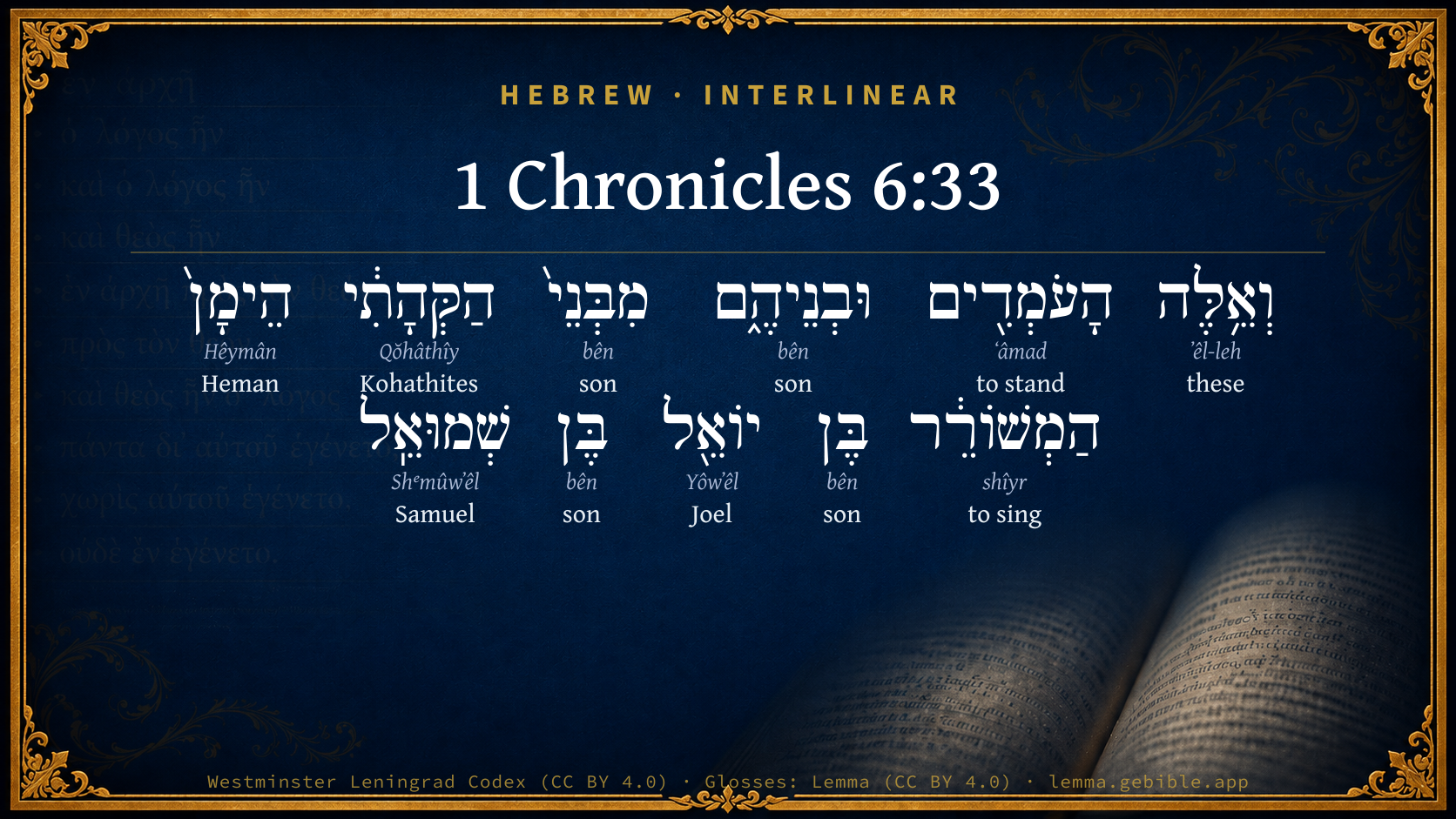
Hebrew (Westminster Leningrad Codex) 1 Chronicles 6:33 appears in the Hebrew Old Testament. The text above is from the Westminster Leningrad Codex. Each word links to its Strong’s number, a concise gloss, and parsing drawn from the Open Scriptures Hebrew Bible morphology. Click any word for its full Brown-Driver-Briggs (BDB) entry.
Download image
Cite this verse

1 Chronicles 6:33 (World English Bible). Public Domain. Lemma interlinear Bible study tool, https://lemma.gebible.app/v/1-chronicles/6/33.

Show BibTeX & RIS
BibTeX
RIS
English Translation
These are those who waited, and their sons. Of the sons of the Kohathites: Heman the singer, the son of Joel, the son of Samuel,
World English Bible · Public Domain
Download a study sheet

One document with this verse’s original text, its word-by-word gloss line, the meaning frame, cross-references with their text, attributed commentary, and full source and license credits — printable, and it pastes into notes with its structure intact.

This verse Autodidact and up

Study sheet (.html) Plain text (.txt)

A passage Seminary Student

Up to 50 verses in one chapter. A passage sheet keeps up to 6 commentary sources and 12 cross-references per verse, in the order this page ranks them, and says so on the sheet whenever that leaves anything out. Ask for a single verse and you get the Autodidact verse sheet above.

Everything on this page stays free to read, with no account — the sheet is a download of what is already on screen, not access to it.

Want to remove ads? Support Godless Engineer
Compare translations 3

The same verse in 3 English versions, stacked beneath the original-language interlinear above. Click any original word for its lexicon entry.

Each is an independent rendering of the whole verse — the interlinear is not word-aligned to these translations.

Highlighted words mark where these versions differ — a whole-verse word diff, not a word-by-word alignment.

  • World English Bible Public Domain
    These are those who waited, and their sons. Of the sons of the Kohathites: Heman the singer, the son of Joel, the son of Samuel,
  • King James Version Public Domain
    And these are they that waited with their children. Of the sons of the Kohathites: Heman a singer, the son of Joel, the son of Shemuel,
  • unfoldingWord Literal Text CC BY-SA 4.0
    And these the ones standing and their sons. From the sons of the Kohathite: Heman the singer, the son of Joel, the son of Samuel,

unfoldingWord Literal Text — © unfoldingWord, licensed CC BY-SA 4.0. Word-aligned USFM3 via Door43 (git.door43.org/unfoldingWord/en_ult).

Versions to compare (up to 4)

3 of 4 selected

Show all 18 translations

Every available English version of this verse, each an independent rendering of the whole verse.

  • World English Bible Public Domain
    These are those who waited, and their sons. Of the sons of the Kohathites: Heman the singer, the son of Joel, the son of Samuel,
  • Berean Standard Bible Public Domain
    These are the men who served, together with their sons. From the Kohathites: Heman the singer, the son of Joel, the son of Samuel,
  • Majority Standard Bible Public Domain
    These are the men who served, together with their sons. From the Kohathites: Heman the singer, the son of Joel, the son of Samuel,
  • King James Version Public Domain
    And these are they that waited with their children. Of the sons of the Kohathites: Heman a singer, the son of Joel, the son of Shemuel,
  • American Standard Version (1901) Public Domain
    And these are they that waited, and their sons. Of the sons of the Kohathites: Heman the singer, the son of Joel, the son of Samuel,
  • Revised Version (1885) Public Domain
    And these are they that waited, and their sons. Of the sons of the Kohathites: Heman the singer, the son of Joel, the son of Samuel;
  • Geneva Bible (1599) Public Domain
    And these ministred with their children: of the sonnes of Kohath, Heman a singer, the sonne of Ioel, the sonne of Shemuel,
  • Douay-Rheims (1899) Public Domain
    And these are they that stood with their sons, of the sons of Caath, Hemam a singer, the son of Joel, the son of Sammuel,
  • Young's Literal Translation Public Domain
    And these `are' those standing, and their sons: of the sons of the Kohathite: Heman the singer, son of Joel, son of Shemuel,
  • Literal Standard Version CC BY-SA 4.0
    And these [are] those standing, and their sons, of the sons of the Kohathite: Heman the singer, son of Joel, son of Shemuel,
  • Unlocked Literal Bible CC BY-SA 4.0
    These were those who served with their sons. From the clans of the Kohathites came Heman the musician. Here were his ancestors, going back in time: Heman was the son of Joel. Joel was the son of Samuel.
  • unfoldingWord Literal Text CC BY-SA 4.0
    And these the ones standing and their sons. From the sons of the Kohathite: Heman the singer, the son of Joel, the son of Samuel,
  • Darby Bible Public Domain
    And these are they that attended, and their sons: Of the sons of the Kohathites: Heman the singer, the son of Joel, the son of Samuel,
  • World Messianic Bible Public Domain
    These are those who served, and their sons. Of the sons of the Kohathites: Heman the singer, the son of Joel, the son of Samuel,
  • Webster's Bible Public Domain
    And these are they that waited with their children. Of the sons of the Kohathites: Heman a singer, the son of Joel, the son of Shemuel,
  • Free Bible Version CC BY-SA 4.0
    Here are the men who served, together with their sons: From the Kohathites: Heman, the singer, the son of Joel, the son of Samuel,
  • Bible in Basic English Public Domain
    And these are those who did this work, and their sons. Of the sons of the Kohathites: Heman, who made melody, the son of Joel, the son of Samuel,
  • JPS Tanakh (1917) Public Domain
    (6-18) And these are they that took their station, and their sons. Of the sons of the Kohathites: Heman the singer, the son of Joel, the son of Samuel;

Literal Standard Version (2020), Covenant Press — licensed CC BY-SA 4.0. Text via the HelloAO Bible API (eBible.org). Unlocked Literal Bible (unfoldingWord) — licensed CC BY-SA 4.0. Text via the HelloAO Bible API (eBible.org). unfoldingWord Literal Text — © unfoldingWord, licensed CC BY-SA 4.0. Word-aligned USFM3 via Door43 (git.door43.org/unfoldingWord/en_ult). Free Bible Version, Dr. Jonathan Gallagher — licensed CC BY-SA 4.0. Text via the HelloAO Bible API (eBible.org).

Word by word

More ways to search: Search by grammar → Find every occurrence → Compare this word →

Practice this passage: Drill this verse → Learn its vocabulary →

הַקְּהָתִ֔י
Qŏhâthîy
H6956
“the · Kohathites”
Particle, Definite Article + Noun, Gentilic, Masculine, Singular, Absolute
Part of Speech
Particle + Noun
Type
Gentilic
Gender
Masculine
Number
Singular
State
Absolute
Full BDB Definition

Origin: patronymically from H6955

TWOT: None

Kohathites = see Kohath " assembly" - the descendants of Kohath, the 2nd son of Levi
  1. וְאֵ֥לֶּה ʼêl-leh H428 “and · these” Conjunction + Pronoun, Demonstrative, Common, Plural
  2. הָעֹמְדִ֖ים ʻâmad H5975 “the · standing” Particle, Definite Article + Verb, Qal, Participle Active, Masculine, Plural, Absolute
  3. וּבְנֵיהֶ֑ם bên H1121 “and · sons · their” Conjunction + Noun, Common, Masculine, Plural, Construct + Suffix, Personal, 3rd Person, Masculine, Plural
  4. מִבְּנֵי֙ bên H1121 “from · sons of” Preposition + Noun, Common, Masculine, Plural, Construct
  5. הֵימָן֙ Hêymân H1968 “Heman” Noun, Proper
  6. הַמְשׁוֹרֵ֔ר shîyr H7891 “the · singing” Particle, Definite Article + Verb, Polel, Participle Active, Masculine, Singular, Absolute
  7. בֶּן bên H1121 “son of” Noun, Common, Masculine, Singular, Construct
  8. יוֹאֵ֖ל Yôwʼêl H3100 “Joel” Noun, Proper
  9. בֶּן bên H1121 “son of” Noun, Common, Masculine, Singular, Construct
  10. שְׁמוּאֵֽל Shᵉmûwʼêl H8050 “Samuel” Noun, Proper

About this verse

These counts appear in no published source. They are computed here, from the morphology-tagged text and Lemma’s own curated glosses. What Lemma adds →

11
words
8
distinct lemmas
Historical
section

Notable vocabulary

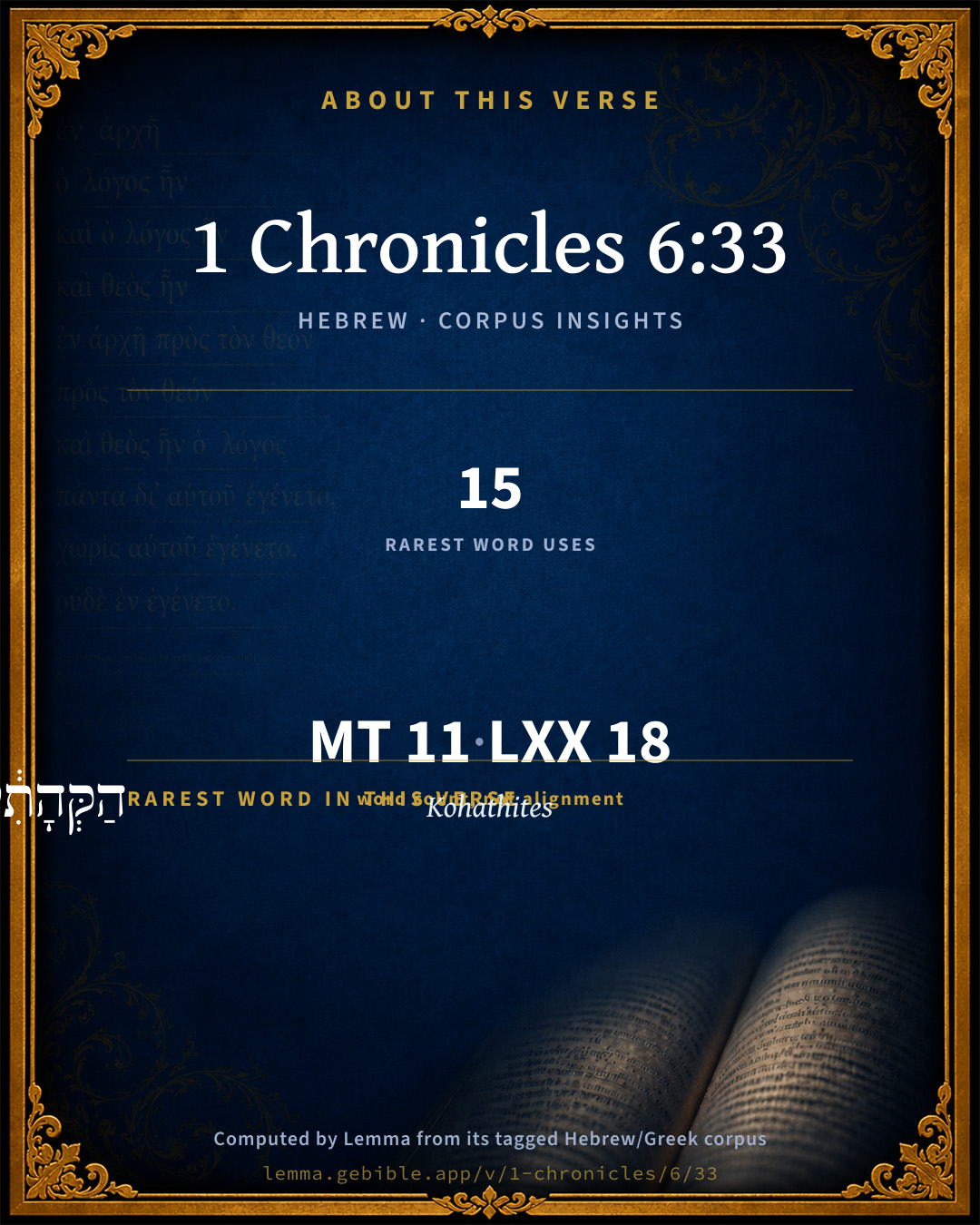
The rarest word here is הַקְּהָתִ֔י Kohathites H6956 — appearing just 15 times in the whole Hebrew Bible.

Shared distinctive vocabulary

הַקְּהָתִ֔י Kohathites H6956 occurs in 15 verses of the Hebrew Bible. Also found in:

Grammatical profile

  • 2 verbs
  • 8 nouns
  • 1 pronoun

Verb forms

  • הָעֹמְדִ֖ים Qal · Participle Active
  • הַמְשׁוֹרֵ֔ר Polel · Participle Active

Repetition

A word recurs within this verse — often emphatic in Hebrew:

  • וּבְנֵיהֶ֑ם son H1121 ×4

Hebrew & Septuagint length

In English translation the verse runs 25 words from the Hebrew and 26 from the Septuagint (LXX English) — closely comparable.

A rough comparison of the two English renderings, which tokenize alike — not a word-level alignment.

Word counts can differ between the Hebrew and the Greek without any difference in meaning — e.g. the Hebrew direct-object marker אֵת has no separate Greek word, and Greek often adds the article ὁ.

In the original languages it is 11 Hebrew tokens and 18 Greek tokens — but the two are counted differently (Hebrew bundles its prefixes and suffixes into one token; the Greek is in lemma form), so that isn’t a like-for-like length.

Cross-references

10

Topical passages linked to 1 Chronicles 6:33 in the Treasury of Scripture Knowledge — connected by theme and wording, ordered by reader-vote popularity; previews shown in the World English Bible.

  • 1 Chronicles 6:28 The sons of Samuel: the firstborn [Joel], and the second Abijah.
  • 1 Chronicles 15:17 So the Levites appointed Heman the son of Joel; and of his brothers, Asaph the son of Berechiah; and of the sons of Merari their brothers, Ethan the son of Kushaiah;
  • 1 Samuel 1:20 It happened, when the time was come about, that Hannah conceived, and bore a son; and she named him Samuel, [saying], Because I have asked him of Yahweh.
  • 1 Samuel 1:28 therefore also I have granted him to Yahweh; as long as he lives he is granted to Yahweh. He worshiped Yahweh there.
  • 1 Chronicles 15:19 So the singers, Heman, Asaph, and Ethan, [were appointed] with cymbals of brass to sound aloud;
  • 1 Chronicles 16:41–42 and with them Heman and Jeduthun, and the rest who were chosen, who were mentioned by name, to give thanks to Yahweh, because his loving kindness endures forever;
  • 1 Chronicles 25:1–5 Moreover, David and the captains of the host set apart for the service certain of the sons of Asaph, and of Heman, and of Jeduthun, who should prophesy with harps, with psalteries, and with cymbals: and the number of those who did the work according to their service was:
  • 2 Chronicles 5:12 also the Levites who were the singers, all of them, even Asaph, Heman, Jeduthun, and their sons and their brothers, arrayed in fine linen, with cymbals and psalteries and harps, stood at the east end of the altar, and with them one hundred twenty priests sounding with trumpets;)
  • 2 Chronicles 29:14 and of the sons of Heman, Jehuel and Shimei; and of the sons of Jeduthun, Shemaiah and Uzziel.
  • Psalms 88:1 Yahweh, the God of my salvation, I have cried day and night before you.

Cross-references courtesy of OpenBible.info (CC BY 4.0).

Hebrew and Greek witnesses Masoretic Hebrew ↔ Greek Septuagint

The same verse in the two great witnesses to the Old Testament, shown verse-for-verse.

These are two independent witnesses, not word-aligned to each other, and the Septuagint is shown in lemma (dictionary) form.

Hebrew 1 Chronicles 6:33 Masoretic · Westminster Leningrad Codex

וְאֵ֥לֶּה הָעֹמְדִ֖ים וּבְנֵיהֶ֑ם מִבְּנֵי֙ הַקְּהָתִ֔י הֵימָן֙ הַמְשׁוֹרֵ֔ר בֶּן יוֹאֵ֖ל בֶּן שְׁמוּאֵֽל

These are those who waited, and their sons. Of the sons of the Kohathites: Heman the singer, the son of Joel, the son of Samuel,

World English Bible · Public Domain

Greek LXX 1 Chronicles 6:33 Septuagint · lemma form

καί ἀδελφός αὐτός κατά οἶκος πατριά αὐτός ὁ λευίτης δίδωμι εἰς πᾶς ἐργασία λειτουργία σκηνή οἶκος ὁ θεός

And these were the men that stood, and their sons, of the sons of Caath: Aeman the psalm singer, son of Joel, the son of Samuel,

LXX2012 (modern English Septuagint) · Public Domain

On this verse, Ellicott's Commentary for English Readers discusses the Septuagint’s reading. Read the note in Commentary ↓

Hebrew: Westminster Leningrad Codex (CC BY 4.0). Greek: Septuagint (public domain); English from LXX2012 (modern English Septuagint) (Public Domain). How the Septuagint differs from the Hebrew →

Commentary

Notes on 1 Chronicles 6:33 from classic Christian and Jewish commentators (each source and its license shown beneath its notes). The classic Christian expositions comment on the surrounding passage and are grouped to its opening verse, so a note may address several verses; the Jewish commentaries on the Tanakh (Rashi and others) are per-verse, so they appear only where the commentator wrote on this verse.

Lemma curates 59 commentaries, every one of them public domain or Creative Commons licensed, each selected and text-cleaned for this edition rather than reprinted as found. About our sources →

Ellicott's Commentary for English Readers

(33) And these are they that waited (stood) with their children.—The main sentence which began at 1Ch_6:31, and was suspended by the parenthetic 1Ch_6:32, is now resumed. The persons meant are the three chiefs of the Levitical guilds of musicians, Heman, Asaph, and Ethan; their “children” are the members of those guilds. (Comp. the phrase, “sons of the prophets,” i.e., members of prophetic guilds, 2Ki_9:1; Amo_7:14.) 1Ch_25:1-7 supplies the names of the principal “sons” of the three masters. Their Levitical descent is shown in the genealogies here traced up from themselves to Levi. First we have the pedigree of Heman (1Ch_6:33-38) the Kohathite.

Heman a singer.—Rather, the singer or minstrel. Heman, as representing the chief branch of the Levites, is primus inter pares as regards the other master singers. His choir occupied the centre, having on its right that of the Gershonite Asaph, on its left that of the Merarite Ethan (1Ch_6:39; 1Ch_6:44), so that Heman would conduct the whole body of musicians, when the three choirs chanted in concert. The word “minstrel” is more appropriate than “singer” because the original term (ham’shôrçr) implies singing which the singer himself accompanies with an instrument of music. (See 1Ch_25:6; LXX., ὁ ψαλτῳδὸς.)

Son of Joel, the son of Shemuel.—It is interesting to learn that Heman, the great minstrel, was a grandson of Samuel the great prophet. (For the connection between music and prophecy, see 2Ki_3:15; 1Sa_10:5-6; and below, 1Ch_25:1, Note.) Considering that some have denied that Samuel was a Levite, the point of contact here noted looks like an undesigned coincidence.

A Bible Commentary for English Readers, edited by Charles John Ellicott (1878–1897) — public domain. Text from a community e-Sword module.

Trapp's Complete Commentary

John Trapp

1Ch 6:33 And these [are] they that waited with their children. Of the sons of the Kohathites: Heman a singer, the son of Joel, the son of Shemuel,

Ver. 33. Heman.] He was Samuel’s grandchild, by Joel. The posterity (haply, not immediate) of the righteous shall be blessed.

John Trapp, A Commentary or Exposition upon All the Books of the Old and New Testament (1647–1656) — public domain. Text from a community e-Sword module.

Tyndale Open Study Notes

Tyndale Open Resources

6:33 Heman held the lead position among David’s singers (see Ps 88:title).

Tyndale Open Study Notes — © Tyndale Open Resources, licensed CC BY-SA 4.0. Text via the HelloAO Bible API.

Jamieson, Fausset & Brown

Robert Jamieson, A. R. Fausset & David Brown

Shemuel--that is, Samuel. This is the exact representation of the Hebrew name.

Jamieson, Fausset & Brown — Commentary Critical and Explanatory on the Whole Bible (1871) — public domain (CC PDM 1.0). Text via the HelloAO Bible API.

The Cambridge Bible for Schools and Colleges

gen. ed. J. J. S. Perowne

33–38 (= 18–23 according to the Heb. division). The descent of Heman, David’s singer, through Kohath from Levi

33. a singer] R.V. the singer.

Shemuel] R.V. Samuel, the well-known prophet being the person meant. Samuel is a form derived from the LXX. through the Latin Vulgate; but Shemuel is a more correct transliteration of the Hebrew name. Cp. 1Ch_6:26-28, notes.

The Cambridge Bible for Schools and Colleges (gen. ed. J. J. S. Perowne; Cambridge University Press, 1878–1918) — public domain. Text from a community e-Sword module.

John Gill's Exposition

Their brethren also the Levites,.... Who were not skilled in singing, and employed in that service, even the rest of the Kohathites, Gershonites, and Merarites:

were appointed unto all manner of service of the tabernacle of the house of God; some were porters at the gates; others had the care of the vessels; others slew the beasts for sacrifices, flayed them, and cut them up, and brought the pieces to the altar of burnt offerings, for the priests to offer.

John Gill's Exposition of the Whole Bible (1746–1763) — public domain (CC PDM 1.0). Text via the HelloAO Bible API.

Haydock's Catholic Bible Commentary

Heman. Some families among the Levites were more distinguished than the rest, having authority to regulate the singers, and to give the tune. Hence many psalms are addressed to these three masters of music. Yet from those titles we cannot surely infer that those psalms were composed by Asaph, &c. (Calmet)

George Leo Haydock (1774–1849), Haydock's Catholic Family Bible and Commentary, 1859 edition — public domain. Excludes Psalms (Douay-Rheims chapter numbering differs from Protestant) and Deuterocanonical books (Catholic canon only).

Matthew Poole's English Annotations

These, to wit,

Heman here mentioned; and Asaph, 1Ch 6:39; and Ethan, 1Ch 6:44.

Shemuel, or, Samuel the prophet.

Matthew Poole's English Annotations on the Holy Bible (1683–1685) — public domain. Text from a community e-Sword/MySword module.

The Pulpit Commentary

We have now the name and pedigree of each of the three chief singers or musicians (their duty was both vocal and instrumental) of David"s appointment, beginning, according to the analogy of ver. 2, supra, with Heman, the descendant of Kohath, instead of Asaph from Gershom. So the place of Heman was still the place of honor, in the centre, with Asaph on the right and Ethan on the left (vers. 39, 44). Heman is the twenty-first according to this list (vers. 33-38) after Levi, but the genealogy is indistinct (see above, vers. 22-28) between Shemuel and Assir, and according to Hervey ("Genealogies of our Lord," p. 214), Heman comes fourteenth after Levi. This Heman is to be distinguished from Heman the "son of Zerah", (1Ch_2:6) and with but little doubt, therefore, from Heman the Ezrahite (Zerahite) of Psalm 88. On the other hand, a theory has been suggested by Lord Arthur C. Hervey which might reconcile the two. He supposes that if Heman the Kohathite (or his father) had married an heiress of the house of Zerah, he might have become reckoned in the line of Zerah as well as in that of Kohath.

The Pulpit Commentary (1880–1919), ed. H.D.M. Spence-Jones & Joseph S. Exell — public domain. Text from a community e-Sword module.

Keil & Delitzsch

C. F. Keil & F. Delitzsch

Their brethren also the Levites,.... Who were not skilled in singing, and employed in that service, even the rest of the Kohathites, Gershonites, and Merarites:

were appointed unto all manner of service of the tabernacle of the house of God; some were porters at the gates; others had the care of the vessels; others slew the beasts for sacrifices, flayed them, and cut them up, and brought the pieces to the altar of burnt offerings, for the priests to offer.

Keil & Delitzsch — Biblical Commentary on the Old Testament (1861–1891) — public domain (CC PDM 1.0). Text via the HelloAO Bible API. (Old Testament only.)

unfoldingWord translationNotes

Door43 World Missions Community

These were those

"These were the musicians"

Kohathites

This is the name of a people group, the descendants of Kohath (1 Chronicles 6:1). (See: How to Translate Names)

going back in time

This means the list is going in order from the most recent to the oldest.

Heman ... Jeroham ... Eliel ... Toah ... Zuph ... Mahath

These are the names of men. (See: How to Translate Names)

Elkanah ... Amasai

See how you translated these men's names in 1 Chronicles 6:25.

translationWords

son

clan

Joel

Samuel

unfoldingWord translationNotes — © Distant Shores Media and the Door43 World Missions Community, licensed CC BY-SA 4.0. Source: git.door43.org/Door43/en_tn.

Rashi

Rabbi Shlomo Yitzchaki (Rashi)

And their brethren the Levites were appointed for the entire service of the Tabernacle of the House of God for gate sentries and to flay [the sacrificial animals], as is written further: (II Chron. 35: 11): “...and the Levites were flaying.”

Rashi on the Tanakh — English translations: “The Judaica Press complete Tanach with Rashi, translated by A. J. Rosenberg” (CC BY 4.0); “Pentateuch with Rashi's commentary by M. Rosenbaum and A.M. Silbermann, 1929-1934” (public domain); “The Metsudah Tanach series, Lakewood, N.J” (CC BY 4.0); and “The Book of Joshua, Metsudah Publications, 1997” (CC BY 4.0). Text via Sefaria.

Lesson kit

Teaching starters — assembled from the data on this page, not authored interpretation. Every prompt links to the verse data it draws on. Edit before teaching.

1 Chronicles, in the Historical, opens this verse with 11 words (8 distinct Hebrew lemmas). Its most distinctive word is Qŏhâthîy (“Kohathites”). A historical commentator’s framing appears above. Read the whole chapter for the surrounding context.

Discussion questions

  1. The word Qŏhâthîy carries the sense “Kohathites.” How does it shape the verse?
  2. How does Numbers 3:27, which shares the word «Kohathites», read alongside this verse?
  3. What does the repetition of “son” (4× in this one verse) do in this verse?
  4. These translations render this verse differently. What is at stake in choosing one wording over another?
  5. «הָעֹמְדִ֖ים» is a Qal Participle Active verb. How does that grammatical form shape the action described?
  6. Compare how Ellicott's Commentary for English Readers and Trapp's Complete Commentary read this verse. Where do they agree or differ?

Things to notice

Reading settings

Reading text

Shown beneath each verse's original-language words.

Old Testament
Old Testament edition

Read the OT as the Masoretic Hebrew (MT) or the Greek Septuagint (LXX).

English shown for the Greek Septuagint (in the Hebrew ↔ Greek comparison).

Comparing translations? Open the Compare panel on any verse page to stack up to four side by side.