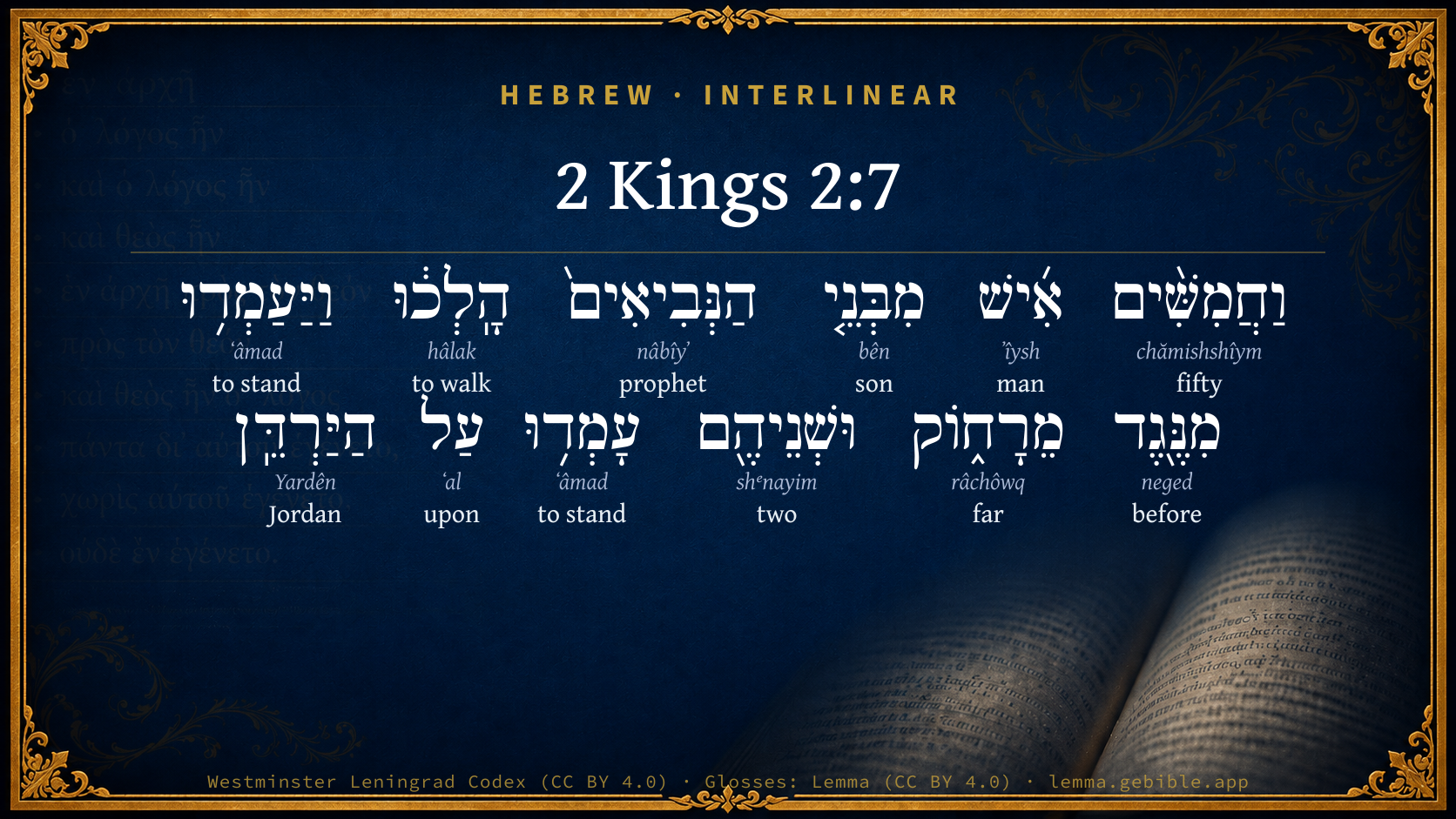
2 Kings 2:7

Hebrew (Westminster Leningrad Codex) 2 Kings 2:7 appears in the Hebrew Old Testament. The text above is from the Westminster Leningrad Codex. Each word links to its Strong’s number, a concise gloss, and parsing drawn from the Open Scriptures Hebrew Bible morphology. Click any word for its full Brown-Driver-Briggs (BDB) entry.
Download image
Cite this verse

2 Kings 2:7 (World English Bible). Public Domain. Lemma interlinear Bible study tool, https://lemma.gebible.app/v/2-kings/2/7.

Show BibTeX & RIS
BibTeX
RIS
English Translation
Fifty men of the sons of the prophets went, and stood over against them afar off: and they two stood by the Jordan.
World English Bible · Public Domain
Download a study sheet

One document with this verse’s original text, its word-by-word gloss line, the meaning frame, cross-references with their text, attributed commentary, and full source and license credits — printable, and it pastes into notes with its structure intact.

This verse Autodidact and up

Study sheet (.html) Plain text (.txt)

A passage Seminary Student

Up to 50 verses in one chapter. A passage sheet keeps up to 6 commentary sources and 12 cross-references per verse, in the order this page ranks them, and says so on the sheet whenever that leaves anything out. Ask for a single verse and you get the Autodidact verse sheet above.

Everything on this page stays free to read, with no account — the sheet is a download of what is already on screen, not access to it.

Want to remove ads? Support Godless Engineer
Compare translations 3

The same verse in 3 English versions, stacked beneath the original-language interlinear above. Click any original word for its lexicon entry.

Each is an independent rendering of the whole verse — the interlinear is not word-aligned to these translations.

Highlighted words mark where these versions differ — a whole-verse word diff, not a word-by-word alignment.

  • World English Bible Public Domain
    Fifty men of the sons of the prophets went, and stood over against them afar off: and they two stood by the Jordan.
  • King James Version Public Domain
    And fifty men of the sons of the prophets went, and stood to view afar off: and they two stood by Jordan.
  • unfoldingWord Literal Text CC BY-SA 4.0
    And fifty men from the sons of the prophets went, and they stood opposite at a distance. And the two of them stood by the Jordan.

unfoldingWord Literal Text — © unfoldingWord, licensed CC BY-SA 4.0. Word-aligned USFM3 via Door43 (git.door43.org/unfoldingWord/en_ult).

Versions to compare (up to 4)

3 of 4 selected

Show all 18 translations

Every available English version of this verse, each an independent rendering of the whole verse.

  • World English Bible Public Domain
    Fifty men of the sons of the prophets went, and stood over against them afar off: and they two stood by the Jordan.
  • Berean Standard Bible Public Domain
    Then a company of fifty of the sons of the prophets went and stood at a distance, facing Elijah and Elisha as the two of them stood by the Jordan.
  • Majority Standard Bible Public Domain
    Then a company of fifty of the sons of the prophets went and stood at a distance, facing Elijah and Elisha as the two of them stood by the Jordan.
  • King James Version Public Domain
    And fifty men of the sons of the prophets went, and stood to view afar off: and they two stood by Jordan.
  • American Standard Version (1901) Public Domain
    And fifty men of the sons of the prophets went, and stood over against them afar off: and they two stood by the Jordan.
  • Revised Version (1885) Public Domain
    And fifty men of the sons of the prophets went, and stood over against them afar off: and they two stood by Jordan.
  • Geneva Bible (1599) Public Domain
    And fiftie men of the sonnes of the Prophets went and stoode on the other side a farre off, and they two stoode by Iorden.
  • Douay-Rheims (1899) Public Domain
    And fifty men of the sons of the prophets followed them, and stood in sight at a distance: but they two stood by the Jordan.
  • Young's Literal Translation Public Domain
    -- and fifty men of the sons of the prophets have gone on, and stand over-against afar off -- and both of them have stood by the Jordan.
  • Literal Standard Version CC BY-SA 4.0
    and fifty men of the sons of the prophets have gone on, and stand opposite [them] far off—and both of them have stood by the Jordan.
  • Unlocked Literal Bible CC BY-SA 4.0
    Later, fifty of the sons of the prophets stood opposite them at a distance while the two stood by the Jordan.
  • unfoldingWord Literal Text CC BY-SA 4.0
    And fifty men from the sons of the prophets went, and they stood opposite at a distance. And the two of them stood by the Jordan.
  • Darby Bible Public Domain
    And fifty men of the sons of the prophets went and stood opposite afar off; and they two stood by the Jordan.
  • World Messianic Bible Public Domain
    Fifty men of the sons of the prophets went and stood opposite them at a distance; and they both stood by the Jordan.
  • Webster's Bible Public Domain
    And fifty men of the sons of the prophets went, and stood to view afar off: and they two stood by Jordan.
  • Free Bible Version CC BY-SA 4.0
    Then a group of fifty of the sons of the prophets went and stood facing Elijah and Elisha at a distance as the two of them stood by the Jordan.
  • Bible in Basic English Public Domain
    And fifty men of the sons of the prophets went out and took their places facing them a long way off, while the two of them were by the edge of Jordan.
  • JPS Tanakh (1917) Public Domain
    And fifty men of the sons of the prophets went, and stood over against them afar off; and they two stood by the Jordan.

Literal Standard Version (2020), Covenant Press — licensed CC BY-SA 4.0. Text via the HelloAO Bible API (eBible.org). Unlocked Literal Bible (unfoldingWord) — licensed CC BY-SA 4.0. Text via the HelloAO Bible API (eBible.org). unfoldingWord Literal Text — © unfoldingWord, licensed CC BY-SA 4.0. Word-aligned USFM3 via Door43 (git.door43.org/unfoldingWord/en_ult). Free Bible Version, Dr. Jonathan Gallagher — licensed CC BY-SA 4.0. Text via the HelloAO Bible API (eBible.org).

Word by word

More ways to search: Search by grammar → Find every occurrence → Compare this word →

Practice this passage: Drill this verse → Learn its vocabulary →

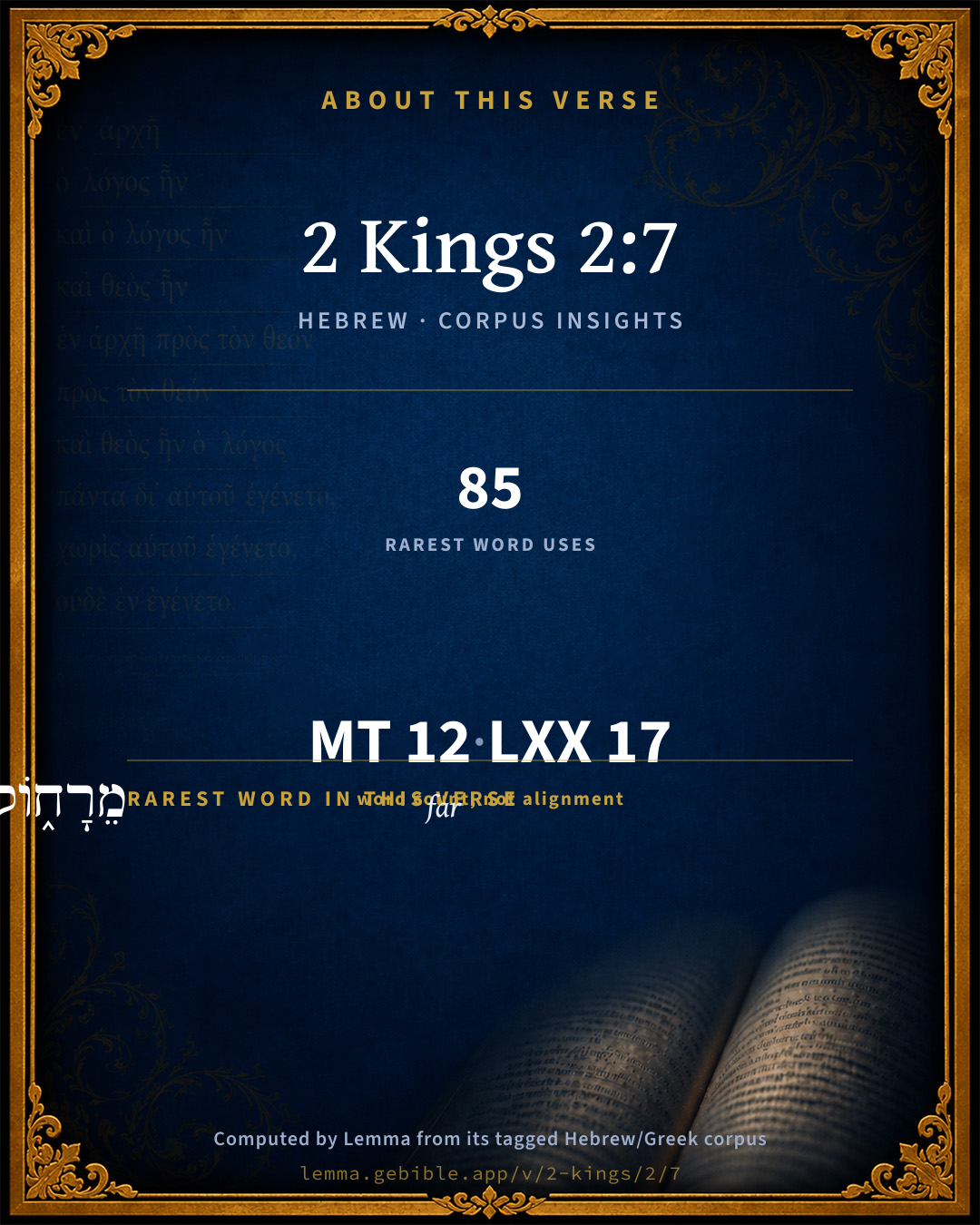
מֵרָח֑וֹק
râchôwq
H7350
“from · far”
Preposition + Adjective, Adjective, Masculine, Singular, Absolute
Part of Speech
Preposition + Adjective
Type
Adjective
Gender
Masculine
Number
Singular
State
Absolute
Full BDB Definition

Origin: from H7368

TWOT: 2151b

remote, far, distant, distant lands, distant ones (adjective) - of distance, time - distance (noun masculine) - from a distance (with preposition)
  1. וַחֲמִשִּׁ֨ים chămishshîym H2572 “and · fifty” Conjunction + Adjective, Cardinal number, Both, Plural, Absolute
  2. אִ֜ישׁ ʼîysh H376 “man” Noun, Common, Masculine, Singular, Absolute
  3. מִבְּנֵ֤י bên H1121 “from · sons of” Preposition + Noun, Common, Masculine, Plural, Construct
  4. הַנְּבִיאִים֙ nâbîyʼ H5030 “the · prophets” Particle, Definite Article + Noun, Common, Masculine, Plural, Absolute
  5. הָֽלְכ֔וּ hâlak H1980 “to walk” Verb, Qal, Perfect, 3rd Person, Common, Plural
  6. וַיַּעַמְד֥וּ ʻâmad H5975 “and · to stand” Conjunction + Verb, Qal, Sequential Imperfect, 3rd Person, Masculine, Plural
  7. מִנֶּ֖גֶד neged H5048 “from · before” Preposition + Preposition
  8. וּשְׁנֵיהֶ֖ם shᵉnayim H8147 “and · two · their” Conjunction + Adjective, Cardinal number, Masculine, Dual, Construct + Suffix, Personal, 3rd Person, Masculine, Plural
  9. עָמְד֥וּ ʻâmad H5975 “to stand” Verb, Qal, Perfect, 3rd Person, Common, Plural
  10. עַל ʻal H5921 “upon” Preposition
  11. הַיַּרְדֵּֽן Yardên H3383 “the · Jordan” Particle, Definite Article + Noun, Proper

About this verse

These counts appear in no published source. They are computed here, from the morphology-tagged text and Lemma’s own curated glosses. What Lemma adds →

12
words
11
distinct lemmas
Historical
section

Grammatical profile

  • 3 verbs
  • 4 nouns
  • 3 adjectives
  • 2 prepositions

Verb forms

  • הָֽלְכ֔וּ Qal · Perfect
  • וַיַּעַמְד֥וּ Qal · Sequential Imperfect
  • עָמְד֥וּ Qal · Perfect

Repetition

A word recurs within this verse — often emphatic in Hebrew:

  • וַיַּעַמְד֥וּ to stand H5975 ×2

Hebrew & Septuagint length

In English translation the verse runs 23 words from the Hebrew and 25 from the Septuagint (LXX English) — closely comparable.

A rough comparison of the two English renderings, which tokenize alike — not a word-level alignment.

Word counts can differ between the Hebrew and the Greek without any difference in meaning — e.g. the Hebrew direct-object marker אֵת has no separate Greek word, and Greek often adds the article ὁ.

In the original languages it is 12 Hebrew tokens and 17 Greek tokens — but the two are counted differently (Hebrew bundles its prefixes and suffixes into one token; the Greek is in lemma form), so that isn’t a like-for-like length.

Cross-references

3

Topical passages linked to 2 Kings 2:7 in the Treasury of Scripture Knowledge — connected by theme and wording, ordered by reader-vote popularity; previews shown in the World English Bible.

  • 1 Kings 18:4 for it was so, when Jezebel cut off the prophets of Yahweh, that Obadiah took one hundred prophets, and hid them by fifty in a cave, and fed them with bread and water.)
  • 1 Kings 18:13 Wasn't it told my lord what I did when Jezebel killed the prophets of Yahweh, how I hid one hundred men of Yahweh's prophets by fifty in a cave, and fed them with bread and water?
  • 2 Kings 2:17 When they urged him until he was ashamed, he said, Send. They sent therefore fifty men; and they sought three days, but didn't find him.

Cross-references courtesy of OpenBible.info (CC BY 4.0).

Hebrew and Greek witnesses Masoretic Hebrew ↔ Greek Septuagint

The same verse in the two great witnesses to the Old Testament, shown verse-for-verse.

These are two independent witnesses, not word-aligned to each other, and the Septuagint is shown in lemma (dictionary) form.

Hebrew 2 Kings 2:7 Masoretic · Westminster Leningrad Codex

וַחֲמִשִּׁ֨ים אִ֜ישׁ מִבְּנֵ֤י הַנְּבִיאִים֙ הָֽלְכ֔וּ וַיַּעַמְד֥וּ מִנֶּ֖גֶד מֵרָח֑וֹק וּשְׁנֵיהֶ֖ם עָמְד֥וּ עַל הַיַּרְדֵּֽן

Fifty men of the sons of the prophets went, and stood over against them afar off: and they two stood by the Jordan.

World English Bible · Public Domain

Greek LXX 2 Kings 2:7 Septuagint · lemma form

καί πεντήκοντα ἀνήρ υἱός ὁ προφήτης καί ἵστημι ἐκ ἐναντίος μακρόθεν καί ἀμφότεροι ἵστημι ἐπί ὁ ἰορδάνης

And fifty men of the sons of the prophets went also, and they stood opposite afar off: and both stood on the bank of Jordan.

LXX2012 (modern English Septuagint) · Public Domain

Hebrew: Westminster Leningrad Codex (CC BY 4.0). Greek: Septuagint (public domain); English from LXX2012 (modern English Septuagint) (Public Domain). How the Septuagint differs from the Hebrew →

Targum (Aramaic paraphrase)

1

The Targum is the ancient Jewish Aramaic paraphrase of the Hebrew Scriptures — an interpretive translation, not the Hebrew text itself. Onkelos (literal) and Pseudo-Jonathan (expansive) render the Torah, and Jonathan the Prophets. Coverage is partial: where no permissively-licensed English translation exists for a verse, only the Aramaic is shown. This is verse-level text, not a word-by-word alignment to the Hebrew.

  1. Targum Jonathan Prophets (Joshua–Malachi)
    וְחַמְשִׁין גַבְרָא מִתַּלְמִידֵי נְבִיַיָא אֲזָלוּ וְקָמוּ מִקֳבֵיל מֵרָחִיק וְתַרְוֵיהוֹן קָמוּ עַל יַרְדְנָא:

    (no public-domain English translation for this verse)

    Targum Jonathan — Aramaic: “Mikraot Gedolot” (public domain). English: “Sefaria Community Translation” (CC0 1.0 (public-domain dedication)); “London "Chaldee Paraphrase," 1871” (public domain). Text via Sefaria.

Commentary

Notes on 2 Kings 2:7 from classic Christian and Jewish commentators (each source and its license shown beneath its notes). The classic Christian expositions comment on the surrounding passage and are grouped to its opening verse, so a note may address several verses; the Jewish commentaries on the Tanakh (Rashi and others) are per-verse, so they appear only where the commentator wrote on this verse.

Lemma curates 59 commentaries, every one of them public domain or Creative Commons licensed, each selected and text-cleaned for this edition rather than reprinted as found. About our sources →

Trapp's Complete Commentary

John Trapp

2Ki 2:7 And fifty men of the sons of the prophets went, and stood to view afar off: and they two stood by Jordan.

Ver. 7. And fifty men of the sons of the prophets.] These were all of one college, and these were strong men, {2Ki 2:16} able and active. In our days, the Jesuits - those locusts, Rev 9:3 - have maintained two hundred thousand scholars, besides the monks and friars of other orders, enough to make up a very formidable army, and such as may serve Antichrist for a sufficient reserve, cum res redierit ad Triarios, when he shall be worst put to it. Oxford is said to have had sometime thirty thousand students in it at once.

And stood to view afar off.] Out of curiosity likely, but not without a special providence of God, that there might be so many witnesses of Elijah’s assumption to heaven.

John Trapp, A Commentary or Exposition upon All the Books of the Old and New Testament (1647–1656) — public domain. Text from a community e-Sword module.

Joseph Benson's Commentary

2Ki 2:7. Fifty men stood to view — To observe this great event, Elijah’s translation to heaven, which they expected every moment: and whereof they desired to be spectators, not to satisfy their own curiosity, but that they might be witnesses of it to others. Afar off — As they were not permitted to accompany him to the place where he was to be taken up, as Elisha was, they looked after him as far as they could see, probably from some eminence that overlooked Jordan. They two stood by Jordan — The rest, it is likely, being forbidden to go thither with them.

Joseph Benson's Commentary on the Old and New Testaments (1811–1818) — public domain. Text from a community e-Sword module.

Adam Clarke's Commentary

Verse 7. Fifty men of the sons of the prophets] They fully expected this extraordinary event, and they could have known it only from Elijah himself, or by a direct revelation from God.

Adam Clarke's Commentary on the Bible (1810–1826) — public domain. Text from a community e-Sword/MySword module.

Ellicott's Commentary for English Readers

(7) And fifty . . . went.—Now fifty . . . had gone.

Stood to view.—Taken their stand opposite, i.e., directly opposite the place where the two were standing by the brink of the river, yet at some distance behind. They wished to see whether and how the companions would cross the stream at a point where there was no ford.

A Bible Commentary for English Readers, edited by Charles John Ellicott (1878–1897) — public domain. Text from a community e-Sword module.

The Cambridge Bible for Schools and Colleges

gen. ed. J. J. S. Perowne

7. And fifty men] It is not without surprise that we come at one single centre upon so large a body of men devoting themselves to a holy life in the service of Jehovah, while Ahab’s children are still on the throne of Israel. There seems also to have been, beside Jericho and Bethel, similar colleges at Gilgal and perhaps on Carmel. It would almost appear as though all those who were true adherents of the Lord had betaken themselves to this life of retirement, that they might escape from the evils which followed so thick in the train of the worship of the Baalim.

stood to view] R.V. over against them, and similarly in verse 15. This rendering stands also as one margin of the A.V. The Hebrew word [neged] originally signifies ‘in front’ of anything; but since we are in front of anything which faces us, and it may be said to be in front of us, the adverb in the text has a double use. Here it refers to the position of the sons of the prophets as they stood looking towards the departing couple, while in the next chapter (2Ki_3:22) it is applied to the blood which the Moabites supposed they saw ‘on the other side’ of the valley. R.V. has ‘over against them’ in that verse also.

The Cambridge Bible for Schools and Colleges (gen. ed. J. J. S. Perowne; Cambridge University Press, 1878–1918) — public domain. Text from a community e-Sword module.

John Gill's Exposition

And Elijah took his mantle, and wrapped it together,.... Folded it up close together, in a position to smite with it; this is thought to be not his hairy garment, but a shorter robe, that was worn upon his shoulders; but the Greek version renders it by "melotes", and so in Kg2 2:14, which, according to Isidore (l), was a goat's skin, hanging down from the neck, and girt at the loins; and being thus clothed, perhaps, may be the reason of his being called an hairy man, Kg2 1:8,

and smote the waters, and they were divided hither and thither; just as Moses lifted up his rod, and the waters of the sea were divided for the Israelites:

so that they two went over on dry ground; in like manner as the Israelites did through the sea.

(l) Origin. l. 19. c. 24.

John Gill's Exposition of the Whole Bible (1746–1763) — public domain (CC PDM 1.0). Text via the HelloAO Bible API.

Albert Barnes' Notes on the Bible

Fifty men of the sons of the prophets - We see by this how large were the prophetical schools. It is implied that the “fifty” were only a portion of the school of Jericho. They ascended the abrupt heights behind the town, from where they would command a view of the whole course of the river and of the opposite bank for many miles.

Albert Barnes' Notes on the Bible (1834–1885) — public domain. Text from a community e-Sword/MySword module.

Matthew Poole's English Annotations

Stood to view; to observe this great event, Elijah’s translation to heaven, which they expected every moment, now when he had taken his last farewell of all the prophets; and whereof they desired to be spectators, not so much to satisfy their own curiosity, as that they might be witnesses of it to others.

Matthew Poole's English Annotations on the Holy Bible (1683–1685) — public domain. Text from a community e-Sword/MySword module.

Whedon's Commentary on the Bible

Daniel D. Whedon

7. Fifty men… stood to view afar off — What all they saw we are not told. They probably saw the waters of Jordan divided, and the two prophets pass beyond the stream; and possibly they beheld Elijah at the moment he was parted from Elisha; but they probably did not behold his ascension, for of that Elisha had only a momentary glimpse, and that by special grace of God.

Daniel D. Whedon (gen. ed.), Commentary on the Old and New Testaments (1874–1909) — public domain. Text from a community e-Sword module.

The Pulpit Commentary

And fifty men of the sons of the prophets went, and stood to view. It is a harsh judgment to blame the "sons of the prophets" for an idle and shallow curiosity in merely "standing" at a distance "to view" the wonderful event, which Elisha was determined to witness as closely, and associate himself with as intimately, as possible. For the sons of the prophets to have approached nearer, and hung on the skirts of Elijah, would have been an impertinence, Elisha"s persistence is only justified by his strong affection, and the special office which he held, of attendant minister. The fifty students showed a courteous sense of what was due to the prophet"s desire of seclusion by not pressing on his footsteps, and at the same time a real interest in him, and a reasonable curiosity, by quitting their college and "standing to view" on some eminence which commanded a prospect of the lower Jordan valley. There were many such eminences within a short distance of Jericho. And they two stood by Jordan. At length all other human companionship was shaken offthey two" stood, side by side, on the banks of the sacred stream, which had played so important a part, and was still to play so far more important a part, in the theocratic history. All the world, except their two selves, was remote was beyond their ken; the master and the servant, the prophet of the past and the prophet of the coming generation, were together, with none to disturb them, or interfere between them, or separate them. Jordan rolled its waters before their eyes, a seeming barrier to further advance; and Elisha may naturally have looked to see the final scene transacted in that "plain below a plain," the Jordan bed, sunk beneath the general level of the Ghor, green with lush grass and aquatic plants, and with beds of reeds and osiers, but squalid with long stretches of mud and masses of decaying vegetation, brought down from the upper river, and with rotting trunks of trees torn from the banks higher up. But the end was not yet. Jordan was to be crossed, and the ascension to take place from the plain whence Moses, when about to quit earth, had made his ascent to Pisgah.

Vers. 7-15.

Elijah taken up.

The translation was to take place on the eastern side of Jordan. Dean Stanley quotes the remark, "The aged Gileadite cannot rest till he again sets foot on his own side of the river,

I CROSSING JORDAN.

1. The fifty disciples. "On the upper terraces, or on the mountain heights behind the city, stood "afar off," in awe, fifty of the young disciples; "and they two stood by Jordan (Stanley). Of all the prophetic company, Elisha alone was permitted to accompany the master. The others do not seem to have ventured to ask. But they did not feel themselves precluded from reverentially standing at a distance, to observe what might take place. They did not witness the translation, but they saw the waters divided. There may be neophytes in spiritual experience, who are unqualified for the reception of God"s grander revelations, but even to these, "standing to view," God will reveal his power in some measure.

2. The stream divided. The river flows between the travelers and the further bank, but Elijah hesitates not a moment. As if his conscious nearness to eternity had already raised him above natural conditions had given him the faith and power before which natural obstacles are nonexistent he roiled his mantle together, and "smote the waters, and they were divided hither and thither, so that they two went over on dry ground." A miracle! Truly, but there are situations in which miracles seem almost natural. When men are on the point of being taken up bodily to heaven, we need not wonder if "therefore mighty works do show forth themselves" in them. (Mar_6:14) Natural laws are fixed only till, in the grasp of a higher influence, they become flexible, and bend and yield. This miracle is a repetition of an earlier one, (Jos_3:14-16) and, on a lesser scale, of an earlier still. (Exo_14:21, Exo_14:22)

II ELISHA"S REQUEST.

1. Encouragement to ask. Elisha had "stood the trial of his unchangeable fidelity and perseverance," and Elijah now said to him, when they had gone over Jordan, "Ask what I shall do for thee, before I be taken away from thee." Elijah did not put himself in place of God. He probably expected Elisha to ask for a parting blessing, or for some other favor which it was in his own power to grant at most to prefer a request which God might grant through him. A greater than Elijah said to his disciples, when he was about to be taken from them, "Hitherto have ye asked nothing in my Name: ask, and ye shall receive". (Joh_16:24)

2. A bold petition. Elisha was not slow to avail himself of the opportunity given. He had in view the position he would be called to occupy as the successor of Elijah, and his request took the form of a prayer for a double portion of Elijah"s spirit. He "coveted earnestly the best gifts". (1Co_12:31) He asked, like Solomon, not for any earthly good or glory, but for spiritual endowment for his great office. (1Ki_3:5-14) Or rather, he asked for the office itself, with the spiritual endowment which accompanied it for there is no reason to suppose that hitherto Elisha was a prophet, or more than the servant of a prophet. The "double portion," by general consent, is to be taken in the sense of Deu_21:17; i.e. the two portions of a firstborn son, in comparison with the portions received by the other sons. Viewing certain features of the ministry of Elisha its longer duration, the number and character of its miracles, etc. we might almost think that Elisha had received literally "a double portion" of the spirit of Elijah, i.e. as some have held, twice as much. But this is not the meaning, and reflection will convince us that, with all his eminence, Elisha is a lesser prophet than Elijah less forceful, original, creative.

3. The decisive sign. Elijah replied that Elisha had asked "a hard thing one which there might be a difficulty in granting. To designate a prophet, and bestow on him the prophetic spirit especially in exceptional measure belongs only to God; and the grounds of his action in such high mattersare not for man to prejudge. There was, however, a natural probability that it would be God"s will to designate Elisha as heir of the prophetic gift, and a sign was given by which it might be known whether it was or not. If Elisha saw Elijah when he was taken from him, he might conclude that his prayer was answered possibly because it was only in an exalted, that is prophetic, state of mind that the vision could be had; (cf. 2Ki_6:16) if he saw nothing, God had not answered it. There is "a vision and a faculty Divine," which is the surest token of answer to a prayer for God"s Spirit. Christ"s parting legacy to his disciples was his Spirit; and in this, not one, but all, may richly share. (Joh_14:16, 17 15:26 16:13-15) We do well to realize, like Elisha, that it is not by might nor power of our own, but only by God"s Spirit, that we are fitted for any great work in his service.

III CHARIOTS OF FIRE.

1. The media of translation. As the two went on, and talked, suddenly there appeared a chariot of fire, and horses of fire, and Elijah was parted from Elisha, and went up by a whirlwind into, or towards, heaven.

(1) There was an actual appearance to Elisha"s vision of fiery chariot and horse. It is wholly against the text to explain this, as Bahr does, by mere figure of speech, even though Elisha afterwards uses this metaphor of Elijah (ver. 12).

(2) It remains doubtful whether the representation is that of a chariot which conveys Elijah to heaven, or of a host of chariots and horses which surrounds him as he ascends. The word is commonly used as a collective, (2Ki_6:17) and probably denotes "chariots." In this case, the heavenly chariots appear, but the actual mode of Elijah"s ascent is by the whirlwind.

(3) At most, Elisha"s vision could only follow Elijah"s ascent for some little way upwards, till, perhaps, as in the ease of the Savior, "a cloud received him out of his sight". (Act_1:9) The realm to which Elijah was taken is not situated in the material heavens, so that, by traversing so much space, he could arrive at it: The change that passed over him, which culminated in his reception into the invisible world, was after a fashion unknown possibly at present incomprehensible to us.

(4) We must hold, however, that Elijah was really taken in the body to heaven. Bahr"s supposition that he was simply whirled away, and disappeared from earth, perhaps undergoing some secret death and burial as Moses did (for this seems to be his idea), is too much akin to the error of the disciples who sent out fifty strong men to seek for him among the hills (vers. 16, 17). It was not Elisha"s view, and has no support in the narrative.

1. The lessons of the translation. Besides being a signal honor put upon a great servant of God, and a striking Old Testament anticipation of the ascension of Christ, it gave to the Israelites, in midtime of their history, a powerful confirmation of the fact of immortality. "The impression made by the history of Enoch, that "God took him," is marked by the repetition of the word as to the ascension of Elijah" (Pusey). It is noteworthy, also, that the immortality typified by these cases is an immortality in the body. We believe, if careful examination of passages is made, it will be found that it was in this form, that is, as connected with a resurrection, and not as an abstract immortality of the soul in Sheol, which had no attractions for the Hebrew mind, that the hope of immortality was entertained by believing Hebrews (cf. Job_14:12-15 Job_19:25-27; Psa_16:10 Psa_17:15 Psa_49:14; Mat_22:31, Mat_22:32; Heb_11:13-22. See also the able discussion of this subject in Fairbairn"s "Typology of Scripture," vol. 1. pp. 352-361, 3rd edit.)

2. Elishas lament. As Elijah was parted from him, and taken up, Elisha broke out into loud lament: "My father, my father! the chariot of Israel, and the horsemen thereof." This no more implies that Elisha did not believe that his master was being taken up to heaven, than the mourning of Christians for the loss of some revered teacher or guide implies doubt as to his eternal happiness. It is the sense of personal loss, and of loss to the world, which prevails on these occasions. Elisha did not overestimate the value of Elijah to Israel more than chariots and horsemen and we cannot overestimate the worth to a nation of the presence and labors of the servants of God in it. The religion of a nation is its best bulwark, and those who do most for religion are those who serve their country best. Armaments without God in the midst are of poor avail.

IV THE FALLEN MANTLE. Elisha had seen the prophet ascend, and he knew that his request was granted. He accordingly picked up the mantle of Elijah, which had fallen from him, and which be rightly regarded as a symbol of the new spirit with which he was to be endowed. Popular speech embodies the thought of this passage when it figures succession to greatness as the descent of the mantle of the great man upon his successor.

1. Test of the new power. Elisha"s possession of the spirit and power of Elias" was soon to be tested. The Jordan waters again rolled between him and his destination, but, invoking Divine power in the words, "Where is the Lord, the God of Elijah, even he?" he smote the waters with the wonderworking mantle, and, as before, they divided apart.

2. Acknowledgment of the new power. The "sons of the prophets" still "stood to view" at Jericho, and when they saw the prophet"s deed, and still more, perhaps, when they looked on his person, to which inspiration lent a new grandeur and dignity, they said, "The spirit of Elijah cloth rest on Elisha." Then they bowed to the ground before him, and acknowledged him master.

(1) The Spirit of God in a man readily betrays its presence.

(2) Where the Spirit of God manifestly possesses a man, others will not be slow to make acknowledgment of the fact, and to yield him appropriate honor.

(3) It is mainly the possession of this Spirit which entitles a man to obedience in the house of God. J.O.

The Pulpit Commentary (1880–1919), ed. H.D.M. Spence-Jones & Joseph S. Exell — public domain. Text from a community e-Sword module.

John Wesley's Explanatory Notes

To view - To observe this great event, Elijah's translation to heaven, which they expected every moment: and whereof they desired to be spectators, not to satisfy their own curiosity, but that they might be witnesses of it to others.

John Wesley, Explanatory Notes Upon the Whole Bible (1754–1765) — public domain. Text via the GEBible commentary corpus.

unfoldingWord translationNotes

Door43 World Missions Community

fifty of the sons

"50 of the sons" (See: Numbers)

the sons of the prophets

This does not mean that they were the sons of prophets, but rather, that they were a group of prophets. See how you translated this phrase in 2 Kings 2:3. AT: "the group of men who were prophets" (See: Idiom)

stood opposite them

This means that they were standing, facing them. AT: "stood facing them" or "stood watching them" (See: Idiom)

cloak

outer piece of clothing used as a covering

The river divided on both sides so that the two of them walked over on dry ground

"The water of the Jordan River opened up so there was a dry path for Elijah and Elisha to cross over to the other side"

on both sides

"to the right and the left." This refers to the right and the left of where Elijah struck the water.

translationWords

Elijah

unfoldingWord translationNotes — © Distant Shores Media and the Door43 World Missions Community, licensed CC BY-SA 4.0. Source: git.door43.org/Door43/en_tn.

Lesson kit

Teaching starters — assembled from the data on this page, not authored interpretation. Every prompt links to the verse data it draws on. Edit before teaching.

2 Kings, in the Historical, opens this verse with 12 words (11 distinct Hebrew lemmas). Its most distinctive word is râchôwq (“far”). A historical commentator’s framing appears above. Read the whole chapter for the surrounding context.

Discussion questions

  1. How does “far” (râchôwq) shape what this verse is saying?
  2. How does 1 Kings 18:4, which shares this passage’s theme, read alongside this verse?
  3. What does the repetition of “to stand” (2× in this one verse) do in this verse?
  4. The translations on this page render this verse differently — a whole-verse word diff, not a word-by-word alignment. What might account for the different wordings?
  5. «הָֽלְכ֔וּ» is a Qal Perfect verb. How does that grammatical form shape the action described?
  6. Compare how Trapp's Complete Commentary and Joseph Benson's Commentary read this verse. Where do they agree or differ?

Things to notice

Reading settings

Reading text

Shown beneath each verse's original-language words.

Old Testament
Old Testament edition

Read the OT as the Masoretic Hebrew (MT) or the Greek Septuagint (LXX).

English shown for the Greek Septuagint (in the Hebrew ↔ Greek comparison).

Comparing translations? Open the Compare panel on any verse page to stack up to four side by side.