2 Kings 5:16

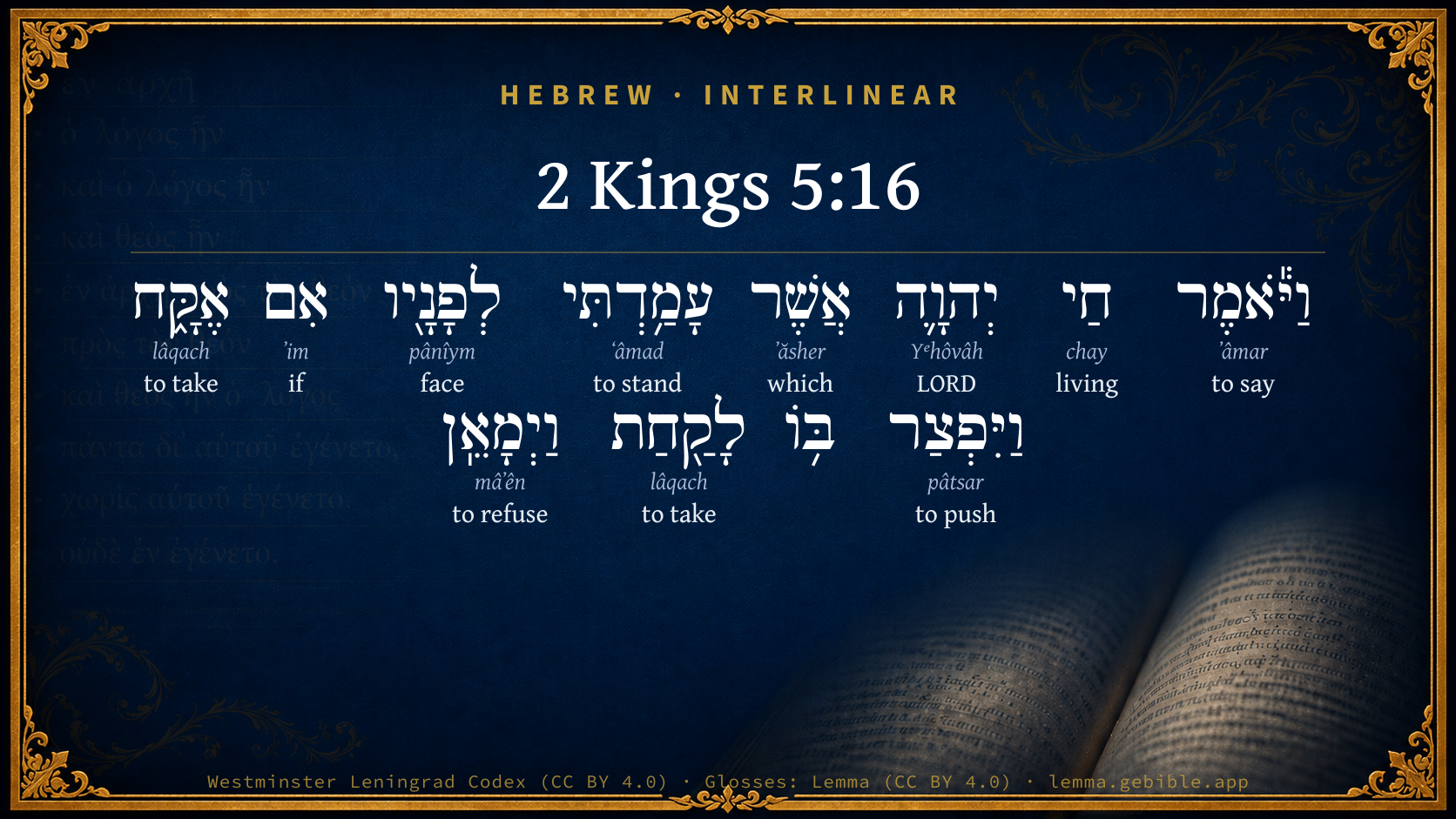
Hebrew (Westminster Leningrad Codex) 2 Kings 5:16 appears in the Hebrew Old Testament. The text above is from the Westminster Leningrad Codex. Each word links to its Strong’s number, a concise gloss, and parsing drawn from the Open Scriptures Hebrew Bible morphology. Click any word for its full Brown-Driver-Briggs (BDB) entry.
Download image
Cite this verse

2 Kings 5:16 (World English Bible). Public Domain. Lemma interlinear Bible study tool, https://lemma.gebible.app/v/2-kings/5/16.

Show BibTeX & RIS
BibTeX
RIS
English Translation
But he said, As Yahweh lives, before whom I stand, I will receive none. He urged him to take it; but he refused.
World English Bible · Public Domain
Download a study sheet

One document with this verse’s original text, its word-by-word gloss line, the meaning frame, cross-references with their text, attributed commentary, and full source and license credits — printable, and it pastes into notes with its structure intact.

This verse Autodidact and up

Study sheet (.html) Plain text (.txt)

A passage Seminary Student

Up to 50 verses in one chapter. A passage sheet keeps up to 6 commentary sources and 12 cross-references per verse, in the order this page ranks them, and says so on the sheet whenever that leaves anything out. Ask for a single verse and you get the Autodidact verse sheet above.

Everything on this page stays free to read, with no account — the sheet is a download of what is already on screen, not access to it.

Want to remove ads? Support Godless Engineer
Compare translations 3

The same verse in 3 English versions, stacked beneath the original-language interlinear above. Click any original word for its lexicon entry.

Each is an independent rendering of the whole verse — the interlinear is not word-aligned to these translations.

Highlighted words mark where these versions differ — a whole-verse word diff, not a word-by-word alignment.

  • World English Bible Public Domain
    But he said, As Yahweh lives, before whom I stand, I will receive none. He urged him to take it; but he refused.
  • King James Version Public Domain
    But he said, As the LORD liveth, before whom I stand, I will receive none. And he urged him to take it; but he refused.
  • unfoldingWord Literal Text CC BY-SA 4.0
    But he said, “The life of Yahweh, to whose face I stand, if I should take.” And he urged him to take, but he refused.

unfoldingWord Literal Text — © unfoldingWord, licensed CC BY-SA 4.0. Word-aligned USFM3 via Door43 (git.door43.org/unfoldingWord/en_ult).

Versions to compare (up to 4)

3 of 4 selected

Show all 18 translations

Every available English version of this verse, each an independent rendering of the whole verse.

  • World English Bible Public Domain
    But he said, As Yahweh lives, before whom I stand, I will receive none. He urged him to take it; but he refused.
  • Berean Standard Bible Public Domain
    But Elisha replied, “As surely as the LORD lives, before whom I stand, I will not accept it.” And although Naaman urged him to accept it, he refused.
  • Majority Standard Bible Public Domain
    But Elisha replied, “As surely as the LORD lives, before whom I stand, I will not accept it.” And although Naaman urged him to accept it, he refused.
  • King James Version Public Domain
    But he said, As the LORD liveth, before whom I stand, I will receive none. And he urged him to take it; but he refused.
  • American Standard Version (1901) Public Domain
    But he said, As Jehovah liveth, before whom I stand, I will receive none. And he urged him to take it; but he refused.
  • Revised Version (1885) Public Domain
    But he said, As the LORD liveth, before whom I stand, I will receive none. And he urged him to take it; but he refused.
  • Geneva Bible (1599) Public Domain
    But hee sayde, As the Lord liueth (before whom I stand) I wil not receiue it. And he would haue constrained him to receiue it, but he refused.
  • Douay-Rheims (1899) Public Domain
    But he answered: As the Lord liveth, before whom I stand, I will receive none. And when he pressed him, he still refused.
  • Young's Literal Translation Public Domain
    And he saith, `Jehovah liveth, before whom I have stood -- if I take `it';' and he presseth on him to take, and he refuseth.
  • Literal Standard Version CC BY-SA 4.0
    And he says, “YHWH lives, before whom I have stood—if I take [it]”; and he presses on him to take, and he refuses.
  • Unlocked Literal Bible CC BY-SA 4.0
    But Elisha replied, “As Yahweh lives, before whom I stand, I will receive nothing.” Naaman urged Elisha to take a gift, but he refused.
  • unfoldingWord Literal Text CC BY-SA 4.0
    But he said, “The life of Yahweh, to whose face I stand, if I should take.” And he urged him to take, but he refused.
  • Darby Bible Public Domain
    But he said, As Jehovah liveth, before whom I stand, I will receive none! And he urged him to take it; but he refused.
  • World Messianic Bible Public Domain
    But he said, “As the LORD lives, before whom I stand, I will receive none.” He urged him to take it; but he refused.
  • Webster's Bible Public Domain
    But he said, As the LORD liveth, before whom I stand, I will receive none. And he urged him to take it; but he refused.
  • Free Bible Version CC BY-SA 4.0
    But Elisha replied, “As the Lord lives, the one I serve, I will not accept anything.” Even though Naaman tried to persuade him to take the gift, he refused.
  • Bible in Basic English Public Domain
    But he said, By the life of the Lord whose servant I am, I will take nothing from you. And he did his best to make him take it but he would not.
  • JPS Tanakh (1917) Public Domain
    But he said: 'As the LORD liveth, before whom I stand, I will receive none.' And he urged him to take it; but he refused.

Literal Standard Version (2020), Covenant Press — licensed CC BY-SA 4.0. Text via the HelloAO Bible API (eBible.org). Unlocked Literal Bible (unfoldingWord) — licensed CC BY-SA 4.0. Text via the HelloAO Bible API (eBible.org). unfoldingWord Literal Text — © unfoldingWord, licensed CC BY-SA 4.0. Word-aligned USFM3 via Door43 (git.door43.org/unfoldingWord/en_ult). Free Bible Version, Dr. Jonathan Gallagher — licensed CC BY-SA 4.0. Text via the HelloAO Bible API (eBible.org).

Word by word

More ways to search: Search by grammar → Find every occurrence → Compare this word →

Practice this passage: Drill this verse → Learn its vocabulary →

וַיִּפְצַר
pâtsar
H6484
“and · to push”
Conjunction + Verb, Qal, Sequential Imperfect, 3rd Person, Masculine, Singular
Part of Speech
Conjunction + Verb
Stem
Qal
Form
Sequential Imperfect
Person
3rd Person
Gender
Masculine
Number
Singular
Full BDB Definition

Origin: a primitive root

TWOT: 1801

to press, push - (Qal) to push, press - (Hiphil) be insolent, display pushing (arrogance, presumption)
  1. וַיֹּ֕אמֶר ʼâmar H559 “and · to say” Conjunction + Verb, Qal, Sequential Imperfect, 3rd Person, Masculine, Singular
  2. חַי chay H2416 “living” Adjective, Adjective, Masculine, Singular, Absolute
  3. יְהוָ֛ה Yᵉhôvâh H3068 “LORD” Noun, Proper
  4. אֲשֶׁר ʼăsher H834 “which” Particle, Relative
  5. עָמַ֥דְתִּי ʻâmad H5975 “to stand” Verb, Qal, Perfect, 1st Person, Common, Singular
  6. לְפָנָ֖יו pânîym H6440 “to/for · face(s) · his” Preposition + Noun, Common, Both, Plural, Construct + Suffix, Personal, 3rd Person, Masculine, Singular
  7. אִם ʼim H518 “if” Conjunction
  8. אֶקָּ֑ח lâqach H3947 “to take” Verb, Qal, Imperfect, 1st Person, Common, Singular
  9. לָקַ֖חַת lâqach H3947 “to take” Preposition + Verb, Qal, Infinitive Construct
  10. וַיְמָאֵֽן mâʼên H3985 “and · to refuse” Conjunction + Verb, Piel, Sequential Imperfect, 3rd Person, Masculine, Singular

About this verse

These counts appear in no published source. They are computed here, from the morphology-tagged text and Lemma’s own curated glosses. What Lemma adds →

12
words
10
distinct lemmas
Historical
section

Notable vocabulary

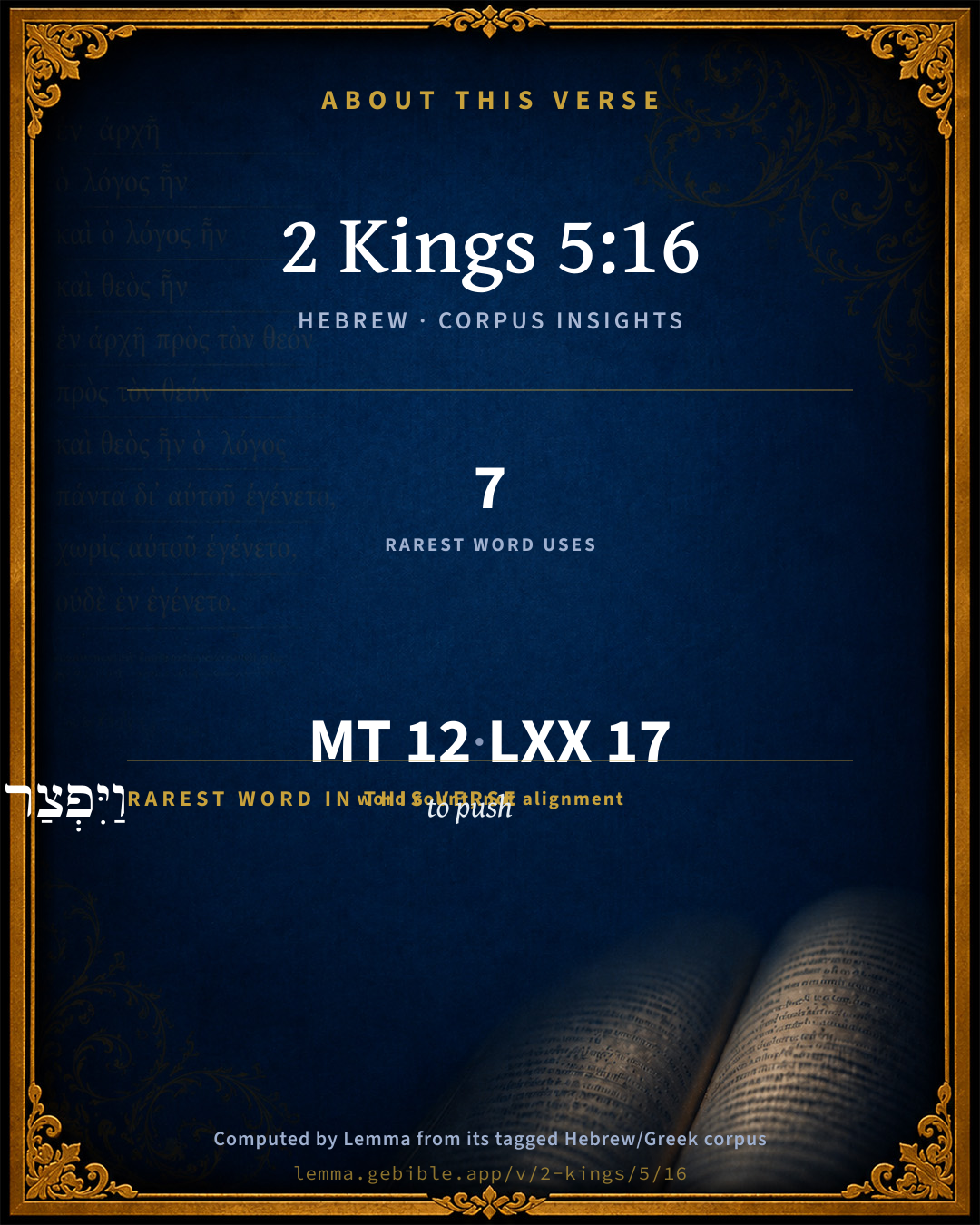
The rarest word here is וַיִּפְצַר to push H6484 — appearing just 7 times in the whole Hebrew Bible.

Shared distinctive vocabulary

וַיִּפְצַר to push H6484 occurs in 7 verses of the Hebrew Bible. Also found in:

Grammatical profile

  • 6 verbs
  • 2 nouns
  • 1 adjective
  • 1 preposition
  • 1 conjunction
  • 1 particle

Verb forms

  • וַיֹּ֕אמֶר Qal · Sequential Imperfect
  • עָמַ֥דְתִּי Qal · Perfect
  • אֶקָּ֑ח Qal · Imperfect
  • וַיִּפְצַר Qal · Sequential Imperfect
  • לָקַ֖חַת Qal · Infinitive Construct
  • וַיְמָאֵֽן Piel · Sequential Imperfect

Repetition

A word recurs within this verse — often emphatic in Hebrew:

  • אֶקָּ֑ח to take H3947 ×2

Hebrew & Septuagint length

In English translation the verse runs 23 words from the Hebrew and 27 from the Septuagint (LXX English) — closely comparable.

A rough comparison of the two English renderings, which tokenize alike — not a word-level alignment.

Word counts can differ between the Hebrew and the Greek without any difference in meaning — e.g. the Hebrew direct-object marker אֵת has no separate Greek word, and Greek often adds the article ὁ.

In the original languages it is 12 Hebrew tokens and 17 Greek tokens — but the two are counted differently (Hebrew bundles its prefixes and suffixes into one token; the Greek is in lemma form), so that isn’t a like-for-like length.

Cross-references

15

Topical passages linked to 2 Kings 5:16 in the Treasury of Scripture Knowledge — connected by theme and wording, ordered by reader-vote popularity; previews shown in the World English Bible.

  • 2 Kings 3:14 Elisha said, As Yahweh of Hosts lives, before whom I stand, surely, were it not that I regard the presence of Jehoshaphat the king of Judah, I would not look toward you, nor see you.
  • 2 Kings 5:20 But Gehazi the servant of Elisha the man of God, said, Behold, my master has spared this Naaman the Syrian, in not receiving at his hands that which he brought: as Yahweh lives, I will run after him, and take somewhat of him.
  • 2 Kings 5:26 He said to him, Didn't my heart go with you, when the man turned from his chariot to meet you? Is it a time to receive money, and to receive garments, and olive groves and vineyards, and sheep and oxen, and men-servants and maid-servants?
  • Genesis 14:22–23 Abram said to the king of Sodom, "I have lifted up my hand to Yahweh, God Most High, possessor of heaven and earth,
  • 1 Kings 13:8 The man of God said to the king, If you will give me half your house, I will not go in with you, neither will I eat bread nor drink water in this place;
  • 1 Kings 17:1 Elijah the Tishbite, who was of the foreigners of Gilead, said to Ahab, As Yahweh, the God of Israel, lives, before whom I stand, there shall not be dew nor rain these years, but according to my word.
  • Daniel 5:17 Then Daniel answered before the king, Let your gifts be to yourself, and give your rewards to another; nevertheless I will read the writing to the king, and make known to him the interpretation.
  • 1 Kings 18:15 Elijah said, As Yahweh of Hosts lives, before whom I stand, I will surely show myself to him today.
  • Matthew 10:8 Heal the sick, cleanse the lepers, and cast out demons. Freely you received, so freely give.
  • Acts 8:18–20 Now when Simon saw that the Holy Spirit was given through the laying on of the apostles' hands, he offered them money,
  • Acts 20:33–35 I coveted no one's silver, or gold, or clothing.
  • 1 Corinthians 6:12 "All things are lawful for me," but not all things are expedient. "All things are lawful for me," but I will not be brought under the power of anything.
  • 1 Corinthians 10:32–33 Give no occasions for stumbling, either to Jews, or to Greeks, or to the assembly of God;
  • 2 Corinthians 11:9–10 When I was present with you and was in need, I wasn't a burden on anyone, for the brothers, when they came from Macedonia, supplied the measure of my need. In everything I kept myself from being burdensome to you, and I will continue to do so.
  • 2 Corinthians 12:14 Behold, this is the third time I am ready to come to you, and I will not be a burden to you; for I seek not your possessions, but you. For the children ought not to save up for the parents, but the parents for the children.

Cross-references courtesy of OpenBible.info (CC BY 4.0).

Hebrew and Greek witnesses Masoretic Hebrew ↔ Greek Septuagint

The same verse in the two great witnesses to the Old Testament, shown verse-for-verse.

These are two independent witnesses, not word-aligned to each other, and the Septuagint is shown in lemma (dictionary) form.

Hebrew 2 Kings 5:16 Masoretic · Westminster Leningrad Codex

וַיֹּ֕אמֶר חַי יְהוָ֛ה אֲשֶׁר עָמַ֥דְתִּי לְפָנָ֖יו אִם אֶקָּ֑ח וַיִּפְצַר בּ֥וֹ לָקַ֖חַת וַיְמָאֵֽן

But he said, As Yahweh lives, before whom I stand, I will receive none. He urged him to take it; but he refused.

World English Bible · Public Domain

Greek LXX 2 Kings 5:16 Septuagint · lemma form

καί εἶπον ελισαιε ζάω κύριος ὅς παραἵστημι ἐνώπιον αὐτός εἰ λαμβάνω καί παραβιάζομαι αὐτός λαμβάνω καί ἀπειθέω

And Elisaie said, As the Lord lives, before whom I stand, I will not take one. And he pressed him to take one: but he would not.

LXX2012 (modern English Septuagint) · Public Domain

Hebrew: Westminster Leningrad Codex (CC BY 4.0). Greek: Septuagint (public domain); English from LXX2012 (modern English Septuagint) (Public Domain). How the Septuagint differs from the Hebrew →

Targum (Aramaic paraphrase)

1

The Targum is the ancient Jewish Aramaic paraphrase of the Hebrew Scriptures — an interpretive translation, not the Hebrew text itself. Onkelos (literal) and Pseudo-Jonathan (expansive) render the Torah, and Jonathan the Prophets. Coverage is partial: where no permissively-licensed English translation exists for a verse, only the Aramaic is shown. This is verse-level text, not a word-by-word alignment to the Hebrew.

  1. Targum Jonathan Prophets (Joshua–Malachi)
    וַאֲמַר קַיָם הוּא יְיָ דִי מְשַׁמֵשְׁנָא קָדָמוֹהִי אִם אֲקַבֵּל וְאַתְקֵיף בֵּיהּ לְקַבָּלָא וְלָא אֲבָא:

    (no public-domain English translation for this verse)

    Targum Jonathan — Aramaic: “Mikraot Gedolot” (public domain). English: “Sefaria Community Translation” (CC0 1.0 (public-domain dedication)); “London "Chaldee Paraphrase," 1871” (public domain). Text via Sefaria.

Commentary

Notes on 2 Kings 5:16 from classic Christian and Jewish commentators (each source and its license shown beneath its notes). The classic Christian expositions comment on the surrounding passage and are grouped to its opening verse, so a note may address several verses; the Jewish commentaries on the Tanakh (Rashi and others) are per-verse, so they appear only where the commentator wrote on this verse.

Lemma curates 59 commentaries, every one of them public domain or Creative Commons licensed, each selected and text-cleaned for this edition rather than reprinted as found. About our sources →

Trapp's Complete Commentary

John Trapp

2Ki 5:16 But he said, [As] the LORD liveth, before whom I stand, I will receive none. And he urged him to take [it]; but he refused.

Ver. 16. Before whom I stand.] As his menial servant, being θεοφορος, i.e., carrying God in him, as Isidor Pelusiot was called, full of God. Particeps Dei est vir sapiens, saith a philosopher, a wise man is a partaker of God, and therefore holds everything else worthless: as Abraham, when once assured that God, "the possessor of heaven and earth," was his "shield and exceeding great reward," would not take of the king of Sodom anything, to a shoelatchet. {Gen 14:23; Gen 15:1}

I will receive none.] Lest I should seem covetous, or to be thy beneficiary, or pensioner engaged. This made also Abraham so resolute. {Gen 14:22-23} Epaminondas, the famous Theban, though very poor, would by no means accept of a great mass of money sent him by the king of Persia; et ut mea fert sententia, magnificentior fuit is qui non aurum accepit, quam qui donavit, {a} saith Aelian, and it was very bravely done of him. It was God’s glory that the prophet in this refusal aimed at, and Naaman’s soul’s good: that he might give all the honour of his cure to God alone; and learn to set light by earthly property, and pomp of the world.

{a} Var., Hist., lib. v.

John Trapp, A Commentary or Exposition upon All the Books of the Old and New Testament (1647–1656) — public domain. Text from a community e-Sword module.

Joseph Benson's Commentary

2Ki 5:16. He said, As the Lord liveth, I will receive none — Not that he thought it unlawful to receive presents, which he did receive from others; but because of the special circumstances of the case, it being much for the honour of God that the Syrians should see the generous piety and kindness of his ministers and servants, and how much they despised all that worldly wealth and glory, which the prophets of the Gentiles so greedily sought after.

Joseph Benson's Commentary on the Old and New Testaments (1811–1818) — public domain. Text from a community e-Sword module.

Geneva Bible (1599)

Geneva Bible translators

So the Lord commandeth that they that receive freely, should give also freely.

Geneva Bible (1599) marginal notes — public domain. Text via Bolls.life.

Adam Clarke's Commentary

Verse 16. I will receive none.] It was very common to give presents to all great and official men; and among these, prophets were always included: but as it might have appeared to the Syrians that he had taken the offered presents as a remuneration for the cure performed, he refused; for as God alone did the work, he alone should have all the glory.

Adam Clarke's Commentary on the Bible (1810–1826) — public domain. Text from a community e-Sword/MySword module.

Ellicott's Commentary for English Readers

(16) But.—And (both times).

I will receive none.—Theodoret compares our Lord’s “Freely ye have received, freely give” (Mat_10:8). (Comp. Act_8:20.) Such may have been Elisha’s feeling. His refusal, strongly contrasting with the conduct of ordinary prophets, Israelite and heathen (comp. 1Sa_9:6-9), would make a deep impression upon Naaman and his retinue.

A Bible Commentary for English Readers, edited by Charles John Ellicott (1878–1897) — public domain. Text from a community e-Sword module.

The Cambridge Bible for Schools and Colleges

gen. ed. J. J. S. Perowne

16. I will receive none] Just as in the earlier part of his conduct Elisha had done everything to direct Naaman’s attention to Jehovah alone as the healer of his disease; so now he will have no gift for himself, lest thereby he should mar the effect of the previous lesson. Heathen priests and prophets were noted for the greed with which they received and demanded rewards. With the servants of the God of Israel there could be nothing of this kind. It was not of them, except as instruments, that the help came, and the gratitude must be paid where it was due. So in spite of much urging, Elisha would receive nothing. He stood before the Lord, and feeling whose servant he was, he must direct all honour to be offered to his Master.

The Cambridge Bible for Schools and Colleges (gen. ed. J. J. S. Perowne; Cambridge University Press, 1878–1918) — public domain. Text from a community e-Sword module.

John Gill's Exposition

But he said, as the Lord liveth, before whom I stand,.... Whose minister and prophet he was, and by whom he swears:

I will receive none: to let him know that this cure was not to be attributed to him, but the Lord only; and that what concern he had in it was not for the sake of money, but for the glory of the God of Israel:

and he urged him to take it, but he refused it; Naaman was very pressing upon him to receive a gift from him, but he could not be prevailed upon to accept it.

John Gill's Exposition of the Whole Bible (1746–1763) — public domain (CC PDM 1.0). Text via the HelloAO Bible API.

Albert Barnes' Notes on the Bible

I will receive none - The prophets were in the habit of receiving presents from those who consulted them 1Sa 9:7-8; 1Ki 14:3, but Elisha refused. It was important that Naaman should not suppose that the prophets of the true God acted from motives of self-interest, much less imagine that “the gift of God might be purchased with money” Act 8:20.

Albert Barnes' Notes on the Bible (1834–1885) — public domain. Text from a community e-Sword/MySword module.

Matthew Poole's English Annotations

Not that he thought it simply unlawful to receive gifts or presents, which he did receive from others, 2Ki 4:42, but because of the special circumstances of the present case; this being much for the honour of the true God and religion, that the Syrians should see the generous piety, and charity, and kindness of his ministers and servants, and how much they despised all that worldly wealth and glory which the priests or prophets of the Gentiles so greedily sought after; and that hereby Naaman might be much confirmed in that good religion which he had embraced, and others might be brought to a love and liking of it.

Matthew Poole's English Annotations on the Holy Bible (1683–1685) — public domain. Text from a community e-Sword/MySword module.

Whedon's Commentary on the Bible

Daniel D. Whedon

16. I will receive none — It seems to have been a custom for the prophets to receive presents from those who consulted them, (1Sa_9:7,) and it would appear from 2Ki_8:8-9 that on another occasion Elisha himself received a present from the king of Syria; why, then, did he refuse to accept one from Naaman? Some say because Naaman did not offer his present until after his cure, and thereby showed no little disrespect to the prophet; but a better reason is found in Elisha’s own words, 2Ki_5:26, “Is it a time to receive money and garments,” etc. It was a time of hypocrisy and avarice among the professed prophets and priests in the northern kingdom, and this fact brought the sacred office into disrepute and contempt among the people. It was wise, therefore, for Elisha, in connexion with this great miracle of healing, to decline the rich present of Naaman, so that all might know that the mighty works of God’s grace were free, and that avarice dwelt not in the heart of the true prophet of Jehovah.

Daniel D. Whedon (gen. ed.), Commentary on the Old and New Testaments (1874–1909) — public domain. Text from a community e-Sword module.

The Pulpit Commentary

But he said, As the Lord liveth, before whom I stand, I will receive none. Elisha regards it as best, under the circumstances, to refuse the offered recompense. It was not compulsory on him so to act; for the precept, "Freely ye have received, freely give", (Mat_10:8) had not been yet uttered. Pious Israelites commonly brought gifts to the prophets whom they consulted (1Sa_9:7, 1Sa_9:8; 1Ki_14:3) But, in the case of a foreigner, ignorant hitherto of true religion, whom it was important to impress favorably, and, if possible, win over to the faith, Elisha deemed it advisable to take no reward. Naaman was thus taught that Jehovah was his true Healer, the prophet the mere instrument, and that it was to Jehovah that his gratitude, his thanks, and his offerings were due. And he urged him to take it; but he refused. Contests of politeness are common in the East, where the one party offers to give and even insists on giving, while the other makes a pretence of declining; but here both parties were in earnest, and the gift was absolutely declined.

The Pulpit Commentary (1880–1919), ed. H.D.M. Spence-Jones & Joseph S. Exell — public domain. Text from a community e-Sword module.

John Wesley's Explanatory Notes

He refused - Not that he thought it unlawful to receive presents, which he did receive from others, but because of the special circumstances of the case; this being much for the honour of God that the Syrians should see the generous piety, and kindness of his ministers and servants, and how much they despised all that worldly wealth and glory, which the prophets of the Gentiles so greedily sought after.

John Wesley, Explanatory Notes Upon the Whole Bible (1754–1765) — public domain. Text via the GEBible commentary corpus.

Rashi

Rabbi Shlomo Yitzchaki (Rashi)

I will not accept. Because monies pertaining to idols are included in it.

Rashi on the Tanakh — English translations: “The Judaica Press complete Tanach with Rashi, translated by A. J. Rosenberg” (CC BY 4.0); “Pentateuch with Rashi's commentary by M. Rosenbaum and A.M. Silbermann, 1929-1934” (public domain); “The Metsudah Tanach series, Lakewood, N.J” (CC BY 4.0); and “The Book of Joshua, Metsudah Publications, 1997” (CC BY 4.0). Text via Sefaria.

Lesson kit

Teaching starters — assembled from the data on this page, not authored interpretation. Every prompt links to the verse data it draws on. Edit before teaching.

2 Kings, in the Historical, opens this verse with 12 words (10 distinct Hebrew lemmas). Its most distinctive word is pâtsar (“to push”). A historical commentator’s framing appears above. Read the whole chapter for the surrounding context.

Discussion questions

  1. What does “to push” (pâtsar) contribute to the verse as a whole?
  2. Genesis 19:3 shares the word «to push» with this verse. How do the two illuminate each other?
  3. “to take” occurs 2× in this one verse. What is the effect of the repetition?
  4. These translations render this verse differently. What is at stake in choosing one wording over another?
  5. The verb «וַיֹּ֕אמֶר» is Qal Sequential Imperfect. How does its form color the action?
  6. Reading how Trapp's Complete Commentary and Joseph Benson's Commentary read this verse, where do the two commentators agree and where do they part?

Things to notice

Reading settings

Reading text

Shown beneath each verse's original-language words.

Old Testament
Old Testament edition

Read the OT as the Masoretic Hebrew (MT) or the Greek Septuagint (LXX).

English shown for the Greek Septuagint (in the Hebrew ↔ Greek comparison).

Comparing translations? Open the Compare panel on any verse page to stack up to four side by side.