2 Kings 5:25

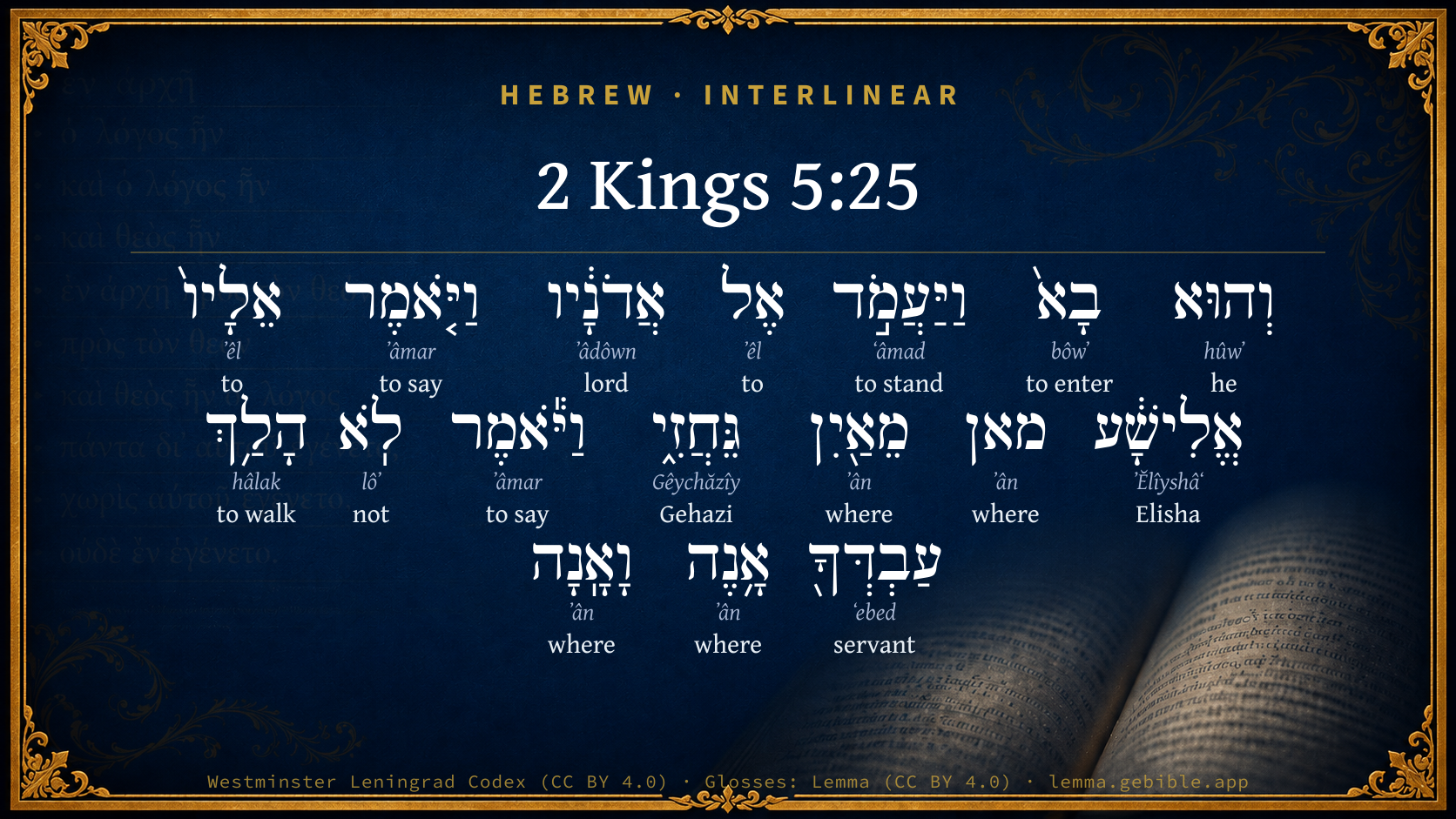
Hebrew (Westminster Leningrad Codex) 2 Kings 5:25 appears in the Hebrew Old Testament. The text above is from the Westminster Leningrad Codex. Each word links to its Strong’s number, a concise gloss, and parsing drawn from the Open Scriptures Hebrew Bible morphology. Click any word for its full Brown-Driver-Briggs (BDB) entry.
Download image
Cite this verse

2 Kings 5:25 (World English Bible). Public Domain. Lemma interlinear Bible study tool, https://lemma.gebible.app/v/2-kings/5/25.

Show BibTeX & RIS
BibTeX
RIS
English Translation
But he went in, and stood before his master. Elisha said to him, Whence come you, Gehazi? He said, Your servant went no where.
World English Bible · Public Domain
Download a study sheet

One document with this verse’s original text, its word-by-word gloss line, the meaning frame, cross-references with their text, attributed commentary, and full source and license credits — printable, and it pastes into notes with its structure intact.

This verse Autodidact and up

Study sheet (.html) Plain text (.txt)

A passage Seminary Student

Up to 50 verses in one chapter. A passage sheet keeps up to 6 commentary sources and 12 cross-references per verse, in the order this page ranks them, and says so on the sheet whenever that leaves anything out. Ask for a single verse and you get the Autodidact verse sheet above.

Everything on this page stays free to read, with no account — the sheet is a download of what is already on screen, not access to it.

Want to remove ads? Support Godless Engineer
Compare translations 3

The same verse in 3 English versions, stacked beneath the original-language interlinear above. Click any original word for its lexicon entry.

Each is an independent rendering of the whole verse — the interlinear is not word-aligned to these translations.

Highlighted words mark where these versions differ — a whole-verse word diff, not a word-by-word alignment.

  • World English Bible Public Domain
    But he went in, and stood before his master. Elisha said to him, Whence come you, Gehazi? He said, Your servant went no where.
  • King James Version Public Domain
    But he went in, and stood before his master. And Elisha said unto him, Whence comest thou, Gehazi? And he said, Thy servant went no whither.
  • unfoldingWord Literal Text CC BY-SA 4.0
    And he, he came, and he stood beside his master. And Elisha said to him, “From where, Gehazi?” And he said, “Your servant did not go here or here.”

unfoldingWord Literal Text — © unfoldingWord, licensed CC BY-SA 4.0. Word-aligned USFM3 via Door43 (git.door43.org/unfoldingWord/en_ult).

Versions to compare (up to 4)

3 of 4 selected

Show all 18 translations

Every available English version of this verse, each an independent rendering of the whole verse.

  • World English Bible Public Domain
    But he went in, and stood before his master. Elisha said to him, Whence come you, Gehazi? He said, Your servant went no where.
  • Berean Standard Bible Public Domain
    When Gehazi went in and stood before his master, Elisha asked him, “Gehazi, where have you been?” “Your servant did not go anywhere,” he replied.
  • Majority Standard Bible Public Domain
    When Gehazi went in and stood before his master, Elisha asked him, “Gehazi, where have you been?” “Your servant did not go anywhere,” he replied.
  • King James Version Public Domain
    But he went in, and stood before his master. And Elisha said unto him, Whence comest thou, Gehazi? And he said, Thy servant went no whither.
  • American Standard Version (1901) Public Domain
    But he went in, and stood before his master. And Elisha said unto him, Whence comest thou, Gehazi? And he said, Thy servant went no whither.
  • Revised Version (1885) Public Domain
    But he went in, and stood before his master. And Elisha said unto him, Whence comest thou, Gehazi? And he said, Thy servant went no whither.
  • Geneva Bible (1599) Public Domain
    Then he went in, and stoode before his master. And Elisha said vnto him, Whence commest thou, Gehazi? And he said, Thy seruant went no whither.
  • Douay-Rheims (1899) Public Domain
    But he went in, and stood before his master. And Eliseus said: Whence comest thou, Giezi? He answered: Thy servant went no whither.
  • Young's Literal Translation Public Domain
    And he hath come in, and doth stand by his lord, and Elisha saith unto him, `Whence -- Gehazi?' and he saith, `Thy servant went not hither or thither.'
  • Literal Standard Version CC BY-SA 4.0
    And he has come in, and stands by his lord, and Elisha says to him, “From where—Gehazi?” And he says, “Your servant did not go here or there.”
  • Unlocked Literal Bible CC BY-SA 4.0
    When Gehazi went in and stood before his master, Elisha said to him, “Where have you come from, Gehazi?” He answered, “Your servant went nowhere.”
  • unfoldingWord Literal Text CC BY-SA 4.0
    And he, he came, and he stood beside his master. And Elisha said to him, “From where, Gehazi?” And he said, “Your servant did not go here or here.”
  • Darby Bible Public Domain
    And he entered in and stood before his master. And Elisha said to him, Whence [comest thou], Gehazi? And he said, Thy servant went no whither.
  • World Messianic Bible Public Domain
    But he went in, and stood before his master. Elisha said to him, “Where did you come from, Gehazi?” He said, “Your servant went nowhere.”
  • Webster's Bible Public Domain
    But he went in, and stood before his master: and Elisha said to him, Whence comest thou Gehazi? and he said, Thy servant went no whither.
  • Free Bible Version CC BY-SA 4.0
    When Gehazi got back and attended his master, Elisha asked him, “Where have you been, Gehazi?” “Your servant hasn't been anywhere,” he replied.
  • Bible in Basic English Public Domain
    Then he came in and took his place before his master. And Elisha said to him, Where have you come from, Gehazi? And he said, Your servant went nowhere.
  • JPS Tanakh (1917) Public Domain
    But he went in, and stood before his master. And Elisha said unto him: 'Whence comest thou, Gehazi?' And he said: 'Thy servant went no whither.'

Literal Standard Version (2020), Covenant Press — licensed CC BY-SA 4.0. Text via the HelloAO Bible API (eBible.org). Unlocked Literal Bible (unfoldingWord) — licensed CC BY-SA 4.0. Text via the HelloAO Bible API (eBible.org). unfoldingWord Literal Text — © unfoldingWord, licensed CC BY-SA 4.0. Word-aligned USFM3 via Door43 (git.door43.org/unfoldingWord/en_ult). Free Bible Version, Dr. Jonathan Gallagher — licensed CC BY-SA 4.0. Text via the HelloAO Bible API (eBible.org).

Word by word

More ways to search: Search by grammar → Find every occurrence → Compare this word →

Practice this passage: Drill this verse → Learn its vocabulary →

גֵּחֲזִ֑י
Gêychăzîy
H1522
“Gehazi”
Noun, Proper
Part of Speech
Noun
Type
Proper
Full BDB Definition

Origin: apparently from H1516 and H2372

TWOT: None

Gehazi = "valley of vision" - the servant of Elisha
  1. וְהוּא hûwʼ H1931 “and · he” Conjunction + Pronoun, Personal, 3rd Person, Masculine, Singular
  2. בָא֙ bôwʼ H935 “to enter” Verb, Qal, Perfect, 3rd Person, Masculine, Singular
  3. וַיַּעֲמֹ֣ד ʻâmad H5975 “and · to stand” Conjunction + Verb, Qal, Sequential Imperfect, 3rd Person, Masculine, Singular
  4. אֶל ʼêl H413 “to” Preposition
  5. אֲדֹנָ֔יו ʼâdôwn H113 “lords · his” Noun, Common, Masculine, Plural, Construct + Suffix, Personal, 3rd Person, Masculine, Singular
  6. וַיֹּ֤אמֶר ʼâmar H559 “and · to say” Conjunction + Verb, Qal, Sequential Imperfect, 3rd Person, Masculine, Singular
  7. אֵלָיו֙ ʼêl H413 “to · him” Preposition + Suffix, Personal, 3rd Person, Masculine, Singular
  8. אֱלִישָׁ֔ע ʼĔlîyshâʻ H477 “Elisha” Noun, Proper
  9. מאן ʼân H575 “from · where” Preposition + Particle, Interrogative
  10. מֵאַ֖יִן ʼân H575 “from · where” Preposition + Particle, Negative
  11. וַיֹּ֕אמֶר ʼâmar H559 “and · to say” Conjunction + Verb, Qal, Sequential Imperfect, 3rd Person, Masculine, Singular
  12. לֹֽא lôʼ H3808 “not” Particle, Negative
  13. הָלַ֥ךְ hâlak H1980 “to walk” Verb, Qal, Perfect, 3rd Person, Masculine, Singular
  14. עַבְדְּךָ֖ ʻebed H5650 “servant · your” Noun, Common, Masculine, Singular, Construct + Suffix, Personal, 2nd Person, Masculine, Singular
  15. אָ֥נֶה ʼân H575 “where” Adverb
  16. וָאָֽנָה ʼân H575 “and · where” Conjunction + Particle, Interrogative

About this verse

These counts appear in no published source. They are computed here, from the morphology-tagged text and Lemma’s own curated glosses. What Lemma adds →

17
words
12
distinct lemmas
Historical
section

Notable vocabulary

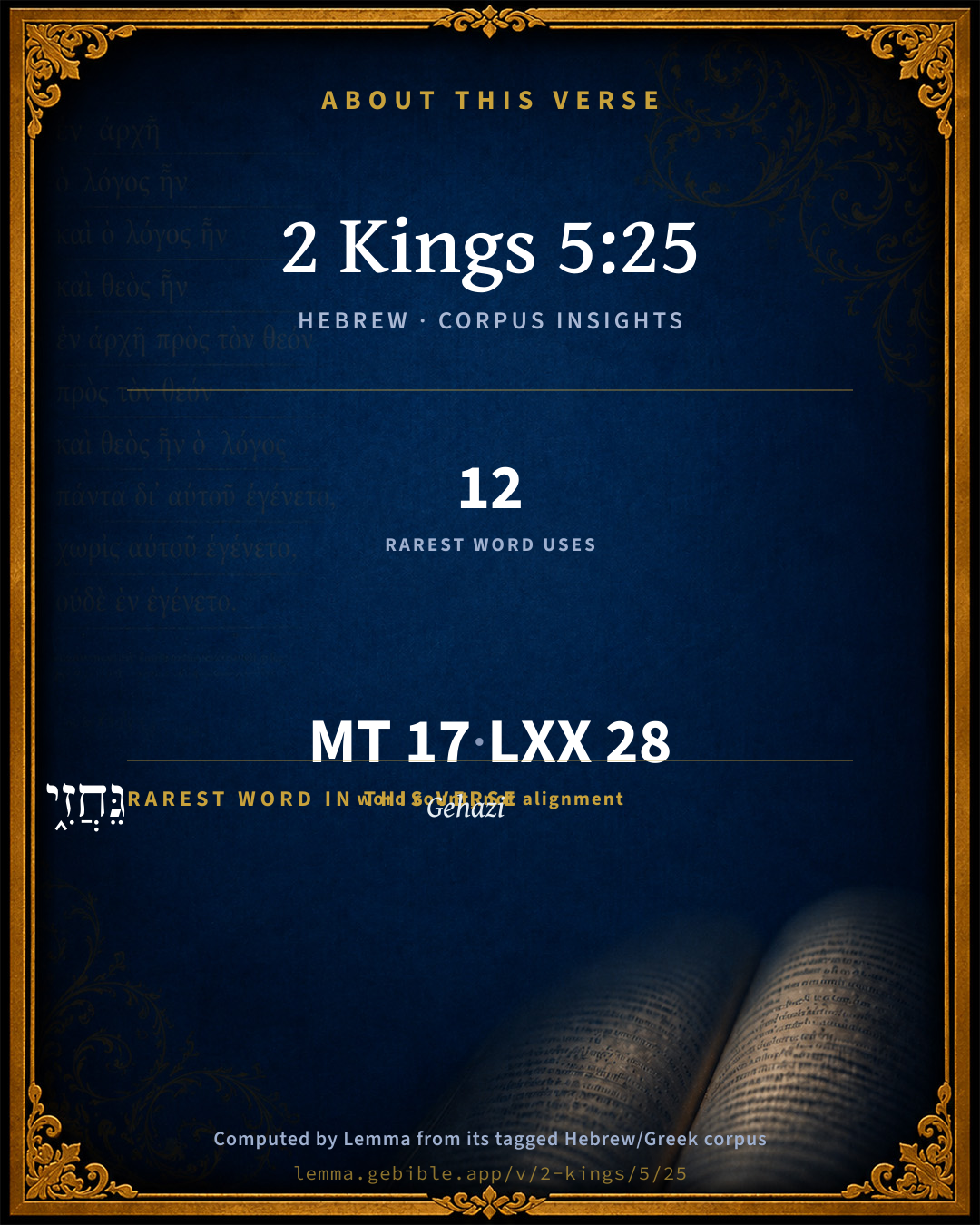
The rarest word here is גֵּחֲזִ֑י Gehazi H1522 — appearing just 12 times in the whole Hebrew Bible.

Shared distinctive vocabulary

גֵּחֲזִ֑י Gehazi H1522 occurs in 12 verses of the Hebrew Bible. Also found in:

Grammatical profile

  • 5 verbs
  • 4 nouns
  • 1 pronoun
  • 2 prepositions
  • 1 adverb
  • 4 particles

Verb forms

  • בָא֙ Qal · Perfect
  • וַיַּעֲמֹ֣ד Qal · Sequential Imperfect
  • וַיֹּ֤אמֶר Qal · Sequential Imperfect
  • וַיֹּ֕אמֶר Qal · Sequential Imperfect
  • הָלַ֥ךְ Qal · Perfect

Repetition

Words recur within this verse — often emphatic in Hebrew:

  • מאן where H575 ×4
  • וַיֹּ֤אמֶר to say H559 ×2
  • אֶל to H413 ×2

Hebrew & Septuagint length

In English translation the verse runs 24 words from the Hebrew and 15 from the Septuagint (LXX English) — the Septuagint runs noticeably shorter here. See the side-by-side →

A rough comparison of the two English renderings, which tokenize alike — not a word-level alignment.

Word counts can differ between the Hebrew and the Greek without any difference in meaning — e.g. the Hebrew direct-object marker אֵת has no separate Greek word, and Greek often adds the article ὁ.

In the original languages it is 17 Hebrew tokens and 28 Greek tokens — but the two are counted differently (Hebrew bundles its prefixes and suffixes into one token; the Greek is in lemma form), so that isn’t a like-for-like length.

Cross-references

12

Topical passages linked to 2 Kings 5:25 in the Treasury of Scripture Knowledge — connected by theme and wording, ordered by reader-vote popularity; previews shown in the World English Bible.

  • 2 Kings 5:22 He said, All is well. My master has sent me, saying, Behold, even now there are come to me from the hill-country of Ephraim two young men of the sons of the prophets; please give them a talent of silver, and two changes of clothing.
  • Genesis 3:8–9 They heard the voice of Yahweh God walking in the garden in the cool of the day, and the man and his wife hid themselves from the presence of Yahweh God among the trees of the garden.
  • Genesis 4:9 Yahweh said to Cain, "Where is Abel, your brother?" He said, "I don't know. Am I my brother's keeper?"
  • Genesis 16:8 He said, "Hagar, Sarai's handmaid, where did you come from? Where are you going?" She said, "I am fleeing from the face of my mistress Sarai."
  • 2 Kings 20:14 Then came Isaiah the prophet to king Hezekiah, and said to him, What said these men? and from whence came they to you? Hezekiah said, They are come from a far country, even from Babylon.
  • Proverbs 30:20 So is the way of an adulterous woman: She eats and wipes her mouth, And says, 'I have done nothing wrong.'
  • Ezekiel 33:31 They come to you as the people comes, and they sit before you as my people, and they hear your words, but don't do them; for with their mouth they show much love, but their heart goes after their gain.
  • Matthew 26:15–16 and said, "What are you willing to give me, that I should deliver him to you?" They weighed out for him thirty pieces of silver.
  • Matthew 26:21 As they were eating, he said, "Most assuredly I tell you that one of you will betray me."
  • John 13:26–30 Jesus therefore answered, "It is he to whom I will give this piece of bread when I have dipped it." So when he had dipped the piece of bread, he gave it to Judas, the son of Simon Iscariot.
  • Acts 5:3–4 But Peter said, "Ananias, why has Satan filled your heart to lie to the Holy Spirit, and to keep back part of the price of the land?
  • John 13:2 After supper, the devil having already put into the heart of Judas Iscariot, Simon's son, to betray him,

Cross-references courtesy of OpenBible.info (CC BY 4.0).

Hebrew and Greek witnesses Masoretic Hebrew ↔ Greek Septuagint

The same verse in the two great witnesses to the Old Testament, shown verse-for-verse.

Here the Septuagint runs noticeably shorter than the Hebrew — LXX2012 (modern English Septuagint) 15 words vs World English Bible 24. A rough length comparison of the two English translations, not a word-level alignment — read both below.

These are two independent witnesses, not word-aligned to each other, and the Septuagint is shown in lemma (dictionary) form.

Hebrew 2 Kings 5:25 Masoretic · Westminster Leningrad Codex

וְהוּא בָא֙ וַיַּעֲמֹ֣ד אֶל אֲדֹנָ֔יו וַיֹּ֤אמֶר אֵלָיו֙ אֱלִישָׁ֔ע מאן מֵאַ֖יִן גֵּחֲזִ֑י וַיֹּ֕אמֶר לֹֽא הָלַ֥ךְ עַבְדְּךָ֖ אָ֥נֶה וָאָֽנָה

But he went in, and stood before his master. Elisha said to him, Whence come you, Gehazi? He said, Your servant went no where.

World English Bible · Public Domain

Greek LXX 2 Kings 5:25 Septuagint · lemma form

καί αὐτός εἰςἔρχομαι καί παρα εἰςτήκω πρός ὁ κύριος αὐτός καί εἶπον πρός αὐτός ελισαιε πόθεν γιεζι καί εἶπον γιεζι οὐ πορεύομαι ὁ δοῦλος σύ ἔνθα καί ἔνθα

And he went in himself and stood before his master; and Elisaie said to him,

LXX2012 (modern English Septuagint) · Public Domain

Hebrew: Westminster Leningrad Codex (CC BY 4.0). Greek: Septuagint (public domain); English from LXX2012 (modern English Septuagint) (Public Domain). How the Septuagint differs from the Hebrew →

Targum (Aramaic paraphrase)

1

The Targum is the ancient Jewish Aramaic paraphrase of the Hebrew Scriptures — an interpretive translation, not the Hebrew text itself. Onkelos (literal) and Pseudo-Jonathan (expansive) render the Torah, and Jonathan the Prophets. Coverage is partial: where no permissively-licensed English translation exists for a verse, only the Aramaic is shown. This is verse-level text, not a word-by-word alignment to the Hebrew.

  1. Targum Jonathan Prophets (Joshua–Malachi)
    וְהוּא אֲתָא וְקָם קֳדָם רִבּוֹנֵיהּ וַאֲמַר לֵיהּ אֱלִישָׁע מְנָן אַתְּ אָתֵי גֵיחֲזִי וַאֲמַר לָא אֲזַל עַבְדָךְ לְכָא וּלְכָא:

    (no public-domain English translation for this verse)

    Targum Jonathan — Aramaic: “Mikraot Gedolot” (public domain). English: “Sefaria Community Translation” (CC0 1.0 (public-domain dedication)); “London "Chaldee Paraphrase," 1871” (public domain). Text via Sefaria.

Commentary

Notes on 2 Kings 5:25 from classic Christian and Jewish commentators (each source and its license shown beneath its notes). The classic Christian expositions comment on the surrounding passage and are grouped to its opening verse, so a note may address several verses; the Jewish commentaries on the Tanakh (Rashi and others) are per-verse, so they appear only where the commentator wrote on this verse.

Lemma curates 59 commentaries, every one of them public domain or Creative Commons licensed, each selected and text-cleaned for this edition rather than reprinted as found. About our sources →

Trapp's Complete Commentary

John Trapp

2Ki 5:25 But he went in, and stood before his master. And Elisha said unto him, Whence [comest thou], Gehazi? And he said, Thy servant went no whither.

Ver. 25. Thy servant went no whither.] Another flat lie; sic mendaciuui mendacio assuit; but with ill success. Our false hearts will answer us in like sort, when they have been ranging and roving in hell’s ways.

John Trapp, A Commentary or Exposition upon All the Books of the Old and New Testament (1647–1656) — public domain. Text from a community e-Sword module.

The Biblical Illustrator

Joseph S. Exell

2Ki_5:25

Thy servant went no whither.

A lie sticks

A little newsboy, to sell his paper, told a lie. The matter came up in the Sunday school. Would you tell a lie for a penny? asked a young lady teacher of one of her boys. No maam, he answered very decidedly. For sixpence, then? No maam. For a shilling? No, maam? For a thousand shillings? Dick was staggered. A thousand shillings looked big. Wouldnt it buy a lot of things? While he was thinking, another boy behind him called out, No, maam. Why not? asked the teacher. Because, said the boy, when the thousand shillings are all gone, and all the things theyve got with them have gone too, the lie is there, all the same. It is so. A lie sticks. Everything else may be gone, but that is left, and it must be carried with you, whether you will or not.

Heredity not wholly a disadvantage

A young man complains to Jupiter that in consequence of his fathers debaucheries he is pierced with pangs and punished with pains for sins not his own. Jupiter replies that in accordance with the very law of which he complains, he also receives from his father delicate nerves, vigorous muscles, and keen senses which are inlets of joy and many noble capacities and faculties of mind and heart. Jupiter offers in his case to suspend the offensive organic law; but warns him that, in losing his pain, he shall also lose all advantages and benefits through that same law of hereditary descent. And he further reminds him that even his pain is a monitor to warn him from the paths of vice trodden by his father. The sufferer withdraws his complaint, resigns himself, and resolves by pious obedience to all bodily laws to bring back his body to a normal and healthy state. (Combe on the Constitution of Man. )

Continuity of evil influences

Suppose a company of shipowners started a sea captain with an imperfect chart and with an unseaworthy vessel, and after the vessel has been gone five days they feel sorry about it, and wish they had not let the vessel go out in that way. Does that make any difference to those who have gone out? No! In the first storm the captain and the crew go down. And if you come to God in the latter part of your life, when you have given your children an impulse in the wrong direction, those ten, or fifteen, or twenty years of example in the wrong direction will be mightier than the few words you can utter now in the right direction. So it is with the influence you have had anywhere in community. If you have all these years given countenance to those who are neglecting religion, can you correct that? (T. De Witt Talmage.)

Heredity may transmit predisposition to disease

We know from experience that a full measure of health is not often the happy condition of human tissues; we have, in short, a variety of circumstances which, as we say, predispose the individual to disease. One of the commonest forms of predisposition is that due to heredity. Probably it is true that what are known as hereditary diseases are due far more to a hereditary predisposition than to any transmission of the virus itself in any form. Antecedent disease predisposes the tissues to form a nidus for bacteria; conditions of environment or personal habits frequently act in the same way. Damp soils must be held responsible for many disasters to health, not directly, but indirectly, by predisposition; dusty trades and injurious occupations have a similar effect. Any one of these three different influences may in a variety of ways affect the tissues and increase their susceptibility to disease. Not infrequently we may get them combined. (Newman, Bacteria.)

Verse 27 The leprosy therefore of Naaman shall cleave unto thee, and unto thy seed for ever.--

Gehazi smitten with leprosy

The sin which led to this punishment suggests--

I. That it is a mark of the highest contempt of the Holy God to link His name with our sinful purposes. As the Lord liveth, said Gehazi, I will take somewhat of him (2Ki_5:20). To stamp base metal with the image and name of the king is regarded as a great crime against the country and the monarch. How much greater the crime of stamping upon our evil actions the name of God. Yet some of the most diabolical acts that stain the page of history have been wrought in the name of the sinless Redeemer.

II. That the transgression of the first table of the moral law is a step to the transgression of the second. The man who will speak lightly of a good master will find it an easy matter to misrepresent the character of his fellow-servant. The child who dishonours a good parent will not be likely to be a kind brother. Those who fear not God, will as a rule regard not men (Luk_18:2). The sin against the less, comes easily after the sin against the greater. Gehazi first profaned the name of God, and then wronged his earthly master.

III. That those who will lie in order to deceive, must lie in order to conceal. Gehazis lie to Naaman was soon followed by another to Elisha. It has been said that a lie has no legs. There are men in the world who have no limbs upon which they can walk, and are indebted to the artificial help of crutches to make their way in the world. So a lie must be kept up by the crutches of other lies. The punishment for the sin teaches--That those who sin and seek to cover it by concealment, will be compelled, in time, to be the means of its revelation. (Outlines of Sermons by a London Minister.)

.

The Biblical Illustrator, edited by Joseph S. Exell (c. 1880s–1900s) — public domain. Text from a community e-Sword module.

Tyndale Open Study Notes

Tyndale Open Resources

5:25-27 Gehazi could not conceal his deed from Elisha. Gehazi’s deception and misuse of his privileged position earned his master’s disapproval and the loss of his status as Elisha’s servant. But it also brought on him the penalty of Naaman’s leprosy, a sign that Gehazi had traded places with Naaman spiritually as well.

Tyndale Open Study Notes — © Tyndale Open Resources, licensed CC BY-SA 4.0. Text via the HelloAO Bible API.

Ellicott's Commentary for English Readers

(25) But he.—And he himself (after putting away his ill-gotten gains).

Went in.—Into his master’s chamber. Gehazi was already in the house.

Stood before.—Came forward to (2Ch_6:12).

Thy servant went no whither.—Literally, Thy servant went not away hither nor thither.

A Bible Commentary for English Readers, edited by Charles John Ellicott (1878–1897) — public domain. Text from a community e-Sword module.

The Cambridge Bible for Schools and Colleges

gen. ed. J. J. S. Perowne

25. and stood before his master] He would let his absence be as little noted as possible. In the East the servants are usually kept in waiting. Hence the phrase ‘to stand before’ is frequent in connexion with Oriental service. Thus David ‘stands before Saul (1Sa_16:21-22), so of Abishag (1Ki_1:2). See also 1Ki_10:8; Dan_1:5, &c.

The Cambridge Bible for Schools and Colleges (gen. ed. J. J. S. Perowne; Cambridge University Press, 1878–1918) — public domain. Text from a community e-Sword module.

John Gill's Exposition

But he went in, and stood before his master,.... To know his will, and minister to him, as he had used to do, and as if he had never been from the house:

and Elisha said unto him, whence comest thou, Gehazi? where had he been, and where was he last?

and he said, thy servant went no whither; he pretended he had never been out of doors, which was another impudent lie; one would have thought that he who had lived so long with the prophet, and had seen the miracles wrought by him, and knew with what a spirit of prophecy he was endowed, would never have ventured to tell such an untruth, since he might expect to be detected; but covetousness had blinded his eyes and hardened his heart.

John Gill's Exposition of the Whole Bible (1746–1763) — public domain (CC PDM 1.0). Text via the HelloAO Bible API.

Albert Barnes' Notes on the Bible

Lest his absence should be noticed, Gehazi hastened, without being called, to appear before his master. In the East it is usual for servants to remain most of the day in their lord’s presence, only quitting it when given some order to execute.

Albert Barnes' Notes on the Bible (1834–1885) — public domain. Text from a community e-Sword/MySword module.

The Pulpit Commentary

But he went in, and stood before his master. Gehazi, lest his absence should be noticed, as soon as he had put away the money, sought his master"s presence, entering the room casually, as if he had been busied about the house. He was met at once, however, by the plain and stern question which follows. And Elisha said unto him; Whence comest thou, Gehazi? literally, Whence, Gehazi? A short, stem, abrupt question. And he said, Thy servant went no whither. There was no help for it. One lie necessitates another. Once enter on the devious path, and you cannot say whither it will conduct you. To deceive and plunder a foreigner of a hostile nation probably seemed to Gehazi a trifle, either no sin at all, or a very venial sin. But now he finds himself led on to telling a direct lie to his master, which even he could not have justified to himself.

The Pulpit Commentary (1880–1919), ed. H.D.M. Spence-Jones & Joseph S. Exell — public domain. Text from a community e-Sword module.

Keil & Delitzsch

C. F. Keil & F. Delitzsch

But when he entered his master's presence again, he asked him, "Whence (comest thou), Gehazi?" and on his returning the lying answer that he had not been anywhere, charged him with all that he had done. הלך לבּי לא, "had not my heart gone, when the man turned from his chariot to meet thee?" This is the simplest and the only correct interpretation of these difficult words, which have been explained in very different ways. Theodoret (οὐχὶ ἡ καρδία μου ἦ μετὰ σοῦ) and the Vulgate (nonne cor meum in praesenti erat, quando, etc.) have already given the same explanation, and so far as the sense is concerned it agrees with that adopted by Thenius: was I not (in spirit) away (from here) and present (there)? הלך stands in a distinct relation to the הלך לא of Gehazi. - וגו האת: "is it time to take silver, and clothes, and olive-trees, and vineyards, and sheep and oxen, and servants and maidens?" i.e., is this the time, when so many hypocrites pretend to be prophets from selfishness and avarice, and bring the prophetic office into contempt with unbelievers, for a servant of the true God to take money and goods from a non-Israelite for that which God has done through him, that he may acquire property and luxury for himself?

Keil & Delitzsch — Biblical Commentary on the Old Testament (1861–1891) — public domain (CC PDM 1.0). Text via the HelloAO Bible API. (Old Testament only.)

Scofield Reference Notes

C. I. Scofield

no whither

Heb. "not hither or thither."

The Scofield Reference Bible (1917 edition), notes by C. I. Scofield — public domain. Text from a community e-Sword module.

Lesson kit

Teaching starters — assembled from the data on this page, not authored interpretation. Every prompt links to the verse data it draws on. Edit before teaching.

2 Kings, in the Historical, opens this verse with 17 words (12 distinct Hebrew lemmas). Its most distinctive word is Gêychăzîy (“Gehazi”). The Greek Septuagint runs shorter here. A historical commentator’s framing appears above. Read the whole chapter for the surrounding context.

Discussion questions

  1. How does “Gehazi” (Gêychăzîy) shape what this verse is saying?
  2. 2 Kings 4:12 shares the word «Gehazi» with this verse. How do the two illuminate each other?
  3. “where” occurs 4× in this one verse. What is the effect of the repetition?
  4. Compared with the Hebrew, the Septuagint runs shorter here. What questions does that raise?
  5. The translations on this page render this verse differently — a whole-verse word diff, not a word-by-word alignment. What might account for the different wordings?
  6. The verb «בָא֙» is Qal Perfect. How does its form color the action?
  7. Reading how Trapp's Complete Commentary and The Biblical Illustrator read this verse, where do the two commentators agree and where do they part?

Things to notice

Reading settings

Reading text

Shown beneath each verse's original-language words.

Old Testament
Old Testament edition

Read the OT as the Masoretic Hebrew (MT) or the Greek Septuagint (LXX).

English shown for the Greek Septuagint (in the Hebrew ↔ Greek comparison).

Comparing translations? Open the Compare panel on any verse page to stack up to four side by side.