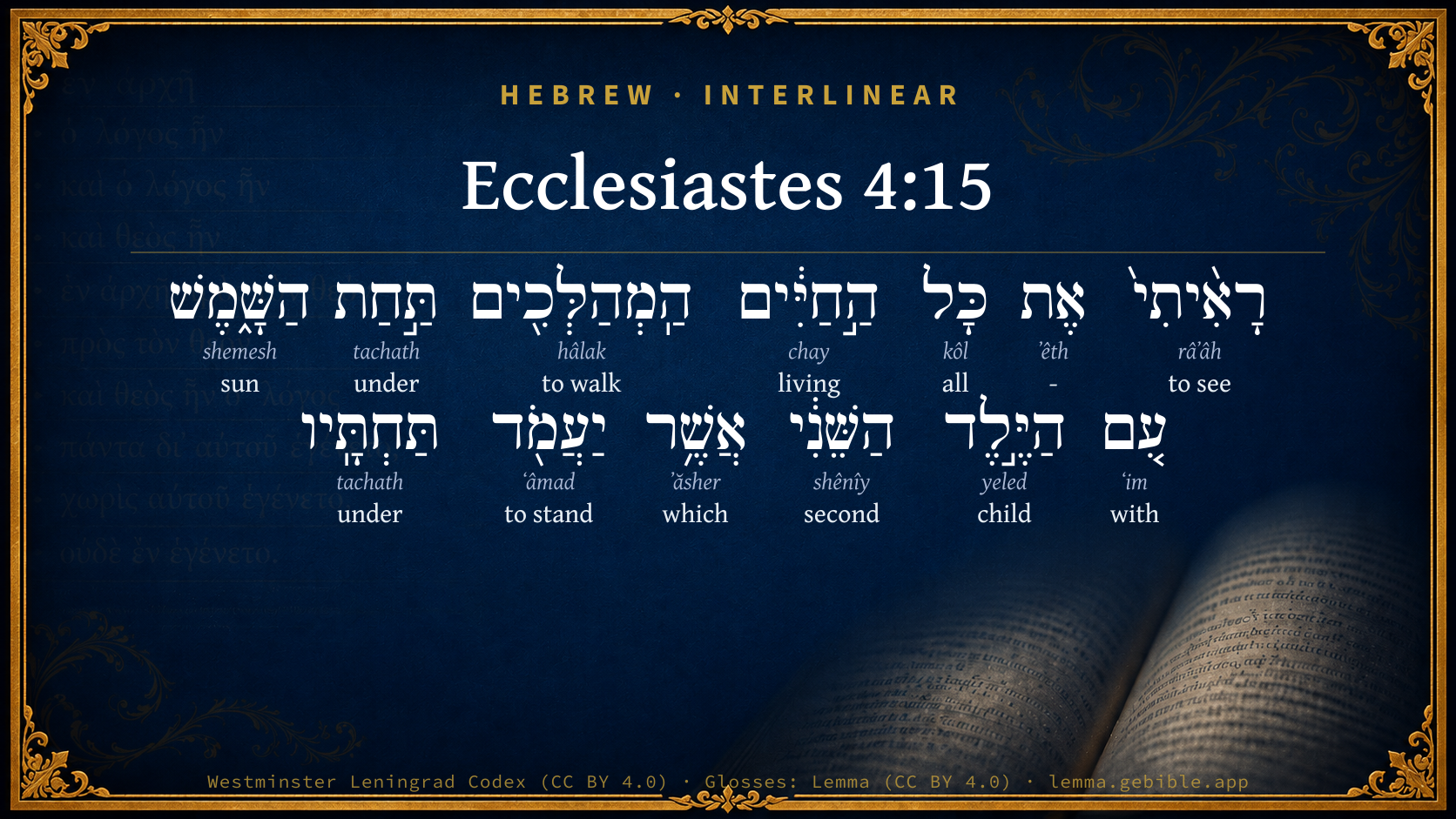
Ecclesiastes 4:15

Hebrew (Westminster Leningrad Codex) Ecclesiastes 4:15 appears in the Hebrew Old Testament. The text above is from the Westminster Leningrad Codex. Each word links to its Strong’s number, a concise gloss, and parsing drawn from the Open Scriptures Hebrew Bible morphology. Click any word for its full Brown-Driver-Briggs (BDB) entry.
Download image
Cite this verse

Ecclesiastes 4:15 (World English Bible). Public Domain. Lemma interlinear Bible study tool, https://lemma.gebible.app/v/ecclesiastes/4/15.

Show BibTeX & RIS
BibTeX
RIS
English Translation
I saw all the living who walk under the sun, that they were with the youth, the other, who succeeded him.
World English Bible · Public Domain
Download a study sheet

One document with this verse’s original text, its word-by-word gloss line, the meaning frame, cross-references with their text, attributed commentary, and full source and license credits — printable, and it pastes into notes with its structure intact.

This verse Autodidact and up

Study sheet (.html) Plain text (.txt)

A passage Seminary Student

Up to 50 verses in one chapter. A passage sheet keeps up to 6 commentary sources and 12 cross-references per verse, in the order this page ranks them, and says so on the sheet whenever that leaves anything out. Ask for a single verse and you get the Autodidact verse sheet above.

Everything on this page stays free to read, with no account — the sheet is a download of what is already on screen, not access to it.

Want to remove ads? Support Godless Engineer
Compare translations 3

The same verse in 3 English versions, stacked beneath the original-language interlinear above. Click any original word for its lexicon entry.

Each is an independent rendering of the whole verse — the interlinear is not word-aligned to these translations.

Highlighted words mark where these versions differ — a whole-verse word diff, not a word-by-word alignment.

  • World English Bible Public Domain
    I saw all the living who walk under the sun, that they were with the youth, the other, who succeeded him.
  • King James Version Public Domain
    I considered all the living which walk under the sun, with the second child that shall stand up in his stead.
  • unfoldingWord Literal Text CC BY-SA 4.0
    I saw all the living, the ones walking around under the sun, with the second child who will stand under him.

unfoldingWord Literal Text — © unfoldingWord, licensed CC BY-SA 4.0. Word-aligned USFM3 via Door43 (git.door43.org/unfoldingWord/en_ult).

Versions to compare (up to 4)

3 of 4 selected

Show all 18 translations

Every available English version of this verse, each an independent rendering of the whole verse.

  • World English Bible Public Domain
    I saw all the living who walk under the sun, that they were with the youth, the other, who succeeded him.
  • Berean Standard Bible Public Domain
    I saw that all who lived and walked under the sun followed this second one, the youth who succeeded the king.
  • Majority Standard Bible Public Domain
    I saw that all who lived and walked under the sun followed this second one, the youth who succeeded the king.
  • King James Version Public Domain
    I considered all the living which walk under the sun, with the second child that shall stand up in his stead.
  • American Standard Version (1901) Public Domain
    I saw all the living that walk under the sun, that they were with the youth, the second, that stood up in his stead.
  • Revised Version (1885) Public Domain
    I saw all the living which walk under the sun, that they were with the youth, the second, that stood up in his stead.
  • Geneva Bible (1599) Public Domain
    I behelde all the liuing, which walke vnder the sunne, with the second childe, which shall stand vp in his place.
  • Douay-Rheims (1899) Public Domain
    I saw all men living, that walk under the sun with the second young man, who shall rise up in his place.
  • Young's Literal Translation Public Domain
    I have seen all the living, who are walking under the sun, with the second youth who doth stand in his place;
  • Literal Standard Version CC BY-SA 4.0
    I have seen all the living, who are walking under the sun, with the second youth who stands in his place;
  • Unlocked Literal Bible CC BY-SA 4.0
    I saw everyone who was alive and was walking around under the sun, along with a youth who was to rise up to take his place.
  • unfoldingWord Literal Text CC BY-SA 4.0
    I saw all the living, the ones walking around under the sun, with the second child who will stand under him.
  • Darby Bible Public Domain
    I saw all the living that walk under the sun, with the child, the second, that should stand up in his stead.
  • World Messianic Bible Public Domain
    I saw all the living who walk under the sun, that they were with the youth, the other, who succeeded him.
  • Webster's Bible Public Domain
    I considered all the living who walk under the sun, with the second child that shall stand up in his stead.
  • Free Bible Version CC BY-SA 4.0
    I observed everyone here on earth following the youth who takes his place.
  • Bible in Basic English Public Domain
    I saw all the living under the sun round the young man who was to be ruler in place of the king.
  • JPS Tanakh (1917) Public Domain
    I saw all the living that walk under the sun, that they were with the child, the second, that was to stand up in his stead.

Literal Standard Version (2020), Covenant Press — licensed CC BY-SA 4.0. Text via the HelloAO Bible API (eBible.org). Unlocked Literal Bible (unfoldingWord) — licensed CC BY-SA 4.0. Text via the HelloAO Bible API (eBible.org). unfoldingWord Literal Text — © unfoldingWord, licensed CC BY-SA 4.0. Word-aligned USFM3 via Door43 (git.door43.org/unfoldingWord/en_ult). Free Bible Version, Dr. Jonathan Gallagher — licensed CC BY-SA 4.0. Text via the HelloAO Bible API (eBible.org).

Word by word

More ways to search: Search by grammar → Find every occurrence → Compare this word →

Practice this passage: Drill this verse → Learn its vocabulary →

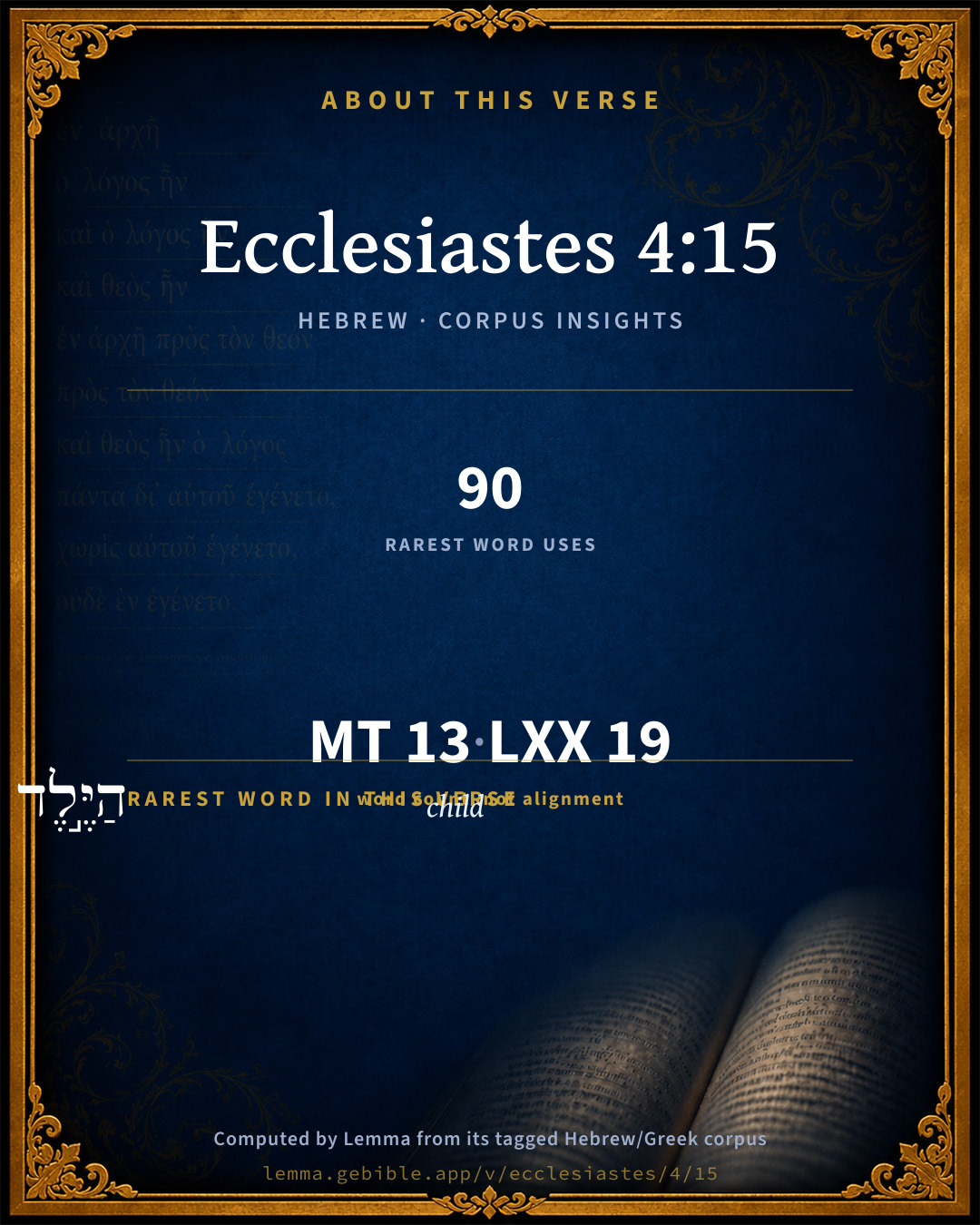
הַיֶּ֣לֶד
yeled
H3206
“the · child”
Particle, Definite Article + Noun, Common, Masculine, Singular, Absolute
Part of Speech
Particle + Noun
Type
Common
Gender
Masculine
Number
Singular
State
Absolute
Full BDB Definition

Origin: from H3205

TWOT: 867b

child, son, boy, offspring, youth - child, son, boy - child, children - descendants - youth - apostate Israelites (figuratively)
  1. רָאִ֨יתִי֙ râʼâh H7200 “to see” Verb, Qal, Perfect, 1st Person, Common, Singular
  2. אֶת ʼêth H853 “-” Particle, Direct Object
  3. כָּל kôl H3605 “all of” Noun, Common, Masculine, Singular, Construct
  4. הַ֣חַיִּ֔ים chay H2416 “the · living” Particle, Definite Article + Adjective, Adjective, Masculine, Plural, Absolute
  5. הַֽמְהַלְּכִ֖ים hâlak H1980 “the · walking” Particle, Definite Article + Verb, Piel, Participle Active, Masculine, Plural, Absolute
  6. תַּ֣חַת tachath H8478 “under” Preposition
  7. הַשָּׁ֑מֶשׁ shemesh H8121 “the · sun” Particle, Definite Article + Noun, Common, Both, Singular, Absolute
  8. עִ֚ם ʻim H5973 “with” Preposition
  9. הַשֵּׁנִ֔י shênîy H8145 “the · second” Particle, Definite Article + Adjective, Ordinal number, Masculine, Singular, Absolute
  10. אֲשֶׁ֥ר ʼăsher H834 “which” Particle, Relative
  11. יַעֲמֹ֖ד ʻâmad H5975 “to stand” Verb, Qal, Imperfect, 3rd Person, Masculine, Singular
  12. תַּחְתָּֽיו tachath H8478 “under · him” Preposition + Suffix, Personal, 3rd Person, Masculine, Singular

About this verse

These counts appear in no published source. They are computed here, from the morphology-tagged text and Lemma’s own curated glosses. What Lemma adds →

13
words
12
distinct lemmas
Wisdom
section

Grammatical profile

  • 3 verbs
  • 3 nouns
  • 2 adjectives
  • 3 prepositions
  • 2 particles

Verb forms

  • רָאִ֨יתִי֙ Qal · Perfect
  • הַֽמְהַלְּכִ֖ים Piel · Participle Active
  • יַעֲמֹ֖ד Qal · Imperfect

Repetition

A word recurs within this verse — often emphatic in Hebrew:

  • תַּ֣חַת under H8478 ×2

Hebrew & Septuagint length

In English translation the verse runs 21 words from the Hebrew and 23 from the Septuagint (LXX English) — closely comparable.

A rough comparison of the two English renderings, which tokenize alike — not a word-level alignment.

Word counts can differ between the Hebrew and the Greek without any difference in meaning — e.g. the Hebrew direct-object marker אֵת has no separate Greek word, and Greek often adds the article ὁ.

In the original languages it is 13 Hebrew tokens and 19 Greek tokens — but the two are counted differently (Hebrew bundles its prefixes and suffixes into one token; the Greek is in lemma form), so that isn’t a like-for-like length.

Cross-references

1

Topical passages linked to Ecclesiastes 4:15 in the Treasury of Scripture Knowledge — connected by theme and wording, ordered by reader-vote popularity; previews shown in the World English Bible.

  • 2 Samuel 15:6 In this manner Absalom did to all Israel who came to the king for judgment: so Absalom stole the hearts of the men of Israel.

Cross-references courtesy of OpenBible.info (CC BY 4.0).

Hebrew and Greek witnesses Masoretic Hebrew ↔ Greek Septuagint

The same verse in the two great witnesses to the Old Testament, shown verse-for-verse.

These are two independent witnesses, not word-aligned to each other, and the Septuagint is shown in lemma (dictionary) form.

Hebrew Ecclesiastes 4:15 Masoretic · Westminster Leningrad Codex

רָאִ֨יתִי֙ אֶת כָּל הַ֣חַיִּ֔ים הַֽמְהַלְּכִ֖ים תַּ֣חַת הַשָּׁ֑מֶשׁ עִ֚ם הַיֶּ֣לֶד הַשֵּׁנִ֔י אֲשֶׁ֥ר יַעֲמֹ֖ד תַּחְתָּֽיו

I saw all the living who walk under the sun, that they were with the youth, the other, who succeeded him.

World English Bible · Public Domain

Greek LXX Ecclesiastes 4:15 Septuagint · lemma form

ὁράω σύν πᾶς ὁ ζάω ὁ περιπατέω ὑπό ὁ ἥλιος μετά ὁ νεανίσκος ὁ δεύτερος ὅς ἵστημι ἀντί αὐτός

I saw all the living who were walking under the sun, with the second youth who shall stand up in each one's place.

LXX2012 (modern English Septuagint) · Public Domain

On this verse, Keil & Delitzsch discusses the Septuagint’s reading. Read the note in Commentary ↓

Hebrew: Westminster Leningrad Codex (CC BY 4.0). Greek: Septuagint (public domain); English from LXX2012 (modern English Septuagint) (Public Domain). How the Septuagint differs from the Hebrew →

Commentary

Notes on Ecclesiastes 4:15 from classic Christian and Jewish commentators (each source and its license shown beneath its notes). The classic Christian expositions comment on the surrounding passage and are grouped to its opening verse, so a note may address several verses; the Jewish commentaries on the Tanakh (Rashi and others) are per-verse, so they appear only where the commentator wrote on this verse.

Lemma curates 59 commentaries, every one of them public domain or Creative Commons licensed, each selected and text-cleaned for this edition rather than reprinted as found. About our sources →

Adam Clarke's Commentary

Verse 15. With the second child that shall stand up] The Targum applies this to the case of Jeroboam and Rehoboam. History affords many instances of mean persons raised to sovereign authority, and of kings being reduced to the meanest offices, and to a morsel of bread. Agrippa himself ascended the throne of Israel after having been long in prison. See Josephus, Ant. lib. xviii. c. 8. This the heathens attributed to fortune.

Si fortuna volet, fies de rhetore consul;

Si volet haec eadem, fies de consule rhetor.

JUV. Sat. vii., ver. 197.

Though I have given what the Jews suppose to be the allusion in these verses, yet the reader may doubt whether the reference be correct. There is a case implied, whether from fact or assumption I cannot say; but it seems to be this:

A king who had abused the authority vested in him by oppressing the people, had a son whose prudent conduct promised much comfort to the nation, when he should come to the throne. The father, seeing the popular wish, and becoming jealous of his son, shut him up in prison. In the interim the old king either dies or is deposed, and the son is brought out of prison, and placed on the throne. Then (Ec 4:15-16) multitudes of the people flock to him, and begin to walk under the sun; i.e., the prosperous state to which the nation is raised by its redemption from the former tyranny. However, the wise man insinuates that this sunshine will not last long. The young king, feeling the reins in his own hands, and being surrounded by those whose interest it was to flatter in order to obtain and continue in court favour, he also becomes corrupted so that those who come after shall have no cause of rejoicing in him. This appears to be the case; and similar cases have frequently occurred, not only in Asiatic, but also in European history, I have, in another place, referred to the case of Rushn Achter, who was brought out of prison and set upon the throne of Hindoostan. This is expressed in the following elegant Persian couplet, where his fortune is represented as similar to that of the patriarch Joseph: -

[Persian]

[Persian]

"The bright star is now become a moon:

Joseph is taken out of prison, and become a king." Rushn Achter signifies a bright or splendid star.

Adam Clarke's Commentary on the Bible (1810–1826) — public domain. Text from a community e-Sword/MySword module.

Trapp's Complete Commentary

John Trapp

Ecc 4:15 I considered all the living which walk under the sun, with the second child that shall stand up in his stead.

Ver. 15. I considered all the living, &c.] He means the multitude, that shallow brained, but great and many headed beast, making defection from their old prince, though never so prudent, and setting up his own son against him, as they dealt by David more than once, merely out of an itch of instability and affectation of novelty. Now, as this is to others, so to kings also a vexation, to see already the common aspect of their people bent upon another object before the time; to behold them worshipping the rising sun, {a} as the proverb is, and themselves laid aside, in a manner, as broken vessels out of request in comparison. {b} Crowns have their cares and crosses, and high seats are never but uneasy. O vilis pannus! O base clout! said one king concerning his diadem, were it but known how many molestations and miseries do attend thee, Nemo foret qui te tollere vellet humo, no man would deign to take thee up lying at his feet. Antoninus the philosopher said often that the empire was malorum oceanus, an ocean of mischiefs; and another caused it to be written upon his tomb, Felix si non imperitassem, Happy had I been if I had never reigned. It is seldom seen, as before hath been observed, that God allows unto the greatest darlings of the world a perfect contentment, be they never so well deserving. Something they must have to complain of, that shall give an unsavoury verdure to their sweetest morsels, and make their very felicity miserable.

{a} Omnes solem orientem adorant, contemnunt occidentem.

{b} Macro, expirante Tiberio, Caium fovebat. Cui Tiberius, Tu recte, inquit, Macro, τον δυομενον εγκαταλιπων π ρος τον ανατελλο τα επειγη. - Dio.

John Trapp, A Commentary or Exposition upon All the Books of the Old and New Testament (1647–1656) — public domain. Text from a community e-Sword module.

Matthew Poole's English Annotations

I considered all the living; the general disposition or humour of common people in all kingdoms, that they are fickle and inconstant, weary of their old governors, and desirous of changes.

Which walk under the sun: this is a periphrasis, or description of living and mortal men, like that Ecc 7:11, that see the sun.

With the second child: these words may be joined either,

1. With those which walk, or, that they walk under the sun, (i.e. upon the earth,) with the second child, i.e. follow, and favour, and worship him as the rising sun, upon whom the eyes and hopes of most people are fixed. Or,

2. With the first words,

I considered all the living which walk under the sun, i.e. the temper of all subjects or people, together

with the condition of the second child; which may be understood either,

1. In general, of a king’s child, or son and heir, who is called second, in respect of his father, whose successor he is to be. Or,

2. That wise and poor child mentioned Ecc 4:13, who is said to come to reign, Ecc 4:14, and may well be called the second to the old and foolish king who became poor, Ecc 4:15, being deposed from his kingdom, whom he succeeds, being put in his place either by the humour of the people, or by some higher power.

Stand up, i.e. arise to reign, as that phrase signifies, Dan 8:22,23; 11:2,3,7,20,21.

Matthew Poole's English Annotations on the Holy Bible (1683–1685) — public domain. Text from a community e-Sword/MySword module.

Joseph Benson's Commentary

Ecc 4:15. I considered all the living — The general disposition of common people in all kingdoms, that they are fickle and inconstant, weary of their old governors, and desirous of changes; with the second child that shall stand up — That shall arise to reign. This may be understood of the king’s child, or son and heir, called second in respect to his father, whose successor he is. Some join this clause with the preceding, thus: I considered all the living which walk — Or, that they walk; under the sun — That is, upon earth; with the second child — That is, that they follow, favour, and worship him, as the rising sun, upon which the eyes and hopes of most people are fixed. Probably Solomon observed this disposition in his own people, who were growing weary of his government, and beginning to desire a change, and to turn their eyes to Rehoboam his successor. At least he remembered the rebellion that had been raised against his father David in favour of Absalom, and might have reason to think the same leaven was still working in his kingdom. The verse is thus paraphrased by Bishop Patrick: “Such is the infelicity of princes, that I have seen a king left with nothing but the bare title, and the outward state of royalty; the hearts and affections of all, nobles, gentry, and common people, from one end of the kingdom to the other, inclining to his son (or next heir) that is to succeed him; unto whom they do obeisance, as if he were already upon the throne; but neglect his old father, who sees himself robbed of those honours in which he placed his happiness.”

Joseph Benson's Commentary on the Old and New Testaments (1811–1818) — public domain. Text from a community e-Sword module.

Tyndale Open Study Notes

Tyndale Open Resources

4:15-16 As with everything else, a ruler’s popularity is only temporary and fleeting, like the wind.

Tyndale Open Study Notes — © Tyndale Open Resources, licensed CC BY-SA 4.0. Text via the HelloAO Bible API.

Geneva Bible (1599)

Geneva Bible translators

Which follow and flatter the King’s son, or him that shall succeed, to enter into credit with them in hope of gain.

Geneva Bible (1599) marginal notes — public domain. Text via Bolls.life.

Jamieson, Fausset & Brown

Robert Jamieson, A. R. Fausset & David Brown

"I considered all the living," the present generation, in relation to ("with") the "second youth" (the "legitimate successor" of the "old king," as opposed to the "poor youth," the one first spoken of, about to be raised from poverty to a throne), that is, Rehoboam.

in his stead--the old king's.

Jamieson, Fausset & Brown — Commentary Critical and Explanatory on the Whole Bible (1871) — public domain (CC PDM 1.0). Text via the HelloAO Bible API.

Ellicott's Commentary for English Readers

(15) I considered.—Heb., I saw. Most modern interpreters regard the “second child” as identical with the “young man” of Ecc_4:13, and understand the passage, “I saw him at the head of all his people; yet his great popularity was but temporary, and the next generation took no pleasure in him.” It seems to me that by no stretch of rhetoric can “all the living which walk under the sun” be taken for the subjects of the sovereign in question. I am inclined to think that the Preacher reverts to the general topic, and considered all the living with the “second youth,” i.e., the second generation which shall succeed them. He saw the old generation hardened in its ways, and incapable of being admonished, and then displaced by a new generation, with which the next will feel equal dissatisfaction.

A Bible Commentary for English Readers, edited by Charles John Ellicott (1878–1897) — public domain. Text from a community e-Sword module.

The Cambridge Bible for Schools and Colleges

gen. ed. J. J. S. Perowne

15. with the second child that shall stand up in his stead] If we take the word “second” in its natural meaning, the clause may point either to the wise young ruler of the previous verse, as succeeding (i.e. coming second to) the old and foolish king, or possibly to his successor, and points in either case to what we have learnt to call the “worship of the rising Sun.” All gather round him, and their name is legion. There is “no end of all the people.”

The Cambridge Bible for Schools and Colleges (gen. ed. J. J. S. Perowne; Cambridge University Press, 1878–1918) — public domain. Text from a community e-Sword module.

John Gill's Exposition

I considered all the living which walk under the sun,.... All men that were then alive, who were capable of walking upon the earth; even all of them that were under the heavens, in every land and nation, under whatsoever dominion or government: these, and their manners, Solomon had particularly observed, and made his remarks upon, by which it appeared how fickle the minds of the populace were under every government, and how precarious and uncertain were the honour and dignity of princes;

with the second child that shall stand up in his stead: the heir and successor or every prince, that shall rise up and take the throne of his father or predecessor, and reign in his stead. The wise man observed how the people commonly behaved towards him; how that they generally stood best affected to him, than to the reigning prince; worshipped the rising sun, courted his favour and friendship, soothed and flattered him; expressing their wishes to see him on the throne, and treated with neglect and contempt their lawful sovereign. Some, contrary to the accents, connect this with the word "walk" (h); that walk with the second child, join themselves to him, converse with him, and show him great respect and honour: and there are others that, by this second child, understand the poor and wise child, that succeeds the old and foolish king, whom yet, in time, the people grow weary of; such is the levity and inconstancy of people, that they are not long pleased with princes, old or young, wise or foolish. The Targum interprets this of the foresight Solomon had, by a spirit of prophecy, of those that rebelled against his son Rehoboam, and of those that cleaved unto him, who was his second, and reigned in his stead. Noldius (i) thinks Solomon refers to the history of his friend Hiram, king of Tyre, whose kingdom, in his and in his son's time, was very large, flourishing, and opulent, but in a following reign not so; and he renders and paraphrases the words thus,

""I saw all the works under the sun; with Baleazarus, the son of a friend" (Hiram, for rendered "second", is the same as "a friend"), "who shall stand" or "reign after him: there is no end of all the people",'' &c.

the kingdom in those two reigns being flourishing; yet posterity shall not rejoice in him, in Abdastratus, the grandson of Hiram, destroyed by the four sons of his nurse (k).

(h) So the Tigurine version, Vatablus, Cocceius, Gejerus. (i) Concord. Part. Ebr. No. 1023. (k) Meander apud Joseph. Contr. Apion. l. 1. s. 18.

John Gill's Exposition of the Whole Bible (1746–1763) — public domain (CC PDM 1.0). Text via the HelloAO Bible API.

Haydock's Catholic Bible Commentary

Second heir. (Menochius) --- "They adore the rising (Papinius) more than the setting sun;["] (Plut.[Plutarch?] Pomp.) and a person is no sooner on the throne than his successor begins to be courted: (ver. 16.) so inconstant are mortals! (Calmet)

George Leo Haydock (1774–1849), Haydock's Catholic Family Bible and Commentary, 1859 edition — public domain. Excludes Psalms (Douay-Rheims chapter numbering differs from Protestant) and Deuterocanonical books (Catholic canon only).

Whedon's Commentary on the Bible

Daniel D. Whedon

15. The second child — The word here rendered “second” is, in Ecc_4:8; Ecc_4:10, used in the sense of an ally or associate, and so it should be here, for the contrast is between him and the lonely, repulsive king. It means that the youth makes himself a fellow and companion to others, gaining in return their favour. It might be rendered “the popular youth.” In his stead, means in the place of the old king, as his rival. Koheleth marks the effect of his ways upon the living, so different from those of his rival.

Daniel D. Whedon (gen. ed.), Commentary on the Old and New Testaments (1874–1909) — public domain. Text from a community e-Sword module.

The Pulpit Commentary

I considered all the living which walk under the sun; or, I have seen all the population. The expression is hyperbolical, as Eastern monarchs speak of their dominions as if they comprised the whole world. (Dan_4:1 Dan_6:25) With the second child that shall stand up in his stead. "With" means "in company with," "on the side of;" and the clause should be rendered, as in the Revised Version, That they were with the youth, the second, that stood up in his stead. The youth who is called the second is the one spoken of in the previous verses, who by general acclamation is raised to the highest place in the realm, while the old monarch is dethroned or depreciated. He is named second, as being the successor of the other, either in popular favor or on the throne. It is the old story of worshipping the rising sun. The verse may still be applied to Joseph, who was made second to Pharaoh, and was virtually supreme in Egypt, standing in the king"s place. (Gen_41:40-44)

The Pulpit Commentary (1880–1919), ed. H.D.M. Spence-Jones & Joseph S. Exell — public domain. Text from a community e-Sword module.

John Wesley's Explanatory Notes

I considered - The general disposition of common people, in all kingdoms, that they are fickle and inconstant. With the second child - This may be understood of the king's child, or son and heir, called second, in respect of his father, whose successor he is. Stand up - Arise to reign.

John Wesley, Explanatory Notes Upon the Whole Bible (1754–1765) — public domain. Text via the GEBible commentary corpus.

Keil & Delitzsch

C. F. Keil & F. Delitzsch

"I saw all the living which walk under the sun on the side of the youth, the second who shall enter upon the place of the former: no end of all the people, all those at whose head he stands." The author, by the expression "I saw," places himself back in the time of the change of government. If we suppose that he represents this to himself in a lively manner, then the words are to be translated: of the second who shall be his successor; but if we suppose that he seeks to express from the standpoint of the past that which, lying farther back in the past, was now for the first time future, then the future represents the time to come in the past, as at Kg2 3:27; Psa 78:6; Job 15:28 (Hitz.): of the second who should enter on his place (עמד, to step to, to step forth, of the new king, Dan 8:23; Dan 11:2.; cf. קוּם, Kg1 8:20). The designation of the crowd which, as the pregnant עם expresses, gathered by the side of the young successor to the old king, by "all the living, those walking under the sun (המה, perhaps intentionally the pathetic word for הלכים, Isa 42; 5)," would remain a hyperbole, even although the throne of the Asiatic world-ruler had been intended; still the expression, so absolute in its universality, would in that case be more natural (vid., the conjectural reference to Cyrus and Astygates). השּׁני, Ewald refers to the successor to the king, the second after the king, and translates: "to the second man who should reign in his stead;" but the second man in this sense has certainly never been the child of fortune; one must then think of Joseph, who, however, remains the second man. Hitzig rightly: "The youth is the second שׁני, not אחר, in contrast to the king, who, as his predecessor, is the first." "Yet," he continues, "הילד should be the appos. and השׁני the principal word," i.e., instead of: with the second youth, was to be expected: with the second, the youth. It is true, we may either translate: with the second youth, or: with the second, the youth - the_ form of expression has in its something incorrect, for it has the appearance as if it treated of two youths. But similar are the expressions, Mat 8:21, ἓτερος κ.τ.λ., "another, and that, too, one of His disciples;" and Luk 23:32, ἤγοντο κ.τ.λ All the world ranks itself by the side (thus we may also express it) of the second youthful king, so that he comes to stand at the head of an endless multitude. The lxx, Jerome, and the Venet. render incorrectly the all (the multitude) as the subject of the relative clause, which Luther, after the Syr., corrects by reading לפניו for לפניהם: of the people that went for him there was no end. Rightly the Targ.: at whose head (= בּרישׁיהון) he had the direction, לפני, as with יצא ובא, Sa1 18:16; Ch2 1:10; Psa 68:8, etc. All the world congregates about him, follows his leadership; but his history thus splendidly begun, viewed backwards, is a history of hopes falsified.

"And yet they who come after do not rejoice in him: for that also is vain, and a grasping after the wind." For all that, and in spite of that (gam has here this meaning, as at Ecc 6:7; Jer 6:15; Psa 129:2; Ewald, 354a), posterity (הא, as at Ecc 1:11; cf. Isa 41:4) has no joy in this king, - the hopes which his contemporaries placed in the young king, who had seized the throne and conquered their hearts, afterwards proved to be delusions; and also this history, at first so beautiful, and afterwards so hateful, contributed finally to the confirmation of the truth, that all under the sun is vain. As to the historical reminiscence from the time of the Ptolemies, in conformity with which Hitzig (in his Comm.) thinks this figure is constructed; Grtz here, as always, rocks himself in Herodian dreams. In his Comm., Hitz. guesses first of Jeroboam, along with Rehoboam the שׁני ילד, who rebelled against King Solomon, who in his old age had become foolish. In an essay, "Zur Exeg. u. Kritik des B. Koheleth," in Hilgenfeld's Zeitschr. XIV 566ff., Saul, on the contrary, appears to him to be the old and foolish king, and David the poor wise youth who rose to the throne, and took possession of the whole kingdom, but in his latter days experienced desertion and adversities; for those who came after (the younger men) had no delight in him, but rebelled against him. But in relation to Saul, who came from the plough to be king, David, who was called from being a shepherd, is not נולד רשׁ; and to Jewish history this Saul, whose nobler self is darkened by melancholy, but again brightens forth, and who to his death maintained the dignity of a king of Israel, never at any time appears as וכסיל ... מלך. Moreover, by both combinations of that which is related with the הסורים בּית (for which הסּ is written) of the history of the old Israelitish kings, a meaning contrary to the usage of the language must be extracted. It is true that סוּר, as the so-called particip. perfecti, may mean "gone aside (to a distance)," Isa 49:21; Jer 17:13; and we may, at any rate, by סורים, think on that poor rabble which at first gathered around David, Sa1 22:2, regarded as outcasts from honourable society. But בית will not accord therewith. That David came forth from the house (home) of the estranged or separated, is and remains historically an awkward expression, linguistically obscure, and not in accordance with the style of Koheleth. In order to avoid this incongruity, Bttcher regards Antiochus the Great as the original of the ילד. He was the second son of his father, who died 225. When a hopeful youth of fifteen years of age, he was recalled to the throne from a voluntary banishment into Farther Asia, very soon gained against his old cousin and rival Achaeus, who was supported by Egypt, a large party, and remained for several years esteemed as a prince and captain; he disappointed, however, at a later time, the confidence which was reposed in him. But granting that the voluntary exile of Antiochus might be designated as האס בית, he was yet not a poor man, born poor, but was the son of King Seleucus Callincus; and his older relative and rival Achaeus wished indeed to become king, but never attained unto it. Hence השׁני is not the youth as second son of his father, but as second on the throne, in relation to the dethroned king reckoned as the first. Thus, far from making it probable that the Book of Koheleth originated in the time of the Diadochs, this combination of Bttcher's also stands on a feeble foundation, and falls in ruins when assailed.

The section Eccl 1:12-4:16, to which we have prefixed the superscription, "Koheleth's Experiences and their Results," has now reached its termination, and here for the first time we meet with a characteristic peculiarity in the composition of the book: the narrative sections, in which Koheleth, on the ground of his own experiences and observations, registers the vanities of earthly life, terminate in series of proverbs in which the I of the preacher retires behind the objectivity of the exhortations, rules, and principles obtained from experience, here recorded. The first of these series of proverbs which here follows is the briefest, but also the most complete in internal connection.

Keil & Delitzsch — Biblical Commentary on the Old Testament (1861–1891) — public domain (CC PDM 1.0). Text via the HelloAO Bible API. (Old Testament only.)

unfoldingWord translationNotes

Door43 World Missions Community

General Information:

Instead of choosing the wise youth, the people choose the king's son, who may not be any wiser.

alive ... walking around

The words "alive" and "walking around" mean basically the same thing and are combined to emphasize living people. (See: Parallelism)

under the sun

This refers to things that are done on earth. See how you translated this in Ecclesiastes 1:3. AT: "on the earth" (See: Idiom)

There is no end to all the people

This is an exaggeration used to emphasize a large number of people. AT: "There are very many people" (See: Hyperbole and Generalization)

vapor ... an attempt to shepherd the wind

These two phrases are both metaphors that emphasize the idea of things being useless and futile. (See: Parallelism)

vapor

"mist." The author speaks of things as being useless and meaningless as if they were vapor. See how you translated this in Ecclesiastes 1:14. AT: "as useless as vapor" or "meaningless" (See: Metaphor)

an attempt to shepherd the wind

The author speaks of everything that people do as being useless as if they were trying to control the wind. See how you translated this in Ecclesiastes 1:14. AT: "are as useless as trying to control the wind" (See: Metaphor)

translationWords

walk

submit

raise

obey

praise

shepherd

unfoldingWord translationNotes — © Distant Shores Media and the Door43 World Missions Community, licensed CC BY-SA 4.0. Source: git.door43.org/Door43/en_tn.

Rashi

Rabbi Shlomo Yitzchaki (Rashi)

I saw all the living, etc. I found in the Midrash of this Book (Ecc. Zuta): This refers to the Generation of the Flood, about which it says (Gen. 6:19): “And of every living thing.”

with the second child who will exist instead of that generation, who were Noah and his sons.

Rashi on the Tanakh — English translations: “The Judaica Press complete Tanach with Rashi, translated by A. J. Rosenberg” (CC BY 4.0); “Pentateuch with Rashi's commentary by M. Rosenbaum and A.M. Silbermann, 1929-1934” (public domain); “The Metsudah Tanach series, Lakewood, N.J” (CC BY 4.0); and “The Book of Joshua, Metsudah Publications, 1997” (CC BY 4.0). Text via Sefaria.

Lesson kit

Teaching starters — assembled from the data on this page, not authored interpretation. Every prompt links to the verse data it draws on. Edit before teaching.

Ecclesiastes, in the Wisdom, opens this verse with 13 words (12 distinct Hebrew lemmas). Its most distinctive word is yeled (“child”). A historical commentator’s framing appears above. Read the whole chapter for the surrounding context.

Discussion questions

  1. What does “child” (yeled) contribute to the verse as a whole?
  2. 2 Samuel 15:6 shares this passage’s theme. How do the two illuminate each other?
  3. “under” occurs 2× in this one verse. What is the effect of the repetition?
  4. These translations render this verse differently; the difference is in the English rendering, not the original. What questions does that raise?
  5. The verb «רָאִ֨יתִי֙» is Qal Perfect. How does its form color the action?
  6. Reading how Adam Clarke's Commentary and Trapp's Complete Commentary read this verse, where do the two commentators agree and where do they part?

Things to notice

Reading settings

Reading text

Shown beneath each verse's original-language words.

Old Testament
Old Testament edition

Read the OT as the Masoretic Hebrew (MT) or the Greek Septuagint (LXX).

English shown for the Greek Septuagint (in the Hebrew ↔ Greek comparison).

Comparing translations? Open the Compare panel on any verse page to stack up to four side by side.