2 Chronicles 11:22

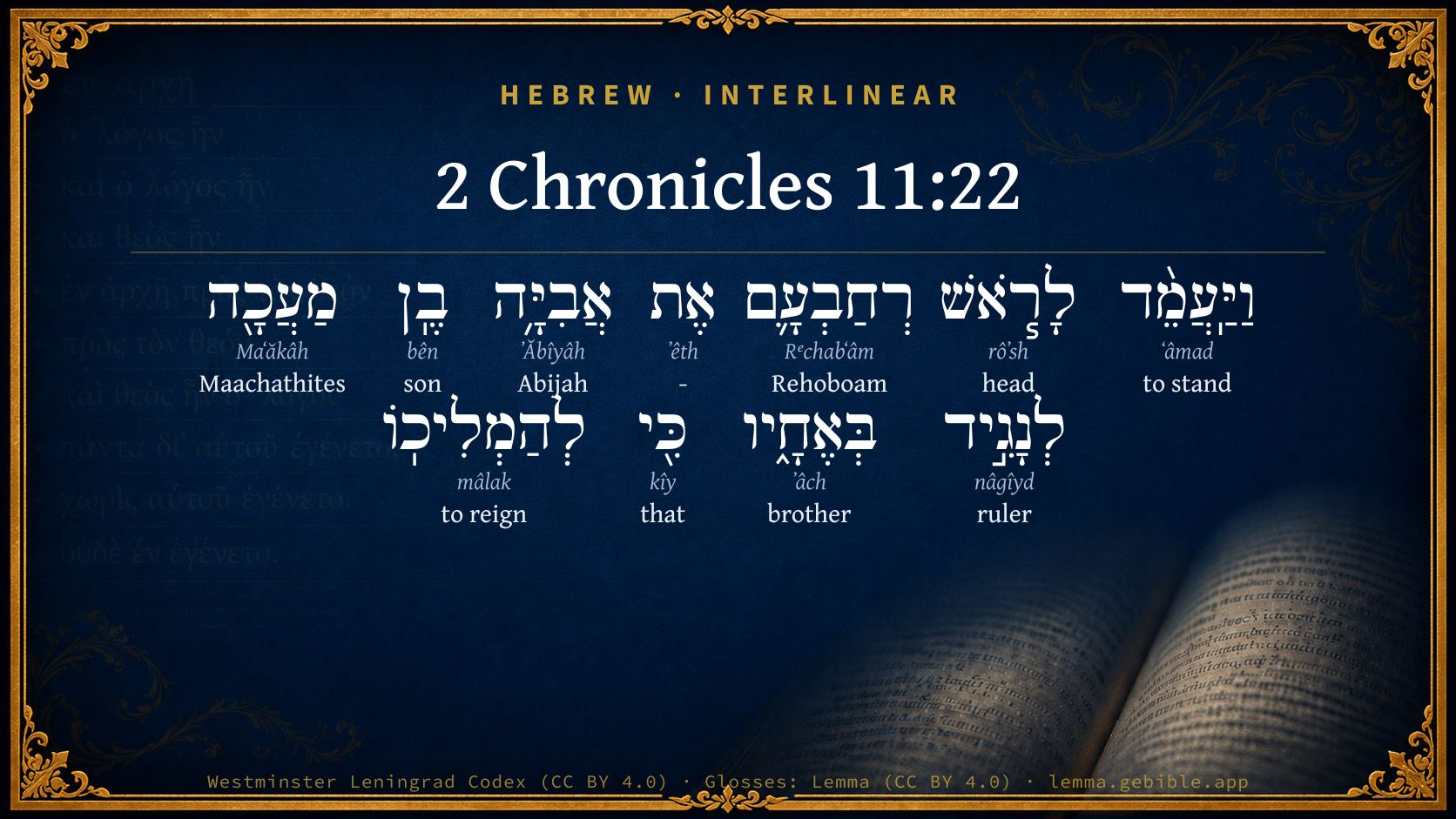
Hebrew (Westminster Leningrad Codex) 2 Chronicles 11:22 appears in the Hebrew Old Testament. The text above is from the Westminster Leningrad Codex. Each word links to its Strong’s number, a concise gloss, and parsing drawn from the Open Scriptures Hebrew Bible morphology. Click any word for its full Brown-Driver-Briggs (BDB) entry.
Download image
Cite this verse

2 Chronicles 11:22 (World English Bible). Public Domain. Lemma interlinear Bible study tool, https://lemma.gebible.app/v/2-chronicles/11/22.

Show BibTeX & RIS
BibTeX
RIS
English Translation
Rehoboam appointed Abijah the son of Maacah to be chief, [even] the prince among his brothers; for [he was minded] to make him king.
World English Bible · Public Domain
Download a study sheet

One document with this verse’s original text, its word-by-word gloss line, the meaning frame, cross-references with their text, attributed commentary, and full source and license credits — printable, and it pastes into notes with its structure intact.

This verse Autodidact and up

Study sheet (.html) Plain text (.txt)

A passage Seminary Student

Up to 50 verses in one chapter. A passage sheet keeps up to 6 commentary sources and 12 cross-references per verse, in the order this page ranks them, and says so on the sheet whenever that leaves anything out. Ask for a single verse and you get the Autodidact verse sheet above.

Everything on this page stays free to read, with no account — the sheet is a download of what is already on screen, not access to it.

Want to remove ads? Support Godless Engineer
Compare translations 3

The same verse in 3 English versions, stacked beneath the original-language interlinear above. Click any original word for its lexicon entry.

Each is an independent rendering of the whole verse — the interlinear is not word-aligned to these translations.

Highlighted words mark where these versions differ — a whole-verse word diff, not a word-by-word alignment.

  • World English Bible Public Domain
    Rehoboam appointed Abijah the son of Maacah to be chief, [even] the prince among his brothers; for [he was minded] to make him king.
  • King James Version Public Domain
    And Rehoboam made Abijah the son of Maachah the chief, to be ruler among his brethren: for he thought to make him king.
  • unfoldingWord Literal Text CC BY-SA 4.0
    And Rehoboam appointed to be head Abijah the son of Maacah, to be leader among his brothers; for he caused to make him king.

unfoldingWord Literal Text — © unfoldingWord, licensed CC BY-SA 4.0. Word-aligned USFM3 via Door43 (git.door43.org/unfoldingWord/en_ult).

Versions to compare (up to 4)

3 of 4 selected

Show all 18 translations

Every available English version of this verse, each an independent rendering of the whole verse.

  • World English Bible Public Domain
    Rehoboam appointed Abijah the son of Maacah to be chief, [even] the prince among his brothers; for [he was minded] to make him king.
  • Berean Standard Bible Public Domain
    Rehoboam appointed Abijah son of Maacah as chief prince among his brothers, intending to make him king.
  • Majority Standard Bible Public Domain
    Rehoboam appointed Abijah son of Maacah as chief prince among his brothers, intending to make him king.
  • King James Version Public Domain
    And Rehoboam made Abijah the son of Maachah the chief, to be ruler among his brethren: for he thought to make him king.
  • American Standard Version (1901) Public Domain
    And Rehoboam appointed Abijah the son of Maacah to be chief, `even' the prince among his brethren; for `he was minded' to make him king.
  • Revised Version (1885) Public Domain
    And Rehoboam appointed Abijah the son of Maacah to be chief, even the prince among his brethren: for he was minded to make him king.
  • Geneva Bible (1599) Public Domain
    And Rehoboam made Abiiah the sonne of Maakah the chiefe ruler among his brethren: for he thought to make him King.
  • Douay-Rheims (1899) Public Domain
    But he put at the head of them Abia the son of Maacha to be the chief ruler over all his brethren: for he meant to make him king,
  • Young's Literal Translation Public Domain
    And Rehoboam appointeth for head Abijah son of Maachah, for leader among his brethren, for to cause him to reign.
  • Literal Standard Version CC BY-SA 4.0
    And Rehoboam appoints Abijah son of Maachah for head, for leader among his brothers, for to cause him to reign.
  • Unlocked Literal Bible CC BY-SA 4.0
    Rehoboam appointed Abijah son of Maacah to be chief, a leader among his brothers; he had the thought of making him king.
  • unfoldingWord Literal Text CC BY-SA 4.0
    And Rehoboam appointed to be head Abijah the son of Maacah, to be leader among his brothers; for he caused to make him king.
  • Darby Bible Public Domain
    And Rehoboam established Abijah the son of Maachah at the head, to be ruler among his brethren; for [he thought] to make him king.
  • World Messianic Bible Public Domain
    Rehoboam appointed Abijah the son of Maacah to be chief, the prince among his brothers, for he intended to make him king.
  • Webster's Bible Public Domain
    And Rehoboam made Abijah the son of Maachah the chief, to be ruler among his brethren: for he thought to make him king.
  • Free Bible Version CC BY-SA 4.0
    Rehoboam made Abijah son of Maacah crown prince among his brothers, planning to make him king.
  • Bible in Basic English Public Domain
    Rehoboam made Abijah, the son of Maacah, chief and ruler among his brothers, for it was his purpose to make him king.
  • JPS Tanakh (1917) Public Domain
    And Rehoboam appointed Abijah the son of Maacah to be chief, even the prince among his brethren; for he was minded to make him king.

Literal Standard Version (2020), Covenant Press — licensed CC BY-SA 4.0. Text via the HelloAO Bible API (eBible.org). Unlocked Literal Bible (unfoldingWord) — licensed CC BY-SA 4.0. Text via the HelloAO Bible API (eBible.org). unfoldingWord Literal Text — © unfoldingWord, licensed CC BY-SA 4.0. Word-aligned USFM3 via Door43 (git.door43.org/unfoldingWord/en_ult). Free Bible Version, Dr. Jonathan Gallagher — licensed CC BY-SA 4.0. Text via the HelloAO Bible API (eBible.org).

Word by word

More ways to search: Search by grammar → Find every occurrence → Compare this word →

Practice this passage: Drill this verse → Learn its vocabulary →

מַעֲכָ֖ה
Maʻăkâh
H4601
“Maachathites”
Noun, Proper
Part of Speech
Noun
Type
Proper
Full BDB Definition

Origin: from H4600

TWOT: None

Maachathites = "pressure (literally she has pressed)" - father of Achish, king of Gath at the beginning of Solomon's reign (noun proper masculine) - father of Hanan, one of David's mighty warriors (noun proper masculine) - a Simeonite, father of Shephatiah, prince of his tribe in the reign of David (noun proper masculine) - son of Nahor by concubine Reumah (noun proper masculine) - daughter of king Talmai of Geshur, wife of David, and mother of Absalom (noun proper feminine) - daughter of Absalom, wife of king Rehoboam of Judah, and mother of king Abijam of Judah (noun proper feminine) - concubine of Caleb the son of Hezron (noun proper feminine) - wife of Machir of the tribe of Manasseh (noun proper feminine) - wife of Jehiel, father of Gibeon (noun proper feminine) - a mercenary people hired to fight David (noun proper)
  1. וַיַּֽעֲמֵ֨ד ʻâmad H5975 “and · to stand” Conjunction + Verb, Hiphil, Sequential Imperfect, 3rd Person, Masculine, Singular
  2. לָרֹ֧אשׁ rôʼsh H7218 “to/for the · head” Preposition, Determined + Noun, Common, Masculine, Singular, Absolute
  3. רְחַבְעָ֛ם Rᵉchabʻâm H7346 “Rehoboam” Noun, Proper
  4. אֶת ʼêth H853 “-” Particle, Direct Object
  5. אֲבִיָּ֥ה ʼĂbîyâh H29 “Abijah” Noun, Proper
  6. בֶֽן bên H1121 “son of” Noun, Common, Masculine, Singular, Construct
  7. לְנָגִ֣יד nâgîyd H5057 “to/for · ruler” Preposition + Noun, Common, Masculine, Singular, Absolute
  8. בְּאֶחָ֑יו ʼâch H251 “in/at · brothers · his” Preposition + Noun, Common, Masculine, Plural, Construct + Suffix, Personal, 3rd Person, Masculine, Singular
  9. כִּ֖י kîy H3588 “that” Conjunction
  10. לְהַמְלִיכֽוֹ mâlak H4427 “to reign · him” Preposition + Verb, Hiphil, Infinitive Construct + Suffix, Personal, 3rd Person, Masculine, Singular

About this verse

These counts appear in no published source. They are computed here, from the morphology-tagged text and Lemma’s own curated glosses. What Lemma adds →

11
words
11
distinct lemmas
Historical
section

Notable vocabulary

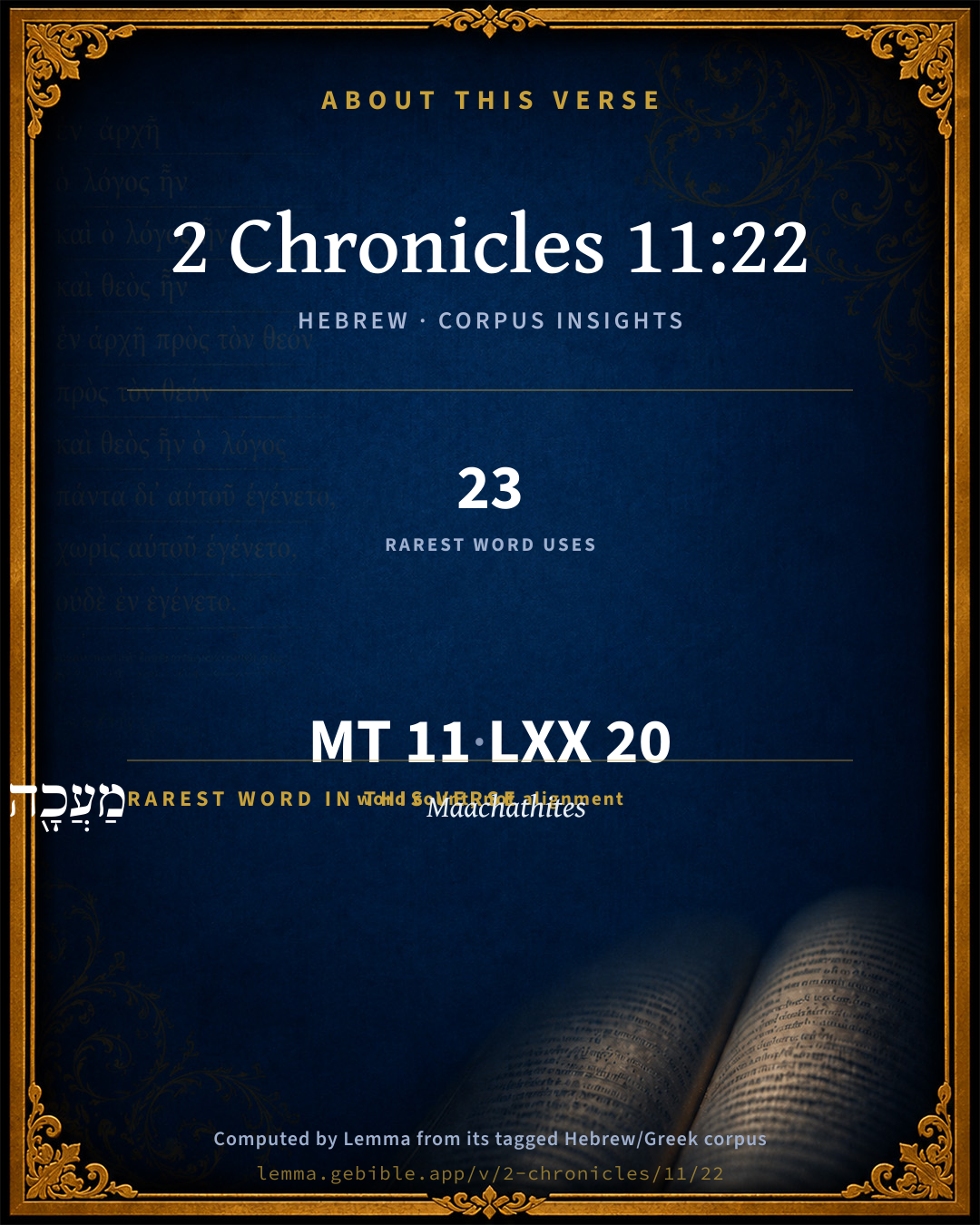
The rarest word here is מַעֲכָ֖ה Maachathites H4601 — appearing just 23 times in the whole Hebrew Bible.

Shared distinctive vocabulary

מַעֲכָ֖ה Maachathites H4601 occurs in 23 verses of the Hebrew Bible. Also found in:

Grammatical profile

  • 2 verbs
  • 7 nouns
  • 1 conjunction
  • 1 particle

Verb forms

  • וַיַּֽעֲמֵ֨ד Hiphil · Sequential Imperfect
  • לְהַמְלִיכֽוֹ Hiphil · Infinitive Construct

Hebrew & Septuagint length

In English translation the verse runs 24 words from the Hebrew and 22 from the Septuagint (LXX English) — closely comparable.

A rough comparison of the two English renderings, which tokenize alike — not a word-level alignment.

Word counts can differ between the Hebrew and the Greek without any difference in meaning — e.g. the Hebrew direct-object marker אֵת has no separate Greek word, and Greek often adds the article ὁ.

In the original languages it is 11 Hebrew tokens and 20 Greek tokens — but the two are counted differently (Hebrew bundles its prefixes and suffixes into one token; the Greek is in lemma form), so that isn’t a like-for-like length.

Cross-references

3

Topical passages linked to 2 Chronicles 11:22 in the Treasury of Scripture Knowledge — connected by theme and wording, ordered by reader-vote popularity; previews shown in the World English Bible.

  • Deuteronomy 21:15–17 If a man have two wives, the one beloved, and the other hated, and they have borne him children, both the beloved and the hated; and if the firstborn son be hers who was hated;
  • 1 Chronicles 5:1–2 The sons of Reuben the firstborn of Israel (for he was the firstborn; but, because he defiled his father's couch, his birthright was given to the sons of Joseph the son of Israel; and the genealogy is not to be reckoned after the birthright.
  • 1 Chronicles 29:1 David the king said to all the assembly, Solomon my son, whom alone God has chosen, is yet young and tender, and the work is great; for the palace is not for man, but for Yahweh God.

Cross-references courtesy of OpenBible.info (CC BY 4.0).

Hebrew and Greek witnesses Masoretic Hebrew ↔ Greek Septuagint

The same verse in the two great witnesses to the Old Testament, shown verse-for-verse.

These are two independent witnesses, not word-aligned to each other, and the Septuagint is shown in lemma (dictionary) form.

Hebrew 2 Chronicles 11:22 Masoretic · Westminster Leningrad Codex

וַיַּֽעֲמֵ֨ד לָרֹ֧אשׁ רְחַבְעָ֛ם אֶת אֲבִיָּ֥ה בֶֽן מַעֲכָ֖ה לְנָגִ֣יד בְּאֶחָ֑יו כִּ֖י לְהַמְלִיכֽוֹ

Rehoboam appointed Abijah the son of Maacah to be chief, [even] the prince among his brothers; for [he was minded] to make him king.

World English Bible · Public Domain

Greek LXX 2 Chronicles 11:22 Septuagint · lemma form

καί καταἵστημι εἰς ἄρχων ροβοαμ ὁ αβια ὁ ὁ μααχα εἰς ἡγέομαι ἐν ὁ ἀδελφός αὐτός ὅτι βασιλεύω διανοέομαι αὐτός

And he made Abia the son of Maacha chief, even a leader among his brethren, for he intended to make him king.

LXX2012 (modern English Septuagint) · Public Domain

On this verse, Haydock's Catholic Bible Commentary discusses the Septuagint’s reading. Read the note in Commentary ↓

Hebrew: Westminster Leningrad Codex (CC BY 4.0). Greek: Septuagint (public domain); English from LXX2012 (modern English Septuagint) (Public Domain). How the Septuagint differs from the Hebrew →

Commentary

Notes on 2 Chronicles 11:22 from classic Christian and Jewish commentators (each source and its license shown beneath its notes). The classic Christian expositions comment on the surrounding passage and are grouped to its opening verse, so a note may address several verses; the Jewish commentaries on the Tanakh (Rashi and others) are per-verse, so they appear only where the commentator wrote on this verse.

Lemma curates 59 commentaries, every one of them public domain or Creative Commons licensed, each selected and text-cleaned for this edition rather than reprinted as found. About our sources →

Trapp's Complete Commentary

John Trapp

2Ch 11:22 And Rehoboam made Abijah the son of Maachah the chief, [to be] ruler among his brethren: for [he thought] to make him king.

Ver. 22. And Rehoboam loved Maachah.] Not for any good that was in her, {see 1Ki 15:13} but either for her beauty, or for her conformity unto him in wicked practices; for likeness maketh love, {a} saith the philosopher, in married couples especially.

“ Uxor pessima, pessimus maritus:

Miror non bene convenire vobis. ” - Martial.

For he thought to make him king.] Maachah would have it so, belike, whether it were right or wrong. Occidar, modo imperet, said Nero’s mother, Let him be king, whatever come of it.

{a} ομοιον ομοιου εφιεται. - Arist., Eth., lib. viii.

John Trapp, A Commentary or Exposition upon All the Books of the Old and New Testament (1647–1656) — public domain. Text from a community e-Sword module.

Joseph Benson's Commentary

2Ch 11:22. Rehoboam made Abijah ruler among his brethren — He declared him his successor, and gave him the dominion over his brethren.

Joseph Benson's Commentary on the Old and New Testaments (1811–1818) — public domain. Text from a community e-Sword module.

Geneva Bible (1599)

Geneva Bible translators

Called also Abijam, who reigned three years, 1 Kings 15:2.

Geneva Bible (1599) marginal notes — public domain. Text via Bolls.life.

Jamieson, Fausset & Brown

Robert Jamieson, A. R. Fausset & David Brown

made Abijah . . . chief . . . ruler among his brethren--This preference seems to have been given to Abijah solely from the king's doting fondness for his mother and through her influence over him. It is plainly implied that Abijah was not the oldest of the family. In destining a younger son for the kingdom, without a divine warrant, as in Solomon's case, Rehoboam acted in violation of the law (Deu 21:15).

Jamieson, Fausset & Brown — Commentary Critical and Explanatory on the Whole Bible (1871) — public domain (CC PDM 1.0). Text via the HelloAO Bible API.

Adam Clarke's Commentary

Verse 22. Made Abijah - the chief] Abijah certainly was not the first-born of Rehoboam; but as he loved Maachah more than any of his wives, so he preferred her son, probably through his mother's influence. In De 21:16, this sort of preference is forbidden; but Rehoboam had a sort of precedent in the preference shown by David to Solomon.

Adam Clarke's Commentary on the Bible (1810–1826) — public domain. Text from a community e-Sword/MySword module.

Ellicott's Commentary for English Readers

(22) And Rehoboam made Abijah the son of Maachah . . . brethren.—Rather, And Rehoboam appointed Abijah the son of Maachah for head—to wit, for prince (nagîd)—among his brethren. The expression “head” is explained by the following clause.

For he thought to make him king.—This gives the sense of the brief Hebrew phrase, “for—for making him king.” In making Abijah heir to the throne, it does not appear that Rehoboam infringed the law of Deu_21:15-17, as the Speaker’s Commentary suggests. The right of the firstborn was only a double share of a man’s property. (Comp. 1Ki_1:35 for a precedent.)

A Bible Commentary for English Readers, edited by Charles John Ellicott (1878–1897) — public domain. Text from a community e-Sword module.

The Cambridge Bible for Schools and Colleges

gen. ed. J. J. S. Perowne

22. the chief, to be ruler] R.V. to be chief, even the prince. “Ruler,” Heb. nâgîd is translated “chief ruler” (“prince” R.V.) in 1Ch_5:2.

for he thought] R.V. for is was minded.

The Cambridge Bible for Schools and Colleges (gen. ed. J. J. S. Perowne; Cambridge University Press, 1878–1918) — public domain. Text from a community e-Sword module.

Albert Barnes' Notes on the Bible

Jeush was probably the oldest of Rehoboam’s sons, and should naturally and according to the provisions of the Law Deu 21:15-17 have been his heir. But Rehoboam’s affection for Maachah led him to transgress the Law.

Albert Barnes' Notes on the Bible (1834–1885) — public domain. Text from a community e-Sword/MySword module.

Haydock's Catholic Bible Commentary

Head. Septuagint, "prince." (Haydock) --- Grotius maintains that Abia was the eldest. But all others are of a contrary opinion, and believe that Roboam derogated from the law, (Deuteronomy xxi. 16.; Calmet) as David had done, unless it was left to the option of the king to appoint whom he pleased for his successor. (Haydock) --- Meant. Protestants supply, "he thought" which is found in the Septuagint.

George Leo Haydock (1774–1849), Haydock's Catholic Family Bible and Commentary, 1859 edition — public domain. Excludes Psalms (Douay-Rheims chapter numbering differs from Protestant) and Deuterocanonical books (Catholic canon only).

Matthew Poole's English Annotations

To be ruler among his brethren; he declared him his successor, and gave him the dominion over his brethren; wherein (if he was not the first-born, as it seems to be implied, because this is mentioned as an effect of his superlative love to his mother) he transgressed that law, Deu 21:15,16, unless God was pleased to dispense with it at this time.

Matthew Poole's English Annotations on the Holy Bible (1683–1685) — public domain. Text from a community e-Sword/MySword module.

Whedon's Commentary on the Bible

Daniel D. Whedon

22. Made Abijah… chief… to make him king — So he, like his grandfather David, did not select and nominate his oldest son and legal heir (comp. Deu_21:15-17) for the throne, but the son of his favourite wife.

Daniel D. Whedon (gen. ed.), Commentary on the Old and New Testaments (1874–1909) — public domain. Text from a community e-Sword module.

The Pulpit Commentary

Cancel in this verse the italics "to be." Rehoboam again offends against the "Law". (see Deu_21:15-17) He cannot justly plead as a precedent the instance of David and Solomon, as in 1Ch_23:1; for this was only justified by the express Divine ordinance, 1Ch_23:9 1Ch_29:1.

The Pulpit Commentary (1880–1919), ed. H.D.M. Spence-Jones & Joseph S. Exell — public domain. Text from a community e-Sword module.

John Wesley's Explanatory Notes

Ruler - He declared him his successor, and gave him the dominion over, his brethren.

John Wesley, Explanatory Notes Upon the Whole Bible (1754–1765) — public domain. Text via the GEBible commentary corpus.

unfoldingWord translationNotes

Door43 World Missions Community

he had the thought of making him king

"he had thought of making Abijah king"

he scattered all his sons throughout all the land of Judah and Benjamin to every fortified city

"he sent all his sons throughout all the land to every fortified city of Judah and Benjamin"

translationWords

chief

king

rule

wise

unfoldingWord translationNotes — © Distant Shores Media and the Door43 World Missions Community, licensed CC BY-SA 4.0. Source: git.door43.org/Door43/en_tn.

Rashi

Rabbi Shlomo Yitzchaki (Rashi)

as a leader among his brothers in order to make him king.

Rashi on the Tanakh — English translations: “The Judaica Press complete Tanach with Rashi, translated by A. J. Rosenberg” (CC BY 4.0); “Pentateuch with Rashi's commentary by M. Rosenbaum and A.M. Silbermann, 1929-1934” (public domain); “The Metsudah Tanach series, Lakewood, N.J” (CC BY 4.0); and “The Book of Joshua, Metsudah Publications, 1997” (CC BY 4.0). Text via Sefaria.

Lesson kit

Teaching starters — assembled from the data on this page, not authored interpretation. Every prompt links to the verse data it draws on. Edit before teaching.

2 Chronicles, in the Historical, opens this verse with 11 words (11 distinct Hebrew lemmas). Its most distinctive word is Maʻăkâh (“Maachathites”). A historical commentator’s framing appears above. Read the whole chapter for the surrounding context.

Discussion questions

  1. How does “Maachathites” (Maʻăkâh) shape what this verse is saying?
  2. Genesis 22:24 shares the word «Maachathites» with this verse. How do the two illuminate each other?
  3. These translations render this verse differently; the difference is in the English rendering, not the original. What questions does that raise?
  4. The verb «וַיַּֽעֲמֵ֨ד» is Hiphil Sequential Imperfect. How does its form color the action?
  5. Reading how Trapp's Complete Commentary and Joseph Benson's Commentary read this verse, where do the two commentators agree and where do they part?

Things to notice

Reading settings

Reading text

Shown beneath each verse's original-language words.

Old Testament
Old Testament edition

Read the OT as the Masoretic Hebrew (MT) or the Greek Septuagint (LXX).

English shown for the Greek Septuagint (in the Hebrew ↔ Greek comparison).

Comparing translations? Open the Compare panel on any verse page to stack up to four side by side.