
Zechariah 14:4

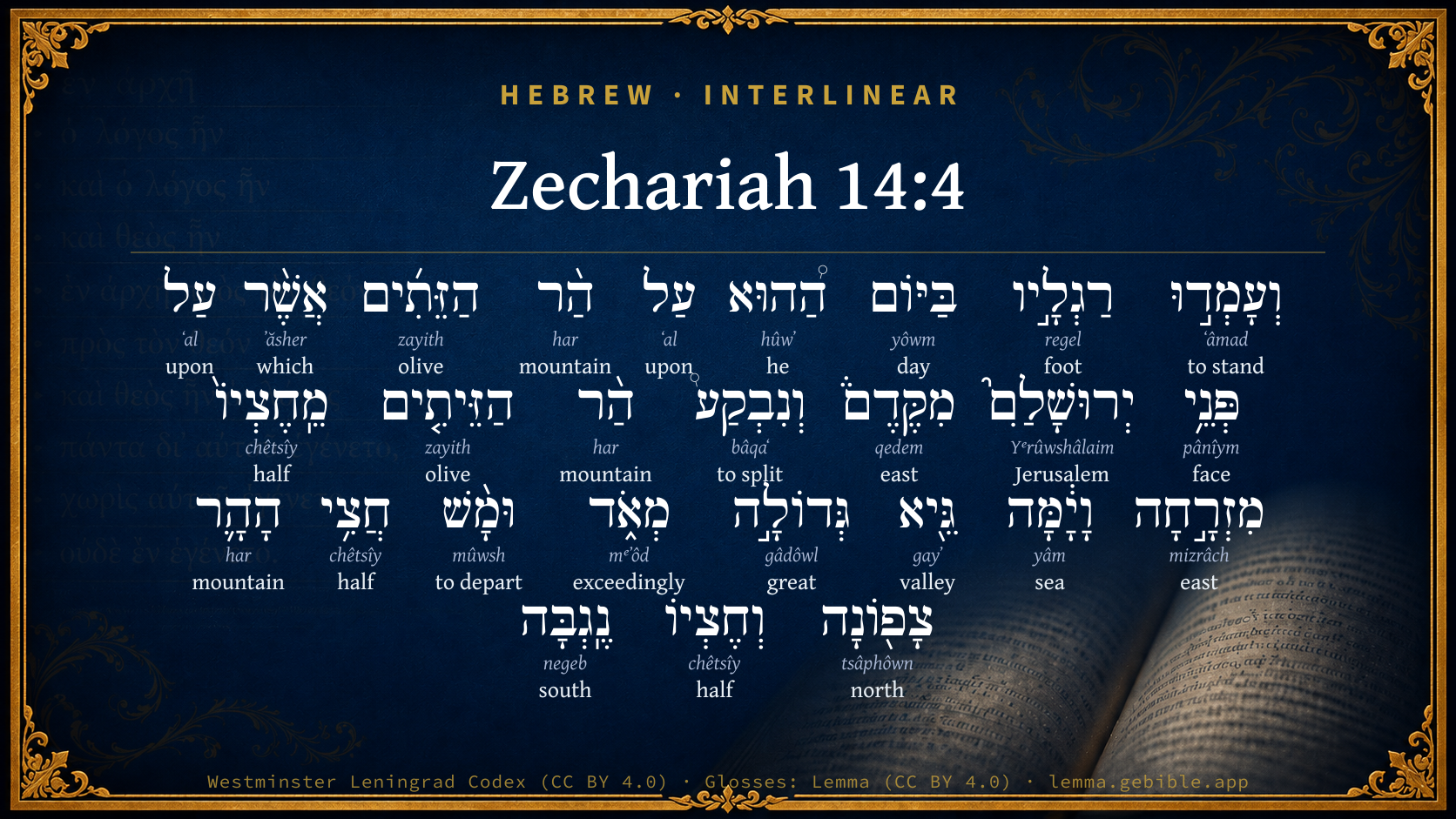
Hebrew (Westminster Leningrad Codex) Zechariah 14:4 appears in the Hebrew Old Testament. The text above is from the Westminster Leningrad Codex. Each word links to its Strong’s number, a concise gloss, and parsing drawn from the Open Scriptures Hebrew Bible morphology. Click any word for its full Brown-Driver-Briggs (BDB) entry.
Download image
Cite this verse

Zechariah 14:4 (World English Bible). Public Domain. Lemma interlinear Bible study tool, https://lemma.gebible.app/v/zechariah/14/4.

Show BibTeX & RIS
BibTeX
RIS
English Translation
His feet will stand in that day on the Mount of Olives, which is before Jerusalem on the east; and the Mount of Olives will be split in two, from east to west, making a very great valley. Half of the mountain will move toward the north, and half of it toward the south.
World English Bible · Public Domain
Download a study sheet

One document with this verse’s original text, its word-by-word gloss line, the meaning frame, cross-references with their text, attributed commentary, and full source and license credits — printable, and it pastes into notes with its structure intact.

This verse Autodidact and up

Study sheet (.html) Plain text (.txt)

A passage Seminary Student

Up to 50 verses in one chapter. A passage sheet keeps up to 6 commentary sources and 12 cross-references per verse, in the order this page ranks them, and says so on the sheet whenever that leaves anything out. Ask for a single verse and you get the Autodidact verse sheet above.

Everything on this page stays free to read, with no account — the sheet is a download of what is already on screen, not access to it.

Want to remove ads? Support Godless Engineer
Compare translations 3

The same verse in 3 English versions, stacked beneath the original-language interlinear above. Click any original word for its lexicon entry.

Each is an independent rendering of the whole verse — the interlinear is not word-aligned to these translations.

Highlighted words mark where these versions differ — a whole-verse word diff, not a word-by-word alignment.

  • World English Bible Public Domain
    His feet will stand in that day on the Mount of Olives, which is before Jerusalem on the east; and the Mount of Olives will be split in two, from east to west, making a very great valley. Half of the mountain will move toward the north, and half of it toward the south.
  • King James Version Public Domain
    And his feet shall stand in that day upon the mount of Olives, which is before Jerusalem on the east, and the mount of Olives shall cleave in the midst thereof toward the east and toward the west, and there shall be a very great valley; and half of the mountain shall remove toward the north, and half of it toward the south.
  • unfoldingWord Literal Text CC BY-SA 4.0
    On that day his feet will stand on the Mount of Olives, which is beside Jerusalem to the east. The Mount of Olives will be split in half between the east and the west by a very great valley and half of the mountain will go back toward the north and half toward the south.

unfoldingWord Literal Text — © unfoldingWord, licensed CC BY-SA 4.0. Word-aligned USFM3 via Door43 (git.door43.org/unfoldingWord/en_ult).

Versions to compare (up to 4)

3 of 4 selected

Show all 18 translations

Every available English version of this verse, each an independent rendering of the whole verse.

  • World English Bible Public Domain
    His feet will stand in that day on the Mount of Olives, which is before Jerusalem on the east; and the Mount of Olives will be split in two, from east to west, making a very great valley. Half of the mountain will move toward the north, and half of it toward the south.
  • Berean Standard Bible Public Domain
    On that day His feet will stand on the Mount of Olives, east of Jerusalem, and the Mount of Olives will be split in two from east to west, forming a great valley, with half the mountain moving to the north and half to the south.
  • Majority Standard Bible Public Domain
    On that day His feet will stand on the Mount of Olives, east of Jerusalem, and the Mount of Olives will be split in two from east to west, forming a great valley, with half the mountain moving to the north and half to the south.
  • King James Version Public Domain
    And his feet shall stand in that day upon the mount of Olives, which is before Jerusalem on the east, and the mount of Olives shall cleave in the midst thereof toward the east and toward the west, and there shall be a very great valley; and half of the mountain shall remove toward the north, and half of it toward the south.
  • American Standard Version (1901) Public Domain
    And his feet shall stand in that day upon the mount of Olives, which is before Jerusalem on the east; and the mount of Olives shall be cleft in the midst thereof toward the east and toward the west, `and there shall be' a very great valley; and half of the mountain shall remove toward the north, and half of it toward the south.
  • Revised Version (1885) Public Domain
    And his feet shall stand in that day upon the mount of Olives, which is before Jerusalem on the east, and the mount of Olives shall cleave in the midst thereof toward the east and toward the west, and there shall be a very great valley; and half of the mountain shall remove toward the north, and half of it toward the south.
  • Geneva Bible (1599) Public Domain
    And his feete shall stand in that day vpon the mount of oliues, which is before Ierusalem on the Eastside, and the mount of oliues shall cleaue in the middes thereof: toward the East and toward the West there shalbe a very great valley, and halfe of ye mountaine shall remooue toward the North, and halfe of the mountaine towarde the South.
  • Douay-Rheims (1899) Public Domain
    And his feet shall stand in that day upon the mount of Olives, which is over against Jerusalem toward the east: and the mount of Olives shall be divided in the midst thereof to the east, and to the west with a very great opening, and half of the mountain shall be separated to the north, and half thereof to the south.
  • Young's Literal Translation Public Domain
    And stood have His feet, in that day, On the mount of Olives, That `is' before Jerusalem eastward, And cleft hath been the mount of Olives at its midst, To the east, and to the west, a very great valley, And removed hath the half of the mount towards the north. And its half towards the south.
  • Literal Standard Version CC BY-SA 4.0
    And His feet have stood, in that day, || On the Mount of Olives, || That [is] eastward before Jerusalem, || And the Mount of Olives has been cleft at its midst, || To the east, and to the west, a very great valley, || And half of the mountain is removed toward the north, || And half toward the south.
  • Unlocked Literal Bible CC BY-SA 4.0
    On that day his feet will stand on the Mount of Olives, which is beside Jerusalem to the east. The Mount of Olives will be split in half between the east and the west by a very great valley and half of the mountain will go back toward the north and half toward the south.
  • unfoldingWord Literal Text CC BY-SA 4.0
    On that day his feet will stand on the Mount of Olives, which is beside Jerusalem to the east. The Mount of Olives will be split in half between the east and the west by a very great valley and half of the mountain will go back toward the north and half toward the south.
  • Darby Bible Public Domain
    And his feet shall stand in that day upon the mount of Olives, which is before Jerusalem toward the east, and the mount of Olives shall cleave in the midst thereof toward the east and toward the west, -- a very great valley; and half of the mountain shall remove toward the north, and half of it toward the south.
  • World Messianic Bible Public Domain
    His feet will stand in that day on the Mount of Olives, which is before Jerusalem on the east; and the Mount of Olives will be split in two from east to west, making a very great valley. Half of the mountain will move toward the north, and half of it toward the south.
  • Webster's Bible Public Domain
    And his feet will stand in that day upon the mount of Olives, which is before Jerusalem on the east, and the mount of Olives shall cleave in the midst of it towards the east and towards the west, and there shall be a very great valley; and half of the mountain shall remove towards the north, and half of it towards the south.
  • Free Bible Version CC BY-SA 4.0
    On that day his feet will stand on the Mount of Olives which faces Jerusalem to the east. The Mount of Olives will split apart, with half moving north and half moving south, creating a wide valley from east to west.
  • Bible in Basic English Public Domain
    And in that day his feet will be on the Mount of Olives, which is opposite Jerusalem on the east, and the Mount of Olives will be parted in the middle to the east and to the west, forming a very great valley; and half the mountain will be moved to the north and half of it to the south.
  • JPS Tanakh (1917) Public Domain
    And His feet shall stand in that day upon the mount of Olives, which is before Jerusalem on the east, and the mount of Olives shall cleft in the midst thereof toward the east and toward the west, so that there shall be a very great valley; and half of the mountain shall remove toward the north, and half of it toward the south.

Literal Standard Version (2020), Covenant Press — licensed CC BY-SA 4.0. Text via the HelloAO Bible API (eBible.org). Unlocked Literal Bible (unfoldingWord) — licensed CC BY-SA 4.0. Text via the HelloAO Bible API (eBible.org). unfoldingWord Literal Text — © unfoldingWord, licensed CC BY-SA 4.0. Word-aligned USFM3 via Door43 (git.door43.org/unfoldingWord/en_ult). Free Bible Version, Dr. Jonathan Gallagher — licensed CC BY-SA 4.0. Text via the HelloAO Bible API (eBible.org).

Word by word

More ways to search: Search by grammar → Find every occurrence → Compare this word →

Practice this passage: Drill this verse → Learn its vocabulary →

וּמָ֨שׁ
mûwsh
H4185
“and · to depart”
Conjunction + Verb, Qal, Sequential Perfect, 3rd Person, Masculine, Singular
Part of Speech
Conjunction + Verb
Stem
Qal
Form
Sequential Perfect
Person
3rd Person
Gender
Masculine
Number
Singular
Full BDB Definition

Origin: a primitive root [perhaps rather the same as H4184 through the idea of receding by contact]

TWOT: 1167

to depart, remove - (Qal) - to depart - to remove - to be removed (of inanimate objects) - (Hiphil) to remove, depart
  1. וְעָמְד֣וּ ʻâmad H5975 “and · to stand” Conjunction + Verb, Qal, Sequential Perfect, 3rd Person, Common, Plural
  2. רַגְלָ֣יו regel H7272 “feet · his” Noun, Common, Feminine, Dual, Construct + Suffix, Personal, 3rd Person, Masculine, Singular
  3. בַּיּוֹם yôwm H3117 “in/at the · day” Preposition, Determined + Noun, Common, Masculine, Singular, Absolute
  4. הַ֠הוּא hûwʼ H1931 “the · he” Particle, Definite Article + Pronoun, Personal, 3rd Person, Masculine, Singular
  5. עַל ʻal H5921 “upon” Preposition
  6. הַ֨ר har H2022 “mountain of” Noun, Common, Masculine, Singular, Construct
  7. הַזֵּתִ֜ים zayith H2132 “the · olives” Particle, Definite Article + Noun, Common, Masculine, Plural, Absolute
  8. אֲשֶׁ֨ר ʼăsher H834 “which” Particle, Relative
  9. עַל ʻal H5921 “upon” Preposition
  10. פְּנֵ֥י pânîym H6440 “face(s) of” Noun, Common, Both, Plural, Construct
  11. יְרוּשָׁלִַם֮ Yᵉrûwshâlaim H3389 “Jerusalem” Noun, Proper
  12. מִקֶּדֶם֒ qedem H6924 “from · east” Preposition + Noun, Common, Masculine, Singular, Absolute
  13. וְנִבְקַע֩ bâqaʻ H1234 “and · to split” Conjunction + Verb, Niphal, Sequential Perfect, 3rd Person, Masculine, Singular
  14. הַ֨ר har H2022 “mountain of” Noun, Common, Masculine, Singular, Construct
  15. הַזֵּיתִ֤ים zayith H2132 “the · olives” Particle, Definite Article + Noun, Common, Masculine, Plural, Absolute
  16. מֵֽחֶצְיוֹ֙ chêtsîy H2677 “from · half · his” Preposition + Noun, Common, Masculine, Singular, Construct + Suffix, Personal, 3rd Person, Masculine, Singular
  17. מִזְרָ֣חָה mizrâch H4217 “east · toward” Noun, Common, Masculine, Singular, Absolute + Suffix, Demonstrative
  18. וָיָ֔מָּה yâm H3220 “and · sea · toward” Conjunction + Noun, Common, Masculine, Singular, Absolute + Suffix, Demonstrative
  19. גֵּ֖יא gayʼ H1516 “valley of” Noun, Common, Both, Singular, Construct
  20. גְּדוֹלָ֣ה gâdôwl H1419 “great” Adjective, Adjective, Feminine, Singular, Absolute
  21. מְאֹ֑ד mᵉʼôd H3966 “exceedingly” Adverb
  22. חֲצִ֥י chêtsîy H2677 “half of” Noun, Common, Masculine, Singular, Construct
  23. הָהָ֛ר har H2022 “the · mountain” Particle, Definite Article + Noun, Common, Masculine, Singular, Absolute
  24. צָפ֖וֹנָה tsâphôwn H6828 “north · toward” Noun, Common, Feminine, Singular, Absolute + Suffix, Demonstrative
  25. וְחֶצְיוֹ chêtsîy H2677 “and · half · his” Conjunction + Noun, Common, Masculine, Singular, Construct + Suffix, Personal, 3rd Person, Masculine, Singular
  26. נֶֽגְבָּה negeb H5045 “south · toward” Noun, Common, Masculine, Singular, Absolute + Suffix, Demonstrative

About this verse

These counts appear in no published source. They are computed here, from the morphology-tagged text and Lemma’s own curated glosses. What Lemma adds →

27
words
21
distinct lemmas
Prophets
section

Notable vocabulary

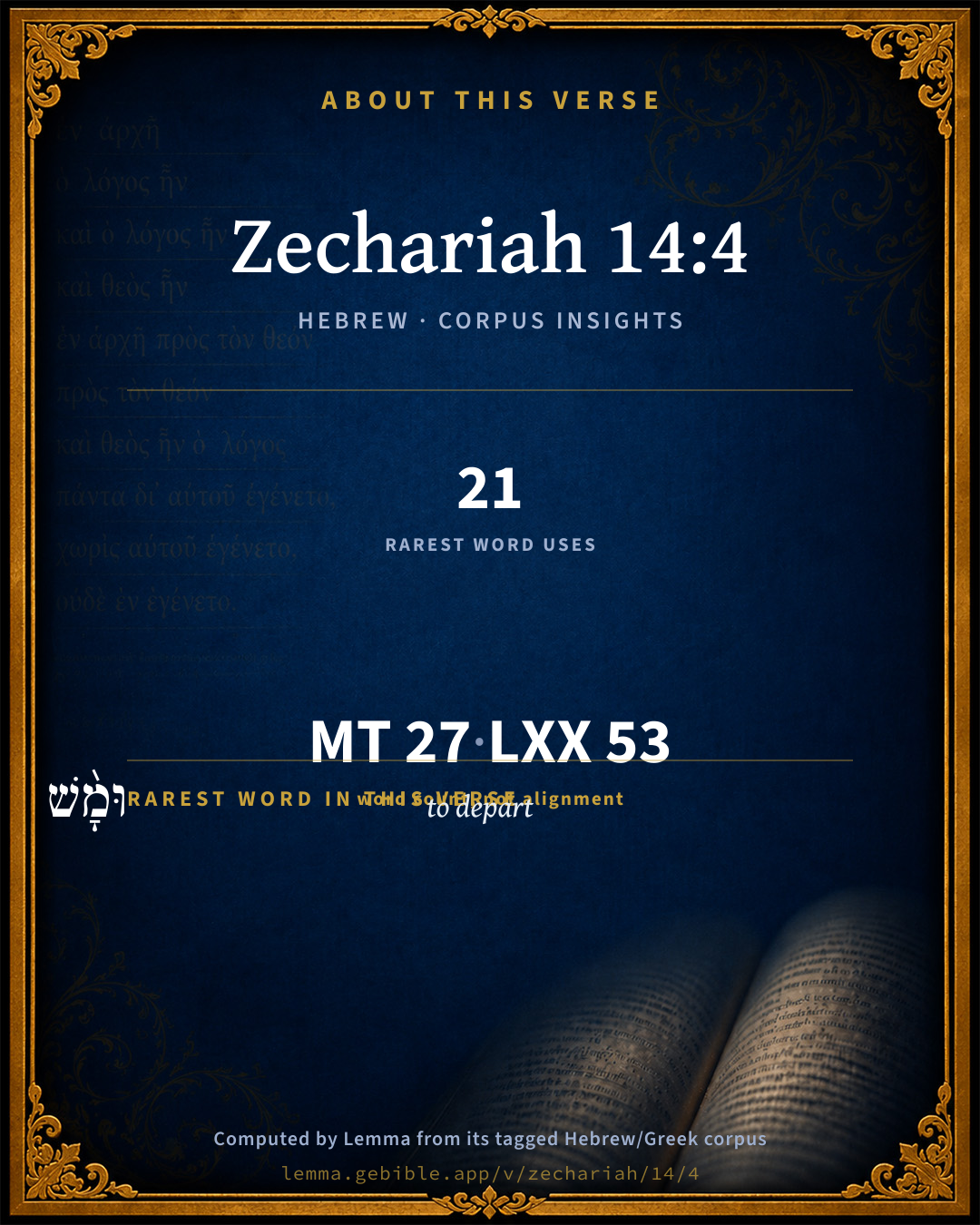
The rarest word here is וּמָ֨שׁ to depart H4185 — appearing just 21 times in the whole Hebrew Bible.

Shared distinctive vocabulary

וּמָ֨שׁ to depart H4185 occurs in 19 verses of the Hebrew Bible. Also found in:

Grammatical profile

  • 3 verbs
  • 18 nouns
  • 1 adjective
  • 1 pronoun
  • 2 prepositions
  • 1 adverb
  • 1 particle

Verb forms

  • וְעָמְד֣וּ Qal · Sequential Perfect
  • וְנִבְקַע֩ Niphal · Sequential Perfect
  • וּמָ֨שׁ Qal · Sequential Perfect

Repetition

Words recur within this verse — often emphatic in Hebrew:

  • הַ֨ר mountain H2022 ×3
  • מֵֽחֶצְיוֹ֙ half H2677 ×3
  • עַל upon H5921 ×2
  • הַזֵּתִ֜ים olive H2132 ×2

Hebrew & Septuagint length

In English translation the verse runs 54 words from the Hebrew and 57 from the Septuagint (LXX English) — closely comparable.

A rough comparison of the two English renderings, which tokenize alike — not a word-level alignment.

Word counts can differ between the Hebrew and the Greek without any difference in meaning — e.g. the Hebrew direct-object marker אֵת has no separate Greek word, and Greek often adds the article ὁ.

In the original languages it is 27 Hebrew tokens and 53 Greek tokens — but the two are counted differently (Hebrew bundles its prefixes and suffixes into one token; the Greek is in lemma form), so that isn’t a like-for-like length.

Cross-references

13

Topical passages linked to Zechariah 14:4 in the Treasury of Scripture Knowledge — connected by theme and wording, ordered by reader-vote popularity; previews shown in the World English Bible.

  • Micah 1:3–4 For, behold, Yahweh comes forth out of his place, And will come down and tread on the high places of the earth.
  • Ezekiel 11:23 The glory of Yahweh went up from the midst of the city, and stood on the mountain which is on the east side of the city.
  • Acts 1:11–12 who also said, "You men of Galilee, why do you stand looking into the sky? This Jesus, who was received up from you into the sky will come back in the same way as you saw him going into the sky."
  • Joel 3:12–14 "Let the nations arouse themselves, And come up to the valley of Jehoshaphat; For there will I sit to judge all the surrounding nations.
  • Zechariah 14:7 It will be a unique day which is known to Yahweh; not day, and not night; but it will come to pass, that at evening time there will be light.
  • Zechariah 14:10 All the land will be made like the Arabah, from Geba to Rimmon south of Jerusalem; and she will be lifted up, and will dwell in her place, from Benjamin's gate to the place of the first gate, to the corner gate, and from the tower of Hananel to the king's wine-presses.
  • Isaiah 64:1–2 Oh that you would tear the heavens, that you would come down, that the mountains might quake at your presence,
  • Nahum 1:5–6 The mountains quake before him, and the hills melt away. The earth trembles at his presence, yes, the world, and all who dwell in it.
  • Zechariah 4:7 Who are you, great mountain? Before Zerubbabel you are a plain; and he will bring out the capstone with shouts of 'Grace, grace, to it!'"
  • Ezekiel 43:2 Behold, the glory of the God of Israel came from the way of the east: and his voice was like the sound of many waters; and the earth shined with his glory.
  • Ezekiel 47:1–12 He brought me back to the door of the house; and, behold, waters issued out from under the threshold of the house eastward; (for the forefront of the house was toward the east;) and the waters came down from under, from the right side of the house, on the south of the altar.
  • Habakkuk 3:6 He stood, and shook the earth. He looked, and made the nations tremble. The ancient mountains were crumbled. The age-old hills collapsed. His ways are eternal.
  • Mark 11:23 For most assuredly I tell you, whoever may tell this mountain, 'Be taken up and cast into the sea,' and doesn't doubt in his heart, but believes that what he says is happening; he shall have whatever he says.

Cross-references courtesy of OpenBible.info (CC BY 4.0).

Hebrew and Greek witnesses Masoretic Hebrew ↔ Greek Septuagint

The same verse in the two great witnesses to the Old Testament, shown verse-for-verse.

These are two independent witnesses, not word-aligned to each other, and the Septuagint is shown in lemma (dictionary) form.

Hebrew Zechariah 14:4 Masoretic · Westminster Leningrad Codex

וְעָמְד֣וּ רַגְלָ֣יו בַּיּוֹם הַ֠הוּא עַל הַ֨ר הַזֵּתִ֜ים אֲשֶׁ֨ר עַל פְּנֵ֥י יְרוּשָׁלִַם֮ מִקֶּדֶם֒ וְנִבְקַע֩ הַ֨ר הַזֵּיתִ֤ים מֵֽחֶצְיוֹ֙ מִזְרָ֣חָה וָיָ֔מָּה גֵּ֖יא גְּדוֹלָ֣ה מְאֹ֑ד וּמָ֨שׁ חֲצִ֥י הָהָ֛ר צָפ֖וֹנָה וְחֶצְיוֹ נֶֽגְבָּה

His feet will stand in that day on the Mount of Olives, which is before Jerusalem on the east; and the Mount of Olives will be split in two, from east to west, making a very great valley. Half of the mountain will move toward the north, and half of it toward the south.

World English Bible · Public Domain

Greek LXX Zechariah 14:4 Septuagint · lemma form

καί ἵστημι ὁ πούς αὐτός ἐν ὁ ἡμέρα ἐκεῖνος ἐπί ὁ ὄρος ὁ ἐλαία ὁ κατέναντι ἰερουσαλήμ ἐκ ἀνατολή καί σχίζω ὁ ὄρος ὁ ἐλαία ὁ ἥμισυς αὐτός πρός ἀνατολή καί ὁ ἥμισυς αὐτός πρός θάλασσα χάος μέγας σφόδρα καί κλίνω ὁ ἥμισυς ὁ ὄρος πρός βορέας καί ὁ ἥμισυς αὐτός πρός νότος

And his feet shall stand in that day on the mount of Olives, which is before Jerusalem on the east, and the mount of Olives shall cleave asunder, half of it toward the east and the west, a very great division; and half the mountain shall lean to the north, and half of it to the south.

LXX2012 (modern English Septuagint) · Public Domain

On this verse, Whedon's Commentary on the Bible discusses the Septuagint’s reading. Read the note in Commentary ↓

Hebrew: Westminster Leningrad Codex (CC BY 4.0). Greek: Septuagint (public domain); English from LXX2012 (modern English Septuagint) (Public Domain). How the Septuagint differs from the Hebrew →

Targum (Aramaic paraphrase)

1

The Targum is the ancient Jewish Aramaic paraphrase of the Hebrew Scriptures — an interpretive translation, not the Hebrew text itself. Onkelos (literal) and Pseudo-Jonathan (expansive) render the Torah, and Jonathan the Prophets. Coverage is partial: where no permissively-licensed English translation exists for a verse, only the Aramaic is shown. This is verse-level text, not a word-by-word alignment to the Hebrew.

  1. Targum Jonathan Prophets (Joshua–Malachi)
    וְיִתְגְלֵי בִּגְבוּרְתֵּיהּ בְּעִדָנָא הַהִיא עַל טוּר זֵיתָא דְעַל אַפֵּי יְרוּשְׁלֵם מִמַדִינְחָא וְיִתְבְּזַע טוּר זֵיתַיָא מִפַּלְגֵיהּ לְמַדִנְחָא וּלְמַעַרְכָא חֵילָא רַבָּא לַחֲדָא וְיִתְלַשׁ פַּלְגֵיהּ דְטוּרָא לְצִפּוּנָא וּפַלְגוֹהִי לְדָרוֹמָא:

    (no public-domain English translation for this verse)

    Targum Jonathan — Aramaic: “Mikraot Gedolot” (public domain). English: “Sefaria Community Translation” (CC0 1.0 (public-domain dedication)); “London "Chaldee Paraphrase," 1871” (public domain). Text via Sefaria.

Commentary

Notes on Zechariah 14:4 from classic Christian and Jewish commentators (each source and its license shown beneath its notes). The classic Christian expositions comment on the surrounding passage and are grouped to its opening verse, so a note may address several verses; the Jewish commentaries on the Tanakh (Rashi and others) are per-verse, so they appear only where the commentator wrote on this verse.

Lemma curates 59 commentaries, every one of them public domain or Creative Commons licensed, each selected and text-cleaned for this edition rather than reprinted as found. About our sources →

Trapp's Complete Commentary

John Trapp

Zec 14:4 And his feet shall stand in that day upon the mount of Olives, which [is] before Jerusalem on the east, and the mount of Olives shall cleave in the midst thereof toward the east and toward the west, [and there shall be] a very great valley; and half of the mountain shall remove toward the north, and half of it toward the south.

Ver. 4. And his feet shall stand in that day upon the mount of Olives] That is, he shall so put forth his power for the defence of his people, as if he did visibly appear among them, and beheld the fight from the top of a mountain; like as Xerxes used to pitch his tent on high, and stand looking on his army when in fight, to encourage them, and to send out orders. From this mount it was that God departed, after many former departures, from Jerusalem, Eze 11:23. And what wonder, when as Har Hamischa, the mount of unction, was become Har Hamaschith, the mount of corruption, 2Ki 23:13? the bold Jews having set up their idol in this mount Olivet, even in the sight of the Lord; so that he never looked out of the sanctuary but he beheld the vile hill of abominations. From this mount it was that our Lord Christ ascended into heaven, Act 1:11-12. There he was apprehended by the Jews, Joh 18:1 Mat 26:30; there therefore it is prophesied that he shall stand against them by the Romans, say some, out of Joseph. B. J. vi. 3, and that when these things should come to pass the Jews might know that their utter destruction was near at hand. So God showed unto the Ninevites on what side their city should be taken; and what at that time should be the power and the attempts of the enemy against them, Nah 2:1-13; Nah 3:1-19, and yet neither of these repented for all this. Others, more probably, hold that here is promised such a powerful presence of God for the relief of his people as shall far exceed the glory that appeared the promulgation of the law, when the mouutains skipped like rams, and the little hills like lambs, Psa 114:6; so terrible also was the sight, that Moses said, "I exceedingly fear and quake," Heb 12:21. I also see and tremble at the resemblance (said a holy man) between that giving of the law and the requiring of it at the last day. In the one mount Sinai only was on a flame; all the world shall be so in the other. To the one Moses (that climbed up that hill, and alone saw it) says, "God came with ten thousand of his saints"; in the other, thousand thousands shall minister to him, and ten thousand thousands shall stand before him. Hereunto some refer that obscure passage in the next verse, "The Lord my God shall come and all the saints with thee," and that at the day of judgment Christ shall descend with all his angels into mount Olivet, which hangs over the valley of Jehoshaphat, that there he may plead with all nations, for his people, and for his heritage Israel, whom they have scattered, and parted their land, Joe 3:2. Further they say, that mount Olivet shall then be shaken with a very great earthquake; so that it shall cleave in the midst, and leave a very great valley; it shall enlarge the valley of Jehoshaphat, that it may be able to receive those that are there to be judged by Christ. Thus Lessius, Sa, a Costa, a Lapide, who also citeth for his purpose, Clemens Remarius, lib. vii. Constit. Ap. cap. 33, speaking thus, Mons ipse Oliveti gloriae venientis cedet et in quatuor partes dissectus longissime diffugiet, ut tribunali iudicis theatrum totius orbis assistat, i.e. Mount Olivet shall give place to the glory of Christ when he cometh; and being cleft into four parts, it shall fly far asunder, to the end that the theatre of the whole world may stand before the tribunal of the judge. Thus he, and surely the following Zec 14:6-8, &c., seem to favour this interpretation, and to have relation to the last day. But in prophecies not yet fulfilled, as this may be one, it is better and more sure to expect and stay for the explication by the event than to give it without any certain ground.

John Trapp, A Commentary or Exposition upon All the Books of the Old and New Testament (1647–1656) — public domain. Text from a community e-Sword module.

The Biblical Illustrator

Joseph S. Exell

Zec_14:4-5

And His feet shall stand in that day upon the Mount of Olives

God in relation to a suffering world

The men in Jerusalem were in great suffering and imminent peril, and here is a figurative representation of the Almighty in relation to them.

I. He observes their terrible condition. And His feet shall stand in that day on the Mount of Olives, which is before Jerusalem on the east. The idea suggested here is that God observes men in all their calamities and dangers. His eye is on them. This is especially the ease with His people. We are assured that His eye is ever upon the righteous; Job said, He knoweth the way I take.

1. He sees what we have to endure.

2. He sees how we behave ourselves in our condition, whether under our afflictions we are trustful, patient, and submissive or otherwise; whether in our perils we are making an effort to escape. Thou compassest my path and my lying down, and art acquainted with all my ways.

II. He makes a way for their deliverance. And the Mount of Olives shall cleave in the midst thereof toward the east and toward the west, and there shall be a very great valley. These verses, says Dr. Henderson, convey, in language of the most beautiful poetical imagery, the assurance of the effectual means of escape that should be provided for the truly pious. We accordingly learn from Eusebius that on the breaking out of the Jewish war the Christian Church at Jerusalem, in obedience to the warning of our Saviour (Mat_24:16) fled to Pella, a city beyond Jordan, where they lived in safety. As the Mount of Olives lay in their way, it is represented as cleaving into two halves, in order to make a passage for them. It is not necessary to suppose that the Mount of Olives was thus riven asunder. The idea is, that the obstruction to their escape, though formidable as a mountain, should be removed. The Almighty would give them every facility to escape to the refuge. This He does for our suffering race. He makes a way for their escape, from guilt, ignorance, and misery, which has been blocked up by mountains of difficulties.

III. He provided a refuge for their safety.

1. The scene of refuge, Azal. An unknown place. Some spot to secure them from danger.

2. The impulse of flight.

3. The necessity for the flight.

The Lord thy God shall come. In some great manifestation of His power. Conclusion. How thankful we should be to know that God has not deserted humanity in its sins and sorrows. (Homilist.)

The Biblical Illustrator, edited by Joseph S. Exell (c. 1880s–1900s) — public domain. Text from a community e-Sword module.

Whedon's Commentary on the Bible

Daniel D. Whedon

4. He will appear as a warrior.

The mount of Olives — Since Jerusalem is in the hands of the hostile nations Jehovah cannot be represented as coming from Mount Zion (compare Amo_1:2); he will come from his heavenly dwelling place (Joe_3:16), and take his stand upon the mountain east of the city, whence he can get a good view of the scene of conflict. The term mount of Olives occurs only here in the Old Testament, though the mountain itself is spoken of several times (see Hastings’s Dictionary of the Bible, article “Mount of Olives”). To accomplish the deliverance of the remnant Jehovah must employ supernatural powers.

Shall cleave — R.V., “shall be cleft.” As soon as Jehovah steps upon it, for before him the whole earth trembles (Exo_19:18; Jdg_5:5; Hab_3:5 ff.). It will cleave from east to west; as a result the northern and southern portions will be separated, and when they recede, the one to the north, the other to the south, a great valley is formed between which will serve as a place of refuge for the remnant that is still in the city. It need hardly be stated that the whole description is figurative, and that it was never intended to be understood literally.

The translation and interpretation of Zec_14:5 are uncertain, and it is not improbable that the text has suffered.

Ye shall flee — This is the reading of the text in the common Hebrew Bibles. The eastern Masorites and some of the ancient versions favor the reading of margin R.V., “the valley of my mountains shall be stopped.” The Greek versions read a form of stop in all three places where the English has a form of flee; support for this reading is found also in Josephus (Antiquities, Zec_9:10; Zec_9:4). What the meaning of this reading would be is not quite certain; it may be that at a given place the valley comes to an end. The common reading is very appropriate. In the day when Jehovah appears the survivors will flee to the valley (Zec_14:4) prepared as a place of refuge.

The valley of the mountains — Literally, of my mountains. This must be the valley of Zec_14:4. The mountains are called by Jehovah my mountains because he made them by stepping upon the Mount of Olives (Zec_14:4). In the second clause also we should read, perhaps, “my mountains.”

Azal — An obscure word. It is not even certain whether or not it is a proper name. If it is it must be a place name, which may be identical with Beth-ezel (Mic_1:11), whose location is not known. According to Cyril it is a village to the east of Mount Olives, but his statement is based upon mere hearsay. It would have to be sought some distance from Jerusalem, for the purpose of the prophet seems to be to indicate the great extent of the valley; it will be large enough to accommodate all. The flight of the people will be like their flight, or rather like the flight of their ancestors, on the occasion of a terrible earthquake. The point of comparison is the swiftness and anxiety with which they will seek a place of refuge.

In the days of Uzziah — See p. 195. This earthquake is mentioned again in Amo_1:1, but nothing more is known concerning it. It must have been a serious calamity, else the memory of it would not have remained alive for so many centuries.

The transition to the last part of Zec_14:5 is somewhat abrupt. It gives the full reason for Jehovah’s coming. To fight against the nations is only one reason; his ultimate purpose is to establish his kingdom upon earth with Jerusalem as the center. When he comes he will be accompanied by his heavenly attendants.

All the saints — Literally, and R.V., “all the holy ones” — the heavenly host, the angels, who will assist Jehovah in the struggle against the nations (Deu_33:2; Job_5:1).

With thee — LXX. and Peshitto read “with him,” which is probably original.

Zec_14:6-7 are not the continuation of Zec_14:1-5, they are rather parallel to them. They describe in apocalyptic imagery the struggle that is pictured in 1-5. R.V. reads Zec_14:6, “And it shall come to pass in that day, that there shall not be light; the bright ones shall withdraw themselves.” With the present Hebrew text the translation of R.V. is to be preferred. The day on which Jehovah will make his appearance will be a dismal and dreary day (see on Joe_2:2; Joe_2:31; Joe_3:15; compare Isa_13:10; Eze_32:7-8; Mat_24:29; Rev_6:12). There will be no light, because the heavenly lights will vanish.

The bright ones (R.V.) — The lights of Gen_1:14-18.

Withdraw themselves (R.V.) — They draw in their brightness (Joe_2:10; Joe_3:15).

7. The result is not absolute darkness, but the deep gloom of a cloudy day.

One day — A unique, unparalleled day, well known to Jehovah.

Not day, nor night — Unbroken dismal gloom, as if light and darkness were struggling for supremacy with one another; however, darkness shall not prevail.

At evening time it shall be light — “The new creation shall be ushered in, as the first was, by a day of lurid gloom and darkness visible, which shall not, however, deepen into night, but brighten at its close into the everlasting dawn.”

This interpretation is based upon the assumption that the present Hebrew text of Zec_14:6-7 is substantially correct. Some consider the two verses a continuation of Zec_14:1-5, describing the conditions that will prevail after the divine interference; but such interpretation demands several emendations of the text. Marti, for example, reads Zec_14:6-7 partly on the basis of LXX., “Nor will there be any heat and cold and frost. And it will be one continuous day, without a change of day and of night; even at evening time it will be day.”

Fertility and prosperity of the whole land, 8-11.

Daniel D. Whedon (gen. ed.), Commentary on the Old and New Testaments (1874–1909) — public domain. Text from a community e-Sword module.

Tyndale Open Study Notes

Tyndale Open Resources

14:4 Jesus ascended into heaven from the Mount of Olives, and the angels’ message to Jesus’ disciples (Acts 1:11-12) implied that he would return in a similar fashion. • Zechariah envisions an earthquake that will split apart the Mount of Olives and create a valley running east and west through the fissure. This valley will become an escape route for Hebrews fleeing Jerusalem during the assault by the nations (Zech 14:5). This event is probably connected to the return of Jesus at the end of the age (see Matt 24; Rev 6:12; 11:13; 16:18).

Tyndale Open Study Notes — © Tyndale Open Resources, licensed CC BY-SA 4.0. Text via the HelloAO Bible API.

Geneva Bible (1599)

Geneva Bible translators

So that out of all the parts of the world, they shall see Jerusalem, which was before hid with this mountain: and this he meaneth of the spiritual Jerusalem the Church.

By this manner of speech the Prophet showeth God’s power and care over his Church, and how he will as it were by miracle save it.

Geneva Bible (1599) marginal notes — public domain. Text via Bolls.life.

Jamieson, Fausset & Brown

Robert Jamieson, A. R. Fausset & David Brown

The object of the cleaving of the mount in two by a fissure or valley (a prolongation of the valley of Jehoshaphat, and extending from Jerusalem on the west towards Jordan, eastward) is to open a way of escape to the besieged (compare Joe 3:12, Joe 3:14). Half the divided mount is thereby forced northward, half southward; the valley running between. The place of His departure at His ascension shall be the place of His return: and the "manner" of His return also shall be similar (Act 1:11). He shall probably "come from the east" (Mat 24:27). He so made His triumphal entry into the city from the Mount of Olives from the east (Mat 21:1-10). This was the scene of His agony: so it shall be the scene of His glory. Compare Eze 11:23, with Eze 43:2, "from the way of the east.

Jamieson, Fausset & Brown — Commentary Critical and Explanatory on the Whole Bible (1871) — public domain (CC PDM 1.0). Text via the HelloAO Bible API.

Adam Clarke's Commentary

Verse 4. And his feet shall stand] He shall appear in full possession of the place, as a mighty conqueror.

And the mount of Olives shall cleave] God shall display his miraculous power as fully in the final restoration of the Jews, as he did when he divided the Red Sea that their forefathers might pass through dry-shod. Some refer this to the destruction of the city by the Romans. It was on the mount of Olives that Titus posted his army to batter Jerusalem. Here the tenth legion that came to him from Jericho was placed. JOSEPH. De Bello, lib. vi. c. 3. It was from this mountain that our Lord beheld Jerusalem, and predicted its future destruction, Lu 19:41, with Mt 24:23; and it was from this mountain that he ascended to heaven, (Ac 1:12,) utterly leaving an ungrateful and condemned city.

And half of the mountain shall remove] I really think that these words refer to the lines of circumvallation, to intrenchments, redoubts, c., which the Romans made while carrying on the siege of this city and particularly the lines or trenches which the army made on Mount Olivet itself.

Adam Clarke's Commentary on the Bible (1810–1826) — public domain. Text from a community e-Sword/MySword module.

John Calvin's Commentaries

He continues the same subject, that God’s power would be then conspicuous in putting enemies to flight. He indeed illustrates here his discourse by figurative expressions, as though he wished to bring the Jews to see the scene itself; for the object of the personification is no other but that the faithful might set God before them as it were in a visible form; and thus he confirms their faith, as indeed it was necessary; for as we are dull and entangled in earthly thoughts, our minds can hardly rise up to heaven, though the Lord with a clear voice invites us to himself. The Prophet then, in order to aid our weakness, adds a vivid representation, as though God stood before their eyes.

Stand, he says, shall his feet on the mount of Olives. He does not here promise a miracle, such as even the ignorant might conceive to be literal; nor does he do this in what follows, when he says, The mount shall be rent, and half of it shall thorn to the east and half to the west This has never happened, that mount has never been rent: but as the Prophet could not, under those grievous trials, which might have overwhelmed the minds of the godly a hundred times, have extolled the power of God as much as the exigency of the case required without employing a highly figurative language, he therefore accommodates himself, as I have said, to the capacity of our flesh.

The import of the whole is, — that God’s power would be so remarkable in the deliverance of his Church, as though God manifested himself in a visible form and reviewed the battle from the top of the mountain, and gave orders how everything was to be done.

He says first, Stand shall his feet on the mount of Olives. Why does he not rather say, “In the city itself?” Even because he meant by this mode of speaking to show, that God would watch, that he might see what would be necessary for the deliverance of his Church. All these things, I know, are explained allegorically, — that Christ appeared on the mount of Olives, when he ascended into heaven, and also, that the mount was divided, that it might be passable, and that the apostles might proceed into the various parts of the world, in order that they might assail all the nations: but these are refinements, which, though they please many, have yet nothing solid in them, when they are by any one properly considered. I then take a simpler view of what the Prophet says, — that God’s hand would be sufficiently conspicuous, whenever his purpose was to aid his miserable and afflicted Church.

The same view is to be taken of what follows, that a great valley would be in the middle, for the rent would be one half towards the north and the other half towards the south. It is the same thing as though he had said, that Jerusalem was as it were concealed under that mountain, so that it was hid, but that afterwards it would be on an elevated place, as it is said elsewhere, “Elevated shall be the mountain of the Lord,” say both Isaiah and Micah, “above all mountains.” (Isaiah 2:2; Micah 4:1.) That hill, we know, was small; and yet Isaiah and Micah promise such a height as will surpass almost the very clouds. What does this mean? Even that the glory of the God of Jerusalem will be so great, that his temple will be visible above all other heights. So also in this place, Rent, he says, shall be the mount of Olives, so that Jerusalem may not be as before in a shaded valley, and have only a small hill on one side, but that it may be seen far and wide, so that all nations may behold it. This, as I think, is what the Prophet simply means. But those who delight in allegories must seek them from others. It now follows —

John Calvin's Commentaries (1540-1563) — public domain. Text from the Calvin Translation Society English edition (1840s-50s) via the Christian Classics Ethereal Library (ccel.org). Calvin's coverage is partial (roughly two-thirds of the Bible); uncommented books and verses are honest gaps, never fabricated. The 19th-century editor's footnotes and remarks are omitted so the notes are faithfully Calvin's own voice.

Ellicott's Commentary for English Readers

(4) And his feet . . .—The language is, of course, figurative.

Shall cleave.—Earthquake is commonly represented as an accompaniment of the Lord’s appearing (Exo_19:18; Isa_29:6; Eze_38:19-20). The Mount of Olives shall be cleft eastward to westward, and its two halves will be removed northward and southward respectively, so that a valley will be formed between them.

A Bible Commentary for English Readers, edited by Charles John Ellicott (1878–1897) — public domain. Text from a community e-Sword module.

The Cambridge Bible for Schools and Colleges

gen. ed. J. J. S. Perowne

4. the mount of Olives] Comp. Act_1:12. “The mount of Olives is the central eminence of a line of hills, of rather more than a mile in length, overhanging the city, from which it is separated only by the narrow bed of the valley of the Brook of Cedron. It rises 187 feet above mount Zion, 295 above mount Moriah, 443 above Gethsemane, and lies between the city and the wilderness toward the Dead Sea.” Pusey.

a very great valley] The cleft in the mountain which is to form this valley will run E. and W., and will be caused by the two parts of the divided mountain moving N. and S.

The Cambridge Bible for Schools and Colleges (gen. ed. J. J. S. Perowne; Cambridge University Press, 1878–1918) — public domain. Text from a community e-Sword module.

John Gill's Exposition

And his feet shall stand in that day upon the mount of Olives,.... Where he often was in the days of his flesh, and from whence he ascended to heaven, Luk 21:37 but here he did not appear at the time of the destruction of Jerusalem; wherefore this must refer to a time to come; and seeing it is certain that he will stand in the latter day on the earth, at the time of the resurrection, and will come down from heaven in like manner as he went up; it seems very probable that he will descend upon that very spot of ground from whence he ascended, Job 19:25. The Jews, (e) have a notion, that, at the general resurrection of the dead, the mount of Olives will cleave asunder, and those of their nation, who have been buried in other countries, will be rolled through the caverns of the earth, and come out from under that mountain. This is what they call "gilgul hammetim", the rolling of the dead; and "gilgul hammechiloth", the rolling through the caverns. So they say in the Targum of Sol 8:5.

"when the dead shall live, the mount of Olives shall be cleaved asunder, and all the dead of Israel shall come out from under it; yea, even the righteous, which die in captivity, shall pass through subterraneous caverns, and come from under the mount of Olives.''

This is sometimes (f) represented as very painful to the righteous; but another writer (g) removes this objection by observing, that at the time of the rolling through the caverns of the earth, we may say that this rolling will be of no other than of the bone "luz", out of which the whole body will spring; so that this business of rolling will be easy and without pain; but they are not all agreed about the thing itself: Kimchi says (h),

"there is a division in the words of our Rabbins, concerning the dead without the land (i.e. of Israel); some of them say that those without the land shall come up out of their graves; and others say they shall come out of their graves to the land of Israel by rolling, and by the way of the caverns; but this verse Eze 37:12 proves that those without the land shall live, as the dead of the land of Israel; for it says, "I will open your graves, and cause you to come up out of your graves"; and after that, "and I will bring you into the land of Israel".''

Which is before Jerusalem on the east; a sabbath day's journey from it, about a mile, Act 1:12,

and the mount of Olives shall cleave in the midst thereof toward the east and toward the west; and there shall be a very great valley, and half of the mountain shall remove toward the north, and half of it toward the south; and this valley will be made by cleaving and removing the mountain in this manner, to hold the dead together when raised; and this is thought by some to be the same with the valley of Jehoshaphat, called the valley of decision, into which the Heathen, being awakened and raised, will be brought and judged, Joe 3:2.

(e) Targum in Cant. viii. 5. (f) T. Bab. Cetubot, fol. 111. 1. (g) Judah Zabarah apud Pocock. Not. Miscell. p. 119. (h) Pirush in Ezek. xxxvii. 12.

John Gill's Exposition of the Whole Bible (1746–1763) — public domain (CC PDM 1.0). Text via the HelloAO Bible API.

Albert Barnes' Notes on the Bible

And His feet shall stand in that day upon the mount of Olives - “Over against Jerusalem to the east, wherein riseth the Sun of Righteousness.” The Mount of Olives is the central eminence of a line of hills, of rather more than a mile in length, overhanging the city, from which it is separated only by the narrow bed of the valley of the brook Cedron. It rises 187 feet above Mount Zion, 295 feet above Mount Moriah, 443 feet above Gethsemane, and lies between the city and the wilderness toward the dead sea: around its northern side, wound the road to Bethany and the Jordan . There, probably, David worshiped 2Sa 15:32; his son, in his decay, profaned it 1Ki 11:7; Josiah desecrated his desecrations 2Ki 23:13; there “upon the mountain, which is on the east side of the city, the glory of the Lord stood,” when it had “gone up from the midst of the city” Eze 11:23; it united the greatest glory of the Lord on earth, His Ascension, with its deepest sorrow, in Gethsemane. Since the Angel said, “This same Jesus, which is taken up from you into heaven, shall so come in like manner as ye have seen Him go into heaven” Act 1:11, the old traditional opinion is not improbable, that our Lord shall come again to judge the earth, where He left the earth, near the place of His Agony and Crucifixion for us. So shall “the Feet” of God literally, “stand upon the Mount of Olives.” Elsewhere it may be that “the Feet of the uncircumscribed and simple God are to be understood not materially, but that the loving and fixed assistance of His power is expressed by that name” (Dionysius).

Which is true, or whether, according to an old opinion, the last act of antichrist shall be an attempt to imitate the Ascension of Christ (as the first antichrist Simon Magus was said to have met his death in some attempt to fly) and be destroyed by His Coming there, the event must show.

And the Mount of Olives shall cleave - (be cleft) in (from) the midst thereof toward the east and toward the west that is, the cleft shall be east and west, so as to form a “very great valley” through it - from Jerusalem toward the Jordan eastward; and this shall be, in that “half of the mountain shall remove northward, and half thereof southward.” If this be literal, it is to form an actual way of escape from Jerusalem; if figurative, it symbolizes how that which would be the greatest hindrance to escape, the mountain which was higher than the city, blocking, as it were, the way, should itself afford the way of escape; as Zechariah speaks, “O great mountain, before Zerubbabel” thou shalt become a “plain” Zec 4:7; and Isaiah, “Every valley shall be exalted and every mountain and hill shall be brought low, and the crooked shall be made straight, and the rough places plain” Is. Isa 40:4; that is, every obstacle should be removed.

Albert Barnes' Notes on the Bible (1834–1885) — public domain. Text from a community e-Sword/MySword module.

Haydock's Catholic Bible Commentary

Olives. Here the tenth legion was stationed, (Josephus, Jewish Wars vi. 3.) on the spot where Christ had denounced this judgment, and ascended into heaven, Luke xix 41., and Acts i. 12. --- South. We cannot shew the literal accomplishment. If it regard the latter times, this must be hidden. But it suffices that some great earthquake should take place, according to most interpreters; or rather, (Calmet) the Romans removed vast quantities of earth and stone. (Josephus, Jewish Wars vi. 12.) (Grotius) --- Olivet has three tops; the southern one is the lowest. But whether this was caused by an earthquake we know not. The rocks are said to split, &c., when God displays his power and affords some miraculous assistance, Psalm xvii. 8., and Isaias xxiv. 8., and Habacuc iii. 10.

George Leo Haydock (1774–1849), Haydock's Catholic Family Bible and Commentary, 1859 edition — public domain. Excludes Psalms (Douay-Rheims chapter numbering differs from Protestant) and Deuterocanonical books (Catholic canon only).

Matthew Poole's English Annotations

Zec 14:3, the Lord is said to dome forth to fight for his people, this 4th verse tells us where he will take his post, or make a stand, viz. on Mount Olivet, which for its situation, in its height, and nearness to Jerusalem and the temple, might appear a convenient post for succours to post themselves on. God (speaking after the manner of men) promiseth succours to his church, and assureth her of his nearness to her, and of the prospect he hath over all that is about her, or in her; that she might be encouraged to wait on God, who is so near to her.

Before Jerusalem on the east; a geographical description of the situation of this mountain with respect to Jerusalem.

Shall cleave in the midst thereof; as if it were sensible of the majesty of God, who stands upon it: this cleaves, Sinai melted, at the presence of the God of the whole earth.

A very great valley; the consequent of this dividing of the mountain, a mighty valley appears running straight from east to west; so there should be plain and easy access from the place of the feet of the Lord unto Jerusalem.

Half of the mountain shall remove toward the north, and half of it toward the south; as if it knew how to comply with the design of God, and withdraw on each hand far enough out of the way, and be no hinderance to the intended relief of the church. So I judge (if these things were not by vision represented to the prophet, which I will not avow, though I may think so) the prophet doth parabolically set forth the future preservation and deliverance of the church of Christ: and suppose we then what wonderful effects the presence of God wrought of old whenever he appeared to rescue his people; how mountains fled, or melted, or sunk into plains, or, as here is said, divided, and made a deep and large valley, i.e. how every obstacle removed, that the relief might be sure and easy; so shall it be with the church of Christ, the gospel Jerusalem, in all times of its troubles; and though Jewish Jerusalem, that ancient city, be ruined, never to be built, yet a more excellent city, the Christian Jerusalem, shall be built, guarded, rescued, and never ruined; for the feet of the Lord shall stand so near to her, as Olivet to Jerusalem, and the way plain and easy before him on purpose to save her. In this manner I understand somewhat of the text, but I cannot suit it with particular accommodation of the events here mentioned, if I look on it as a prediction of what shall be done according to the letter, or be matter of history. Nor do I meet with any that do tell me any such thing hath been done between the time of Zechariah’s prophesying and Titus wasting and sacking Jerusalem, nor shall any such thing ever be if material Jerusalem never be built.

Matthew Poole's English Annotations on the Holy Bible (1683–1685) — public domain. Text from a community e-Sword/MySword module.

The Pulpit Commentary

His feet shall stand. By this theophany he shall come to the aid of his people; nature shall do his bidding, owning the presence of its Maker. Upon the Mount of Olives... on the east. This mount lay on the east of Jerusalem, from which it was separated by the deep valley of the Kidron, rising to a height of some six hundred feet, and intercepting the view of the wilderness of Judaea and the Jordan ghor. The geographical detail is added in the text to indicate the line of escape which shall be opened for those who are to be de-livened. This is the only place in the Old Testament where the Mount of Olives is thus exactly named; but it is often alluded to; e.g. 2Sa_15:30 1Ki_11:7 2Ki_23:13 (where it is called "the mount of corruption"), etc. Shall cleave in the midst thereof. As the enemy are supposed to beset Jerusalem, so as to make escape by any ordinary road impossible, the Lord will open a way through the very centre of the mountain (as he opened a path through the Red Sea), by cleaving the hill in sunder, the two parts moving north and south, and leaving a great valley running east and west, and leading to the Arabah.

Vers. 4, 5. God in relation to a suffering world.

"And his feet shall stand in that day upon the Mount of Olives, which is before Jerusalem on the cast, and the Mount of Olives shall cleave in the midst thereof toward the east and toward the west, and there shall be a very great valley," etc. The men in Jerusalem were in great suffering and imminent peril, and here is a figurative representation of the Almighty in relation to them.

I HE OBSERVES THEIR TERRIBLE CONDITION. "And his feet shall stand in that day upon the Mount of Olives, which is before Jerusalem on the east." On this Mount of Olives Jesus often stood, and from it he commanded a view of the holy city; on one occasion, from its brow, he beheld the city, and wept over it on account of its approaching doom. But the idea suggested here is that God observes men in all their calamities and dangers. His eye is on them. He watches them with the interest of a Father. This is especially the case with his people. We are assured that his eye is ever upon the righteous. Job said, "He knoweth the way that I take." Let us remember, in our greatest trials and sufferings, that he stands on the Mount of Olives. In standing there:

1. He sees what we have to endure.

2. He sees how we behave ourselves in our condition, whether under our afflictions we are trustful, patient, and submissive, or otherwise; whether in our perils we are making an effort to escape. How comforting it is to feel that the eye of a tender, compassionate Father is ever on us, in all our sufferings, in this world of sorrow, trial, and dangers! "Thou compassest my path and my lying down, and art acquainted with all my ways.

II HE MAKES A WAY FOR THEIR DELIVERANCE. "And the Mount of Olives shall cleave in the midst thereof toward the east and toward the west, and there shall be a very great valley" "These verses," says Dr. Henderson, "convey in language of the most beautiful poetical imagery, the assurance of the effectual means of escape that should be provided for the truly pious. We accordingly learn from Eusebius that on the breaking out of the Jewish war, the Christian Church at Jerusalem, in obedience to the warning of our Saviour, (Mat_24:16) fled to Pella, a city beyond Jordan, where they lived in safety. As the Mount of Olives lay in their way, it is represented as cleaving into two halves, in order to make a passage for them." it is not necessary to suppose that the Mount of Olives was thus riven asunder. The idea is that the obstruction to their escape, though formidable as a mountain, should be removed. Christ had said, "Let them which be in Judaea flee unto the mountains," etc. It was their duty, therefore, to do so. And here is promised the removal of every obstruction. The Almighty would give them every facility to escape to the refuge. This he does for our suffering race. He makes a way for their escape. He makes the crooked places straight, and the rough places smooth. The way for their escape from guilt, ignorance, and misery, which has been blocked up by mountains of difficulties, he has read straight. The mountains have been cleft asunder, nay, removed. Christ is the Way.

III HE PROVIDES A REFUGE FOR THEIR SAFETY. "And ye shall flee to the valley of the mountains; for the valley of the mountains shall reach unto Azal: yea, ye shall flee, like as ye fled from before the earthquake in the days of Uzziah King of Judah." Mark here three things.

1. The scene of refuge. "Azal." Where is this "Azal"? No one knows. Its position is a matter of pure conjecture. Nor does it matter. It was some asylum to secure them from danger. God has provided a refuge for sinners. We are exhorted to flee to the Refuge set before us in the gospel.

2. The impulse of flight. "Like as ye fled from before the earthquake in the days of Uzziah King of Judah.

3. The necessity of the flight. "The Lord my God shall come." Providential dispensations are often spoken of in the Scripture as the coming of the Lord. The destruction of Jerusalem is spoken of as his coming, and here it is assured as a certainty, the ruin was inevitable. "There is not a word," says a modern expositor, "concerning this earthquake as spoken of in Scripture history." The only other allusion to it occurs in the Book of Amos, who was amongst the herdmen of Tekoa, "which he saw concerning Israel in the days of Uzziah King of Judah, and in the days of Jeroboam the son of Joash King of Israel, two years before the earthquake." It must have been something extraordinary, unusually extensive and awful, when it is thus used to date a period, and, at the same time, as having occasioned such a flight from the destruction wrought by it as to render it a suitable comparison for the prophet here. Fear was to be their inspiration in flight. As the people fled panic stricken from the presence of the earthquake in the days of Uzziah, they were to flee from the dangers at Jerusalem. "Men and brethren, what shall we do?

CONCLUSION. How thankful should we be to know that God has not deserted humanity in its sins and sorrows! His eye is on it. He has provided a Way for its escape, and a safe Refuge to which it should flee. Our world, bad as it is, is not a God-deserted world. D.T.

The Pulpit Commentary (1880–1919), ed. H.D.M. Spence-Jones & Joseph S. Exell — public domain. Text from a community e-Sword module.

John Wesley's Explanatory Notes

Shall cleave - Sinai melted, at the presence of the God of the whole earth. Great valley - So rich shall be a plain access from the place of the feet of the Lord unto Jerusalem.

John Wesley, Explanatory Notes Upon the Whole Bible (1754–1765) — public domain. Text via the GEBible commentary corpus.

Scofield Reference Notes

C. I. Scofield

and the mount of Olives

Zec 14:5 implies that the cleavage of the Mount of Olives is due to an earthquake, and this is confirmed by; Isa 29:6; Rev 16:19. In both passages the context, as in Zec 14:1-3 associates the earthquake with the Gentile invasion under the Beast; Dan 7:8; Rev 19:20. Surely, in a land seamed by seismic disturbances it should not be difficult to believe that another earthquake might cleave the little hill called the Mount of Olives. Not one of the associated events of Zechariah 14 occurred at the first coming of Christ, closely associated though He then was with the Mount of Olives.

The Scofield Reference Bible (1917 edition), notes by C. I. Scofield — public domain. Text from a community e-Sword module.

Rashi

Rabbi Shlomo Yitzchaki (Rashi)

in the midst thereof lit., from its half

toward the east and toward the west From east to west, as he goes on and concludes.

and half the mountain shall move to the north, etc. The northern half shall move from its place and draw toward the north, and so... and half of it to the south Toward the south; and the valley between them will have its beginning to the east and its end to the west.

Rashi on the Tanakh — English translations: “The Judaica Press complete Tanach with Rashi, translated by A. J. Rosenberg” (CC BY 4.0); “Pentateuch with Rashi's commentary by M. Rosenbaum and A.M. Silbermann, 1929-1934” (public domain); “The Metsudah Tanach series, Lakewood, N.J” (CC BY 4.0); and “The Book of Joshua, Metsudah Publications, 1997” (CC BY 4.0). Text via Sefaria.

Lesson kit

Teaching starters — assembled from the data on this page, not authored interpretation. Every prompt links to the verse data it draws on. Edit before teaching.

Zechariah, in the Prophets, opens this verse with 27 words (21 distinct Hebrew lemmas). Its most distinctive word is mûwsh (“to depart”). A historical commentator’s framing appears above. Read the whole chapter for the surrounding context.

Discussion questions

  1. What does “to depart” (mûwsh) contribute to the verse as a whole?
  2. Exodus 13:22 shares the word «to depart» with this verse. How do the two illuminate each other?
  3. “mountain” occurs 3× in this one verse. What is the effect of the repetition?
  4. The translations on this page render this verse differently — a whole-verse word diff, not a word-by-word alignment. What might account for the different wordings?
  5. The verb «וְעָמְד֣וּ» is Qal Sequential Perfect. How does its form color the action?
  6. Reading how Trapp's Complete Commentary and The Biblical Illustrator read this verse, where do the two commentators agree and where do they part?

Things to notice

Reading settings

Reading text

Shown beneath each verse's original-language words.

Old Testament
Old Testament edition

Read the OT as the Masoretic Hebrew (MT) or the Greek Septuagint (LXX).

English shown for the Greek Septuagint (in the Hebrew ↔ Greek comparison).

Comparing translations? Open the Compare panel on any verse page to stack up to four side by side.