Daniel 8:6

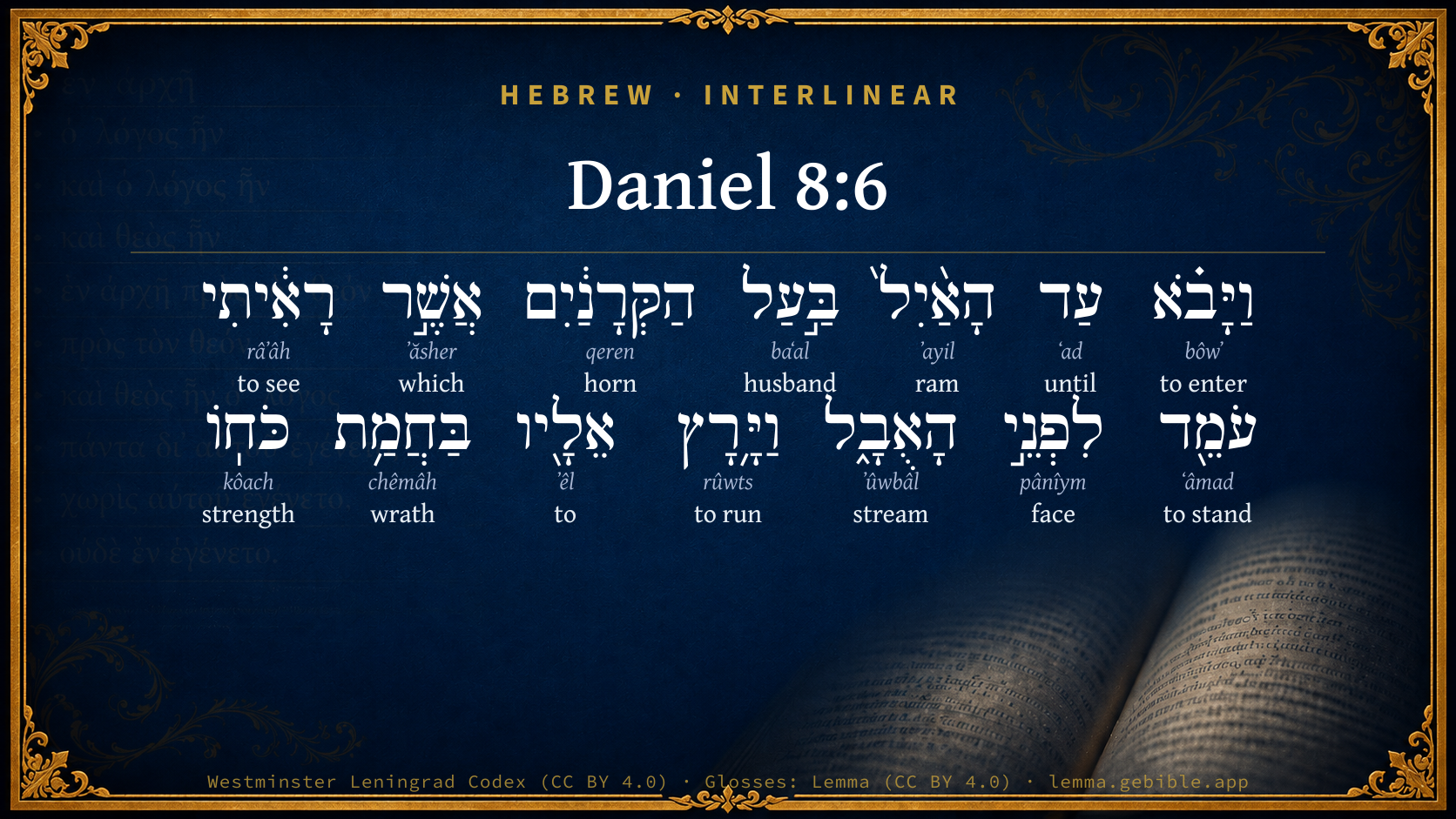
Hebrew (Westminster Leningrad Codex) Daniel 8:6 appears in the Hebrew Old Testament. The text above is from the Westminster Leningrad Codex. Each word links to its Strong’s number, a concise gloss, and parsing drawn from the Open Scriptures Hebrew Bible morphology. Click any word for its full Brown-Driver-Briggs (BDB) entry.
Download image
Cite this verse

Daniel 8:6 (World English Bible). Public Domain. Lemma interlinear Bible study tool, https://lemma.gebible.app/v/daniel/8/6.

Show BibTeX & RIS
BibTeX
RIS
English Translation
He came to the ram that had the two horns, which I saw standing before the river, and ran on him in the fury of his power.
World English Bible · Public Domain
Download a study sheet

One document with this verse’s original text, its word-by-word gloss line, the meaning frame, cross-references with their text, attributed commentary, and full source and license credits — printable, and it pastes into notes with its structure intact.

This verse Autodidact and up

Study sheet (.html) Plain text (.txt)

A passage Seminary Student

Up to 50 verses in one chapter. A passage sheet keeps up to 6 commentary sources and 12 cross-references per verse, in the order this page ranks them, and says so on the sheet whenever that leaves anything out. Ask for a single verse and you get the Autodidact verse sheet above.

Everything on this page stays free to read, with no account — the sheet is a download of what is already on screen, not access to it.

Want to remove ads? Support Godless Engineer
Compare translations 3

The same verse in 3 English versions, stacked beneath the original-language interlinear above. Click any original word for its lexicon entry.

Each is an independent rendering of the whole verse — the interlinear is not word-aligned to these translations.

Highlighted words mark where these versions differ — a whole-verse word diff, not a word-by-word alignment.

  • World English Bible Public Domain
    He came to the ram that had the two horns, which I saw standing before the river, and ran on him in the fury of his power.
  • King James Version Public Domain
    And he came to the ram that had two horns, which I had seen standing before the river, and ran unto him in the fury of his power.
  • unfoldingWord Literal Text CC BY-SA 4.0
    He came to the ram that had two horns, which I had seen standing in front of the canal, and he ran at him in his powerful rage.

unfoldingWord Literal Text — © unfoldingWord, licensed CC BY-SA 4.0. Word-aligned USFM3 via Door43 (git.door43.org/unfoldingWord/en_ult).

Versions to compare (up to 4)

3 of 4 selected

Show all 18 translations

Every available English version of this verse, each an independent rendering of the whole verse.

  • World English Bible Public Domain
    He came to the ram that had the two horns, which I saw standing before the river, and ran on him in the fury of his power.
  • Berean Standard Bible Public Domain
    He came toward the two-horned ram I had seen standing beside the canal and rushed at him with furious power.
  • Majority Standard Bible Public Domain
    He came toward the two-horned ram I had seen standing beside the canal and rushed at him with furious power.
  • King James Version Public Domain
    And he came to the ram that had two horns, which I had seen standing before the river, and ran unto him in the fury of his power.
  • American Standard Version (1901) Public Domain
    And he came to the ram that had the two horns, which I saw standing before the river, and ran upon him in the fury of his power.
  • Revised Version (1885) Public Domain
    And he came to the ram that had the two horns, which I saw standing before the river, and ran upon him in the fury of his power.
  • Geneva Bible (1599) Public Domain
    And he came vnto the ramme that had the two hornes, whome I had seene standing by the riuer, and ranne vnto him in his fierce rage.
  • Douay-Rheims (1899) Public Domain
    And he went up to the ram that had the horns, which I had seen standing before the gate, and he ran towards him in the force of his strength.
  • Young's Literal Translation Public Domain
    And it cometh unto the ram possessing the two horns, that I had seen standing before the stream, and runneth unto it in the fury of its power.
  • Literal Standard Version CC BY-SA 4.0
    And it comes to the ram possessing the two horns, that I had seen standing before the stream, and runs to it in the fury of its power.
  • Unlocked Literal Bible CC BY-SA 4.0
    He came to the ram who had two horns—I had seen the ram standing on the bank of the canal—and the goat ran toward the ram in a powerful rage.
  • unfoldingWord Literal Text CC BY-SA 4.0
    He came to the ram that had two horns, which I had seen standing in front of the canal, and he ran at him in his powerful rage.
  • Darby Bible Public Domain
    And he came to the ram that had the two horns, which I had seen standing before the river, and ran upon him in the fury of his power.
  • World Messianic Bible Public Domain
    He came to the ram that had the two horns, which I saw standing before the river, and ran on him in the fury of his power.
  • Webster's Bible Public Domain
    And he came to the ram that had two horns, which I had seen standing before the river, and ran to him in the fury of his power.
  • Free Bible Version CC BY-SA 4.0
    It approached the ram with the two horns which I had seen standing beside the river, rushing in to attack in a furious rage.
  • Bible in Basic English Public Domain
    And he came to the two-horned sheep which I saw before the stream, rushing at him in the heat of his power.
  • JPS Tanakh (1917) Public Domain
    And he came to the ram that had the two horns, which I saw standing before the stream, and ran at him in the fury of his power.

Literal Standard Version (2020), Covenant Press — licensed CC BY-SA 4.0. Text via the HelloAO Bible API (eBible.org). Unlocked Literal Bible (unfoldingWord) — licensed CC BY-SA 4.0. Text via the HelloAO Bible API (eBible.org). unfoldingWord Literal Text — © unfoldingWord, licensed CC BY-SA 4.0. Word-aligned USFM3 via Door43 (git.door43.org/unfoldingWord/en_ult). Free Bible Version, Dr. Jonathan Gallagher — licensed CC BY-SA 4.0. Text via the HelloAO Bible API (eBible.org).

Word by word

More ways to search: Search by grammar → Find every occurrence → Compare this word →

Practice this passage: Drill this verse → Learn its vocabulary →

הָאֻבָ֑ל
ʼûwbâl
H180
“the · stream”
Particle, Definite Article + Noun, Common, Masculine, Singular, Absolute
Part of Speech
Particle + Noun
Type
Common
Gender
Masculine
Number
Singular
State
Absolute
Full BDB Definition

Origin: from H2986 (in the sense of H2988 )

TWOT: 835g

stream, river
  1. וַיָּבֹ֗א bôwʼ H935 “and · to enter” Conjunction + Verb, Qal, Sequential Imperfect, 3rd Person, Masculine, Singular
  2. עַד ʻad H5704 “until” Preposition
  3. הָאַ֨יִל֙ ʼayil H352 “the · ram” Particle, Definite Article + Noun, Common, Masculine, Singular, Absolute
  4. בַּ֣עַל baʻal H1167 “husband of” Noun, Common, Masculine, Singular, Construct
  5. הַקְּרָנַ֔יִם qeren H7161 “the · horns” Particle, Definite Article + Noun, Common, Both, Dual, Absolute
  6. אֲשֶׁ֣ר ʼăsher H834 “which” Particle, Relative
  7. רָאִ֔יתִי râʼâh H7200 “to see” Verb, Qal, Perfect, 1st Person, Common, Singular
  8. עֹמֵ֖ד ʻâmad H5975 “standing” Verb, Qal, Participle Active, Masculine, Singular, Absolute
  9. לִפְנֵ֣י pânîym H6440 “to/for · face(s) of” Preposition + Noun, Common, Both, Plural, Construct
  10. וַיָּ֥רָץ rûwts H7323 “and · to run” Conjunction + Verb, Qal, Sequential Imperfect, 3rd Person, Masculine, Singular
  11. אֵלָ֖יו ʼêl H413 “to · him” Preposition + Suffix, Personal, 3rd Person, Masculine, Singular
  12. בַּחֲמַ֥ת chêmâh H2534 “in/at · wrath of” Preposition + Noun, Common, Feminine, Singular, Construct
  13. כֹּחֽוֹ kôach H3581 “strength · his” Noun, Common, Masculine, Singular, Construct + Suffix, Personal, 3rd Person, Masculine, Singular

About this verse

These counts appear in no published source. They are computed here, from the morphology-tagged text and Lemma’s own curated glosses. What Lemma adds →

14
words
14
distinct lemmas
Prophets
section

Notable vocabulary

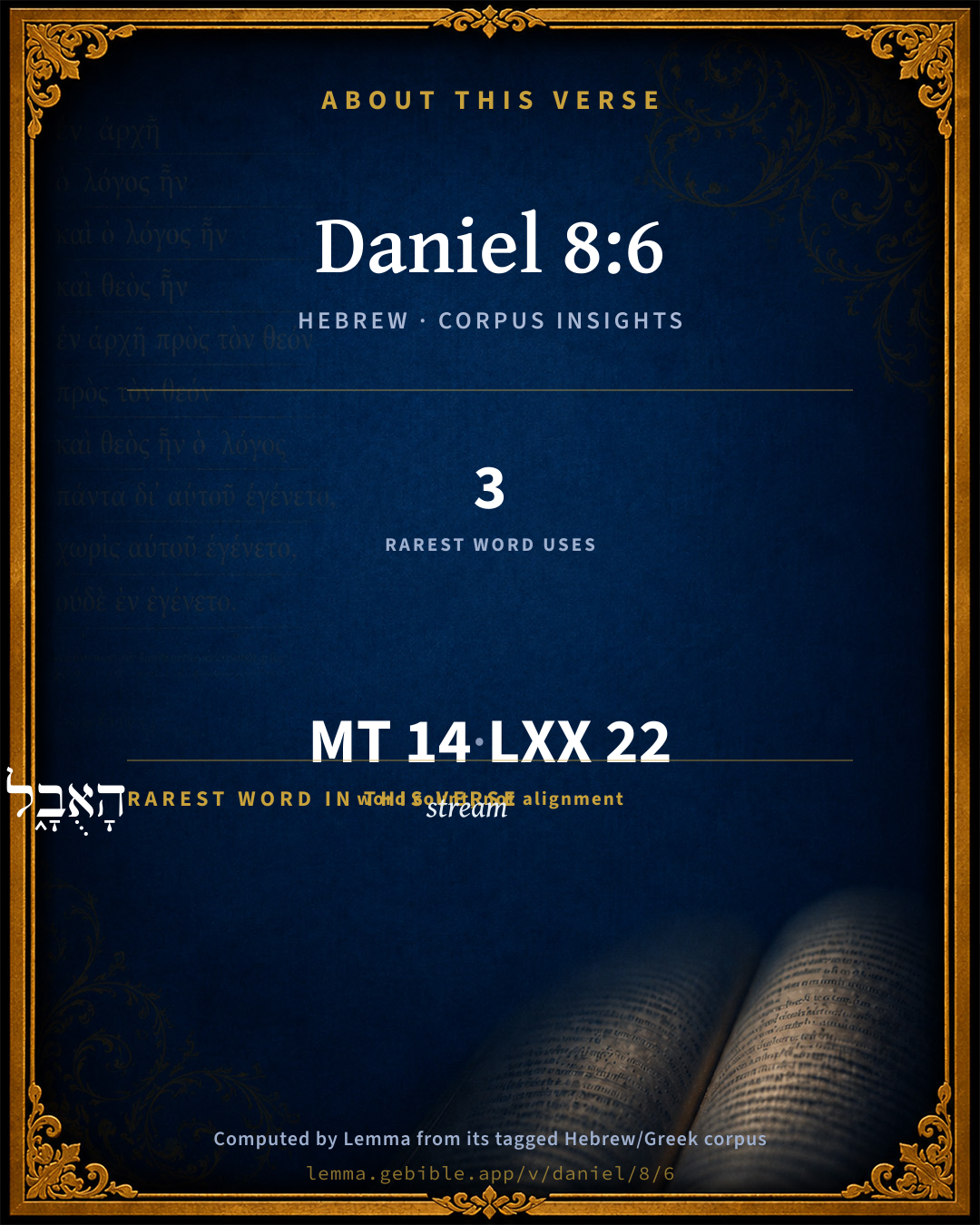
The rarest word here is הָאֻבָ֑ל stream H180 — appearing just 3 times in the whole Hebrew Bible.

Shared distinctive vocabulary

הָאֻבָ֑ל stream H180 occurs in 3 verses of the Hebrew Bible. Also found in:

Grammatical profile

  • 4 verbs
  • 7 nouns
  • 2 prepositions
  • 1 particle

Verb forms

  • וַיָּבֹ֗א Qal · Sequential Imperfect
  • רָאִ֔יתִי Qal · Perfect
  • עֹמֵ֖ד Qal · Participle Active
  • וַיָּ֥רָץ Qal · Sequential Imperfect

Hebrew & Septuagint length

In English translation the verse runs 27 words from the Hebrew and 31 from the Septuagint (LXX English) — closely comparable.

A rough comparison of the two English renderings, which tokenize alike — not a word-level alignment.

Word counts can differ between the Hebrew and the Greek without any difference in meaning — e.g. the Hebrew direct-object marker אֵת has no separate Greek word, and Greek often adds the article ὁ.

In the original languages it is 14 Hebrew tokens and 22 Greek tokens — but the two are counted differently (Hebrew bundles its prefixes and suffixes into one token; the Greek is in lemma form), so that isn’t a like-for-like length.

Hebrew and Greek witnesses Masoretic Hebrew ↔ Greek Septuagint

The same verse in the two great witnesses to the Old Testament, shown verse-for-verse.

These are two independent witnesses, not word-aligned to each other, and the Septuagint is shown in lemma (dictionary) form.

Hebrew Daniel 8:6 Masoretic · Westminster Leningrad Codex

וַיָּבֹ֗א עַד הָאַ֨יִל֙ בַּ֣עַל הַקְּרָנַ֔יִם אֲשֶׁ֣ר רָאִ֔יתִי עֹמֵ֖ד לִפְנֵ֣י הָאֻבָ֑ל וַיָּ֥רָץ אֵלָ֖יו בַּחֲמַ֥ת כֹּחֽוֹ

He came to the ram that had the two horns, which I saw standing before the river, and ran on him in the fury of his power.

World English Bible · Public Domain

Greek LXX Daniel 8:6 Septuagint · lemma form

καί ἔρχομαι ἐπί ὁ κριός ὁ ὁ κέρας ἔχω ὅς ὁράω ἵστημι πρός ὁ πύλη καί τρέχω πρός αὐτός ἐν θυμός ὀργή

And he came to the ram that had the horns, which I had seen standing in front of the Ubal, and he ran at him with the violence of his strength.

LXX2012 (modern English Septuagint) · Public Domain

On this verse, The Pulpit Commentary discusses the Septuagint’s reading. Read the note in Commentary ↓

Hebrew: Westminster Leningrad Codex (CC BY 4.0). Greek: Septuagint (public domain); English from LXX2012 (modern English Septuagint) (Public Domain). How the Septuagint differs from the Hebrew →

Commentary

Notes on Daniel 8:6 from classic Christian and Jewish commentators (each source and its license shown beneath its notes). The classic Christian expositions comment on the surrounding passage and are grouped to its opening verse, so a note may address several verses; the Jewish commentaries on the Tanakh (Rashi and others) are per-verse, so they appear only where the commentator wrote on this verse.

Lemma curates 59 commentaries, every one of them public domain or Creative Commons licensed, each selected and text-cleaned for this edition rather than reprinted as found. About our sources →

Trapp's Complete Commentary

John Trapp

Dan 8:6 And he came to the ram that had [two] horns, which I had seen standing before the river, and ran unto him in the fury of his power.

Ver. 6. And he came to the ram that had two horns.] He came. This may betoken the slower preparations of Philip, king of Macedonia.

And ran unto him.] Alexander did, by quick and furious marches.

“ Nil actum credens dum quid superesset agendam

Fertur atrox. ” - De Cas. Lucan,

John Trapp, A Commentary or Exposition upon All the Books of the Old and New Testament (1647–1656) — public domain. Text from a community e-Sword module.

Joseph Benson's Commentary

Dan 8:6-7. And he came to the ram that had two horns, &c. — “The ram had before pushed westward, and the Persians, in the reign of Darius Hystaspes and Xerxes, had poured down with great armies into Greece; but now the Grecians, in return, carried their arms into Asia, and the he- goat invaded the ram that had invaded him. And he came to the ram &c., which I had seen standing before the river, and ran unto him in the fury of his power. One can hardly read these words without having some image of Darius’s army standing and guarding the river Granicus, and of Alexander on the other side, with his forces plunging in, swimming across the stream, and rushing on the enemy with all the fire and fury that can be imagined. And I saw him come close unto the ram — He had several close engagements, or set battles, with the king of Persia, and particularly at Granicus in Phrygia, at the straits of Issus in Cilicia, and in the plains of Arbela, in Assyria. And he was moved with choler against him — For the cruelties which the Persians had exercised toward the Grecians; and for Darius’s attempting to corrupt sometimes his soldiers to betray him, and sometimes his friends to destroy him: so that he would not listen to the most advantageous offers of peace, but determined to pursue the Persian king, not as a generous and noble enemy, but as a poisoner and a murderer, to the death which he deserved. And smote the ram, and brake his two horns — He subdued Persia and Media, with other provinces and kingdoms of the Persian empire; and it is remarkable, that in Persia he barbarously sacked and burned the royal city of Persepolis, the capital of the empire; and in Media, Darius was seized and made prisoner by some of his own treacherous subjects, who not long afterward basely murdered him. And there was no power in the ram to stand before him, &c. — He conquered wherever he came; routed all the forces, took all the cities and castles, and entirely subverted and ruined the Persian empire. And there was none that could deliver the ram out of his hand — Not even his numerous armies could defend the king of Persia, though his forces in the battle of Issus amounted to 600,000 men, and in that of Arbela, to 10 or 1100,000, whereas the whole number of Alexander’s was not more than 47,000 in either engagement.” — Bishop Newton.

Joseph Benson's Commentary on the Old and New Testaments (1811–1818) — public domain. Text from a community e-Sword module.

Jamieson, Fausset & Brown

Robert Jamieson, A. R. Fausset & David Brown

standing before the river--Ulai. It was at the "river" Granicus that Alexander fought his first victorious battle against Darius, 334 B.C.

Jamieson, Fausset & Brown — Commentary Critical and Explanatory on the Whole Bible (1871) — public domain (CC PDM 1.0). Text via the HelloAO Bible API.

Adam Clarke's Commentary

Verse 6. And he came to the ram.] This and the following verse give an account of the overthrow of the Persian empire by Alexander.

And ran unto him in the fury of his power] The conflicts between the Greeks and the Persians were excessively severe. Alexander first vanquished the generals of Darius, at the river Granicus, in Phrygia; he next attacked and totally routed Darius, at the straits of Issus, in Cilicia; and afterwards at the plains of Arbela, in Assyria. One can hardly read these words, says Bp. Newton, "the ram - which I had seen standing by the river, ran unto him in the fury of his power," without having the image of Darius' army standing and guarding the river Granicus and of Alexander on the other side, with his forces plunging in swimming across the stream, and rushing on the enemy, with all the fire and fury that can be conceived.

Adam Clarke's Commentary on the Bible (1810–1826) — public domain. Text from a community e-Sword/MySword module.

Ellicott's Commentary for English Readers

(6) Ran unto him.—The wonderful rapidity of Alexander’s movements, incredible, if it were not so well attested in history, is here pointed out. From the battle of Granicus to that of Arbela only three years elapsed. During this brief period the whole Persian empire fell to pieces.

A Bible Commentary for English Readers, edited by Charles John Ellicott (1878–1897) — public domain. Text from a community e-Sword module.

The Cambridge Bible for Schools and Colleges

gen. ed. J. J. S. Perowne

6. Alexander’s attack upon Persia.

that had two horns] that had the two horns (Dan_8:3).

the river] the stream (Dan_8:2).

ran unto him] at or (R.V.) upon him (Job_15:26).

The Cambridge Bible for Schools and Colleges (gen. ed. J. J. S. Perowne; Cambridge University Press, 1878–1918) — public domain. Text from a community e-Sword module.

John Gill's Exposition

And he came to the ram that had two horns,.... Alexander being chosen and made by the states of Greece captain general of all Greece against the Persians, marched from thence with his army, passed the Hellespont, and entered into the kingdom of the Medes and Persians, signified by the ram with two horns, and came up to Darius Codomannus, possessed of this large monarchy, and at the head of a numerous army:

which I had seen standing before the river; the river Ulai, near to Shushan, the royal seat of the kings of Persia; here Darius stood in his royal majesty and dignity, as the defender of his empire, and unconcerned at the attempt of Alexander, having nothing to fear, as he thought, from such a puny adversary:

and ran unto him in the fury of his power; or, "heat of his power" (b); which denotes the haste Alexander made with his army into Asia; his eager desire, and the fervour of his mind to engage with the Persians: the historian says, that he passed the Hellespont into Asia, "incredibli ardore mentis accensus"; fired with an incredible ardour of mind: and a little after, having conquered the rebels of Pisidia, he marched against Darius, "summo mentis ardore"; with the greatest ardour of mind, and with no less alacrity (c); which exactly agrees with the sacred text. The running of the he goat to the ram in a hostile way is described in allusion to the manner of those creatures when they fight with one another, or attack an enemy.

(b) "fervore virtutis suae", Munster; "cum ardore virium suarum", Cocceius; "in aestu robaris sui", Michaelis. (c) Supplem. in Curt. l. 2. p. 26, 28.

John Gill's Exposition of the Whole Bible (1746–1763) — public domain (CC PDM 1.0). Text via the HelloAO Bible API.

Albert Barnes' Notes on the Bible

And he came to the ram ... - Representing the Medo-Persian power.

And ran unto him in the fury of his power - Representing the fierceness and fury with which Alexander attacked the Persians at the Granicus, at Issus, and at Arbela, with which he invaded and overthrew them in their own country. Nothing would better express this than to say that it was done in “the fury of power.”

Albert Barnes' Notes on the Bible (1834–1885) — public domain. Text from a community e-Sword/MySword module.

Matthew Poole's English Annotations

The ram that had two horns, i.e. the king of Media and Persia, and joined battle presently and furiously, Jehu like.

Matthew Poole's English Annotations on the Holy Bible (1683–1685) — public domain. Text from a community e-Sword/MySword module.

Whedon's Commentary on the Bible

Daniel D. Whedon

6, 7. A graphic picture of Alexander’s conquest of the Medo-Persian empire under Darius. Alexander was really the aggressor, and refusing absolutely to make terms of peace pursued him to his death, notwithstanding the sympathy of many onlookers who feared that it would be their turn next to be trampled upon.

Daniel D. Whedon (gen. ed.), Commentary on the Old and New Testaments (1874–1909) — public domain. Text from a community e-Sword module.

The Pulpit Commentary

And he came to the ram that had two horns, which I had seen standing before the river, and ran unto him in the fury of his power. The differences of the Septuagint from the received text are slight here. Oobal is still translated pulh; it renders, "fury of his rage" rather than "fury of his power." The Massoretic, as the less obvious collocation, is the better reading. Theodotion and the Peshitta leave oobal untranslated. The latter omits the last clause of the Massoretic. In the Hebrew the ram is called Baal-karnayeem, "lord of two horns." Alexander"s war against Persia was one of simple aggression.

The Pulpit Commentary (1880–1919), ed. H.D.M. Spence-Jones & Joseph S. Exell — public domain. Text from a community e-Sword module.

John Wesley's Explanatory Notes

The ram - The king of Media and Persia.

John Wesley, Explanatory Notes Upon the Whole Bible (1754–1765) — public domain. Text via the GEBible commentary corpus.

Lesson kit

Teaching starters — assembled from the data on this page, not authored interpretation. Every prompt links to the verse data it draws on. Edit before teaching.

Daniel, in the Prophets, opens this verse with 14 words (14 distinct Hebrew lemmas). Its most distinctive word is ʼûwbâl (“stream”). A historical commentator’s framing appears above. Read the whole chapter for the surrounding context.

Discussion questions

  1. What does “stream” (ʼûwbâl) contribute to the verse as a whole?
  2. How does Daniel 8:2, which shares the word «stream», read alongside this verse?
  3. These translations render this verse differently; the difference is in the English rendering, not the original. What questions does that raise?
  4. «וַיָּבֹ֗א» is a Qal Sequential Imperfect verb. How does that grammatical form shape the action described?
  5. Compare how Trapp's Complete Commentary and Joseph Benson's Commentary read this verse. Where do they agree or differ?

Things to notice

Reading settings

Reading text

Shown beneath each verse's original-language words.

Old Testament
Old Testament edition

Read the OT as the Masoretic Hebrew (MT) or the Greek Septuagint (LXX).

English shown for the Greek Septuagint (in the Hebrew ↔ Greek comparison).

Comparing translations? Open the Compare panel on any verse page to stack up to four side by side.