
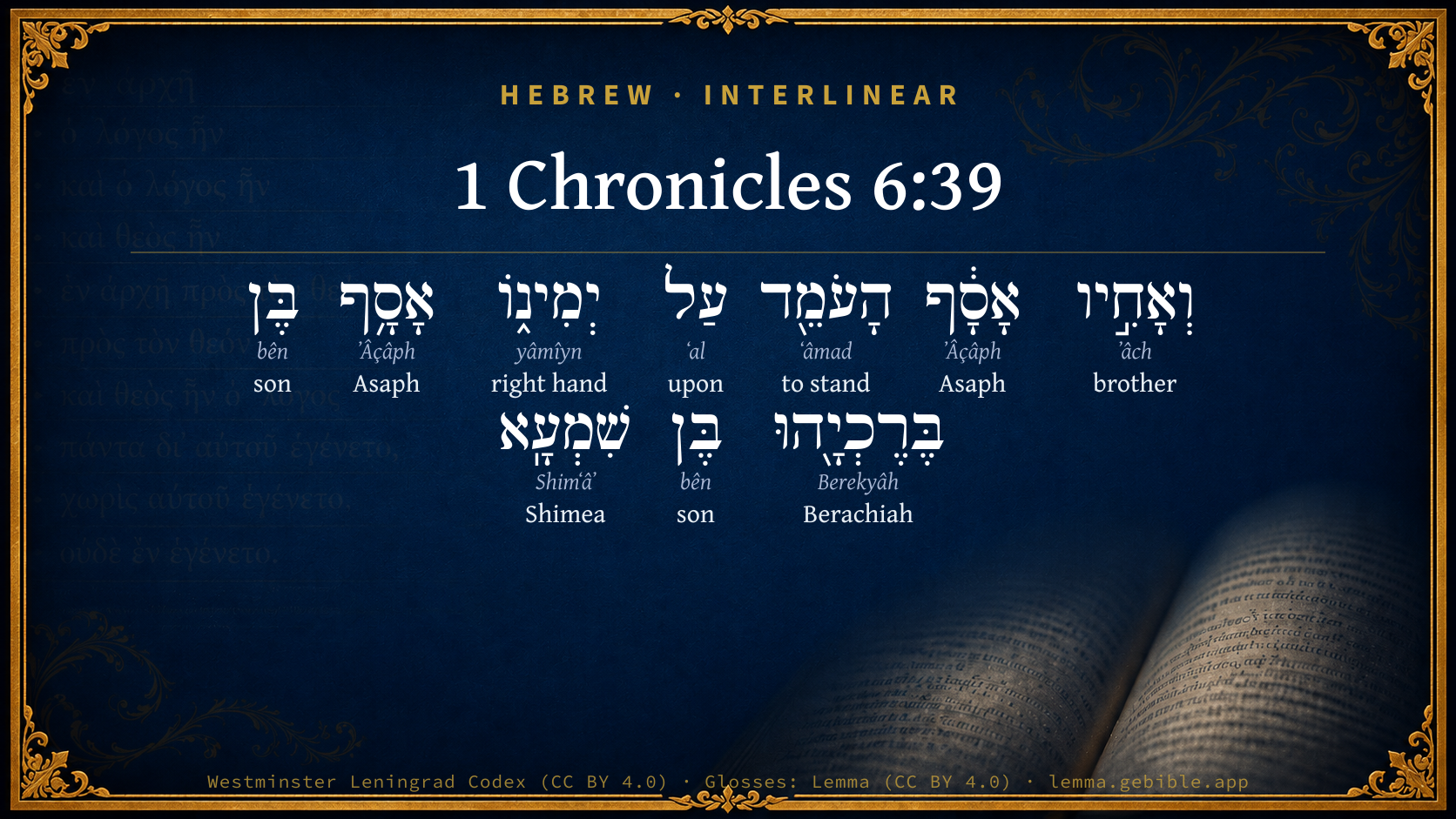
1 Chronicles 6:39

Hebrew (Westminster Leningrad Codex) 1 Chronicles 6:39 appears in the Hebrew Old Testament. The text above is from the Westminster Leningrad Codex. Each word links to its Strong’s number, a concise gloss, and parsing drawn from the Open Scriptures Hebrew Bible morphology. Click any word for its full Brown-Driver-Briggs (BDB) entry.
Download image
Cite this verse

1 Chronicles 6:39 (World English Bible). Public Domain. Lemma interlinear Bible study tool, https://lemma.gebible.app/v/1-chronicles/6/39.

Show BibTeX & RIS
BibTeX
RIS
English Translation
His brother Asaph, who stood on his right hand, even Asaph the son of Berechiah, the son of Shimea,
World English Bible · Public Domain
Download a study sheet

One document with this verse’s original text, its word-by-word gloss line, the meaning frame, cross-references with their text, attributed commentary, and full source and license credits — printable, and it pastes into notes with its structure intact.

This verse Autodidact and up

Study sheet (.html) Plain text (.txt)

A passage Seminary Student

Up to 50 verses in one chapter. A passage sheet keeps up to 6 commentary sources and 12 cross-references per verse, in the order this page ranks them, and says so on the sheet whenever that leaves anything out. Ask for a single verse and you get the Autodidact verse sheet above.

Everything on this page stays free to read, with no account — the sheet is a download of what is already on screen, not access to it.

Want to remove ads? Support Godless Engineer
Compare translations 3

The same verse in 3 English versions, stacked beneath the original-language interlinear above. Click any original word for its lexicon entry.

Each is an independent rendering of the whole verse — the interlinear is not word-aligned to these translations.

Highlighted words mark where these versions differ — a whole-verse word diff, not a word-by-word alignment.

  • World English Bible Public Domain
    His brother Asaph, who stood on his right hand, even Asaph the son of Berechiah, the son of Shimea,
  • King James Version Public Domain
    And his brother Asaph, who stood on his right hand, even Asaph the son of Berachiah, the son of Shimea,
  • unfoldingWord Literal Text CC BY-SA 4.0
    And his brother Asaph, the one standing at his right hand, Asaph, the son of Berekiah, the son of Shimea,

unfoldingWord Literal Text — © unfoldingWord, licensed CC BY-SA 4.0. Word-aligned USFM3 via Door43 (git.door43.org/unfoldingWord/en_ult).

Versions to compare (up to 4)

3 of 4 selected

Show all 18 translations

Every available English version of this verse, each an independent rendering of the whole verse.

  • World English Bible Public Domain
    His brother Asaph, who stood on his right hand, even Asaph the son of Berechiah, the son of Shimea,
  • Berean Standard Bible Public Domain
    Heman’s kinsman was Asaph, who served at his right hand: Asaph the son of Berechiah, the son of Shimea,
  • Majority Standard Bible Public Domain
    Heman’s kinsman was Asaph, who served at his right hand: Asaph the son of Berechiah, the son of Shimea,
  • King James Version Public Domain
    And his brother Asaph, who stood on his right hand, even Asaph the son of Berachiah, the son of Shimea,
  • American Standard Version (1901) Public Domain
    And his brother Asaph, who stood on his right hand, even Asaph the son of Berechiah, the son of Shimea,
  • Revised Version (1885) Public Domain
    And his brother Asaph, who stood on his right hand, even Asaph the son of Berechiah, the son of Shimea;
  • Geneva Bible (1599) Public Domain
    And his brother Asaph stoode on his right hand: and Asaph was the sonne of Berechiah, the sonne of Shimea,
  • Douay-Rheims (1899) Public Domain
    And his brother Asaph, who stood on his right hand, Asaph the son of Barachias, the son of Samaa.
  • Young's Literal Translation Public Domain
    And his brother Asaph, who is standing on his right -- Asaph, son of Berachiah, son of Shimea,
  • Literal Standard Version CC BY-SA 4.0
    And his brother Asaph, who is standing on his right—Asaph, son of Berachiah, son of Shimea,
  • Unlocked Literal Bible CC BY-SA 4.0
    Heman's colleague was Asaph, who stood at his right hand. Asaph was the son of Berekiah. Berekiah was the son of Shimea.
  • unfoldingWord Literal Text CC BY-SA 4.0
    And his brother Asaph, the one standing at his right hand, Asaph, the son of Berekiah, the son of Shimea,
  • Darby Bible Public Domain
    And his brother Asaph, who stood on his right hand: Asaph, the son of Berechiah, the son of Shimea,
  • World Messianic Bible Public Domain
    His brother Asaph, who stood on his right hand, even Asaph the son of Berechiah, the son of Shimea,
  • Webster's Bible Public Domain
    And his brother Asaph, who stood on his right hand, even Asaph the son of Berechiah, the son of Shimea,
  • Free Bible Version CC BY-SA 4.0
    Asaph, Heman's relative, who served beside him on the right: Asaph son of Berekiah, the son of Shimea,
  • Bible in Basic English Public Domain
    And his brother Asaph, whose place was at his right hand, Asaph, the son of Berechiah, the son of Shimea,
  • JPS Tanakh (1917) Public Domain
    (6-24) And his brother Asaph, who stood on his right hand; even Asaph the son of Berechiah, the son of Shimea;

Literal Standard Version (2020), Covenant Press — licensed CC BY-SA 4.0. Text via the HelloAO Bible API (eBible.org). Unlocked Literal Bible (unfoldingWord) — licensed CC BY-SA 4.0. Text via the HelloAO Bible API (eBible.org). unfoldingWord Literal Text — © unfoldingWord, licensed CC BY-SA 4.0. Word-aligned USFM3 via Door43 (git.door43.org/unfoldingWord/en_ult). Free Bible Version, Dr. Jonathan Gallagher — licensed CC BY-SA 4.0. Text via the HelloAO Bible API (eBible.org).

Word by word

More ways to search: Search by grammar → Find every occurrence → Compare this word →

Practice this passage: Drill this verse → Learn its vocabulary →

שִׁמְעָֽא
Shimʻâʼ
H8092
“Shimea”
Noun, Proper
Part of Speech
Noun
Type
Proper
Full BDB Definition

Origin: for H8093

TWOT: None

Shimea = "fame" - son of David by Bathsheba - brother of David, the 3rd son of Jesse - also 'Shammah', 'Shimma', and 'Shimeah' - a Gershonite Levite, father of Berachiah, and grandfather of Asaph - a Merarite Levite, son of Uzzah, and father of Haggiah
  1. וְאָחִ֣יו ʼâch H251 “and · brother · his” Conjunction + Noun, Common, Masculine, Singular, Construct + Suffix, Personal, 3rd Person, Masculine, Singular
  2. אָסָ֔ף ʼÂçâph H623 “Asaph” Noun, Proper
  3. הָעֹמֵ֖ד ʻâmad H5975 “the · standing” Particle, Definite Article + Verb, Qal, Participle Active, Masculine, Singular, Absolute
  4. עַל ʻal H5921 “upon” Preposition
  5. יְמִינ֑וֹ yâmîyn H3225 “right hand · his” Noun, Common, Feminine, Singular, Construct + Suffix, Personal, 3rd Person, Masculine, Singular
  6. אָסָ֥ף ʼÂçâph H623 “Asaph” Noun, Proper
  7. בֶּן bên H1121 “son of” Noun, Common, Masculine, Singular, Construct
  8. בֶּרֶכְיָ֖הוּ Berekyâh H1296 “Berachiah” Noun, Proper
  9. בֶּן bên H1121 “son of” Noun, Common, Masculine, Singular, Construct

About this verse

These counts appear in no published source. They are computed here, from the morphology-tagged text and Lemma’s own curated glosses. What Lemma adds →

10
words
8
distinct lemmas
Historical
section

Notable vocabulary

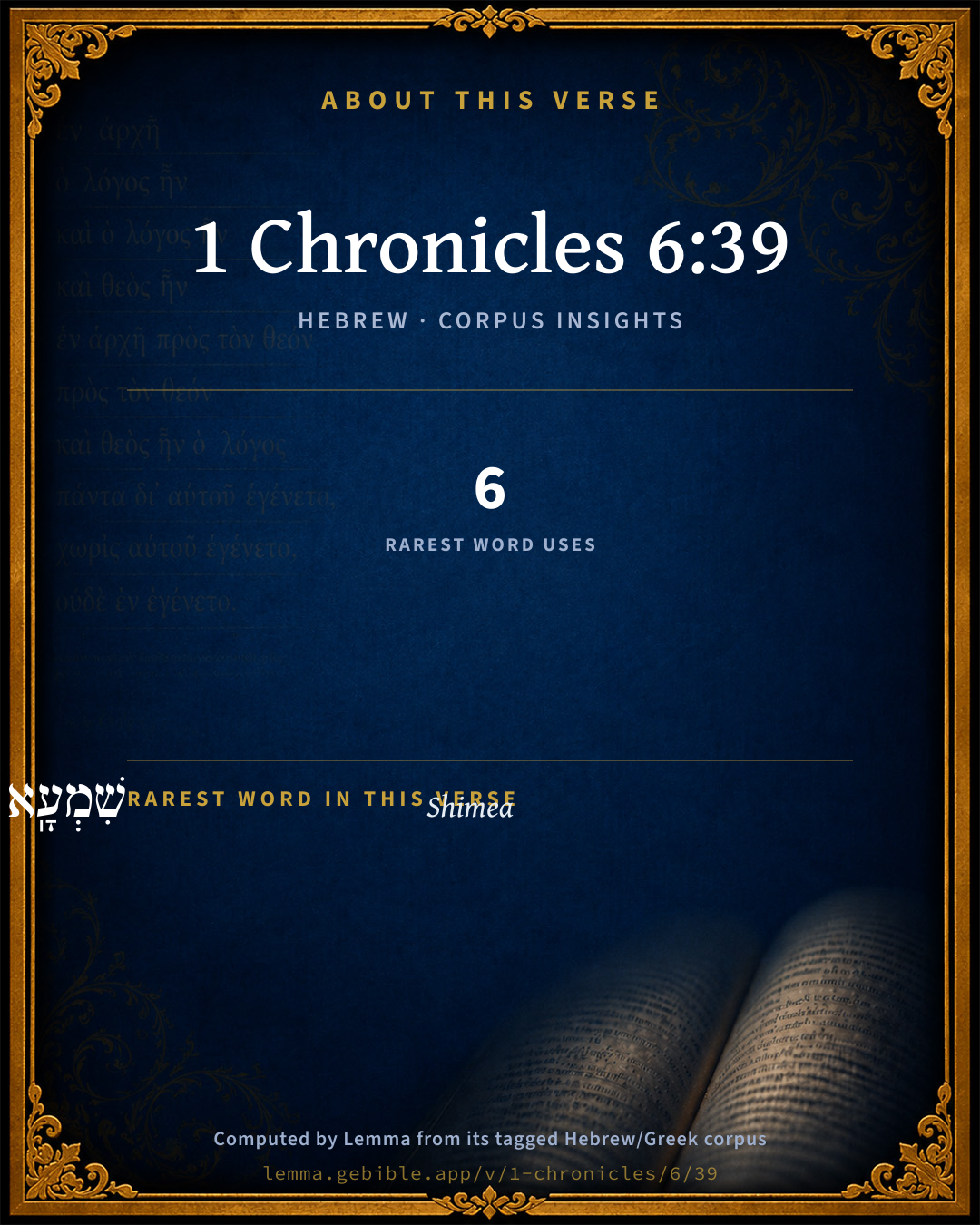
The rarest word here is שִׁמְעָֽא Shimea H8092 — appearing just 6 times in the whole Hebrew Bible.

Shared distinctive vocabulary

שִׁמְעָֽא Shimea H8092 occurs in 6 verses of the Hebrew Bible. Also found in:

Grammatical profile

  • 1 verb
  • 8 nouns
  • 1 preposition

Verb forms

  • הָעֹמֵ֖ד Qal · Participle Active

Repetition

Words recur within this verse — often emphatic in Hebrew:

  • אָסָ֔ף Asaph H623 ×2
  • בֶּן son H1121 ×2

Hebrew & Septuagint length

In English translation the verse runs 19 words from the Hebrew and 19 from the Septuagint (LXX English) — the same length.

A rough comparison of the two English renderings, which tokenize alike — not a word-level alignment.

Word counts can differ between the Hebrew and the Greek without any difference in meaning — e.g. the Hebrew direct-object marker אֵת has no separate Greek word, and Greek often adds the article ὁ.

Cross-references

28

Topical passages linked to 1 Chronicles 6:39 in the Treasury of Scripture Knowledge — connected by theme and wording, ordered by reader-vote popularity; previews shown in the World English Bible.

  • Ezra 2:41 The singers: the children of Asaph, one hundred twenty-eight.
  • Nehemiah 7:44 The singers: the children of Asaph, one hundred forty-eight.
  • 2 Chronicles 5:12 also the Levites who were the singers, all of them, even Asaph, Heman, Jeduthun, and their sons and their brothers, arrayed in fine linen, with cymbals and psalteries and harps, stood at the east end of the altar, and with them one hundred twenty priests sounding with trumpets;)
  • 2 Chronicles 29:13 and of the sons of Elizaphan, Shimri and Jeuel; and of the sons of Asaph, Zechariah and Mattaniah;
  • Nehemiah 11:17 and Mattaniah the son of Mica, the son of Zabdi, the son of Asaph, who was the chief to begin the thanksgiving in prayer, and Bakbukiah, the second among his brothers; and Abda the son of Shammua, the son of Galal, the son of Jeduthun.
  • Nehemiah 12:46 For in the days of David and Asaph of old there was a chief of the singers, and songs of praise and thanksgiving to God.
  • Psalms 73:1 Surely God is good to Israel, To those who are pure in heart.
  • Psalms 75:1 We give thanks to you, God, We give thanks, for your Name is near. Men tell about your wondrous works.
  • Psalms 77:1 My cry goes to God! Indeed, I cry to God for help, And for him to listen to me.
  • Psalms 79:1 God, the nations have come into your inheritance. They have defiled your holy temple. They have laid Jerusalem in heaps.
  • Psalms 81:1 Sing aloud to God, our strength! Make a joyful shout to the God of Jacob!
  • Psalms 83:1 God, don't keep silent. Don't keep silent, And don't be still, God.
  • 1 Chronicles 15:17–19 So the Levites appointed Heman the son of Joel; and of his brothers, Asaph the son of Berechiah; and of the sons of Merari their brothers, Ethan the son of Kushaiah;
  • 1 Chronicles 16:7 Then on that day David first ordained to give thanks to Yahweh, by the hand of Asaph and his brothers.
  • 1 Chronicles 25:2 of the sons of Asaph: Zaccur, and Joseph, and Nethaniah, and Asharelah, the sons of Asaph, under the hand of Asaph, who prophesied after the order of the king.
  • 1 Chronicles 26:1 For the divisions of the doorkeepers: of the Korahites, Meshelemiah the son of Kore, of the sons of Asaph.
  • 2 Chronicles 20:14 Then on Jahaziel the son of Zechariah, the son of Benaiah, the son of Jeiel, the son of Mattaniah, the Levite, of the sons of Asaph, came the Spirit of Yahweh in the midst of the assembly;
  • 2 Chronicles 29:30 Moreover Hezekiah the king and the princes commanded the Levites to sing praises to Yahweh with the words of David, and of Asaph the seer. They sang praises with gladness, and they bowed their heads and worshiped.
  • 2 Chronicles 35:15 The singers the sons of Asaph were in their place, according to the commandment of David, and Asaph, and Heman, and Jeduthun the king's seer; and the porters were at every gate: they didn't need to depart from their service; for their brothers the Levites prepared for them.
  • Ezra 3:10 When the builders laid the foundation of the temple of Yahweh, they set the priests in their clothing with trumpets, and the Levites the sons of Asaph with cymbals, to praise Yahweh, after the order of David king of Israel.
  • Nehemiah 11:22 The overseer also of the Levites at Jerusalem was Uzzi the son of Bani, the son of Hashabiah, the son of Mattaniah, the son of Mica, of the sons of Asaph, the singers, over the business of the house of God.
  • Nehemiah 12:35 and certain of the priests' sons with trumpets: Zechariah the son of Jonathan, the son of Shemaiah, the son of Mattaniah, the son of Micaiah, the son of Zaccur, the son of Asaph;
  • Psalms 50:1 The Mighty One, God, Yahweh, speaks, And calls the earth from sunrise to sunset.
  • Psalms 74:1 God, why have you rejected us forever? Why does your anger smolder against the sheep of your pasture?
  • Psalms 76:1 In Judah, God is known. His name is great in Israel.
  • Psalms 78:1 Hear my law, my people. Turn your ears to the words of my mouth.
  • Psalms 80:1 Hear us, Shepherd of Israel, You who lead Joseph like a flock, You who sit above the cherubim, shine forth.
  • Psalms 82:1 God presides in the great assembly. He judges among the gods.

Cross-references courtesy of OpenBible.info (CC BY 4.0).

Hebrew and Greek witnesses Masoretic Hebrew ↔ Greek Septuagint

The same verse in the two great witnesses to the Old Testament, shown verse-for-verse.

These are two independent witnesses, not word-aligned to each other, and the Septuagint is shown in lemma (dictionary) form.

Hebrew 1 Chronicles 6:39 Masoretic · Westminster Leningrad Codex

וְאָחִ֣יו אָסָ֔ף הָעֹמֵ֖ד עַל יְמִינ֑וֹ אָסָ֥ף בֶּן בֶּרֶכְיָ֖הוּ בֶּן שִׁמְעָֽא

His brother Asaph, who stood on his right hand, even Asaph the son of Berechiah, the son of Shimea,

World English Bible · Public Domain

Greek LXX 1 Chronicles 6:39 Septuagint · lemma form

καί οὗτος ὁ κατοικία αὐτός ἐν ὁ κώμη αὐτός ἐν ὁ ὅριον αὐτός ὁ υἱός ἀαρών ὁ πατριά ὁ κααθι ὅτι αὐτός γίγνομαι ὁ κλῆρος

And his brother Asaph, who stood at his right hand; Asaph the son of Barachias, the son of Samaa,

LXX2012 (modern English Septuagint) · Public Domain

Hebrew: Westminster Leningrad Codex (CC BY 4.0). Greek: Septuagint (public domain); English from LXX2012 (modern English Septuagint) (Public Domain). How the Septuagint differs from the Hebrew →

Commentary

Notes on 1 Chronicles 6:39 from classic Christian and Jewish commentators (each source and its license shown beneath its notes). The classic Christian expositions comment on the surrounding passage and are grouped to its opening verse, so a note may address several verses; the Jewish commentaries on the Tanakh (Rashi and others) are per-verse, so they appear only where the commentator wrote on this verse.

Lemma curates 59 commentaries, every one of them public domain or Creative Commons licensed, each selected and text-cleaned for this edition rather than reprinted as found. About our sources →

Joseph Benson's Commentary

1Ch 6:39. His brother Asaph — Asaph is here called Heman’s brother, according to the Hebrew phraseology, by which all near relations are brothers; and because he was of the same office and employment.

Joseph Benson's Commentary on the Old and New Testaments (1811–1818) — public domain. Text from a community e-Sword module.

Tyndale Open Study Notes

Tyndale Open Resources

6:39 Asaph wrote several psalms (Pss 50; 73–83).

Tyndale Open Study Notes — © Tyndale Open Resources, licensed CC BY-SA 4.0. Text via the HelloAO Bible API.

Geneva Bible (1599)

Geneva Bible translators

Meaning, the cousin of Heman, verse 33.

Or, cousin.

Geneva Bible (1599) marginal notes — public domain. Text via Bolls.life.

Jamieson, Fausset & Brown

Robert Jamieson, A. R. Fausset & David Brown

his brother Asaph--They were brothers naturally, both being descended from Levi, as well as officially, both being of the Levitical order.

Jamieson, Fausset & Brown — Commentary Critical and Explanatory on the Whole Bible (1871) — public domain (CC PDM 1.0). Text via the HelloAO Bible API.

Adam Clarke's Commentary

Verse 39. Asaph] This person, with Heman, the sons of Kora, Ethan, Jeduthun, c., are celebrated in these books, and in the Psalms, for their skill in singing, and the part they performed in the public worship of God.

It is very likely that their singing was only a kind of recitative or chanting, such as we still find in the synagogues. It does not appear that God had especially appointed these singers, much less any musical instruments, (the silver trumpets excepted,) to be employed in his service. Musical instruments in the house of God are, at least under the Gospel, repugnant to the spirit of Christianity, and tend not a little to corrupt the worship of God. Those who are fond of music in the theatre are fond of it in the house of God when they go thither and some, professing Christianity, set up such a spurious worship in order to draw people to hear the Gospel! This is doing evil that good may come of it; and by this means, light and trifling people are introduced into the Church of Christ, and when in, are generally very troublesome, hard to be pleased, and difficult to be saved.

Adam Clarke's Commentary on the Bible (1810–1826) — public domain. Text from a community e-Sword/MySword module.

Ellicott's Commentary for English Readers

(39) His brother Asaph.—Asaph was Heman’s brother (1) as a Levite; (2) as a choir-master.

The striking agreement of the line of Heman with that of the Kohathites, detailed in 1Ch_6:22-28 above, has led critics to look for a like coincidence between the line of Asaph as given here, and that of the Gershonites in 1Ch_6:20-21. There, however, we have only seven names, here there are thirteen. Still we observe that in the former passage the three names, Jahath, Zimmah, and Zerah appear in the same order of lineal descent from Gershon as in the present list; while the Adaiah of 1Ch_6:41 obviously answers to the Iddo of 1Ch_6:21, and Ethni (1Ch_6:41) is in Hebrew writing not unlike Jeaterai; and we are already familiar with the fact that genealogies sometimes recur in abbreviated forms. (Comp. Ezr_7:1-5, with the line of Aaron in the present chapter.) Upon the whole, therefore, if the suggested identifications be correct, it appears that Asaph’s pedigree has really been partially anticipated in 1Ch_6:20-21.

(39-43) The pedigree of Asaph the Gershonite, traced back through thirteen names to Levi. That of Heman names twenty ancestors for the same period of time. This is one more illustration of the common usage of overleaping names in these genealogies.

A Bible Commentary for English Readers, edited by Charles John Ellicott (1878–1897) — public domain. Text from a community e-Sword module.

The Cambridge Bible for Schools and Colleges

gen. ed. J. J. S. Perowne

39–43 (= 24–28 according to the Heb. division). The descent of Asaph, David’s singer, through Gershom from Levi

39. his brother] i.e. his kinsman.

The Cambridge Bible for Schools and Colleges (gen. ed. J. J. S. Perowne; Cambridge University Press, 1878–1918) — public domain. Text from a community e-Sword module.

John Gill's Exposition

But Aaron and his sons,.... Those that descended from him, though of the same tribe of Levi were all priests:

and they offered upon the altar of burnt offerings; the daily sacrifice, and all the offerings of the people brought to them:

and on the altar of incense; they burnt incense night and morning: and were appointed

for all the work of the place most holy; such as were high priests of the line of Eleazar, whose work it was to go into the most holy place once a year:

to make atonement for all Israel, according to all that Moses the servant of God commanded; in Lev 16:1 which see; and on mention of this, a list of the high priests from Aaron, in the line of Eleazar, is given, to the times of Solomon, in the four following verses, just in the same order as in Ch1 6:4.

John Gill's Exposition of the Whole Bible (1746–1763) — public domain (CC PDM 1.0). Text via the HelloAO Bible API.

Haydock's Catholic Bible Commentary

Brother, or relation, though of the family of Gerson. He also followed the same profession as Ethan did, ver. 44.

George Leo Haydock (1774–1849), Haydock's Catholic Family Bible and Commentary, 1859 edition — public domain. Excludes Psalms (Douay-Rheims chapter numbering differs from Protestant) and Deuterocanonical books (Catholic canon only).

Matthew Poole's English Annotations

Asaph is here called Heman’s brother, both by birth, being of the same tribe and father, Levi; and by his office and employment, which was thee same with his.

Matthew Poole's English Annotations on the Holy Bible (1683–1685) — public domain. Text from a community e-Sword/MySword module.

The Pulpit Commentary

Asaph is called brother of Heman, either as brother in office or generally as relative in the degree of cousin by many removes. He stands fourteenth in line of descent after Levi, while Ethan (ver. 44) stands thirteenth. If the line of Heman (as given in vers. 33-38) were correct. it would force on us the conviction that there are several omissions in these two lines; but if these are correct, we must conclude that there are unwarranted additions in the other. On the names of Asaph"s ancestors, see notes on vers. 20, 21. From 2Ch_29:30 it seems plain that Asaph was himself a composer of psalms, and not simply either the musician or rehearser of those of David.

The Pulpit Commentary (1880–1919), ed. H.D.M. Spence-Jones & Joseph S. Exell — public domain. Text from a community e-Sword module.

Keil & Delitzsch

C. F. Keil & F. Delitzsch

But Aaron and his sons,.... Those that descended from him, though of the same tribe of Levi were all priests:

and they offered upon the altar of burnt offerings; the daily sacrifice, and all the offerings of the people brought to them:

and on the altar of incense; they burnt incense night and morning: and were appointed

for all the work of the place most holy; such as were high priests of the line of Eleazar, whose work it was to go into the most holy place once a year:

to make atonement for all Israel, according to all that Moses the servant of God commanded; in Lev 16:1 which see; and on mention of this, a list of the high priests from Aaron, in the line of Eleazar, is given, to the times of Solomon, in the four following verses, just in the same order as in Ch1 6:4.

Keil & Delitzsch — Biblical Commentary on the Old Testament (1861–1891) — public domain (CC PDM 1.0). Text via the HelloAO Bible API. (Old Testament only.)

unfoldingWord translationNotes

Door43 World Missions Community

Heman's colleague

"Heman's fellow worker"

who stood at his right hand

The authority of a person is described by where they stand. The right side of a person is the place where the person with the most authority stands. (See: Metonymy)

Berekiah ... Shimea ... Michael ... Baaseiah ... Malkijah ... Ethni ... Zerah ... Adaiah ... Ethan ... Zimmah ... Shimei ... Jahath ... Gershon

These are the names of men. (See: How to Translate Names)

translationWords

Asaph

right hand

unfoldingWord translationNotes — © Distant Shores Media and the Door43 World Missions Community, licensed CC BY-SA 4.0. Source: git.door43.org/Door43/en_tn.

Rashi

Rabbi Shlomo Yitzchaki (Rashi)

And these were their settlements for their palaces in their border, etc. until “for theirs was the lot,” i.e., for the Levites and for the priests. All Israel cast lots [to determine] how much of the land of Israel would go to them and to the priests and to the Levites, and the lot fell to Judah first. That is the meaning of “for theirs was the lot”; they were the first to give them the towns mentioned here.

Rashi on the Tanakh — English translations: “The Judaica Press complete Tanach with Rashi, translated by A. J. Rosenberg” (CC BY 4.0); “Pentateuch with Rashi's commentary by M. Rosenbaum and A.M. Silbermann, 1929-1934” (public domain); “The Metsudah Tanach series, Lakewood, N.J” (CC BY 4.0); and “The Book of Joshua, Metsudah Publications, 1997” (CC BY 4.0). Text via Sefaria.

Lesson kit

Teaching starters — assembled from the data on this page, not authored interpretation. Every prompt links to the verse data it draws on. Edit before teaching.

1 Chronicles, in the Historical, opens this verse with 10 words (8 distinct Hebrew lemmas). Its most distinctive word is Shimʻâʼ (“Shimea”). A historical commentator’s framing appears above. Read the whole chapter for the surrounding context.

Discussion questions

  1. How does “Shimea” (Shimʻâʼ) shape what this verse is saying?
  2. How does 2 Samuel 21:21, which shares the word «Shimea», read alongside this verse?
  3. What does the repetition of “Asaph” (2× in this one verse) do in this verse?
  4. These translations render this verse differently; the difference is in the English rendering, not the original. What questions does that raise?
  5. «הָעֹמֵ֖ד» is a Qal Participle Active verb. How does that grammatical form shape the action described?
  6. Compare how Joseph Benson's Commentary and Tyndale Open Study Notes read this verse. Where do they agree or differ?

Things to notice

  • These translations choose different wording for 8 words in this verse.
  • “Asaph” occurs 2× in this single verse.
  • 8 distinct Hebrew lemmas span 10 words in this verse.

Reading settings

Reading text

Shown beneath each verse's original-language words.

Old Testament
Old Testament edition

Read the OT as the Masoretic Hebrew (MT) or the Greek Septuagint (LXX).

English shown for the Greek Septuagint (in the Hebrew ↔ Greek comparison).

Comparing translations? Open the Compare panel on any verse page to stack up to four side by side.