
Exodus 20:21

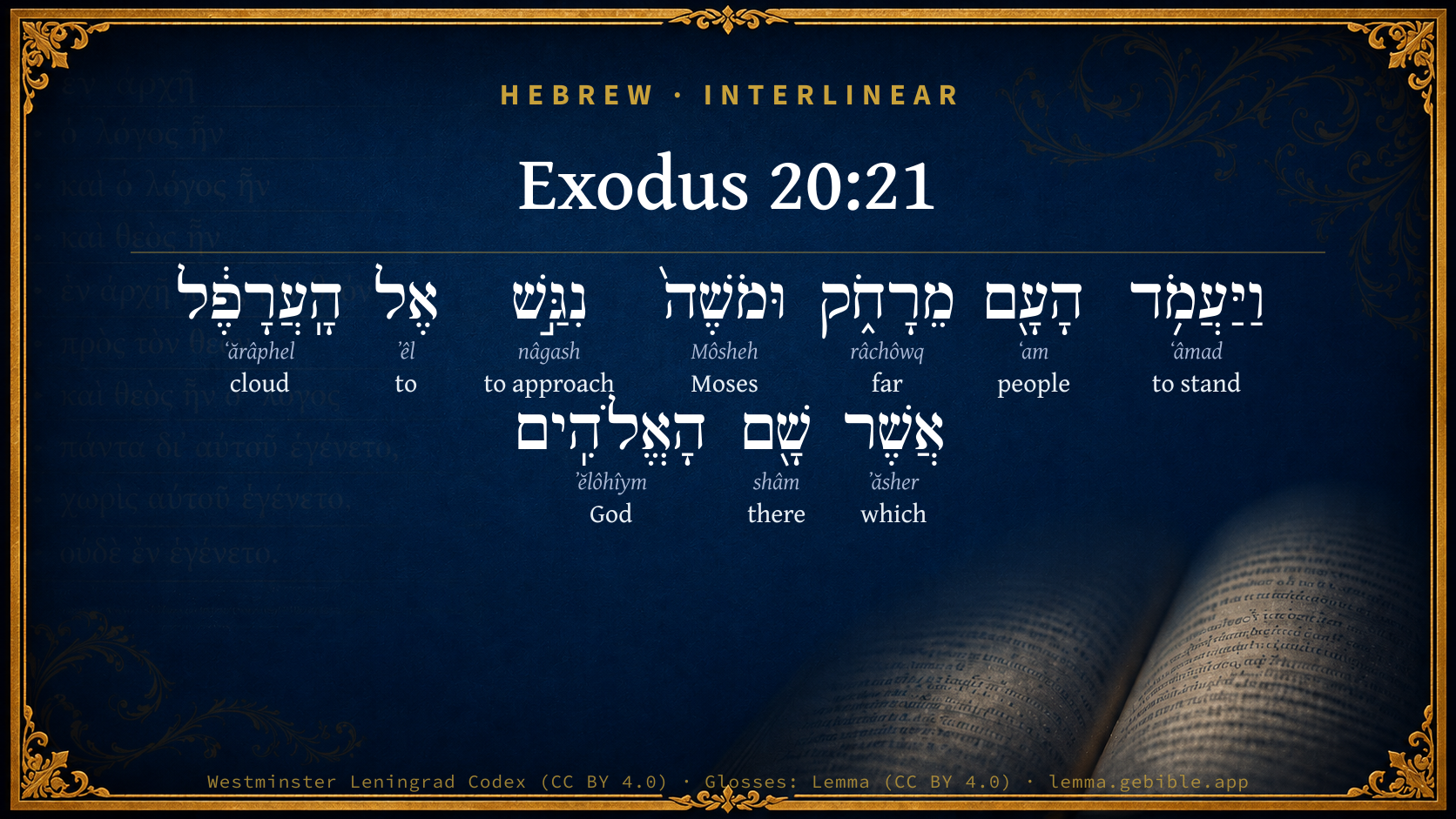
Hebrew (Westminster Leningrad Codex) Exodus 20:21 appears in the Hebrew Old Testament. The text above is from the Westminster Leningrad Codex. Each word links to its Strong’s number, a concise gloss, and parsing drawn from the Open Scriptures Hebrew Bible morphology. Click any word for its full Brown-Driver-Briggs (BDB) entry.
Download image
Cite this verse

Exodus 20:21 (World English Bible). Public Domain. Lemma interlinear Bible study tool, https://lemma.gebible.app/v/exodus/20/21.

Show BibTeX & RIS
BibTeX
RIS
English Translation
The people stayed at a distance, and Moses drew near to the thick darkness where God was.
World English Bible · Public Domain
Highlights
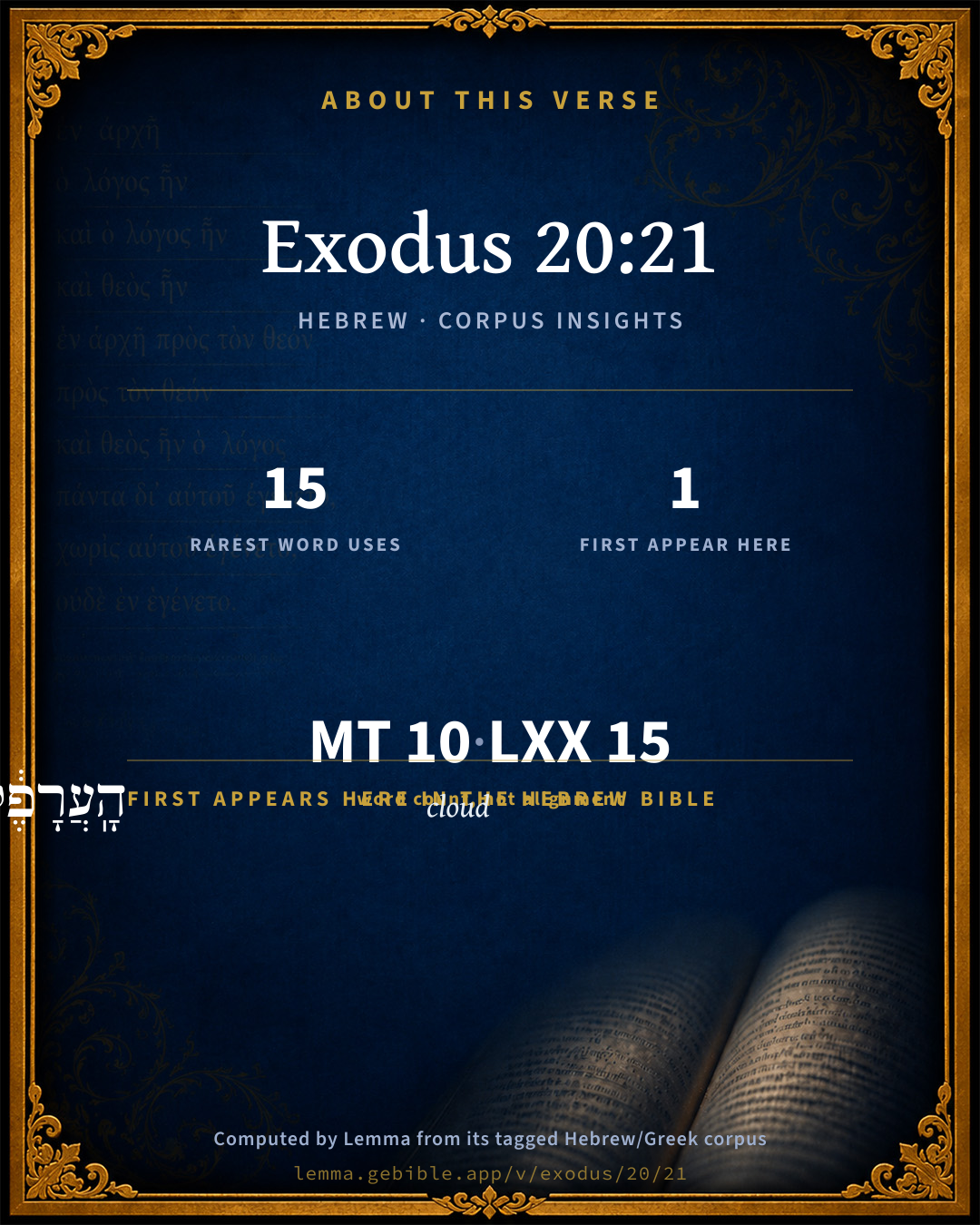
  • 1 first appearance in the Hebrew Bible
Full analysis ↓
Download a study sheet

One document with this verse’s original text, its word-by-word gloss line, the meaning frame, cross-references with their text, attributed commentary, and full source and license credits — printable, and it pastes into notes with its structure intact.

This verse Autodidact and up

Study sheet (.html) Plain text (.txt)

A passage Seminary Student

Up to 50 verses in one chapter. A passage sheet keeps up to 6 commentary sources and 12 cross-references per verse, in the order this page ranks them, and says so on the sheet whenever that leaves anything out. Ask for a single verse and you get the Autodidact verse sheet above.

Everything on this page stays free to read, with no account — the sheet is a download of what is already on screen, not access to it.

Want to remove ads? Support Godless Engineer
Compare translations 3

The same verse in 3 English versions, stacked beneath the original-language interlinear above. Click any original word for its lexicon entry.

Each is an independent rendering of the whole verse — the interlinear is not word-aligned to these translations.

Highlighted words mark where these versions differ — a whole-verse word diff, not a word-by-word alignment.

  • World English Bible Public Domain
    The people stayed at a distance, and Moses drew near to the thick darkness where God was.
  • King James Version Public Domain
    And the people stood afar off, and Moses drew near unto the thick darkness where God was.
  • unfoldingWord Literal Text CC BY-SA 4.0
    So the people stood far off, and Moses approached toward the thick darkness where God was.

unfoldingWord Literal Text — © unfoldingWord, licensed CC BY-SA 4.0. Word-aligned USFM3 via Door43 (git.door43.org/unfoldingWord/en_ult).

Versions to compare (up to 4)

3 of 4 selected

Show all 18 translations

Every available English version of this verse, each an independent rendering of the whole verse.

  • World English Bible Public Domain
    The people stayed at a distance, and Moses drew near to the thick darkness where God was.
  • Berean Standard Bible Public Domain
    And the people stood at a distance as Moses approached the thick darkness where God was.
  • Majority Standard Bible Public Domain
    And the people stood at a distance as Moses approached the thick darkness where God was.
  • King James Version Public Domain
    And the people stood afar off, and Moses drew near unto the thick darkness where God was.
  • American Standard Version (1901) Public Domain
    And the people stood afar off, and Moses drew near unto the thick darkness where God was.
  • Revised Version (1885) Public Domain
    And the people stood afar off, and Moses drew near unto the thick darkness where God was.
  • Geneva Bible (1599) Public Domain
    So the people stoode afarre off, but Moses drew neere vnto the darkenes where God was.
  • Douay-Rheims (1899) Public Domain
    And the people stood afar off. But Moses went to the dark cloud wherein God was.
  • Young's Literal Translation Public Domain
    And the people stand afar off, and Moses hath drawn nigh unto the thick darkness where God `is'.
  • Literal Standard Version CC BY-SA 4.0
    And the people stand far off, and Moses has drawn near to the thick darkness where God [is].
  • Unlocked Literal Bible CC BY-SA 4.0
    So the people stood far off, and Moses approached the thick darkness where God was.
  • unfoldingWord Literal Text CC BY-SA 4.0
    So the people stood far off, and Moses approached toward the thick darkness where God was.
  • Darby Bible Public Domain
    And the people stood afar off, and Moses drew near to the obscurity where God was.
  • World Messianic Bible Public Domain
    The people stayed at a distance, and Moses came near to the thick darkness where God was.
  • Webster's Bible Public Domain
    And the people stood afar off, and Moses drew near to the thick darkness where God was.
  • Free Bible Version CC BY-SA 4.0
    The people stood a long way off as Moses went over to the thick, dark cloud where God was.
  • Bible in Basic English Public Domain
    And the people kept their places far off, but Moses went near to the dark cloud where God was.
  • JPS Tanakh (1917) Public Domain
    (20-18) And the people stood afar off; but Moses drew near unto the thick darkness where God was.

Literal Standard Version (2020), Covenant Press — licensed CC BY-SA 4.0. Text via the HelloAO Bible API (eBible.org). Unlocked Literal Bible (unfoldingWord) — licensed CC BY-SA 4.0. Text via the HelloAO Bible API (eBible.org). unfoldingWord Literal Text — © unfoldingWord, licensed CC BY-SA 4.0. Word-aligned USFM3 via Door43 (git.door43.org/unfoldingWord/en_ult). Free Bible Version, Dr. Jonathan Gallagher — licensed CC BY-SA 4.0. Text via the HelloAO Bible API (eBible.org).

Word by word

More ways to search: Search by grammar → Find every occurrence → Compare this word →

Practice this passage: Drill this verse → Learn its vocabulary →

הָֽעֲרָפֶ֔ל
ʻărâphel
H6205
“the · cloud”
Particle, Definite Article + Noun, Common, Masculine, Singular, Absolute
Part of Speech
Particle + Noun
Type
Common
Gender
Masculine
Number
Singular
State
Absolute
Full BDB Definition

Origin: probably from H6201

TWOT: 1701b

cloud, heavy or dark cloud, darkness, gross darkness, thick darkness
  1. וַיַּעֲמֹ֥ד ʻâmad H5975 “and · to stand” Conjunction + Verb, Qal, Sequential Imperfect, 3rd Person, Masculine, Singular
  2. הָעָ֖ם ʻam H5971 “the · people” Particle, Definite Article + Noun, Common, Masculine, Singular, Absolute
  3. מֵרָחֹ֑ק râchôwq H7350 “from · far” Preposition + Adjective, Adjective, Masculine, Singular, Absolute
  4. וּמֹשֶׁה֙ Môsheh H4872 “and · Moses” Conjunction + Noun, Proper
  5. נִגַּ֣שׁ nâgash H5066 “to approach” Verb, Niphal, Perfect, 3rd Person, Masculine, Singular
  6. אֶל ʼêl H413 “to” Preposition
  7. אֲשֶׁר ʼăsher H834 “which” Particle, Relative
  8. שָׁ֖ם shâm H8033 “there” Adverb
  9. הָאֱלֹהִֽים ʼĕlôhîym H430 “the · God(s)” Particle, Definite Article + Noun, Common, Masculine, Plural, Absolute

About this verse

These counts appear in no published source. They are computed here, from the morphology-tagged text and Lemma’s own curated glosses. What Lemma adds →

10
words
10
distinct lemmas
Pentateuch
section

Notable vocabulary

The rarest word here is הָֽעֲרָפֶ֔ל cloud H6205 — appearing just 15 times in the whole Hebrew Bible.

First appearance in Scripture

This word makes its first canonical appearance in the Hebrew Bible here:

  • הָֽעֲרָפֶ֔ל cloud H6205

Shared distinctive vocabulary

הָֽעֲרָפֶ֔ל cloud H6205 occurs in 15 verses of the Hebrew Bible. Also found in:

Grammatical profile

  • 2 verbs
  • 4 nouns
  • 1 adjective
  • 1 preposition
  • 1 adverb
  • 1 particle

Verb forms

  • וַיַּעֲמֹ֥ד Qal · Sequential Imperfect
  • נִגַּ֣שׁ Niphal · Perfect

Hebrew & Septuagint length

In English translation the verse runs 17 words from the Hebrew and 15 from the Septuagint (LXX English) — closely comparable.

A rough comparison of the two English renderings, which tokenize alike — not a word-level alignment.

Word counts can differ between the Hebrew and the Greek without any difference in meaning — e.g. the Hebrew direct-object marker אֵת has no separate Greek word, and Greek often adds the article ὁ.

In the original languages it is 10 Hebrew tokens and 15 Greek tokens — but the two are counted differently (Hebrew bundles its prefixes and suffixes into one token; the Greek is in lemma form), so that isn’t a like-for-like length.

Cross-references

10

Topical passages linked to Exodus 20:21 in the Treasury of Scripture Knowledge — connected by theme and wording, ordered by reader-vote popularity; previews shown in the World English Bible.

  • 1 Kings 8:12 Then spoke Solomon, Yahweh has said that he would dwell in the thick darkness.
  • Psalms 97:2 Clouds and darkness are around him. Righteousness and justice are the foundation of his throne.
  • Psalms 18:9 He bowed the heavens also, and came down. Thick darkness was under his feet.
  • 1 Timothy 6:16 who alone has immortality, dwelling in unapproachable light; whom no man has seen, nor can see: to whom be honor and eternal power. Amen.
  • 2 Chronicles 6:1 Then spoke Solomon, Yahweh has said that he would dwell in the thick darkness.
  • Exodus 19:16–17 It happened on the third day, when it was morning, that there were thunders and lightnings, and a thick cloud on the mountain, and the sound of an exceedingly loud trumpet; and all the people who were in the camp trembled.
  • Deuteronomy 5:5 (I stood between Yahweh and you at that time, to show you the word of Yahweh: for you were afraid because of the fire, and didn't go up onto the mountain;) saying,
  • Psalms 18:12 At the brightness before him his thick clouds passed, Hailstones and coals of fire.
  • Psalms 104:2 He covers himself with light as with a garment. He stretches out the heavens like a curtain.
  • Deuteronomy 5:22 These words Yahweh spoke to all your assembly on the mountain out of the midst of the fire, of the cloud, and of the thick darkness, with a great voice: and he added no more. He wrote them on two tables of stone, and gave them to me.

Cross-references courtesy of OpenBible.info (CC BY 4.0).

Hebrew and Greek witnesses Masoretic Hebrew ↔ Greek Septuagint

The same verse in the two great witnesses to the Old Testament, shown verse-for-verse.

These are two independent witnesses, not word-aligned to each other, and the Septuagint is shown in lemma (dictionary) form.

Hebrew Exodus 20:21 Masoretic · Westminster Leningrad Codex

וַיַּעֲמֹ֥ד הָעָ֖ם מֵרָחֹ֑ק וּמֹשֶׁה֙ נִגַּ֣שׁ אֶל הָֽעֲרָפֶ֔ל אֲשֶׁר שָׁ֖ם הָאֱלֹהִֽים

The people stayed at a distance, and Moses drew near to the thick darkness where God was.

World English Bible · Public Domain

Greek LXX Exodus 20:21 Septuagint · lemma form

ἵστημι δέ ὁ λαός μακρόθεν μωυσῆς δέ εἰςἔρχομαι εἰς ὁ γνόφος οὗ εἰμί ὁ θεός

And the people stood afar off, and Moses went into the darkness where God was.

LXX2012 (modern English Septuagint) · Public Domain

Hebrew: Westminster Leningrad Codex (CC BY 4.0). Greek: Septuagint (public domain); English from LXX2012 (modern English Septuagint) (Public Domain). How the Septuagint differs from the Hebrew →

Targum (Aramaic paraphrase)

2

The Targum is the ancient Jewish Aramaic paraphrase of the Hebrew Scriptures — an interpretive translation, not the Hebrew text itself. Onkelos (literal) and Pseudo-Jonathan (expansive) render the Torah, and Jonathan the Prophets. Coverage is partial: where no permissively-licensed English translation exists for a verse, only the Aramaic is shown. This is verse-level text, not a word-by-word alignment to the Hebrew.

  1. Targum Onkelos Torah (Genesis–Deuteronomy)
    מַדְבַּח אַדְמְתָא תַּעְבֵּד קֳדָמַי וּתְהֵי דַבָּח עֲלוֹהִי יָת עֲלָוָתָךְ וְיָת נְכַס קוּדְשָׁךְ מִן עָנָךְ וּמִן תּוֹרָךְ בְּכָל אַתְרָא דִי אַשְׁרֵי יָת שְׁכִנְתִּי לְתַמָן אֶשְׁלַח בִּרְכְּתִי לָךְ וֶאֱבָרֵכִנָךְ:

    (no public-domain English translation for this verse)

    Targum Onkelos — Aramaic: “Onkelos Genesis” (public domain); “Onkelos Exodus” (public domain); “Onkelos Leviticus” (public domain); “Onkelos Numbers” (public domain); “Onkelos Deuteronomy” (public domain). English: “Sefaria Community Translation” (CC0 1.0 (public-domain dedication)); “J.W. Etheridge. The Targums of Onkelos and Jonathan Ben Uzziel on the Pentateuch. London: Longmans, Green, 1862” (public domain). Text via Sefaria.

  2. Targum Pseudo-Jonathan Torah (Genesis–Deuteronomy)
    מַדְבַּח אַדְמְתָא תַעֲבֵיד לִשְׁמִי וּתְהֵי דַבַּח עֲלוֹי יַת עַלְוָותָךְ וְיַת נִכְסַת קוּדְשָׁךְ מִן עָנָךְ וּמִן תּוֹרָךְ בְּכָל אַתְרָא דְאַשְׁרֵי שְׁכִינְתִּי וְאַנְתְּ פְּלַח קֳדָמַי תַּמָּן אֲשַׁלַח עֲלָךְ בִּרְכָתִי וְאֵיבָרֵיכִינָךְ

    An altar of earth ye shall make to My Name, and sacrifice upon it thy burnt offerings and thy sanctified oblations from thy sheep and from thy oxen. And in every place where My Shekinah shall dwell, and thou worship before Me, there will I send My blessing upon thee, and will bless thee.

    Targum Pseudo-Jonathan — Aramaic: “Targum Jonathan on Genesis” (public domain); “Targum Jonathan on Exodus” (public domain); “Targum Jonathan on Leviticus” (public domain); “Targum Jonathan on Numbers” (public domain); “Targum Jonathan on Deuteronomy” (public domain). English: “The Targum of Jonathan ben Uzziel, trans. J. W. Etheridge, London, 1862” (public domain). Text via Sefaria.

Commentary

Notes on Exodus 20:21 from classic Christian and Jewish commentators (each source and its license shown beneath its notes). The classic Christian expositions comment on the surrounding passage and are grouped to its opening verse, so a note may address several verses; the Jewish commentaries on the Tanakh (Rashi and others) are per-verse, so they appear only where the commentator wrote on this verse.

Lemma curates 59 commentaries, every one of them public domain or Creative Commons licensed, each selected and text-cleaned for this edition rather than reprinted as found. About our sources →

Trapp's Complete Commentary

John Trapp

Exo 20:21 And the people stood afar off, and Moses drew near unto the thick darkness where God [was].

Ver. 21. Stood afar off.] Yea, God, tendering their infirmity, gave them leave to go home to their tents. {Deu 5:30-31}

John Trapp, A Commentary or Exposition upon All the Books of the Old and New Testament (1647–1656) — public domain. Text from a community e-Sword module.

Joseph Benson's Commentary

Exo 20:21-23. While the people continued to stand afar off — Afraid of God’s wrath, Moses drew near unto the thick darkness — He was made to draw near; so the word is: Of himself he durst not have ventured into the thick darkness: if God had not called him, and encouraged him. And being gone into the thick darkness where God was, God there spoke, in his hearing only, all that follows from hence to the end of chapter 23., which is mostly an exposition of the ten commandments; and he was to transmit it to the people. The laws in these verses relate to God’s worship. Ye have seen that I have talked with you from heaven — Such was his wonderful condescension; ye shall not make gods of silver — This repetition of the second commandment comes in here, because they were more addicted to idolatry than to any other sin.

Joseph Benson's Commentary on the Old and New Testaments (1811–1818) — public domain. Text from a community e-Sword module.

The Cambridge Bible for Schools and Colleges

gen. ed. J. J. S. Perowne

21. thick darkness] ‘ǎrâphel, the word, mostly poetical (Psa_18:9, 1Ki_8:12), used in Deu_4:11; Deu_5:22 [Heb. 19].

With the preceding narrative, especially the parts that belong to E Exo_9:16-19, Exo_20:1-21), comp. the rhetorically amplified descriptions

The Cambridge Bible for Schools and Colleges (gen. ed. J. J. S. Perowne; Cambridge University Press, 1878–1918) — public domain. Text from a community e-Sword module.

John Gill's Exposition

Ye shall not make with me,.... This is a proposition of itself, as appears by the accent Athnach placed at the end of it, which divides it from the following, and therefore "gods of silver" belong to the next clause or proposition; something seems to be wanting to complete the sense, which the Talmudists (s) and Jarchi after them supply thus,"ye shall not make with me as the likeness of my ministers which minister before me on high;''as the seraphim, ministering angels, &c. as the sun, moon, and stars; and so the Targum of Jonathan paraphrases the words,"ye shall not make, to worship, the likeness of the sun, and of the moon, and of the stars, and of the planets, and of the angels that minister before me:''or rather, "ye shall not make any likeness with me", or any likeness of me; and so the words stand connected with the preceding verse, that since they only saw the cloud and fire, and perceived the voice of God from thence, but saw no likeness or similitude of him, therefore they were not to make any under a pretence of worshipping him with it, or in it, or by it; and so Ben Melech adds, by way of explanation, although your intention is to my service: "gods of silver and gods of gold ye shall not make unto you"; for so this clause is to be read: that is, images made of gold and silver, images of angels, or of the host of heaven, the sun, moon, and stars, or of great men on earth, as kings or heroes, or of any creature in heaven, earth, or sea; these they were not to make unto them, in order to serve and worship them, or to worship God in them, or by them, or with them: the first images for idolatrous worship were made of gold and silver, because, being rich and glittering, they more affected the minds of the people, as the golden calf a little after made, and perhaps the gods of Egypt were such, at least some of them; wherefore this law against idolatry is repeated, because the people of Israel were prone unto it, and many of them had been ensnared with it in Egypt, upon every occasion were ready to relapse into it: or images made of meaner materials, as brass, wood, and stone, though not mentioned, are equally forbidden; for if those of richer materials were not to be made and worshipped, much less those of baser ones.

(s) T. Bab. Roshhashanah, fol. 24. 1. 2. Avoda Zara, fol, 43. 1. 2.

John Gill's Exposition of the Whole Bible (1746–1763) — public domain (CC PDM 1.0). Text via the HelloAO Bible API.

Whedon's Commentary on the Bible

Daniel D. Whedon

21. The people stood afar off — As stated in Exo_20:18. After Moses had gone up unto the thick darkness where God was, the people returned to their tents as they had been instructed. Comp. Deu_5:30. It would seem from Exo_19:24, that when Moses at this time drew near unto the divine presence, Aaron accompanied him. In the profound and various symbolism by which God revealed himself through the Mosaic legislation, it was fitting that his own divine person should be hidden in thick darkness, (ערפל,) and no manner of likeness or similitude of Deity be exhibited to any eye. So, later, in the construction of the tabernacle, the most holy place, the immediate throne-chamber of Jehovah, was made in the form of a perfect cube, and veiled in darkness. Comp. Exo_25:22; Lev_16:2; 1Ki_8:12. Jehovah thus signifies that his power and wisdom and ways are wrapped in mystery, and cannot be searched by mortal eyes.

Daniel D. Whedon (gen. ed.), Commentary on the Old and New Testaments (1874–1909) — public domain. Text from a community e-Sword module.

The Pulpit Commentary

The people stood afar off. They retired from the base of Sinai to their tents, where they "stood," probably in their tent doors. And Moses drew near unto the thick darkness. As the people drew back, Moses drew near. The display which drove them off, attracted him. He did not even fear the "thick darkness a thing front which human nature commonly shrinks. Where God was, he would be.

The Pulpit Commentary (1880–1919), ed. H.D.M. Spence-Jones & Joseph S. Exell — public domain. Text from a community e-Sword module.

John Wesley's Explanatory Notes

While the people continued to stand afar off - Afraid of God's wrath, Moses drew near unto the thick darkness; he was made to draw near, so the word is: Moses of himself durst not have ventured into the thick darkness if God had not called him, and encouraged him, and, as some of the Rabbins suppose, sent an angel to take him by the hand, and lead him up.

John Wesley, Explanatory Notes Upon the Whole Bible (1754–1765) — public domain. Text via the GEBible commentary corpus.

Keil & Delitzsch

C. F. Keil & F. Delitzsch

"So the people stood afar off" (as in Exo 20:18), not "went far away," although, according to Deu 5:30, Moses was directed by God to tell the people to return to their tents. This is passed over here, and it is merely observed, for the purpose of closing the first act in the giving the law, and preparing the way for the second, that the people remained afar off, whereas Moses (and Aaron, cf. Exo 19:24) drew near to the darkness where God was, to receive the further commands of the Lord.

Keil & Delitzsch — Biblical Commentary on the Old Testament (1861–1891) — public domain (CC PDM 1.0). Text via the HelloAO Bible API. (Old Testament only.)

Rashi

Rabbi Shlomo Yitzchaki (Rashi)

מזבח אדמה AN ALTAR OF EARTH [SHALT THOU MAKE] — i. e. an altar attached to the earth, meaning, that they should not build an altar upon columnes or upon a base but it must rest upon the actual ground. Another explanation is, that one should fill the hollow interior of the copper altar (Exodus 27:8) with earth at the time when they encamp, and then erect it for the purpose of sacrifice (Mekhilta).

תעשה לי THOU SHALT MAKE FOR ME — this implies that from its very beginning it shall be made for My Name (i. e. for the service of Me).

וזבחת עליו AND THOU SHALT SACRIFICE (slaughter) עליו — i. e. near it, in the same sense as, (Numbers 2:20) “and by him (ועליו) the tribe of Manasseh”. Or perhaps this is not the meaning, but it means “[thou shalt slaughter] upon it”, in its literal sense? This cannot be so, because it states, (Deuteronomy 12:27) “[And thou shalt offer thy burnt offerings] as regards the flesh and the blood upon the altar of the Lord thy God”, but the slaughtering shall not be on the top of the altar (Mekhilta).

את עלתיך ואת שלמיך THY BURNT OFFERINGS AND THY FEAST OFFERINGS which are from (belong to) thy flocks and thy herds. [את צאנך ואת בקרך are thus a further explanation of the words את עלתיך ואת שלמיך‎].

בכל המקום אשר אזכיר את שמי IN ALL PLACES WHERE I MENTION MY NAME — This means: where I will give you permission to mention My Proper Name, there אבא אליך וברכתיך I WILL COME TO THEE AND I WILL BLESS THEE — I will make My Shechina rest upon thee. From this you may learn that He did not give any permission to mention (pronounce) His Proper Name except in the place where the Shechina would come — and this is the Chosen House (another term for the Temple at Jerusalem). He gave permission to the priests to pronounce His Proper Name there whilst lifting up their hands to bless the people (cf. Mekhilta; Sotah 38a; and Rashi on Numbers 6:27).

Rashi on the Tanakh — English translations: “The Judaica Press complete Tanach with Rashi, translated by A. J. Rosenberg” (CC BY 4.0); “Pentateuch with Rashi's commentary by M. Rosenbaum and A.M. Silbermann, 1929-1934” (public domain); “The Metsudah Tanach series, Lakewood, N.J” (CC BY 4.0); and “The Book of Joshua, Metsudah Publications, 1997” (CC BY 4.0). Text via Sefaria.

Ramban (Nachmanides)

Rabbi Moshe ben Nachman (Ramban / Nachmanides)

AN ALTAR OF EARTH THOU SHALT MAKE UNTO ME. Rabbi Abraham ibn Ezra explained that He is saying: “Ye shall not make with Me gods of silver, or gods of gold to receive power from heavenly creatures through them, that they be intermediaries between Me and you, for in every place where I cause My Name to be mentioned I — I in My Glory — will come unto thee and bless thee. You have no need at all for an intermediary.” And according to the opinion of the Rabbis concerning [the verses here, i.e., that they speak of] the altars that were made in the Tabernacle and in the Sanctuary, He mentioned the commandment of the altars of earth and of stones in order to say that they also make the altars for G-d alone and that there they shall sacrifice the burnt-offerings and the peace-offerings, and not to the demons in the open field. In every place where they will mention His Name, He will come upon them in His Glory to make His Divine Presence dwell among them and to bless them.

Ramban (Nachmanides) on the Tanakh — English translation: “Commentary on the Torah by Ramban (Nachmanides). Translated and annotated by Charles B. Chavel. New York, Shilo Pub. House, 1971-1976” (CC BY 4.0). Text via Sefaria.

Lesson kit

Teaching starters — assembled from the data on this page, not authored interpretation. Every prompt links to the verse data it draws on. Edit before teaching.

Exodus, in the Pentateuch, opens this verse with 10 words (10 distinct Hebrew lemmas). Its most distinctive word is ʻărâphel (“cloud”). A historical commentator’s framing appears above. Read the whole chapter for the surrounding context.

Discussion questions

  1. What does “cloud” (ʻărâphel) contribute to the verse as a whole?
  2. This is the first place “cloud” appears in Scripture (first appears here). What does its debut here establish?
  3. How does Deuteronomy 4:11, which shares the word «cloud», read alongside this verse?
  4. These translations render this verse differently. What is at stake in choosing one wording over another?
  5. «וַיַּעֲמֹ֥ד» is a Qal Sequential Imperfect verb. How does that grammatical form shape the action described?
  6. Compare how Trapp's Complete Commentary and Joseph Benson's Commentary read this verse. Where do they agree or differ?

Things to notice

Reading settings

Reading text

Shown beneath each verse's original-language words.

Old Testament
Old Testament edition

Read the OT as the Masoretic Hebrew (MT) or the Greek Septuagint (LXX).

English shown for the Greek Septuagint (in the Hebrew ↔ Greek comparison).

Comparing translations? Open the Compare panel on any verse page to stack up to four side by side.