1 Samuel 30:9

Hebrew (Westminster Leningrad Codex) 1 Samuel 30:9 appears in the Hebrew Old Testament. The text above is from the Westminster Leningrad Codex. Each word links to its Strong’s number, a concise gloss, and parsing drawn from the Open Scriptures Hebrew Bible morphology. Click any word for its full Brown-Driver-Briggs (BDB) entry.
Download image
Cite this verse

1 Samuel 30:9 (World English Bible). Public Domain. Lemma interlinear Bible study tool, https://lemma.gebible.app/v/1-samuel/30/9.

Show BibTeX & RIS
BibTeX
RIS
English Translation
So David went, he and the six hundred men who were with him, and came to the brook Besor, where those who were left behind stayed.
World English Bible · Public Domain
Highlights
  • 1 first appearance in the Hebrew Bible
Full analysis ↓
Download a study sheet

One document with this verse’s original text, its word-by-word gloss line, the meaning frame, cross-references with their text, attributed commentary, and full source and license credits — printable, and it pastes into notes with its structure intact.

This verse Autodidact and up

Study sheet (.html) Plain text (.txt)

A passage Seminary Student

Up to 50 verses in one chapter. A passage sheet keeps up to 6 commentary sources and 12 cross-references per verse, in the order this page ranks them, and says so on the sheet whenever that leaves anything out. Ask for a single verse and you get the Autodidact verse sheet above.

Everything on this page stays free to read, with no account — the sheet is a download of what is already on screen, not access to it.

Want to remove ads? Support Godless Engineer
Compare translations 3

The same verse in 3 English versions, stacked beneath the original-language interlinear above. Click any original word for its lexicon entry.

Each is an independent rendering of the whole verse — the interlinear is not word-aligned to these translations.

Highlighted words mark where these versions differ — a whole-verse word diff, not a word-by-word alignment.

  • World English Bible Public Domain
    So David went, he and the six hundred men who were with him, and came to the brook Besor, where those who were left behind stayed.
  • King James Version Public Domain
    So David went, he and the six hundred men that were with him, and came to the brook Besor, where those that were left behind stayed.
  • unfoldingWord Literal Text CC BY-SA 4.0
    So David went, he and the 600 men who with him, and they came to the wadi of Besor. And the ones left behind stayed.

unfoldingWord Literal Text — © unfoldingWord, licensed CC BY-SA 4.0. Word-aligned USFM3 via Door43 (git.door43.org/unfoldingWord/en_ult).

Versions to compare (up to 4)

3 of 4 selected

Show all 18 translations

Every available English version of this verse, each an independent rendering of the whole verse.

  • World English Bible Public Domain
    So David went, he and the six hundred men who were with him, and came to the brook Besor, where those who were left behind stayed.
  • Berean Standard Bible Public Domain
    So David and his six hundred men went to the Brook of Besor, where some stayed behind
  • Majority Standard Bible Public Domain
    So David and his six hundred men went to the Brook of Besor, where some stayed behind
  • King James Version Public Domain
    So David went, he and the six hundred men that were with him, and came to the brook Besor, where those that were left behind stayed.
  • American Standard Version (1901) Public Domain
    So David went, he and the six hundred men that were with him, and came to the brook Besor, where those that were left behind stayed.
  • Revised Version (1885) Public Domain
    So David went, he and the six hundred men that were with him, and came to the brook Besor, where those that were left behind stayed.
  • Geneva Bible (1599) Public Domain
    So Dauid and the sixe hundreth men that were with him, went, and came to the riuer Besor, where a part of them abode:
  • Douay-Rheims (1899) Public Domain
    So David went, he and the six hundred men that were with him, and they came to the torrent Besor: and some being weary stayed there.
  • Young's Literal Translation Public Domain
    And David goeth on, he and six hundred men who `are' with him, and they come in unto the brook of Besor, and those left have stood still,
  • Literal Standard Version CC BY-SA 4.0
    And David goes on, he and six hundred men who [are] with him, and they come to the Brook of Besor, and those left have stood still,
  • Unlocked Literal Bible CC BY-SA 4.0
    So David went, he and the six hundred men who were with him; they came to the brook Besor, where those who were left behind stayed.
  • unfoldingWord Literal Text CC BY-SA 4.0
    So David went, he and the 600 men who with him, and they came to the wadi of Besor. And the ones left behind stayed.
  • Darby Bible Public Domain
    So David went, he and the six hundred men that were with him, and they came to the torrent Besor; and those that were left stayed behind.
  • World Messianic Bible Public Domain
    So David went, he and the six hundred men who were with him, and came to the brook Besor, where those who were left behind stayed.
  • Webster's Bible Public Domain
    So David went, he and the six hundred men that were with him, and came to the brook Besor, where those that were left behind remained.
  • Free Bible Version CC BY-SA 4.0
    David and six hundred of his men set off for the Besor Valley.
  • Bible in Basic English Public Domain
    So David went, and his six hundred men went with him, and they came to the stream Besor.
  • JPS Tanakh (1917) Public Domain
    So David went, he and the six hundred men that were with him, and came to the brook Besor, where those that were left behind stayed.

Literal Standard Version (2020), Covenant Press — licensed CC BY-SA 4.0. Text via the HelloAO Bible API (eBible.org). Unlocked Literal Bible (unfoldingWord) — licensed CC BY-SA 4.0. Text via the HelloAO Bible API (eBible.org). unfoldingWord Literal Text — © unfoldingWord, licensed CC BY-SA 4.0. Word-aligned USFM3 via Door43 (git.door43.org/unfoldingWord/en_ult). Free Bible Version, Dr. Jonathan Gallagher — licensed CC BY-SA 4.0. Text via the HelloAO Bible API (eBible.org).

Word by word

More ways to search: Search by grammar → Find every occurrence → Compare this word →

Practice this passage: Drill this verse → Learn its vocabulary →

הַבְּשׂ֑וֹר
Bᵉsôwr
H1308
“the · Besor”
Particle, Definite Article + Noun, Proper
Part of Speech
Particle + Noun
Type
Proper
Full BDB Definition

Origin: from H1319

TWOT: None

Besor = "cheerful" - a stream, torrent-bed, or wadi in extreme south of Judah in Philistia; empties into the Mediterranean Sea
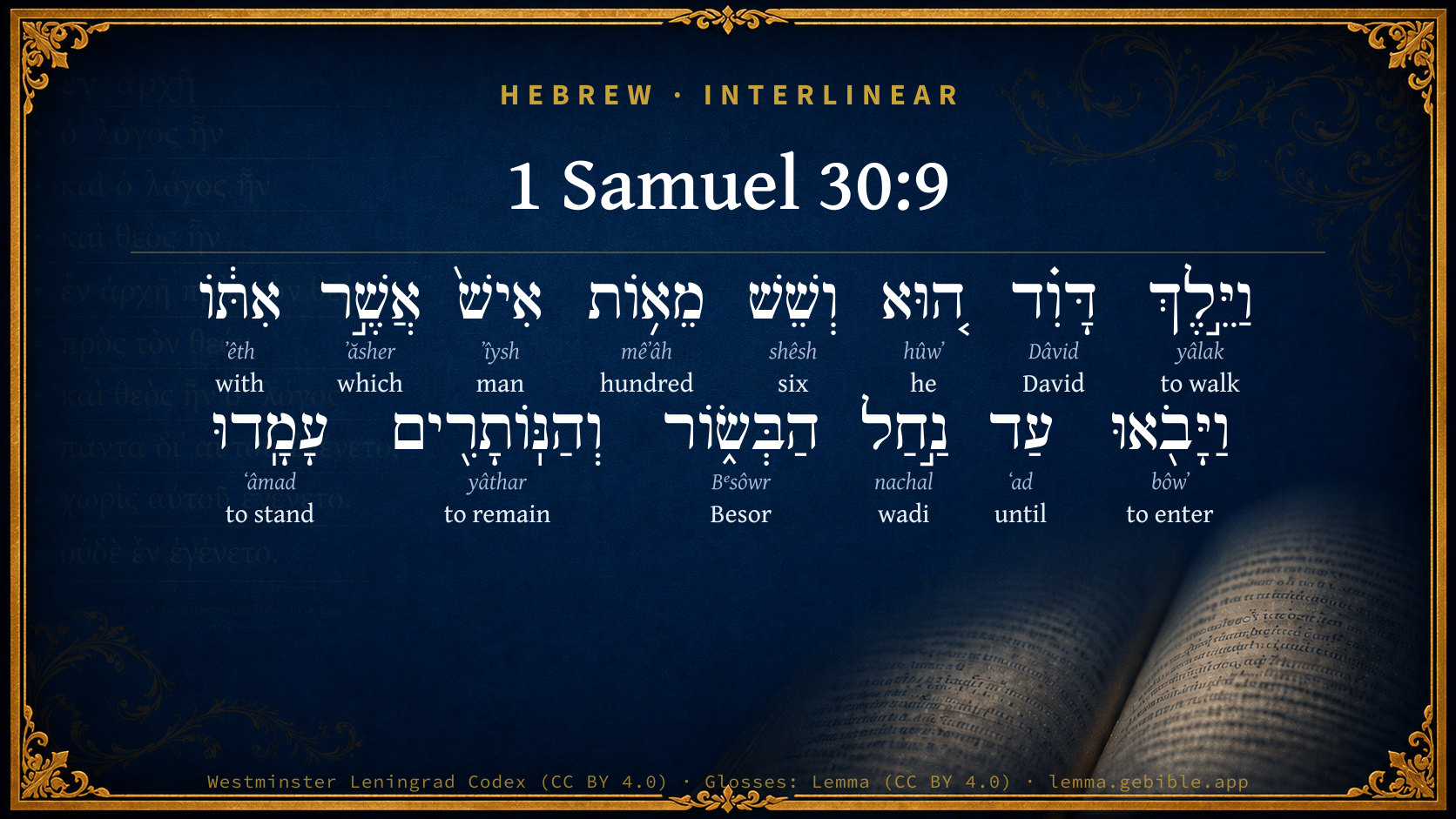
  1. וַיֵּ֣לֶךְ yâlak H3212 “and · to walk” Conjunction + Verb, Qal, Sequential Imperfect, 3rd Person, Masculine, Singular
  2. דָּוִ֗ד Dâvid H1732 “David” Noun, Proper
  3. ה֚וּא hûwʼ H1931 “he” Pronoun, Personal, 3rd Person, Masculine, Singular
  4. וְשֵׁשׁ shêsh H8337 “and · six” Conjunction + Adjective, Cardinal number, Feminine, Singular, Absolute
  5. מֵא֥וֹת mêʼâh H3967 “hundred” Adjective, Cardinal number, Both, Plural, Absolute
  6. אִישׁ֙ ʼîysh H376 “man” Noun, Common, Masculine, Singular, Absolute
  7. אֲשֶׁ֣ר ʼăsher H834 “which” Particle, Relative
  8. אִתּ֔וֹ ʼêth H854 “with · him” Preposition + Suffix, Personal, 3rd Person, Masculine, Singular
  9. וַיָּבֹ֖אוּ bôwʼ H935 “and · to enter” Conjunction + Verb, Qal, Sequential Imperfect, 3rd Person, Masculine, Plural
  10. עַד ʻad H5704 “until” Preposition
  11. נַ֣חַל nachal H5158 “wadi of” Noun, Common, Masculine, Singular, Construct
  12. וְהַנּֽוֹתָרִ֖ים yâthar H3498 “and · the · remaining” Conjunction + Particle, Definite Article + Verb, Niphal, Participle Active, Masculine, Plural, Absolute
  13. עָמָֽדוּ ʻâmad H5975 “to stand” Verb, Qal, Perfect, 3rd Person, Common, Plural

About this verse

These counts appear in no published source. They are computed here, from the morphology-tagged text and Lemma’s own curated glosses. What Lemma adds →

14
words
14
distinct lemmas
Historical
section

Notable vocabulary

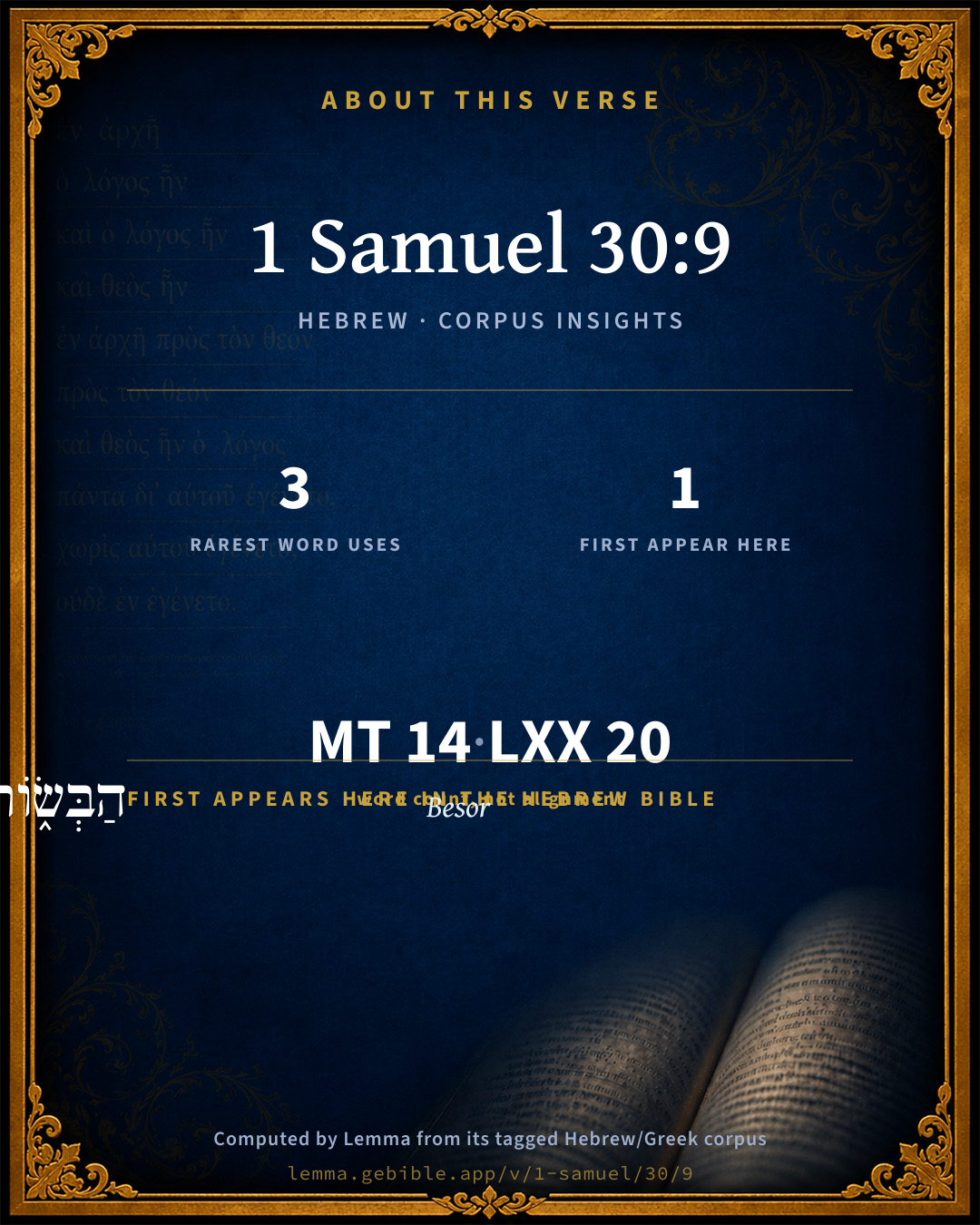
The rarest word here is הַבְּשׂ֑וֹר Besor H1308 — appearing just 3 times in the whole Hebrew Bible.

First appearance in Scripture

This word makes its first canonical appearance in the Hebrew Bible here:

  • הַבְּשׂ֑וֹר Besor H1308

Shared distinctive vocabulary

הַבְּשׂ֑וֹר Besor H1308 occurs in 3 verses of the Hebrew Bible. Also found in:

Grammatical profile

  • 4 verbs
  • 4 nouns
  • 2 adjectives
  • 1 pronoun
  • 2 prepositions
  • 1 particle

Verb forms

  • וַיֵּ֣לֶךְ Qal · Sequential Imperfect
  • וַיָּבֹ֖אוּ Qal · Sequential Imperfect
  • וְהַנּֽוֹתָרִ֖ים Niphal · Participle Active
  • עָמָֽדוּ Qal · Perfect

Hebrew & Septuagint length

In English translation the verse runs 26 words from the Hebrew and 25 from the Septuagint (LXX English) — closely comparable.

A rough comparison of the two English renderings, which tokenize alike — not a word-level alignment.

Word counts can differ between the Hebrew and the Greek without any difference in meaning — e.g. the Hebrew direct-object marker אֵת has no separate Greek word, and Greek often adds the article ὁ.

In the original languages it is 14 Hebrew tokens and 20 Greek tokens — but the two are counted differently (Hebrew bundles its prefixes and suffixes into one token; the Greek is in lemma form), so that isn’t a like-for-like length.

Cross-references

1

Topical passages linked to 1 Samuel 30:9 in the Treasury of Scripture Knowledge — connected by theme and wording, ordered by reader-vote popularity; previews shown in the World English Bible.

  • 1 Samuel 27:2 David arose, and passed over, he and the six hundred men who were with him, to Achish the son of Maoch, king of Gath.

Cross-references courtesy of OpenBible.info (CC BY 4.0).

Hebrew and Greek witnesses Masoretic Hebrew ↔ Greek Septuagint

The same verse in the two great witnesses to the Old Testament, shown verse-for-verse.

These are two independent witnesses, not word-aligned to each other, and the Septuagint is shown in lemma (dictionary) form.

Hebrew 1 Samuel 30:9 Masoretic · Westminster Leningrad Codex

וַיֵּ֣לֶךְ דָּוִ֗ד ה֚וּא וְשֵׁשׁ מֵא֥וֹת אִישׁ֙ אֲשֶׁ֣ר אִתּ֔וֹ וַיָּבֹ֖אוּ עַד נַ֣חַל הַבְּשׂ֑וֹר וְהַנּֽוֹתָרִ֖ים עָמָֽדוּ

So David went, he and the six hundred men who were with him, and came to the brook Besor, where those who were left behind stayed.

World English Bible · Public Domain

Greek LXX 1 Samuel 30:9 Septuagint · lemma form

καί πορεύομαι δαυίδ αὐτός καί ὁ ἑξακόσιοι ἀνήρ μετά αὐτός καί ἔρχομαι ἕως ὁ χειμάρρους βοσορ καί ὁ περισσός ἵστημι

So David went, he and the six hundred men with him, an they come as far as the brook Bosor, and the superfluous ones stopped.

LXX2012 (modern English Septuagint) · Public Domain

Hebrew: Westminster Leningrad Codex (CC BY 4.0). Greek: Septuagint (public domain); English from LXX2012 (modern English Septuagint) (Public Domain). How the Septuagint differs from the Hebrew →

Targum (Aramaic paraphrase)

1

The Targum is the ancient Jewish Aramaic paraphrase of the Hebrew Scriptures — an interpretive translation, not the Hebrew text itself. Onkelos (literal) and Pseudo-Jonathan (expansive) render the Torah, and Jonathan the Prophets. Coverage is partial: where no permissively-licensed English translation exists for a verse, only the Aramaic is shown. This is verse-level text, not a word-by-word alignment to the Hebrew.

  1. Targum Jonathan Prophets (Joshua–Malachi)
    וַאֲזַל דָוִד הוּא וְשִׁית מְאָה גַבְרָא דִי עִמֵיהּ וַאֲתוֹ עַד נַחֲלָא דִבְשׂוֹר וּמִקְצַתְהוֹן אִשְׁתָּאֲרוּ:

    (no public-domain English translation for this verse)

    Targum Jonathan — Aramaic: “Mikraot Gedolot” (public domain). English: “Sefaria Community Translation” (CC0 1.0 (public-domain dedication)); “London "Chaldee Paraphrase," 1871” (public domain). Text via Sefaria.

Commentary

Notes on 1 Samuel 30:9 from classic Christian and Jewish commentators (each source and its license shown beneath its notes). The classic Christian expositions comment on the surrounding passage and are grouped to its opening verse, so a note may address several verses; the Jewish commentaries on the Tanakh (Rashi and others) are per-verse, so they appear only where the commentator wrote on this verse.

Lemma curates 59 commentaries, every one of them public domain or Creative Commons licensed, each selected and text-cleaned for this edition rather than reprinted as found. About our sources →

Trapp's Complete Commentary

John Trapp

1Sa 30:9 So David went, he and the six hundred men that [were] with him, and came to the brook Besor, where those that were left behind stayed.

Ver. 9. He and the six hundred men.] Mighty men, and chafed in their minds, as a bear robbed of her whelps in the field, {2Sa 17:8} of redoubted and redoubled resolution.

John Trapp, A Commentary or Exposition upon All the Books of the Old and New Testament (1647–1656) — public domain. Text from a community e-Sword module.

Joseph Benson's Commentary

1Sa 30:9-10. Where those that were left behind stayed — Those that were left to look after the stuff, 1Sa 30:24; who were so tired, that they were not able to march any further. David pursued, he and four hundred men — A small number for such an attempt; but David was strong in faith, giving God the glory of his power and faithfulness.

Joseph Benson's Commentary on the Old and New Testaments (1811–1818) — public domain. Text from a community e-Sword module.

Tyndale Open Study Notes

Tyndale Open Resources

30:9 Besor was a large brook in Philistine territory that emptied into the Mediterranean southwest of Gaza.

Tyndale Open Study Notes — © Tyndale Open Resources, licensed CC BY-SA 4.0. Text via the HelloAO Bible API.

Jamieson, Fausset & Brown

Robert Jamieson, A. R. Fausset & David Brown

came to the brook Besor--now Wady Gaza, a winter torrent, a little to the south of Gaza. The bank of a stream naturally offered a convenient rest to the soldiers, who, through fatigue, were unable to continue the pursuit.

Jamieson, Fausset & Brown — Commentary Critical and Explanatory on the Whole Bible (1871) — public domain (CC PDM 1.0). Text via the HelloAO Bible API.

Adam Clarke's Commentary

Verse 9. The brook Besor] This had its source in the mountain of Idumea, and fell into the Mediterranean Sea beyond Gaza. Some suppose it to have been the same with the river of the wilderness, or the river of Egypt. The sense of this and the following verse is, that when they came to the brook Besor, there were found two hundred out of his six hundred men so spent with fatigue that they could proceed no farther. The baggage or stuff was left there, 1Sa 30:24, and they were appointed to guard it.

Adam Clarke's Commentary on the Bible (1810–1826) — public domain. Text from a community e-Sword/MySword module.

Ellicott's Commentary for English Readers

(9) So David went.—Immediately on receiving the answer of the Urim, David started in rapid pursuit. The “six hundred” by no means represented his present force; but these were probably the old band of veteran soldiers, whose speed and endurance he could depend upon—men tried, no doubt, by many a weary night march, by many a rough, wild piece of work. A large contingent even of these veterans could not stand the forced march of their leader on this occasion.

In the words “for two hundred abode behind,” the narrator anticipated what is told in 1Sa_30:10. It is a proleptical expression, arising from the vivacious description of David’s rapid march with four hundred men (Lange). The Vulg. paraphrases, or rather seeks to amend the text here: “and certain tired ones stayed.” The Syriac changes the text into “David left two hundred men;” these men who had fallen out of the rapid march were gathered together, and kept the baggage and everything that could be left behind at the encampment at the brook Besor. It is to be supposed that owing to the hurried departure, but scanty provision for the forced march was made, hence the falling out through weariness in the course of the rapid advance. The brook Besor cannot be identified with certainty; and Raumer (Palestine) supposes it to be the Wady Shariah, which falls into the sea below Askelon.

A Bible Commentary for English Readers, edited by Charles John Ellicott (1878–1897) — public domain. Text from a community e-Sword module.

The Cambridge Bible for Schools and Colleges

gen. ed. J. J. S. Perowne

9. the six hundred men] For a rapid pursuit a small force of picked men was most suitable. Cp. 1Sa_27:2. No doubt by this time he had a much larger force at his command.

the brook Besor] The Heb. word is nachal, which means a ravine, or torrent-bed, with a stream at the bottom. The brook Besor is mentioned here only, and has not been identified with certainty. Perhaps it was the Wady es Sherîah, which runs down to the sea a few miles south of Gaza.

The Cambridge Bible for Schools and Colleges (gen. ed. J. J. S. Perowne; Cambridge University Press, 1878–1918) — public domain. Text from a community e-Sword module.

John Gill's Exposition

So David went, he and the six hundred men that were with him,.... Encouraged by the oracle of the Lord:

and came to the brook Besor; which Adrichomius (q) places in the tribe of Simeon; it is thought to be near Gaza. Aristaeus (r) speaks of brooks that flowed by Gaza and Ashdod, places that belonged to the Philistines; some take it to be the river of the wilderness in Amos; see Gill on Amo 6:14,

where those that were left behind stayed: or a part of them were left, as the Targum; all the six hundred came to this brook, but two hundred of them were left here, Sa1 30:10 shows, and stayed here till the rest returned; for this is not to be understood of any that were left behind at Ziklag, for all came from thence to this brook.

(q) Theatrum Terrae Sanct. p. 133. (r) Hist. 72. Interpret. p. 41.

John Gill's Exposition of the Whole Bible (1746–1763) — public domain (CC PDM 1.0). Text via the HelloAO Bible API.

Albert Barnes' Notes on the Bible

Besor - Thought to be the stream of the Wady Sheriah which enters the sea a little south of Gaza.

Albert Barnes' Notes on the Bible (1834–1885) — public domain. Text from a community e-Sword/MySword module.

Haydock's Catholic Bible Commentary

Besor is formed by the water falling from the mountains of Idumea, and discharges itself into the Mediterranean, below Gaza. (Calmet) --- Some take it to be the torrent of the desert, or the river of Egypt. Adrichomius makes it run from the mountains of Juda, so as to form the southern boundary of the tribe of Simeon. (Haydock)

George Leo Haydock (1774–1849), Haydock's Catholic Family Bible and Commentary, 1859 edition — public domain. Excludes Psalms (Douay-Rheims chapter numbering differs from Protestant) and Deuterocanonical books (Catholic canon only).

Whedon's Commentary on the Bible

Daniel D. Whedon

9. The brook Besor — Some have supposed this might be the Wady Sheriah, a few miles to the south of Gaza; but it is more likely to have been far south of this, for Ziklag must have been situated far south of Gaza. Compare 1Sa_27:6, note.

Those that were left behind stayed — As further explained in 1Sa_30:10; 1Sa_30:21, two hundred became so faint and weary that they were unable to proceed, and so they stationed themselves on the banks of this wady, and there remained till David and the four hundred returned.

Daniel D. Whedon (gen. ed.), Commentary on the Old and New Testaments (1874–1909) — public domain. Text from a community e-Sword module.

The Pulpit Commentary

Vers. 9, 10. Having obtained this favourable answer, David starts in pursuit with his old band of 600 men. So rapid was his march that one third of these dropped out of the ranks, so that the newcomers from Manasseh would have been useless, nor had they lost wives or children. The brook (or rather "torrent") Besor practically remains unidentified, as the site of Ziklag is unknown; but possibly it is the Wady-es-Sheriah, which runs into the sea a little to the south of Gaza. As there was water here, those that were left behind stayed. Hebrew, "the stragglers stayed." It seems also to have been wide enough to cause some difficulty in crossing, as it is said that these 200 were too faint, or tired, to go over the torrent Besor. From ver. 24 we find that David also left with them as much as possible of his baggage. Stragglers had no doubt been falling out for some time, but would here be rallied, and obtain rest and refreshment.

The Pulpit Commentary (1880–1919), ed. H.D.M. Spence-Jones & Joseph S. Exell — public domain. Text from a community e-Sword module.

unfoldingWord translationNotes

Door43 World Missions Community

six hundred men

600 men (See: Numbers)

brook

small stream

kept pursuing

"kept chasing them, trying to catch them"

four hundred men

400 men (See: Numbers)

two hundred

200 men (See: Numbers)

who were so weak

They were tired from their own raids and now in pursuit of the Amalekites. They no longer had the strength to continue.

translationWords

David

unfoldingWord translationNotes — © Distant Shores Media and the Door43 World Missions Community, licensed CC BY-SA 4.0. Source: git.door43.org/Door43/en_tn.

Rashi

Rabbi Shlomo Yitzchaki (Rashi)

And they came to the Nachal Besor. [The] six hundred men.

Some of them remained behind. When they reached the Nachal Besor, there were among them some who were faint, and some of those remained there.

Rashi on the Tanakh — English translations: “The Judaica Press complete Tanach with Rashi, translated by A. J. Rosenberg” (CC BY 4.0); “Pentateuch with Rashi's commentary by M. Rosenbaum and A.M. Silbermann, 1929-1934” (public domain); “The Metsudah Tanach series, Lakewood, N.J” (CC BY 4.0); and “The Book of Joshua, Metsudah Publications, 1997” (CC BY 4.0). Text via Sefaria.

Lesson kit

Teaching starters — assembled from the data on this page, not authored interpretation. Every prompt links to the verse data it draws on. Edit before teaching.

1 Samuel, in the Historical, opens this verse with 14 words (14 distinct Hebrew lemmas). Its most distinctive word is Bᵉsôwr (“Besor”). A historical commentator’s framing appears above. Read the whole chapter for the surrounding context.

Discussion questions

  1. How does “Besor” (Bᵉsôwr) shape what this verse is saying?
  2. The word “Besor” first appears here in Scripture. What is being introduced at this debut?
  3. 1 Samuel 30:10 shares the word «Besor» with this verse. How do the two illuminate each other?
  4. These translations render this verse differently. What is at stake in choosing one wording over another?
  5. The verb «וַיֵּ֣לֶךְ» is Qal Sequential Imperfect. How does its form color the action?
  6. Reading how Trapp's Complete Commentary and Joseph Benson's Commentary read this verse, where do the two commentators agree and where do they part?

Things to notice

Reading settings

Reading text

Shown beneath each verse's original-language words.

Old Testament
Old Testament edition

Read the OT as the Masoretic Hebrew (MT) or the Greek Septuagint (LXX).

English shown for the Greek Septuagint (in the Hebrew ↔ Greek comparison).

Comparing translations? Open the Compare panel on any verse page to stack up to four side by side.