
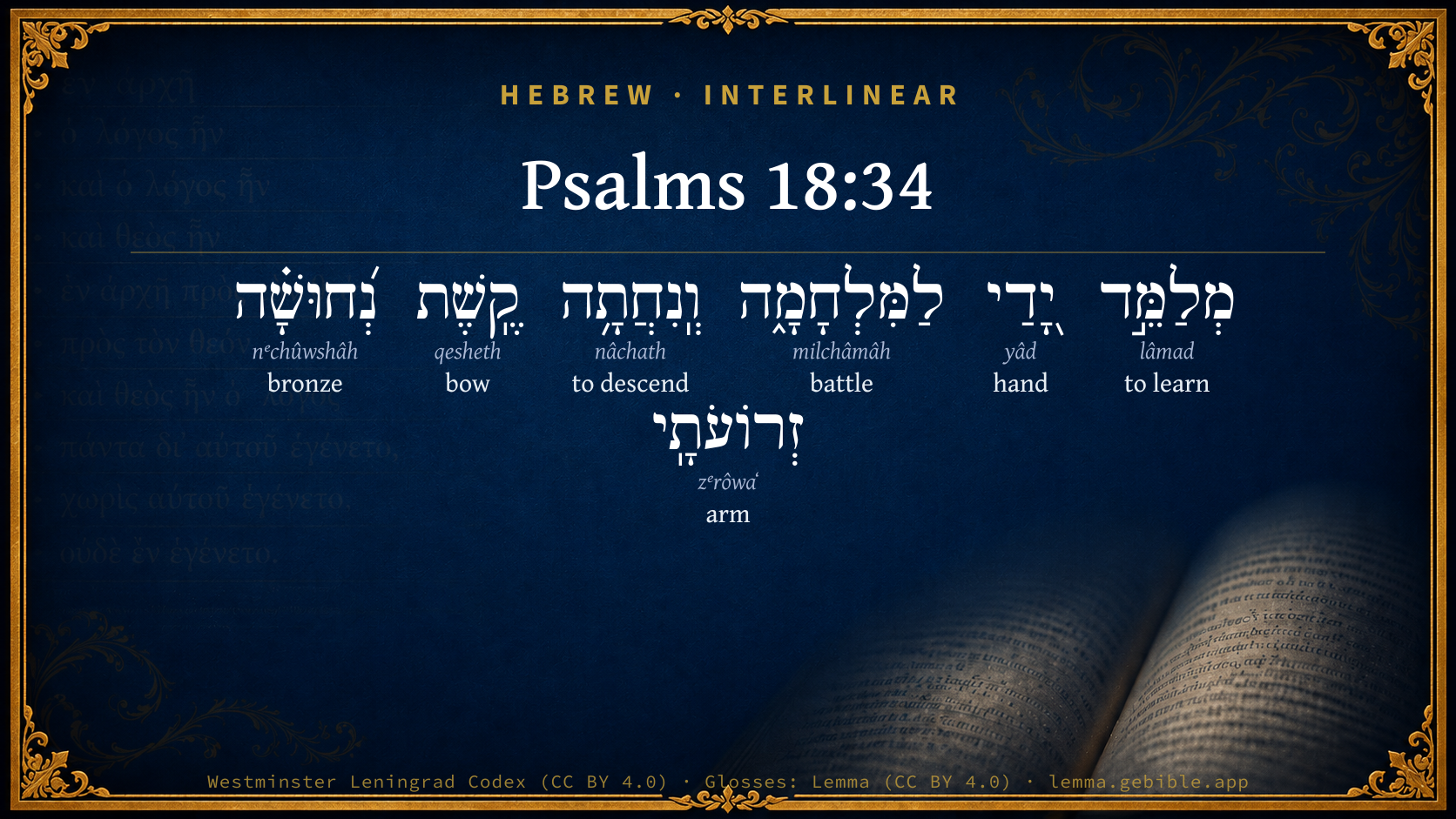
Psalms 18:34

Hebrew (Westminster Leningrad Codex) Psalms 18:34 appears in the Hebrew Old Testament. The text above is from the Westminster Leningrad Codex. Each word links to its Strong’s number, a concise gloss, and parsing drawn from the Open Scriptures Hebrew Bible morphology. Click any word for its full Brown-Driver-Briggs (BDB) entry.
Download image
Cite this verse

Psalms 18:34 (World English Bible). Public Domain. Lemma interlinear Bible study tool, https://lemma.gebible.app/v/psalms/18/34.

Show BibTeX & RIS
BibTeX
RIS
English Translation
He teaches my hands to war; So that my arms bend a bow of bronze.
World English Bible · Public Domain
Download a study sheet

One document with this verse’s original text, its word-by-word gloss line, the meaning frame, cross-references with their text, attributed commentary, and full source and license credits — printable, and it pastes into notes with its structure intact.

This verse Autodidact and up

Study sheet (.html) Plain text (.txt)

A passage Seminary Student

Up to 50 verses in one chapter. A passage sheet keeps up to 6 commentary sources and 12 cross-references per verse, in the order this page ranks them, and says so on the sheet whenever that leaves anything out. Ask for a single verse and you get the Autodidact verse sheet above.

Everything on this page stays free to read, with no account — the sheet is a download of what is already on screen, not access to it.

Want to remove ads? Support Godless Engineer
Compare translations 3

The same verse in 3 English versions, stacked beneath the original-language interlinear above. Click any original word for its lexicon entry.

Each is an independent rendering of the whole verse — the interlinear is not word-aligned to these translations.

Highlighted words mark where these versions differ — a whole-verse word diff, not a word-by-word alignment.

  • World English Bible Public Domain
    He teaches my hands to war; So that my arms bend a bow of bronze.
  • King James Version Public Domain
    He teacheth my hands to war, so that a bow of steel is broken by mine arms.
  • unfoldingWord Literal Text CC BY-SA 4.0
    training my hands for war, and my arms bend a bow of bronze.

unfoldingWord Literal Text — © unfoldingWord, licensed CC BY-SA 4.0. Word-aligned USFM3 via Door43 (git.door43.org/unfoldingWord/en_ult).

Versions to compare (up to 4)

3 of 4 selected

Show all 18 translations

Every available English version of this verse, each an independent rendering of the whole verse.

  • World English Bible Public Domain
    He teaches my hands to war; So that my arms bend a bow of bronze.
  • Berean Standard Bible Public Domain
    He trains my hands for battle; my arms can bend a bow of bronze.
  • Majority Standard Bible Public Domain
    He trains my hands for battle; my arms can bend a bow of bronze.
  • King James Version Public Domain
    He teacheth my hands to war, so that a bow of steel is broken by mine arms.
  • American Standard Version (1901) Public Domain
    He teacheth my hands to war; So that mine arms do bend a bow of brass.
  • Revised Version (1885) Public Domain
    He teacheth my hands to war; so that mine arms do bend a bow of brass.
  • Geneva Bible (1599) Public Domain
    He teacheth mine hands to fight: so that a bowe of brasse is broken with mine armes.
  • Douay-Rheims (1899) Public Domain
    Who hath made my feet like the feet of harts: and who setteth me upon high places.
  • Young's Literal Translation Public Domain
    Teaching my hands for battle, And a bow of brass was brought down by my arms.
  • Literal Standard Version CC BY-SA 4.0
    Teaching my hands for battle, || And a bow of bronze was brought down by my arms.
  • Unlocked Literal Bible CC BY-SA 4.0
    He trains my hands for war and my arms to bend a bow of bronze.
  • unfoldingWord Literal Text CC BY-SA 4.0
    training my hands for war, and my arms bend a bow of bronze.
  • Darby Bible Public Domain
    Who teacheth my hands to war, and mine arms bend a bow of brass;
  • World Messianic Bible Public Domain
    He teaches my hands to war, so that my arms bend a bow of bronze.
  • Webster's Bible Public Domain
    \\18:33\\He maketh my feet like hinds' feet, and setteth me upon my high places.
  • Free Bible Version CC BY-SA 4.0
    He teaches me how to fight in battle; he gives me the strength to draw a bronze bow.
  • Bible in Basic English Public Domain
    He makes my hands expert in war, so that a bow of brass is bent by my arms.
  • JPS Tanakh (1917) Public Domain
    (18-35) Who traineth my hands for war, so that mine arms do bend a bow of brass.

Literal Standard Version (2020), Covenant Press — licensed CC BY-SA 4.0. Text via the HelloAO Bible API (eBible.org). Unlocked Literal Bible (unfoldingWord) — licensed CC BY-SA 4.0. Text via the HelloAO Bible API (eBible.org). unfoldingWord Literal Text — © unfoldingWord, licensed CC BY-SA 4.0. Word-aligned USFM3 via Door43 (git.door43.org/unfoldingWord/en_ult). Free Bible Version, Dr. Jonathan Gallagher — licensed CC BY-SA 4.0. Text via the HelloAO Bible API (eBible.org).

Word by word

More ways to search: Search by grammar → Find every occurrence → Compare this word →

Practice this passage: Drill this verse → Learn its vocabulary →

וְֽנִחֲתָ֥ה
nâchath
H5181
“and · to descend”
Conjunction + Verb, Piel, Sequential Perfect, 3rd Person, Feminine, Singular
Part of Speech
Conjunction + Verb
Stem
Piel
Form
Sequential Perfect
Person
3rd Person
Gender
Feminine
Number
Singular
Full BDB Definition

Origin: a primitive root

TWOT: 1351

to go down, descend - (Qal) - to go down, descend - to descend, descend into (chastisement) (figuratively) - (Niphal) to come down into, penetrate - (Piel) to cause to descend, press down, stretch (a bow) - (Hiphil) to bring down
  1. מְלַמֵּ֣ד lâmad H3925 “learning” Verb, Piel, Participle Active, Masculine, Singular, Absolute
  2. יָ֭דַי yâd H3027 “hands · my” Noun, Common, Both, Dual, Construct + Suffix, Personal, 1st Person, Common, Singular
  3. לַמִּלְחָמָ֑ה milchâmâh H4421 “to/for the · battle” Preposition, Determined + Noun, Common, Feminine, Singular, Absolute
  4. קֶֽשֶׁת qesheth H7198 “bow of” Noun, Common, Feminine, Singular, Construct
  5. נְ֝חוּשָׁ֗ה nᵉchûwshâh H5154 “bronze” Noun, Common, Feminine, Singular, Absolute
  6. זְרוֹעֹתָֽי zᵉrôwaʻ H2220 “arms · my” Noun, Common, Both, Plural, Construct + Suffix, Personal, 1st Person, Common, Singular

About this verse

These counts appear in no published source. They are computed here, from the morphology-tagged text and Lemma’s own curated glosses. What Lemma adds →

7
words
7
distinct lemmas
Wisdom
section

Notable vocabulary

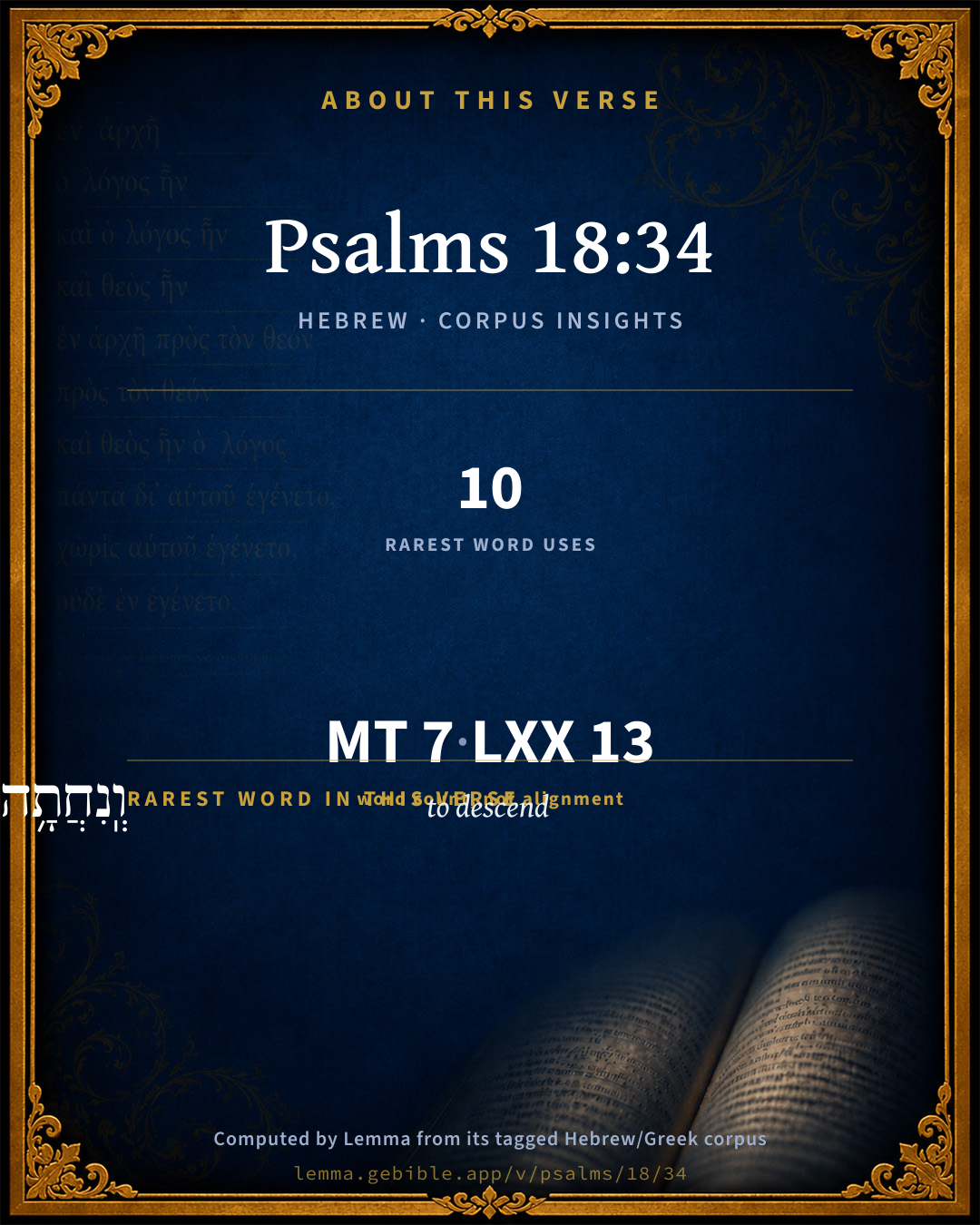
The rarest word here is וְֽנִחֲתָ֥ה to descend H5181 — appearing just 10 times in the whole Hebrew Bible.

Shared distinctive vocabulary

וְֽנִחֲתָ֥ה to descend H5181 occurs in 9 verses of the Hebrew Bible. Also found in:

Grammatical profile

  • 2 verbs
  • 5 nouns

Verb forms

  • מְלַמֵּ֣ד Piel · Participle Active
  • וְֽנִחֲתָ֥ה Piel · Sequential Perfect

Hebrew & Septuagint length

In English translation the verse runs 15 words from the Hebrew and 16 from the Septuagint (LXX English) — closely comparable.

A rough comparison of the two English renderings, which tokenize alike — not a word-level alignment.

Word counts can differ between the Hebrew and the Greek without any difference in meaning — e.g. the Hebrew direct-object marker אֵת has no separate Greek word, and Greek often adds the article ὁ.

In the original languages it is 7 Hebrew tokens and 13 Greek tokens — but the two are counted differently (Hebrew bundles its prefixes and suffixes into one token; the Greek is in lemma form), so that isn’t a like-for-like length.

Cross-references

7

Topical passages linked to Psalms 18:34 in the Treasury of Scripture Knowledge — connected by theme and wording, ordered by reader-vote popularity; previews shown in the World English Bible.

  • Psalms 144:1 Blessed be Yahweh, my rock, Who teaches my hands to war, And my fingers to battle:
  • Psalms 46:9 He makes wars cease to the end of the earth. He breaks the bow, and shatters the spear. He burns the chariots in the fire.
  • 2 Samuel 22:36 You have also given me the shield of your salvation; Your gentleness has made me great.
  • Isaiah 28:6 and a spirit of justice to him who sits in judgment, and strength to those who turn back the battle at the gate.
  • Isaiah 45:1 Thus says Yahweh to his anointed, to Cyrus, whose right hand I have held, to subdue nations before him, and I will loose the loins of kings; to open the doors before him, and the gates shall not be shut:
  • Jeremiah 49:35 Thus says Yahweh of Hosts: Behold, I will break the bow of Elam, the chief of their might.
  • Hosea 1:5 It will happen in that day that I will break the bow of Israel in the valley of Jezreel."

Cross-references courtesy of OpenBible.info (CC BY 4.0).

Hebrew and Greek witnesses Masoretic Hebrew ↔ Greek Septuagint

The same verse in the two great witnesses to the Old Testament, shown verse-for-verse.

You’re reading Greek Psalm 17 (Hebrew Psalm 18). The Septuagint counts the superscription, so verse numbers can differ from the Hebrew — chapter-level alignment, not verse-by-verse. Numbering follows Rahlfs.

These are two independent witnesses, not word-aligned to each other, and the Septuagint is shown in lemma (dictionary) form.

Hebrew Psalms 18:34 Masoretic · Westminster Leningrad Codex

מְלַמֵּ֣ד יָ֭דַי לַמִּלְחָמָ֑ה וְֽנִחֲתָ֥ה קֶֽשֶׁת נְ֝חוּשָׁ֗ה זְרוֹעֹתָֽי

He teaches my hands to war; So that my arms bend a bow of bronze.

World English Bible · Public Domain

Greek LXX Greek Psalm 17:34 Septuagint · lemma form

ὁ καταἀρτίζω ὁ πούς ἐγώ ὡς ἔλαφος καί ἐπί ὁ ὑψηλός ἵστημι ἐγώ

He instructs my hands for war: and you have made my arms as a brazen bow.

LXX2012 (modern English Septuagint) · Public Domain

On this verse, Ellicott's Commentary for English Readers discusses the Septuagint’s reading. Read the note in Commentary ↓

Hebrew: Westminster Leningrad Codex (CC BY 4.0). Greek: Septuagint (public domain); English from LXX2012 (modern English Septuagint) (Public Domain). How the Septuagint differs from the Hebrew →

Commentary

Notes on Psalms 18:34 from classic Christian and Jewish commentators (each source and its license shown beneath its notes). The classic Christian expositions comment on the surrounding passage and are grouped to its opening verse, so a note may address several verses; the Jewish commentaries on the Tanakh (Rashi and others) are per-verse, so they appear only where the commentator wrote on this verse.

Lemma curates 59 commentaries, every one of them public domain or Creative Commons licensed, each selected and text-cleaned for this edition rather than reprinted as found. About our sources →

Trapp's Complete Commentary

John Trapp

Psa 18:34 He teacheth my hands to war, so that a bow of steel is broken by mine arms.

Ver. 34. He teacheth mine hands to war] David ascribeth all his military skill and success to God; so did not other great warriors, Alexander, Scipio, Fabius, &c., but sacrificed to their own nets, and were ready to say, as Sesostris, king of Egypt, did when he had conquered any country, he was wont to set up pillars with these words engraven upon them, This country I got by mine own strength and valour, ταυτην την χωρην ωμοισι τοις εμοισιν εκτησαμην (Herodot. l. 2).

So that a bow of steel, &c.] Which is more flexible and stronger than a bow of iron; whence is that, Job 20:24.

John Trapp, A Commentary or Exposition upon All the Books of the Old and New Testament (1647–1656) — public domain. Text from a community e-Sword module.

The Biblical Illustrator

Joseph S. Exell

Psa_18:34

He teacheth my hands to war.

Divine endowment for service

God raises up men specially qualified to meet the exigencies of human society--the soldier, the statesman, the lawgiver, the teacher of religion, the ready writer, the eloquent man, and the cunning artificer. He had need of a soldier to accomplish the purposes of His will, and He qualified David for the work, and so long as David prosecuted his wars, free of ambitious and malevolent feelings, and solely with the desire of accomplishing the will of God, he served God as acceptably in the field as he could have served Him in His temple. Provided his cause be just, and he prosecute it with right motives, the patriot soldier is engaged on as holy a work as the priest at the altar. God so taught David the art of war that a bow of steel was broken by his arms. It required the use of both hands and feet to bend the ancient bow of steel; how great, then, must Davids strength have been to break it with his arms. This verse has, of course, a spiritual application, showing how easily God can clothe with overcoming might all who are engaged in the good fight of faith, enabling them to overcome, with a moiety of their strength, the strongest weapons with which they may be assailed. (David Caldwell, A. M.)

The Biblical Illustrator, edited by Joseph S. Exell (c. 1880s–1900s) — public domain. Text from a community e-Sword module.

Joseph Benson's Commentary

Psa 18:34. He teacheth my hands to war — To him I owe all the military skill, or strength, or courage which I have. A bow of steel is broken by mine arm — Chandler renders it, Mine arms have bent the bow of steel. That David was able to bend and draw together even a brazen bow, or one of steel, and to use it in his wars, was a proof of his great strength. Dr. Delaney, however, certainly draws an unwarranted conclusion from these poetical expressions when he infers from them, “that David was the swiftest and strongest of all mankind.”

Joseph Benson's Commentary on the Old and New Testaments (1811–1818) — public domain. Text from a community e-Sword module.

J. A. Alexander on Psalms

Joseph Addison Alexander

35. (Psa 18:34). Teaching my hands to war, and my arms have bent a bow of brass. The construction is continued from the preceding verse, all the participles having reference to the name of God in Psa 18:33 (32). The last clause is a strong expression for extraordinary strength, which is mentioned merely as a heroic quality. The translation broken rests on what is now regarded as a false etymology. Brass was used before iron in Egypt and other ancient countries as a material for arms.

Joseph Addison Alexander, The Psalms Translated and Explained (1850) — public domain. Text from a community e-Sword module.

Geneva Bible (1599)

Geneva Bible translators

Or, steel.

Geneva Bible (1599) marginal notes — public domain. Text via Bolls.life.

Adam Clarke's Commentary

Verse 34. He teacheth my hands to war] The success which I have had in my military exercises I owe to the Divine help. How few of the conquerors of mankind can say so! And how few among those who call themselves Christian warriors dare to say so! War is as contrary to the spirit of Christianity as murder. Nothing can justify Christian nations in shedding each other's blood! All men should live in peace; all men might live in peace; and the nation that is first to break it is under a heavy curse.

A bow of steel is broken by mine arms.] All the versions render this: "Thou hast made my arm like a brazen bow." A bow of steel is out of the question. In the days of David it is not likely that the method of making steel was known. The method of making brass out of copper was known at a very early period of the world; and the ancients had the art of hardening it, so as to work it into the most efficient swords. From his own account David was swift, courageous, and strong.

Adam Clarke's Commentary on the Bible (1810–1826) — public domain. Text from a community e-Sword/MySword module.

Ellicott's Commentary for English Readers

(34) So that a bow.—Better, and mine arms bend a bow of copper. For the copper bow comp. Job_20:24. Nechushah, χαλκὸς, is certainly not steel, whether the custom of hardening iron was known to the Jews or not (see Jer_15:12, and art. “Steel,” in Smith’s Biblical Dict.). The LXX. and Vulgate have, “thou hast made mine arms a bow of copper.” For this test of strength we naturally compare the famous bow of Ulysses—

“So the great master drew the mighty bow,

And drew with ease.”—Odyssey, POPE’S trans.

A Bible Commentary for English Readers, edited by Charles John Ellicott (1878–1897) — public domain. Text from a community e-Sword module.

The Cambridge Bible for Schools and Colleges

gen. ed. J. J. S. Perowne

34. The first line is borrowed in Psa_144:1.

so that a bow of steel &c.] R.V., so that mine arms do bend a bow of brass. The ability to bend a metal bow (cp. Job_20:24) was a sign of supereminent strength. Readers of the Odyssey will recall Ulysses’ bow, which no one but himself could bend (Hom. Od. xxi. 409).

The Cambridge Bible for Schools and Colleges (gen. ed. J. J. S. Perowne; Cambridge University Press, 1878–1918) — public domain. Text from a community e-Sword module.

John Gill's Exposition

Thou hast given me the shield of thy salvation,.... Meaning either temporal salvation, which was a shield to him when he had no outward one, as when he fought with Goliath; and was what preserved him in all his battles at other times: or spiritual salvation, which is of the Lord, of his contriving, effecting:, and applying, and in which his glory is concerned; interest in which is a free gift of his, as are the knowledge, application, and possession of it; and this is as a shield, which saves from sin, from all sin, and the damning power of it; keeps off the curses of the law, secures from wrath to come, and repels Satan's temptations; the words may be applied to Christ, who, though he was not saved from dying, yet was preserved in the day of salvation, and was not suffered to see corruption in the grave, and was quickly delivered from the power and dominion of it;

and thy right hand hath holden me up; Christ may be said to be the right hand of God, being as dear to him as his right hand; and being exalted at it; and because by him he communicates all good things to his people, and with him upholds and sustains them; or else it designs the mighty power of God, which is often signified by it, Psa 20:6; and may be understood of the sustentation of David, both in a providential way, with respect to his being, the preservation of it, the supplies of life, and support in times of trouble and distress; and in a spiritual sense, maintaining the principle of grace in him, furnishing him with fresh supplies of grace, and bearing him up under and through every temptation and exercise; so upholding him that he stood firm in the true grace of God, in the exercise of it implanted, and in the doctrine of grace, so as to go forward in the ways of God, and follow hard after him, and so as not to fall and utterly perish; and which is true of all the saints; see Psa 63:8. The words may be interpreted of Christ, who, as man and Mediator, as God's righteous servant, was upheld by him, so that he failed not, nor was he discouraged; the hand of the Lord was established with him, and his arm also strengthened him, Isa 42:1; this clause is not in Sa2 22:36;

and thy gentleness hath made me great; David was very mean and low by his birth and occupation, and while persecuted by Saul; but God of his grace and goodness, of his sovereign good will and pleasure, raised him to an high estate, set him on the throne of Israel, and gave him honour among and above the kings of the earth; so Kimchi interprets the word for "gentleness" by "goodness" or "merciful" kindness; R. Jonah by "providence"; and R. Isaac explains it "thy help and good will"; and all shows that his greatness was not owing to his merits, but to the providential goodness of God; and his special grace and mercy in Christ Jesus made him still greater, even a child of God, an heir of God, a joint heir with Christ, a King and a Priest unto God; gave him a right unto and a meetness for a crown of glory, an everlasting kingdom, an eternal inheritance, as it does all the saints. The words may be rendered, "thy humility hath made me great" (p); which may be understood either of God's humbling himself to look upon him in his low estate, and to raise him to such honour and dignity as he did, both in a temporal and spiritual sense; see Psa 113:6; or of the humility which he had in himself from God, as Aben Ezra interprets it; of which grace God is the author; it is a fruit of the Spirit; which he takes great notice of, gives more grace to them that have it, and exalts them, as he did David, who was mean and low in his own eyes. The Septuagint, and those versions which follow that, render it "thy discipline" or "correction": and so may design the gentleness and lenity of God in chastising his people, which is always in measure and in judgment, and for their good; whereby he increases grace in them, and trains them up for, and brings them to his kingdom and glory. The Chaldee paraphrase is, "by thy word thou hast increased me"; it may not be improperly interpreted of Christ, who was very low in his estate of humiliation on earth, but is now highly exalted, and crowned with glory and honour; who first endured great sufferings, and then entered into his glory.

(p) "mansuetudo tua", Pagninus, Montanus, Musculus, Gejerus; "thy meekness", Ainsworth; "sumitur pro humilitate seu mansuetudine", Zeph. ii. 3. Gejerus.

John Gill's Exposition of the Whole Bible (1746–1763) — public domain (CC PDM 1.0). Text via the HelloAO Bible API.

Albert Barnes' Notes on the Bible

He teacheth my hands to war - Compare Psa 144:1. The skill which David had in the use of the bow, the sword, or the spear - all of which depends on the hands - he ascribes entirely to God.

So that a bow of steel is broken by mine arms - This is mentioned as an instance of extraordinary strength, as if he were able to break a bow made of metal. The original word rendered steel means properly brass. Wood was doubtless first used in constructing the bow, but metals came afterward to be employed, and brass would naturally be used before the manufacture of steel was discovered. Rosenmuller in loc.

Albert Barnes' Notes on the Bible (1834–1885) — public domain. Text from a community e-Sword/MySword module.

Matthew Poole's English Annotations

To him I owe all that military skill, or strength, or cou rage which I have. My strength is sufficient, not only to bend

a bow of steel, but to break it.

Matthew Poole's English Annotations on the Holy Bible (1683–1685) — public domain. Text from a community e-Sword/MySword module.

The Treasury of David

Charles H. Spurgeon

Ver. 34. He teacheth my hands to war. Martial prowess and skill in the use of weapons are gratefully acknowledged to be the result of divine teaching; no sacrifice is offered at the shrine of self in praise of natural dexterity, or acquired skilfulness; but, regarding all warlike prowess as a gift of heavenly favour, thankfulness is presented to the Giver. The Holy Spirit is the great Drillmaster of heavenly soldiers.

So that a bow of steel is broken by mine arms. A bow of brass is probably meant, and these bows could scarcely be bent by the arms alone, the archer had to gain the assistance of his foot; it was, therefore, a great feat of strength to bend the bow, so far as even to snap it in halves. This was meant of the enemies' bow, which he not only snatched from his grasp, but rendered useless by breaking it in pieces. Jesus not only destroyed the fiery suggestions of Satan, but he broke his arguments with which he shot them, by using Holy Scripture against him; by the same means we may win a like triumph, breaking the bow and cutting the spear in sunder by the sharp edge of revealed truth. Probably David had by nature a vigorous bodily frame; but it is even more likely that, like Samson, he was at times clothed with more than common strength; at any rate, he ascribes the honour of his feats entirely to his God. Let us never wickedly rob the Lord of his due, but faithfully give unto him the glory which is due unto his name.

Ver. 34. He teacheth my hands to war, etc. To him I owe all that military skill, or strength, or courage, which I have. My strength is sufficient, not only to bend a bow of steel, but to break it. Matthew Poole.

Ver. 34. Steel. The word so rendered in the authorised version, properly means "copper" (tvwxn) It is doubtful if the Hebrews were acquainted with the process of hardening iron into steel, for though the "northern iron" of Jer 15:12, has been supposed by some to be steel, this is by no means certain; it may have only been a superior sort of iron. William Lindsay Alexander, in "Kitto's Cyclopaedia."

Ver. 34. The drawing of a mighty bow was a mark of great slaughter and skill.

"So the great master drew the mighty bow, And drew with ease. One hand aloft displayed

The bending horns, and one the string essayed."

Alexander Pope, 1688-1744 Translation of Homer.

Charles H. Spurgeon's The Treasury of David (1869–1885) — public domain. Psalms only. Text from a community e-Sword/MySword module.

Whedon's Commentary on the Bible

Daniel D. Whedon

34. He teacheth, etc.—Whether in peace or war, his skill and strength to act well his part the psalmist ascribes to God.

Bow of steel is broken—A bow of copper, or bronze, is bent by my arms. The idea is, that of drawing a heavy bow in battle, and thus shooting at long range. The verb נהת, (nahath,) signifies to go or come down, to descend; and, in Piel, to press down, to bend, as in the text. The Hebrews, so far as is known, were not acquainted with the use of steel and נהושׁ(nahoosh) should be translated copper. The elastic copper or bronze bow was far more powerful and more difficult to bend than the wooden bow; but David could draw it. See Job_20:24

Daniel D. Whedon (gen. ed.), Commentary on the Old and New Testaments (1874–1909) — public domain. Text from a community e-Sword module.

The Pulpit Commentary

He teacheth my hands to war, so that a bow of steel is broken by mine arms. (comp. Psa_144:1) "A bow of steel" is a mistranslation, since nechusha (hvWjn) is not "steel," but "brass," or rather "bronze "- and bows of steel were unknown to the ancients. Compare the comment on Job_20:24 ("Homiletic Commentary," p. 352).

The Pulpit Commentary (1880–1919), ed. H.D.M. Spence-Jones & Joseph S. Exell — public domain. Text from a community e-Sword module.

Rashi

Rabbi Shlomo Yitzchaki (Rashi)

He makes my feet like hinds The feet of the females stand straighter than those of the males.

Rashi on the Tanakh — English translations: “The Judaica Press complete Tanach with Rashi, translated by A. J. Rosenberg” (CC BY 4.0); “Pentateuch with Rashi's commentary by M. Rosenbaum and A.M. Silbermann, 1929-1934” (public domain); “The Metsudah Tanach series, Lakewood, N.J” (CC BY 4.0); and “The Book of Joshua, Metsudah Publications, 1997” (CC BY 4.0). Text via Sefaria.

Lesson kit

Teaching starters — assembled from the data on this page, not authored interpretation. Every prompt links to the verse data it draws on. Edit before teaching.

Psalms, in the Wisdom, opens this verse with 7 words (7 distinct Hebrew lemmas). Its most distinctive word is nâchath (“to descend”). A historical commentator’s framing appears above. Read the whole chapter for the surrounding context.

Discussion questions

  1. The word nâchath carries the sense “to descend.” How does it shape the verse?
  2. 1 Samuel 2:10 shares the word «to descend» with this verse. How do the two illuminate each other?
  3. These translations render this verse differently; the difference is in the English rendering, not the original. What questions does that raise?
  4. The verb «מְלַמֵּ֣ד» is Piel Participle Active. How does its form color the action?
  5. Reading how Trapp's Complete Commentary and The Biblical Illustrator read this verse, where do the two commentators agree and where do they part?

Things to notice

Reading settings

Reading text

Shown beneath each verse's original-language words.

Old Testament
Old Testament edition

Read the OT as the Masoretic Hebrew (MT) or the Greek Septuagint (LXX).

English shown for the Greek Septuagint (in the Hebrew ↔ Greek comparison).

Comparing translations? Open the Compare panel on any verse page to stack up to four side by side.