Ezekiel 11:23

Hebrew (Westminster Leningrad Codex) Ezekiel 11:23 appears in the Hebrew Old Testament. The text above is from the Westminster Leningrad Codex. Each word links to its Strong’s number, a concise gloss, and parsing drawn from the Open Scriptures Hebrew Bible morphology. Click any word for its full Brown-Driver-Briggs (BDB) entry.
Download image
Cite this verse

Ezekiel 11:23 (World English Bible). Public Domain. Lemma interlinear Bible study tool, https://lemma.gebible.app/v/ezekiel/11/23.

Show BibTeX & RIS
BibTeX
RIS
English Translation
The glory of Yahweh went up from the midst of the city, and stood on the mountain which is on the east side of the city.
World English Bible · Public Domain
Download a study sheet

One document with this verse’s original text, its word-by-word gloss line, the meaning frame, cross-references with their text, attributed commentary, and full source and license credits — printable, and it pastes into notes with its structure intact.

This verse Autodidact and up

Study sheet (.html) Plain text (.txt)

A passage Seminary Student

Up to 50 verses in one chapter. A passage sheet keeps up to 6 commentary sources and 12 cross-references per verse, in the order this page ranks them, and says so on the sheet whenever that leaves anything out. Ask for a single verse and you get the Autodidact verse sheet above.

Everything on this page stays free to read, with no account — the sheet is a download of what is already on screen, not access to it.

Want to remove ads? Support Godless Engineer
Compare translations 3

The same verse in 3 English versions, stacked beneath the original-language interlinear above. Click any original word for its lexicon entry.

Each is an independent rendering of the whole verse — the interlinear is not word-aligned to these translations.

Highlighted words mark where these versions differ — a whole-verse word diff, not a word-by-word alignment.

  • World English Bible Public Domain
    The glory of Yahweh went up from the midst of the city, and stood on the mountain which is on the east side of the city.
  • King James Version Public Domain
    And the glory of the LORD went up from the midst of the city, and stood upon the mountain which is on the east side of the city.
  • unfoldingWord Literal Text CC BY-SA 4.0
    Then the glory of Yahweh went up from within the midst of the city and stood on the mountain to the east of the city.

unfoldingWord Literal Text — © unfoldingWord, licensed CC BY-SA 4.0. Word-aligned USFM3 via Door43 (git.door43.org/unfoldingWord/en_ult).

Versions to compare (up to 4)

3 of 4 selected

Show all 18 translations

Every available English version of this verse, each an independent rendering of the whole verse.

  • World English Bible Public Domain
    The glory of Yahweh went up from the midst of the city, and stood on the mountain which is on the east side of the city.
  • Berean Standard Bible Public Domain
    And the glory of the LORD rose up from within the city and stood over the mountain east of the city.
  • Majority Standard Bible Public Domain
    And the glory of the LORD rose up from within the city and stood over the mountain east of the city.
  • King James Version Public Domain
    And the glory of the LORD went up from the midst of the city, and stood upon the mountain which is on the east side of the city.
  • American Standard Version (1901) Public Domain
    And the glory of Jehovah went up from the midst of the city, and stood upon the mountain which is on the east side of the city.
  • Revised Version (1885) Public Domain
    And the glory of the LORD went up from the midst of the city, and stood upon the mountain which is on the east side of the city.
  • Geneva Bible (1599) Public Domain
    And the glorie of the Lord went vp from the middes of the citie, and stoode vpon the moutaine which is towarde the East side of the citie.
  • Douay-Rheims (1899) Public Domain
    And the glory of the Lord went up from the midst of the city, and stood over the mount that is on the east side of the city.
  • Young's Literal Translation Public Domain
    And the honour of Jehovah goeth up from off the midst of the city, and standeth on the mountain, that `is' on the east of the city.
  • Literal Standard Version CC BY-SA 4.0
    And the glory of YHWH goes up from off the midst of the city, and stands on the mountain, that [is] on the east of the city.
  • Unlocked Literal Bible CC BY-SA 4.0
    Then the glory of Yahweh went up from within the midst of the city and stood on the mountain to the east of the city.
  • unfoldingWord Literal Text CC BY-SA 4.0
    Then the glory of Yahweh went up from within the midst of the city and stood on the mountain to the east of the city.
  • Darby Bible Public Domain
    And the glory of Jehovah went up from the midst of the city, and stood upon the mountain which is on the east side of the city.
  • World Messianic Bible Public Domain
    The LORD’s glory went up from the middle of the city, and stood on the mountain which is on the east side of the city.
  • Webster's Bible Public Domain
    And the glory of the LORD went up from the midst of the city, and stood upon the mountain which is on the east side of the city.
  • Free Bible Version CC BY-SA 4.0
    The glory of the Lord rose from inside the city and went over to the mountain to the east of the city.
  • Bible in Basic English Public Domain
    And the glory of the Lord went up from inside the town, and came to rest on the mountain on the east side of the town.
  • JPS Tanakh (1917) Public Domain
    And the glory of the LORD went up from the midst of the city, and stood upon the mountain which is on the east side of the city.

Literal Standard Version (2020), Covenant Press — licensed CC BY-SA 4.0. Text via the HelloAO Bible API (eBible.org). Unlocked Literal Bible (unfoldingWord) — licensed CC BY-SA 4.0. Text via the HelloAO Bible API (eBible.org). unfoldingWord Literal Text — © unfoldingWord, licensed CC BY-SA 4.0. Word-aligned USFM3 via Door43 (git.door43.org/unfoldingWord/en_ult). Free Bible Version, Dr. Jonathan Gallagher — licensed CC BY-SA 4.0. Text via the HelloAO Bible API (eBible.org).

Word by word

More ways to search: Search by grammar → Find every occurrence → Compare this word →

Practice this passage: Drill this verse → Learn its vocabulary →

מִקֶּ֥דֶם
qedem
H6924
“from · east”
Preposition + Noun, Common, Masculine, Singular, Absolute
Part of Speech
Preposition + Noun
Type
Common
Gender
Masculine
Number
Singular
State
Absolute
Full BDB Definition

Origin: from H6923

TWOT: 1988a

east, antiquity, front, that which is before, aforetime (noun masculine) - front, from the front or east, in front, mount of the East - ancient time, aforetime, ancient, from of old, earliest time - anciently, of old (adverb) - beginning - east - eastward, to or toward the East (adverb)
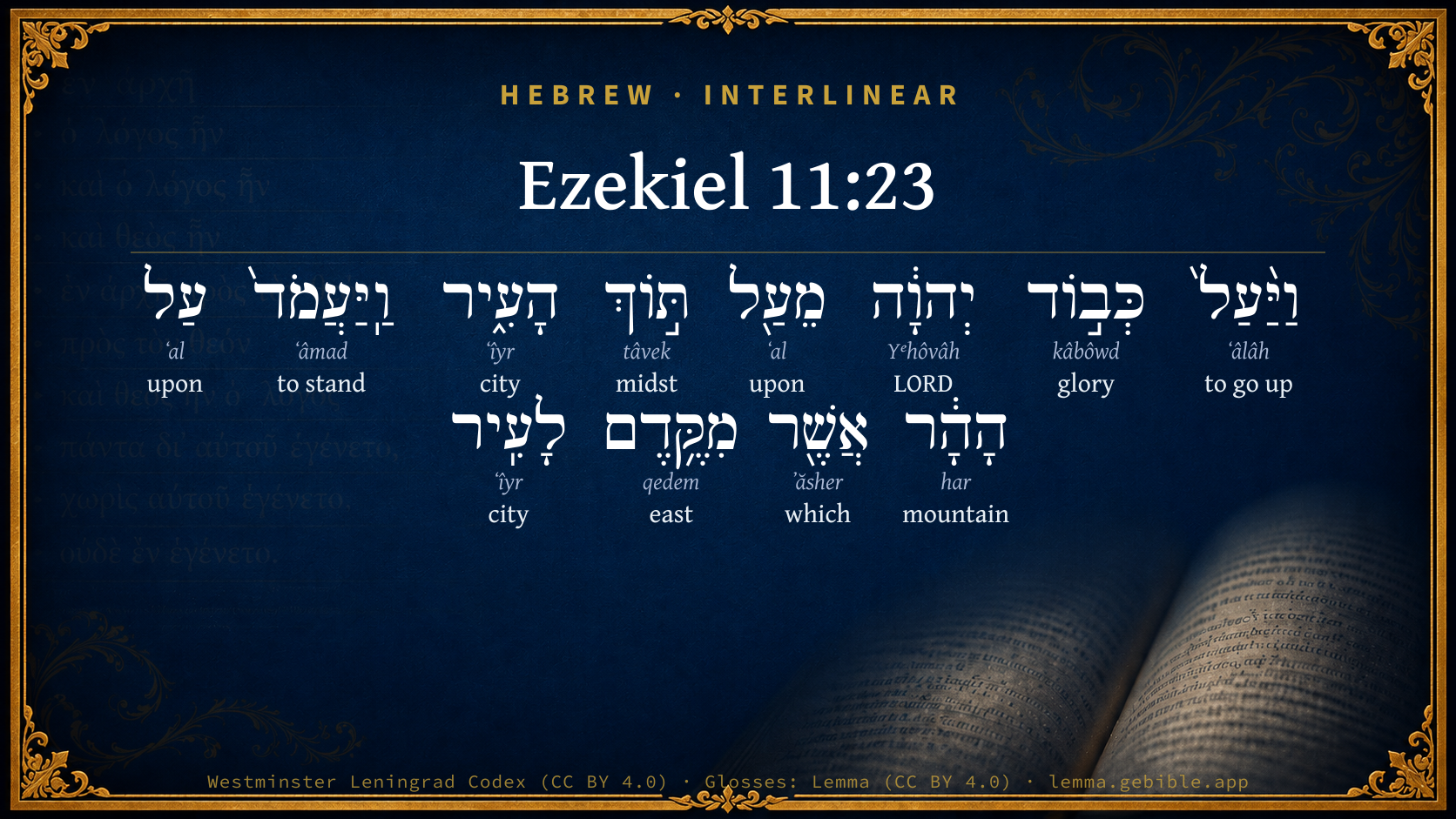
  1. וַיַּ֨עַל֙ ʻâlâh H5927 “and · to go up” Conjunction + Verb, Qal, Sequential Imperfect, 3rd Person, Masculine, Singular
  2. כְּב֣וֹד kâbôwd H3519 “glory of” Noun, Common, Both, Singular, Construct
  3. יְהוָ֔ה Yᵉhôvâh H3068 “LORD” Noun, Proper
  4. מֵעַ֖ל ʻal H5921 “from · upon” Preposition + Preposition
  5. תּ֣וֹךְ tâvek H8432 “midst of” Noun, Common, Masculine, Singular, Construct
  6. הָעִ֑יר ʻîyr H5892 “the · city” Particle, Definite Article + Noun, Common, Feminine, Singular, Absolute
  7. וַֽיַּעֲמֹד֙ ʻâmad H5975 “and · to stand” Conjunction + Verb, Qal, Sequential Imperfect, 3rd Person, Masculine, Singular
  8. עַל ʻal H5921 “upon” Preposition
  9. הָהָ֔ר har H2022 “the · mountain” Particle, Definite Article + Noun, Common, Masculine, Singular, Absolute
  10. אֲשֶׁ֖ר ʼăsher H834 “which” Particle, Relative
  11. לָעִֽיר ʻîyr H5892 “to/for the · city” Preposition, Determined + Noun, Common, Feminine, Singular, Absolute

About this verse

These counts appear in no published source. They are computed here, from the morphology-tagged text and Lemma’s own curated glosses. What Lemma adds →

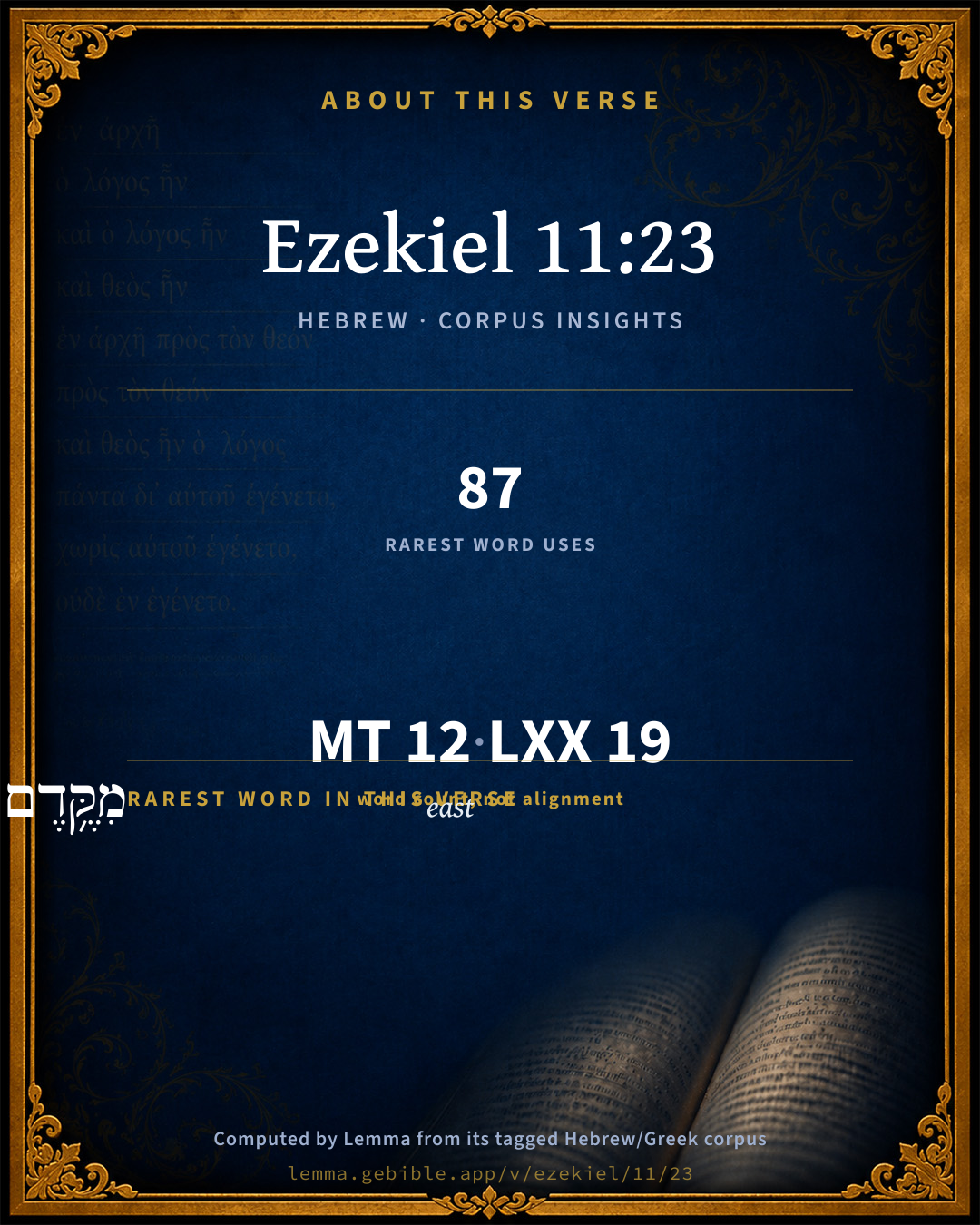
12
words
10
distinct lemmas
Prophets
section

Grammatical profile

  • 2 verbs
  • 7 nouns
  • 2 prepositions
  • 1 particle

Verb forms

  • וַיַּ֨עַל֙ Qal · Sequential Imperfect
  • וַֽיַּעֲמֹד֙ Qal · Sequential Imperfect

Repetition

Words recur within this verse — often emphatic in Hebrew:

  • מֵעַ֖ל upon H5921 ×2
  • הָעִ֑יר city H5892 ×2

Hebrew & Septuagint length

In English translation the verse runs 26 words from the Hebrew and 26 from the Septuagint (LXX English) — the same length.

A rough comparison of the two English renderings, which tokenize alike — not a word-level alignment.

Word counts can differ between the Hebrew and the Greek without any difference in meaning — e.g. the Hebrew direct-object marker אֵת has no separate Greek word, and Greek often adds the article ὁ.

In the original languages it is 12 Hebrew tokens and 19 Greek tokens — but the two are counted differently (Hebrew bundles its prefixes and suffixes into one token; the Greek is in lemma form), so that isn’t a like-for-like length.

Cross-references

8

Topical passages linked to Ezekiel 11:23 in the Treasury of Scripture Knowledge — connected by theme and wording, ordered by reader-vote popularity; previews shown in the World English Bible.

  • Zechariah 14:4 His feet will stand in that day on the Mount of Olives, which is before Jerusalem on the east; and the Mount of Olives will be split in two, from east to west, making a very great valley. Half of the mountain will move toward the north, and half of it toward the south.
  • Ezekiel 8:4 Behold, the glory of the God of Israel was there, according to the appearance that I saw in the plain.
  • Ezekiel 10:4 The glory of Yahweh mounted up from the cherub, [and stood] over the threshold of the house; and the house was filled with the cloud, and the court was full of the brightness of Yahweh's glory.
  • Ezekiel 43:2 Behold, the glory of the God of Israel came from the way of the east: and his voice was like the sound of many waters; and the earth shined with his glory.
  • Ezekiel 9:3 The glory of the God of Israel was gone up from the cherub, whereupon it was, to the threshold of the house: and he called to the man clothed in linen, who had the writer's inkhorn by his side.
  • Ezekiel 10:18 The glory of Yahweh went forth from over the threshold of the house, and stood over the cherubim.
  • Ezekiel 43:4 The glory of Yahweh came into the house by the way of the gate whose prospect is toward the east.
  • Matthew 23:37–24:2 "Jerusalem, Jerusalem, who kills the prophets, and stones those who are sent to her! How often would I have gathered your children together, even as a hen gathers her chickens under her wings, and you would not!

Cross-references courtesy of OpenBible.info (CC BY 4.0).

Hebrew and Greek witnesses Masoretic Hebrew ↔ Greek Septuagint

The same verse in the two great witnesses to the Old Testament, shown verse-for-verse.

These are two independent witnesses, not word-aligned to each other, and the Septuagint is shown in lemma (dictionary) form.

Hebrew Ezekiel 11:23 Masoretic · Westminster Leningrad Codex

וַיַּ֨עַל֙ כְּב֣וֹד יְהוָ֔ה מֵעַ֖ל תּ֣וֹךְ הָעִ֑יר וַֽיַּעֲמֹד֙ עַל הָהָ֔ר אֲשֶׁ֖ר מִקֶּ֥דֶם לָעִֽיר

The glory of Yahweh went up from the midst of the city, and stood on the mountain which is on the east side of the city.

World English Bible · Public Domain

Greek LXX Ezekiel 11:23 Septuagint · lemma form

καί ἀναβαίνω ὁ δόξα κύριος ἐκ μέσος ὁ πόλις καί ἵστημι ἐπί ὁ ὄρος ὅς εἰμί ἀπέναντι ὁ πόλις

And the glory of the Lord went up from the midst of the city, and stood on the mountain which was in front of the city.

LXX2012 (modern English Septuagint) · Public Domain

Hebrew: Westminster Leningrad Codex (CC BY 4.0). Greek: Septuagint (public domain); English from LXX2012 (modern English Septuagint) (Public Domain). How the Septuagint differs from the Hebrew →

Targum (Aramaic paraphrase)

1

The Targum is the ancient Jewish Aramaic paraphrase of the Hebrew Scriptures — an interpretive translation, not the Hebrew text itself. Onkelos (literal) and Pseudo-Jonathan (expansive) render the Torah, and Jonathan the Prophets. Coverage is partial: where no permissively-licensed English translation exists for a verse, only the Aramaic is shown. This is verse-level text, not a word-by-word alignment to the Hebrew.

  1. Targum Jonathan Prophets (Joshua–Malachi)
    וְאִסְתַּלֵק יְקָרָא דַייָ מִן גוֹ קַרְתָּא וּשְׁרָא עַל טוּר זֵיתָא דְמִמִדְנַח לְקַרְתָּא:

    (no public-domain English translation for this verse)

    Targum Jonathan — Aramaic: “Mikraot Gedolot” (public domain). English: “Sefaria Community Translation” (CC0 1.0 (public-domain dedication)); “London "Chaldee Paraphrase," 1871” (public domain). Text via Sefaria.

Commentary

Notes on Ezekiel 11:23 from classic Christian and Jewish commentators (each source and its license shown beneath its notes). The classic Christian expositions comment on the surrounding passage and are grouped to its opening verse, so a note may address several verses; the Jewish commentaries on the Tanakh (Rashi and others) are per-verse, so they appear only where the commentator wrote on this verse.

Lemma curates 59 commentaries, every one of them public domain or Creative Commons licensed, each selected and text-cleaned for this edition rather than reprinted as found. About our sources →

Trapp's Complete Commentary

John Trapp

Eze 11:23 And the glory of the LORD went up from the midst of the city, and stood upon the mountain which [is] on the east side of the city.

Ver. 23. From the midst of the city.] From the east gate.

And stood upon the mountain.] Mount Olivet. There he made his last stand, to see if they would meet him with entreaties of peace, that he might stop or step back. Here it was that Christ wept over the city, and hence he went up to heaven; after which came the Romans and destroyed it.

John Trapp, A Commentary or Exposition upon All the Books of the Old and New Testament (1647–1656) — public domain. Text from a community e-Sword module.

The Biblical Illustrator

Joseph S. Exell

Eze_11:23

The glory of the Lord went up from the midst of the city.

Departure of God from His temple

I. How averse God is to forsake His people. Look we to His declarations; look we to examples.

II. What are the different steps by which His departure may be discovered? He withholds--

1. The manifestations of His love.

2. The influences of His grace.

3. The warnings of His Spirit.

III. The dreadful state of those who are forsaken by Him.

1. They are delivered up into the hands of their spiritual enemies;

2. They live only to increase their guilt and misery. Apply--

(1) How are we to reconcile this doctrine with other parts of Scripture?

(2) How are we to avert this awful calamity? (C. Simeon, M. A.)

Stood upon the mountain.

Climbing the mountain

When the summer sun is hot, and the mountain snow melts; when days are long and skies are clear; when strong men rejoice to climb exceeding high mountains--and they rejoice in climbing higher and higher every year--Snowdon and Skiddaw, Ben Nevis and Ben Lomond, Mont Blanc and the great Matterhorn, and many other high hills, are surveyed, and then scaled by skilful and fearless men. It is well. We need examples of calm courage and indomitable perseverance. We need to see what effort, training, strength, health, and brave endurance can accomplish. But I would speak of the holy mountains and spiritual heights. I would point to lofty peaks in religious life, and glorious ascents into spheres of thought and joy beyond--far beyond--the common level of Christian experience.

I. The mountain of Scripture. More study of the Bible, and more meditation on God mean more lofty views of His providence and grace--a mental life of crystalline clearness and purer air; of richer joys than are common to men. Climb, then, for the glory of the Lord is upon the mountain, not down in the valley, and blessed is the man who climbs until he sees it, and is encircled with its beauty and its light. Oh that we may see the glory of God, this day, in the face of Jesus Christ!

II. The mountain of prayer. We are satisfied, for a time, with the lispings of a babe, but we expect it to learn a fuller and more comprehensive tongue. So we must not be always as babes in Christ in our prayers. There should be new prayers; there should be holier prayers; there should be prevailing prayers. A few more struggles, a few more upward flights, and your soul shall be in the centre of the bright cloud where God dwells, and you shall sun yourselves in His great glory. Climb, then, the mountain of prayer, and you shall be crowned with grace, mercy, and truth.

III. The mountain of usefulness. Are all the hungry fed, all the children taught, all the drunkards reformed, all the sinners converted? No, no! Our mission is not fulfilled, nor is our work done. Christian usefulness; this is the highest form and sweetest flower of life. Leave the monotony of your work far behind you, and do some new thing for the Lord. Behold His glory is upon the mountain summit, and He is waiting for your fruits and sheaves and noble deeds. Rise; gird up your loins; work for the Lord, as Nelson fought for victory, and as Paul sought to save some, and God, even our God, will bless you with fruitfulness of life.

IV. The mountain of salvation. A sinner--what a name is that! An unsaved sinner--that is worse. An unsaved, unhappy sinner--that is worst of all. Is that your name? Come and climb the mountain of salvation, and get for yourself a new name. Lo! here on a shining throne is Jesus Himself, and as we enter His presence He benignly says, I will give you rest. And here, in the mountain of salvation, He does give us rest. He gives full pardon, perfect peace, joyful hope, holy strength, loving confidence, glorious righteousness, and everlasting life. Come, then, far up into the secure heights of this mountain; come, now, to where Jesus and the glory of God are waiting for you.

V. The mountain of heavenly vision. Faith, prayer, zeal, work, and love are so many steps leading us to the lofty peaks of the mountain of Celestial vision, whence, even on stormy days, we may see afar the Promised Land. With heaven in sight, toil and tears will be easier to bear, and death be welcome whenever and wherever it may come. Fear not death, nor Jordans rolling waves. Let the mountain of salvation lead to the mountain of vision, and it will be then only one step into heaven itself. (G. W. MCree.)

The Biblical Illustrator, edited by Joseph S. Exell (c. 1880s–1900s) — public domain. Text from a community e-Sword module.

Joseph Benson's Commentary

Eze 11:23. And the glory of the Lord went up from the midst of the city — The symbol of God’s presence, which had before departed from the temple, (Eze 10:18,) now quite left the city, to signify that he would acknowledge no longer his relation to either, but deliver them up to be profaned by the heathen. It deserves to be observed here, that God did not quit the temple and city all at once, but by little and little. The cloud of his presence was first withdrawn from the mercy-seat in the holy of holies, the usual place of its residence, and removed to the threshold of the house, (Eze 9:1,) where it remained some time waiting for their repentance. Its second remove was from this threshold, leaving the house altogether, to settle upon the cherubim, which were hovering over the court, and upon the wing to depart, Eze 10:18. It then, with these angelic ministers of the divine will, and the accompanying wheels of providence, withdrew to the east gate of the inner court, Eze 10:19. And now at last it quits Jerusalem altogether, and fixes itself upon the mountain on the east side of the city. By withdrawing himself from his people by slow degrees, God gave them time for consideration and repentance, to which each remove of the Shechinah was a fresh and solemn call, and he thus also manifested with what reluctance he entirely abandoned the seed of Abraham his friend. And even his causing the symbol of his presence, before his final departure, to take its station on the mount of Olives, where it was, as it were, within call, and ready to return, if now at length in this their day they would have understood the things that made for their peace, was a further manifestation of grace as well as of justice; for while the cloud of glory lingered there, it gave fresh encouragement to them to repent, and a final warning so to do, at the same time that it was emblematical of the judgment which, if their repentance did not prevent, should begin to be executed upon them from that mount, from whence the city would be annoyed by the darts of the Chaldeans. Nor was this only a figure of the calamities which were to be brought on the Jews by Nebuchadnezzar, but it was also an emblem of the evils which were to befall them in consequence of their rejecting and crucifying their own Messiah, the Lord of glory. This Divine Saviour, after exhausting his patience in instructing, correcting, and threatening Jerusalem, at length forsook it, and ascended to heaven from this same mount of Olives, in the presence of his apostles and disciples, that he might exercise his kingly office, and inflict a just and exemplary vengeance on this obstinately wicked and irreclaimable people.

Joseph Benson's Commentary on the Old and New Testaments (1811–1818) — public domain. Text from a community e-Sword module.

Jamieson, Fausset & Brown

Robert Jamieson, A. R. Fausset & David Brown

The Shekinah glory now moves from the east gate (Eze 10:4, Eze 10:19) to the Mount of Olives, altogether abandoning the temple. The mount was chosen as being the height whence the missiles of the foe were about to descend on the city. So it was from it that Jesus ascended to heaven when about to send His judgments on the Jews; and from it He predicted its overthrow before His crucifixion (Mat 24:3). It is also to be the scene of His return in person to deliver His people (Zac 14:4), when He shall come by the same way as He went, "the way of the east" (Eze 43:2).

Jamieson, Fausset & Brown — Commentary Critical and Explanatory on the Whole Bible (1871) — public domain (CC PDM 1.0). Text via the HelloAO Bible API.

Adam Clarke's Commentary

Verse 23. The glory of the Lord went up from the midst of the city] This vision is no mean proof of the long-suffering of God. He did not abandon this people all at once; he departed by little and little. FIRST, he left the temple. SECONDLY, he stopped a little at the gate of the city. THIRDLY, he departed entirely from the city and went to the Mount of Olives, which lay on the east side of the city. Having tarried there for some time to see i! they would repent and turn to him - FOURTHLY, he departed to heaven. The vision being now concluded, the prophet is taken away by the Spirit of God into Chaldea, and there announces to the captive Israelites what God had showed him in the preceding visions, and the good that he had spoken concerning them; who at first did not seem to profit much by them, which the prophet severely reproves.

Adam Clarke's Commentary on the Bible (1810–1826) — public domain. Text from a community e-Sword/MySword module.

Ellicott's Commentary for English Readers

(23) Stood upon the mountain.—This mountain, on the east of the city, is that which was afterwards known as the Mount of Olives. It is considerably higher than the city, and commands a view over its entire extent. Here the Divine glory rested after taking its departure from the Temple and the city in the vision of the prophet. Here, in the vision of a later prophet (Zec_14:4), the Lord is represented as standing in the day of final judgment. Here, not in vision, the incarnate Son of God proclaimed the second destruction of the obdurate city (Matthew 24; Luk_21:20); and from the same mountain He made His visible ascension into heaven (Luk_24:50-51; Act_1:11-12). The vision is now closed, and the prophet is transported in spirit back into Chaldæa, to declare what he had seen to his fellow-captives, and show them the vanity of their trust in the preservation of the guilty city.

A Bible Commentary for English Readers, edited by Charles John Ellicott (1878–1897) — public domain. Text from a community e-Sword module.

John Gill's Exposition

And the glory of the Lord went up from the midst of the city,.... Of Jerusalem, whither it was removed from the door of the east gate of the temple, Eze 10:19; though no mention is made of such removal; and now, having left the temple, it leaves the city:

and stood upon the mountain, which is on the east side of the city; either waiting for the repentance of the inhabitants of it, leaving them with reluctance; or in order to bring down his judgments upon it, and behold its destruction and ruin: this mountain was the mountain of Olives, as the Targum interprets it: and so Jarchi and Kimchi; see Zac 14:5. Christ stood on this mountain and wept over Jerusalem, and from hence he ascended to heaven. This Jarchi calls the third remove of the Shechinah or glory of the God of Israel. The Rabbins say (q) it removed ten times, and reckon them thus,

"from the mercy seat to the cherub; from the cherub to the cherub; from the cherub to the threshold; from the threshold to the court; from the court to the altar; from the altar to the roof; from the roof to the wall; from the wall to the city; from the city to the mountain; from the mountain to the wilderness; and from the wilderness it ascended and sat in its own place, according to Hos 5:15.''

(q) T. Bab. Roshhashana, fol. 31. 1.

John Gill's Exposition of the Whole Bible (1746–1763) — public domain (CC PDM 1.0). Text via the HelloAO Bible API.

Albert Barnes' Notes on the Bible

The mountain which is on the east side of the city - The Mount of Olives. The rabbis commenting on this passage said the Shechinah retired to this Mount, and there for three years called in vain to the people with human voice that they should repent. On that mountain, Christ stood, when He wept over the fair city so soon to be utterly destroyed. From that mountain he descended, amid loud Hosannas, to enter the city and temple as a Judge.

Albert Barnes' Notes on the Bible (1834–1885) — public domain. Text from a community e-Sword/MySword module.

Haydock's Catholic Bible Commentary

Mount Olivet, whence he might behold the conflagration of the city, before his ascent into heaven. (Menochius) --- He leaves his habitation by degrees, to shew how Jerusalem would be treated, and the Jews suffer after the ascension of our Saviour. Theodoret well observes, that the person on the throne represented Him, the upper part of the body being different from the lower, (chap. i. 26.) to denote the two natures. (Calmet)

George Leo Haydock (1774–1849), Haydock's Catholic Family Bible and Commentary, 1859 edition — public domain. Excludes Psalms (Douay-Rheims chapter numbering differs from Protestant) and Deuterocanonical books (Catholic canon only).

Matthew Poole's English Annotations

See Eze 3:23; 8:4; 9:3; 10:18,19. The glory of the Lord removes now out of the city, over which it had stood some space of time waiting for their repentance; but no fruits of this, and God now departed from them.

Upon the mountain; above it. It was Mount Olivet, as the description of it in this place and elsewhere doth clearly show.

Matthew Poole's English Annotations on the Holy Bible (1683–1685) — public domain. Text from a community e-Sword/MySword module.

Whedon's Commentary on the Bible

Daniel D. Whedon

23. Went up from the midst of the city, and stood upon the mountain — The glory of the Lord, which had been at the eastern gate of the temple (x, 19), now abandoned the temple entirely, passed through the city, and paused on Mount Olivet, as if to take one last sorrowful farewell of the doomed temple. This scene reminds one irresistibly of the fact that it was from this same spot that Jesus near the end of his ministry wept over this same city, crying, “O that thou hadst known, even thou, at least in this thy day, the things which belong unto thy peace! but now they are hid from thine eyes” (Luk_19:41-42). It was also from this spot that he ascended to take his place as judge at the right hand of the Father (Luk_24:50-51).

COMING OUT OF HIS TRANCE, EZEKIEL DESCRIBES HIS VISION TO HIS FELLOW-CAPTIVES, 24, 25.

It would seem that Ezekiel also accompanied the Shekinah to the Mount of Olives, for in the same way as before (Eze_8:3) he is conducted “in the Spirit of God” back to Tel-abib. The vision of glory departs, and awakening from his spiritual ecstasy he tells what he has seen.

Daniel D. Whedon (gen. ed.), Commentary on the Old and New Testaments (1874–1909) — public domain. Text from a community e-Sword module.

John Wesley's Explanatory Notes

Went up - The glory of the Lord removes now out of the city, over which it had stood some time, waiting for their repentance. The mountain - Mount Olivet. He removed thither, to be as it were within call, and ready to return, if now at length in this their day, they would have understood the things that made for their peace.

John Wesley, Explanatory Notes Upon the Whole Bible (1754–1765) — public domain. Text via the GEBible commentary corpus.

Rashi

Rabbi Shlomo Yitzchaki (Rashi)

on the mountain that was on the east of the city That is the Mount of Olives, which is east of the city, and this is the third stage [of the Shechinah’s departure].

Rashi on the Tanakh — English translations: “The Judaica Press complete Tanach with Rashi, translated by A. J. Rosenberg” (CC BY 4.0); “Pentateuch with Rashi's commentary by M. Rosenbaum and A.M. Silbermann, 1929-1934” (public domain); “The Metsudah Tanach series, Lakewood, N.J” (CC BY 4.0); and “The Book of Joshua, Metsudah Publications, 1997” (CC BY 4.0). Text via Sefaria.

Lesson kit

Teaching starters — assembled from the data on this page, not authored interpretation. Every prompt links to the verse data it draws on. Edit before teaching.

Ezekiel, in the Prophets, opens this verse with 12 words (10 distinct Hebrew lemmas). Its most distinctive word is qedem (“east”). A historical commentator’s framing appears above. Read the whole chapter for the surrounding context.

Discussion questions

  1. The word qedem carries the sense “east.” How does it shape the verse?
  2. Zechariah 14:4 shares this passage’s theme. How do the two illuminate each other?
  3. “upon” occurs 2× in this one verse. What is the effect of the repetition?
  4. These translations render this verse differently. What is at stake in choosing one wording over another?
  5. The verb «וַיַּ֨עַל֙» is Qal Sequential Imperfect. How does its form color the action?
  6. Reading how Trapp's Complete Commentary and The Biblical Illustrator read this verse, where do the two commentators agree and where do they part?

Things to notice

Reading settings

Reading text

Shown beneath each verse's original-language words.

Old Testament
Old Testament edition

Read the OT as the Masoretic Hebrew (MT) or the Greek Septuagint (LXX).

English shown for the Greek Septuagint (in the Hebrew ↔ Greek comparison).

Comparing translations? Open the Compare panel on any verse page to stack up to four side by side.