
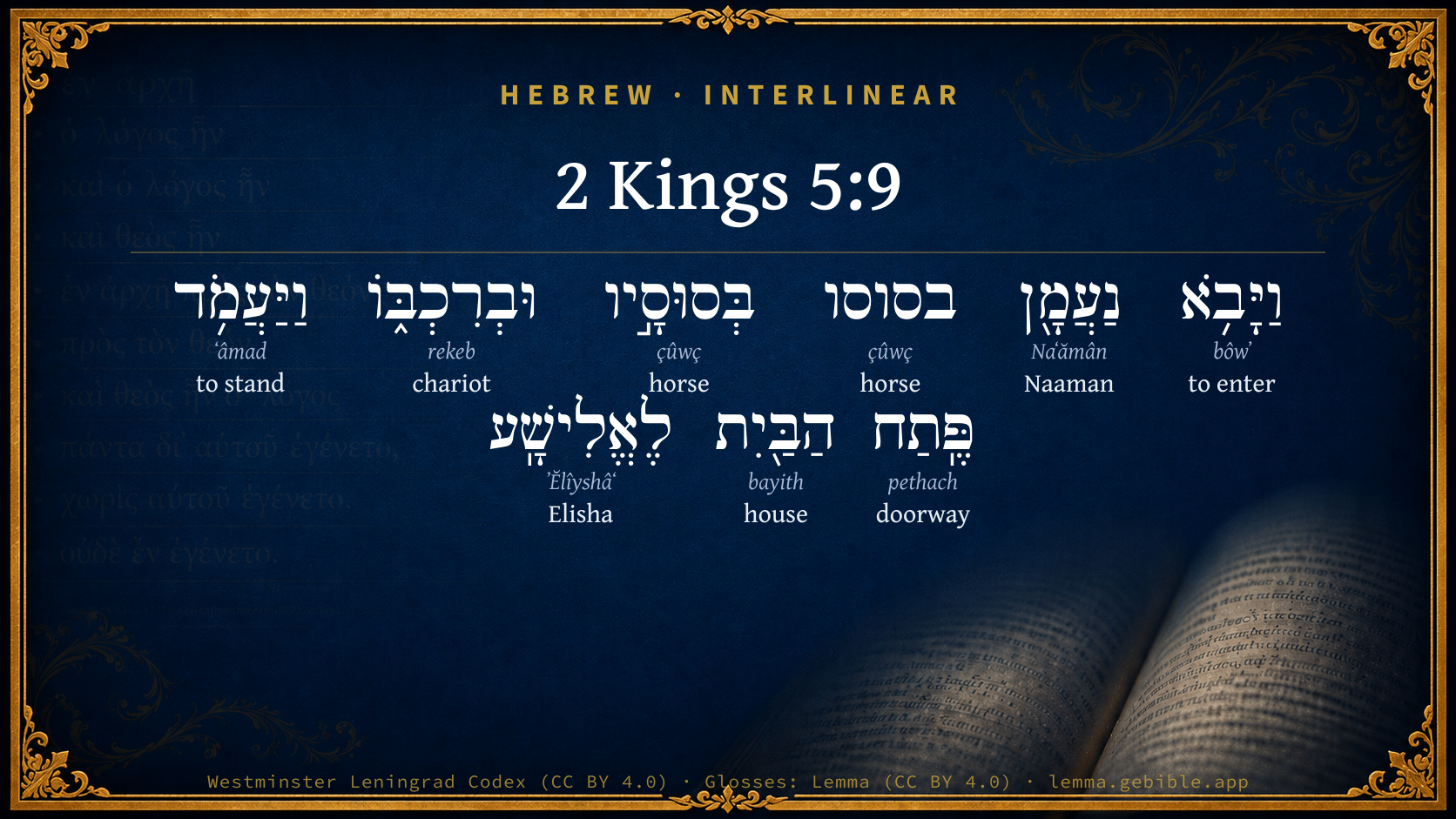
2 Kings 5:9

Hebrew (Westminster Leningrad Codex) 2 Kings 5:9 appears in the Hebrew Old Testament. The text above is from the Westminster Leningrad Codex. Each word links to its Strong’s number, a concise gloss, and parsing drawn from the Open Scriptures Hebrew Bible morphology. Click any word for its full Brown-Driver-Briggs (BDB) entry.
Download image
Cite this verse

2 Kings 5:9 (World English Bible). Public Domain. Lemma interlinear Bible study tool, https://lemma.gebible.app/v/2-kings/5/9.

Show BibTeX & RIS
BibTeX
RIS
English Translation
So Naaman came with his horses and with his chariots, and stood at the door of the house of Elisha.
World English Bible · Public Domain
Download a study sheet

One document with this verse’s original text, its word-by-word gloss line, the meaning frame, cross-references with their text, attributed commentary, and full source and license credits — printable, and it pastes into notes with its structure intact.

This verse Autodidact and up

Study sheet (.html) Plain text (.txt)

A passage Seminary Student

Up to 50 verses in one chapter. A passage sheet keeps up to 6 commentary sources and 12 cross-references per verse, in the order this page ranks them, and says so on the sheet whenever that leaves anything out. Ask for a single verse and you get the Autodidact verse sheet above.

Everything on this page stays free to read, with no account — the sheet is a download of what is already on screen, not access to it.

Want to remove ads? Support Godless Engineer
Compare translations 3

The same verse in 3 English versions, stacked beneath the original-language interlinear above. Click any original word for its lexicon entry.

Each is an independent rendering of the whole verse — the interlinear is not word-aligned to these translations.

Highlighted words mark where these versions differ — a whole-verse word diff, not a word-by-word alignment.

  • World English Bible Public Domain
    So Naaman came with his horses and with his chariots, and stood at the door of the house of Elisha.
  • King James Version Public Domain
    So Naaman came with his horses and with his chariot, and stood at the door of the house of Elisha.
  • unfoldingWord Literal Text CC BY-SA 4.0
    So Naaman came with his horses and with his chariots. And he stood the entrance of the house of Elisha.

unfoldingWord Literal Text — © unfoldingWord, licensed CC BY-SA 4.0. Word-aligned USFM3 via Door43 (git.door43.org/unfoldingWord/en_ult).

Versions to compare (up to 4)

3 of 4 selected

Show all 18 translations

Every available English version of this verse, each an independent rendering of the whole verse.

  • World English Bible Public Domain
    So Naaman came with his horses and with his chariots, and stood at the door of the house of Elisha.
  • Berean Standard Bible Public Domain
    So Naaman came with his horses and chariots and stood at the door of Elisha’s house.
  • Majority Standard Bible Public Domain
    So Naaman came with his horses and chariots and stood at the door of Elisha’s house.
  • King James Version Public Domain
    So Naaman came with his horses and with his chariot, and stood at the door of the house of Elisha.
  • American Standard Version (1901) Public Domain
    So Naaman came with his horses and with his chariots, and stood at the door of the house of Elisha.
  • Revised Version (1885) Public Domain
    So Naaman came with his horses and with his chariots, and stood at the door of the house of Elisha.
  • Geneva Bible (1599) Public Domain
    Then Naaman came with his horses, and with his charets, and stoode at the doore of the house of Elisha.
  • Douay-Rheims (1899) Public Domain
    So Naaman came with Iris horses and chariots, and stood at the door of the house of Eliseus:
  • Young's Literal Translation Public Domain
    And Naaman cometh, with his horses and with his chariot, and standeth at the opening of the house for Elisha;
  • Literal Standard Version CC BY-SA 4.0
    And Naaman comes, with his horses and with his chariot, and stands at the opening of the house for Elisha;
  • Unlocked Literal Bible CC BY-SA 4.0
    So Naaman came with his horses and with his chariots and stood at the door of Elisha's house.
  • unfoldingWord Literal Text CC BY-SA 4.0
    So Naaman came with his horses and with his chariots. And he stood the entrance of the house of Elisha.
  • Darby Bible Public Domain
    And Naaman came with his horses and with his chariot, and stood at the doorway of the house of Elisha.
  • World Messianic Bible Public Domain
    So Naaman came with his horses and with his chariots, and stood at the door of the house of Elisha.
  • Webster's Bible Public Domain
    So Naaman came with his horses and with his chariot, and stood at the door of the house of Elisha.
  • Free Bible Version CC BY-SA 4.0
    So Naaman arrived with his horses and chariots and stood waiting at the door of Elisha's house.
  • Bible in Basic English Public Domain
    So Naaman, with all his horses and his carriages, came to the door of Elisha's house.
  • JPS Tanakh (1917) Public Domain
    So Naaman came with his horses and with his chariots, and stood at the door of the house of Elisha.

Literal Standard Version (2020), Covenant Press — licensed CC BY-SA 4.0. Text via the HelloAO Bible API (eBible.org). Unlocked Literal Bible (unfoldingWord) — licensed CC BY-SA 4.0. Text via the HelloAO Bible API (eBible.org). unfoldingWord Literal Text — © unfoldingWord, licensed CC BY-SA 4.0. Word-aligned USFM3 via Door43 (git.door43.org/unfoldingWord/en_ult). Free Bible Version, Dr. Jonathan Gallagher — licensed CC BY-SA 4.0. Text via the HelloAO Bible API (eBible.org).

Word by word

More ways to search: Search by grammar → Find every occurrence → Compare this word →

Practice this passage: Drill this verse → Learn its vocabulary →

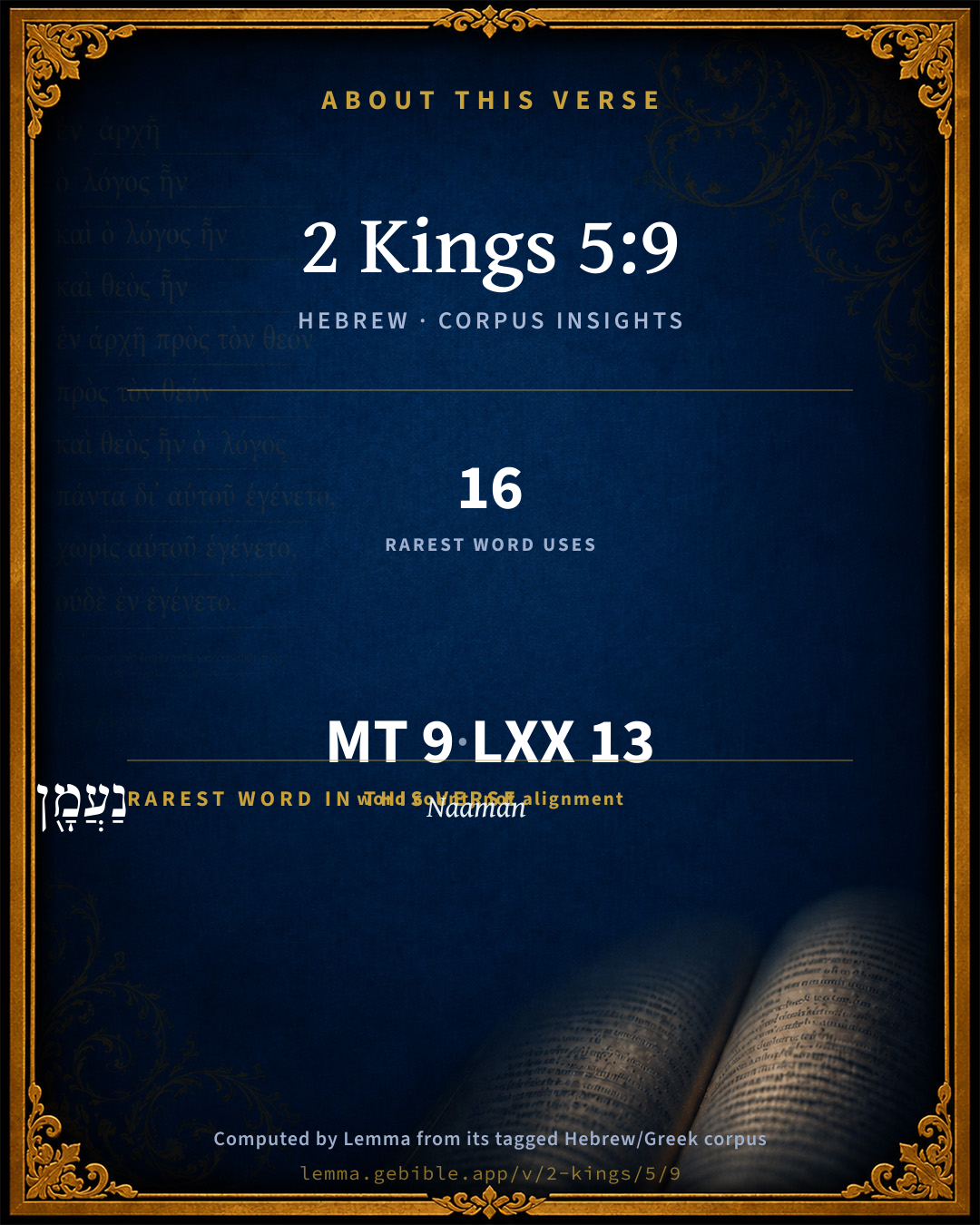
נַעֲמָ֖ן
Naʻămân
H5283
“Naaman”
Noun, Proper
Part of Speech
Noun
Type
Proper
Full BDB Definition

Origin: the same as H5282

TWOT: None

Naaman = "pleasantness" - son of Bela of the family of Benjamin; he was among the family of Jacob that went down to Egypt - commander-in-chief of the army of Syria; stricken with leprosy he went to Elisha, eventually followed his instructions, and was cured
  1. וַיָּבֹ֥א bôwʼ H935 “and · to enter” Conjunction + Verb, Qal, Sequential Imperfect, 3rd Person, Masculine, Singular
  2. בסוסו çûwç H5483 “in/at · horses · his” Preposition + Noun, Common, Masculine, Plural, Construct + Suffix, Personal, 3rd Person, Masculine, Singular
  3. בְּסוּסָ֣יו çûwç H5483 “in/at · horses · his” Preposition + Noun, Common, Masculine, Plural, Construct + Suffix, Personal, 3rd Person, Masculine, Singular
  4. וּבְרִכְבּ֑וֹ rekeb H7393 “and · in/at · chariot · his” Conjunction + Preposition + Noun, Common, Masculine, Singular, Construct + Suffix, Personal, 3rd Person, Masculine, Singular
  5. וַיַּעֲמֹ֥ד ʻâmad H5975 “and · to stand” Conjunction + Verb, Qal, Sequential Imperfect, 3rd Person, Masculine, Singular
  6. פֶּֽתַח pethach H6607 “doorway of” Noun, Common, Masculine, Singular, Construct
  7. הַבַּ֖יִת bayith H1004 “the · house” Particle, Definite Article + Noun, Common, Masculine, Singular, Absolute
  8. לֶאֱלִישָֽׁע ʼĔlîyshâʻ H477 “to/for · Elisha” Preposition + Noun, Proper

About this verse

These counts appear in no published source. They are computed here, from the morphology-tagged text and Lemma’s own curated glosses. What Lemma adds →

9
words
8
distinct lemmas
Historical
section

Notable vocabulary

The rarest word here is נַעֲמָ֖ן Naaman H5283 — appearing just 16 times in the whole Hebrew Bible.

Shared distinctive vocabulary

נַעֲמָ֖ן Naaman H5283 occurs in 14 verses of the Hebrew Bible. Also found in:

Grammatical profile

  • 2 verbs
  • 7 nouns

Verb forms

  • וַיָּבֹ֥א Qal · Sequential Imperfect
  • וַיַּעֲמֹ֥ד Qal · Sequential Imperfect

Repetition

A word recurs within this verse — often emphatic in Hebrew:

  • בסוסו horse H5483 ×2

Hebrew & Septuagint length

In English translation the verse runs 20 words from the Hebrew and 17 from the Septuagint (LXX English) — closely comparable.

A rough comparison of the two English renderings, which tokenize alike — not a word-level alignment.

Word counts can differ between the Hebrew and the Greek without any difference in meaning — e.g. the Hebrew direct-object marker אֵת has no separate Greek word, and Greek often adds the article ὁ.

In the original languages it is 9 Hebrew tokens and 13 Greek tokens — but the two are counted differently (Hebrew bundles its prefixes and suffixes into one token; the Greek is in lemma form), so that isn’t a like-for-like length.

Cross-references

5

Topical passages linked to 2 Kings 5:9 in the Treasury of Scripture Knowledge — connected by theme and wording, ordered by reader-vote popularity; previews shown in the World English Bible.

  • 2 Kings 3:12 Jehoshaphat said, The word of Yahweh is with him. So the king of Israel and Jehoshaphat and the king of Edom went down to him.
  • 2 Kings 6:32 But Elisha was sitting in his house, and the elders were sitting with him; and [the king] sent a man from before him: but before the messenger came to him, he said to the elders, See you how this son of a murderer has sent to take away my head? behold, when the messenger comes, shut the door, and hold the door fast against him: isn't the sound of his master's feet behind him?
  • Isaiah 60:14 The sons of those who afflicted you shall come bending to you; and all those who despised you shall bow themselves down at the soles of your feet; and they shall call you The city of Yahweh, The Zion of the Holy One of Israel.
  • Acts 16:29–30 He called for lights and sprang in, and, fell down trembling before Paul and Silas,
  • Acts 16:37–39 But Paul said to them, "They have beaten us publicly, without a trial, men who are Romans, and have cast us into prison! Do they now release us secretly? No, most assuredly, but let them come themselves and bring us out!"

Cross-references courtesy of OpenBible.info (CC BY 4.0).

Hebrew and Greek witnesses Masoretic Hebrew ↔ Greek Septuagint

The same verse in the two great witnesses to the Old Testament, shown verse-for-verse.

These are two independent witnesses, not word-aligned to each other, and the Septuagint is shown in lemma (dictionary) form.

Hebrew 2 Kings 5:9 Masoretic · Westminster Leningrad Codex

וַיָּבֹ֥א נַעֲמָ֖ן בסוסו בְּסוּסָ֣יו וּבְרִכְבּ֑וֹ וַיַּעֲמֹ֥ד פֶּֽתַח הַבַּ֖יִת לֶאֱלִישָֽׁע

So Naaman came with his horses and with his chariots, and stood at the door of the house of Elisha.

World English Bible · Public Domain

Greek LXX 2 Kings 5:9 Septuagint · lemma form

καί ἔρχομαι ναιμαν ἐν ἵππος καί ἅρμα καί ἵστημι ἐπί θύρα οἶκος ελισαιε

So Naiman came with horse and chariot, and stood at the door of the house of Elisaie.

LXX2012 (modern English Septuagint) · Public Domain

Hebrew: Westminster Leningrad Codex (CC BY 4.0). Greek: Septuagint (public domain); English from LXX2012 (modern English Septuagint) (Public Domain). How the Septuagint differs from the Hebrew →

Targum (Aramaic paraphrase)

1

The Targum is the ancient Jewish Aramaic paraphrase of the Hebrew Scriptures — an interpretive translation, not the Hebrew text itself. Onkelos (literal) and Pseudo-Jonathan (expansive) render the Torah, and Jonathan the Prophets. Coverage is partial: where no permissively-licensed English translation exists for a verse, only the Aramaic is shown. This is verse-level text, not a word-by-word alignment to the Hebrew.

  1. Targum Jonathan Prophets (Joshua–Malachi)
    וַאֲתָא נַעֲמָן בְּסוּסוֹהִי וּבִרְתִיכוֹהִי וְקָם בִּתְרַע בֵּיתָא דֶאֱלִישָׁע:

    (no public-domain English translation for this verse)

    Targum Jonathan — Aramaic: “Mikraot Gedolot” (public domain). English: “Sefaria Community Translation” (CC0 1.0 (public-domain dedication)); “London "Chaldee Paraphrase," 1871” (public domain). Text via Sefaria.

Commentary

Notes on 2 Kings 5:9 from classic Christian and Jewish commentators (each source and its license shown beneath its notes). The classic Christian expositions comment on the surrounding passage and are grouped to its opening verse, so a note may address several verses; the Jewish commentaries on the Tanakh (Rashi and others) are per-verse, so they appear only where the commentator wrote on this verse.

Lemma curates 59 commentaries, every one of them public domain or Creative Commons licensed, each selected and text-cleaned for this edition rather than reprinted as found. About our sources →

Matthew Henry's Commentary

We have here the cure of Naaman's leprosy.

I. The short and plain direction which the prophet gave him, with assurance of success. Naaman designed to do honour to Elisha when he came in his chariot, and with all his retinue, to Elisha's door, Kg2 5:9. Those that showed little respect to prophets at other times were very complaisant to them when they needed them. He attended at Elisha's door as a beggar for an alms. Those that would be cleansed from the spiritual leprosy must wait at Wisdom's gate, and watch at the posts of her doors. Naaman expected to have his compliment returned, but Elisha gave him his answer without any formality, would not go to the door to him, lest he should seem too much pleased with the honour done him, but sent a messenger to him, saying, Go wash in Jordan seven times, and promising him that if he did so his disease should be cured. The promise was express: Thou shalt be clean. The method prescribed was plain: Go wash in Jordan. This was not intended as any means of the cure; for, though cold bathing is recommended by many as a very wholesome thing, yet some think that in the case of a leprosy it was rather hurtful. But it was intended as a sign of the cure, and a trial of his obedience. Those that will be helped of God must do as they are bidden. But why did Elisha send a messenger to him with these directions? 1. Because he had retired, at this time, for devotion, was intent upon his prayers for the cure, and would not be diverted; or, 2. Because he knew Naaman to be a proud man, and he would let him know that before the great God all men stand upon the same level.

II. Naaman's disgust at the method prescribed, because it was not what he expected. Two things disgusted him: -

1. That Elisha, as he thought, put a slight upon his person, in sending him orders by a servant, and not coming to him himself, Kg2 5:11. Being big with the expectation of a cure, he had been fancying how this cure would be wrought, and the scheme he had laid was this: "He will surely come out to me, that is the least he can do to me, a peer of Syria, to me that have come to him in all this state, to me that have so often been victorious over Israel. He will stand, and call on the name of his God, and name me in his prayer, and then he will wave his hand over the place, and so effect the cure." And, because the thing was not done just thus, he fell into a passion, forgetting, (1.) That he was a leper, and the law of Moses, which Elisha would religiously observe, shut lepers out from society - a leper, and therefore he ought not to insist upon the punctilios of honor. Note, Many have hearts unhumbled under humbling providences; see Num 12:14. (2.) That he was a petitioner, suing for a favour which he could not demand; and beggars must not be choosers, patients must not prescribe to their physicians. See in Naaman the folly of pride. A cure will not content him unless he be cured with ceremony, with a great deal of pomp and parade; he scorns to be healed, unless he be humoured.

2. That Elisha, as he thought, put a slight upon his country. He took it hard that he must be sent to wash in Jordan, a river of Israel, when he thought Abana and Pharpar, rivers of Damascus, better than all the waters of Israel. How magnificently does he speak of these two rivers that watered Damascus, which soon after fell into one, called by geographers Chrysoroas - the golden stream! How scornfully does he speak of all the waters of Israel, though God had called the land of Israel the glory of all lands, and particularly for its brooks of water! Deu 8:7. So common it is for God and man to differ in their judgments. How slightly does he speak of the prophet's directions! May I not wash in them and be clean? He might wash in them and be clean from dirt, but not wash in them and be clean from leprosy. He was angry that the prophet bade him wash and be clean; he thought that the prophet must do all and was not pleased that he was bidden to do any thing, - or he thought this too cheap, too plain, too common a thing for so great a man to be cured by, - or he did not believe it would at all effect the cure, or, if it would, what medicinal virtue was there in Jordan more than in the rivers of Damascus? But he did not consider, (1.) That Jordan belonged to Israel's God, from whom he was to expect the cure, and not from the gods of Damascus; it watered the Lord's land, the holy land, and, in a miraculous cure, relation to God was much more considerable than the depth of the channel or the beauty of the stream. (2.) That Jordan had more than once before this obeyed the commands of omnipotence. It had of old yielded a passage to Israel, and of late to Elijah and Elisha, and therefore was fitter for such a purpose than those rivers which had only observed the common law of their creation, and had never been thus distinguished; but, above all, (3.) Jordan was the river appointed, and, if he expected a cure from the divine power, he ought to acquiesce in the divine will, without asking why or wherefore. Note, It is common for those that are wise in their own conceit to look with contempt on the dictates and prescriptions of divine wisdom and to prefer their own fancies before them; those that are for establishing their own righteousness will not submit to the righteousness of God, Rom 10:3. Naaman talked himself into such a heat (as passionate men usually do) that he turned away from the prophet's door in a rage, ready to swear he would never have any thing more to say to Elisha; and who then would be the loser? Note, Those that observe lying vanities forsake their own mercies. Jon 2:8. Proud men are the worst enemies to themselves and forego their own redemption.

III. The modest advice which his servants gave him, to observe the prophet's prescriptions, with a tacit reproof of his resentments, Kg2 5:13. Though at other times they kept their distance, and now saw him in a passion, yet, knowing him to be a man that would hear reason at any time, and from any body (a good character of great men, and a very rare one), they drew near, and made bold to argue the matter a little with him. They had conceived a great opinion of the prophet (having, perhaps, heard more of him from the common people, whom they had conversed with, than Naaman had heard from the king and courtiers, whom he had conversed with), and therefore begged of him to consider: "If the prophet had bidden thee to do some great thing, had ordered thee into a tedious course of physic, or to submit to some painful operation, blistering, or cupping, or salivating, Wouldst thou not have done it? No doubt thou wouldst. And wilt thou not submit to so easy a method as this, Wash and be clean?" Observe, 1. His own servants gave him this reproof and counsel, which was no more disparagement to him than that he had intelligence of one that could cure him from his wife's maid, Kg2 5:3. Note, It is a great mercy to have those about us that will be free with us, and faithfully tell us of our faults and follies, though they be our inferiors. Masters must be willing to hear reason from their servants, Job 31:13, Job 31:14. As we should be deaf to the counsel of the ungodly, though given by the greatest and most venerable names, so we should have our ear open to good advice, though brought us by those who are much below us: no matter who speaks, if the thing be well said. 2. The reproof was very modest and respectful. They call him Father; for servants must honour and obey their masters with a kind of filial affection. In giving reproof or counsel we must make it appear that it comes from love and true honour, and that we intend, not reproach, but reformation. 3. It was very rational and considerate. If the rude and unthinking servants had stirred up their master's angry resentment, and offered to avenge his quarrel upon the prophet, who (he thought) affronted him, how mischievous would the consequences have been! Fire from heaven, probably, upon them all! But they, to our great surprise, took the prophet's part. Elisha, though it is likely he perceived that what he had said had put Naaman out of humour, did not care to pacify him: it was at his peril if he persisted in his wrath. But his servants were made use of by Providence to reduce him to temper. They reasoned with him, (1.) From his earnest desire of a cure: Wouldst thou not do any thing? Note, When diseased sinners come to this, that they are content to do any thing, to submit to any thing, to part with any thing, for a cure, then, and not till then, there begin to be some hopes of them. Then they will take Christ on his own terms when they are made willing to have Christ upon any terms. (2.) From the easiness of the method prescribed: "It is but, Wash and be clean. It is but trying; the experiment is cheap and easy, it can do no hurt, but may do good." Note, the methods prescribed for the healing of the leprosy of sin are so plain that we are utterly inexcusable if we do not observe them. It is but, "Believe, and be saved" - "Repent, and be pardoned" - "Wash, and be clean."

IV. The cure effected, in the use of the means prescribed, Kg2 5:14. Naaman, upon second thoughts, yielded to make the experiment, yet, it should seem, with no great faith and resolution; for, whereas the prophet bade him wash in Jordan seven times, he did but dip himself so many times, as lightly as he could. However God was pleased so far to honour himself and his word as to make that effectual. His flesh came again, like the flesh of a child. to his great surprise and joy. This men get by yielding to the will of God, by attending to his institutions. His being cleansed by washing put an honour on the law for cleansing lepers. God will magnify his word above all his name.

Matthew Henry's Commentary on the Whole Bible (1708–1710) — public domain (CC PDM 1.0). Text via the HelloAO Bible API.

Trapp's Complete Commentary

John Trapp

2Ki 5:9 So Naaman came with his horses and with his chariot, and stood at the door of the house of Elisha.

Ver. 9. And stood at the door.] Where the prophet held him; not out of pride, - as that Pope did the emperor whom he made to wait three days at his gate in the depth of winter ere he would admit him, - but humility rather: that God might have the whole glory of all the cure. Hereby also Naaman’s pride was pulled down, and he the better prepared for such a miraculous mercy.

John Trapp, A Commentary or Exposition upon All the Books of the Old and New Testament (1647–1656) — public domain. Text from a community e-Sword module.

Joseph Benson's Commentary

2Ki 5:9-10. Naaman stood at the door of the house of Elisha — Waiting for Elisha’s coming to him. And Elisha sent a messenger, &c. — Which he did partly to try and exercise Naaman’s faith and obedience; partly for the honour of his religion and ministry, that it might appear he sought not his own glory and profit, but only God’s honour and the good of men; and partly for the manifestation of the almighty power of God, which could cure such a desperate disease by such slight means.

Joseph Benson's Commentary on the Old and New Testaments (1811–1818) — public domain. Text from a community e-Sword module.

Tyndale Open Study Notes

Tyndale Open Resources

5:9-12 Rather than receiving Naaman, who came to buy his healing, Elisha left him standing at the door and communicated with him by messenger. Naaman expected special treatment befitting his station and was disappointed both in Elisha’s failure to receive him and at his instructions to wash . . . seven times in the Jordan River, which he considered inferior to the rivers of Aram. Washing in the Jordan would be a visible reminder that only Yahweh, the God of Israel, could heal Naaman.

Tyndale Open Study Notes — © Tyndale Open Resources, licensed CC BY-SA 4.0. Text via the HelloAO Bible API.

Adam Clarke's Commentary

Verse 9. Came with his horses and with his chariot] In very great pomp and state. Closely inspected, this was preposterous enough; a leper sitting in state, and affecting it!

Adam Clarke's Commentary on the Bible (1810–1826) — public domain. Text from a community e-Sword/MySword module.

Ellicott's Commentary for English Readers

(9) With his horses and with his chariot.—Chariots. (See on 2Ki_2:11-12; and comp. 2Ki_5:15, infra.) The proper term for a single chariot is used in 2Ki_5:21. The magnificence of his retinue is suggested.

Stood.—Stopped. The text hardly conveys, as Bähr thinks, the idea that Elisha’s house in Samaria was “a poor hovel,” which the great man would not deign to enter, but waited for the prophet to come forth to him. The prophet had “a messenger” (2Ki_5:10) at his command.

A Bible Commentary for English Readers, edited by Charles John Ellicott (1878–1897) — public domain. Text from a community e-Sword module.

The Cambridge Bible for Schools and Colleges

gen. ed. J. J. S. Perowne

9. with his horses and with his chariot] R.V. chariots. For though the Hebrew word is singular, the sense is ‘chariotry’, i.e., a number of chariots. In attendance on so great a man as Naaman there would be many persons on horseback and in carriages, and the display would seem such as to draw even the prophet forth to behold.

The Cambridge Bible for Schools and Colleges (gen. ed. J. J. S. Perowne; Cambridge University Press, 1878–1918) — public domain. Text from a community e-Sword module.

John Gill's Exposition

So Naaman came with his horses, and with his chariot,.... In his chariot drawn by horses; or "with horsemen and chariots", a great retinue, both for his own grandeur, and for the honour of the prophet, and to make him the more respectable by him:

and stood at the door of the house of Elisha; who now dwelt at Gilgal, as is probable, see Kg2 4:38, hither Naaman was directed, and here he stopped; and having sent a messenger to Elisha to acquaint him who he was, and what was his business, he stayed waiting for an answer.

John Gill's Exposition of the Whole Bible (1746–1763) — public domain (CC PDM 1.0). Text via the HelloAO Bible API.

Matthew Poole's English Annotations

Waiting for Elisha’s coming to him.

Matthew Poole's English Annotations on the Holy Bible (1683–1685) — public domain. Text from a community e-Sword/MySword module.

Whedon's Commentary on the Bible

Daniel D. Whedon

9. Came with his horses and… chariot — In great pomp and state. And he expected that Elisha would show respect for the evidences of royal favour with which he was accompanied.

The house of Elisha — The prophet seems to have had a residence of his own in the city of Samaria. Compare 2Ki_6:32.

Daniel D. Whedon (gen. ed.), Commentary on the Old and New Testaments (1874–1909) — public domain. Text from a community e-Sword module.

The Pulpit Commentary

So Naaman came with his horses and with his chariot. The Syrians had had chariots, and used horses to draw them, from a remote date. The Hyksos, who introduced horses and chariots into Egypt, though not exactly a Syrian people, entered Egypt from Syria; and in all the Syrian wars of the Egyptians, which began about B.C. 1600, we find their adversaries employing a chariot force. In one representation of a fight between the Egyptians and a people invading Egypt from" Syria, the war-chariots of the latter are drawn by four oxen; but generally the horse was used on both sides. Syria imported her horses and chariots from Egypt, (1Ki_10:29) and, as appears from this passage, employed them for peaceful as well as for warlike purposes. There was a similar employment of them from a very early time in Egypt. (see Gen_41:43 Gen_50:9) And stood at the door of the house of Elisha. Elisha was at this time residing in Samaria, whether in his own house or not we cannot say. His abode was probably a humble one; and when the great general, accompanied by his cavalcade of followers, drew up before it, he had, we may be sure, no intention of dismounting and entering. What he expected he tells us himself in ver. 11. The prophet regarded his pride and self-conceit as deserving of a rebuke.

The Pulpit Commentary (1880–1919), ed. H.D.M. Spence-Jones & Joseph S. Exell — public domain. Text from a community e-Sword module.

Lesson kit

Teaching starters — assembled from the data on this page, not authored interpretation. Every prompt links to the verse data it draws on. Edit before teaching.

2 Kings, in the Historical, opens this verse with 9 words (8 distinct Hebrew lemmas). Its most distinctive word is Naʻămân (“Naaman”). A historical commentator’s framing appears above. Read the whole chapter for the surrounding context.

Discussion questions

  1. What does “Naaman” (Naʻămân) contribute to the verse as a whole?
  2. Genesis 46:21 shares the word «Naaman» with this verse. How do the two illuminate each other?
  3. “horse” occurs 2× in this one verse. What is the effect of the repetition?
  4. The translations on this page render this verse differently — a whole-verse word diff, not a word-by-word alignment. What might account for the different wordings?
  5. The verb «וַיָּבֹ֥א» is Qal Sequential Imperfect. How does its form color the action?
  6. Reading how Matthew Henry's Commentary and Trapp's Complete Commentary read this verse, where do the two commentators agree and where do they part?

Things to notice

Reading settings

Reading text

Shown beneath each verse's original-language words.

Old Testament
Old Testament edition

Read the OT as the Masoretic Hebrew (MT) or the Greek Septuagint (LXX).

English shown for the Greek Septuagint (in the Hebrew ↔ Greek comparison).

Comparing translations? Open the Compare panel on any verse page to stack up to four side by side.