

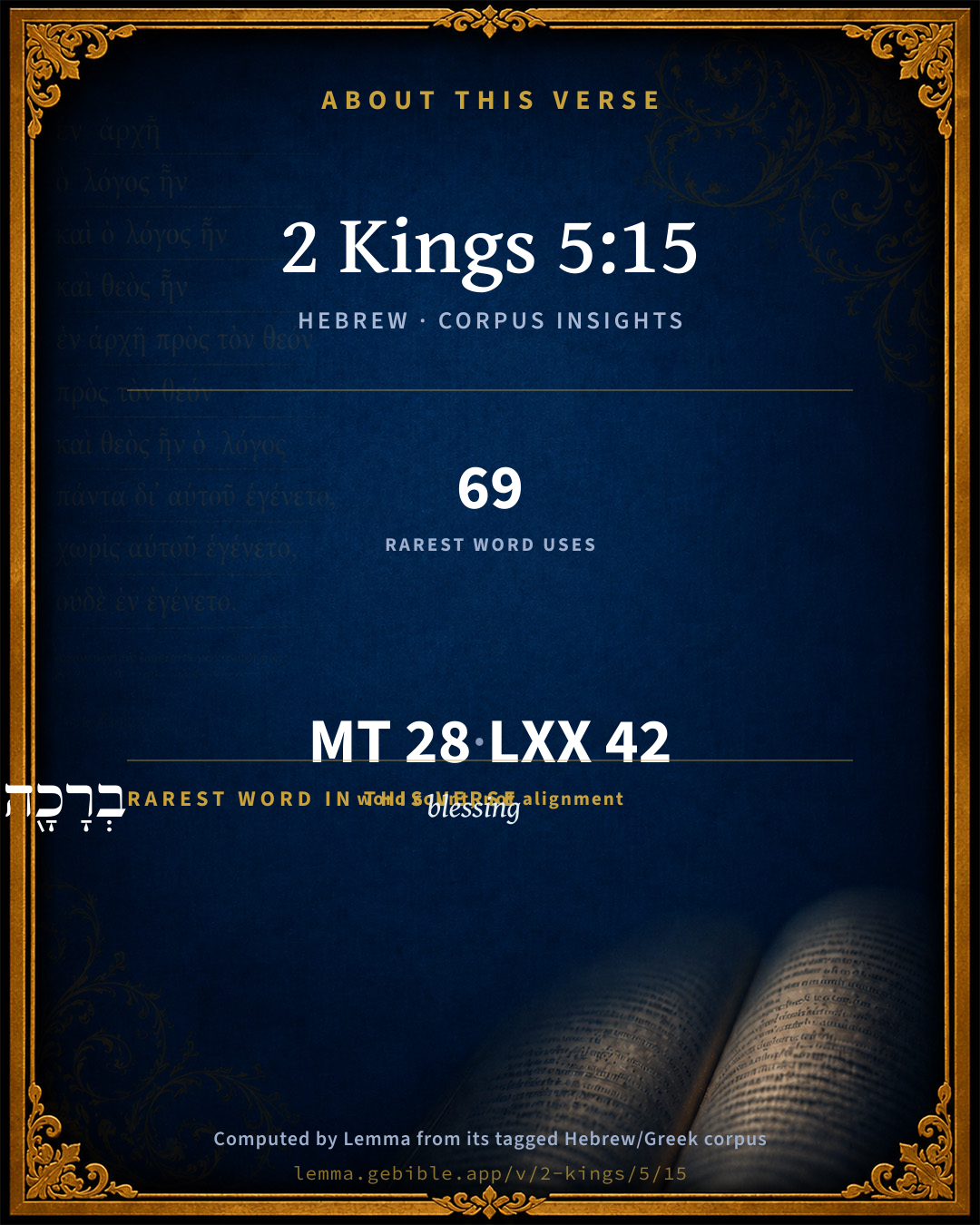
2 Kings 5:15

Hebrew (Westminster Leningrad Codex) 2 Kings 5:15 appears in the Hebrew Old Testament. The text above is from the Westminster Leningrad Codex. Each word links to its Strong’s number, a concise gloss, and parsing drawn from the Open Scriptures Hebrew Bible morphology. Click any word for its full Brown-Driver-Briggs (BDB) entry.
Download image
Cite this verse

2 Kings 5:15 (World English Bible). Public Domain. Lemma interlinear Bible study tool, https://lemma.gebible.app/v/2-kings/5/15.

Show BibTeX & RIS
BibTeX
RIS
English Translation
He returned to the man of God, he and all his company, and came, and stood before him; and he said, See now, I know that there is no God in all the earth, but in Israel: now therefore, please take a present from your servant.
World English Bible · Public Domain
Download a study sheet

One document with this verse’s original text, its word-by-word gloss line, the meaning frame, cross-references with their text, attributed commentary, and full source and license credits — printable, and it pastes into notes with its structure intact.

This verse Autodidact and up

Study sheet (.html) Plain text (.txt)

A passage Seminary Student

Up to 50 verses in one chapter. A passage sheet keeps up to 6 commentary sources and 12 cross-references per verse, in the order this page ranks them, and says so on the sheet whenever that leaves anything out. Ask for a single verse and you get the Autodidact verse sheet above.

Everything on this page stays free to read, with no account — the sheet is a download of what is already on screen, not access to it.

Want to remove ads? Support Godless Engineer
Compare translations 3

The same verse in 3 English versions, stacked beneath the original-language interlinear above. Click any original word for its lexicon entry.

Each is an independent rendering of the whole verse — the interlinear is not word-aligned to these translations.

Highlighted words mark where these versions differ — a whole-verse word diff, not a word-by-word alignment.

  • World English Bible Public Domain
    He returned to the man of God, he and all his company, and came, and stood before him; and he said, See now, I know that there is no God in all the earth, but in Israel: now therefore, please take a present from your servant.
  • King James Version Public Domain
    And he returned to the man of God, he and all his company, and came, and stood before him: and he said, Behold, now I know that there is no God in all the earth, but in Israel: now therefore, I pray thee, take a blessing of thy servant.
  • unfoldingWord Literal Text CC BY-SA 4.0
    And he returned to the man of God, he and all of his camp, and he came and stood to his face. And he said, “Behold, please, I know that there is no God in all of the earth except in Israel. And now, please take a blessing from your servant.”

unfoldingWord Literal Text — © unfoldingWord, licensed CC BY-SA 4.0. Word-aligned USFM3 via Door43 (git.door43.org/unfoldingWord/en_ult).

Versions to compare (up to 4)

3 of 4 selected

Show all 18 translations

Every available English version of this verse, each an independent rendering of the whole verse.

  • World English Bible Public Domain
    He returned to the man of God, he and all his company, and came, and stood before him; and he said, See now, I know that there is no God in all the earth, but in Israel: now therefore, please take a present from your servant.
  • Berean Standard Bible Public Domain
    Then Naaman and all his attendants went back to the man of God, stood before him, and declared, “Now I know for sure that there is no God in all the earth except in Israel. So please accept a gift from your servant.”
  • Majority Standard Bible Public Domain
    Then Naaman and all his attendants went back to the man of God, stood before him, and declared, “Now I know for sure that there is no God in all the earth except in Israel. So please accept a gift from your servant.”
  • King James Version Public Domain
    And he returned to the man of God, he and all his company, and came, and stood before him: and he said, Behold, now I know that there is no God in all the earth, but in Israel: now therefore, I pray thee, take a blessing of thy servant.
  • American Standard Version (1901) Public Domain
    And he returned to the man of God, he and all his company, and came, and stood before him; and he said, Behold now, I know that there is no God in all the earth, but in Israel: now therefore, I pray thee, take a present of thy servant.
  • Revised Version (1885) Public Domain
    And he returned to the man of God, he and all his company, and came, and stood before him: and he said, Behold now, I know that there is no God in all the earth, but in Israel: now therefore, I pray thee, take a present of thy servant.
  • Geneva Bible (1599) Public Domain
    And hee turned againe to the man of God, hee, and all his companie, and came and stood before him, and sayd, Behold, now I knowe that there is no God in all the world, but in Israel: now therefore, I pray thee, take a reward of thy seruant.
  • Douay-Rheims (1899) Public Domain
    And returning to the man of God with all his train, be came, and stood before him, and said: In truth, I know there is no other God in all the earth, but only in Israel: I beseech thee therefore take a blessing of thy servant.
  • Young's Literal Translation Public Domain
    And he turneth back unto the man of God, he and all his camp, and cometh in, and standeth before him, and saith, `Lo, I pray thee, I have known that there is not a God in all the earth except in Israel; and now, take, I pray thee, a blessing from thy servant.'
  • Literal Standard Version CC BY-SA 4.0
    And he turns back to the man of God, he and all his camp, and comes in, and stands before him, and says, “Now behold, I have known that there is not a God in all the earth except in Israel; and now, please take a blessing from your servant.”
  • Unlocked Literal Bible CC BY-SA 4.0
    Naaman returned to the man of God, he and all his company, and came and stood before him. He said, “Look, now I know that there is no God in all the earth except in Israel. So therefore, please take a gift from your servant.”
  • unfoldingWord Literal Text CC BY-SA 4.0
    And he returned to the man of God, he and all of his camp, and he came and stood to his face. And he said, “Behold, please, I know that there is no God in all of the earth except in Israel. And now, please take a blessing from your servant.”
  • Darby Bible Public Domain
    And he returned to the man of God, he and all his company, and came and stood before him; and he said, Behold, I know that there is no God in all the earth but in Israel; and now, I pray thee, take a present of thy servant.
  • World Messianic Bible Public Domain
    He returned to the man of God, he and all his company, and came, and stood before him; and he said, “See now, I know that there is no God in all the earth, but in Israel. Now therefore, please take a gift from your servant.”
  • Webster's Bible Public Domain
    And he returned to the man of God, he and all his company, and came and stood before him: and he said, Behold, now I know that there is no God in all the earth, but in Israel: now therefore, I pray thee, take a blessing from thy servant.
  • Free Bible Version CC BY-SA 4.0
    Then Naaman and his whole entourage went back to the man of God, stood before him, and Naaman announced, “Now I'm convinced that there is no God in all the world except in Israel. Please accept a gift from me, your servant.”
  • Bible in Basic English Public Domain
    Then he went back to the man of God, with all his train, and, taking his place before him, said, Now I am certain that there is no God in all the earth, but only in Israel: now then, take an offering from me.
  • JPS Tanakh (1917) Public Domain
    And he returned to the man of God, he and all his company, and came, and stood before him; and he said: 'Behold now, I know that there is no God in all the earth, but in Israel; now therefore, I pray thee, take a present of thy servant.'

Literal Standard Version (2020), Covenant Press — licensed CC BY-SA 4.0. Text via the HelloAO Bible API (eBible.org). Unlocked Literal Bible (unfoldingWord) — licensed CC BY-SA 4.0. Text via the HelloAO Bible API (eBible.org). unfoldingWord Literal Text — © unfoldingWord, licensed CC BY-SA 4.0. Word-aligned USFM3 via Door43 (git.door43.org/unfoldingWord/en_ult). Free Bible Version, Dr. Jonathan Gallagher — licensed CC BY-SA 4.0. Text via the HelloAO Bible API (eBible.org).

Word by word

More ways to search: Search by grammar → Find every occurrence → Compare this word →

Practice this passage: Drill this verse → Learn its vocabulary →

בְרָכָ֖ה
Bᵉrâkâh
H1293
“blessing”
Noun, Common, Feminine, Singular, Absolute
Part of Speech
Noun
Type
Common
Gender
Feminine
Number
Singular
State
Absolute
Full BDB Definition

Origin: from H1288

TWOT: None

blessing - (source of) blessing - blessing, prosperity - blessing, praise of God - a gift, present - treaty of peace
  1. וַיָּשָׁב֩ shûwb H7725 “and · to return” Conjunction + Verb, Qal, Sequential Imperfect, 3rd Person, Masculine, Singular
  2. אֶל ʼêl H413 “to” Preposition
  3. אִ֨ישׁ ʼîysh H376 “man of” Noun, Common, Masculine, Singular, Construct
  4. הָאֱלֹהִ֜ים ʼĕlôhîym H430 “the · God(s)” Particle, Definite Article + Noun, Common, Masculine, Plural, Absolute
  5. ה֣וּא hûwʼ H1931 “he” Pronoun, Personal, 3rd Person, Masculine, Singular
  6. וְכָֽל kôl H3605 “and · all of” Conjunction + Noun, Common, Masculine, Singular, Construct
  7. מַחֲנֵ֗הוּ machăneh H4264 “camp · his” Noun, Common, Both, Singular, Construct + Suffix, Personal, 3rd Person, Masculine, Singular
  8. וַיָּבֹא֮ bôwʼ H935 “and · to enter” Conjunction + Verb, Qal, Sequential Imperfect, 3rd Person, Masculine, Singular
  9. וַיַּעֲמֹ֣ד ʻâmad H5975 “and · to stand” Conjunction + Verb, Qal, Sequential Imperfect, 3rd Person, Masculine, Singular
  10. לְפָנָיו֒ pânîym H6440 “to/for · face(s) · his” Preposition + Noun, Common, Both, Plural, Construct + Suffix, Personal, 3rd Person, Masculine, Singular
  11. וַיֹּ֗אמֶר ʼâmar H559 “and · to say” Conjunction + Verb, Qal, Sequential Imperfect, 3rd Person, Masculine, Singular
  12. הִנֵּה hinnêh H2009 “behold” Particle, Demonstrative
  13. נָ֤א nâʼ H4994 “please” Particle, Exhortation
  14. יָדַ֨עְתִּי֙ yâdaʻ H3045 “to know” Verb, Qal, Perfect, 1st Person, Common, Singular
  15. כִּ֣י kîy H3588 “that” Conjunction
  16. אֵ֤ין ʼayin H369 “nothing” Particle, Negative
  17. אֱלֹהִים֙ ʼĕlôhîym H430 “God(s)” Noun, Common, Masculine, Plural, Absolute
  18. בְּכָל kôl H3605 “in/at · all of” Preposition + Noun, Common, Masculine, Singular, Construct
  19. הָאָ֔רֶץ ʼerets H776 “the · land” Particle, Definite Article + Noun, Common, Both, Singular, Absolute
  20. כִּ֖י kîy H3588 “that” Conjunction
  21. אִם ʼim H518 “if” Conjunction
  22. בְּיִשְׂרָאֵ֑ל Yisrâʼêl H3478 “in/at · Israel” Preposition + Noun, Proper
  23. וְעַתָּ֛ה ʻattâh H6258 “and · now” Conjunction + Adverb
  24. קַח lâqach H3947 “take” Verb, Qal, Imperative, 2nd Person, Masculine, Singular
  25. נָ֥א nâʼ H4994 “please” Particle, Exhortation
  26. מֵאֵ֥ת ʼêth H854 “from · with” Preposition + Preposition
  27. עַבְדֶּֽךָ ʻebed H5650 “servant · your” Noun, Common, Masculine, Singular, Construct + Suffix, Personal, 2nd Person, Masculine, Singular

About this verse

These counts appear in no published source. They are computed here, from the morphology-tagged text and Lemma’s own curated glosses. What Lemma adds →

28
words
24
distinct lemmas
Historical
section

Grammatical profile

  • 6 verbs
  • 11 nouns
  • 1 pronoun
  • 2 prepositions
  • 3 conjunctions
  • 1 adverb
  • 4 particles

Verb forms

  • וַיָּשָׁב֩ Qal · Sequential Imperfect
  • וַיָּבֹא֮ Qal · Sequential Imperfect
  • וַיַּעֲמֹ֣ד Qal · Sequential Imperfect
  • וַיֹּ֗אמֶר Qal · Sequential Imperfect
  • יָדַ֨עְתִּי֙ Qal · Perfect
  • קַח Qal · Imperative

Repetition

Words recur within this verse — often emphatic in Hebrew:

  • הָאֱלֹהִ֜ים God H430 ×2
  • וְכָֽל all H3605 ×2
  • נָ֤א please H4994 ×2
  • כִּ֣י that H3588 ×2

Hebrew & Septuagint length

In English translation the verse runs 46 words from the Hebrew and 42 from the Septuagint (LXX English) — closely comparable.

A rough comparison of the two English renderings, which tokenize alike — not a word-level alignment.

Word counts can differ between the Hebrew and the Greek without any difference in meaning — e.g. the Hebrew direct-object marker אֵת has no separate Greek word, and Greek often adds the article ὁ.

In the original languages it is 28 Hebrew tokens and 42 Greek tokens — but the two are counted differently (Hebrew bundles its prefixes and suffixes into one token; the Greek is in lemma form), so that isn’t a like-for-like length.

Cross-references

20

Topical passages linked to 2 Kings 5:15 in the Treasury of Scripture Knowledge — connected by theme and wording, ordered by reader-vote popularity; previews shown in the World English Bible.

  • Daniel 2:47 The king answered to Daniel, and said, Of a truth your God is the God of gods, and the Lord of kings, and a revealer of secrets, seeing you have been able to reveal this secret.
  • Daniel 6:26–27 I make a decree, that in all the dominion of my kingdom men tremble and fear before the God of Daniel; for he is the living God, and steadfast forever, His kingdom that which shall not be destroyed; and his dominion shall be even to the end.
  • Joshua 2:9–11 and she said to the men, I know that Yahweh has given you the land, and that the fear of you is fallen on us, and that all the inhabitants of the land melt away before you.
  • Joshua 9:9 They said to him, From a very far country your servants are come because of the name of Yahweh your God: for we have heard the fame of him, and all that he did in Egypt,
  • 1 Samuel 17:46–47 This day will Yahweh deliver you into my hand; and I will strike you, and take your head from off you; and I will give the dead bodies of the host of the Philistines this day to the birds of the sky, and to the wild animals of the earth; that all the earth may know that there is a God in Israel,
  • 1 Samuel 25:27 Now this present which your servant has brought to my lord, let it be given to the young men who follow my lord.
  • 1 Kings 18:36 It happened at the time of the offering of the [evening] offering, that Elijah the prophet came near, and said, Yahweh, the God of Abraham, of Isaac, and of Israel, let it be known this day that you are God in Israel, and that I am your servant, and that I have done all these things at your word.
  • 2 Kings 5:8 It was so, when Elisha the man of God heard that the king of Israel had torn his clothes, that he sent to the king, saying, Why have you torn your clothes? let him come now to me, and he shall know that there is a prophet in Israel.
  • Isaiah 43:10–11 You are my witnesses, says Yahweh, and my servant whom I have chosen; that you may know and believe me, and understand that I am he: before me there was no God formed, neither shall there be after me.
  • Isaiah 44:6 Thus says Yahweh, the King of Israel, and his Redeemer, Yahweh of Hosts: I am the first, and I am the last; and besides me there is no God.
  • Isaiah 44:8 Don't fear, neither be afraid: haven't I declared to you of old, and shown it? You are my witnesses. Is there a God besides me? Indeed, there is not. I don't know any Rock.
  • Isaiah 45:6 that they may know from the rising of the sun, and from the west, that there is none besides me: I am Yahweh, and there is no one else.
  • Daniel 3:29 Therefore I make a decree, that every people, nation, and language, which speak anything evil against the God of Shadrach, Meshach, and Abednego, shall be cut in pieces, and their houses shall be made a dunghill; because there is no other god who is able to deliver after this sort.
  • Luke 17:15–18 One of them, when he saw that he was healed, turned back, glorifying God with a loud voice.
  • Romans 10:10 For with the heart, one believes unto righteousness; and with the mouth confession is made unto salvation.
  • 2 Corinthians 9:5 I thought it necessary therefore to entreat the brothers that they would go before to you, and arrange ahead of time the generous gift that you promised before, that the same might be ready as a matter of generosity, and not of greediness.
  • Genesis 33:11 Please take the gift that I brought to you; because God has dealt graciously with me, and because I have enough." He urged him, and he took it.
  • Jeremiah 10:10–11 But Yahweh is the true God; he is the living God, and an everlasting King: at his wrath the earth trembles, and the nations are not able to abide his indignation.
  • Jeremiah 16:19–21 Yahweh, my strength, and my stronghold, and my refuge in the day of affliction, to you shall the nations come from the ends of the earth, and shall say, Our fathers have inherited nothing but lies, [even] vanity and things in which there is no profit.
  • Daniel 4:34 At the end of the days I, Nebuchadnezzar, lifted up my eyes to heaven, and my understanding returned to me, and I blessed the Most High, and I praised and honored him who lives forever; for his dominion is an everlasting dominion, and his kingdom from generation to generation.

Cross-references courtesy of OpenBible.info (CC BY 4.0).

Hebrew and Greek witnesses Masoretic Hebrew ↔ Greek Septuagint

The same verse in the two great witnesses to the Old Testament, shown verse-for-verse.

These are two independent witnesses, not word-aligned to each other, and the Septuagint is shown in lemma (dictionary) form.

Hebrew 2 Kings 5:15 Masoretic · Westminster Leningrad Codex

וַיָּשָׁב֩ אֶל אִ֨ישׁ הָאֱלֹהִ֜ים ה֣וּא וְכָֽל מַחֲנֵ֗הוּ וַיָּבֹא֮ וַיַּעֲמֹ֣ד לְפָנָיו֒ וַיֹּ֗אמֶר הִנֵּה נָ֤א יָדַ֨עְתִּי֙ כִּ֣י אֵ֤ין אֱלֹהִים֙ בְּכָל הָאָ֔רֶץ כִּ֖י אִם בְּיִשְׂרָאֵ֑ל וְעַתָּ֛ה קַח נָ֥א בְרָכָ֖ה מֵאֵ֥ת עַבְדֶּֽךָ

He returned to the man of God, he and all his company, and came, and stood before him; and he said, See now, I know that there is no God in all the earth, but in Israel: now therefore, please take a present from your servant.

World English Bible · Public Domain

Greek LXX 2 Kings 5:15 Septuagint · lemma form

καί ἐπιστρέφω πρός ελισαιε αὐτός καί πᾶς ὁ παρεμβολή αὐτός καί ἔρχομαι καί ἵστημι καί εἶπον ἰδού δή γιγνώσκω ὅτι οὐ εἰμί θεός ἐν πᾶς ὁ γῆ ὅτι ἀλλά ἤ ἐν ὁ ἰσραήλ καί νῦν λαμβάνω ὁ εὐλογία παρά ὁ δοῦλος σύ

And he and all his company returned to Elisaie, and he came and stood before him, and said, Behold, I know that there is no God in all the earth, save only in Israel: and now receive a blessing of your servant.

LXX2012 (modern English Septuagint) · Public Domain

Hebrew: Westminster Leningrad Codex (CC BY 4.0). Greek: Septuagint (public domain); English from LXX2012 (modern English Septuagint) (Public Domain). How the Septuagint differs from the Hebrew →

Targum (Aramaic paraphrase)

1

The Targum is the ancient Jewish Aramaic paraphrase of the Hebrew Scriptures — an interpretive translation, not the Hebrew text itself. Onkelos (literal) and Pseudo-Jonathan (expansive) render the Torah, and Jonathan the Prophets. Coverage is partial: where no permissively-licensed English translation exists for a verse, only the Aramaic is shown. This is verse-level text, not a word-by-word alignment to the Hebrew.

  1. Targum Jonathan Prophets (Joshua–Malachi)
    וְתַב לְוַת נְבִיָא דַייָ הוּא וְכָל מַשִׁרְיָתֵיהּ וַאֲתָא וְקָם קֳדָמוֹהִי וַאֲמַר הָא כְעַן יְדָעִית אֲרֵי לֵית אֱלָהָא קַיָם בְּכָל אַרְעָא אֱלָהֵין בְּיִשְׂרָאֵל וּכְעַן קַבֵּל כְעַן תִּקְרוּבְתָּא מִן עַבְדָךְ:

    (no public-domain English translation for this verse)

    Targum Jonathan — Aramaic: “Mikraot Gedolot” (public domain). English: “Sefaria Community Translation” (CC0 1.0 (public-domain dedication)); “London "Chaldee Paraphrase," 1871” (public domain). Text via Sefaria.

Commentary

Notes on 2 Kings 5:15 from classic Christian and Jewish commentators (each source and its license shown beneath its notes). The classic Christian expositions comment on the surrounding passage and are grouped to its opening verse, so a note may address several verses; the Jewish commentaries on the Tanakh (Rashi and others) are per-verse, so they appear only where the commentator wrote on this verse.

Lemma curates 59 commentaries, every one of them public domain or Creative Commons licensed, each selected and text-cleaned for this edition rather than reprinted as found. About our sources →

Matthew Henry's Commentary

Of the ten lepers that our Saviour cleansed, the only one that returned to give thanks was a Samaritan, Luk 17:16. This Syrian did so, and here expresses himself.

I. Convinced of the power of the God of Israel, not only that he is God, but that he is God alone, and that indeed there is no God in all the earth but in Israel (Kg2 5:15) - a noble confession, but such as intimates the misery of the Gentile world; for the nations that had many gods really had no God, but were without God in the world. He had formerly thought the gods of Syria gods indeed, but now experience had rectified his mistake, and he knew Israel's God was God alone, the sovereign Lord of all. Had he seen other lepers cleansed, perhaps the sight would not have convinced him, but the mercy of the cure affected him more than the miracle of it. Those are best able to speak of the power of divine grace who have themselves experienced it.

II. Grateful to Elisha the prophet: "Therefore, for his sake whose servant thou art, I have a present for thee, silver, and gold, and raiment, whatever thou wilt please to accept." He valued the cure, not by the easiness of it to the prophet, but the acceptableness of it to himself, and would gladly pay for it accordingly. But Elisha generously refused the fee, though urged to accept it; and, to prevent further importunity, backed his refusal with an oath: As the Lord liveth, I will receive none (Kg2 5:16), not because he did not need it, for he was poor enough, and knew what to do with it, and how to bestow it among the sons of the prophets, nor because he thought it unlawful, for he received presents from others; but he would not be beholden to this Syrian, nor should he say, I have made Elisha rich, Gen 14:23. It would be much for the honour of God to show this new convert that the servants of the God of Israel were taught to look upon the wealth of this world with a holy contempt, which would confirm him in his belief that there was no God but in Israel. See Co1 9:18; Co2 11:9.

III. Proselyted to the worship of the God of Israel. He will not only offer a sacrifice to the Lord, in thanks for his present cure, but he resolves he will never offer sacrifice to any other gods, Kg2 5:17. It was a happy cure of his leprosy which cured him of his idolatry, a more dangerous disease. But here are two instances of his weakness and infirmity in his conversion: - 1. In one instance he over-did it, that he would not only worship the God of Israel, but he would have clods of earth out of the prophet's garden, or at least of the prophet's ordering, to make an altar of, Kg2 5:17. He that awhile ago had spoken very slightly of the waters of Israel (Kg2 5:12) now is in another extreme, and over-values the earth of Israel, supposing (since God has appointed altars of earth, Exo 20:24) that an altar of that earth would be most acceptable to him, not considering that all the earth is the Lord's and the fulness thereof. Or perhaps the transport of his affection and veneration for the prophet, not only upon the account of his power, but of his virtue and generosity, made him, as we say, love the very ground he went upon and desire to have some of it home with him. The modern compliment equivalent to this would be, "Pray, sir, let me have your picture." 2. In another instance he under-did it, that he reserved to himself a liberty to bow in the house of Rimmon, in complaisance to the king his master, and according to the duty of his place at court (Kg2 5:18), in this thing he must be excused. He owns he ought not to do it, but that he cannot otherwise not do it, but that he cannot otherwise keep his place, - protests that his bowing is not, nor ever shall be, as it had been, in honour to the idol, but only in honour to the king, - and therefore he hopes God will forgive him. Perhaps, all things considered, this might admit of some apology, though it was not justifiable. But, as to us, I am sure, (1.) If, in covenanting with God, we make a reservation for any known sin, which we will continue to indulge ourselves in, that reservation is a defeasance of his covenant. We must cast away all our transgressions and not except any house of Rimmon. (2.) Though we are encouraged to pray for the remission of the sins we have committed, yet, if we ask for a dispensation to go on in any sin for the future, we mock God, and deceive ourselves. (3.) Those that know not how to quit a place at court when they cannot keep it without sinning against God, and wronging their consciences, do not rightly value the divine favour. (4.) Those that truly hate evil will make conscience of abstaining from all appearances of evil. Though Naaman's dissembling his religion cannot be approved, yet because his promise to offer no sacrifice to any god but the God of Israel only was a great point gained with a Syrian, and because, by asking pardon in this matter, he showed such a degree of conviction and ingenuousness as gave hopes of improvement, the prophet took fair leave of him, and bade him Go in peace, Kg2 5:19. Young converts must be tenderly dealt with.

Matthew Henry's Commentary on the Whole Bible (1708–1710) — public domain (CC PDM 1.0). Text via the HelloAO Bible API.

Jamieson, Fausset & Brown

Robert Jamieson, A. R. Fausset & David Brown

ELISHA REFUSES NAAMAN'S GIFTS. (Kg2 5:15-19)

he returned to the man of God--After the miraculous cure, Naaman returned to Elisha, to whom he acknowledged his full belief in the sole supremacy of the God of Israel and offered him a liberal reward. But to show that he was not actuated by the mercenary motives of the heathen priests and prophets, Elisha, though he accepted presents on other occasions (Kg2 4:42), respectfully but firmly declined them on this, being desirous that the Syrians should see the piety of God's servants, and their superiority to all worldly and selfish motives in promoting the honor of God and the interests of true religion.

Jamieson, Fausset & Brown — Commentary Critical and Explanatory on the Whole Bible (1871) — public domain (CC PDM 1.0). Text via the HelloAO Bible API.

Trapp's Complete Commentary

John Trapp

2Ki 5:15 And he returned to the man of God, he and all his company, and came, and stood before him: and he said, Behold, now I know that [there is] no God in all the earth, but in Israel: now therefore, I pray thee, take a blessing of thy servant.

Ver. 15. And he returned to the man of God.] Like the tenth leper. {Luk 17:15} Many men are, that they may receive benefits, importunate; till they have received them, unquiet; when they have received them, unthankful. Naaman was none such.

Behold, now I know.] Hereby it appeareth that Naaman was cured on both sides, and became a pledge of the Gentiles’ conversion. {Luk 4:27}

John Trapp, A Commentary or Exposition upon All the Books of the Old and New Testament (1647–1656) — public domain. Text from a community e-Sword module.

The Biblical Illustrator

Joseph S. Exell

2Ki_5:15-16

Now therefore, I pray thee, take a blessing of thy servant.

Naamans money

This chapter contains valuable lessons concerning money; how the servants of God ought to use and to regard it. Some of our Lords weightiest and most solemn sayings were addressed to those who had much money, or were spoken with reference to them, as in the case of the rich fool, the man clothed in purple and fine linen, and the young ruler. The prominence given to this matter m Scripture need not be wondered at; for,

1. Money represents the good things of this world, which all are prone to love too well (Mar_10:22).

2. As the Lord Jesus has bought us, He claims absolute proprietorship over us (1Co_6:19-20), and therefore His claim extends to our money.

3. The manner in which a man acknowledges or repudiates this claim is, to a great extent, decisive of his spiritual condition (Mat_6:21). In the latter part of this chapter the money test is applied to three characters, Naaman, Elisha, and Gehazi:

I. Naaman longs at once to prove his gratitude, convinced that he was indebted to the God of Israel for the cure of his leprosy (Psa_116:12; Luk_17:15). He was wealthy, and to offer Elisha a present was the most natural way of showing his thankfulness. It is well when thank-offerings are common in families, when special gifts are offered for special mercies received by individual members of the household; thus the young are trained to recognise Gods claim on their possessions. But, more generally, a man who, through the cleansing power of the blood of Christ, has been cured of the leprosy of sin, will (if he has the means) pour his grateful offerings into the Lords treasury (2Co_8:1-5).

II. But Elisha firmly declined the gift. He feared lest Naaman should imagine him to be influenced by selfish considerations, and to be exercising the prophets craft for filthy lucres sake. He must not leave Naaman with false impressions as to the principles of the worshippers of the true God. Bishop Patrick says: It gives great authority to a teacher of virtue, not to be covetous. This example shows what an all-pervading principle true piety is; it leads its votary to make the glory of God his supreme end, and to shape his course accordingly (cp. Act_8:20; 1Co_9:15).

III. Tried by the money test, Gehazi is found wanting. He had every religious advantage: the constant attendant of Elisha, the witness of his miracles, the hearer of his words, the observer of his godly life, he ran well for a time. Covetousness, the love of money, is his ruin (1Ti_6:10; see verse 20). It made him a liar, and his lie made him a leper (Pro_21:6). Compare the cases of Judas and Demas. (F. F. Goe, M. A.)

The Biblical Illustrator, edited by Joseph S. Exell (c. 1880s–1900s) — public domain. Text from a community e-Sword module.

Joseph Benson's Commentary

2Ki 5:15. He returned to the man of God — To give him thanks and a recompense for the great benefit which he had received. I know there is no God in all the earth but in Israel — By this wonderful work I am fully convinced that the God of Israel is the only true God, and that other gods are impotent idols. A noble confession! but such as speaks the misery of the Gentile world; for the nations that had many gods, really had no God, but were without God in the world. He had formerly thought the gods of Syria gods indeed, but now experience had rectified his mistake, and he knew Israel’s God was God alone, the sovereign Lord of all. Had he merely seen other lepers cleansed, perhaps it would not have convinced him; but the mercy of the cure affected him more than the miracle of it. Those are best able to speak of the power of divine grace, who have themselves experienced it. I pray thee take a blessing of thy servant — A thankful acknowledgment, or token of gratitude. The Hebrews called every gift a blessing.

Joseph Benson's Commentary on the Old and New Testaments (1811–1818) — public domain. Text from a community e-Sword module.

MacLaren's Expositions of Holy Scripture

Alexander MacLaren

2 Kings

NAAMAN’S IMPERFECT FAITH

2Ki 5:15 - 2Ki 5:27.

Like the Samaritan leper healed by Jesus, Naaman came back to give glory to God. Samaria was quite out of his road to Damascus, but benefit melted his heart, and the pride, which had been indignant that the prophet did not come out to him, faded before thankfulness, which impelled him to go to the prophet. God’s gifts should humble, and gratitude is not afraid to stoop. Elisha would not see Naaman before, for he needed to be taught; but he gladly welcomes him into his presence now, for he has learned his lesson. Sometimes the best way to attract is to repel, and the true servant of God consults not his own dignity, but others’ good, whichever he does.

I. The first point is the offer and refusal of the gift. The benefited is liberal and the benefactor disinterested. Naaman was a convert to pure monotheism. His avowal is clear and full. But what a miserable conclusion he draws with that ‘therefore’! He should have said, ‘Therefore I come to trust under the shadow of His wings.’ But he is not ready to give himself, and, like some of the rest of us, thinks to compound by giving money. When the outward giving of goods is token of inward surrender of self, it is accepted. When it is a substitute for that, it is rejected. No doubt, too, Naaman thought that Elisha was, like the sorcerers of heathenism, very accessible to gifts; and if he had come to believe in Elisha’s God, he had yet to learn the loving-kindness of the God in whom he had come to believe. He had to learn next that ‘the gift of God’ was not ‘purchased with money’ and the prophet’s acceptance of his present would have dimmed Elisha’s own character, and that of his God, in the newly opened eyes of Naaman.

Elisha’s answer begins with the solemn adjuration which we first hear from Elijah. In its use here, it not only declares the unalterable determination of Elisha, but reveals its grounds. To a man who feels ever the burning consciousness that he is in the presence of God, all earthly good dwindles into nothing. How should talents of silver and gold, and changes of raiment, have worth in eyes before which that awful, blessed vision flames? A candle shows black against the sun. If we walk all the day in the light of God’s countenance, we shall not see much brightness to dazzle us in the pale and borrowed lights of earth. The vivid realisation of God in our daily lives is the true shield against the enticements of the world. Further, the consciousness of being God’s servant, which is implied in the expression ‘before whom I stand,’ makes a man shrink from receiving wages from men. ‘To his own Master he standeth or falleth,’ and will be scrupulously careful that no taint of apparent self-seeking shall spoil his service, in the eyes of men or in the judgment of the ‘great Taskmaster.’ Elisha felt that the honour of his order, and, in some sense, of his God, in the eyes of this half-convert, depended on his own perfect and transparent disinterestedness. Therefore, although he made no scruple of taking the Shunemite’s gifts, and probably lived on similar offerings, he steadfastly refused the enormous sum proffered by Naaman. ‘The labourer is worthy of his hire,’ but if accepting it is likely to make people think that he did his work for the sake of it, he must refuse it. A hireling is not a man who is paid for his work, but one who works for the sake of the pay. If once a professed servant of God falls under reasonable suspicion of doing that, his power for good is ended, as it should be.

II. The next point to notice is the alloy in the gold, or the imperfection of Naaman’s new convictions. He had been cured of his leprosy at once, but the cure of his soul had to be more gradual. It is unreasonable to expect clear sight, with the power of rightly estimating magnitudes, from a man seeing for the first time. But though Naaman’s shortcomings are very natural and excusable, they are plainly shortcomings. Note the two forms which they take,-superstition and selfish compromise. What good would a couple of loads of soil be, and could he not have taken that from the roadside without leave? The connection between the two halves of 2Ki 5:17 makes his object plain. He wished the earth ‘for’ he would not sacrifice but to Jehovah. That is, he meant to use it as the foundation of an altar, as if only some of the very ground on which Jehovah had manifested Himself was sacred enough for such a purpose. He did not, indeed, think of ‘the Lord’ as a local deity of Israel, as his ample confession of faith in 2Ki 5:15 proves; but neither had he reached the point of feeling that the Being worshipped makes the altar sacred. No wonder that he did not unlearn in an hour his whole way of thinking of religion! The reliance on externals is too natural to us all, even with all our training in a better faith, to allow of our wondering at or severely blaming him. A sackful of earth from Palestine has been supposed to make a whole graveyard a ‘Campo Santo’; and, no doubt, there are many good people in England who have carried home bottles of Jordan water for christenings. Does not the very name of ‘the Holy Land’ witness to the survival of Naaman’s sentimental error?

The other tarnish on the clear mirror was of a graver kind. Notice that he does not ask Elisha’s sanction to his intended compromise, but simply announces his intention, and hopes for forgiveness. It looks ill when a man, in the first fervour of adopting a new faith, is casting about for ways to reconcile it with the public profession of his old abandoned one. We should have thought better of Naaman’s monotheism, if he had not coupled his avowal of it, where it was safe to be honest, with the announcement that he did not intend to stand by his avowal when it was risky. It would have required huge courage to have gone back to Damascus and denied Rimmon; and our censure must be lenient, but decided.

Naaman was the first preacher of a doctrine of compromise, which has found eminent defenders and practisers, in our own and other times. To separate the official from the man, and to allow the one to profess in public a creed which the other disavows in private, is rank immorality, whoever does or advocates it. The motive in this case was, perhaps, not so much cowardice as selfish unwillingness to forfeit position and favour at court. He wants to keep all the good things he has got; and he tries to blind his conscience by representing the small compliance of bowing as almost forced on him by the grasp of the bowing king, who leaned on his hand. But was it necessary that he should be the king’s favourite? A deeper faith would have said, ‘Perish court favour and everything that hinders me from making known whose I am.’ But Naaman is an early example of the family of ‘Facing-both-ways,’ and of trying to ‘make the best of both worlds.’ But his sophistication of conscience will not do, and his own dissatisfaction with his excuse peeps out plainly in his petition that he may be forgiven. If his act needed forgiveness, it should not have been done, nor thus calmly announced. It is vain to ask forgiveness beforehand for known sin about to be committed.

Elisha is not asked for his sanction, and he neither gives nor refuses it. He dismissed Naaman with cold dignity, in the ordinary conventional form of leave-taking. His silence indicated at least the absence of hearty approval, and probably he was silent to Naaman because, as he said about the Shunemite’s trouble, the Lord had been silent to him, and he had no authoritative decision to give. Let us hope that Naaman’s faith grew and stiffened before the time of trial came, and that he did not lie to God in the house of Rimmon. Let us take the warning that we are to publish on the housetops what we hear in the ear, and that, if in anything we should be punctiliously sincere, it is in the profession of our faith.

III. The last point is Gehazi’s avarice, and what he got by it. How differently the same sight affected the man who lived near God and the one who lived by sense! Elisha had no desires stirred by the wealth in Naaman’s train. Gehazi’s mouth watered after it. Regulate desires and you rule conduct. The true regulation of desires is found in communion with God. Gehazi had a sordid soul, like Judas; and, like the traitor Apostle, he was untouched by contact with goodness and unworldliness. Perhaps the parallel might be carried farther, and both were moved with coarse contempt for their master’s silly indifference to earthly good. That feeling speaks in Gehazi’s soliloquy. He evidently thought the prophet a fool for having let ‘this Syrian’ off so easily. He was fair game, and he had brought the wealth on purpose to leave it. Profanity speaks in uttering a solemn oath on such an occasion. The putting side by side of ‘the Lord liveth’ and ‘I will run after him’ would be ludicrous if it were not horrible. How much profanity may live close beside a prophet, and learn nothing from him but a holy name to sully in an oath!

The after part of the story suggests that Naaman was out of sight of the city before he saw Gehazi coming after him. The cunning liar timed his arrival well. The courtesy of Naaman in lighting down from his chariot to receive the prophet’s servant shows how real a change had been wrought upon him, even though there were imperfections in him. Gehazi’s story is well hung together, and has plenty of ‘local colour’ to make it probable. Such glib ingenuity in lying augurs long practice in the art. If he had been content with a small fee, he needed only to have told the truth; but his story was required to put a fair face on the amount of his request. And in what an amiable light it sets Elisha! He would not take for himself, but he has nothing to give to the two imaginary scholars, who have come from some of the schools of the prophets in the hill-country of Ephraim, thirsting for instruction. How sweet the picture, and what a hard heart that could refuse the request! Truly said Paul, ‘The love of money is a root of all kinds of evil.’ Any sin may come from it, and be done to gratify it. ‘Honestly if you can, but get it,’ was Gehazi’s principle, as it is that of many a man in the Christian Churches of this day. Greed of gain is a sin that seldom keeps house alone. Naaman no doubt was glad to give, both because he was grateful, and because, like most people in high positions, he was galled by the sense of obligation to a man beneath him in rank. So back went Gehazi, with the two Syrian slaves carrying his baggage for him, and he chuckling at his lucky stroke, and pleasantly imagining how to spend his wealth.

‘The tower’ in 2Ki 5:24 is more correctly ‘the hill,’ and it was probably there where the little group would come in sight of Elisha’s house. So Gehazi gets rid of the porters before they could be seen or speak to any one, and manages his load for a little way himself, carefully hides it in the house, and, seeing the men safely off, appears obsequious and innocent before Elisha. The prophet’s gift of supernatural knowledge was intermittent, as witness his ignorance of the Shunemite’s sorrow; but Gehazi must have known its occasional action, and we can fancy that his heart sank at the ominous question, so curt in the original, and conveying so clearly the prophet’s knowledge that he had been away from the house: ‘Whence, Gehazi?’ One lie needs another to cover it, and every sin is likely to beget a successor. So, with some tremor, but without hesitation, he tries to hide his tracks. Did not Elisha’s eye pierce the wretched hypocrite as with a dart? and did not his voice ring like a judgment trumpet, as he confounded the silent sinner with the conviction that the prophet himself had been at the spot, though his body had remained in the house? So, at last, will men be reduced to stony dumbness, when they discover that an Eye which can see deeper than Elisha’s has been gazing on all their secret sins. The question, ‘Is this a time to receive?’ etc., suggests the special reasons, in Naaman’s new faith, for conspicuous disregard of wealth, in order that he might thereby learn the free love of Elisha’s God and of Jehovah’s servant, both of which had been tarnished by Gehazi’s ill-omened greed. The long enumeration following on ‘garments’ includes, no doubt, the things that Gehazi had solaced his return with the thought of buying, and so adds another proof that his heart was turned inside out before the prophet.

His punishment is severe; but his sin was great. The leprosy was a fitting punishment, both because it had been Naaman’s, from which obedient reliance on God had set him free, and because of its symbolical meaning, as the type of sin. Gehazi got his coveted money, but he got something else along with it, which he did not bargain for, and which took all the sweetness out of it. That is always the case. ‘Ill-gotten gear never prospers’; and, if a man has set his heart on worldly good, he may succeed in amassing a fortune, but the leprosy will cleave to him, and his soul will be all crusted and foul with that living death. How many successful men, perhaps high in reputation in the Church as in the world, would stand ‘lepers as white as snow,’ if we had God’s eyes to see them with!

Alexander MacLaren, Expositions of Holy Scripture (1904–1910) — public domain. Text from a community e-Sword module.

Tyndale Open Study Notes

Tyndale Open Resources

5:15-16 No God . . . except in Israel: Naaman’s physical healing led to spiritual conversion. Like the Samaritan leper healed by Jesus, Naaman returned to give thanks to his benefactor (Luke 17:15-16). • Naaman offered a gift out of gratitude, but Elisha refused; God’s grace and blessings were not to be obtained through money, gifts, or favors (Isa 55:1-5; Rom 2:4; 1 Cor 2:12; Eph 4:8).

Tyndale Open Study Notes — © Tyndale Open Resources, licensed CC BY-SA 4.0. Text via the HelloAO Bible API.

Geneva Bible (1599)

Geneva Bible translators

Hebrew, blessing.

Geneva Bible (1599) marginal notes — public domain. Text via Bolls.life.

Adam Clarke's Commentary

Verse 15. He returned to the man of God] He saw that the hand of the Lord was upon him; he felt gratitude for his cleansing; and came back to acknowledge, in the most public way, his obligation to God and his servant.

Stood before him] He was now truly humbled, and left all his state behind him. It is often the case that those who have least to value themselves on are proud and haughty; whereas the most excellent of the earth are the most humble, knowing that they have nothing but what they have received. Naaman, the leper, was more proud and dictatorial than he was when cleansed of his leprosy.

There is no God in all the earth] Those termed gods are no gods; the God of Israel is sole God in all the earth. See my sermon on this subject.

Take a blessing] Accept a present. Take an expiatory gift. - Arabic. He desired to offer something for his cleansing. He thought it right thus to acknowledge the hand from which he had received his healing, and thus honour the Lord by giving something to his servant.

Adam Clarke's Commentary on the Bible (1810–1826) — public domain. Text from a community e-Sword/MySword module.

Ellicott's Commentary for English Readers

(15) Company.—Heb., camp, host. Naaman’s following consisted of “horses and chariots” (2Ki_5:9).

Came.—Went in: into Elisha’s house. Gratitude overcame awe and dread.

Behold, now.—Behold, I pray thee. The “now” belongs to “behold,” not to “I know.”

I know that . . . in Israel.—Naaman, like most of his contemporaries, Jewish as well as Syriau, believed in locally restricted deities. The powerlessness of the Syrian gods and the potency of Jehovah having been brought home to his mind by his marvellous recovery, he concludes that there is no god anywhere save in the land of Israel. In other words, his local conception of deity still clings to him. What a mark of historic truth appears in this representation!

Now therefore.—And now.

Take a blessing of.—Accept a present from (Gen_33:11).

A Bible Commentary for English Readers, edited by Charles John Ellicott (1878–1897) — public domain. Text from a community e-Sword module.

The Cambridge Bible for Schools and Colleges

gen. ed. J. J. S. Perowne

15–19. Naaman’s gratitude. His imperfect knowledge makes his practice imperfect (Not in Chronicles)

15. And he returned to the man of God] He was a stranger in Israel, like the Samaritan among the ten lepers whom our Lord cured, but like him he also manifested his thankfulness. He came back with all his company, that the thanksgiving might lose nothing of its fulness, and in the presence of them all, proclaims the new knowledge which he has gained, how he has found that ‘there is no god who can deliver after this sort’.

came, and stood before him] His feelings and attitude are alike changed, and so the prophet now shews himself to him. Naaman has begun his lesson in the school of Jehovah and Elisha is ready to encourage his weak steps.

no God in all the earth, but in Israel] He has still his notion of different gods assigned to different lands, and does not conceive that Jehovah may be the God of all the earth. He is the God of Israel only, but all that are called gods elsewhere are not to be compared to Him.

take a blessing [R.V. present] of thy servant] Because with a present there generally is given good wishes and benediction, the Hebrews frequently used ‘blessing’ as here for ‘a gift’. Thus (Gen_33:11) Jacob calls the present which he had prepared for Esau by this name. ‘Take I pray thee, my blessing’. Cf. also Jdg_1:15; 1Sa_25:27; 1Sa_30:26 (with margin).

The Cambridge Bible for Schools and Colleges (gen. ed. J. J. S. Perowne; Cambridge University Press, 1878–1918) — public domain. Text from a community e-Sword module.

John Gill's Exposition

And he returned to the man of God, he and all his company,.... To give him thanks for the advice he had given him, and by him to give thanks to God for the cure he had received; for he was sensible it was from the Lord, his words show:

and came and stood before him; for being admitted into the prophet's house, instead of the prophet standing before him, as he before expected, he now stood before the prophet in veneration of him, and sensible of his obligation to him:

behold, now I know there is no God in all the earth, but in Israel; though he did not before, but his cure fully convinced him of it:

I pray thee, take a blessing of thy servant; not a wish of health and happiness, which the prophet would not have refused, but a present; the Targum calls it an offering.

John Gill's Exposition of the Whole Bible (1746–1763) — public domain (CC PDM 1.0). Text via the HelloAO Bible API.

Albert Barnes' Notes on the Bible

He returned - Naaman was grateful (compare Luk 17:15). From the Jordan to Samaria was a distance of not less than 32 miles. Naaman further went to Damascus, far out of his way, lengthening his necessary journey by at least three days. His special object in returning seems to have been to relieve his feelings of obligation by inducing the prophet to accept a “blessing,” i. e. a gift.

There is no God ... - Compare the marginal references; but in none of them are the expressions quite so strong as here. Naaman seems absolutely to renounce all belief in any other God but Yahweh.

Albert Barnes' Notes on the Bible (1834–1885) — public domain. Text from a community e-Sword/MySword module.

Haydock's Catholic Bible Commentary

A blessing. A present, (Challoner) accompanied with wishes of happiness, on both sides. We have seen that the prophets generally received such presents. But Eliseus acts with more reserve in regard of this stranger, as St. Paul did towards the new converts; though he received some sustenance from those, who would be less in danger of suspecting that he was actuated by selfish views in preaching the gospel, 2 Corinthians x. 7., and xii. 14., and Matthew x. 8. (Calmet) --- They abstained from every appearance of evil, (Haydock) though they might lawfully have accepted such presents. Eliseus wished to convince Naaman that God’s grace was not to be purchased, and to leave a lesson of moderation to future teachers. (Menochius)

George Leo Haydock (1774–1849), Haydock's Catholic Family Bible and Commentary, 1859 edition — public domain. Excludes Psalms (Douay-Rheims chapter numbering differs from Protestant) and Deuterocanonical books (Catholic canon only).

Matthew Poole's English Annotations

He returned to the man of God, to give him thanks, and a recompence for his great kindness.

I know that there is no God in all the earth, but in Israel; by this wonderful work I am fully convinced the God of Israel is the only true God, and that other gods are but impotent idols.

A blessing; a thankful acknowledgment. See Gen 33:11.

Matthew Poole's English Annotations on the Holy Bible (1683–1685) — public domain. Text from a community e-Sword/MySword module.

Whedon's Commentary on the Bible

Daniel D. Whedon

15. He returned — Deeply humbled, and filled with adoring gratitude to the mighty God who had wrought his cure.

No God… but in Israel — Not even in Syria, but in Israel alone, is there any God worth worshipping! A little before he had boasted of the rivers of Damascus, but he cannot henceforth reverence her gods.

Daniel D. Whedon (gen. ed.), Commentary on the Old and New Testaments (1874–1909) — public domain. Text from a community e-Sword module.

The Pulpit Commentary

And he returned to the man of God, he and all his company. It is not always seen what this involved. It involved going out of his way at least fifty miles. At the Jordan, Naaman was on his way home, had accomplished a fourth part of his return journey; in three more days he would be in Damascus, in his own palace. But he feels that it would be an unworthy act to accept his cure and make no acknowledgment of it, having turned away from the prophet "in a rage" (ver. 12), now, without apology, or retraction, or expression of regret or gratitude, to return into his own country under the obligation of an inestimable benefit. His cure has wrought in him, not merely a revulsion of feeling from rage and fury to thankfulness, hut a change of belief. It has convinced him that the God of Elisha is the God of the whole earth. It has turned him from a worshipper of Rimmon into a worshipper of Jehovah. He must proclaim this. He must let the prophet know what is in his heart. He must, if possible, induce him to accept a recompense. Therefore he thinks nothing of an outlay of time and trouble, but retraces his steps to the Israelite capital, taking with him all his company, his horses and his chariots, his gold and silver and bales of clothing, and numerous train of attendants. And came, and stood before him; i.e. descended from his chariot, and asked admittance into the prophet"s house, and was received and allowed an audience a striking contrast with his previous appearance before the house, in expectation that the prophet would come down and wait upon him. And he said, Behold, now I know that there is no God in all the earth, but in Israel. This is an acknowledgment of the sole supremacy of Jehovah on the part of a heathen, such as we scarcely find elsewhere. The general belief of the time, and indeed of antiquity, was that every land had its own god, who was supreme in it Baal in Phoenicia, Che-mesh in Moab, Moloch in Ammon, Rimmon in Syria, Bel or Bel-Merodach in Babylon, Amun-Ra in Egypt, etc.; and when there is an acknowledgment of Jehovah on the part of heathens in Scripture, it is almost always the recognition of him as a god the God of the Jews or of the Israelites, one among many (see Exo_10:16, Exo_10:17; 2Ki_17:26 2Ki_18:33-35; 2Ch_2:11; Dan_2:47 Dan_3:29 Dan_6:20, etc.) But here we have a plain and distinct recognition of him as the one and only God that is in all the earth. Naaman thus shows a greater docility, a readier receptivity, than almost any of the other pious heathens who are brought before us in Scripture. Balaam and Cyrus alone equal him. Now therefore, I pray thee, take a blessing i.e. "a presentof thy servant. Heathens were accustomed to carry presents to the oracles which they consulted, and to reward those from which they received favorable responses with gifts of enormous value (see Herod., 1:14, 50, etc.). The Jewish prophets did net generally object to such free-will offerings. Naaman therefore quite naturally and reasonably made the offer. He would have contravened usage had he not done so.

The Pulpit Commentary (1880–1919), ed. H.D.M. Spence-Jones & Joseph S. Exell — public domain. Text from a community e-Sword module.

unfoldingWord translationNotes

Door43 World Missions Community

Look

This word is used here to draw someone's attention to what is said next. AT: "Listen"

there is no God in all the earth except in Israel

"the only God in all the earth is in Israel"

As Yahweh lives, before whom I stand, I

"As surely as I know that Yahweh lives, before whom I stand." Here Elisha compares the certainty that Yahweh is alive to the certainty that he will not receive any gifts from Naaman. This is a way of making a solemn promise. AT: "As surely as Yahweh lives, before whom I stand, I promise you that I" (See: Simile)

before whom I stand

Here serving Yahweh is spoken of as standing in his presence. AT: "whom I serve" (See: Metaphor)

I will receive nothing

This means that he will not accept any gifts. AT: "I will not take any gifts" (See: Assumed Knowledge and Implicit Information)

translationWords

God

earth

Israel

gift

Elisha

Yahweh

life

receive

unfoldingWord translationNotes — © Distant Shores Media and the Door43 World Missions Community, licensed CC BY-SA 4.0. Source: git.door43.org/Door43/en_tn.

Rashi

Rabbi Shlomo Yitzchaki (Rashi)

A blessing [a gift]. A gift of peace, upon greeting, [e.g.,] when a student or a servant greets [his] master, salud, in O.F.

Rashi on the Tanakh — English translations: “The Judaica Press complete Tanach with Rashi, translated by A. J. Rosenberg” (CC BY 4.0); “Pentateuch with Rashi's commentary by M. Rosenbaum and A.M. Silbermann, 1929-1934” (public domain); “The Metsudah Tanach series, Lakewood, N.J” (CC BY 4.0); and “The Book of Joshua, Metsudah Publications, 1997” (CC BY 4.0). Text via Sefaria.

Lesson kit

Teaching starters — assembled from the data on this page, not authored interpretation. Every prompt links to the verse data it draws on. Edit before teaching.

2 Kings, in the Historical, opens this verse with 28 words (24 distinct Hebrew lemmas). Its most distinctive word is Bᵉrâkâh (“blessing”). A historical commentator’s framing appears above. Read the whole chapter for the surrounding context.

Discussion questions

  1. How does “blessing” (Bᵉrâkâh) shape what this verse is saying?
  2. How does Daniel 2:47, which shares this passage’s theme, read alongside this verse?
  3. What does the repetition of “God” (2× in this one verse) do in this verse?
  4. These translations render this verse differently; the difference is in the English rendering, not the original. What questions does that raise?
  5. «וַיָּשָׁב֩» is a Qal Sequential Imperfect verb. How does that grammatical form shape the action described?
  6. Compare how Matthew Henry's Commentary and Jamieson, Fausset & Brown read this verse. Where do they agree or differ?

Things to notice

Reading settings

Reading text

Shown beneath each verse's original-language words.

Old Testament
Old Testament edition

Read the OT as the Masoretic Hebrew (MT) or the Greek Septuagint (LXX).

English shown for the Greek Septuagint (in the Hebrew ↔ Greek comparison).

Comparing translations? Open the Compare panel on any verse page to stack up to four side by side.