Amos 2:15

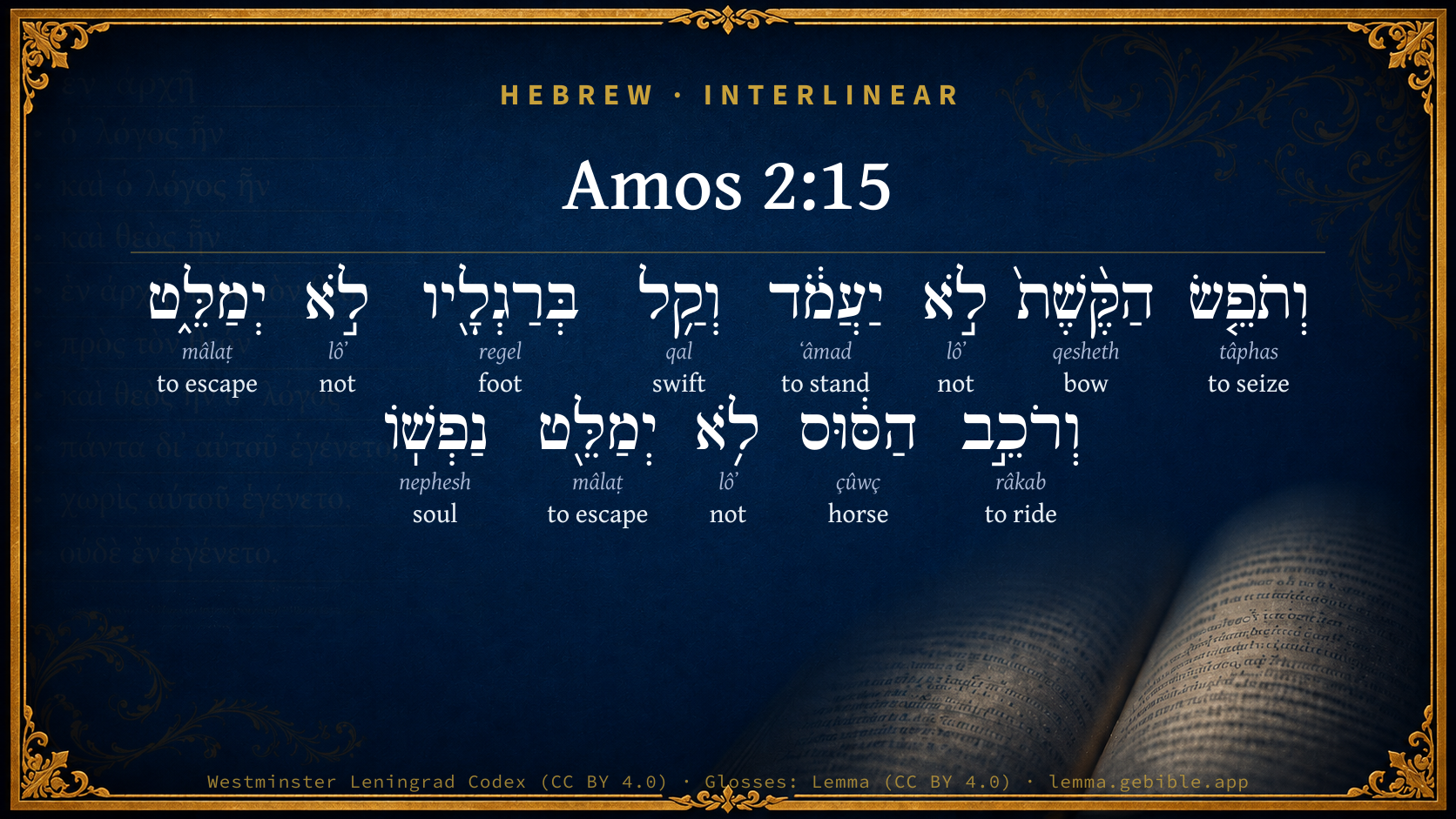
Hebrew (Westminster Leningrad Codex) Amos 2:15 appears in the Hebrew Old Testament. The text above is from the Westminster Leningrad Codex. Each word links to its Strong’s number, a concise gloss, and parsing drawn from the Open Scriptures Hebrew Bible morphology. Click any word for its full Brown-Driver-Briggs (BDB) entry.
Download image
Cite this verse

Amos 2:15 (World English Bible). Public Domain. Lemma interlinear Bible study tool, https://lemma.gebible.app/v/amos/2/15.

Show BibTeX & RIS
BibTeX
RIS
English Translation
Neither shall he stand who handles the bow; And he who is swift of foot won't escape; Neither shall he who rides the horse deliver himself;
World English Bible · Public Domain
Download a study sheet

One document with this verse’s original text, its word-by-word gloss line, the meaning frame, cross-references with their text, attributed commentary, and full source and license credits — printable, and it pastes into notes with its structure intact.

This verse Autodidact and up

Study sheet (.html) Plain text (.txt)

A passage Seminary Student

Up to 50 verses in one chapter. A passage sheet keeps up to 6 commentary sources and 12 cross-references per verse, in the order this page ranks them, and says so on the sheet whenever that leaves anything out. Ask for a single verse and you get the Autodidact verse sheet above.

Everything on this page stays free to read, with no account — the sheet is a download of what is already on screen, not access to it.

Want to remove ads? Support Godless Engineer
Compare translations 3

The same verse in 3 English versions, stacked beneath the original-language interlinear above. Click any original word for its lexicon entry.

Each is an independent rendering of the whole verse — the interlinear is not word-aligned to these translations.

Highlighted words mark where these versions differ — a whole-verse word diff, not a word-by-word alignment.

  • World English Bible Public Domain
    Neither shall he stand who handles the bow; And he who is swift of foot won't escape; Neither shall he who rides the horse deliver himself;
  • King James Version Public Domain
    Neither shall he stand that handleth the bow; and he that is swift of foot shall not deliver himself: neither shall he that rideth the horse deliver himself.
  • unfoldingWord Literal Text CC BY-SA 4.0
    The one who holds the bow will not stand; the one who is swift with his feet will not escape; the one who rides the horse will not escape with his life.

unfoldingWord Literal Text — © unfoldingWord, licensed CC BY-SA 4.0. Word-aligned USFM3 via Door43 (git.door43.org/unfoldingWord/en_ult).

Versions to compare (up to 4)

3 of 4 selected

Show all 18 translations

Every available English version of this verse, each an independent rendering of the whole verse.

  • World English Bible Public Domain
    Neither shall he stand who handles the bow; And he who is swift of foot won't escape; Neither shall he who rides the horse deliver himself;
  • Berean Standard Bible Public Domain
    The archer will not stand his ground, the fleet of foot will not escape, and the horseman will not save his life.
  • Majority Standard Bible Public Domain
    The archer will not stand his ground, the fleet of foot will not escape, and the horseman will not save his life.
  • King James Version Public Domain
    Neither shall he stand that handleth the bow; and he that is swift of foot shall not deliver himself: neither shall he that rideth the horse deliver himself.
  • American Standard Version (1901) Public Domain
    neither shall he stand that handleth the bow; and he that is swift of foot shall not deliver `himself'; neither shall he that rideth the horse deliver himself;
  • Revised Version (1885) Public Domain
    neither shall he stand that handleth the bow; and he that is swift of foot shall not deliver himself: neither shall he that rideth the horse deliver himself:
  • Geneva Bible (1599) Public Domain
    Nor he that handleth the bowe, shall stand, and he that is swift of foote, shall not escape, neyther shall he that rideth the horse, saue his life.
  • Douay-Rheims (1899) Public Domain
    And he that holdeth the bow shall not stand, and the swift of foot shall not escape, neither shall the rider of the horse save his life.
  • Young's Literal Translation Public Domain
    And the handler of the bow standeth not, And the swift with his feet delivereth not `himself', And the rider of the horse delivereth not his soul.
  • Literal Standard Version CC BY-SA 4.0
    And the handler of the bow does not stand, || And the swift does not deliver [himself] with his feet, || And the rider of the horse does not deliver his soul.
  • Unlocked Literal Bible CC BY-SA 4.0
    The archer will not stand; the fast runner will not escape; the horseman will not save himself.
  • unfoldingWord Literal Text CC BY-SA 4.0
    The one who holds the bow will not stand; the one who is swift with his feet will not escape; the one who rides the horse will not escape with his life.
  • Darby Bible Public Domain
    Neither shall he stand that handleth the bow; and the swift of foot shall not escape, and he that rideth the horse shall not deliver his soul;
  • World Messianic Bible Public Domain
    He who handles the bow won’t stand. He who is swift of foot won’t escape. He who rides the horse won’t deliver himself.
  • Webster's Bible Public Domain
    Neither shall he stand that handleth the bow; and he that is swift of foot shall not deliver himself: neither shall he that rideth the horse deliver himself.
  • Free Bible Version CC BY-SA 4.0
    The archer will not stand his ground. The quickest on his feet will not be able to get away, and even those on horseback will not save themselves.
  • Bible in Basic English Public Domain
    And the bowman will not keep his place; he who is quick-footed will not get away safely: and the horseman will not keep his life.
  • JPS Tanakh (1917) Public Domain
    Neither shall he stand that handleth the bow; and he that is swift of foot shall not deliver himself; neither shall he that rideth the horse deliver himself;

Literal Standard Version (2020), Covenant Press — licensed CC BY-SA 4.0. Text via the HelloAO Bible API (eBible.org). Unlocked Literal Bible (unfoldingWord) — licensed CC BY-SA 4.0. Text via the HelloAO Bible API (eBible.org). unfoldingWord Literal Text — © unfoldingWord, licensed CC BY-SA 4.0. Word-aligned USFM3 via Door43 (git.door43.org/unfoldingWord/en_ult). Free Bible Version, Dr. Jonathan Gallagher — licensed CC BY-SA 4.0. Text via the HelloAO Bible API (eBible.org).

Word by word

More ways to search: Search by grammar → Find every occurrence → Compare this word →

Practice this passage: Drill this verse → Learn its vocabulary →

וְקַ֥ל
qal
H7031
“and · swift”
Conjunction + Adjective, Adjective, Masculine, Singular, Absolute
Part of Speech
Conjunction + Adjective
Type
Adjective
Gender
Masculine
Number
Singular
State
Absolute
Full BDB Definition

Origin: contracted from H7043

TWOT: 2028a

swift, light, fleet - swift - one who is swift
  1. וְתֹפֵ֤שׂ tâphas H8610 “and · seizing” Conjunction + Verb, Qal, Participle Active, Masculine, Singular, Construct
  2. הַקֶּ֨שֶׁת֙ qesheth H7198 “the · bow” Particle, Definite Article + Noun, Common, Feminine, Singular, Absolute
  3. לֹ֣א lôʼ H3808 “not” Particle, Negative
  4. יַעֲמֹ֔ד ʻâmad H5975 “to stand” Verb, Qal, Imperfect, 3rd Person, Masculine, Singular
  5. בְּרַגְלָ֖יו regel H7272 “in/at · feet · his” Preposition + Noun, Common, Feminine, Dual, Construct + Suffix, Personal, 3rd Person, Masculine, Singular
  6. לֹ֣א lôʼ H3808 “not” Particle, Negative
  7. יְמַלֵּ֑ט mâlaṭ H4422 “to escape” Verb, Piel, Imperfect, 3rd Person, Masculine, Singular
  8. וְרֹכֵ֣ב râkab H7392 “and · riding” Conjunction + Verb, Qal, Participle Active, Masculine, Singular, Construct
  9. הַסּ֔וּס çûwç H5483 “the · horse” Particle, Definite Article + Noun, Common, Masculine, Singular, Absolute
  10. לֹ֥א lôʼ H3808 “not” Particle, Negative
  11. יְמַלֵּ֖ט mâlaṭ H4422 “to escape” Verb, Piel, Imperfect, 3rd Person, Masculine, Singular
  12. נַפְשֽׁוֹ nephesh H5315 “soul · his” Noun, Common, Both, Singular, Construct + Suffix, Personal, 3rd Person, Masculine, Singular

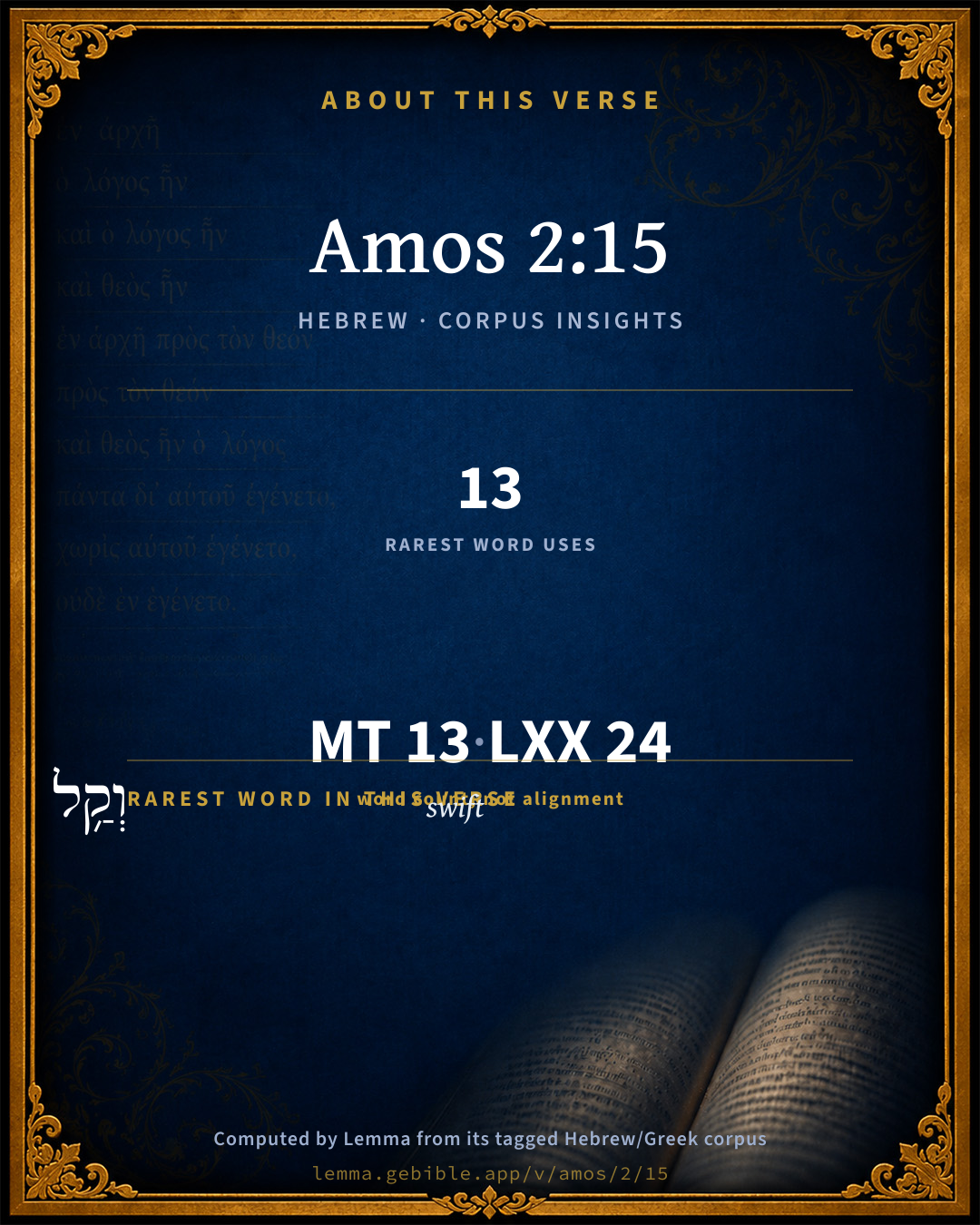
About this verse

These counts appear in no published source. They are computed here, from the morphology-tagged text and Lemma’s own curated glosses. What Lemma adds →

13
words
10
distinct lemmas
Prophets
section

Notable vocabulary

The rarest word here is וְקַ֥ל swift H7031 — appearing just 13 times in the whole Hebrew Bible.

Shared distinctive vocabulary

וְקַ֥ל swift H7031 occurs in 13 verses of the Hebrew Bible. Also found in:

Grammatical profile

  • 5 verbs
  • 4 nouns
  • 1 adjective
  • 3 particles

Verb forms

  • וְתֹפֵ֤שׂ Qal · Participle Active
  • יַעֲמֹ֔ד Qal · Imperfect
  • יְמַלֵּ֑ט Piel · Imperfect
  • וְרֹכֵ֣ב Qal · Participle Active
  • יְמַלֵּ֖ט Piel · Imperfect

Repetition

Words recur within this verse — often emphatic in Hebrew:

  • יְמַלֵּ֑ט to escape H4422 ×2
  • לֹ֣א not H3808 ×3

Hebrew & Septuagint length

In English translation the verse runs 26 words from the Hebrew and 26 from the Septuagint (LXX English) — the same length.

A rough comparison of the two English renderings, which tokenize alike — not a word-level alignment.

Word counts can differ between the Hebrew and the Greek without any difference in meaning — e.g. the Hebrew direct-object marker אֵת has no separate Greek word, and Greek often adds the article ὁ.

In the original languages it is 13 Hebrew tokens and 24 Greek tokens — but the two are counted differently (Hebrew bundles its prefixes and suffixes into one token; the Greek is in lemma form), so that isn’t a like-for-like length.

Cross-references

2

Topical passages linked to Amos 2:15 in the Treasury of Scripture Knowledge — connected by theme and wording, ordered by reader-vote popularity; previews shown in the World English Bible.

  • Psalms 33:16–17 There is no king saved by the multitude of a host. A mighty man is not delivered by great strength.
  • Ezekiel 39:3 and I will strike your bow out of your left hand, and will cause your arrows to fall out of your right hand.

Cross-references courtesy of OpenBible.info (CC BY 4.0).

Hebrew and Greek witnesses Masoretic Hebrew ↔ Greek Septuagint

The same verse in the two great witnesses to the Old Testament, shown verse-for-verse.

These are two independent witnesses, not word-aligned to each other, and the Septuagint is shown in lemma (dictionary) form.

Hebrew Amos 2:15 Masoretic · Westminster Leningrad Codex

וְתֹפֵ֤שׂ הַקֶּ֨שֶׁת֙ לֹ֣א יַעֲמֹ֔ד וְקַ֥ל בְּרַגְלָ֖יו לֹ֣א יְמַלֵּ֑ט וְרֹכֵ֣ב הַסּ֔וּס לֹ֥א יְמַלֵּ֖ט נַפְשֽׁוֹ

Neither shall he stand who handles the bow; And he who is swift of foot won't escape; Neither shall he who rides the horse deliver himself;

World English Bible · Public Domain

Greek LXX Amos 2:15 Septuagint · lemma form

καί ὁ τοξότης οὐ μή ὑποἵστημι καί ὁ ὀξύς ὁ πούς αὐτός οὐ μή διασώζω οὐδέ ὁ ἱππεύς οὐ μή σώζω ὁ ψυχή αὐτός

and the archer shall not withstand, and he that is swift of foot shall in no wise escape; and the horseman shall not save his life.

LXX2012 (modern English Septuagint) · Public Domain

Hebrew: Westminster Leningrad Codex (CC BY 4.0). Greek: Septuagint (public domain); English from LXX2012 (modern English Septuagint) (Public Domain). How the Septuagint differs from the Hebrew →

Targum (Aramaic paraphrase)

1

The Targum is the ancient Jewish Aramaic paraphrase of the Hebrew Scriptures — an interpretive translation, not the Hebrew text itself. Onkelos (literal) and Pseudo-Jonathan (expansive) render the Torah, and Jonathan the Prophets. Coverage is partial: where no permissively-licensed English translation exists for a verse, only the Aramaic is shown. This is verse-level text, not a word-by-word alignment to the Hebrew.

  1. Targum Jonathan Prophets (Joshua–Malachi)
    וַאֲחִיד קַשְׁתָּא לָא יְקוּם וּדְקַלִיל בְּרִגְלֵיה לָא יִשְׁתֵּיזֵיב וּרְכִיב סוּסַיָא לָא יְשֵׁיזֵיב נַפְשֵׁיהּ:

    (no public-domain English translation for this verse)

    Targum Jonathan — Aramaic: “Mikraot Gedolot” (public domain). English: “Sefaria Community Translation” (CC0 1.0 (public-domain dedication)); “London "Chaldee Paraphrase," 1871” (public domain). Text via Sefaria.

Commentary

Notes on Amos 2:15 from classic Christian and Jewish commentators (each source and its license shown beneath its notes). The classic Christian expositions comment on the surrounding passage and are grouped to its opening verse, so a note may address several verses; the Jewish commentaries on the Tanakh (Rashi and others) are per-verse, so they appear only where the commentator wrote on this verse.

Lemma curates 59 commentaries, every one of them public domain or Creative Commons licensed, each selected and text-cleaned for this edition rather than reprinted as found. About our sources →

Trapp's Complete Commentary

John Trapp

Amo 2:15 Neither shall he stand that handleth the bow; and [he that is] swift of foot shall not deliver [himself]: neither shall he that rideth the horse deliver himself.

Ver. 15. Neither shall he stand that handleth the bow] Arcitenens, though he can do it never so dexterously, yet if he trust in his bow, Psa 44:6, God will break it, Jer 49:35, or otherwise render it unuseful; as it befell the army of Sennacherib in Egypt, of Maximus against Theodosius, and the French in the battle between our Edward III and their King Philip, who being enraged with a defeat, resolved presently to revenge it, being elevated with an assured hope of triumphant victory. But it happened otherwise; for there fell at the instant of the battle a piercing shower of rain which dissolved their strings, and made their bows useless.

Neither shall he that rideth the horse] Though it be as good a one as Cain is feigned by Dubertas to have managed, or as Alexander’s Bucephalus, or Julius Cesar’s great horse serviceable, and full of terror. A horse is so swift that Job saith he "eateth up the ground"; and the Persians dedicated him to their god the sun, as the swiftest creature to the swiftest power divine, ωσπερ το ταχιστον τω ταχυτατφ θεων (Pausan.). But as the sun in heaven can neither be outrun nor stopped in his race, so neither by men nor means can God be frustrated, or his anger avoided. The Canaanites had both horses and chariots, the Israelites had neither; and yet they found a horse a vain thing for victory, Psa 33:17; Psa 147:10.

John Trapp, A Commentary or Exposition upon All the Books of the Old and New Testament (1647–1656) — public domain. Text from a community e-Sword module.

Tyndale Open Study Notes

Tyndale Open Resources

2:15 The archers stood in the last ranks. If they fled, it meant the forward ranks had collapsed.

Tyndale Open Study Notes — © Tyndale Open Resources, licensed CC BY-SA 4.0. Text via the HelloAO Bible API.

Adam Clarke's Commentary

Verse 15. Neither shall he that rideth the horse deliver himself.] I believe all these sayings, Am 2:13-16, are proverbs, to show the inutility of all attempts, even in the best circumstances, to escape the doom now decreed, because the cup of their iniquity was full.

Adam Clarke's Commentary on the Bible (1810–1826) — public domain. Text from a community e-Sword/MySword module.

Ellicott's Commentary for English Readers

(15) Is omitted in some of Kennicott’s and De Rossi’s MSS., but without authority.

A Bible Commentary for English Readers, edited by Charles John Ellicott (1878–1897) — public domain. Text from a community e-Sword module.

The Cambridge Bible for Schools and Colleges

gen. ed. J. J. S. Perowne

15. stand] i.e. keep his place, or halt in the flight: so Nah_2:8; Jer_46:21.

swift of foot] For this virtue of a warrior cf. 2Sa_1:23; 2Sa_2:18 (the same expression as here), 1Ch_12:8.

deliver himself] As the text stands, himself must be understood from the next clause: but it is better, with a change of vowel-points, to read yimmâlçṭ, which will itself mean ‘deliver himself.’

The Cambridge Bible for Schools and Colleges (gen. ed. J. J. S. Perowne; Cambridge University Press, 1878–1918) — public domain. Text from a community e-Sword module.

John Gill's Exposition

Neither shall he stand that handleth the bow,.... That is, at some distance, and can make use of his instruments of war afar off; yet will not think it safe to stand his ground, but will betake himself to his heels as fast as he can to save himself:

and he that is swift of foot shall not deliver himself; this is repeated, lest any should place confidence in their agility, and to show how complete and inevitable the affliction will be:

neither shall he that rideth the horse deliver himself; by fleeing on horseback, no more than he that is on foot; no ways that can be devised or thought on would preserve from this general calamity; see Psa 33:17.

John Gill's Exposition of the Whole Bible (1746–1763) — public domain (CC PDM 1.0). Text via the HelloAO Bible API.

Haydock's Catholic Bible Commentary

CHAPTER II.

George Leo Haydock (1774–1849), Haydock's Catholic Family Bible and Commentary, 1859 edition — public domain. Excludes Psalms (Douay-Rheims chapter numbering differs from Protestant) and Deuterocanonical books (Catholic canon only).

Matthew Poole's English Annotations

Neither shall he stand; though at distance from the enemies, yet shall not dare to keep his place.

That handleth the bow; much used in the wars of those times, and used by strong and valiant men, but now both strength and valour should fail Israel’s bow-men.

He that is swift of foot shall not deliver himself: this is the same, and explains that in the 14th verse.

Neither shall he that rideth the horse deliver himself: here the prophet foretells that the swiftness of the horse, which some will make use of, shall as little avail, nor his strength joined with his speed shall deliver the rider; neither the strength of the horse shall carry him through, nor his swiftness carry him away from the hand of the pursuer.

Matthew Poole's English Annotations on the Holy Bible (1683–1685) — public domain. Text from a community e-Sword/MySword module.

The Pulpit Commentary

Stand (Jer_46:21; Nah_2:8) The skilled archer shall not stand firm. That handleth the bow. (Jer_46:9)

The Pulpit Commentary (1880–1919), ed. H.D.M. Spence-Jones & Joseph S. Exell — public domain. Text from a community e-Sword module.

unfoldingWord translationNotes

Door43 World Missions Community

Connecting Statement:

Yahweh continues his message of judgment on the people of Israel.

The archer will not stand

Here "stand" means to keep one's place in battle.

the fast runner will not escape

The implied information is that the fast runner will not escape from his enemies. AT: "the fast runner will be captured" (See: Assumed Knowledge and Implicit Information)

flee naked

Possible meanings are 1) this is a metonym for "run away without his weapons" or 2) this is meant literally as "run away wearing no clothes" (See: Metonymy)

in that day

"at that time"

this is Yahweh's declaration

Yahweh speaks of himself by name to express the certainty of what he is declaring. See how you translated this in Amos 2:11. AT: "this is what Yahweh has declared" or "this is what I, Yahweh, have declared" (See: First, Second, or Third Person)

translationWords

archer

horseman

Yahweh

declare

unfoldingWord translationNotes — © Distant Shores Media and the Door43 World Missions Community, licensed CC BY-SA 4.0. Source: git.door43.org/Door43/en_tn.

Rashi

Rabbi Shlomo Yitzchaki (Rashi)

and the fleet-footed shall not deliver—himself.

Rashi on the Tanakh — English translations: “The Judaica Press complete Tanach with Rashi, translated by A. J. Rosenberg” (CC BY 4.0); “Pentateuch with Rashi's commentary by M. Rosenbaum and A.M. Silbermann, 1929-1934” (public domain); “The Metsudah Tanach series, Lakewood, N.J” (CC BY 4.0); and “The Book of Joshua, Metsudah Publications, 1997” (CC BY 4.0). Text via Sefaria.

Lesson kit

Teaching starters — assembled from the data on this page, not authored interpretation. Every prompt links to the verse data it draws on. Edit before teaching.

Amos, in the Prophets, opens this verse with 13 words (10 distinct Hebrew lemmas). Its most distinctive word is qal (“swift”). A historical commentator’s framing appears above. Read the whole chapter for the surrounding context.

Discussion questions

  1. The word qal carries the sense “swift.” How does it shape the verse?
  2. 2 Samuel 2:18 shares the word «swift» with this verse. How do the two illuminate each other?
  3. “to escape” occurs 2× in this one verse. What is the effect of the repetition?
  4. These translations render this verse differently; the difference is in the English rendering, not the original. What questions does that raise?
  5. The verb «וְתֹפֵ֤שׂ» is Qal Participle Active. How does its form color the action?
  6. Reading how Trapp's Complete Commentary and Tyndale Open Study Notes read this verse, where do the two commentators agree and where do they part?

Things to notice

Reading settings

Reading text

Shown beneath each verse's original-language words.

Old Testament
Old Testament edition

Read the OT as the Masoretic Hebrew (MT) or the Greek Septuagint (LXX).

English shown for the Greek Septuagint (in the Hebrew ↔ Greek comparison).

Comparing translations? Open the Compare panel on any verse page to stack up to four side by side.