
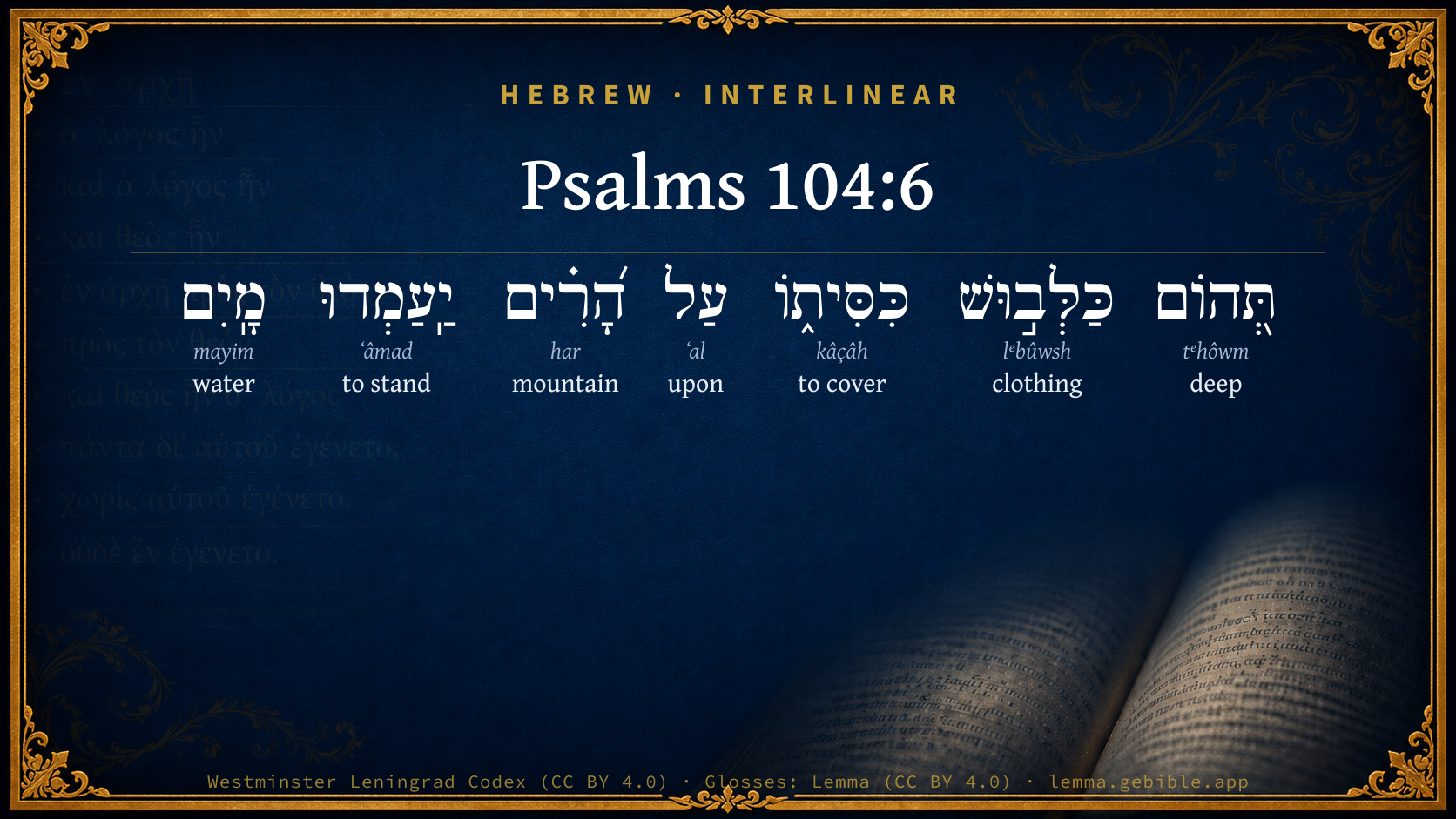
Psalms 104:6

Hebrew (Westminster Leningrad Codex) Psalms 104:6 appears in the Hebrew Old Testament. The text above is from the Westminster Leningrad Codex. Each word links to its Strong’s number, a concise gloss, and parsing drawn from the Open Scriptures Hebrew Bible morphology. Click any word for its full Brown-Driver-Briggs (BDB) entry.
Download image
Cite this verse

Psalms 104:6 (World English Bible). Public Domain. Lemma interlinear Bible study tool, https://lemma.gebible.app/v/psalms/104/6.

Show BibTeX & RIS
BibTeX
RIS
English Translation
You covered it with the deep as with a cloak. The waters stood above the mountains.
World English Bible · Public Domain
Download a study sheet

One document with this verse’s original text, its word-by-word gloss line, the meaning frame, cross-references with their text, attributed commentary, and full source and license credits — printable, and it pastes into notes with its structure intact.

This verse Autodidact and up

Study sheet (.html) Plain text (.txt)

A passage Seminary Student

Up to 50 verses in one chapter. A passage sheet keeps up to 6 commentary sources and 12 cross-references per verse, in the order this page ranks them, and says so on the sheet whenever that leaves anything out. Ask for a single verse and you get the Autodidact verse sheet above.

Everything on this page stays free to read, with no account — the sheet is a download of what is already on screen, not access to it.

Want to remove ads? Support Godless Engineer
Compare translations 3

The same verse in 3 English versions, stacked beneath the original-language interlinear above. Click any original word for its lexicon entry.

Each is an independent rendering of the whole verse — the interlinear is not word-aligned to these translations.

Highlighted words mark where these versions differ — a whole-verse word diff, not a word-by-word alignment.

  • World English Bible Public Domain
    You covered it with the deep as with a cloak. The waters stood above the mountains.
  • King James Version Public Domain
    Thou coveredst it with the deep as with a garment: the waters stood above the mountains.
  • unfoldingWord Literal Text CC BY-SA 4.0
    You covered it the deep like a garment; the waters stood above the mountains.

unfoldingWord Literal Text — © unfoldingWord, licensed CC BY-SA 4.0. Word-aligned USFM3 via Door43 (git.door43.org/unfoldingWord/en_ult).

Versions to compare (up to 4)

3 of 4 selected

Show all 18 translations

Every available English version of this verse, each an independent rendering of the whole verse.

  • World English Bible Public Domain
    You covered it with the deep as with a cloak. The waters stood above the mountains.
  • Berean Standard Bible Public Domain
    You covered it with the deep like a garment; the waters stood above the mountains.
  • Majority Standard Bible Public Domain
    You covered it with the deep like a garment; the waters stood above the mountains.
  • King James Version Public Domain
    Thou coveredst it with the deep as with a garment: the waters stood above the mountains.
  • American Standard Version (1901) Public Domain
    Thou coveredst it with the deep as with a vesture; The waters stood above the mountains.
  • Revised Version (1885) Public Domain
    Thou coveredst it with the deep as with a vesture; the waters stood above the mountains.
  • Geneva Bible (1599) Public Domain
    Thou coueredst it with the deepe as with a garment: the waters woulde stand aboue the mountaines.
  • Douay-Rheims (1899) Public Domain
    The deep like a garment is its clothing: above the mountains shall the waters stand.
  • Young's Literal Translation Public Domain
    The abyss! as with clothing Thou hast covered it, Above hills do waters stand.
  • Literal Standard Version CC BY-SA 4.0
    The abyss! You have covered it as with clothing, || Waters stand above hills.
  • Unlocked Literal Bible CC BY-SA 4.0
    You covered the earth with water like a garment; the water covered the mountains.
  • unfoldingWord Literal Text CC BY-SA 4.0
    You covered it the deep like a garment; the waters stood above the mountains.
  • Darby Bible Public Domain
    Thou hadst covered it with the deep, as with a vesture; the waters stood above the mountains:
  • World Messianic Bible Public Domain
    You covered it with the deep as with a cloak. The waters stood above the mountains.
  • Webster's Bible Public Domain
    Thou coveredst it with the deep as with a garment: the waters stood above the mountains.
  • Free Bible Version CC BY-SA 4.0
    It was clothed with ocean depths—the waters even covered the mountains—
  • Bible in Basic English Public Domain
    Covering it with the sea as with a robe: the waters were high over the mountains;
  • JPS Tanakh (1917) Public Domain
    Thou didst cover it with the deep as with a vesture; the waters stood above the mountains.

Literal Standard Version (2020), Covenant Press — licensed CC BY-SA 4.0. Text via the HelloAO Bible API (eBible.org). Unlocked Literal Bible (unfoldingWord) — licensed CC BY-SA 4.0. Text via the HelloAO Bible API (eBible.org). unfoldingWord Literal Text — © unfoldingWord, licensed CC BY-SA 4.0. Word-aligned USFM3 via Door43 (git.door43.org/unfoldingWord/en_ult). Free Bible Version, Dr. Jonathan Gallagher — licensed CC BY-SA 4.0. Text via the HelloAO Bible API (eBible.org).

Word by word

More ways to search: Search by grammar → Find every occurrence → Compare this word →

Practice this passage: Drill this verse → Learn its vocabulary →

About this verse

These counts appear in no published source. They are computed here, from the morphology-tagged text and Lemma’s own curated glosses. What Lemma adds →

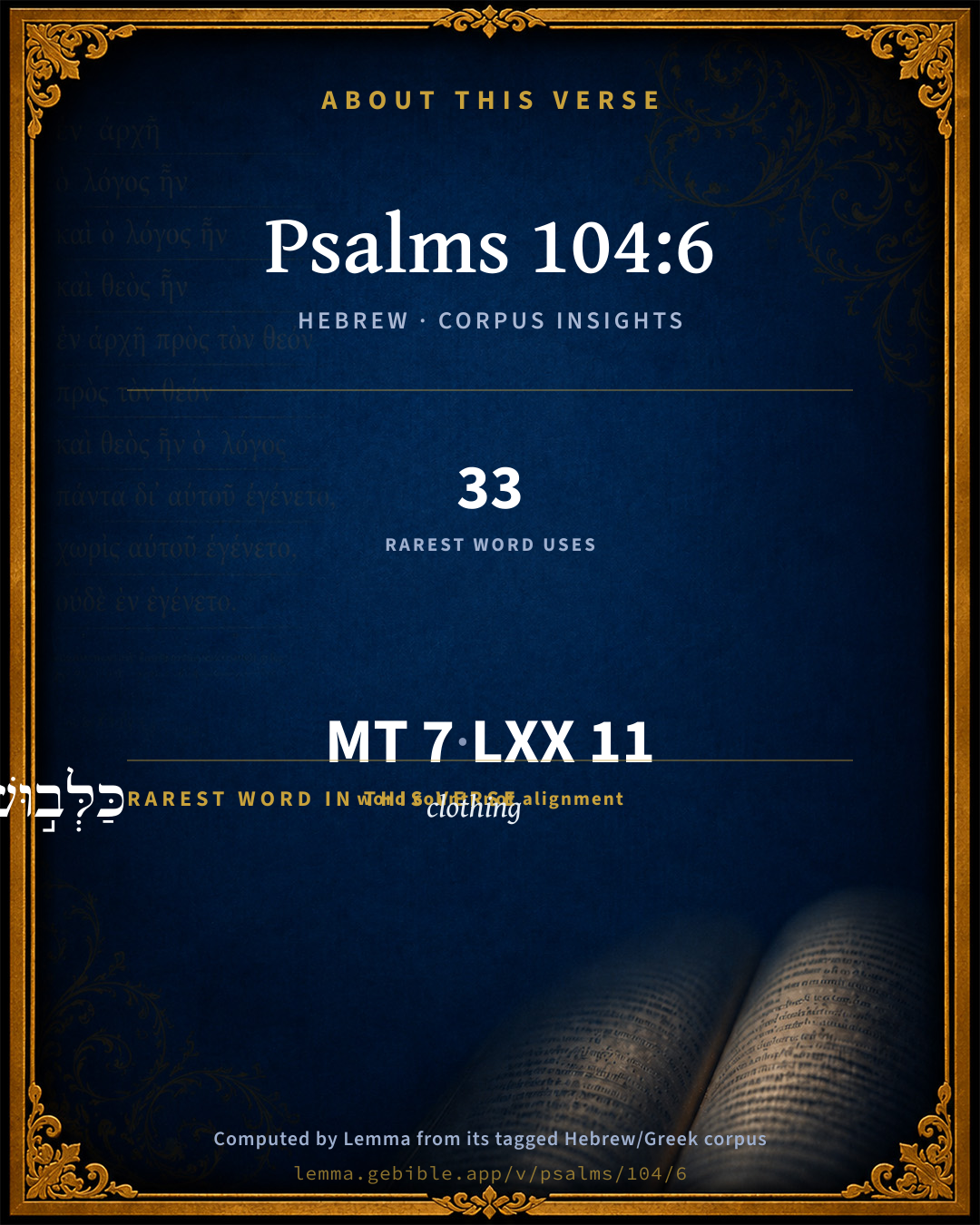
7
words
7
distinct lemmas
Wisdom
section

Shared distinctive vocabulary

כַּלְּב֣וּשׁ clothing H3830 occurs in 33 verses of the Hebrew Bible. Also found in:

Grammatical profile

  • 2 verbs
  • 4 nouns
  • 1 preposition

Verb forms

  • כִּסִּית֑וֹ Piel · Perfect
  • יַֽעַמְדוּ Qal · Imperfect

Hebrew & Septuagint length

In English translation the verse runs 16 words from the Hebrew and 17 from the Septuagint (LXX English) — closely comparable.

A rough comparison of the two English renderings, which tokenize alike — not a word-level alignment.

Word counts can differ between the Hebrew and the Greek without any difference in meaning — e.g. the Hebrew direct-object marker אֵת has no separate Greek word, and Greek often adds the article ὁ.

In the original languages it is 7 Hebrew tokens and 11 Greek tokens — but the two are counted differently (Hebrew bundles its prefixes and suffixes into one token; the Greek is in lemma form), so that isn’t a like-for-like length.

Cross-references

3

Topical passages linked to Psalms 104:6 in the Treasury of Scripture Knowledge — connected by theme and wording, ordered by reader-vote popularity; previews shown in the World English Bible.

  • Genesis 7:19 The waters prevailed exceedingly on the earth. All the high mountains that were under the whole sky were covered.
  • 2 Peter 3:5 For this they willfully forget, that there were heavens from of old, and an earth formed out of water and amid water, by the word of God;
  • Genesis 1:2–10 Now the earth was formless and empty. Darkness was on the surface of the deep. God's Spirit was hovering over the surface of the waters.

Cross-references courtesy of OpenBible.info (CC BY 4.0).

Hebrew and Greek witnesses Masoretic Hebrew ↔ Greek Septuagint

The same verse in the two great witnesses to the Old Testament, shown verse-for-verse.

You’re reading Greek Psalm 103 (Hebrew Psalm 104). The Septuagint counts the superscription, so verse numbers can differ from the Hebrew — chapter-level alignment, not verse-by-verse. Numbering follows Rahlfs.

These are two independent witnesses, not word-aligned to each other, and the Septuagint is shown in lemma (dictionary) form.

Hebrew Psalms 104:6 Masoretic · Westminster Leningrad Codex

תְּ֭הוֹם כַּלְּב֣וּשׁ כִּסִּית֑וֹ עַל הָ֝רִ֗ים יַֽעַמְדוּ מָֽיִם

You covered it with the deep as with a cloak. The waters stood above the mountains.

World English Bible · Public Domain

Greek LXX Greek Psalm 103:6 Septuagint · lemma form

ἄβυσσος ὡς ἱμάτιον ὁ περιβόλαιον αὐτός ἐπί ὁ ὄρος ἵστημι ὕδωρ

The deep, as it were a garment, is his covering: the waters shall stand on the hills.

LXX2012 (modern English Septuagint) · Public Domain

Hebrew: Westminster Leningrad Codex (CC BY 4.0). Greek: Septuagint (public domain); English from LXX2012 (modern English Septuagint) (Public Domain). How the Septuagint differs from the Hebrew →

Commentary

Notes on Psalms 104:6 from classic Christian and Jewish commentators (each source and its license shown beneath its notes). The classic Christian expositions comment on the surrounding passage and are grouped to its opening verse, so a note may address several verses; the Jewish commentaries on the Tanakh (Rashi and others) are per-verse, so they appear only where the commentator wrote on this verse.

Lemma curates 59 commentaries, every one of them public domain or Creative Commons licensed, each selected and text-cleaned for this edition rather than reprinted as found. About our sources →

Trapp's Complete Commentary

John Trapp

Psa 104:6 Thou coveredst it with the deep as [with] a garment: the waters stood above the mountains.

Ver. 6. Thou coverest it with the deep as with a garment] Operueras, Thou hadst at first covered it, till thou for man’s sake hadst made a distinction; for else such a garment would this have been to the earth as the shirt made for the murdering of Agamemnon, where he had no issue out.

The waters stood above the mountains] As the garment, in the proper use of it, is above the body; and so they would still, did not God, for our sakes, set them their bounds and borders.

John Trapp, A Commentary or Exposition upon All the Books of the Old and New Testament (1647–1656) — public domain. Text from a community e-Sword module.

Joseph Benson's Commentary

Psa 104:6-7. Thou coveredst it with the deep — That is, in the first creation, of which the psalmist is here speaking, when the earth, while yet without form, was covered all over, and, as it were, clothed with the great deep, that vast expansion of air and waters; the waters stood above the mountains — Those which are now the highest mountains were all under that liquid element. At thy rebuke — That is, at thy powerful command, which, as it were, rebuked, and thereby corrected and regulated that indigested congeries and confusion of things; they fled — Namely, the inferior waters; at the voice of thy thunder — Thy powerful voice, which resounded like thunder; they hasted away — To the place that thou hadst prepared for them, where they still make their bed.

Joseph Benson's Commentary on the Old and New Testaments (1811–1818) — public domain. Text from a community e-Sword module.

J. A. Alexander on Psalms

Joseph Addison Alexander

6. (Psa 104:6) (With) the deep, like a garment, thou didst cover it; above the mountains stand the waters. Next in importance to the separation of the land and water in the beginning (Gen 1:9-10), was the temporary confounding. of the two in the universal deluge (Gen 7:19-20), which the Psalmist therefore here connects with the creation, as equally demonstrative of almighty power, and also for the purpose of founding on this seeming vio lation of the promise in the last clause of ver. 5 (Psa 104:5), a still more solemn repetition of it. The grammatical objection that the pronoun in the phrase didst cover it is masculine, and cannot therefore refer to earth which is feminine, is easily removed by a reference to the general licence of the Hebrew syntax with respect to genders, and the idiomatic tendency to use the masculine,not as a distinctive but as a generic form, in cases where the subject is sufficiently indicated by the context. There are, moreover, several clear examples of the masculine construction of this very noun besides those in which earth or land is put for its inhabitants. See e.g. Gen 13:6, Isa 9:18. The allusion in the last clause to Gen 7:19-20, is too plain to be mistaken.

Joseph Addison Alexander, The Psalms Translated and Explained (1850) — public domain. Text from a community e-Sword module.

Tyndale Open Study Notes

Tyndale Open Resources

104:6 At first, water covered the earth.

Tyndale Open Study Notes — © Tyndale Open Resources, licensed CC BY-SA 4.0. Text via the HelloAO Bible API.

Geneva Bible (1599)

Geneva Bible translators

Thou makest the sea to be an ornament unto the earth.

If by thy power thou didst not bridle the rage of the waters, it were not possible, but the whole world should be destroyed.

Geneva Bible (1599) marginal notes — public domain. Text via Bolls.life.

Adam Clarke's Commentary

Verse 6. Thou coveredst it with the deep] This seems to be spoken in allusion to the creation of the earth, when it was without form and void, and darkness was upon the face of the deep, and the waters invested the whole, till God separated the dry land from them; thus forming the seas and the terraqueous globe.

The poet Ovid has nearly the same idea: -

Densior his tellus, elementaque grandia traxit,

Et pressa est gravitate sua; circumfluus humor

Ultima possedit, solidumque coercuit orbem.

Met. lib. i., ver. 29.

Earth sinks beneath, and draws a numerous throng

Of ponderous, thick, unwieldy seeds along:

About her coasts unruly waters roar;

And, rising on a ridge, insult the shore.

DRYDEN.

Adam Clarke's Commentary on the Bible (1810–1826) — public domain. Text from a community e-Sword/MySword module.

John Calvin's Commentaries

6. He hath covered it with the deep as with a garment, This may be understood in two ways, either as implying that now the sea covers the earth as a garment, or that at the beginning, before God by his omnipotent word held gathered the waters together into one place, the earth was covered with the deep. But the more suitable sense appears to be, that the sea is now the covering of the earth. At the first creation the deep was not so much a garment as a grave, inasmuch as nothing bears less resemblance to the adorning of apparel than the state of confused desolation and shapeless chaos in which the earth then was. Accordingly, in my judgment, there is here celebrated that wonderful arrangement by which the deep, although without form, is yet the garment of the earth. But as the context seems to lead to a different view, interpreters are rather inclined to explain the language as denoting, That the earth was covered with the deep before the waters had been collected into a separate place. This difficulty is however easily solved, if the words of the prophet, The waters shall stand above the mountains, are resolved into the potential mood thus, The waters would stand above the mountains; which is sufficiently vindicated from the usage of the Hebrew language. I have indeed no doubt that the prophet, after having said that God had clothed the earth with waters, adds, by way of exposition, that the waters would stand above the mountains, were it not that they flee away at God’s rebuke. Whence is it that the mountains are elevated, and that the valleys sink down, but because bounds are set to the waters, that they may not return to overwhelm the earth? The passage then, it is obvious, may very properly be understood thus, — that the sea, although a mighty deep, which strikes terror by its vastness, is yet as a beautiful garment to the earth. The reason of the metaphor is, because the surface of the earth stands uncovered. The prophet affirms that this does not happen by chance; for, if the providence of God did not restrain the waters, would they not immediately rush forth to overwhelm the whole earth? He, therefore, speaks advisedly when he maintains that the appearance of any part of the earth’s surface is not the effect of nature, but is an evident miracle. Were God to give loose reins to the sea, the waters would suddenly cover the mountains. But now, fleeing at God’s rebuke, they retire to a different quarter. By the rebuke of God, and the voice of his thunder, is meant the awful command of God, by which he restrains the violent raging of the sea. Although at the beginning, by his word alone, he confined the sea within determinate bounds, and continues to this day to keep it within them, yet if we consider how tumultuously its billows cast up their foam when it is agitated, it is not without reason that the prophet speaks of it, as kept in check by the powerful command of God; just as, both in Jeremiah, (Jeremiah 5:22) and in Job, (Job 28:25) God, with much sublimity, commends his power, as displayed in the ocean. The ascending of the mountains, and the descending of the valleys, are poetical figures, implying, that unless God confined the deep within bounds, the distinction between mountains and valleys, which contributes to the beauty of the earth, would cease to exist, for it would engulf the whole earth. It is said that God has founded a place for the valleys; for there would be no dry land at the foot of the mountains, but the deep would bear sway, did not God command the space there to be unoccupied by the sea, as it were contrary to nature.

John Calvin's Commentaries (1540-1563) — public domain. Text from the Calvin Translation Society English edition (1840s-50s) via the Christian Classics Ethereal Library (ccel.org). Calvin's coverage is partial (roughly two-thirds of the Bible); uncommented books and verses are honest gaps, never fabricated. The 19th-century editor's footnotes and remarks are omitted so the notes are faithfully Calvin's own voice.

Ellicott's Commentary for English Readers

(6) The deep.—The water-world is first considered as a vast garment wrapped round the earth, so that the mountain-tops are covered. But here it is beyond its right, and the Divine rebuke forces it to retire within narrower limits. It is noticeable that the idea of a chaos finds no place in the poetic conception of the world’s genesis. The primitive world is not formless, but has its mountains and valleys already existing, though merged beneath the sea.

A Bible Commentary for English Readers, edited by Charles John Ellicott (1878–1897) — public domain. Text from a community e-Sword module.

The Cambridge Bible for Schools and Colleges

gen. ed. J. J. S. Perowne

6. This verse does not refer to the Flood, though its language may be borrowed from the account of the Flood (Gen_7:19-20; and cp. Psa_104:9 with Gen_9:11; Gen_9:15), but to the primitive condition of the earth. It is regarded as already moulded into hill and valley, but enveloped with the ‘abyss’ of waters (Gen_1:2), by which even the highest mountains are covered. Cp. Milton, Par. Lost, vii. 278,

Over all the face of earth

Main ocean flowed.”

The tense of the original is a graphic ‘imperfect.’ “The waters were standing above the mountains.”

The Cambridge Bible for Schools and Colleges (gen. ed. J. J. S. Perowne; Cambridge University Press, 1878–1918) — public domain. Text from a community e-Sword module.

John Gill's Exposition

Thou coverest it with the deep as with a garment,.... This refers not to the waters of the flood, when the earth was covered with them, even the tops of the highest mountains; but to the huge mass of waters, the abyss and depth of them, which lay upon the earth and covered it as a garment, at its first creation, as the context and the scope of it show; and which deep was covered with darkness, at which time the earth was without form, and void, Gen 1:2 an emblem of the corrupt state of man by nature, destitute of the image of God, void and empty of all that is good, having an huge mass of sin and corruption on him, and being darkness itself; though this depth does not separate the elect of God, in this state, from his love; nor these aboundings of sin hinder the superaboundings of the grace of God; nor the operations of his Spirit; nor the communication of light unto them; nor the forming and renewing them, so as to become a curious piece of workmanship; even as the state of the original earth did not hinder the moving of the Spirit upon the waters that covered it, to the bringing of it into a beautiful form and order.

The waters stood above the mountains; from whence we learn the mountains were from the beginning of the creation; since they were when the depths of water covered the unformed chaos; and which depths were so very great as to reach above the highest mountains; an emblem of the universal corruption of human nature; the highest, the greatest men that ever were, comparable to mountains, have been involved in it, as David, Paul, and others.

John Gill's Exposition of the Whole Bible (1746–1763) — public domain (CC PDM 1.0). Text via the HelloAO Bible API.

Albert Barnes' Notes on the Bible

Thou coveredst it with the deep as with a garment - Compare the notes at Job 38:9. The meaning is, that God covered the earth with the sea - the waters - the abyss - as if a garment had been spread over it. The reference is to Gen 1:2; where, in the account of the work of creation, what is there called “the deep” - the abyss - (the same Hebrew word as here - תהום tehôm - covered the earth, or was what “appeared,” or was manifest, before the waters were collected into seas, and the dry land was seen.

The waters stood above the mountains - Above what are now the mountains. As yet no dry land appeared. It seemed to be one wide waste of waters. This does not refer to the Deluge, but to the appearance of the earth at the time of the creation, before the gathering of the waters into seas and oceans, Gen 1:9. At that stage in the work, all that appeared was a wide waste of waters.

Albert Barnes' Notes on the Bible (1834–1885) — public domain. Text from a community e-Sword/MySword module.

Matthew Poole's English Annotations

Thou coveredst it with the deep; either,

1. In the general deluge. Or rather,

2. In the first creation, as we read, Gen 1:2,9; of which the psalmist is here speaking.

The waters stood above the mountains; the mountains were not made by the deluge, as some have thought, who for that reason understand this verse of the said deluge, for it is apparent they were before it, Gen 7:19, and most probably were in the first creation, because this variety of mountains and valleys is both ornamental and useful to the world.

Matthew Poole's English Annotations on the Holy Bible (1683–1685) — public domain. Text from a community e-Sword/MySword module.

The Treasury of David

Charles H. Spurgeon

Ver. 6. Thou coveredst it with the deep as with a garment. The new born earth was wrapped in aqueous swaddling bands. In the first ages, ere man appeared, the proud waters ruled the whole earth.

The waters stood above the mountains, no dry land was visible, vapour as from a steaming cauldron covered all. Geologists inform us of this as a discovery, but the Holy Spirit had revealed the fact long before. The passage before us shows us the Creator commencing his work, and laying the foundation for future order and beauty: to think of this reverently will fill us with adoration; to conceive of it grossly and carnally would be highly blasphemous.

Ver. 6"Stood, ""fled, ""hasted away." The words of the psalm put the original wondrous process graphically before the eye. The change of tense, too, from past to present, in verses 6, 7, 8, is expressive, and paints the scene in its progress. In ver. 6 "stood" should be STAND: in ver. 7 "fled" should be FLEE: and "hasted away" should be HASTE AWAY, as in the P.B.V. "The Speaker's Commentary."

Psalms 104:7*

Charles H. Spurgeon's The Treasury of David (1869–1885) — public domain. Psalms only. Text from a community e-Sword/MySword module.

Whedon's Commentary on the Bible

Daniel D. Whedon

6. Thou coveredst it with the deep—The word “deep,” תהום, (tehom,) means, agitated “deep,” “mass of raging waters,” flood. So Psa_42:7. Compare Job_38:8, “Who shut up the sea… when it brake forth?” or, after it had broken forth. The language suits an unwonted, lawless condition of the waters of the ocean, answering to the geological theory of the drift period, immediately preceding the human or historic era. This description of the state of the earth prior to the first day’s work assumes the existence of land and water, and is against the notion of a chaos, the rudis indigestaque moles of Ovid. (Metem., lib. 1:10.)

Mountains—The existence of these before the “six days” of Moses is another important coincidence with modern science, and a total refutation of the heathen theory of a chaos, adopted by the old commentators.

Daniel D. Whedon (gen. ed.), Commentary on the Old and New Testaments (1874–1909) — public domain. Text from a community e-Sword module.

The Pulpit Commentary

Thou coveredst it with the deep, as with a garment. (see Gen_1:9) A watery covering was spread at first over the whole earth, and enveloped it like a garment. The waters stood above the mountains. The highest inequalities of the land were concealed under the watery integument.

Vers. 6-13. Water witnesses to the glory of God.

The psalmist dwells most lovingly on the various wonders of God"s ways with the water; and nothing more readily influences us than masses of waters, or falling waters, or gentle streams, or pouring rains. Poetically, man is very sensitive to the manifold forms in which God arranges this one simple thing water. And nothing brings to man such a sense of irresistible power as loosened waters.

I THE LEVELLING OF THE WATERS. (Vers. 5-8) Evidently the poet is conceiving the original condition of the earth, when God dealt with it to make it the abode of man. Then it is conceived as a solid mass, surrounded by an envelope of watery mist, which rose higher than the tops of the mountains. The ancients did not apprehend the circular form of the earth, and so mists rising above the mountains presented to them no difficulty. The poet sees this mist dispelled by the command of God, and any one who has seen the mists roll away, in a mountain district, will fully appreciate his figures. They do seem to "go up by the mountains and down by the valleys." But in the Divine leading, the issue is that the waters gather into their various appointed places, and the dry land appears. What intangible, fickle things these mists seem to be! Then how glorious must he be at whose bidding they move!

II THE CONTROLLING OF THE WATERS. (Ver. 9) This impression is best associated with the sea. Sometimes, when it is driven high by wind and tide, its destructive possibilities seem overwhelming. Yet even then we calmly take our place on the tide line, and feel sure God"s bound of silver sand will be an effective defence. When he is pleased to loosen his control, the world is flooded again, as in Noah"s days. What must he be who holds in restraint the great wide sea?

III THE EMPLOYING OF THE WATERS. Even more wonderful than the restraining of the sea in bounds is the storing of the waters in the thousandfold cisterns of the hills, whence they come forth in perennial springs to supply the creatures of God. More wonderful is the continuous uplifting of the great sea into the sky, where it may form the banks of clouds, which, at fit times and seasons, burst over the earth, and, falling in chemically enriched drops, fertilize the earth, and make it bring forth food for beast and man. What must be the glory of him who is the God of the springs, and the God of the rain, to whom the waters are but an ever-obedient ministry? R.T.

The Pulpit Commentary (1880–1919), ed. H.D.M. Spence-Jones & Joseph S. Exell — public domain. Text from a community e-Sword module.

John Wesley's Explanatory Notes

The deep - In the first creation, Gen. i, 2, 9.

John Wesley, Explanatory Notes Upon the Whole Bible (1754–1765) — public domain. Text via the GEBible commentary corpus.

unfoldingWord translationNotes

Door43 World Missions Community

You covered the earth with water like a garment

Here the water that covered the earth is being compared to how a large garment is able to completely cover something. AT: "You completely covered the earth with water" (See: Simile)

Your rebuke made the waters ... they fled

These two phrases have basically the same meaning and are used together to emphasize how God spoke and the waters went away. (See: Parallelism)

recede

move back, go down

they fled

Here the psalmist speaks about the waters receding as if they fled like an animal after hearing Yahweh's voice. The word "fled" means to run away quickly. AT: "rushed away" (See: Personification)

translationWords

rebuke

water

voice

unfoldingWord translationNotes — © Distant Shores Media and the Door43 World Missions Community, licensed CC BY-SA 4.0. Source: git.door43.org/Door43/en_tn.

Rashi

Rabbi Shlomo Yitzchaki (Rashi)

You covered the deep as [with] a garment This is similar to what is said elsewhere (Job 38: 9): “When I made the cloud its raiment, etc.”

the deep That is the sea.

the waters stand on the mountains The waters of the ocean are higher than the whole world. They stand on the mountains, and so Scripture states (Amos 5:8, 9:6): “He who calls the water of the sea and pours it upon the face of the earth.” Pouring denotes only [pouring] from above downward.

Rashi on the Tanakh — English translations: “The Judaica Press complete Tanach with Rashi, translated by A. J. Rosenberg” (CC BY 4.0); “Pentateuch with Rashi's commentary by M. Rosenbaum and A.M. Silbermann, 1929-1934” (public domain); “The Metsudah Tanach series, Lakewood, N.J” (CC BY 4.0); and “The Book of Joshua, Metsudah Publications, 1997” (CC BY 4.0). Text via Sefaria.

Lesson kit

Teaching starters — assembled from the data on this page, not authored interpretation. Every prompt links to the verse data it draws on. Edit before teaching.

Psalms, in the Wisdom, opens this verse with 7 words (7 distinct Hebrew lemmas). Its most distinctive word is lᵉbûwsh (“clothing”). A historical commentator’s framing appears above. Read the whole chapter for the surrounding context.

Discussion questions

  1. The word lᵉbûwsh carries the sense “clothing.” How does it shape the verse?
  2. How does Genesis 49:11, which shares the word «clothing», read alongside this verse?
  3. These translations render this verse differently. What is at stake in choosing one wording over another?
  4. «כִּסִּית֑וֹ» is a Piel Perfect verb. How does that grammatical form shape the action described?
  5. Compare how Trapp's Complete Commentary and Joseph Benson's Commentary read this verse. Where do they agree or differ?

Things to notice

Reading settings

Reading text

Shown beneath each verse's original-language words.

Old Testament
Old Testament edition

Read the OT as the Masoretic Hebrew (MT) or the Greek Septuagint (LXX).

English shown for the Greek Septuagint (in the Hebrew ↔ Greek comparison).

Comparing translations? Open the Compare panel on any verse page to stack up to four side by side.