
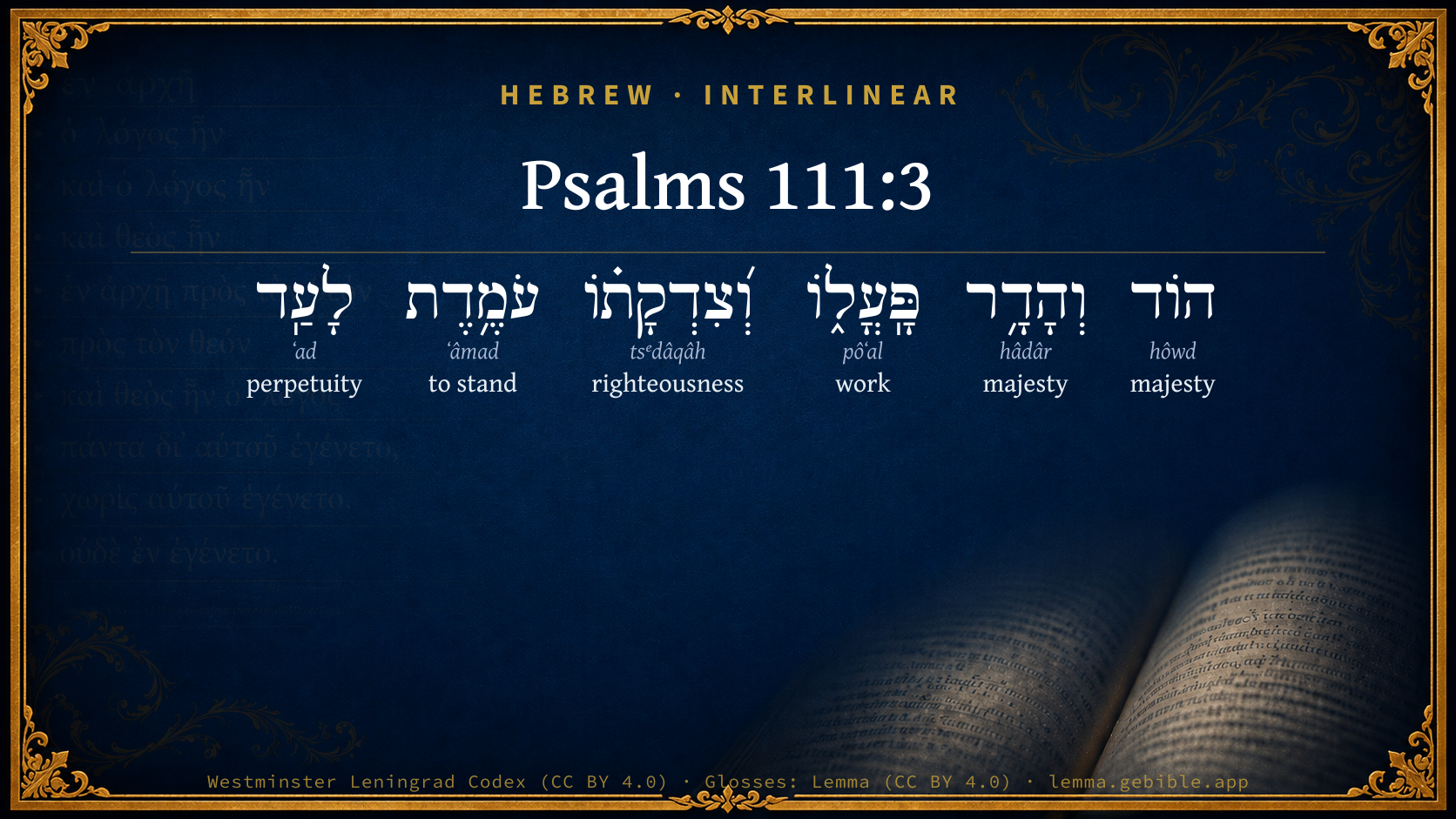
Psalms 111:3

Hebrew (Westminster Leningrad Codex) Psalms 111:3 appears in the Hebrew Old Testament. The text above is from the Westminster Leningrad Codex. Each word links to its Strong’s number, a concise gloss, and parsing drawn from the Open Scriptures Hebrew Bible morphology. Click any word for its full Brown-Driver-Briggs (BDB) entry.
Download image
Cite this verse

Psalms 111:3 (World English Bible). Public Domain. Lemma interlinear Bible study tool, https://lemma.gebible.app/v/psalms/111/3.

Show BibTeX & RIS
BibTeX
RIS
English Translation
His work is honor and majesty. His righteousness endures forever.
World English Bible · Public Domain
Download a study sheet

One document with this verse’s original text, its word-by-word gloss line, the meaning frame, cross-references with their text, attributed commentary, and full source and license credits — printable, and it pastes into notes with its structure intact.

This verse Autodidact and up

Study sheet (.html) Plain text (.txt)

A passage Seminary Student

Up to 50 verses in one chapter. A passage sheet keeps up to 6 commentary sources and 12 cross-references per verse, in the order this page ranks them, and says so on the sheet whenever that leaves anything out. Ask for a single verse and you get the Autodidact verse sheet above.

Everything on this page stays free to read, with no account — the sheet is a download of what is already on screen, not access to it.

Want to remove ads? Support Godless Engineer
Compare translations 3

The same verse in 3 English versions, stacked beneath the original-language interlinear above. Click any original word for its lexicon entry.

Each is an independent rendering of the whole verse — the interlinear is not word-aligned to these translations.

Highlighted words mark where these versions differ — a whole-verse word diff, not a word-by-word alignment.

  • World English Bible Public Domain
    His work is honor and majesty. His righteousness endures forever.
  • King James Version Public Domain
    His work is honourable and glorious: and his righteousness endureth for ever.
  • unfoldingWord Literal Text CC BY-SA 4.0
    His work splendor and majesty, and his righteousness stands forever.

unfoldingWord Literal Text — © unfoldingWord, licensed CC BY-SA 4.0. Word-aligned USFM3 via Door43 (git.door43.org/unfoldingWord/en_ult).

Versions to compare (up to 4)

3 of 4 selected

Show all 18 translations

Every available English version of this verse, each an independent rendering of the whole verse.

  • World English Bible Public Domain
    His work is honor and majesty. His righteousness endures forever.
  • Berean Standard Bible Public Domain
    Splendid and majestic is His work; His righteousness endures forever.
  • Majority Standard Bible Public Domain
    Splendid and majestic is His work; His righteousness endures forever.
  • King James Version Public Domain
    His work is honourable and glorious: and his righteousness endureth for ever.
  • American Standard Version (1901) Public Domain
    His work is honor and majesty; And his righteousness endureth for ever.
  • Revised Version (1885) Public Domain
    His work is honour and majesty: and his righteousness endureth for ever.
  • Geneva Bible (1599) Public Domain
    His worke is beautifull and glorious, and his righteousnesse endureth for euer.
  • Douay-Rheims (1899) Public Domain
    His work is praise and magnificence: and his justice continueth for ever and ever.
  • Young's Literal Translation Public Domain
    Honourable and majestic is His work, And His righteousness is standing for ever.
  • Literal Standard Version CC BY-SA 4.0
    Splendid and majestic is His work, || And His righteousness is standing forever.
  • Unlocked Literal Bible CC BY-SA 4.0
    His work is majestic and glorious, and his righteousness endures forever.
  • unfoldingWord Literal Text CC BY-SA 4.0
    His work splendor and majesty, and his righteousness stands forever.
  • Darby Bible Public Domain
    His work is majesty and splendour, and his righteousness abideth for ever.
  • World Messianic Bible Public Domain
    His work is honor and majesty. His righteousness endures forever.
  • Webster's Bible Public Domain
    His work is honorable and glorious: and his righteousness endureth for ever.
  • Free Bible Version CC BY-SA 4.0
    His majesty and honor are revealed by what he does; his goodness lasts forever.
  • Bible in Basic English Public Domain
    His work is full of honour and glory; and his righteousness is unchanging for ever.
  • JPS Tanakh (1917) Public Domain
    His work is glory and majesty; and His righteousness endureth for ever.

Literal Standard Version (2020), Covenant Press — licensed CC BY-SA 4.0. Text via the HelloAO Bible API (eBible.org). Unlocked Literal Bible (unfoldingWord) — licensed CC BY-SA 4.0. Text via the HelloAO Bible API (eBible.org). unfoldingWord Literal Text — © unfoldingWord, licensed CC BY-SA 4.0. Word-aligned USFM3 via Door43 (git.door43.org/unfoldingWord/en_ult). Free Bible Version, Dr. Jonathan Gallagher — licensed CC BY-SA 4.0. Text via the HelloAO Bible API (eBible.org).

Word by word

More ways to search: Search by grammar → Find every occurrence → Compare this word →

Practice this passage: Drill this verse → Learn its vocabulary →

About this verse

These counts appear in no published source. They are computed here, from the morphology-tagged text and Lemma’s own curated glosses. What Lemma adds →

6
words
6
distinct lemmas
Wisdom
section

Notable vocabulary

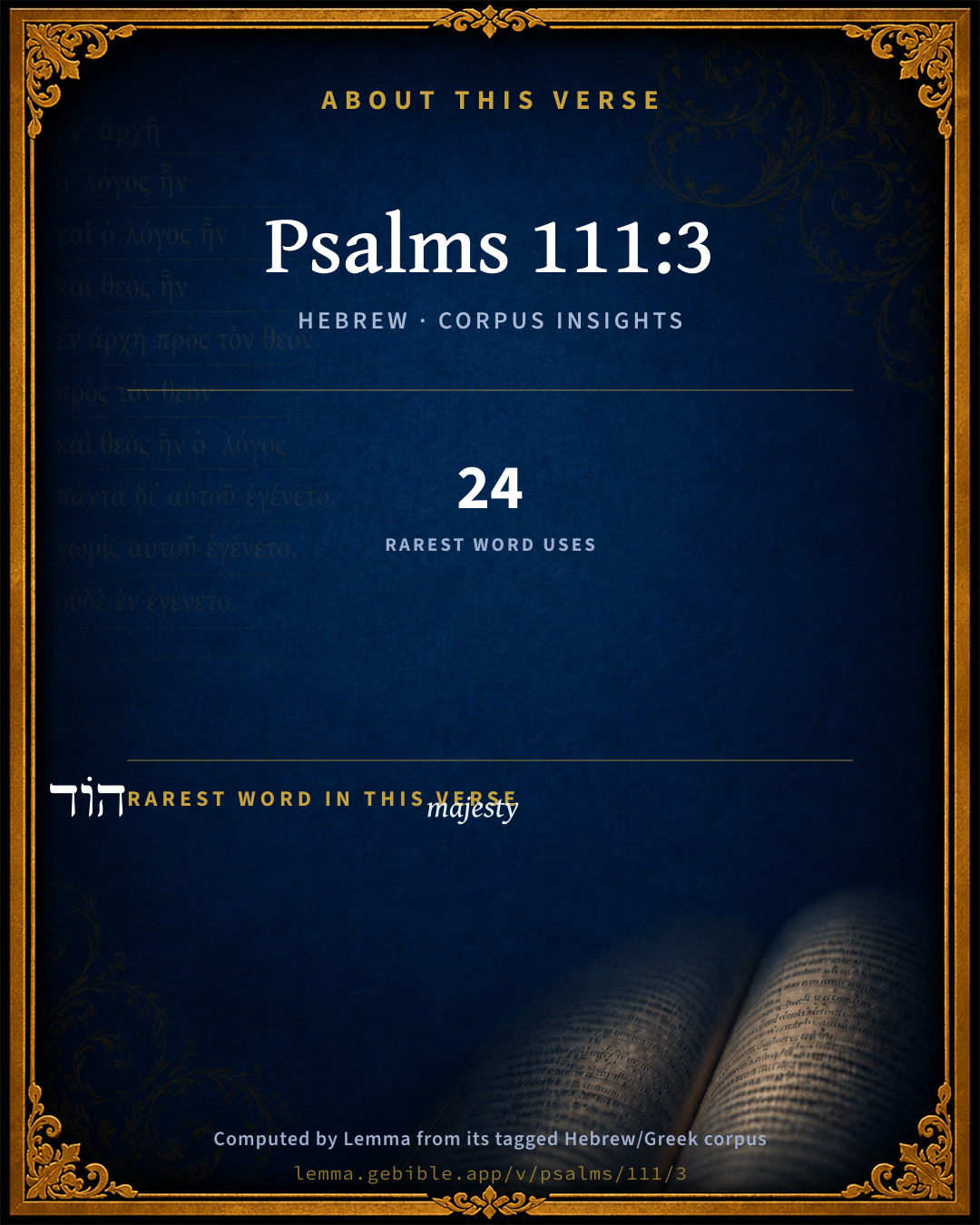
The rarest word here is הוֹד majesty H1935 — appearing just 24 times in the whole Hebrew Bible.

Shared distinctive vocabulary

הוֹד majesty H1935 occurs in 24 verses of the Hebrew Bible. Also found in:

Grammatical profile

  • 1 verb
  • 5 nouns

Verb forms

  • עֹמֶ֥דֶת Qal · Participle Active

Hebrew & Septuagint length

In English translation the verse runs 10 words from the Hebrew and 16 from the Septuagint (LXX English) — closely comparable.

A rough comparison of the two English renderings, which tokenize alike — not a word-level alignment.

Word counts can differ between the Hebrew and the Greek without any difference in meaning — e.g. the Hebrew direct-object marker אֵת has no separate Greek word, and Greek often adds the article ὁ.

Cross-references

17

Topical passages linked to Psalms 111:3 in the Treasury of Scripture Knowledge — connected by theme and wording, ordered by reader-vote popularity; previews shown in the World English Bible.

  • Psalms 145:4–5 One generation will commend your works to another, And will declare your mighty acts.
  • Psalms 145:10–12 All your works will give thanks to you, Yahweh. Your saints will extol you.
  • Ephesians 3:10 to the intent that now through the assembly the manifold wisdom of God might be made known to the principalities and the powers in the heavenly places,
  • Revelation 5:12–14 saying with a loud voice, "Worthy is the Lamb who has been killed to receive the power, wealth, wisdom, strength, honor, glory, and blessing!"
  • Psalms 119:142 Your righteousness is an everlasting righteousness. Your law is truth.
  • Exodus 15:11 Who is like you, Yahweh, among the gods? Who is like you, glorious in holiness, Fearful in praises, doing wonders?
  • Psalms 19:1 The heavens declare the glory of God. The expanse shows his handiwork.
  • Psalms 103:17 But Yahweh's loving kindness is from everlasting to everlasting with those who fear him, His righteousness to children's children;
  • Isaiah 51:8 For the moth shall eat them up like a garment, and the worm shall eat them like wool; but my righteousness shall be forever, and my salvation to all generations.
  • Ephesians 1:6–8 to the praise of the glory of his grace, by which he freely bestowed favor on us in the Beloved,
  • Exodus 15:6–7 Your right hand, Yahweh, is glorious in power, Your right hand, Yahweh, dashes the enemy in pieces.
  • Psalms 112:3 Wealth and riches are in his house. His righteousness endures forever.
  • Psalms 112:9 He has dispersed, he has given to the poor. His righteousness endures forever. His horn will be exalted with honor.
  • Psalms 119:144 Your testimonies are righteous forever. Give me understanding, that I may live.
  • Psalms 145:17 Yahweh is righteous in all his ways, And gracious in all his works.
  • Isaiah 51:5–6 My righteousness is near, my salvation is gone forth, and my arms shall judge the peoples; the isles shall wait for me, and on my arm shall they trust.
  • Daniel 9:24 Seventy weeks are decreed on your people and on your holy city, to finish disobedience, and to make an end of sins, and to make reconciliation for iniquity, and to bring in everlasting righteousness, and to seal up vision and prophecy, and to anoint the most holy.

Cross-references courtesy of OpenBible.info (CC BY 4.0).

Hebrew and Greek witnesses Masoretic Hebrew ↔ Greek Septuagint

The same verse in the two great witnesses to the Old Testament, shown verse-for-verse.

You’re reading Greek Psalm 110 (Hebrew Psalm 111). The Septuagint counts the superscription, so verse numbers can differ from the Hebrew — chapter-level alignment, not verse-by-verse. Numbering follows Rahlfs.

These are two independent witnesses, not word-aligned to each other, and the Septuagint is shown in lemma (dictionary) form.

Hebrew Psalms 111:3 Masoretic · Westminster Leningrad Codex

הוֹד וְהָדָ֥ר פָּֽעֳל֑וֹ וְ֝צִדְקָת֗וֹ עֹמֶ֥דֶת לָעַֽד

His work is honor and majesty. His righteousness endures forever.

World English Bible · Public Domain

Greek LXX Greek Psalm 110:3 Septuagint · lemma form

ἐξομολόγησις καί μεγαλοπρέπεια ὁ ἔργον αὐτός καί ὁ δικαιοσύνη αὐτός μένω εἰς ὁ αἰών ὁ αἰών

His work is worthy of thanksgiving and honor: and his righteousness endures for ever and ever.

LXX2012 (modern English Septuagint) · Public Domain

Hebrew: Westminster Leningrad Codex (CC BY 4.0). Greek: Septuagint (public domain); English from LXX2012 (modern English Septuagint) (Public Domain). How the Septuagint differs from the Hebrew →

Commentary

Notes on Psalms 111:3 from classic Christian and Jewish commentators (each source and its license shown beneath its notes). The classic Christian expositions comment on the surrounding passage and are grouped to its opening verse, so a note may address several verses; the Jewish commentaries on the Tanakh (Rashi and others) are per-verse, so they appear only where the commentator wrote on this verse.

Lemma curates 59 commentaries, every one of them public domain or Creative Commons licensed, each selected and text-cleaned for this edition rather than reprinted as found. About our sources →

Trapp's Complete Commentary

John Trapp

Psa 111:3 His work [is] honourable and glorious: and his righteousness endureth for ever.

Ver. 3. His work is honourable] Heb. honour and glory, they all come tipped and gilt, with a glory upon them, a centro ad coelum. This the brutish man knoweth not, Psa 92:6.

His righteousness endureth for ever] His judgments are sometimes secret, but always just.

John Trapp, A Commentary or Exposition upon All the Books of the Old and New Testament (1647–1656) — public domain. Text from a community e-Sword module.

The Biblical Illustrator

Joseph S. Exell

Psa_111:3

His work is honourable and glorious: and His righteousness endureth for ever.

God and the godly

(with Psa_112:3):--These two psalms are obviously intended as a pair. They are identical in number of verses, and in structure, both being acrostic, that is to say, the first clause of each commences with the first letter of the Hebrew alphabet, the second clause with the second, and so on. The general idea that runs through them is the likeness of the godly man to God. Worship is, or should be, adoration of and yearning after the highest conceivable good. Such an attitude must necessarily lead to imitation, and be crowned by resemblance. Love makes like, and they who worship God are bound to, and certainly will, in proportion to the ardour and sincerity of their devotion, grow like Him whom they adore.

I. In enduring righteousness. That seems a bold thing to say, especially when we remember how lofty and transcendent were the Old Testament conceptions of the righteousness of God. But, lofty as these were, this psalmist lifts an unpresumptuous eye to the heavens, and having said of Him who dwells there: His righteousness endureth for ever, is not afraid to turn to the humble worshipper on this low earth, and declare the same thing of him. Our finite, frail, feeble lives may be really conformed to the image of the heavenly. The dew-drop with its little rainbow is a miniature of the great arch that spans the earth and rises into the high heavens. And so, though there are differences, deep and impassable, between anything that can be called a creatural righteousness and that which bears the same name in the heavens, the fact that it does bear the same name is a guarantee to us that there is an essential resemblance between the righteousness of God in its lustrous perfectness and the righteousness of his child in its imperfect effort. Another psalmist has sung of the man who can stand in the holy place. He shall receive the blessing from the Lord, even righteousness from the God of his salvation. And our psalms hint, if they do not articulately declare, how that reception is possible for us, when they set forth waiting upon God as the condition of being made like Him. We translate the psalmists feeling after the higher truth which we know, when we desire that we may be found in Him, not having our own righteousness which is of the law, but that which is of God by faith.

II. In gracious compassion. In the former psalm we read The Lord is gracious and full of compassion; in the latter we find he (the upright man) is gracious and full of compassion, and righteous. Our hearts need something more than a righteous God if we are ever to worship and draw near. Just as the white snow on the high peak needs to be flushed with the roseate hue of the morning before it can become tender, and create longings, so the righteousness of the great White Throne has to be tinged with the ruddy heart hue of gracious compassion if men are to be moved to adore and to love. And each enhances the other. What God hath joined together, in Himself, let not man put asunder; nor talk about the stern Deity of the Old Testament, and pit Him against the compassionate Father of the New. He is righteous, but the proclaimers of His righteousness in old days never forgot to blend with the righteousness the mercy; and the combination heightens the lustre of both the colours. And the same combination is absolutely needful in the copy, as is emphatically set forth in our text by the addition, in the ease of the man, of and righteous. For whilst with God the two attributes do lie, side by side, in perfect harmony, in us men there is always danger that the one shall trench upon the territory of the other, and that, he who has cultivated the habit of looking upon sorrows and sins with compassion and tenderness shall somewhat lose the power of looking at them with righteousness. And so our text, in regard of man, proclaims more emphatically than it needs to do in regard to the perfect God, that ever his highest beauty of compassion must be wedded to righteousness, and ever his truest strength of righteousness must be knit with compassion. But, beyond that, note how, wherever there is the loving and childlike contemplation of God, there will be an analogy to His perfectness in our compassion. We are transformed by beholding. The sun strikes a poor little pane of glass in a cottage miles away, and it flashes with some likeness of the sun and casts a light across the plain. The man whose face is turned Godwards will have beauty pass into his face, and all that look upon him will see as it had been the countenance of an angel.

III. We have still another point, not so much of resemblance as of correspondence, in the firmness of Gods utterances and of the godly heart. In the first of our two psalms we read, in the seventh verse, all His commandments are sure. In the second we read, in the corresponding verse, his heart is fixed, trusting in the Lord. The former psalm goes on, His commandments stand fast for ever and ever; and the next psalm, in the corresponding verse, says his heart is established, the original employing the same word in both cases, which in our version is rendered, in the one case stand fast, and in the other established. So that the psalmist is thinking of a correspondence between the stability of Gods utterances and the stability of the heart that clasps them in faith. His commandments are not only precepts which enjoin duty. All which God says is law, whether it be directly in the nature of guiding precept, or whether it be in the nature of revealing truth, or whether it be in the nature of promise. It is sure, reliable, utterly trustworthy. We may be certain that it will direct us aright, that it will reveal to us absolute truth, that it will hold forth no flattering and false promises. And it is established. The one fixed point amidst the whirl of things is the uttered will of God. Therefore the heart that builds there builds safely. And there should be a correspondence, whether there is or no, between the faithfulness of the Speaker and the faith of the hearer. Lean hard upon God, put all your weight upon Him. You cannot put too much, you cannot lean too hard. The harder the better, the better He is pleased, and the more He breathes support and strength into us. (A. Maclaren, D.D.)

The Biblical Illustrator, edited by Joseph S. Exell (c. 1880s–1900s) — public domain. Text from a community e-Sword module.

Joseph Benson's Commentary

Psa 111:3-4. His work — Either all his works, or that eminent branch of them, his providence toward his people, as is expressed afterward; is honourable and glorious — Becoming the Divine Majesty, and bringing glory to him from all that observe and consider it. And his righteousness — His justice or faithfulness in performing his word; endureth for ever —

Hath always been, and will still be, evident to his people in all generations, and in all conditions, even when he afflicts them, and seems to deal most severely, and to break his promise with them. He hath made his wonderful works to be remembered — Either, 1st, By those memorials which he hath left of them in his word; or, rather, 2d, By their own wonderful nature, and their lasting effects, and the benefits flowing from them, which are such as cannot easily be forgotten. The Lord is full of compassion — Toward his people, as appears from his works and conduct toward us, in sparing, pardoning, restoring, and preserving us, when we deserved to be utterly destroyed.

Joseph Benson's Commentary on the Old and New Testaments (1811–1818) — public domain. Text from a community e-Sword module.

J. A. Alexander on Psalms

Joseph Addison Alexander

3. (Psa 111:3) Honour and majesty (is) his work—and his righteousness standing for ever. In the first clause, work is the subject of the proposition, honour and majesty the predicate. His work is honour and majesty, i.e. all that he does is noble and majestic, worthy of the great King, to whom these epithets are often applied elsewhere. See above, on Psa 104:1. His work means specifically here what he does for the protection and deliverance of his people. In the last clause, as in many other places, this work is referred to his righteousness, not his justice, in the technical and strict sense, but his rectitude, including his fidelity to his engagements, and securing the exercise of his covenanted mercy. This seems more natural than to explain it as meaning the practical justification of his people by his providential care of them. Standing to eternity (or perpetuity), not fitful or capricious, not confined or temporary, but perpetual and constant.

Joseph Addison Alexander, The Psalms Translated and Explained (1850) — public domain. Text from a community e-Sword module.

MacLaren's Expositions of Holy Scripture

Alexander MacLaren

Psalms

GOD AND THE GODLY

Psa 111:3; Psa 112:3.

These two psalms are obviously intended as a pair. They are identical in number of verses and in structure, both being acrostic, that is to say, the first clause of each commences with the first letter of the Hebrew alphabet, the second clause with the second, and so on. The general idea that runs through them is the likeness of the godly man to God. That resemblance comes very markedly to the surface at several points in the psalms, and pervades them traceably even where it is less conspicuous. The two corresponding clauses which I have read as my text are the first salient instances of it. But I propose to deal not only with them, but with a couple of others which occur in the course of the psalms, and will appear as I proceed.

The general underlying thought is a noteworthy one. The worshipper is to be like his God. So it is in idolatry; so it should be with us. Worship is, or should be, adoration of and yearning after the highest conceivable good. Such an attitude must necessarily lead to imitation, and be crowned by resemblance. Love makes like, and they who worship God are bound to, and certainly will, in proportion to the ardour and sincerity of their devotion, grow like Him whom they adore. So I desire to look with you at the instances of this resemblance or parallelism which the Psalmist emphasises.

I. The first of them is that in the clauses which I have read as our starting-point, viz. God and the godly are alike in enduring righteousness.

That seems a bold thing to say, especially when we remember how lofty and transcendent were the Old Testament conceptions of the righteousness of God. But, lofty as these were, this Psalmist lifts an unpresumptuous eye to the heavens, and having said of Him who dwells there, ‘His righteousness endureth for ever,’ is not afraid to turn to the humble worshipper on this low earth, and declare the same thing of him. Our finite, frail, feeble lives may be really conformed to the image of the heavenly. The dewdrop with its little rainbow has a miniature of the great arch that spans the earth and rises into the high heavens. And so, though there are differences, deep and impassable, between anything that can be called creatural righteousness, and that which bears the same name in the heavens, the fact that it does bear the same name is a guarantee to us that there is an essential resemblance between the righteousness of God in its lustrous perfectness, and the righteousness of His child in its imperfect effort.

But how can we venture to run any kind of parallelism between the eternity of the one and that of the other? God’s righteousness we can understand as enduring for ever, because it is inseparable from His very being; because it is manifested unbrokenly in all the works that for ever pour out from that central Source, and because it and its doings stand fast and unshaken amidst the passage of ages, and the ‘wreck of matter and the crash of worlds.’ But may there not be, if not an eternity, yet a perpetuity, in our reflection of the divine righteousness which shall serve to vindicate the application of the same mighty word to both? Is it not possible that, unbroken amidst the stress of temptation, and running on without interruptions, there may be in our hearts and in our lives conformity to the divine will? And is it not possible that the transiencies of our earthly doings may be sublimed into perpetuity if there is in them the preserving salt of righteousness?

‘The actions of the just

Smell sweet, and blossom in the dust.’

And may it not be, too, that though this Psalmist may have had no clear articulate doctrine of eternal life beyond, he may have felt, and rightly felt, that there were things that were too fair to die, and that it was inconceivable that a soul which had been, in some measure, tinged with the righteousness of God could ever be altogether a prey to the law of transiency and decay which seizes upon things material and corporeal? That which is righteous is eternal, be it manifested in the acts of the unchanging God or in the acts of a dying man, and when all else has passed away, and the elements have melted with fervent heat, ‘he that doeth the will of God,’ and the deeds which did it, ‘shall abide for ever.’ ‘His righteousness endureth for ever.’

Now, brethren! there are two ways in which we may look at this parallelism of our text: the one is as containing a stringent requirement; the other as holding forth a mighty hope. It contains a stringent requirement. Our religion does not consist in assenting to any creed. Our religion is not wholly to consist of devout emotions and loving and joyous acts of communion and friendship with God. There must be more than these; these things there must be. For if a man is to be guided mainly by reason, there must, first of all, be creed; then there must be corresponding emotions. But creed and emotions are both meant to be forces which shall drive the wheels of life, and conduct is, after all, the crown of religion and the test of godliness. They that hold communion with God are bound to mould their lives into the likeness of His. ‘Little children, let no man deceive you,’ and let not your own hearts deceive you. You are not a Christian because you believe the truths of the Gospel. You are not such a Christian as you ought to be, if your religion is more manifest in loving trust than in practical obedience which comes from trust. ‘He that doeth righteousness is righteous,’ and he is to be righteous ‘even as He is righteous.’ If you are God’s, you will be like God. Apply the touchstone to your lives, and test your Christianity by this simple and most stringent test.

But again, we may look at the thought as holding forth a great hope. I do not wish to force upon Old Testament writers New Testament truth. It would be an anachronism and an absurdity to make this Psalmist responsible for anything like a clear evangelistic statement of the way by which a man may be made righteous. That waited for coming days, and eminently for Jesus Christ. But it would be quite as great a mistake to eviscerate the words of their plain implications. And when they put side by side the light and the reflection, God and the godly, it seems to me to be doing violence to their meaning for the sake of trying to make them mean less than they do, if we refuse to recognise that they have at any rate an inkling of the thought that the Original and Pattern of human righteousness was likewise the Source of it. This at least is plain, that the Psalmist thought that ‘the fear of the Lord’ was not only, as he calls it at the close of the former of the two psalms, ‘the beginning of wisdom,’ but also the basis of goodness, for he begins his description of the godly with it.

I believe that he felt, what is assuredly true, that no man, by his own unaided effort, can ever work out for himself a righteousness which will satisfy his own conscience, and that he must, first of all, be in touch with God, in order to receive from Him that which he cannot create. Ah, brethren! the ‘fine linen, clean and white, which is the righteousness of saints,’ is woven in no earthly looms; and the lustrous light with which it glistens is such as ‘no fuller on earth can white’ men’s characters into. Another Psalmist has sung of the man who can stand in the holy place, ‘He shall receive the blessing from the Lord, even righteousness from the God of his salvation,’ and our psalms hint, if they do not articulately declare, how that reception is possible for us, when they set forth waiting upon God as the condition of being made like Him. We translate the Psalmist’s feeling after the higher truth which we know, when we desire ‘that we may be found in Him, not having our own righteousness which is of the law, but that which is of God by faith.’ So much, then, for the first point of correspondence in these two psalms.

II. God and the godly are alike in gracious compassion.

If you will turn to the two psalms for a moment, and look at the last clauses of the two fourth verses, you will see how that thought is brought out. In the former psalm we read, ‘The Lord is gracious and full of compassion’: in the latter we find, ‘he’ {the upright man} ‘is gracious and full of compassion, and righteous.’

I need not trouble you with any remarks about certain difficulties that lie in the rendering of that latter verse. Suffice it to say that they are such as to make more emphatic the intentional resemblance between the godly as there described, and God as described in the previous one. Of both it is said ‘gracious and full of compassion.’

Now that great truth of which I have been speaking, the divine righteousness, is like white Alpine snow, sublime, but cold, awful and repellent, when taken by itself. Our hearts need something more than a righteous God if we are ever to worship and draw near. Just as the white snow on the high peak needs to be flushed with the roseate hue of the morning before it can become tender, and create longings, so the righteousness of the great white Throne has to be tinged with the ruddy heart-hue of gracious compassion if men are to be moved to adore and to love. Each enhances the other. ‘What God hath joined together,’ in Himself, ‘let not man put asunder’; nor talk about the stern Deity of the Old Testament, and pit Him against the compassionate Father of the New. He is righteous, but the proclaimers of His righteousness in old days never forgot to blend with the righteousness the mercy; and the combination heightens the lustre of both attributes.

The same combination is absolutely needful in the copy, as is emphatically set forth in our text by the addition of ‘and righteous,’ in the case of the man. For whilst with God the tyro attributes do lie, side by side, in perfect harmony, in us men there is always danger that the one shall trench upon the territory of the other, and that he who has cultivated the habit of looking upon sorrows and sins with compassion and tenderness shall somewhat lose the power of looking at them with righteousness. So our text, in regard to man, proclaims more emphatically than it needs to do in regard to the perfect God, that ever his highest beauty of compassion must be wedded to righteousness, and ever his truest strength of righteousness must be softened with compassion.

But beyond that, note how, wherever there is the loving and childlike contemplation of God, there will be an analogy in our compassion, to His perfectness. We are transformed by beholding. The sun strikes a poor little pane of glass in a cottage miles away, and it flashes with some likeness of the sun and casts a light across the plain. The man whose face is turned Godwards will have beauty pass into his face, and all that look upon him will see ‘as it had been the countenance of an angel.’

If we have, in any real and deep measure, received mercy we shall reflect mercy. Remember the parable of the unmerciful debtor. The servant that cast himself at his lord’s feet, and got the acquittal of his debt, and went out and gripped his fellow-servant by the throat, leaving the marks of his fingernails on his windpipe, with his ‘Pay me that thou owest!’ had all the pardon cancelled, and all the debt laid upon his shoulders again. If we owe all our hope and peace to a forgiving God, how can we make anything else the law of our lives than that, having received mercy, we should show mercy? The test of your being a forgiven man is your forgivingness. There is no getting away from that plain principle, which modifies the declaration of the freedom of God’s full pardon.

But I would have you notice, further, as a very remarkable illustration of this correspondence between the gracious and compassionate Lord and His servant, that in the verses which follow respectively the two about which I am now speaking, the same idea is wrought out in another shape. In the psalm dealing with the divine character and works we read, immediately after the declaration that He is ‘gracious and full of compassion,’ this-’He hath given meat to them that fear Him’; and the corresponding clause in the second of our psalms is followed by this-to translate accurately-’It is well with the man who showeth favour and lendeth.’ So man’s open-handedness in regard to money is put down side by side with God’s open-handedness in regard to giving meat unto them that fear Him. And again, in the ninth verse of each psalm, we have the same thought set forth in another fashion. ‘He sent redemption unto His people,’ says the one; ‘He hath dispersed, He hath given to the poor,’ says the other. That is to say, our paltry giving may be paralleled with the unspeakable gifts which God has bestowed, if they come from a love which is like His. It does not matter though they are so small and His are so great; there is a resemblance. The tiniest crystal may be like the hugest. God gives to us the possession of things in order that we may enjoy the luxury, which is one of the elements in the blessedness of the blessed God, who is blessed because He is the giving God, the luxury of giving. Poor though our bestowments must be, they are not unlike His. The little burn amongst the heather carves its tiny bed, and impels its baby ripples by the same laws which roll the waters of the Amazon, and every fall that it makes over a shelf of rock a foot high is a miniature Niagara.

III. So, lastly, we have still another point, not so much of resemblance as of correspondence, in the firmness of God’s utterances and of the godly heart.

In the first of our two psalms we read, in the seventh verse, ‘All His commandments are sure.’ In the second we read, in the corresponding verse, ‘his heart is fixed, trusting in the Lord.’ The former psalm goes on, ‘His commandments stand fast for ever and ever; and the next psalm, in the corresponding verse, says ‘his heart is established,’ the original employing the same word in both cases, which in our version is rendered, in the one place, ‘stand fast,’ and in the other ‘established.’ So that the Psalmist is thinking of a correspondence between the stability of God’s utterances and the stability of the heart that clasps them in faith.

His commandments are not only precepts which enjoin duty. All which God says is law, whether it be directly in the nature of guiding precept, or whether it be in the nature of revealing truth, or whether it be in the nature of promise. It is sure, reliable, utterly trustworthy. We may be certain that it will direct us aright, that it will reveal to us absolute truth, that it will hold forth no flattering and false promises. And it is ‘established.’ The one fixed point amidst the whirl of things is the uttered will of God.

Therefore, the heart that builds there builds safely. And there should be a correspondence, whether there is or no, between the faithfulness of the Speaker and the faith of the hearer. A man who is doubtful about the solidity of the parapet which keeps him from toppling over into the abyss will lean gingerly upon it, until he has found out that it is firm. The man that knows how strong is the stay on which he rests ought to lean hard upon it. Lean hard upon God, put all your weight upon Him. You cannot put too much, you cannot lean too hard. The harder the better; the better He is pleased, and the more He breathes support and strength into us. And, brethren! if thus we build an established faith on that sure foundation, and match the unchangeableness of God in Christ with the constancy of our faith in Him, then, ‘He that believeth shall never make haste,’ and as my psalm says, ‘He shall not be afraid of evil tidings; his heart is fixed, trusting in the Lord.’

The upshot of the whole matter is-we cannot work out for ourselves a righteousness that will satisfy our own consciences, nor secure for ourselves a strength that will give peace to our hearts, and stability to our lives, by any other means than by cleaving fast to God revealed in Jesus Christ.

We have borne the image of the earthly long enough; let us open our hearts to God in Christ. Let us yield ourselves to Him; let us gaze upon Him with fixed eyes of love, and labour to make our own what He bestows upon us. Thus living near Him, we shall be bathed in His light, and show forth something of His beauty. Godliness is God-likeness. It is of no use to say that we are God’s children if we have none of the family likeness. ‘If ye were Abraham’s sons ye would do the works of Abraham,’ said Christ to the Jews. If we are God’s sons we shall do the works of God. ‘Be ye therefore perfect, as your Father in heaven is perfect;’ be ye merciful as your Father is merciful. And if thus we here, dwelling with Christ, are being conformed to the image of His Son, we shall one day ‘be satisfied’ when we ‘awake in His likeness.’

Alexander MacLaren, Expositions of Holy Scripture (1904–1910) — public domain. Text from a community e-Sword module.

Adam Clarke's Commentary

Verse 3. His work is honourable, c.] He has done nothing in nature or grace that does not redound to his own honour and glory and because all is done in righteousness, it endureth for ever.

Adam Clarke's Commentary on the Bible (1810–1826) — public domain. Text from a community e-Sword/MySword module.

John Calvin's Commentaries

3 His work is beautiful Others render it splendor. The meaning of the clause is this, That every act of God is replete with glorious majesty. In the following part of the verse he specifies more clearly in what this beauty and magnificence consist, by stating that the justice of God is everywhere conspicuous. It is not the design of God to furnish us with such a display of his power and sovereignty in his works, as might only fill our minds with terror, but he also gives us a display of his justice in a manner so inviting as to captivate our hearts. This commendation of the works and ways of God is introduced in opposition to the clamor and calumny of the ungodly, by which they impiously endeavor, to the utmost extent of their power, to disfigure and deface the glory of the works of God. In the next verse, he more especially extols the wonderful works in which God has principally set forth his power. To cause his marvellous works to be remembered, is equivalent to the doing of works worthy of being remembered, or the renown of which shall continue for ever. And having above called upon us to contemplate his justice, now, in like manner, and almost in like terms, he celebrates the grace and mercy of God, principally in relation to his works, because that justice which he displays in the preservation and protection of his people, issues from the source of his unmerited favor which he bears towards them.

John Calvin's Commentaries (1540-1563) — public domain. Text from the Calvin Translation Society English edition (1840s-50s) via the Christian Classics Ethereal Library (ccel.org). Calvin's coverage is partial (roughly two-thirds of the Bible); uncommented books and verses are honest gaps, never fabricated. The 19th-century editor's footnotes and remarks are omitted so the notes are faithfully Calvin's own voice.

The Cambridge Bible for Schools and Colleges

gen. ed. J. J. S. Perowne

3. His work is majesty and splendour,

And his righteousness standeth fast for ever.

All His works are a revelation of those attributes of royal dignity with which He clothes Himself (Psa_104:1), and at the same time they are the outcome of His eternal righteousness. With Him there is no divorce between might and right. Similarly “His counsel standeth fast for ever” (Psa_33:11).

The Cambridge Bible for Schools and Colleges (gen. ed. J. J. S. Perowne; Cambridge University Press, 1878–1918) — public domain. Text from a community e-Sword module.

John Gill's Exposition

His work is honourable and glorious,.... Or "honour and glory" (g) itself; there is nothing mean and trifling done by him; nothing unworthy of him in nature, providence, and grace; every work of his serves to display his glory, and set off the greatness of his majesty; the heavens and the earth are full of his glory; and he does all things well and wisely in the government of the world; and whatever he does in a way of grace is for the glory of it, and tends to make his people honourable and glorious, as well as manifests his own glory, and makes for the honour of his own name.

And his righteousness endureth for ever; his justice and holiness, which appear in all his ways and works; for there is no unrighteousness in anything done by him, just and true are all his ways; there is a constant tenor of righteousness in them all; his faithfulness in fulfilling every word of promise, in making his words good by his works, is to be seen in all generations; and true evangelical righteousness, the righteousness of Christ, which is so considerable a branch of the work of redemption and salvation, is an everlasting one; it can never be abolished, it will answer for the saints in a time to come.

(g) "gloria et decor", Pagninus, Montanus, Gejerus, Michaelis; "gloria et splendor", Musculus; "majestas et magnificentia", Piscator.

John Gill's Exposition of the Whole Bible (1746–1763) — public domain (CC PDM 1.0). Text via the HelloAO Bible API.

Albert Barnes' Notes on the Bible

His work is honorable and glorious - literally, “Honour and glory is his work;” that is, All that he does is honorable and glorious. The language would cover all that God does in the works of creation, providence, and redemption. There is honor - there is majesty - in “everything” that he does.

And his righteousness endureth for ever - That is, It will be found in all the investigations of his works, that he is unchangeably righteous or just. All that he has done, or that he now does, goes to demonstrate this. There are doings of people - even of good people - which will not bear investigation; but there are no such acts of God. There are things that people do which excite admiration only when there is no investigation in regard to them; but the works of God are admired the more, the more they are studied. There are things which appear beautiful, or appear sweet only when they are not shaken; a collection of perfumes will give out sweets the more it is stirred.

Albert Barnes' Notes on the Bible (1834–1885) — public domain. Text from a community e-Sword/MySword module.

Matthew Poole's English Annotations

His work; either all his works, of which See Poole "Psa 111:2"; or that eminent branch of those works, his providence towards his people, as it is expressed afterwards

Honourable and glorious; becoming the Divine Majesty, and bringing glory to him from all that observe and consider it.

His righteousness; his justice or faithfulness in performing his word.

Endureth for ever; hath always been, and will still be, evident to his people in all generations, and in all conditions, even when he afflicts them, and seems to deal most severely, and to break his promise with them.

Matthew Poole's English Annotations on the Holy Bible (1683–1685) — public domain. Text from a community e-Sword/MySword module.

The Treasury of David

Charles H. Spurgeon

Ver. 3. His work is honourable and glorious. His one special work, the salvation of his people, is here mentioned as distinguished from his many other works. This reflects honour and glory upon him. It is deservedly the theme of the highest praise, and compels those who understand it and experience it to ascribe all honour and glory unto the Lord. Its conception, its sure foundations, its gracious purpose, its wise arrangements, its gift of Jesus as Redeemer, its application of redemption by the Holy Ghost in regeneration and sanctification, and all else which make up the one glorious whole, all redound to the infinite honour of Him who contrived and carried out so astounding a method of salvation. No other work can be compared with it: it honours both the Saviour and the saved, and while it brings glory to God it also brings us to glory. There is none like the God of Jeshurun, and there is no salvation like that which he has wrought for his people.

And his righteousness endureth for ever. In the work of grace righteousness is not forgotten, nor deprived of its glory; rather, it is honoured in the eyes of the intelligent universe. The bearing of guilt by our great Substitute proved that not even to effect the purposes of his grace would the Lord forget his righteousness; no future strain upon his justice can ever be equal to that which it has already sustained in the bruising of his dear Son; it must henceforth assuredly endure for ever. Moreover, the righteousness of God in the whole plan can never now be suspected of failure, for all that it requires is already performed, its demands are satisfied by the double deed of our Lord in enduring the vengeance due, and in rendering perfect obedience to the law. Caprice does not enter into the government of the Lord, the rectitude of it is and must for ever be beyond all question. In no single deed of God can unrighteousness be found, nor shall there ever be: this is the very glory of his work, and even its adversaries cannot gainsay it. Let believers, therefore, praise him evermore, and never blush to speak of that work which is so honourable and glorious.

Ver. 3. His work is honourable and glorious. The first thing that we notice is, that whereas the preceding verse spoke of the Lord's "works" in the plural number, this speaks of his "work" in the singular number; it would seem as if the psalmist, from the contemplation of the works of the Lord in general, was, as it were, irresistibly drawn away to the study of one work in particular; his mind and whole attention, so to speak, absorbed in that one work: a work so preeminently glorious and divine, that it eclipses, at least in his eyes, all the other works, although he has just said of them that they are great, and sought out of all them that have pleasure therein. "The works of the Lord are great. His work is honourable and glorious." My next remark is, that the words used in the original are different, and as the former more strictly signifies makings, or things made, so the word in this verse more properly imports a doing or a thing done, and this, perhaps, is not without its significance. It leads me to the inference, that from the contemplation of the great works of creation, God's makings, wonderful, and interesting, and useful as they are, the spiritual mind of God's servant rapidly passes to some greater deed which the Lord hath done, some more marvellous act which he has accomplished, and which he designates as an honourable and a glorious deed. Now, since I consider that he spoke before of Christ, as the visible and immediate agent in creation, without whom was not anything made that was made, can we hesitate long as to this greater work, the rather as to it is immediately subjoined the suggestive sentence, And his righteousness endureth for ever. Is not this doing, the making an end of sin, and the bringing in of an everlasting righteousness? Is it not the great mystery, in which, as in creation, though the Eternal Father is the Fountain source, the Original Contriver, He, the coeternal Son, is the Doer, the Worker? Is it not, in short, salvation, the all absorbing subject of God's people's wonder, love, and praise? James H. Vidal, in "Jesus, God and Man, "1863.

Ver. 3 (last clause). As an essential attribute, as revealed in providence, as vindicated in redemption, as demonstrated in punishment, as appropriated by believers.

Psalms 111:4*

Charles H. Spurgeon's The Treasury of David (1869–1885) — public domain. Psalms only. Text from a community e-Sword/MySword module.

Whedon's Commentary on the Bible

Daniel D. Whedon

3. Honourable and glorious—Two words of nearly the same import, often occurring together and applied to God and to kings, as Psa_21:5; Psa_45:3; Psa_96:6; Psa_104:1, where they express whatever is excellent in quality or grand in appearance, associated with royal dignity. The works of God rank with his own eternal nature, and fitly show forth his character and will, and man’s only path to honour, immortality, and eternal life. Psalms 19; Psa_145:10

Daniel D. Whedon (gen. ed.), Commentary on the Old and New Testaments (1874–1909) — public domain. Text from a community e-Sword module.

The Pulpit Commentary

His work is honorable and glorious; literally, honor and glory; but our translators have rightly paraphrased. And his righteousness endureth forever; i.e. his just and righteous dealing with all his creatures.

The Pulpit Commentary (1880–1919), ed. H.D.M. Spence-Jones & Joseph S. Exell — public domain. Text from a community e-Sword module.

John Wesley's Explanatory Notes

Work - Either all his works, or that eminent branch of those works, his providence towards his people. Righteousness - His justice or faithfulness in performing his word.

John Wesley, Explanatory Notes Upon the Whole Bible (1754–1765) — public domain. Text via the GEBible commentary corpus.

Lesson kit

Teaching starters — assembled from the data on this page, not authored interpretation. Every prompt links to the verse data it draws on. Edit before teaching.

Psalms, in the Wisdom, opens this verse with 6 words (6 distinct Hebrew lemmas). Its most distinctive word is hôwd (“majesty”). A historical commentator’s framing appears above. Read the whole chapter for the surrounding context.

Discussion questions

  1. The word hôwd carries the sense “majesty.” How does it shape the verse?
  2. Numbers 27:20 shares the word «majesty» with this verse. How do the two illuminate each other?
  3. These translations render this verse differently; the difference is in the English rendering, not the original. What questions does that raise?
  4. The verb «עֹמֶ֥דֶת» is Qal Participle Active. How does its form color the action?
  5. Reading how Trapp's Complete Commentary and The Biblical Illustrator read this verse, where do the two commentators agree and where do they part?

Things to notice

Reading settings

Reading text

Shown beneath each verse's original-language words.

Old Testament
Old Testament edition

Read the OT as the Masoretic Hebrew (MT) or the Greek Septuagint (LXX).

English shown for the Greek Septuagint (in the Hebrew ↔ Greek comparison).

Comparing translations? Open the Compare panel on any verse page to stack up to four side by side.