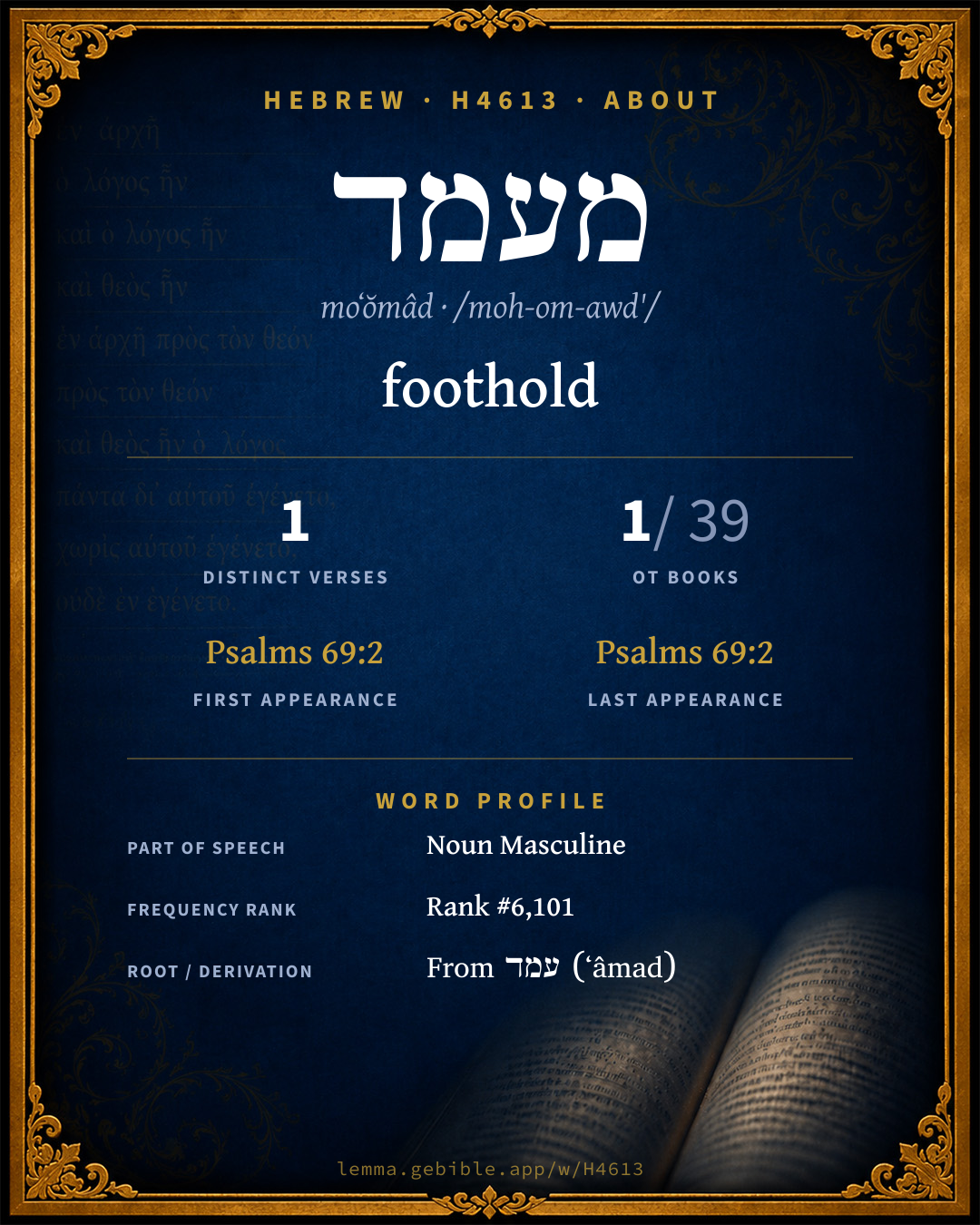
מׇעֳמָ֑ד
foothold
Full lexicon entry — Brown-Driver-Briggs (BDB)
From Brown-Driver-Briggs (BDB)
Where this word appears
Grammar key — what these labels mean
Part of speech
- Noun
- A naming word — a person, place, thing, or idea.
Noun type
- Common
- A common noun — a general class of person, place, or thing (“king,” “city,” “water”), not a specific name.
State
- Absolute
- The independent form of a noun, not bound to a following word.
Gender
- Masculine
- Grammatically masculine.
Number
- Singular
- One.
Every verse where H4613 appears — 1 distinct verse across 1 book. Click any verse to open its interlinear word-by-word view. Verse text shown in the World English Bible for context — . Each verse’s Hebrew form is shown with its reference; the English is not keyword-highlighted, since the data carries no word-level English alignment. Use “Compare translations” on any verse to read it across multiple English versions. This concordance covers the Hebrew Bible; Septuagint (Greek Old Testament) occurrences are not indexed here.
Psalms 1 verse
About this entry
At a glance — auto-summarized from this page’s data, not written by a person. Every figure links to its source below. This summary describes the numbers; it doesn’t interpret them.
מעמד (moʻŏmâd) is a Hebrew noun most often rendered “foothold.” With only 1 verse it sits in the long tail of Hebrew Bible vocabulary. Psalms dominates its distribution — 1 of 1 verses. A true hapax — its single appearance is Psalms 69:2. Related forms include עמד, מעמד and עמד. For the data behind this summary, explore the sense tree and the renderings breakdown below.
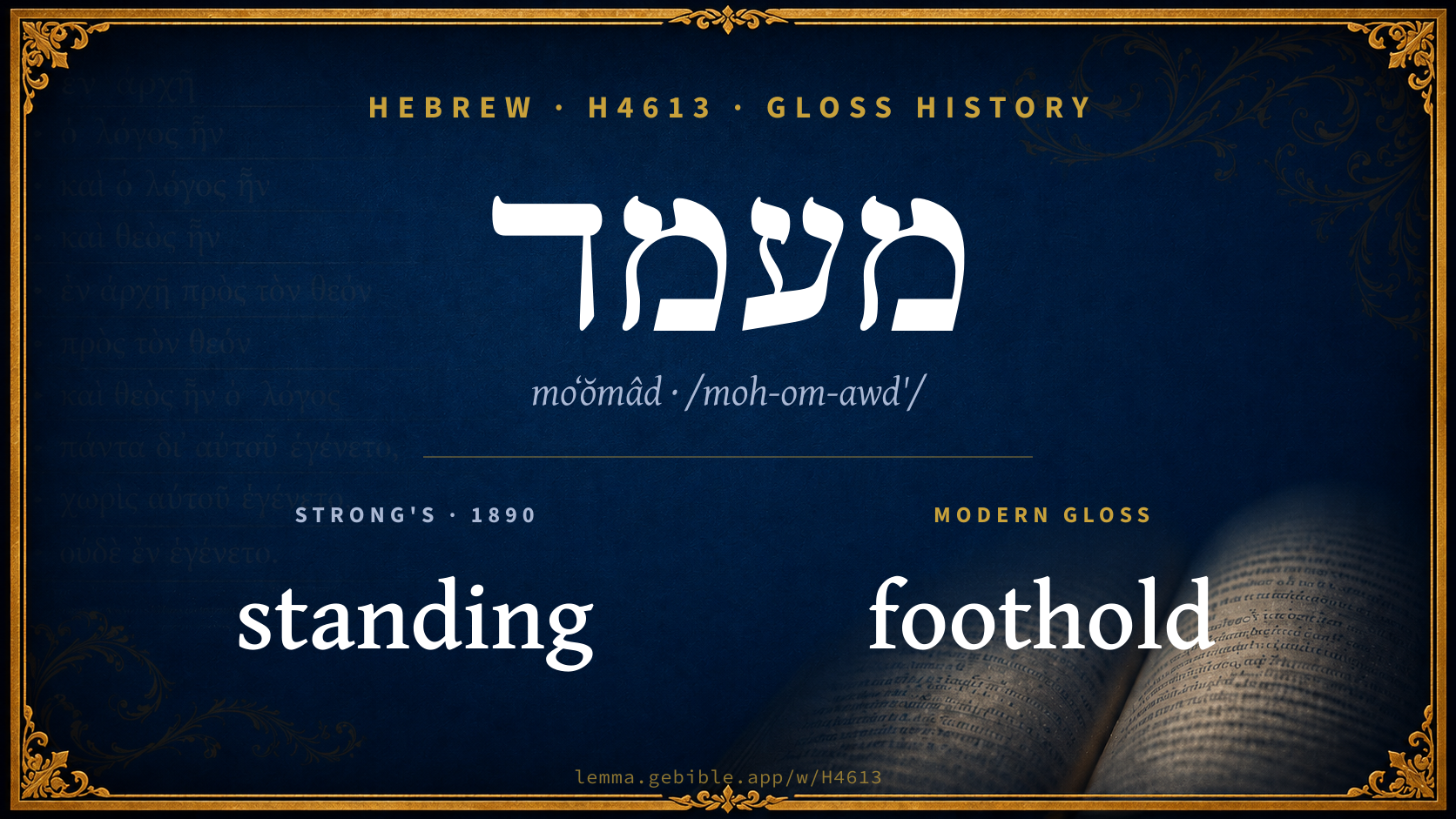
Gloss history
Strong's 1890 vs modern scholarship
About this word
Strong's H4613 catalogs a Hebrew word from the Hebrew Old Testament.
These counts are not copied from any lexicon or concordance. They are computed here, from the morphology-tagged Hebrew Old Testament. What Lemma adds →
- 1
- distinct verses
- The word appears in 1 distinct verse.
- 1 / 39
- OT books
- The word appears in 1 of 39 Old Testament books.
- #6,101
- by frequency
- Rank #6,101 (rank 6,101 of 8,640 Hebrew words by occurrence).
View all 1 occurrence in the concordance →
Most concentrated in
- Psalms 1 verse 100%
By section of the Old Testament
By traditional corpus
Conventional, traditional groupings — biblical authorship is debated, so this is a traditional corpus grouping, not an authorship claim. Each share is this word’s portion of its verses in that division of the Hebrew canon. Each figure is a share of the word’s 1 distinct verse.
- Writings (Ketuvim) 1 verse · 100%
How translations render this word
Counts come from each version’s own published word-to-Strong’s tagging or interlinear alignment — an approximate guide to how each version renders this word, not a word-level alignment the data otherwise carries. Because each total is that version’s own tagged count, the per-version totals vary from one another and need not match the appearance or distinct-verse counts above. These counts may also differ from a printed concordance because Lemma counts each distinctly tagged rendering and does not collapse phrase taggings into a single head-word total. This is a fixed set of word-tagged versions (KJV, ASV, BSB, ULT) and does not change with the reading translation you choose elsewhere. Each version’s license is shown beside its name below (and on Sources).
- King James Version: Is no standing 1×
- American Standard Version: Is no standing 1×
- Berean Standard Bible: Footing 1×
- unfoldingWord Literal Text: Standing 1×
King James Version Public Domain
Renders H4613 across 1 tagged occurrence — most commonly:
American Standard Version Public Domain
Renders H4613 across 1 tagged occurrence — most commonly:
Berean Standard Bible Public Domain
Renders H4613 across 1 tagged occurrence — most commonly:
unfoldingWord Literal Text CC BY-SA 4.0
Renders H4613 across 1 tagged occurrence — most commonly:
Senses in BDB
The 1 sense BDB distinguishes for this word, in lexicon order (not ranked by frequency or importance). The full entry — with sub-senses — is in the Lexicon Entry tab.
- foothold, standing ground
Word origin
n.[m.] standing-ground, foot-hold ψ 69:3 (in fig.).
— Brown-Driver-Briggs (Oxford 1906, public domain), digitized via Sefaria, supplemented by the OpenScriptures HebrewLexicon (CC BY 4.0). See Sources.
Derived from עמד (ʻâmad) (H5975) — to stand.
Jastrow Dictionary
A second Hebrew/Aramaic lexicon for comparison, covering Aramaic and post-biblical (Talmudic, Targumic, Midrashic) usage that the biblical-Hebrew BDB does not. Matched by lemma rather than by Strong’s number, so a lemma may carry more than one Jastrow headword (shown separately below), and the entries cover usage well beyond the Bible.
מַעֲמָד
- 1. standing up; מ׳ ומושב standing up and sitting down, halt of the funeral escort on returning from burial for lamentation or consolation. Tosef. Pes. II (III), 15 אין מ׳ ומו׳ וכ׳ no less than seven halts are made. Ib. 14 מקום שנהגו לעשות מ׳ ומו׳ where it is customary to make halts (on the eve of Passover). B. Bath. 100ᵇ עבד לה מ׳ ומו׳ arranged for her sake a maʿămad &c. Meg. IV, 3 (23ᵇ) אין עושין מ׳ … בפחות מעשרה we arrange no maʿămad &c. with less than ten persons; a. fr.—B. Bath. l. c. המוכר … מקום מַעֲמָדוֹ if one sells his grave, the road to his grave, or his halting place.—Pl. מַעֲמָדוֹת. Ib. אין פוחתין מז׳ מ׳ ומושבות no less than seven &c., v. supra.
- 2. (law) presence of witnesses, judges &c. Ib. 144ᵃ bot. במַעֲמַד שלשתן in the presence of us three (the owner, the trustee, and the recipient). Y. Shebu. VI, 37ᵃ top; Y. Gitt. IX, 50ᶜ bot., v. אָשַׁר. Y. Keth. XIII, 36ᵃ bot. בשפסק במַעֲמָדָהּ when her father made the promise in her presence; a. fr.
- 3. post, a division of popular representatives deputed to accompany the daily services in the Temple with prayers, and also a corresponding division in the country towns, answering to the divisions (guards, v. מִשְׁמָר) of priests and Levites. Taan. IV, 2 על כל משמר ומשמר היה מ׳ וכ׳ corresponding to every guard was a post of priests, Levites and Israelites stationed in Jerusalem. Ib. 4 אין בו מ׳ no prayer meeting of the maʿămad took place.—אַנְשֵׁי מ׳, v. אֱנוֹשׁ; a. fr.—Pl. as ab. Ib. 2 אלו הן מ׳ this is the origin of the maʿămadoth. Ib. 27ᵇ, a. e. אלמלא מ׳ but for the prayer meetings of &c. Meg. III, 6 במ׳ במעשה בראשית at the prayer meetings the first chapter of Genesis was read (one section each day of the week).
A Dictionary of the Targumim, the Talmud Babli and Yerushalmi, and the Midrashic Literature (Marcus Jastrow; London, Luzac, 1903) — Public Domain. Digitized via Sefaria. Digitized via Sefaria. Full attribution on Sources.
Same root — word family
Other BDB entries built from the same root as H4613, grouped by Strong’s listed origin. These share a root / origin per the lexicon — not necessarily a shared meaning. Each links to that word’s own entry.
Derives from
Shares the same root
- מעמד maʻămâd H4612 service
- עמד ʻômed H5977 standing place
- עמדה ʻemdâh H5979 standing ground
- עמוד ʻammûwd H5982 pillar
Compare all same-root words → Showing 4 of 6 — not the complete family. They share a root, not necessarily a meaning.
Septuagint verse parallels
This word appears in 1 verse that also exists in the Greek Old Testament (Septuagint), out of the 1 Hebrew verse it occurs in. You can read those verses in Greek by switching the Old Testament edition to the Septuagint.
Read these verses in the Septuagint
This is a verse-level parallel only — the same verses exist in both the Hebrew and Greek Old Testaments. No word-level Hebrew↔Greek correspondence is claimed: the data carries no such alignment, so no Greek word is shown as this Hebrew word’s translation. Coverage is not total — the Septuagint omits the deuterocanon and renumbers the Psalms, so some Hebrew verses have no direct Greek parallel.