
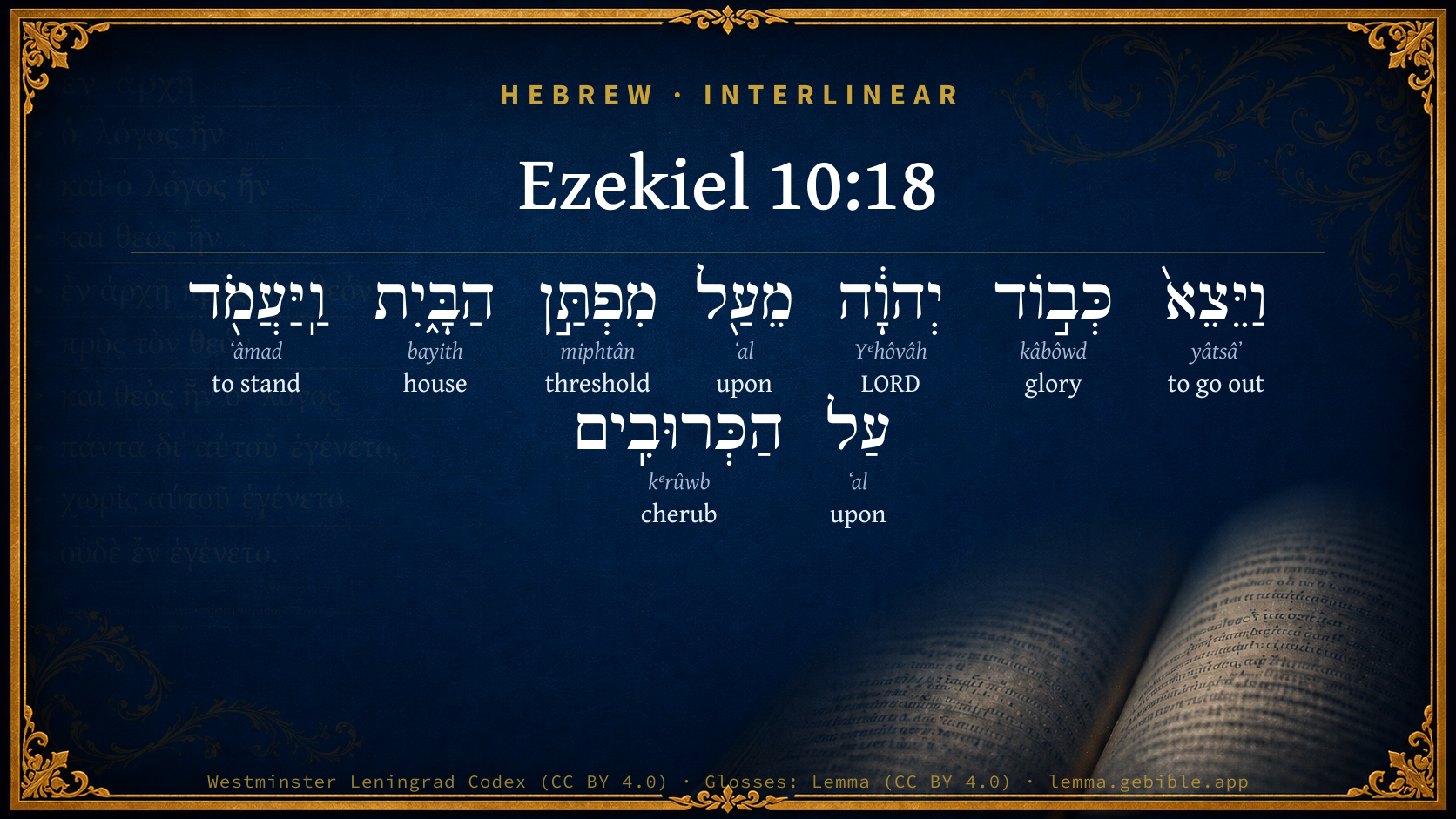
Ezekiel 10:18

Hebrew (Westminster Leningrad Codex) Ezekiel 10:18 appears in the Hebrew Old Testament. The text above is from the Westminster Leningrad Codex. Each word links to its Strong’s number, a concise gloss, and parsing drawn from the Open Scriptures Hebrew Bible morphology. Click any word for its full Brown-Driver-Briggs (BDB) entry.
Download image
Cite this verse

Ezekiel 10:18 (World English Bible). Public Domain. Lemma interlinear Bible study tool, https://lemma.gebible.app/v/ezekiel/10/18.

Show BibTeX & RIS
BibTeX
RIS
English Translation
The glory of Yahweh went forth from over the threshold of the house, and stood over the cherubim.
World English Bible · Public Domain
Download a study sheet

One document with this verse’s original text, its word-by-word gloss line, the meaning frame, cross-references with their text, attributed commentary, and full source and license credits — printable, and it pastes into notes with its structure intact.

This verse Autodidact and up

Study sheet (.html) Plain text (.txt)

A passage Seminary Student

Up to 50 verses in one chapter. A passage sheet keeps up to 6 commentary sources and 12 cross-references per verse, in the order this page ranks them, and says so on the sheet whenever that leaves anything out. Ask for a single verse and you get the Autodidact verse sheet above.

Everything on this page stays free to read, with no account — the sheet is a download of what is already on screen, not access to it.

Want to remove ads? Support Godless Engineer
Compare translations 3

The same verse in 3 English versions, stacked beneath the original-language interlinear above. Click any original word for its lexicon entry.

Each is an independent rendering of the whole verse — the interlinear is not word-aligned to these translations.

Highlighted words mark where these versions differ — a whole-verse word diff, not a word-by-word alignment.

  • World English Bible Public Domain
    The glory of Yahweh went forth from over the threshold of the house, and stood over the cherubim.
  • King James Version Public Domain
    Then the glory of the LORD departed from off the threshold of the house, and stood over the cherubims.
  • unfoldingWord Literal Text CC BY-SA 4.0
    Then the glory of Yahweh went out from over the threshold of the house and stood over the cherubim.

unfoldingWord Literal Text — © unfoldingWord, licensed CC BY-SA 4.0. Word-aligned USFM3 via Door43 (git.door43.org/unfoldingWord/en_ult).

Versions to compare (up to 4)

3 of 4 selected

Show all 18 translations

Every available English version of this verse, each an independent rendering of the whole verse.

  • World English Bible Public Domain
    The glory of Yahweh went forth from over the threshold of the house, and stood over the cherubim.
  • Berean Standard Bible Public Domain
    Then the glory of the LORD moved away from the threshold of the temple and stood above the cherubim.
  • Majority Standard Bible Public Domain
    Then the glory of the LORD moved away from the threshold of the temple and stood above the cherubim.
  • King James Version Public Domain
    Then the glory of the LORD departed from off the threshold of the house, and stood over the cherubims.
  • American Standard Version (1901) Public Domain
    And the glory of Jehovah went forth from over the threshold of the house, and stood over the cherubim.
  • Revised Version (1885) Public Domain
    And the glory of the LORD went forth from over the threshold of the house, and stood over the cherubim.
  • Geneva Bible (1599) Public Domain
    Then the glorie of the Lord departed from aboue the doore of the house, and stoode vpon the Cherubims.
  • Douay-Rheims (1899) Public Domain
    And the glory of the Lord went forth from the threshold of the temple: and stood over the cherubims.
  • Young's Literal Translation Public Domain
    And go forth doth the honour of Jehovah from off the threshold of the house, and standeth over the cherubs,
  • Literal Standard Version CC BY-SA 4.0
    And the glory of YHWH goes forth from off the threshold of the house, and stands over the cherubim,
  • Unlocked Literal Bible CC BY-SA 4.0
    Then the glory of Yahweh went out from over the threshold of the house and stood over the cherubim.
  • unfoldingWord Literal Text CC BY-SA 4.0
    Then the glory of Yahweh went out from over the threshold of the house and stood over the cherubim.
  • Darby Bible Public Domain
    And the glory of Jehovah departed from over the threshold of the house, and stood over the cherubim.
  • World Messianic Bible Public Domain
    The LORD’s glory went out from over the threshold of the house and stood over the cherubim.
  • Webster's Bible Public Domain
    Then the glory of the LORD departed from off the threshhold of the house, and stood over the cherubim.
  • Free Bible Version CC BY-SA 4.0
    Then the glory of the Lord left the entrance to the Temple and stopped above the cherubim.
  • Bible in Basic English Public Domain
    Then the glory of the Lord went out from the doorstep of the house, and came to rest over the winged ones.
  • JPS Tanakh (1917) Public Domain
    And the glory of the LORD went forth from off the threshold of the house, and stood over the cherubim.

Literal Standard Version (2020), Covenant Press — licensed CC BY-SA 4.0. Text via the HelloAO Bible API (eBible.org). Unlocked Literal Bible (unfoldingWord) — licensed CC BY-SA 4.0. Text via the HelloAO Bible API (eBible.org). unfoldingWord Literal Text — © unfoldingWord, licensed CC BY-SA 4.0. Word-aligned USFM3 via Door43 (git.door43.org/unfoldingWord/en_ult). Free Bible Version, Dr. Jonathan Gallagher — licensed CC BY-SA 4.0. Text via the HelloAO Bible API (eBible.org).

Word by word

More ways to search: Search by grammar → Find every occurrence → Compare this word →

Practice this passage: Drill this verse → Learn its vocabulary →

About this verse

These counts appear in no published source. They are computed here, from the morphology-tagged text and Lemma’s own curated glosses. What Lemma adds →

9
words
8
distinct lemmas
Prophets
section

Notable vocabulary

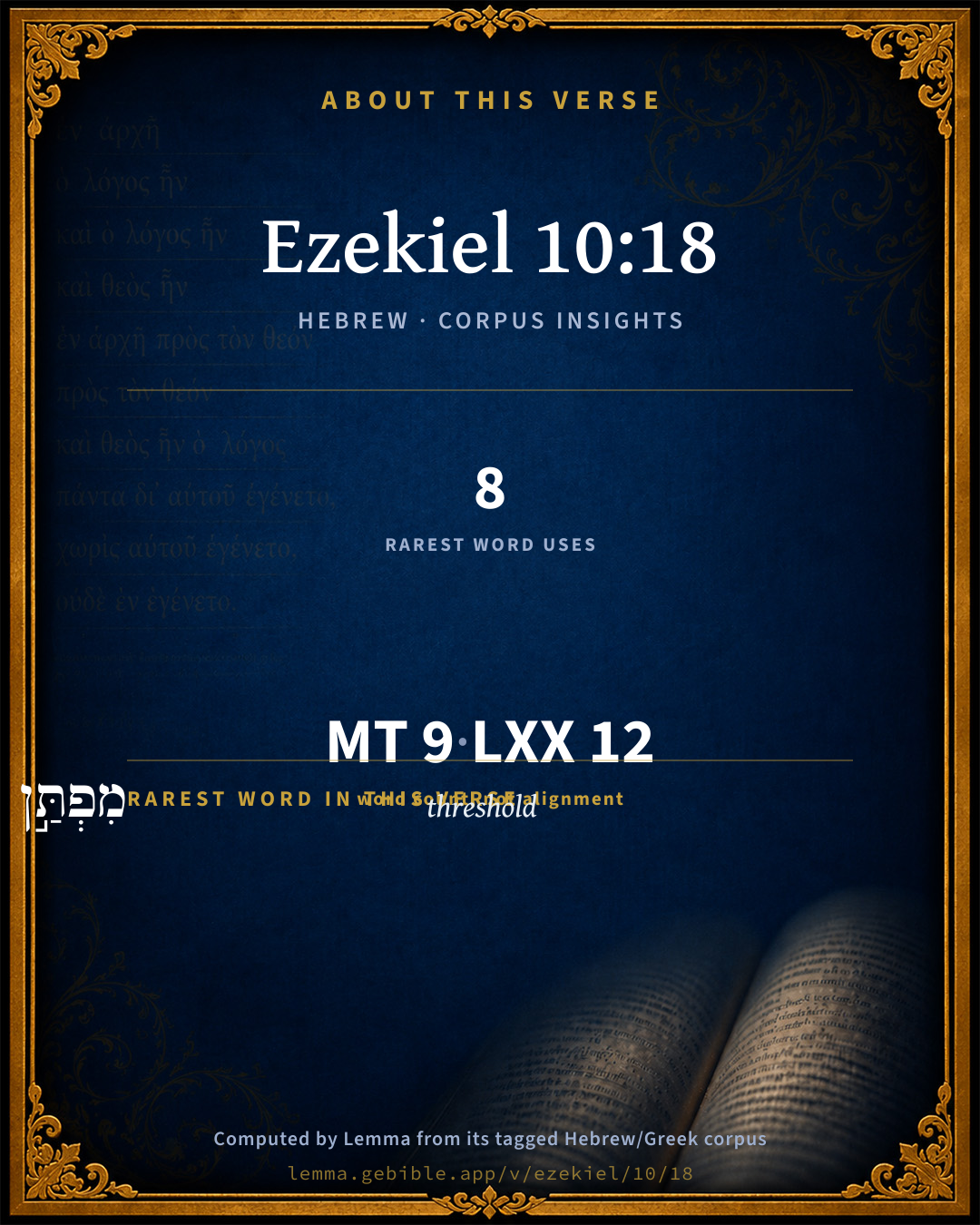
The rarest word here is מִפְתַּ֣ן threshold H4670 — appearing just 8 times in the whole Hebrew Bible.

Shared distinctive vocabulary

מִפְתַּ֣ן threshold H4670 occurs in 8 verses of the Hebrew Bible. Also found in:

Grammatical profile

  • 2 verbs
  • 5 nouns
  • 2 prepositions

Verb forms

  • וַיֵּצֵא֙ Qal · Sequential Imperfect
  • וַֽיַּעֲמֹ֖ד Qal · Sequential Imperfect

Repetition

A word recurs within this verse — often emphatic in Hebrew:

  • מֵעַ֖ל upon H5921 ×2

Hebrew & Septuagint length

In English translation the verse runs 18 words from the Hebrew and 16 from the Septuagint (LXX English) — closely comparable.

A rough comparison of the two English renderings, which tokenize alike — not a word-level alignment.

Word counts can differ between the Hebrew and the Greek without any difference in meaning — e.g. the Hebrew direct-object marker אֵת has no separate Greek word, and Greek often adds the article ὁ.

In the original languages it is 9 Hebrew tokens and 12 Greek tokens — but the two are counted differently (Hebrew bundles its prefixes and suffixes into one token; the Greek is in lemma form), so that isn’t a like-for-like length.

Cross-references

11

Topical passages linked to Ezekiel 10:18 in the Treasury of Scripture Knowledge — connected by theme and wording, ordered by reader-vote popularity; previews shown in the World English Bible.

  • Psalms 18:10 He rode on a cherub, and flew. Yes, he soared on the wings of the wind.
  • Psalms 78:60–61 So that he forsook the tent of Shiloh, The tent which he placed among men;
  • Matthew 23:37–39 "Jerusalem, Jerusalem, who kills the prophets, and stones those who are sent to her! How often would I have gathered your children together, even as a hen gathers her chickens under her wings, and you would not!
  • Genesis 3:24 So he drove out the man; and he placed Cherubs at the east of the garden of Eden, and the flame of a sword which turned every way, to guard the way to the tree of life.
  • 2 Kings 2:11 It happened, as they still went on, and talked, that behold, [there appeared] a chariot of fire, and horses of fire, which parted them both apart; and Elijah went up by a whirlwind into heaven.
  • Psalms 68:17–18 The chariots of God are tens of thousands and thousands of thousands. The Lord is among them, from Sinai, into the sanctuary.
  • Jeremiah 6:8 Be instructed, Jerusalem, lest my soul be alienated from you; lest I make you a desolation, a land not inhabited.
  • Jeremiah 7:12–14 But go you now to my place which was in Shiloh, where I caused my name to dwell at the first, and see what I did to it for the wickedness of my people Israel.
  • Ezekiel 7:20–22 As for the beauty of his ornament, he set it in majesty; but they made the images of their abominations [and] their detestable things therein: therefore have I made it to them as an unclean thing.
  • Hosea 9:12 Though they bring up their children, Yet I will bereave them, so that not a man shall be left. Indeed, woe also to them when I depart from them!
  • Ezekiel 10:3–4 Now the cherubim stood on the right side of the house, when the man went in; and the cloud filled the inner court.

Cross-references courtesy of OpenBible.info (CC BY 4.0).

Hebrew and Greek witnesses Masoretic Hebrew ↔ Greek Septuagint

The same verse in the two great witnesses to the Old Testament, shown verse-for-verse.

These are two independent witnesses, not word-aligned to each other, and the Septuagint is shown in lemma (dictionary) form.

Hebrew Ezekiel 10:18 Masoretic · Westminster Leningrad Codex

וַיֵּצֵא֙ כְּב֣וֹד יְהוָ֔ה מֵעַ֖ל מִפְתַּ֣ן הַבָּ֑יִת וַֽיַּעֲמֹ֖ד עַל הַכְּרוּבִֽים

The glory of Yahweh went forth from over the threshold of the house, and stood over the cherubim.

World English Bible · Public Domain

Greek LXX Ezekiel 10:18 Septuagint · lemma form

καί ἐκἔρχομαι δόξα κύριος ἀπό ὁ οἶκος καί ἐπιβαίνω ἐπί ὁ χερουβείμ

Then the glory of the Lord departed from the house, and went up on the cherubs.

LXX2012 (modern English Septuagint) · Public Domain

Hebrew: Westminster Leningrad Codex (CC BY 4.0). Greek: Septuagint (public domain); English from LXX2012 (modern English Septuagint) (Public Domain). How the Septuagint differs from the Hebrew →

Targum (Aramaic paraphrase)

1

The Targum is the ancient Jewish Aramaic paraphrase of the Hebrew Scriptures — an interpretive translation, not the Hebrew text itself. Onkelos (literal) and Pseudo-Jonathan (expansive) render the Torah, and Jonathan the Prophets. Coverage is partial: where no permissively-licensed English translation exists for a verse, only the Aramaic is shown. This is verse-level text, not a word-by-word alignment to the Hebrew.

  1. Targum Jonathan Prophets (Joshua–Malachi)
    וְאִסְתַּלֵק יְקָרָא דַייָ דַהֲוָה שָׁרַי עֲלוֹהִי מֵעֵיל לָקֳבֵיל סְקוּפַת בֵּיתָא וּשְׁרָא עַל כְּרוּבַיָא:

    (no public-domain English translation for this verse)

    Targum Jonathan — Aramaic: “Mikraot Gedolot” (public domain). English: “Sefaria Community Translation” (CC0 1.0 (public-domain dedication)); “London "Chaldee Paraphrase," 1871” (public domain). Text via Sefaria.

Commentary

Notes on Ezekiel 10:18 from classic Christian and Jewish commentators (each source and its license shown beneath its notes). The classic Christian expositions comment on the surrounding passage and are grouped to its opening verse, so a note may address several verses; the Jewish commentaries on the Tanakh (Rashi and others) are per-verse, so they appear only where the commentator wrote on this verse.

Lemma curates 59 commentaries, every one of them public domain or Creative Commons licensed, each selected and text-cleaned for this edition rather than reprinted as found. About our sources →

Jamieson, Fausset & Brown

Robert Jamieson, A. R. Fausset & David Brown

The departure of the symbol of God's presence from the temple preparatory to the destruction of the city. Foretold in Deu 31:17. Woe be to those from whom God departs (Hos 9:12)! Compare Sa1 28:15-16; Sa1 4:21 : "I-chabod, Thy glory is departed." Successive steps are marked in His departure; so slowly and reluctantly does the merciful God leave His house. First He leaves the sanctuary (Eze 9:3); He elevates His throne above the threshold of the house (Eze 10:1); leaving the cherubim He sits on the throne (Eze 10:4); He and the cherubim, after standing for a time at the door of the east gate (where was the exit to the lower court of the people), leave the house altogether (Eze 10:18-19), not to return till Eze 43:2.

Jamieson, Fausset & Brown — Commentary Critical and Explanatory on the Whole Bible (1871) — public domain (CC PDM 1.0). Text via the HelloAO Bible API.

Trapp's Complete Commentary

John Trapp

Eze 10:18 Then the glory of the LORD departed from off the threshold of the house, and stood over the cherubims.

Ver. 18. Then the glory of the Lord departed.] This the stubborn Jews would never be drawn to believe possible, till it befell them; hence they hear of it so often, but to little good purpose as to them.

John Trapp, A Commentary or Exposition upon All the Books of the Old and New Testament (1647–1656) — public domain. Text from a community e-Sword module.

The Biblical Illustrator

Joseph S. Exell

Eze_10:18-19

Then the glory of the Lord departed.

Departing glory

1. How unwilling the Lord is to depart, and leave that people He hath dwelt amongst, and been engaged unto!

2. There is no visible church but may fall, and cease to be. God is not tied to any place, to any people; but if they corrupt His worship He may withdraw: He did depart from Jerusalem, from the temple, and they were unchurched.

3. When the Lord goes from a people, then the protection and benefits they have by the angels go away. When the sun is gone from us, we have short days and long nights, little light but much darkness; and when God departs, you have much night and little day left, your comforts fade suddenly, and miseries come upon you swiftly. When God and His angels go from a church, the dragon and his angels get in; when mens inventions prevail, they are subject to all woes and miseries (Hos_9:12).

4. God would have men the notice of His departure. The cherubims stood at the door of the east gate, and there the glory stood over them; that gate was so seated in Mount Zion that they might see the entrance by it from most parts of the city, and here the glory now stood; it was come forth from the temple, and now exposed to public view, that they might inquire what was the matter, use all means to recover the glory which was going. (W. Greenhill, M. A.)

Gods gradual withdrawal

Observe with how many steps and pauses God departs, as loth to go, as if to see if there be any that will intercede with Him to return. None of the priests in the inner court between the temple and the altar would court His stay; therefore He leaves their court and stands at the east gate, which led into the court of the people, to see if any of them would yet at length stand in the gap. God removes by degrees from a provoking people; and, when He is ready to depart in displeasure, would return to them in mercy if they were but a repenting, praying people. (M. Henry.)

The Biblical Illustrator, edited by Joseph S. Exell (c. 1880s–1900s) — public domain. Text from a community e-Sword module.

Joseph Benson's Commentary

Eze 10:18-19. Then the glory of the Lord departed from off the threshold, &c. — The cloud of glory, emblematical of the divine presence, now makes a further remove from the temple: it now quite left the house itself, and settled upon the cherubim, which stood in the court adjoining to it, Eze 10:3. And the cherubims lifted up their wings: the wheels also — See Eze 1:19; Eze 1:26. And stood at the door of the east gate — This was a still further remove from the temple, (for the east gate was just at the entrance into the inner court before the temple,) to signify that the divine protection would entirely leave the house; and, God departing, the angels depart also, and withdraw that benefit and service which they gave before. Here, however, the glory of God, the cherubim, and the wheels, all stood, respiting execution, and giving opportunity of preventing the approaching misery.

Joseph Benson's Commentary on the Old and New Testaments (1811–1818) — public domain. Text from a community e-Sword module.

Geneva Bible (1599)

Geneva Bible translators

Read Ezek. 9:3.

Geneva Bible (1599) marginal notes — public domain. Text via Bolls.life.

John Calvin's Commentaries

Here the Prophet teaches us what is the principal point in the vision, namely, that God had deserted the temple: for we, know with what confidence the Jews boasted that they should be safe continually under the protection of God. In consequence of the promise, that God’s temple should be the place of his rest wherein he would dwell, (Psalm 132:14,) they did not think it possible that God would ever leave them: so they sinned without restraint; and while they drove him far away from them by their crimes, yet they wished to have him in some way bound to them. This folly is derided by Isaiah — Heaven is my seat, and earth is my foot. stool: what house therefore will ye build for me? (Isaiah 66:1.) God had commanded his temple to be built, and wished to have his earthly dwelling, place there: but he says that his wish had been rendered nugatory: and how? why when he promised that he would dwell in the temple, he wished his name to be purely and reverently invoked there.

But the Jews had polluted the temple in every way. Hence they thought that God was shut up there in vain: because his liberality did not tend to his partaking of the captivity of the Jews, but to his having them in obedience to himself. Therefore Isaiah deservedly says, that the temple became unfit for the use of God when it was profaned. So also we see in Jeremiah: Do not trust in lying words, the temple of Jehovah, the temple of Jehovah, the temple of Jehovah. (Jeremiah 7:4.) That repetition is used because they were so elated by their obstinacy. The Jews resisted the Prophets, and as often as any threat was uttered against them, they immediately fled to that asylum, the temple of the Lord.

For this reason therefore the Prophet now relates, that the glory of God had deserted the sanctuary: for otherwise what we have seen would have been out of place: he was sent to scatter burning through the whole city: in this way the temple would have been burnt, and God would have been consumed by peculiar fire: here I speak after the common form, because when the ark of the covenant is called the God of hosts, (2 Samuel 6:2,) how could it happen that the fire should destroy the ark, together with all parts of the temple? But God himself meets them and shows them that the temple was deprived of its glory when it was destroyed by the enemy. Afterwards the temple was overthrown And in the Psalms its lamentable ruin is described, how cruelly and proudly, and with what barbarous mockery the enemy insulted it, (Psalm 74, and Psalm 79:) this was very disgraceful, and disturbed their weak minds. Hence it was necessary to persuade the faithful that God no longer dwelt in the temple, but that it remained only an empty spectacle, because he had taken away his glory since the place was corrupted by so many defilements. Now therefore we understand the design of the Prophet, when he says that the glory of Jehovah had departed from the threshold of the house, and stood above the cherubim But he had already said that the cherubim had raised their wings, which he again confirms. Whence it follows, that God with his angels, when the temple was left, deserted the Jews, so that for the future they would boast themselves in vain to be safe under his protection. Therefore he says that the cherubim raised their wings, and ascended from the earth before his eyes Nor is this clause superfluous, since it was difficult to persuade the Jews of what he said about his deserting them. There was a celebrated oracle, “here will I dwell, since I have chosen it.” (Psalm 132:14.) When they grasped at that, they thought that the sun would sooner fall from heaven than God would leave that temple.

But the Prophet says that he saw it clearly, that no doubt might remain. If any one should here ask, how that promise which I have mentioned agrees with that departure which the Prophet here relates? the answer is easy, if we only understand that God does not always work by human means, nor yet according to our carnal perception. God often seems to act so abruptly that his beginning is without an end: in fine, God seems sometimes to sport and to draw back his hand, so that the event does not answer to the joyful beginnings. Since therefore, according to our carnal senses, God’s works appear to be frustrated, it is necessary to use such language: otherwise we should never understand how God departed from the sanctuary, when he had chosen it in perpetuity. But he so departed, that the place still remained sacred, and the temple stood before God though it had been overthrown in the eyes of men. The visible appearance of the temple was taken away, but meanwhile, since the temple was founded on the promise of God, it stood among its ruins, as I have said. For this reason Daniel, although solitude and devastation ought to avert his eyes and senses from Judea, prayed in that direction, as if the temple had remained entire. And why so? He looked at the promise. (Daniel 6:10.) And for this reason the Prophet said, after the return from the captivity, that the glory of the second temple surpassed that of the first, as the Prophet Haggai says. (Haggai 2:9.) And we know with what copiousness and magnificence Isaiah discourses concerning the splendor of the second temple and its inestimable glory. (Isaiah 60:7.) We shall see also a similar doctrine at the end of this book. Since therefore the temple stood before God, because it was founded on his promise, this temporary desertion could not abolish what I have said concerning God’s perpetual station.

same thing also must be said concerning the kingdom: that kingdom ought to stand while the sun and moon shone in heaven, (Psalm 89:37, 38,) this is true: and yet there was a sad interruption during many years. For we know what a serious disgrace the last king suffered: then had all dignity fallen to ruin, so that nothing could be seen but the horrible vengeance of God. And yet that promise always had its own effect; as long as the sun and moon shall stand, they shall be my faithful witnesses of the perpetuity of the kingdom. Now then we understand in what sense God left his temple, and yet did not in anywise break his promise. But he says, the glory of the God of Israel stood at the eastern gate, but above it, so that it was raised up from the earth. The meaning of that speech was, that the Jews might know that God was no longer to be sought in that dwelling of wood and stone, because he had not only left his seat, but had ascended upwards, that they should have no more intercourse with him. Now it follows —

John Calvin's Commentaries (1540-1563) — public domain. Text from the Calvin Translation Society English edition (1840s-50s) via the Christian Classics Ethereal Library (ccel.org). Calvin's coverage is partial (roughly two-thirds of the Bible); uncommented books and verses are honest gaps, never fabricated. The 19th-century editor's footnotes and remarks are omitted so the notes are faithfully Calvin's own voice.

The Cambridge Bible for Schools and Colleges

gen. ed. J. J. S. Perowne

18. The glory of the Lord returns from the threshold of the house to the cherubim, and these mount up and remove outside the precincts of the temple altogether, and stand within the city at the eastern gateway of the outward court.

The Cambridge Bible for Schools and Colleges (gen. ed. J. J. S. Perowne; Cambridge University Press, 1878–1918) — public domain. Text from a community e-Sword module.

John Gill's Exposition

Then the glory of the Lord departed from off the threshold of the house,.... Whither he had removed from the cherub or the cherubim, between the mercy seat, Eze 10:4; taking another step towards a general departure from the temple and city, of which this was another signal and warning:

and stood over the cherubim: not on the mercy seat from whence he came, for hither he returned not; but over the cherubim or living creatures seen in the vision, which were under the throne in the firmament of heaven; an emblem, as we have seen, of Gospel ministers: and this may denote the exaltation of Christ, who is the glory of the Lord, the brightness of his Father's glory, above sheen; his protection of them, and presence with them; for, let him move where he will, he will not depart from his faithful ministers; he will be with them to the end of the world.

John Gill's Exposition of the Whole Bible (1746–1763) — public domain (CC PDM 1.0). Text via the HelloAO Bible API.

Matthew Poole's English Annotations

The Jews dreamed that God could not depart from his temple; indeed, whilst it was his, and used as his, he did not, nor would he depart, but he will abandon it when profaned, and thereby made not his.

The house; the temple; he had withdrawn out of the sanctuary, and stood awhile at the door.

Over the cherubims; on the right side of the house, where the cherubims were in the inner court, Eze 10:3.

Matthew Poole's English Annotations on the Holy Bible (1683–1685) — public domain. Text from a community e-Sword/MySword module.

The Pulpit Commentary

Then the glory of the Lord, etc. The chariot throne was, as it were, ready for its kingly Rider. The "glory"-cloud, or Shechinah. takes its place over them, and the departure begins. From that hour the temple was, in Ezekiel"s thoughts, to be, till the time of restoration contemplated in ch. 40-48., what Shiloh had been, a God-deserted place. We arc reminded of the voice which Josephus tells us was heard before the final destruction of the second temple, exclaiming, "Let us depart hence," as the priests were making ready for the Pentecostal feast. ("Bell. Jud:," 6:5:3)

Glory departed.

In ver. 4 Ezekiel says that the glory visited the threshold of the house. Now he describes its departure and return to the cherubim.

I THE GLORY OF NEW DIVINE REVELATIONS HAS DEPARTED. The glory that visited the threshold of the temple brought a special symbolical revelation, and when that revelation had been made the glory retreated and left the scene in its normal earthly condition. Revelation has come in epochs separated by periods of assimilation, when the newly revealed truth has been left to work among man like leaven. God gave the Law once for all from Sinai. The gospel was brought into the world by Christ and his apostles, and left there to spread not left without the aid of God"s Spirit and that inward revelation by which an old truth becomes new in each fresh heart that receives it, but still given as a completed thing in respect to its facts and substance. We have no more prophets like Isaiah nor apostles like St. Paul. But we do not need them, for Christ has given us the perfect truth for all time. Yet we cannot but feel that there was a wonder and a beauty in those old days when the glory of the growing revelation was flashing out upon an astonished world.

II THE GLORY OF HIGHEST RAPTURE WILL DEPART. There are times when heaven is opened and we see the angels of God ascending and descending upon the Son of man. Then we would fain build our tabernacles and retain the rare delight. But it is not to be. These angel visits are few and far between. Jacob wakes from his dream to the chili loneliness of the desolate hills of Bethel. The disciples who have witnessed the Transfiguration must descend from Hermon to the troubles of the plain, and exchange the society of Moses and Elijah for that of a raving lunatic. It is rare for the soul to be in a condition to enjoy the greatest bliss. But it is not necessary that this condition should remain; indeed, it is better to be in quieter moods for the homely tasks of life. Therefore we must still tread this lower earth, though we may have some fine glimpses of the heavenly splendour. The spray that is flung off from the great ocean of celestial bliss may occasionally reach us in drops of gold. Yet our vocation is to walk by faith. Meanwhile the departure of this glory does not mean the departure of God; he is with us in the dullest days. Nor does it mean our fall and shame; it may be best for the faithful servant to work in quiet without the full revelation of the Divine presence. We need ceaseless grace; we can wait for eternal glory.

III THE GLORY OF THE CHRISTIAN LIFE MAY DEPART. There is a glory which should be on us and abiding with us. All Christians are "called to be saints." Few of us may behold the celestial splendour, but all of us should wear the aureole of purity. When we have washed our robes and made them white in the blood of the Lamb, the new glory of pardon and cleansing should abide. But, alas! even this glory too soon departs; the cleansed garments are again dragged through the mire, and the Christian, though renewed by Christ, dares not regard himself as a "saint." When he falls into a great sin the glory has indeed departed. If the fresh fervour of youth fades, and a commonplace character is all that remains, must it nut be said that the glory has departed, though the faith and fidelity may remain?

The Pulpit Commentary (1880–1919), ed. H.D.M. Spence-Jones & Joseph S. Exell — public domain. Text from a community e-Sword module.

John Wesley's Explanatory Notes

And stood - On the right side of the house, where the cherubim were in the inner court.

John Wesley, Explanatory Notes Upon the Whole Bible (1754–1765) — public domain. Text via the GEBible commentary corpus.

unfoldingWord translationNotes

Door43 World Missions Community

the glory of Yahweh

See how you translated this in Ezekiel 1:28.

the house

the temple

stood over

"stayed over" or "waited over"

came upon them from above

"went above the cherubim"

translationWords

threshold

house

Israel

unfoldingWord translationNotes — © Distant Shores Media and the Door43 World Missions Community, licensed CC BY-SA 4.0. Source: git.door43.org/Door43/en_tn.

Lesson kit

Teaching starters — assembled from the data on this page, not authored interpretation. Every prompt links to the verse data it draws on. Edit before teaching.

Ezekiel, in the Prophets, opens this verse with 9 words (8 distinct Hebrew lemmas). Its most distinctive word is miphtân (“threshold”). A historical commentator’s framing appears above. Read the whole chapter for the surrounding context.

Discussion questions

  1. What does “threshold” (miphtân) contribute to the verse as a whole?
  2. How does 1 Samuel 5:4, which shares the word «threshold», read alongside this verse?
  3. What does the repetition of “upon” (2× in this one verse) do in this verse?
  4. The translations on this page render this verse differently — a whole-verse word diff, not a word-by-word alignment. What might account for the different wordings?
  5. «וַיֵּצֵא֙» is a Qal Sequential Imperfect verb. How does that grammatical form shape the action described?
  6. Compare how Jamieson, Fausset & Brown and Trapp's Complete Commentary read this verse. Where do they agree or differ?

Things to notice

Reading settings

Reading text

Shown beneath each verse's original-language words.

Old Testament
Old Testament edition

Read the OT as the Masoretic Hebrew (MT) or the Greek Septuagint (LXX).

English shown for the Greek Septuagint (in the Hebrew ↔ Greek comparison).

Comparing translations? Open the Compare panel on any verse page to stack up to four side by side.