Isaiah 36:3

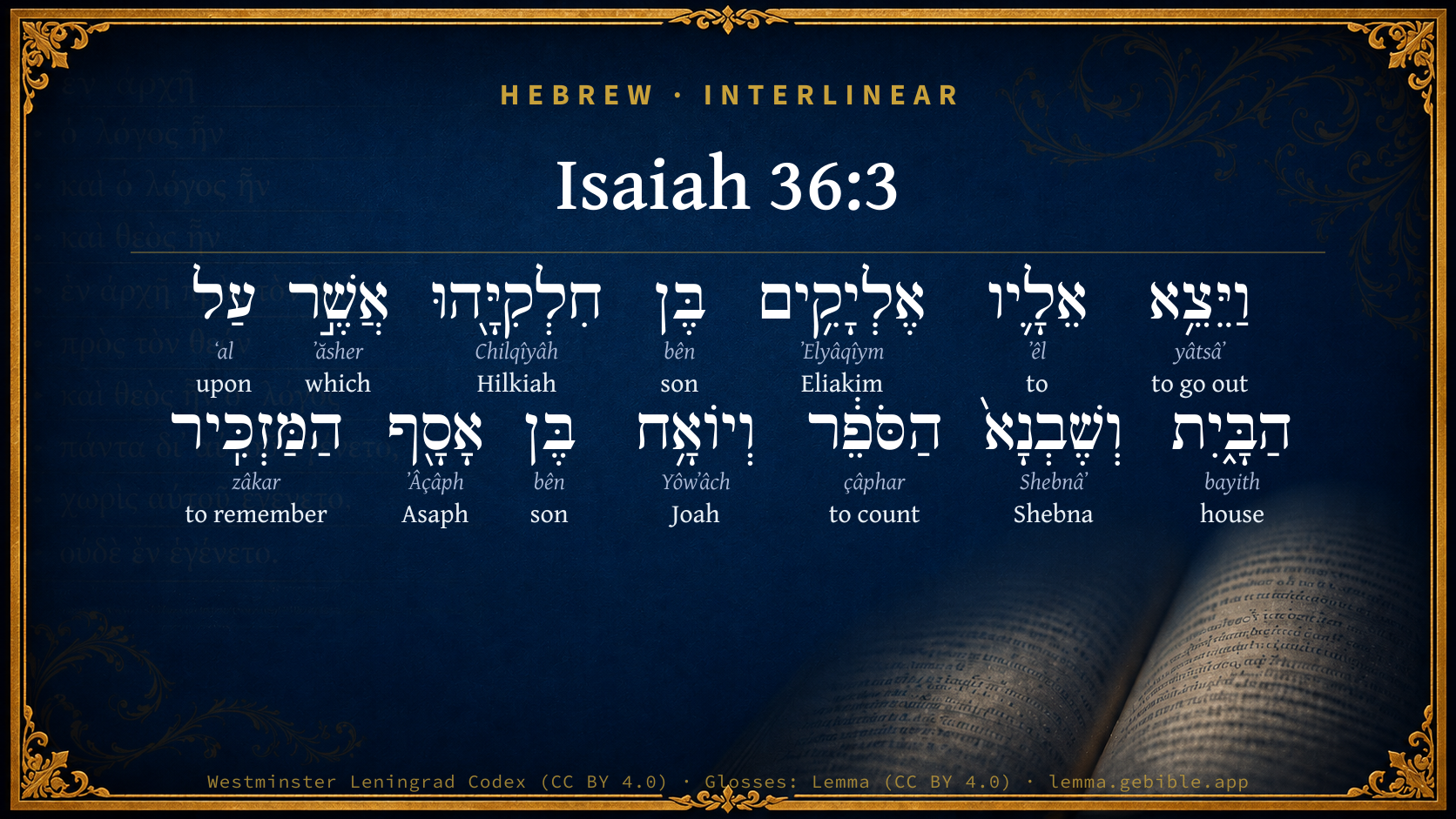
Hebrew (Westminster Leningrad Codex) Isaiah 36:3 appears in the Hebrew Old Testament. The text above is from the Westminster Leningrad Codex. Each word links to its Strong’s number, a concise gloss, and parsing drawn from the Open Scriptures Hebrew Bible morphology. Click any word for its full Brown-Driver-Briggs (BDB) entry.
Download image
Cite this verse

Isaiah 36:3 (World English Bible). Public Domain. Lemma interlinear Bible study tool, https://lemma.gebible.app/v/isaiah/36/3.

Show BibTeX & RIS
BibTeX
RIS
English Translation
Then came forth to him Eliakim the son of Hilkiah, who was over the household, and Shebna the scribe, and Joah, the son of Asaph, the recorder.
World English Bible · Public Domain
Download a study sheet

One document with this verse’s original text, its word-by-word gloss line, the meaning frame, cross-references with their text, attributed commentary, and full source and license credits — printable, and it pastes into notes with its structure intact.

This verse Autodidact and up

Study sheet (.html) Plain text (.txt)

A passage Seminary Student

Up to 50 verses in one chapter. A passage sheet keeps up to 6 commentary sources and 12 cross-references per verse, in the order this page ranks them, and says so on the sheet whenever that leaves anything out. Ask for a single verse and you get the Autodidact verse sheet above.

Everything on this page stays free to read, with no account — the sheet is a download of what is already on screen, not access to it.

Want to remove ads? Support Godless Engineer
Compare translations 3

The same verse in 3 English versions, stacked beneath the original-language interlinear above. Click any original word for its lexicon entry.

Each is an independent rendering of the whole verse — the interlinear is not word-aligned to these translations.

Highlighted words mark where these versions differ — a whole-verse word diff, not a word-by-word alignment.

  • World English Bible Public Domain
    Then came forth to him Eliakim the son of Hilkiah, who was over the household, and Shebna the scribe, and Joah, the son of Asaph, the recorder.
  • King James Version Public Domain
    Then came forth unto him Eliakim, Hilkiah's son, which was over the house, and Shebna the scribe, and Joah, Asaph's son, the recorder.
  • unfoldingWord Literal Text CC BY-SA 4.0
    And Eliakim, the son of Hilkiah, who over the house, and Shebna the scribe and Joah, the son of Asaph, the recorder, went out to him.

unfoldingWord Literal Text — © unfoldingWord, licensed CC BY-SA 4.0. Word-aligned USFM3 via Door43 (git.door43.org/unfoldingWord/en_ult).

Versions to compare (up to 4)

3 of 4 selected

Show all 18 translations

Every available English version of this verse, each an independent rendering of the whole verse.

  • World English Bible Public Domain
    Then came forth to him Eliakim the son of Hilkiah, who was over the household, and Shebna the scribe, and Joah, the son of Asaph, the recorder.
  • Berean Standard Bible Public Domain
    Then Eliakim son of Hilkiah the palace administrator, Shebna the scribe, and Joah son of Asaph the recorder, went out to him.
  • Majority Standard Bible Public Domain
    Then Eliakim son of Hilkiah the palace administrator, Shebna the scribe, and Joah son of Asaph the recorder, went out to him.
  • King James Version Public Domain
    Then came forth unto him Eliakim, Hilkiah's son, which was over the house, and Shebna the scribe, and Joah, Asaph's son, the recorder.
  • American Standard Version (1901) Public Domain
    Then came forth unto him Eliakim the son of Hilkiah, who was over the household, and Shebna the scribe, and Joah, the son of Asaph, the recorder.
  • Revised Version (1885) Public Domain
    Then came forth unto him Eliakim the son of Hilkiah, which was over the household, and Shebna the scribe, and Joah the son of Asaph the recorder.
  • Geneva Bible (1599) Public Domain
    Then came foorth vnto him Eliakim the sonne of Hilkiah the steward of the house, and Shebna the chanceler, and Ioah the sonne of Asaph the recorder.
  • Douay-Rheims (1899) Public Domain
    And there went out to him Eliacim the son of Helcias, who was over the house, and Sobna the scribe, and Joahe the son of Asaph the recorder.
  • Young's Literal Translation Public Domain
    and go forth unto him doth Eliakim son of Hilkiah, who `is' over the house, and Shebna the scribe, and Joah son of Asaph, the remembrancer.
  • Literal Standard Version CC BY-SA 4.0
    and Eliakim son of Hilkiah goes forth to him, who [is] over the house, and Shebna the scribe, and Joah son of Asaph, the remembrancer.
  • Unlocked Literal Bible CC BY-SA 4.0
    The Israelite officials who went out of the city to talk with them were Hilkiah's son Eliakim, the palace administrator, Shebna the king's secretary, and Asaph's son Joah, who wrote down the government decisions.
  • unfoldingWord Literal Text CC BY-SA 4.0
    And Eliakim, the son of Hilkiah, who over the house, and Shebna the scribe and Joah, the son of Asaph, the recorder, went out to him.
  • Darby Bible Public Domain
    Then came forth to him Eliakim the son of Hilkijah, who was over the household, and Shebna the scribe, and Joah the son of Asaph, the chronicler.
  • World Messianic Bible Public Domain
    Then Eliakim the son of Hilkiah, who was over the household, and Shebna the scribe, and Joah, the son of Asaph the recorder came out to him.
  • Webster's Bible Public Domain
    Then came forth to him Eliakim, Hilkiah's son, who was over the house, and Shebna the scribe, and Joah, Asaph's son, the recorder.
  • Free Bible Version CC BY-SA 4.0
    Eliakim, son of Hilkiah, the palace manager, Shebnah the scribe, and Joah, son of Asaph, the record-keeper, went out to speak with him.
  • Bible in Basic English Public Domain
    And there came out to him Eliakim, the son of Hilkiah, who was over the house, and Shebna the scribe, and Joah, the son of Asaph, the recorder.
  • JPS Tanakh (1917) Public Domain
    Then came forth unto him Eliakim the son of Hilkiah, that was over the household, and Shebna the scribe, and Joah the son of Asaph the recorder.

Literal Standard Version (2020), Covenant Press — licensed CC BY-SA 4.0. Text via the HelloAO Bible API (eBible.org). Unlocked Literal Bible (unfoldingWord) — licensed CC BY-SA 4.0. Text via the HelloAO Bible API (eBible.org). unfoldingWord Literal Text — © unfoldingWord, licensed CC BY-SA 4.0. Word-aligned USFM3 via Door43 (git.door43.org/unfoldingWord/en_ult). Free Bible Version, Dr. Jonathan Gallagher — licensed CC BY-SA 4.0. Text via the HelloAO Bible API (eBible.org).

Word by word

More ways to search: Search by grammar → Find every occurrence → Compare this word →

Practice this passage: Drill this verse → Learn its vocabulary →

וְשֶׁבְנָא֙
Shebnâʼ
H7644
“and · Shebna”
Conjunction + Noun, Proper
Part of Speech
Conjunction + Noun
Type
Proper
Full BDB Definition

Origin: from an unused root meaning to grow

TWOT: None

Shebna = "vigour" - a person of high position in the court of king Hezekiah of Judah; subsequently the secretary of Hezekiah
  1. וַיֵּצֵ֥א yâtsâʼ H3318 “and · to go out” Conjunction + Verb, Qal, Sequential Imperfect, 3rd Person, Masculine, Singular
  2. אֵלָ֛יו ʼêl H413 “to · him” Preposition + Suffix, Personal, 3rd Person, Masculine, Singular
  3. אֶלְיָקִ֥ים ʼElyâqîym H471 “Eliakim” Noun, Proper
  4. בֶּן bên H1121 “son of” Noun, Common, Masculine, Singular, Construct
  5. חִלְקִיָּ֖הוּ Chilqîyâh H2518 “Hilkiah” Noun, Proper
  6. אֲשֶׁ֣ר ʼăsher H834 “which” Particle, Relative
  7. עַל ʻal H5921 “upon” Preposition
  8. הַבָּ֑יִת bayith H1004 “the · house” Particle, Definite Article + Noun, Common, Masculine, Singular, Absolute
  9. הַסֹּפֵ֔ר çâphar H5608 “the · scribe” Particle, Definite Article + Noun, Common, Masculine, Singular, Absolute
  10. וְיוֹאָ֥ח Yôwʼâch H3098 “and · Joah” Conjunction + Noun, Proper
  11. בֶּן bên H1121 “son of” Noun, Common, Masculine, Singular, Construct
  12. אָסָ֖ף ʼÂçâph H623 “Asaph” Noun, Proper
  13. הַמַּזְכִּֽיר zâkar H2142 “the · remembering” Particle, Definite Article + Verb, Hiphil, Participle Active, Masculine, Singular, Absolute

About this verse

These counts appear in no published source. They are computed here, from the morphology-tagged text and Lemma’s own curated glosses. What Lemma adds →

14
words
13
distinct lemmas
Prophets
section

Notable vocabulary

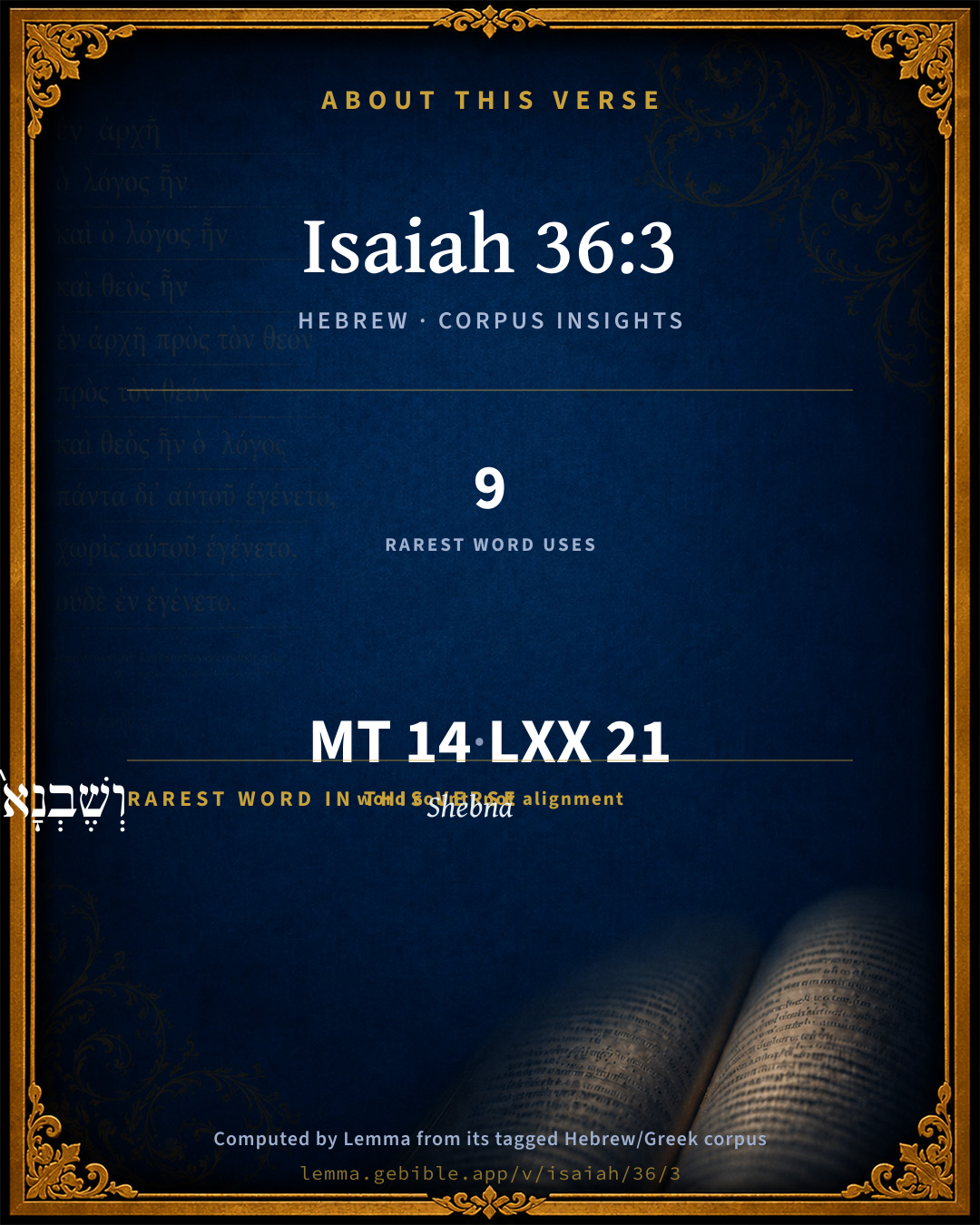
The rarest word here is וְשֶׁבְנָא֙ Shebna H7644 — appearing just 9 times in the whole Hebrew Bible.

Shared distinctive vocabulary

וְשֶׁבְנָא֙ Shebna H7644 occurs in 9 verses of the Hebrew Bible. Also found in:

Grammatical profile

  • 2 verbs
  • 9 nouns
  • 2 prepositions
  • 1 particle

Verb forms

  • וַיֵּצֵ֥א Qal · Sequential Imperfect
  • הַמַּזְכִּֽיר Hiphil · Participle Active

Repetition

A word recurs within this verse — often emphatic in Hebrew:

Hebrew & Septuagint length

In English translation the verse runs 27 words from the Hebrew and 25 from the Septuagint (LXX English) — closely comparable.

A rough comparison of the two English renderings, which tokenize alike — not a word-level alignment.

Word counts can differ between the Hebrew and the Greek without any difference in meaning — e.g. the Hebrew direct-object marker אֵת has no separate Greek word, and Greek often adds the article ὁ.

In the original languages it is 14 Hebrew tokens and 21 Greek tokens — but the two are counted differently (Hebrew bundles its prefixes and suffixes into one token; the Greek is in lemma form), so that isn’t a like-for-like length.

Cross-references

3

Topical passages linked to Isaiah 36:3 in the Treasury of Scripture Knowledge — connected by theme and wording, ordered by reader-vote popularity; previews shown in the World English Bible.

  • 2 Samuel 8:16–17 Joab the son of Zeruiah was over the host; and Jehoshaphat the son of Ahilud was recorder;
  • 2 Samuel 20:24–25 and Adoram was over the men subject to forced labor; and Jehoshaphat the son of Ahilud was the recorder;
  • Isaiah 22:15–21 Thus says the Lord, Yahweh of Hosts, Go, get yourself to this treasurer, even to Shebna, who is over the house, [and say],

Cross-references courtesy of OpenBible.info (CC BY 4.0).

Hebrew and Greek witnesses Masoretic Hebrew ↔ Greek Septuagint

The same verse in the two great witnesses to the Old Testament, shown verse-for-verse.

These are two independent witnesses, not word-aligned to each other, and the Septuagint is shown in lemma (dictionary) form.

Hebrew Isaiah 36:3 Masoretic · Westminster Leningrad Codex

וַיֵּצֵ֥א אֵלָ֛יו אֶלְיָקִ֥ים בֶּן חִלְקִיָּ֖הוּ אֲשֶׁ֣ר עַל הַבָּ֑יִת וְשֶׁבְנָא֙ הַסֹּפֵ֔ר וְיוֹאָ֥ח בֶּן אָסָ֖ף הַמַּזְכִּֽיר

Then came forth to him Eliakim the son of Hilkiah, who was over the household, and Shebna the scribe, and Joah, the son of Asaph, the recorder.

World English Bible · Public Domain

Greek LXX Isaiah 36:3 Septuagint · lemma form

καί ἐκἔρχομαι πρός αὐτός ελιακιμ ὁ ὁ χελκιας ὁ οἰκονόμος καί σομνας ὁ γραμματεύς καί ιωαχ ὁ ὁ ασαφ ὁ ςὑπομνηματογράφο

And there went forth to him Heliakim the steward, the son of Chelcias, and Somnas the scribe, and Joach the son of Asaph, the recorder.

LXX2012 (modern English Septuagint) · Public Domain

Hebrew: Westminster Leningrad Codex (CC BY 4.0). Greek: Septuagint (public domain); English from LXX2012 (modern English Septuagint) (Public Domain). How the Septuagint differs from the Hebrew →

Targum (Aramaic paraphrase)

1

The Targum is the ancient Jewish Aramaic paraphrase of the Hebrew Scriptures — an interpretive translation, not the Hebrew text itself. Onkelos (literal) and Pseudo-Jonathan (expansive) render the Torah, and Jonathan the Prophets. Coverage is partial: where no permissively-licensed English translation exists for a verse, only the Aramaic is shown. This is verse-level text, not a word-by-word alignment to the Hebrew.

  1. Targum Jonathan Prophets (Joshua–Malachi)
    וּנְפַק לְוָתֵהּ אֱלְיָקִים בַּר חִלְקִיָה דִי מְמַנָא עַל בֵּיתָא וְשֶׁבְנָא סַפְרָא וְיוֹאָח בַּר אָסָף דִי מְמַנָא עַל דָכְרָנַיָא:

    Then came forth unto him Eliakim, Hilkiah's son, who was appointed over the household, and Shebna, the scribe, and Joah, Asaph's son, who was appointed over the records.

    Targum Jonathan — Aramaic: “Mikraot Gedolot” (public domain). English: “Sefaria Community Translation” (CC0 1.0 (public-domain dedication)); “London "Chaldee Paraphrase," 1871” (public domain). Text via Sefaria.

Commentary

Notes on Isaiah 36:3 from classic Christian and Jewish commentators (each source and its license shown beneath its notes). The classic Christian expositions comment on the surrounding passage and are grouped to its opening verse, so a note may address several verses; the Jewish commentaries on the Tanakh (Rashi and others) are per-verse, so they appear only where the commentator wrote on this verse.

Lemma curates 59 commentaries, every one of them public domain or Creative Commons licensed, each selected and text-cleaned for this edition rather than reprinted as found. About our sources →

Keil & Delitzsch

C. F. Keil & F. Delitzsch

Hezekiah's confidential ministers go there also. Isa 36:3 (K. "And they called to the king), and there went out to him (K. to them) Eliakim son of Hilkiyahu, the house-minister, and Shebna the chancellor, and Joah son of Asaph, the recorder." On the office of the house-minister, or major-domo, which was now filled by Eliakim instead of Shebna (שׁבנא, K. twice שׁבנה), see Isa 22:15.; and on that of sōphēr and mazkı̄r. Rabshakeh's message follows in Isa 36:4-10 : "And Rabshakeh said to them, Say now to Hizkiyahu, Thus saith the great king, the king of Asshur, What sort of confidence is this that thou hast got? I say (K. thou sayest, i.e., thou talkest), vain talk is counsel and strength for war: now, then, in whom dost thou trust, that thou hast rebelled against me? (K. Now) Behold, thou trustest (K. לּך) in this broken reed-staff there, in Egypt, on which one leans, and it runs into his hand and pierces it; so does Pharaoh king of Egypt to all who trust in him. But if thou sayest to me (K. ye say), We trust in Jehovah our God; is it not He whose high places and altars Hizkiyahu has removed, and has said to Judah and Jerusalem, Ye shall worship before the altar (K. ads, in Jerusalem)? And now take a wager with my lord (K. with) the king of Asshur; I will deliver thee two thousand horses, if thou art able for thy part to give horsemen upon them. And how couldst thou repel the advance of a single satrap among the least of the servants of my lord?! Thou puttest thy trust then in Egypt for chariots and riders! And (omitted in K.) now have I come up without Jehovah against this land to destroy it (K. against this place, to destroy it)? Jehovah said to me, Go up to (K. against) this land, and destroy it." The chronicler has a portion of this address of Rabshakeh in Ch2 32:10-12. And just as the prophetic words in the book of Kings have a Deuteronomic sound, and those in the Chronicles the ring of a chronicle, so do Rabshakeh's words, and those which follow, sound like the words of Isaiah himself. "The great king" is the standing royal title appended to the names of Sargon and Sennacherib upon the Assyrian monuments (compare Isa 10:8). Hezekiah is not thought worthy of the title of king, ether here or afterwards. The reading אמרתּ in Isa 36:5 (thou speakest vain talk) is not the preferable one, because in that case we should expect דּבּרתּ, or rather (according to the usual style) אך דּבּרתּ. The meaning is, that he must look upon Hezekiah's resolution, and his strength (וּגבוּרה עצה connected as in Isa 11:2) for going to war, as mere boasting ("lip-words," as in Pro 14:23), and must therefore assume that there was something in the background of which he was well aware. And this must be Egypt, which would not only be of no real help to its ally, but would rather do him harm by leaving him in the lurch. The figure of a reed-staff has been borrowed by Ezekiel in Isa 29:6-7. It was a very appropriate one for Egypt, with its abundance of reeds and rushes (Isa 19:6), and it has Isaiah's peculiar ring (for the expression itself, compare Isa 42:3; and for the fact itself, Isa 30:5, and other passages). רצוּץ does not mean fragile (Luzz. quella fragil canna), but broken, namely, in consequence of the loss of the throne by the native royal family, from whom it had been wrested by the Ethiopians (Isa 18:1-7), and the defeats sustained at the hands of Sargon (Isa 20:1-6). The construction cui quis innitur et intrat is paratactic for cui si quis. In Isa 36:7 the reading תאמרוּן commends itself, from the fact that the sentence is not continued with הסירת; but as Hezekiah is addressed throughout, and it is to him that the reply is to be made, the original reading was probably תאמר. The fact that Hezekiah had restricted the worship of Jehovah to Jerusalem, by removing the other places of worship (Kg2 18:4), is brought against him in a thoroughly heathen, and yet at the same time (considering the inclination to worship other gods which still existed in the nation) a very crafty manner. In Isa 36:8, Isa 36:9, he throws in his teeth, with most imposing scorn, his own weakness as compared with Asshur, which was chiefly dreaded on account of its strength in cavalry and war-chariots. נא התערב does not refer to the performance and counter-performance which follow, in the sense of "connect thyself" (Luzz. associati), but is used in a similar sense to the Omeric μιγῆναι, though with the idea of vying with one another, not of engaging in war (the synonym in the Talmud is himrâh, to bet, e.g., b. Sabbath 31a): a bet and a pledge are kindred notions (Heb. ערבון, cf., Lat. vadari). On pechâh (for pachâh), which also occurs as an Assyrian title in Eze 23:6, Eze 23:23. אחד פּחת, two constructives, the first of which is to be explained according to Ewald, 286, a (compare above, Isa 36:2, כבד חיל), form the logical regens of the following servorum dominin mei minimorum; and hēshı̄bh penē does not mean here to refuse a petitioner, but to repel an antagonist (Isa 28:6). The fut. consec. ותּבטח deduces a consequence: Hezekiah could not do anything by himself, and therefore he trusted in Egypt, from which he expected chariots and horsemen. In Isa 36:10, the prophetic idea, that Asshur was the instrument employed by Jehovah (Isa 10:5, etc.), is put into the mouth of the Assyrian himself. This is very conceivable, but the colouring of Isaiah is undeniable.

Keil & Delitzsch — Biblical Commentary on the Old Testament (1861–1891) — public domain (CC PDM 1.0). Text via the HelloAO Bible API. (Old Testament only.)

Tyndale Open Study Notes

Tyndale Open Resources

36:3 Eliakim eventually advanced in rank, while Shebna was demoted (see 22:15-24).

Tyndale Open Study Notes — © Tyndale Open Resources, licensed CC BY-SA 4.0. Text via the HelloAO Bible API.

Geneva Bible (1599)

Geneva Bible translators

For he was now restored to his office, as Isaiah had prophesied, Isa. 22:20.

This declareth that there were few godly to be found in the king’s house, when he was driven to send this wicked man in such a weighty matter.

Geneva Bible (1599) marginal notes — public domain. Text via Bolls.life.

Jamieson, Fausset & Brown

Robert Jamieson, A. R. Fausset & David Brown

Eliakim--successor to Shebna, who had been "over the household," that is, chief minister of the king; in Isa 22:15-20, this was foretold.

scribe--secretary, recorder--literally, "one who reminds"; a remembrancer to keep the king informed on important facts, and to act as historiographer. In Kg2 18:18, the additional fact is given that the Assyrian envoys "called to the king," in consequence of which Eliakim, &c., "came out to them."

Jamieson, Fausset & Brown — Commentary Critical and Explanatory on the Whole Bible (1871) — public domain (CC PDM 1.0). Text via the HelloAO Bible API.

Adam Clarke's Commentary

Verse 3. Then came forth unto him] Before these words the other copy, 2Kg 18:18, adds, ויקראו אל המלך vaiyikreu el hammelech, "And they demanded audience of the king."

Adam Clarke's Commentary on the Bible (1810–1826) — public domain. Text from a community e-Sword/MySword module.

Ellicott's Commentary for English Readers

(3) Eliakim.—It is significant that Eliakim now fills the office which, a short time before, had been filled by Shebna, while the latter is reduced to the inferior position of a scribe (Isa_22:15-25). The change is clearly traceable to Isaiah’s influence. The “scribe” was the secretary who formulated despatches and degrees; the “recorder,” probably the registrar of the official annals.

A Bible Commentary for English Readers, edited by Charles John Ellicott (1878–1897) — public domain. Text from a community e-Sword module.

The Cambridge Bible for Schools and Colleges

gen. ed. J. J. S. Perowne

3. The words “and they called the king” in 2Ki_18:18 are omitted. which was over the house] See ch. Isa_22:15. It will be seen that in accordance with ch. Isa_22:20, Eliakim here occupies the office formerly held by Shebna, although the latter still appears in a subordinate capacity as scribe or rather secretary (R.V. marg.).

the recorder] Lit. the remembrancer.

The Cambridge Bible for Schools and Colleges (gen. ed. J. J. S. Perowne; Cambridge University Press, 1878–1918) — public domain. Text from a community e-Sword module.

John Gill's Exposition

Then came forth unto him,.... Being sent by Hezekiah; for otherwise Rabshakeh had the impudence to call to him, in order to parley, and treat with him about the surrender of the city; but as this was not thought either safe or honourable for the king to go in person, his following ministers went; see Kg2 18:18,

Eliakim, Hilkiah's son, which was over the house; not over the house of the Lord, the temple, as some, but the king's house, being high steward of if, or "major domo". This is the same person as is mentioned in Isa 22:20,

and Shebna the scribe; not of the book of the law, a copier, or interpreter of that, but secretary of state; he had been treasurer, but now removed, Isa 22:15,

and Joah, Asaph's son, the recorder; the master of requests, or the "remembrancer" (e); who, as the Targum, was appointed over things memorable; whose business it was to take notice of things worthy of memory, write them down, and digest them in order; perhaps the king's historiographer.

(e) "recordator, commonfactor", Vatablus; "commenefaciens", Montanus: "a nemoria", Junius & Tremellius, Piscator.

John Gill's Exposition of the Whole Bible (1746–1763) — public domain (CC PDM 1.0). Text via the HelloAO Bible API.

Albert Barnes' Notes on the Bible

Then came forth unto him - Isaiah has here omitted what is recorded in 2Ki 18:18, namely, that Rabshakeh and his companions ‘called to the king,’ and as the result of that probably Hezekiah sent out Eliakim.

Eliakim, Hilkiah’s son, which was over the house - Respecting Eliakim, and his character, see the notes at Isa 22:20-25.

And Shebna the scribe - This may have been some other man than the one mentioned in Isa 22:15. He is there said to have been ‘over the house,’ and it is stated that he should be degraded from that office, and succeeded by Eliakim. It is possible, however, that Hezekiah retained him as scribe, or as secretary (see the analysis of Isa 22:15-25).

And Joah, Asaph’s son, the recorder - The “chronicler;” the officer to whom was entrusted the keeping of the records of state. The Hebrew word means ‘the remembrancer;’ him by whose means former events might be recalled and remembered, perhaps an officer such as would be called historiographer.

Albert Barnes' Notes on the Bible (1834–1885) — public domain. Text from a community e-Sword/MySword module.

Whedon's Commentary on the Bible

Daniel D. Whedon

3. Only the confidential ministers of Hezekiah went out to Rabshakeh at the upper pool. He had been sent from Lachish, a frontier town southwest from Jerusalem, in Judah, in the fruitful hills just above the western plain. A slab from Kouyunjik, now in the British Museum, represents it as a large fortified town. In the case of Shebna, see fulfilment of Isa_22:19.

Daniel D. Whedon (gen. ed.), Commentary on the Old and New Testaments (1874–1909) — public domain. Text from a community e-Sword module.

The Pulpit Commentary

Eliakim: Hilkiah"s son. (see above, Isa_22:20) Eliakim had now taken the place of the Shebna who was "over the house" when Isaiah prophesied his downfall (Isa_22:19) and Eliakim"s advancement. (Isa_22:21-23) Shebna the scribe. It is not quite certain that this is the same "Shebna" as the former prefect of the palace, but the uncommonness of the name is a strong argument for the identity. The post of "scribe" or "secretary "(marginal rendering) was one of some importance, (see 1Ki_4:3) though inferior to that of palace prefect. Joah... the recorder. (comp. 2Ki_18:18, where the same three officials are mentioned in the same order) We learn from Kings that Sennacherib sent in reality three envoys (2Ki_18:17) to Hezekiah the Tartan, or "commander-in-chief;" the Rabsaris, or "chief eunuch;" and the Rabshakeh, or "rab-sak," the "chief captain," the second in command after the tartan. Hezekiah thought it right to appoint an equal number of officials to meet and confer with them.

The Pulpit Commentary (1880–1919), ed. H.D.M. Spence-Jones & Joseph S. Exell — public domain. Text from a community e-Sword module.

J. A. Alexander on Isaiah

Joseph Addison Alexander

“Then came forth unto him Eliakim, Hilkiah’s son, who was over the house, and Shebna the scribe, and Joah, Asaph’s son, the recorder. The parallel narrative (2Ki 18:18) prefixes to this verse a statement that he called to (or for) the king, in answer to which summons these three ministers came out. Eliakim here appears as Shebna’s successor, according to the prophecy in Isa 22:20, and Shebna himself as an inferior office-bearer. Interpreters have amused themselves with trying to discover equivalents in modern parlance for these three official titles, such as chamberlain, steward, majordomo, secretary, master of requests, master of the rolls, historiographer, etc. It is enough to know that they probably denote three principal officers of state, or of the royal household, which in oriental governments is very much the same thing.

Joseph Addison Alexander, The Prophecies of Isaiah (1846–1847; New York: Scribner, 1870–1878) — public domain. Text from a community e-Sword module.

Rashi

Rabbi Shlomo Yitzchaki (Rashi)

the recorder The writer of the records in the annals. (Another explanation: He would record which judgment came before him first, that he adjudicate it first.)

Rashi on the Tanakh — English translations: “The Judaica Press complete Tanach with Rashi, translated by A. J. Rosenberg” (CC BY 4.0); “Pentateuch with Rashi's commentary by M. Rosenbaum and A.M. Silbermann, 1929-1934” (public domain); “The Metsudah Tanach series, Lakewood, N.J” (CC BY 4.0); and “The Book of Joshua, Metsudah Publications, 1997” (CC BY 4.0). Text via Sefaria.

Lesson kit

Teaching starters — assembled from the data on this page, not authored interpretation. Every prompt links to the verse data it draws on. Edit before teaching.

Isaiah, in the Prophets, opens this verse with 14 words (13 distinct Hebrew lemmas). Its most distinctive word is Shebnâʼ (“Shebna”). A historical commentator’s framing appears above. Read the whole chapter for the surrounding context.

Discussion questions

  1. How does “Shebna” (Shebnâʼ) shape what this verse is saying?
  2. How does 2 Kings 18:18, which shares the word «Shebna», read alongside this verse?
  3. What does the repetition of “son” (2× in this one verse) do in this verse?
  4. These translations render this verse differently; the difference is in the English rendering, not the original. What questions does that raise?
  5. «וַיֵּצֵ֥א» is a Qal Sequential Imperfect verb. How does that grammatical form shape the action described?
  6. Compare how Keil & Delitzsch and Tyndale Open Study Notes read this verse. Where do they agree or differ?

Things to notice

Reading settings

Reading text

Shown beneath each verse's original-language words.

Old Testament
Old Testament edition

Read the OT as the Masoretic Hebrew (MT) or the Greek Septuagint (LXX).

English shown for the Greek Septuagint (in the Hebrew ↔ Greek comparison).

Comparing translations? Open the Compare panel on any verse page to stack up to four side by side.