
Jeremiah 36:23

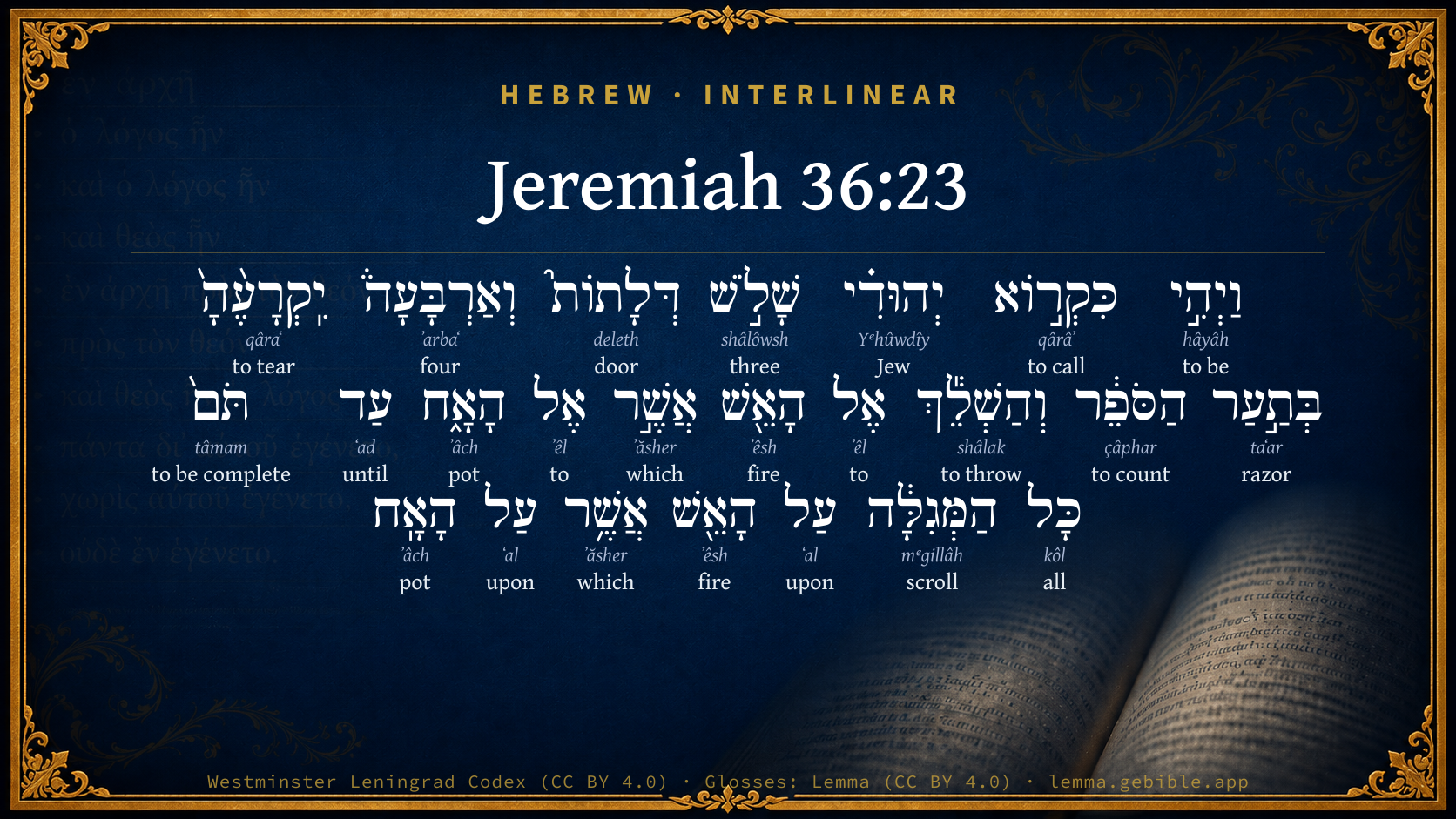
Hebrew (Westminster Leningrad Codex) Jeremiah 36:23 appears in the Hebrew Old Testament. The text above is from the Westminster Leningrad Codex. Each word links to its Strong’s number, a concise gloss, and parsing drawn from the Open Scriptures Hebrew Bible morphology. Click any word for its full Brown-Driver-Briggs (BDB) entry.
Download image
Cite this verse

Jeremiah 36:23 (World English Bible). Public Domain. Lemma interlinear Bible study tool, https://lemma.gebible.app/v/jeremiah/36/23.

Show BibTeX & RIS
BibTeX
RIS
English Translation
It happened, when Jehudi had read three or four leaves, that [the king] cut it with the penknife, and cast it into the fire that was in the brazier, until all the scroll was consumed in the fire that was in the brazier.
World English Bible · Public Domain
Download a study sheet

One document with this verse’s original text, its word-by-word gloss line, the meaning frame, cross-references with their text, attributed commentary, and full source and license credits — printable, and it pastes into notes with its structure intact.

This verse Autodidact and up

Study sheet (.html) Plain text (.txt)

A passage Seminary Student

Up to 50 verses in one chapter. A passage sheet keeps up to 6 commentary sources and 12 cross-references per verse, in the order this page ranks them, and says so on the sheet whenever that leaves anything out. Ask for a single verse and you get the Autodidact verse sheet above.

Everything on this page stays free to read, with no account — the sheet is a download of what is already on screen, not access to it.

Want to remove ads? Support Godless Engineer
Compare translations 3

The same verse in 3 English versions, stacked beneath the original-language interlinear above. Click any original word for its lexicon entry.

Each is an independent rendering of the whole verse — the interlinear is not word-aligned to these translations.

Highlighted words mark where these versions differ — a whole-verse word diff, not a word-by-word alignment.

  • World English Bible Public Domain
    It happened, when Jehudi had read three or four leaves, that [the king] cut it with the penknife, and cast it into the fire that was in the brazier, until all the scroll was consumed in the fire that was in the brazier.
  • King James Version Public Domain
    And it came to pass, that when Jehudi had read three or four leaves, he cut it with the penknife, and cast it into the fire that was on the hearth, until all the roll was consumed in the fire that was on the hearth.
  • unfoldingWord Literal Text CC BY-SA 4.0
    It happened that as Jehudi read three or four columns, the king would cut it off with a knife and throw it into the fire in the brazier until all of the scroll was destroyed.

unfoldingWord Literal Text — © unfoldingWord, licensed CC BY-SA 4.0. Word-aligned USFM3 via Door43 (git.door43.org/unfoldingWord/en_ult).

Versions to compare (up to 4)

3 of 4 selected

Show all 18 translations

Every available English version of this verse, each an independent rendering of the whole verse.

  • World English Bible Public Domain
    It happened, when Jehudi had read three or four leaves, that [the king] cut it with the penknife, and cast it into the fire that was in the brazier, until all the scroll was consumed in the fire that was in the brazier.
  • Berean Standard Bible Public Domain
    And as soon as Jehudi had read three or four columns, Jehoiakim would cut them off with a scribe’s knife and throw them into the firepot, until the entire scroll had been consumed by the fire.
  • Majority Standard Bible Public Domain
    And as soon as Jehudi had read three or four columns, Jehoiakim would cut them off with a scribe’s knife and throw them into the firepot, until the entire scroll had been consumed by the fire.
  • King James Version Public Domain
    And it came to pass, that when Jehudi had read three or four leaves, he cut it with the penknife, and cast it into the fire that was on the hearth, until all the roll was consumed in the fire that was on the hearth.
  • American Standard Version (1901) Public Domain
    And it came to pass, when Jehudi had read three or four leaves, that `the king' cut it with the penknife, and cast it into the fire that was in the brazier, until all the roll was consumed in the fire that was in the brazier.
  • Revised Version (1885) Public Domain
    And it came to pass, when Jehudi had read three or four leaves, that the king cut it with the penknife, and cast it into the fire that was in the brasier, until all the roll was consumed in the fire that was in the brasier.
  • Geneva Bible (1599) Public Domain
    And when Iehudi had read three, or foure sides, hee cut it with the penknife and cast it into the fire, that was on the hearth vntil all the roule was consumed in the fire, that was on the hearth.
  • Douay-Rheims (1899) Public Domain
    And when Judi had read three or four pages, he cut it with the penknife, and he cast it into the Are, that was upon the hearth, till all the volume was consumed with the fire that was on the hearth.
  • Young's Literal Translation Public Domain
    and it cometh to pass, when Jehudi readeth three or four leaves, he cutteth it out with the scribe's knife, and hath cast unto the fire, that `is' on the stove, till the consumption of all the roll by the fire that `is' on the stove.
  • Literal Standard Version CC BY-SA 4.0
    and it comes to pass, when Jehudi reads three or four leaves, he cuts it out with the scribe’s knife, and has cast [it] into the fire that [is] on the stove, until the consumption of all the scroll by the fire that [is] on the stove.
  • Unlocked Literal Bible CC BY-SA 4.0
    It happened that as Jehudi read three or four columns, the king would cut it off with a knife and throw it into the fire in the brazier until all of the scroll was destroyed.
  • unfoldingWord Literal Text CC BY-SA 4.0
    It happened that as Jehudi read three or four columns, the king would cut it off with a knife and throw it into the fire in the brazier until all of the scroll was destroyed.
  • Darby Bible Public Domain
    And it came to pass, that when Jehudi had read three or four columns, he cut it with the scribe's knife, and cast it into the fire that was in the pan until all the roll was consumed in the fire that was in the pan.
  • World Messianic Bible Public Domain
    When Jehudi had read three or four columns, the king cut it with the penknife, and cast it into the fire that was in the brazier, until all the scroll was consumed in the fire that was in the brazier.
  • Webster's Bible Public Domain
    And it came to pass, that when Jehudi had read three or four leaves, he cut it with the scribe's pen-knife, and cast it into the fire that was on the hearth, until all the roll was consumed in the fire that was on the hearth.
  • Free Bible Version CC BY-SA 4.0
    Whenever Jehudi finished reading three or four columns, Jehoiakim would chop them off with a scribe's knife and toss them into the fire. Eventually the whole scroll was completely burned up.
  • Bible in Basic English Public Domain
    And it came about that whenever Jehudi, in his reading, had got through three or four divisions, the king, cutting them with his penknife, put them into the fire, till all the book was burned up in the fire which was burning in the fireplace.
  • JPS Tanakh (1917) Public Domain
    And it came to pass, when Jehudi had read three or four columns, that he cut it with the penknife, and cast it into the fire that was in the brazier, until all the roll was consumed in the fire that was in the brazier.

Literal Standard Version (2020), Covenant Press — licensed CC BY-SA 4.0. Text via the HelloAO Bible API (eBible.org). Unlocked Literal Bible (unfoldingWord) — licensed CC BY-SA 4.0. Text via the HelloAO Bible API (eBible.org). unfoldingWord Literal Text — © unfoldingWord, licensed CC BY-SA 4.0. Word-aligned USFM3 via Door43 (git.door43.org/unfoldingWord/en_ult). Free Bible Version, Dr. Jonathan Gallagher — licensed CC BY-SA 4.0. Text via the HelloAO Bible API (eBible.org).

Word by word

More ways to search: Search by grammar → Find every occurrence → Compare this word →

Practice this passage: Drill this verse → Learn its vocabulary →

הָאָ֑ח
ʼâch
H254
“the · pot”
Particle, Definite Article + Noun, Common, Masculine, Singular, Absolute
Part of Speech
Particle + Noun
Type
Common
Gender
Masculine
Number
Singular
State
Absolute
Full BDB Definition

Origin: of uncertain derivation

TWOT: 66a

fire-pot, brazier
  1. וַיְהִ֣י hâyâh H1961 “and · to be” Conjunction + Verb, Qal, Sequential Imperfect, 3rd Person, Masculine, Singular
  2. כִּקְר֣וֹא qârâʼ H7121 “like/as · to call” Preposition + Verb, Qal, Infinitive Construct
  3. יְהוּדִ֗י Yᵉhûwdîy H3065 “Jew” Noun, Proper
  4. שָׁלֹ֣שׁ shâlôwsh H7969 “three” Adjective, Cardinal number, Feminine, Singular, Absolute
  5. דְּלָתוֹת֮ deleth H1817 “doors” Noun, Common, Feminine, Plural, Absolute
  6. וְאַרְבָּעָה֒ ʼarbaʻ H702 “and · four” Conjunction + Adjective, Cardinal number, Masculine, Singular, Absolute
  7. יִֽקְרָעֶ֨הָ֙ qâraʻ H7167 “to tear · her” Verb, Qal, Imperfect, 3rd Person, Masculine, Singular + Suffix, Personal, 3rd Person, Feminine, Singular
  8. בְּתַ֣עַר taʻar H8593 “in/at · razor of” Preposition + Noun, Common, Both, Singular, Construct
  9. הַסֹּפֵ֔ר çâphar H5608 “the · scribe” Particle, Definite Article + Noun, Common, Masculine, Singular, Absolute
  10. וְהַשְׁלֵ֕ךְ shâlak H7993 “and · to throw” Conjunction + Verb, Hiphil, Infinitive Absolute
  11. אֶל ʼêl H413 “to” Preposition
  12. הָאֵ֖שׁ ʼêsh H784 “the · fire” Particle, Definite Article + Noun, Common, Both, Singular, Absolute
  13. אֲשֶׁ֣ר ʼăsher H834 “which” Particle, Relative
  14. אֶל ʼêl H413 “to” Preposition
  15. עַד ʻad H5704 “until” Preposition
  16. תֹּם֙ tâmam H8552 “to be complete” Verb, Qal, Infinitive Construct
  17. כָּל kôl H3605 “all of” Noun, Common, Masculine, Singular, Construct
  18. הַמְּגִלָּ֔ה mᵉgillâh H4039 “the · scroll” Particle, Definite Article + Noun, Common, Feminine, Singular, Absolute
  19. עַל ʻal H5921 “upon” Preposition
  20. הָאֵ֖שׁ ʼêsh H784 “the · fire” Particle, Definite Article + Noun, Common, Both, Singular, Absolute
  21. אֲשֶׁ֥ר ʼăsher H834 “which” Particle, Relative
  22. עַל ʻal H5921 “upon” Preposition
  23. הָאָֽח ʼâch H254 “the · pot” Particle, Definite Article + Noun, Common, Masculine, Singular, Absolute

About this verse

These counts appear in no published source. They are computed here, from the morphology-tagged text and Lemma’s own curated glosses. What Lemma adds →

24
words
19
distinct lemmas
Prophets
section

Notable vocabulary

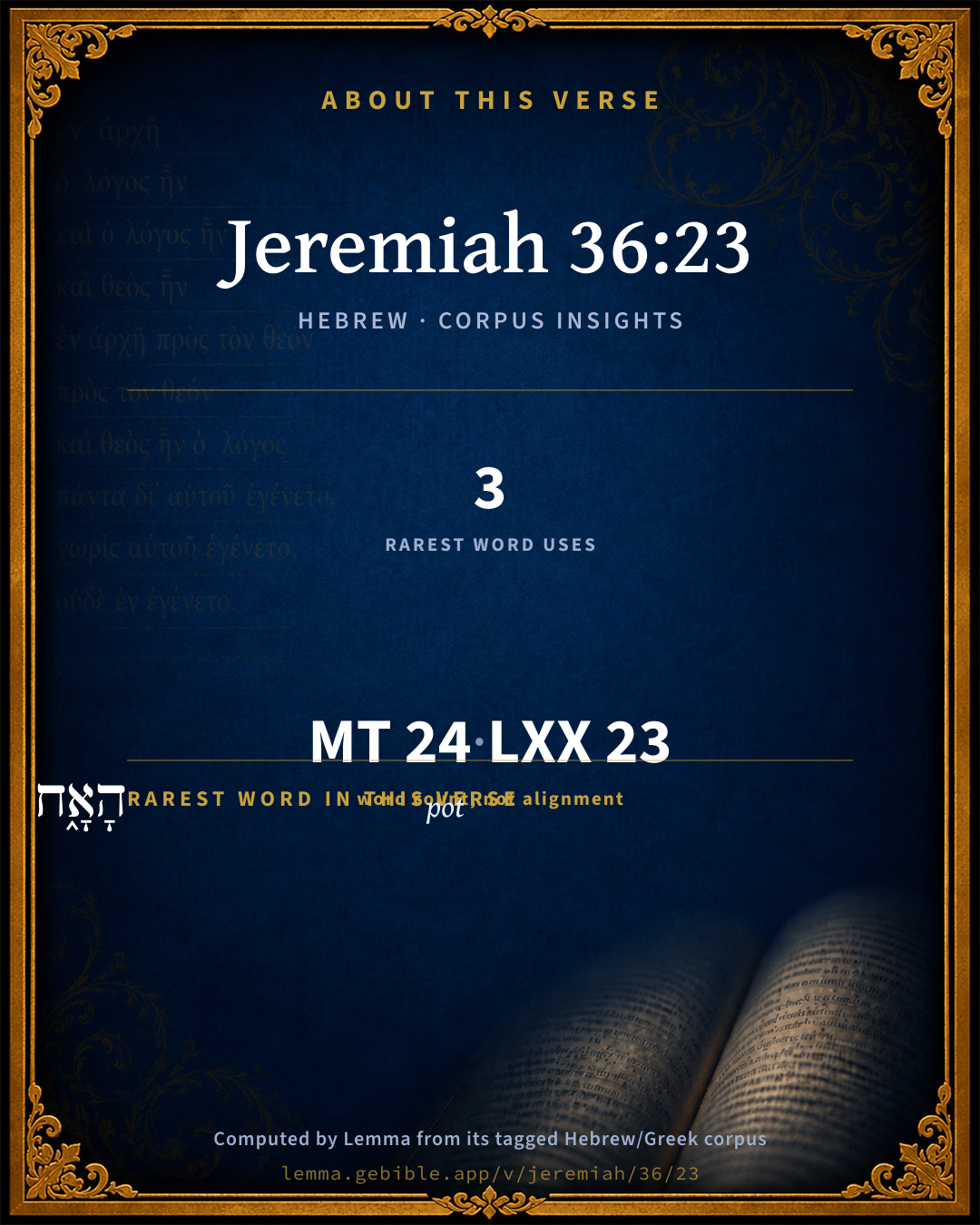
The rarest word here is הָאָ֑ח pot H254 — appearing just 3 times in the whole Hebrew Bible.

Shared distinctive vocabulary

הָאָ֑ח pot H254 occurs in 2 verses of the Hebrew Bible. Also found in:

Grammatical profile

  • 5 verbs
  • 10 nouns
  • 2 adjectives
  • 5 prepositions
  • 2 particles

Verb forms

  • וַיְהִ֣י Qal · Sequential Imperfect
  • כִּקְר֣וֹא Qal · Infinitive Construct
  • יִֽקְרָעֶ֨הָ֙ Qal · Imperfect
  • וְהַשְׁלֵ֕ךְ Hiphil · Infinitive Absolute
  • תֹּם֙ Qal · Infinitive Construct

Repetition

Words recur within this verse — often emphatic in Hebrew:

  • הָאֵ֖שׁ fire H784 ×2
  • הָאָ֑ח pot H254 ×2
  • עַל upon H5921 ×2
  • אֶל to H413 ×2
  • אֲשֶׁ֣ר which H834 ×2

Hebrew & Septuagint length

In the original languages it is 24 Hebrew tokens and 23 Greek tokens — but the two are counted differently (Hebrew bundles its prefixes and suffixes into one token; the Greek is in lemma form), so that isn’t a like-for-like length.

Cross-references

15

Topical passages linked to Jeremiah 36:23 in the Treasury of Scripture Knowledge — connected by theme and wording, ordered by reader-vote popularity; previews shown in the World English Bible.

  • 1 Kings 22:8 The king of Israel said to Jehoshaphat, there is yet one man by whom we may inquire of Yahweh, Micaiah the son of Imlah: but I hate him; for he does not prophesy good concerning me, but evil. Jehoshaphat said, "Don't let the king say so."
  • 1 Kings 22:27 and say, Thus says the king, Put this fellow in the prison, and feed him with bread of affliction and with water of affliction, until I come in peace.
  • Proverbs 1:30 They wanted none of my counsel. They despised all my reproof.
  • Proverbs 13:13 Whoever despises instruction will pay for it, But he who respects a command will be rewarded.
  • Proverbs 19:21 There are many plans in a man's heart, But Yahweh's counsel will prevail.
  • Proverbs 21:30 There is no wisdom nor understanding Nor counsel against Yahweh.
  • Isaiah 5:18–19 Woe to those who draw iniquity with cords of falsehood, And wickedness as with cart rope;
  • Isaiah 28:14–15 Why hear the word of Yahweh, you scoffers, that rule this people that is in Jerusalem:
  • Deuteronomy 29:19–21 and it happen, when he hears the words of this curse, that he bless himself in his heart, saying, I shall have peace, though I walk in the stubbornness of my heart, to destroy the moist with the dry.
  • Psalms 50:17 Seeing you hate instruction, And throw my words behind you?
  • Proverbs 5:12 And say, "How I have hated instruction, And my heart despised reproof;
  • Proverbs 29:1 He who is often rebuked and stiffens his neck Will be destroyed suddenly, with no remedy.
  • Isaiah 28:17–22 I will make justice the line, and righteousness the plummet; and the hail shall sweep away the refuge of lies, and the waters shall overflow the hiding-place.
  • Jeremiah 36:29–31 Concerning Jehoiakim king of Judah you shall say, Thus says Yahweh: You have burned this scroll, saying, Why have you written therein, saying, The king of Babylon shall certainly come and destroy this land, and shall cause to cease from there man and animal?
  • Revelation 22:19 If anyone takes away from the words of the book of this prophecy, may God take away his part from the tree of life, and out of the holy city, which are written in this book.

Cross-references courtesy of OpenBible.info (CC BY 4.0).

Hebrew and Greek witnesses Masoretic Hebrew ↔ Greek Septuagint

The same verse in the two great witnesses to the Old Testament, shown verse-for-verse.

These are two independent witnesses, not word-aligned to each other, and the Septuagint is shown in lemma (dictionary) form.

Hebrew Jeremiah 36:23 Masoretic · Westminster Leningrad Codex

וַיְהִ֣י כִּקְר֣וֹא יְהוּדִ֗י שָׁלֹ֣שׁ דְּלָתוֹת֮ וְאַרְבָּעָה֒ יִֽקְרָעֶ֨הָ֙ בְּתַ֣עַר הַסֹּפֵ֔ר וְהַשְׁלֵ֕ךְ אֶל הָאֵ֖שׁ אֲשֶׁ֣ר אֶל הָאָ֑ח עַד תֹּם֙ כָּל הַמְּגִלָּ֔ה עַל הָאֵ֖שׁ אֲשֶׁ֥ר עַל הָאָֽח

It happened, when Jehudi had read three or four leaves, that [the king] cut it with the penknife, and cast it into the fire that was in the brazier, until all the scroll was consumed in the fire that was in the brazier.

World English Bible · Public Domain

Greek LXX Structure differs

In the Septuagint, Jeremiah is about an eighth shorter than the Hebrew and arranges its material differently — the Oracles Against the Nations (Hebrew chapters 46–51) appear in the middle of the Greek book, after 25:13. Because the chapter and verse boundaries do not line up, a verse-for-verse comparison with the Hebrew is not shown.

A verse-for-verse comparison isn’t shown here because the chapters and verses don’t line up. Switch to the LXX edition with the MT / LXX toggle above to read the Greek directly.

Hebrew: Westminster Leningrad Codex (CC BY 4.0). Greek: Septuagint (public domain); English from a public-domain English Septuagint. How the Septuagint differs from the Hebrew →

Targum (Aramaic paraphrase)

1

The Targum is the ancient Jewish Aramaic paraphrase of the Hebrew Scriptures — an interpretive translation, not the Hebrew text itself. Onkelos (literal) and Pseudo-Jonathan (expansive) render the Torah, and Jonathan the Prophets. Coverage is partial: where no permissively-licensed English translation exists for a verse, only the Aramaic is shown. This is verse-level text, not a word-by-word alignment to the Hebrew.

  1. Targum Jonathan Prophets (Joshua–Malachi)
    וַהֲוָה כַּד קָרֵי יְהוּדִי תְּלַת פַּצִין וְאַרְבַּע בְּזַע בְּאִזְמֵיל סַפְרָא וּרְמֵי לְנוּרָא דִלְגוּמְרֵיהּ עַד דִשְׁלִימַת כָּל מְגִלְתָא עַל נוּרָא דְעַל גוּמְרֵי:

    (no public-domain English translation for this verse)

    Targum Jonathan — Aramaic: “Mikraot Gedolot” (public domain). English: “Sefaria Community Translation” (CC0 1.0 (public-domain dedication)); “London "Chaldee Paraphrase," 1871” (public domain). Text via Sefaria.

Commentary

Notes on Jeremiah 36:23 from classic Christian and Jewish commentators (each source and its license shown beneath its notes). The classic Christian expositions comment on the surrounding passage and are grouped to its opening verse, so a note may address several verses; the Jewish commentaries on the Tanakh (Rashi and others) are per-verse, so they appear only where the commentator wrote on this verse.

Lemma curates 59 commentaries, every one of them public domain or Creative Commons licensed, each selected and text-cleaned for this edition rather than reprinted as found. About our sources →

Trapp's Complete Commentary

John Trapp

Jer 36:23 And it came to pass, [that] when Jehudi had read three or four leaves, he cut it with the penknife, and cast [it] into the fire that [was] on the hearth, until all the roll was consumed in the fire that [was] on the hearth.

Ver. 23. When Jehudi had read three or four leaves.] Vespasian is said to have been patientissimus veri, {a} very patient of truth; so was good Josiah, whose heart melted at the hearing of the law; {2Ch 34:27} but so was not this degenerate son of his, Jehoiakim, but more like Tiberius, that tiger, who tore with his teeth all that displeased him; or like Vitellius the tyrant, of whom Tacitus {b} saith, Ita formatae principis aures, ut aspera quae utilia: nec quidquam nisi iucundum et non laesurum acciperet, That his ears were of that temper that he could hear no counsel, though never so profitable, unless it were pleasant, and did suit with his humours.

He cut it with the penknife.] Why? what could he dislike in that precious piece? Of Petronius’s Satyricon one said well, Tolle obscaena et tollis omnia; of Jeremiah’s prophecies I may safely say, Tolle sancta, et tollis omnia. But this brutish prince could not away with downright truth, &c.

And cast it into the fire.] O stultitiam! quid innocentes chartae commeruerant? {c} O madness! what evil had those innocent papers deserved that they nmst die this double death, as it were? Those magical books at Ephesus were worthily burned; {Act 19:19} Aretine’s love-books are so lascivious that they deserve to be burned, saith Boissard, {d} together with their author; many seditious pamphlets are now committed to Vulcan to be corrected, and more should be; but, O sancta Apocalysis! as that martyr once said when he took up the book of the Revelation, cast into the same fire with himself; so, O holy Jeremiah! what hast thou said or written to be thus slashed, and then cast into the fire? Jehoiakim is the first we read of that ever offered to burn the Bible. Antiochus, indeed, did the like afterwards, and Dioclesian the tyrant, and now the Pope. But though there were not a Bible left upon earth, yet "for ever, O Lord, thy Word is stablished in heaven," saith David. {Psa 119:89}

Until all the roll was consumed.] So far was he from repenting of his wickedness, that he fed his eyes with such a sad spectacle, and was ready to say, as Solon did when he burned the usurers’ bonds in Athens, that he never saw a fairer or clearer fire burn in all his life.

{a} Quintilian.

{b} Lib. iii. Hist.

{c} Oecolamp.

{d} Bois., Biblioth.

John Trapp, A Commentary or Exposition upon All the Books of the Old and New Testament (1647–1656) — public domain. Text from a community e-Sword module.

Joseph Benson's Commentary

Jer 36:23. When Jehudi had read three or four leaves — Hebrew, דלתות, rolls, or scrolls, for their books, as we have observed, consisted of several pieces of parchment rolled upon each other. Dr. Waterland renders the word columns, and Blaney, sections, observing that to render it leaves, “seems rather to carry an eye to the books of modern times, than to suit that ancient mode of writing.” The word primarily signifies doors, that open and shut, and therefore is properly enough put for distinct and separate rolls, or parts of those prophecies which, being delivered at different times, and having a relation to different subjects, have each a proper beginning and ending of its own. Houbigant reads, pages, which he says, “were the same with those now found in the parchments called, ‘The Volumes of the Synagogue,’ in which the parchments are not sewed one beneath another; for if this were the case, the volume would only have one page, whose beginning would be at the top, and its end at the bottom of the parchment; but the parchments are sewed one to another on their sides, and are read by unfolding the volume either to the right or left; so that there are as many pages as there are parchments.” He cut it with a penknife — Hebrew, בתער הספר, the knife of the scribe. It seems the implements for writing were lying on the table before the king, ready for the scribe’s or secretary’s use, in case there was any call for writing orders, or despatches. Among these was the knife he used, either for cutting the pen when necessary, or for making erasures. And cast into the fire until all the roll was consumed — Not considering or not regarding its containing a revelation of the will of God, and a divine message to him in particular: a piece this of as daring impiety as a man could easily be guilty of, and a most impudent affront to the God of heaven!

Joseph Benson's Commentary on the Old and New Testaments (1811–1818) — public domain. Text from a community e-Sword module.

Tyndale Open Study Notes

Tyndale Open Resources

36:23-24 Jehoiakim was so antagonistic and hardened that after three or four columns of the scroll were read, he cut off the section with a sharp knife and threw it into the fire. Jehoiakim’s father, Josiah, had responded very differently when the newly discovered Book of the Law was read to him (2 Kgs 22:11).

Tyndale Open Study Notes — © Tyndale Open Resources, licensed CC BY-SA 4.0. Text via the HelloAO Bible API.

Jamieson, Fausset & Brown

Robert Jamieson, A. R. Fausset & David Brown

three or four leaves--not distinct leaves as in a book, but the consecutive spaces on the long roll in the shape of doors (whence the Hebrew name is derived), into which the writing is divided: as the books of Moses in the synagogue in the present day are written in a long parchment rolled round a stick, the writing divided into columns, like pages.

pen-knife--the writer's knife with which the reed, used as a pen, was mended. "He" refers to the king (Jer 36:22). As often as Jehudi read three or four columns, the king cut asunder the part of the roll read; and so he treated the whole, until all the parts read consecutively were cut and burnt; Jer 36:24, "all these words," implies that the whole volume was read through, not merely the first three or four columns (Kg1 22:8).

Jamieson, Fausset & Brown — Commentary Critical and Explanatory on the Whole Bible (1871) — public domain (CC PDM 1.0). Text via the HelloAO Bible API.

Adam Clarke's Commentary

Verse 23. When Jehudi had read three or four leaves] Rather columns; for the law, and the sacred Hebrew Books, are written in columns of a certain breadth. דלתות delathoth, signifies gates or openings between column and column, or between section and section.

He cut it with the penknife] בתער הספר bethaar hassopher, "the knife of the scribe," properly enough penknife.

And cast it into the fire] To show his contempt for God's words.

Adam Clarke's Commentary on the Bible (1810–1826) — public domain. Text from a community e-Sword/MySword module.

John Calvin's Commentaries

Here Jeremiah shews how little he had effected; for the king not only cast aside but tore the roll into pieces, and after having torn it, he wished its memory to perish, for he cast it into the fire. This trial must have grievously affected the mind of the Prophet; he had dictated that roll by God’s command; he saw now that all his labor had been in vain. He might then have complained to God that so much labor had been spent without fruit. For why had God bidden the roll to be written, except for the purpose of leading the king and his counsellors to repentance. As to the people, the Prophet could not know whether it had answered the end for which he sent his scribe Baruch to them, for no account is given as to the attention paid by them. But Baruch was led to the king’s palace, so the minds of all were kept in suspense: what was now the issue? The king burnt the roll. There is no doubt then but that the mind of the Prophet was much affected. But God thus exercises his servants when he bids them to speak to the deaf or to bring light to the blind.

Let us then learn simply to obey God, though the labor he requires from us may seem to be useless. And hence Paul rises above all the ingratitude of the world and says, that the ministers of the Gospel are a sweet odor to God, whether for death or for life, (2 Corinthians 2:15, 16) for though the greater part are rendered worse by hearing the Gospel, yet the obedience rendered to God by ministers is acceptable to him, nor is the event to be looked to. Jeremiah then saw that the king’s mind was exasperated, but he did not on that account repent of his obedience, for he knew that the event was to be left with God and to his will. The duty of men is to execute whatever God commands, though no fruit may appear to proceed from their labors. This then is one thing.

Now as to the king, we see in him as in a glass how monstrous is their blindness who are the slaves of Satan. Surely the king, when God so thundered in his ears, ought to have been terrified. He could not indeed treat the word with ridicule, but he became enraged, and acted violently like a rabid wild beast, and vented his rage against the roll itself! If he thought Jeremiah to have been the author, why did he not disregard him as a man of no authority in public affairs? for Jeremiah could not have lessened his character as a king. There is then no doubt but that he perceived, though unwillingly, that he had to do with God; why then did he become thus enraged? what could he hope to gain by such madness towards God? But this, as I have said, was that dreadful blindness which is found in all the reprobate, whose minds the devil has fascinated; for on the one hand they perceive, willing or unwilling, that God is present, and that they are in a manner summoned to his tribunal; and on the other, as though they were forgetful of God, they rage madly against him.

It is then said of King Jehoiakim, that while he was in his winter-house and sitting before the fire, when three or four pages had been read, he cut the roll with an iron pen, or with the small knife of a scribe. The word תער tor, means often a razor, but is to be taken here for the knife used by scribes, un canivet. The king, in the first place, did not wait until Jehudi finished the roll; after he had heard three or four leaves, or pages, as we call them, he seized the roll and cut it; and in the second place, being not content with this sacrilege he burnt the roll, as though he could abolish God’s judgment together with the book. But we shall hereafter see what he gained by this intemperate spirit in burning the roll until the whole was consumed in the fire It now follows —

John Calvin's Commentaries (1540-1563) — public domain. Text from the Calvin Translation Society English edition (1840s-50s) via the Christian Classics Ethereal Library (ccel.org). Calvin's coverage is partial (roughly two-thirds of the Bible); uncommented books and verses are honest gaps, never fabricated. The 19th-century editor's footnotes and remarks are omitted so the notes are faithfully Calvin's own voice.

Ellicott's Commentary for English Readers

(23) Three or four leaves . . .—The English words suggest the idea of a papyrus book rather than a parchment roll (see Note on Jer_36:4), but the Hebrew word (literally = a door) may indicate the column of writing on such a roll, as well as a leaf. The act, in its childish impatience, betrayed the anger of the king. He could not bear to hear of the seventy years of exile which were in store for his people, and which, if we assume the roll to have included the substance of Jeremiah 25, would have come into one of the earlier columns. The word for “pen-knife” is used generally for any sharp instrument of iron—for a razor (Eze_5:1), and for a sword (Isa_7:20). Here it is the knife which was used to shape the reed, or calamus, used in writing. It should, perhaps, be noted that the Hebrew, like the English, leaves it uncertain whether the king himself cut and burnt the roll, or Jehudi with his approval. Jer_36:25 is in favour of the former view. We are reminded, as we read the words, of like orders given by Antiochus Epiphanes for the destruction of the Law (1Ma_1:56), by Diocletian for that of the sacred books of the Christians, perhaps also of those of the Court of Rome for the destruction of the writings of Wyclif and Luther.

A Bible Commentary for English Readers, edited by Charles John Ellicott (1878–1897) — public domain. Text from a community e-Sword module.

The Cambridge Bible for Schools and Colleges

gen. ed. J. J. S. Perowne

23. when Jehudi had read] rather, as Dr. “as often as J. read”; for Jer_36:24 implies that the king heard all the contents.

leaves] mg. columns, lit. doors (see on Jer_36:2).

that the king cut it, etc.] In the absence of a nominative to the verb in MT., it seems at least as natural to suppose that, as often as Jehudi had read three or four leaves, the king ordered him to cut them off and burn them. Otherwise we must assume that the king himself had the knife and that he repeatedly took pieces of the Roll from the reader.

penknife] lit. scribe’s knife, used for making and mending reed pens, cutting up writing materials, etc.

The Cambridge Bible for Schools and Colleges (gen. ed. J. J. S. Perowne; Cambridge University Press, 1878–1918) — public domain. Text from a community e-Sword module.

John Gill's Exposition

And it came to pass, that when Jehudi had read three or four leaves,.... Either three or four of the breadths of parchment, which were glued together, and rolled up; or three or four of the columns in those breadths. The meaning is, he had read a few of them. The Rabbins (s) would have it, that three or four verses in the book of the Lamentations are meant:

he cut it with the penknife; that is, he cut the roll to pieces with a penknife he had in his hand, or lay near him. It is difficult to say who it was that did this; whether Jehudi that read the roll, or Jehoiakim the king that heard it; most interpreters understand it of the latter; but the connection of the words carries it to the former; for the nearest antecedent to the relative he is Jehudi; though it is highly probable he did it at the king's command; or, however, saw by his countenance and behaviour that such an action would be grateful to him; and that he was highly displeased with what had been read, and could not hear any longer with patience:

and cast it into the fire that was on the hearth, until all the roll was consumed in the fire that was on the hearth; that is, he cast it into the fire, and there let it lie, until it was wholly consumed; a very impious action, to burn the word of God; a full evidence of an ungodly mind; a clear proof of the enmity of the heart against God, and of its indignation against his word and servants; and yet a vain attempt to frustrate the divine predictions in it, or avert the judgments threatened; but the ready way to bring them on.

(s) T. Hieros. Moed Katon, fol. 83. 2.

John Gill's Exposition of the Whole Bible (1746–1763) — public domain (CC PDM 1.0). Text via the HelloAO Bible API.

Albert Barnes' Notes on the Bible

Leaves - Columns: literally folding-doors; the word exactly describes the shape of the columns of writing upon the scroll.

Penknife - “Scribe’s knife;” used to shape the reed for writing, and to make erasures in the parchment.

On the hearth - Or, in the fire-pan. The conduct of the king shows how violent was his temper.

Albert Barnes' Notes on the Bible (1834–1885) — public domain. Text from a community e-Sword/MySword module.

Haydock's Catholic Bible Commentary

Pages. Perhaps what was written on so many skins, (Haydock) or sheets of paper, pasted together, and rolled up; or there might be some marks to shew the different subjects, like the sections used in the synagogue, (Calmet) or our chapters; though we are assured that all was formerly written without any separation even of letters. Protestants have "leaves." (Haydock) --- Hebrew, "doors." (Calmet) The secretary cut and burnt the leaves by the king’s order, ver. 25. (Worthington)

George Leo Haydock (1774–1849), Haydock's Catholic Family Bible and Commentary, 1859 edition — public domain. Excludes Psalms (Douay-Rheims chapter numbering differs from Protestant) and Deuterocanonical books (Catholic canon only).

Matthew Poole's English Annotations

He, that is, the king, not having patience to hear above three or four columns, or periods, or titles, took the penknife that (it is like) Jehudi had, and cut it in pieces, and burned it in the fire that was before him, not considering that it was the revelation of the will of God, but exalting himself above all that was called God. This showed both the wickedness and passionate temper of this prince, and his high contempt of God and his prophets.

Matthew Poole's English Annotations on the Holy Bible (1683–1685) — public domain. Text from a community e-Sword/MySword module.

Whedon's Commentary on the Bible

Daniel D. Whedon

23. Three or four leaves — Rather, columns. The exact word here is doors. This was a continuous roll, but the writing, as is customary, was in sections or columns. Cut it, etc. — That is, the king, not Jehudi, “cut it.” The act illustrates the violence of the king’s temper. The book had made a deep impression on the princes, and they were careful to provide for its safe keeping when they sent to tell the king, but he incontinently destroys it. It is manifestly an error to interpret, as some do, that as often as three or four columns were read they were cast on the brazier, and that this process was kept up until the entire roll was read through and burned up, as this would be silly and incredible.

Daniel D. Whedon (gen. ed.), Commentary on the Old and New Testaments (1874–1909) — public domain. Text from a community e-Sword module.

The Pulpit Commentary

Three or four leaves; rather, columns or compartments. "Leaves" would imply that it was a book out of which Jehudi read, Whereas it was a roll (m"gillah never has any other meaning). But "books" were not yet known, nor would a knife have been necessary to separate the pages. He cut it. The subject may be either the king or Jehudi (at the bidding of the king). The term implies that the action of cutting was repeated several times; but we are not to suppose that each successive portion was cut off as it was read. The indignation of the hearer translated itself into the repeated mutilation of the roll, until all the roll was (east into the fire and) consumed. With the penknife ; literally, with the scribe"s knife. On the hearth; rather, in the chafing dish (or, brazier).

The indestructible Word.

The king"s knife and fire did what they could to destroy the prophet"s word, but with what result this chapter shows. The king was Jehoiakim; the prophet, Jeremiah; the word, his written prophecies. It was necessary that these should be written down. The army of Babylon was already in the land, and drawing near to the doomed city of Jerusalem, if they had not already captured it for the first time. There was no hope of successful resistance. Therefore, for a testimony when all that had been foretold came to pass, and for a solace and warning to that and to all coming generations, it was necessary that the twenty-three years" witness which the prophet had borne against that guilty nation should be put on record. Jeremiah was "shut up," whether by his own will, or the word of the Lord, or for fear of his enemies, we cannot certainly say; but Baruch, who seems to have been to Jeremiah as Timothy to Paul, was commanded to write these prophecies, and then, on the "fasting day," to read them in the hearing of all the people. He did so. One of his hearers, alarmed and troubled, hastened away to the council of the princes, and told them what he had heard. Baruch was sent for, and declared again what he had before read to the people. The book was too terrible to show to the king; they therefore commanded that it and its author should be concealed, whilst they went in to the king to announce its fearful contents. A third time these prophecies were recited, hut the king demanded that the book itself should be read to him. But when brought and the reading had begun, the angry king had no patience to listen beyond the first three or four leaves, but snatching it from the hand of the reader, he vented his rage upon it by cutting and hacking it with his knife, and then, to make short work of it, cast it, in spite of the horror-stricken entreaties of his princes, into the burning coals before him, where it was utterly consumed. Then he commands, but in vain, for "the Lord hid them," that Baruch and Jeremiah be arrested; but the Lord commands that these prophecies be written again, which was done, with the doom of the king added, and "beside them many like words." But this King Jehoiakim, in his dealing with the Word of God, and in its dealing with him, has had many successors. He is the type of

I THOSE WHO ARE IMPATIENT WITH THE WORD OF GOD. Jehoiakim only heard three or four leaves read, when he put a stop to the reading altogether in the foolish way we have seen. He would not hear the whole. Did any man ever destroy the Bible who knew it wholly? Many have thrown it into the fire who have heard or read a part only. The difficulty is in the "three or four leaves." How many stumble because they won"t read on!

II THOSE WHO BECOME VERY ANGRY WITH THE BIBLE. To men of this king"s stamp the Bible has not one word of comfort, commendation, or hope. It is all full of thunder and storm. It is a dreadful book to the impenitent, No wonder that he snatches it from the reader"s hand, and hacks at it with his knife, and then flings it into the blazing fire. Yes; be like this king, and you will do as he did, and be done unto as he.

III THOSE WHO STRIVE TO DESTROY THE BIBLE.

1. Some would only partly do this. They admit a large amount of good in the book; they only desire to cut out what they think is otherwise. Theologians use their penknives. They practically put out of the Bible what makes against their favourite ideas. Science seems to be forever at this miserable cutting. Philosophy is equally guilty; but sin is worst of all. It loves not the hard things the Bible will keep saying against it; therefore it would cut them out only it cannot.

2. There are those who would destroy the book altogether. What Bible burnings there have been! The histories of pagan and Romish persecutions are full of them. Are there none now? What is the difference between such burning and utter disregard of the book as too many are guilty of? If we trample it underfoot, in our hearts, our lips, our lives, how could burning it be any worse?

IV THOSE WHO FIND THE BIBLE TOO STRONG FOR THEM. "O Galilaean, thou hast conquered!" said the Emperor Julian shortly before he died. And that has been the confession in regard to the Word of God on the part of all those who have tried to destroy it (ver. 30). The Word of God can neither be bound nor burned. It has been cut, cast into flames, proscribed, branded, corrupted, and treated with every conceivable form of opprobrium; but here it is today, a living and mighty factor in the lives of the foremost men and nations throughout the whole world. And the ungodly who practically seek to destroy it for themselves, they will find they cannot do this. Its truths will come back, its teachings reassert themselves, and will add beside "many like words C.

Burning the Word of the Lord.

I THE KING"S MOTIVES IN THIS ACT. Perhaps he was not conscious of any distinct set of motives. He was but a despot, and despots are in many things like spoiled children; they act not from any clear reason, good or bad, so much as from the caprice of the moment. If this act had been a singularity of Jehoiakim"s, there would have been less need to attend to it, but unhappily it only illustrates a whole series of acts by those occupying stations of power among men. Putting Jeremiah in prison, burning Baruch"s roll, slaying the innocents at Bethlehem, putting apostles in prison, and all the long list of martyrdoms, what are these but the same essential act all through? Jehoiakim would have been in full sympathy with Roman Catholic priests burning the Scriptures in translations understood of the common people. Jehoiakim was a man buttressed with privileges, pampered with privileges; and here he had a document forced upon his ears which contained assertions by no means compatible with the continuance of his privileges. And there was one thing he could do he could get rid of the offensive document. He stands before us a great example of those and how many there are! who, in their eagerness to get rid of an unpleasant subject, take the first means that comes to hand for getting rid of it.

II LOOK AT THE ACT IN THE LIGHT OF HISTORY. Jehoiakim burnt Baruch"s roll, but he did not destroy Jeremiah"s prophecies; nor did he nullify the truth of Jeremiah"s predictions; nor did he stop other prophetic utterances. If Jehoiakim can, he may burn, not only Baruch"s roll, but Baruch and Jeremiah as well. Suppose this done; yet Ezekiel, Daniel, Haggai, Zechariah, Malachi, and probably many more, of whose words we know nothing, have to be reckoned with. This is the peculiar folly of men like Jehoiakim, that they perform acts monumental of their folly. Jehoiakim might have quietly said, "If these words are true, then we cannot make them false; and if they be false, time will show their falsity, and bring to shame both the dictator and the writer of them." Instead of acting thus with dignified endurance, Jehoiakim, in burning the roll, challenged the attention not only of his own people but of all ages. He did what there was no sort of need for him to do. It may be said Why not apply the same line of remark to Luther burning the pope"s bull? To this the answer is obvious, that Luther"s act was a message of renunciation, a summons of the papacy"s bondslaves to freedom, an act of sublime trust in God. Looked at from the point of view given in the present, it is seen to have been an inspiration. But what did Jehoiakim"s act amount to? Only empty bravado. He had nothing to fear from men. Luther did something when he burnt the bull. Jehoiakim did nothing but proclaim his own shame, and advertise the glory of that God over against whose throne his paltry throne had been set up. Y.

The Pulpit Commentary (1880–1919), ed. H.D.M. Spence-Jones & Joseph S. Exell — public domain. Text from a community e-Sword module.

John Wesley's Explanatory Notes

He - The king not having patience to hear above three or four columns, or periods, cut it in pieces and burned it in the fire.

John Wesley, Explanatory Notes Upon the Whole Bible (1754–1765) — public domain. Text via the GEBible commentary corpus.

unfoldingWord translationNotes

Door43 World Missions Community

It happened that

This phrase is used here to mark an important event in the story. If your language has a way for doing this, you could consider using it here.

Jehudi

See how you translated this in Jeremiah 36:14.

columns

these are columns of words on the scroll

would cut it off

"would cut that part of the scroll off"

with a knife

"using a scribe's knife" or "using the kind of knife that scribes use"

brazier

See how you translated this in Jeremiah 36:22.

until all of the scroll was destroyed

"until the scroll was completely gone"

all these words

the words from the scroll that Baruch wrote as Jeremiah dictated

nor did they tear their clothes

People tore their cloths when they were extremely sad. AT: "nor did they mourn by tearing their clothes" (See: Symbolic Action)

translationWords

king

fire

scroll

servant

word

unfoldingWord translationNotes — © Distant Shores Media and the Door43 World Missions Community, licensed CC BY-SA 4.0. Source: git.door43.org/Door43/en_tn.

Rashi

Rabbi Shlomo Yitzchaki (Rashi)

three...verses Our Rabbis (Moed Katan 26a) stated. This was the Scroll of Lamentations. They read before him, (1:1) “How...(:2) She weeps...(ibid. 3) Judah has been exiled...(ibid. 4) The roads of Zion are mournful.” Despite all this, he was not troubled. He said, “I am the king over the survivors.” As soon as he read (ibid. 5), Her adversaries have become the head,” he said, “From now on, I am [no longer] the king.” Immediately, he rent it with a scribe’s razor.

he rent Heb. יקרעה, like קְרָעָה.

Rashi on the Tanakh — English translations: “The Judaica Press complete Tanach with Rashi, translated by A. J. Rosenberg” (CC BY 4.0); “Pentateuch with Rashi's commentary by M. Rosenbaum and A.M. Silbermann, 1929-1934” (public domain); “The Metsudah Tanach series, Lakewood, N.J” (CC BY 4.0); and “The Book of Joshua, Metsudah Publications, 1997” (CC BY 4.0). Text via Sefaria.

Lesson kit

Teaching starters — assembled from the data on this page, not authored interpretation. Every prompt links to the verse data it draws on. Edit before teaching.

Jeremiah, in the Prophets, opens this verse with 24 words (19 distinct Hebrew lemmas). Its most distinctive word is ʼâch (“pot”). A historical commentator’s framing appears above. Read the whole chapter for the surrounding context.

Discussion questions

  1. What does “pot” (ʼâch) contribute to the verse as a whole?
  2. How does Jeremiah 36:22, which shares the word «pot», read alongside this verse?
  3. What does the repetition of “fire” (2× in this one verse) do in this verse?
  4. These translations render this verse differently; the difference is in the English rendering, not the original. What questions does that raise?
  5. «וַיְהִ֣י» is a Qal Sequential Imperfect verb. How does that grammatical form shape the action described?
  6. Compare how Trapp's Complete Commentary and Joseph Benson's Commentary read this verse. Where do they agree or differ?

Things to notice

Reading settings

Reading text

Shown beneath each verse's original-language words.

Old Testament
Old Testament edition

Read the OT as the Masoretic Hebrew (MT) or the Greek Septuagint (LXX).

English shown for the Greek Septuagint (in the Hebrew ↔ Greek comparison).

Comparing translations? Open the Compare panel on any verse page to stack up to four side by side.