
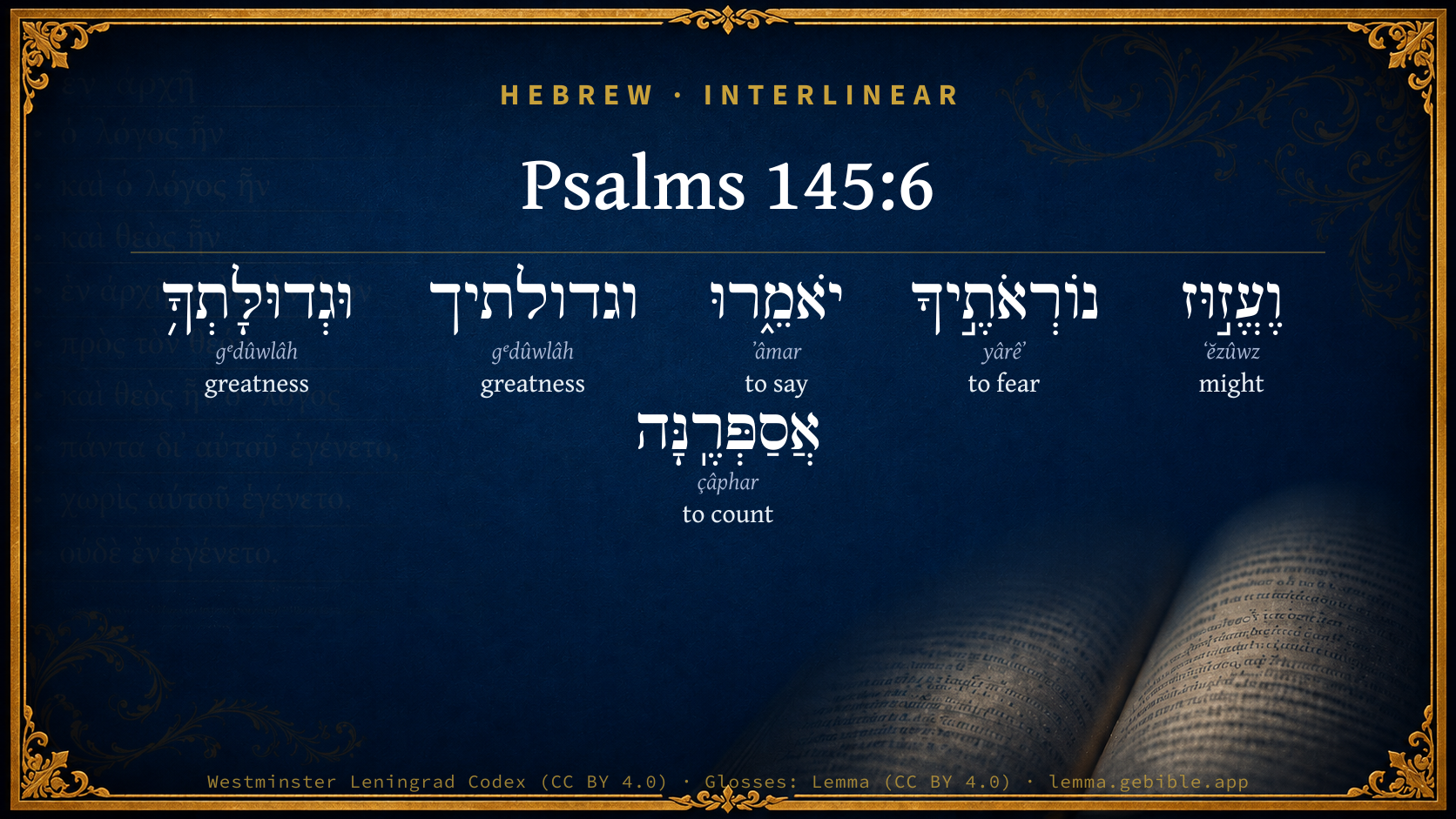
Psalms 145:6

Hebrew (Westminster Leningrad Codex) Psalms 145:6 appears in the Hebrew Old Testament. The text above is from the Westminster Leningrad Codex. Each word links to its Strong’s number, a concise gloss, and parsing drawn from the Open Scriptures Hebrew Bible morphology. Click any word for its full Brown-Driver-Briggs (BDB) entry.
Download image
Cite this verse

Psalms 145:6 (World English Bible). Public Domain. Lemma interlinear Bible study tool, https://lemma.gebible.app/v/psalms/145/6.

Show BibTeX & RIS
BibTeX
RIS
English Translation
Men will speak of the might of your awesome acts. I will declare your greatness.
World English Bible · Public Domain
Download a study sheet

One document with this verse’s original text, its word-by-word gloss line, the meaning frame, cross-references with their text, attributed commentary, and full source and license credits — printable, and it pastes into notes with its structure intact.

This verse Autodidact and up

Study sheet (.html) Plain text (.txt)

A passage Seminary Student

Up to 50 verses in one chapter. A passage sheet keeps up to 6 commentary sources and 12 cross-references per verse, in the order this page ranks them, and says so on the sheet whenever that leaves anything out. Ask for a single verse and you get the Autodidact verse sheet above.

Everything on this page stays free to read, with no account — the sheet is a download of what is already on screen, not access to it.

Want to remove ads? Support Godless Engineer
Compare translations 3

The same verse in 3 English versions, stacked beneath the original-language interlinear above. Click any original word for its lexicon entry.

Each is an independent rendering of the whole verse — the interlinear is not word-aligned to these translations.

Highlighted words mark where these versions differ — a whole-verse word diff, not a word-by-word alignment.

  • World English Bible Public Domain
    Men will speak of the might of your awesome acts. I will declare your greatness.
  • King James Version Public Domain
    And men shall speak of the might of thy terrible acts: and I will declare thy greatness.
  • unfoldingWord Literal Text CC BY-SA 4.0
    And they will tell the strength of your making fearful, and let me recount it, your greatness.

unfoldingWord Literal Text — © unfoldingWord, licensed CC BY-SA 4.0. Word-aligned USFM3 via Door43 (git.door43.org/unfoldingWord/en_ult).

Versions to compare (up to 4)

3 of 4 selected

Show all 18 translations

Every available English version of this verse, each an independent rendering of the whole verse.

  • World English Bible Public Domain
    Men will speak of the might of your awesome acts. I will declare your greatness.
  • Berean Standard Bible Public Domain
    They will proclaim the power of Your awesome deeds, and I will declare Your greatness.
  • Majority Standard Bible Public Domain
    They will proclaim the power of Your awesome deeds, and I will declare Your greatness.
  • King James Version Public Domain
    And men shall speak of the might of thy terrible acts: and I will declare thy greatness.
  • American Standard Version (1901) Public Domain
    And men shall speak of the might of thy terrible acts; And I will declare thy greatness.
  • Revised Version (1885) Public Domain
    And men shall speak of the might of thy terrible acts; and I will declare thy greatness.
  • Geneva Bible (1599) Public Domain
    And they shall speake of the power of thy fearefull actes, and I will declare thy greatnes.
  • Douay-Rheims (1899) Public Domain
    Send forth lightning, and thou shalt scatter them: shoot out thy arrows, and thou shalt trouble them.
  • Young's Literal Translation Public Domain
    And the strength of Thy fearful acts they tell, And Thy greatness I recount.
  • Literal Standard Version CC BY-SA 4.0
    And they tell of the strength of Your fearful acts, || And I recount Your greatness.
  • Unlocked Literal Bible CC BY-SA 4.0
    They will speak of the power of your awesome works, and I will declare your greatness.
  • unfoldingWord Literal Text CC BY-SA 4.0
    And they will tell the strength of your making fearful, and let me recount it, your greatness.
  • Darby Bible Public Domain
    And they shall tell of the might of thy terrible acts; and thy great deeds will I declare.
  • World Messianic Bible Public Domain
    Men will speak of the might of your awesome acts. I will declare your greatness.
  • Webster's Bible Public Domain
    And men shall speak of the might of thy terrible acts: and I will declare thy greatness.
  • Free Bible Version CC BY-SA 4.0
    They will speak of the power of your awesome actions, and I will say how wonderful you are.
  • Bible in Basic English Public Domain
    Men will be talking of the power and fear of your acts; I will give word of your glory.
  • JPS Tanakh (1917) Public Domain
    And men shall speak of the might of Thy tremendous acts; and I will tell of Thy greatness.

Literal Standard Version (2020), Covenant Press — licensed CC BY-SA 4.0. Text via the HelloAO Bible API (eBible.org). Unlocked Literal Bible (unfoldingWord) — licensed CC BY-SA 4.0. Text via the HelloAO Bible API (eBible.org). unfoldingWord Literal Text — © unfoldingWord, licensed CC BY-SA 4.0. Word-aligned USFM3 via Door43 (git.door43.org/unfoldingWord/en_ult). Free Bible Version, Dr. Jonathan Gallagher — licensed CC BY-SA 4.0. Text via the HelloAO Bible API (eBible.org).

Word by word

More ways to search: Search by grammar → Find every occurrence → Compare this word →

Practice this passage: Drill this verse → Learn its vocabulary →

About this verse

These counts appear in no published source. They are computed here, from the morphology-tagged text and Lemma’s own curated glosses. What Lemma adds →

6
words
5
distinct lemmas
Wisdom
section

Notable vocabulary

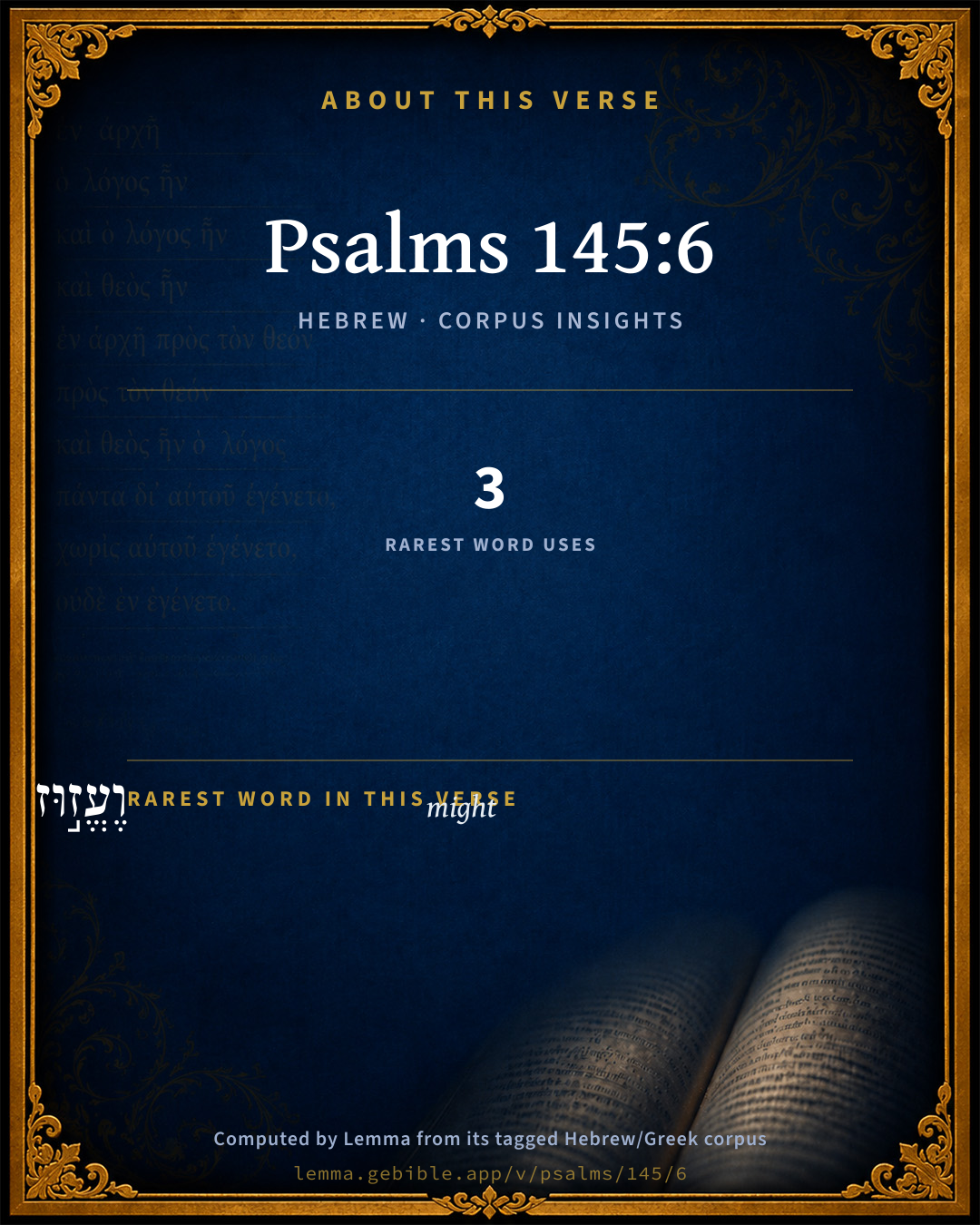
The rarest word here is וֶעֱז֣וּז might H5807 — appearing just 3 times in the whole Hebrew Bible.

Shared distinctive vocabulary

וֶעֱז֣וּז might H5807 occurs in 3 verses of the Hebrew Bible. Also found in:

Grammatical profile

  • 3 verbs
  • 3 nouns

Verb forms

  • נוֹרְאֹתֶ֣יךָ Niphal · Participle Active
  • יֹאמֵ֑רוּ Qal · Imperfect
  • אֲסַפְּרֶֽנָּה Piel · Imperfect

Repetition

A word recurs within this verse — often emphatic in Hebrew:

  • וגדולתיך greatness H1420 ×2

Hebrew & Septuagint length

In English translation the verse runs 15 words from the Hebrew and 15 from the Septuagint (LXX English) — the same length.

A rough comparison of the two English renderings, which tokenize alike — not a word-level alignment.

Word counts can differ between the Hebrew and the Greek without any difference in meaning — e.g. the Hebrew direct-object marker אֵת has no separate Greek word, and Greek often adds the article ὁ.

Cross-references

18

Topical passages linked to Psalms 145:6 in the Treasury of Scripture Knowledge — connected by theme and wording, ordered by reader-vote popularity; previews shown in the World English Bible.

  • Habakkuk 2:14 For the earth will be filled with the knowledge of the glory of Yahweh, as the waters cover the sea.
  • Psalms 107:31–32 Let them praise Yahweh for his loving kindness, For his wonderful works for the children of men!
  • Daniel 3:28–29 Nebuchadnezzar spoke and said, Blessed be the God of Shadrach, Meshach, and Abednego, who has sent his angel, and delivered his servants who trusted in him, and have changed the king's word, and have yielded their bodies, that they might not serve nor worship any god, except their own God.
  • Psalms 22:27 All the ends of the earth shall remember and turn to Yahweh. All the relatives of the nations shall worship before you.
  • Psalms 22:31 They shall come and shall declare his righteousness to a people that shall be born, For he has done it.
  • Psalms 113:3 From the rising of the sun to the going down of the same, Yahweh's name is to be praised.
  • Psalms 126:2–3 Then our mouth was filled with laughter, And our tongue with singing. Then they said among the nations, "Yahweh has done great things for them."
  • Psalms 66:3 Tell God, "How awesome are your deeds! Through the greatness of your power, your enemies submit themselves to you.
  • Psalms 92:1–2 It is a good thing to give thanks to Yahweh, To sing praises to your name, Most High;
  • Jeremiah 50:28 The voice of those who flee and escape out of the land of Babylon, to declare in Zion the vengeance of Yahweh our God, the vengeance of his temple.
  • Joshua 9:9–10 They said to him, From a very far country your servants are come because of the name of Yahweh your God: for we have heard the fame of him, and all that he did in Egypt,
  • Psalms 22:22–23 I will declare your name to my brothers. In the midst of the assembly, I will praise you.
  • Psalms 107:21–22 Let them praise Yahweh for his loving kindness, For his wonderful works to the children of men!
  • Daniel 6:25–27 Then king Darius wrote to all the peoples, nations, and languages, who dwell in all the earth: Peace be multiplied to you.
  • Deuteronomy 32:3 For I will proclaim the name of Yahweh: Ascribe greatness to our God.
  • Joshua 2:9–11 and she said to the men, I know that Yahweh has given you the land, and that the fear of you is fallen on us, and that all the inhabitants of the land melt away before you.
  • Ezra 1:2 Thus says Cyrus king of Persia, All the kingdoms of the earth has Yahweh, the God of heaven, given me; and he has charged me to build him a house in Jerusalem, which is in Judah.
  • Psalms 98:2–3 Yahweh has made known his salvation. He has openly shown his righteousness in the sight of the nations.

Cross-references courtesy of OpenBible.info (CC BY 4.0).

Hebrew and Greek witnesses Masoretic Hebrew ↔ Greek Septuagint

The same verse in the two great witnesses to the Old Testament, shown verse-for-verse.

You’re reading Greek Psalm 144 (Hebrew Psalm 145). The Septuagint counts the superscription, so verse numbers can differ from the Hebrew — chapter-level alignment, not verse-by-verse. Numbering follows Rahlfs.

These are two independent witnesses, not word-aligned to each other, and the Septuagint is shown in lemma (dictionary) form.

Hebrew Psalms 145:6 Masoretic · Westminster Leningrad Codex

וֶעֱז֣וּז נוֹרְאֹתֶ֣יךָ יֹאמֵ֑רוּ וגדולתיך וּגְדוּלָּתְךָ֥ אֲסַפְּרֶֽנָּה

Men will speak of the might of your awesome acts. I will declare your greatness.

World English Bible · Public Domain

Greek LXX Greek Psalm 144:6 Septuagint · lemma form

καί ὁ δύναμις ὁ φοβερός σύ εἶπον καί ὁ μεγαλωσύνη σύ διαἡγέομαι

And they shall speak of the power of your terrible acts; and recount your greatness.

LXX2012 (modern English Septuagint) · Public Domain

Hebrew: Westminster Leningrad Codex (CC BY 4.0). Greek: Septuagint (public domain); English from LXX2012 (modern English Septuagint) (Public Domain). How the Septuagint differs from the Hebrew →

Commentary

Notes on Psalms 145:6 from classic Christian and Jewish commentators (each source and its license shown beneath its notes). The classic Christian expositions comment on the surrounding passage and are grouped to its opening verse, so a note may address several verses; the Jewish commentaries on the Tanakh (Rashi and others) are per-verse, so they appear only where the commentator wrote on this verse.

Lemma curates 59 commentaries, every one of them public domain or Creative Commons licensed, each selected and text-cleaned for this edition rather than reprinted as found. About our sources →

Trapp's Complete Commentary

John Trapp

Psa 145:6 And [men] shall speak of the might of thy terrible acts: and I will declare thy greatness.

Ver. 6. And men shall speak of the might of thy terrible acts] Those that will not talk of thy bounty shall be made to say, Oh the severity of God!

John Trapp, A Commentary or Exposition upon All the Books of the Old and New Testament (1647–1656) — public domain. Text from a community e-Sword module.

The Biblical Illustrator

Joseph S. Exell

Psa_145:6-7

And men shall speak of the might of Thy terrible acts: and I will declare Thy greatness.

How the unspeakable is spoken of

Various are the ways in which men speak of the Lord. There is an ascending scale in the four sentences of our text. We hear--

I. The awestruck talk. Men shall . . . terrible acts. There have been times m human history when men have thus spoken. As often the flood, the destruction of Sodom, the judgments on Egypt, on Canaan. So, too, in regard to Nineveh, Babylon. When such acts are abroad turn them into prayer that men may learn Gods lesson from them. Such acts leave deep impress; the boldest blasphemers are silenced then.

II. The bold discourse. And I will declare Thy greatness. After the many have spoken in awe I will deliver my soul with courage. It is the right time for this. I heard it said of a certain preacher by one who was no ill judge, though a simple countryman, I have heard many preachers, but I never heard one that seemed to make God so great as that man does. That was high praise--too little deserved in our day. All divinity is now to be shaped according to man, and from mans point of view. Men are such wonderful beings in this nineteenth century that we are called upon to tone down the Gospel to the spirit of the age--that is, to the fashions and follies of human thought as they vary from day to day. This, by Gods help, we will never do. But after the awestruck people talking of Gods mighty acts, and then the child of God coming in with his personal testimony, we have--

III. The grateful outpouring of thankful spirits. They shall abundantly utter the memory of Thy great goodness. The Hebrew word tells of a bubbling up, as of a full fountain, a springing well. Did you ever tell the story of your life to anybody to the full? Did you ever write it? I am sometimes not a little amused, certainly not surprised, when I get, as I did this week, a letter upon foolscap, twelve sheets, twenty-four pages, all filled up with the story of a man I never saw, who lives far away in the backwoods. Nothing will do but he must tell somebody or other what God has done for him, and he has selected me to hear it. But I like the instinct that makes a man feel, I must tell what the Lord hath done for me.

IV. Listen to the select song. It is of Thy righteousness. David says in Psa_51:1-19. that he will sing aloud of this. Is it not a strange choice? Gods righteousness is a terror to many. But see how Gods righteousness is preceded and succeeded by mention of His goodness. It is righteous mercy and merciful righteousness. What a horror it would be if we had an unrighteous God. But He is righteous in all that He reveals, commands, decrees, does; in all His judgments, but especially in Christ Jesus. To sing of Gods righteousness is in our day one chief mark of real conversion. If we were more sanctified we should be less tempted to cavil at the righteousness of God. Here is a man who takes down his Bible, and he reads, These shall go away into everlasting punishment. Cant bear it, says he. It is because you do not know the mind of God fully, or else, terrible as it is, you would say, It must be right if God determines it. The modern men blot out from Gods Word what they like, or they lay it aside altogether. But when the soul is brought to know God it does not question His Word or His doings any more. Men dream, and then assert their visions as truth. If there be a larger hope, so be it, but let me not preach it as a doctrine. Let us each learn to say, I will sing of Thy righteousness. (C. H. Spurgeon.)

The Biblical Illustrator, edited by Joseph S. Exell (c. 1880s–1900s) — public domain. Text from a community e-Sword module.

J. A. Alexander on Psalms

Joseph Addison Alexander

6. (Psa 145:6) And the force of thy dread (deeds) they utter—and (as to) thy greatness, I will recount it. Dread, literally feared, and then to be feared, as praised means to be praised in Psa 145:3 above. Utter, literally say precisely as in Psa 40:10. Greatness, or according to the reading in the text of the Hebrew Bible, greatnesses, i.e. great deeds, as mights means mighty deeds in Psa 145:5.

Joseph Addison Alexander, The Psalms Translated and Explained (1850) — public domain. Text from a community e-Sword module.

Geneva Bible (1599)

Geneva Bible translators

Of thy terrible judgments against the wicked.

Geneva Bible (1599) marginal notes — public domain. Text via Bolls.life.

Jamieson, Fausset & Brown

Robert Jamieson, A. R. Fausset & David Brown

terrible acts--which produce dread or fear.

Jamieson, Fausset & Brown — Commentary Critical and Explanatory on the Whole Bible (1871) — public domain (CC PDM 1.0). Text via the HelloAO Bible API.

Ellicott's Commentary for English Readers

(6) Thy greatness.—Or, according to the written text, greatnesses. So Aquila and Jerome. The parallelism is decidedly in favour of the plural.

A Bible Commentary for English Readers, edited by Charles John Ellicott (1878–1897) — public domain. Text from a community e-Sword module.

The Cambridge Bible for Schools and Colleges

gen. ed. J. J. S. Perowne

6. Jehovah, Who is “the great, mighty, and terrible God” (Deu_10:17), manifests Himself not only in ‘mighty acts’ of deliverance (Psa_145:4), but in ‘terrible acts’ of judgement, which inspire His enemies with terror, and His people with reverence. Cp. Psa_65:5. Might is a different word from that in Psa_145:4; Psa_145:12, and may be rendered strength, to bring out the connexion of the two words with the epithets strong and mighty in Psa_24:8.

thy greatness] So the Q’rç, as in Psa_145:3. But the K’thibh, ‘great deeds,’ suits the parallelism better. Cp. 1Ch_17:19; 1Ch_17:11 (R.V.).

The Cambridge Bible for Schools and Colleges (gen. ed. J. J. S. Perowne; Cambridge University Press, 1878–1918) — public domain. Text from a community e-Sword module.

John Gill's Exposition

And men shall speak of the might of thy terrible acts,.... The terrible things of Christ, which his right hand has taught him, and his mighty power has performed; such as the destruction of a disobedient and ungodly world by a flood, to whom he preached by his Spirit in the days of Noah; the burning of Sodom and Gomorrah by raining on them fire and brimstone from the Lord out of heaven; and the dreadful things he did in Egypt and at the Red sea by the hands of Moses; these, men or saints of the former dispensation, in, before, and after the times of David, could speak of: there are others done by him on the cross, as the bruising the serpent's head, destroying his works, and him himself with his principalities and powers; and at the time of his sufferings, when the sun was darkened at noon day, the earth quaked, the rocks were split, the vail of the temple rent in twain, and graves opened, which threw the centurion and his soldiers into a panic that watched Jesus on the cross; and at his resurrection, when was a great earthquake also, and angels appeared, which made the keepers shake and tremble; and in a few years followed the terrible destruction of the Jewish nation, city, and temple, for the rejection of the Messiah; as also of Rome Pagan in a few ages after that; which are things besides the others that men under the Gospel dispensation can speak of: and there are others yet to be done, terrible to the kings of the earth, as the destruction of antichrist and all the antichristian states, the burning of Rome, the fall of the tenth part of the great city, or Romish jurisdiction, and also of the cities of the nations by an earthquake, and the downfall of all kingdoms and states, to make way for the everlasting kingdom of Christ. Now the power of Christ, as the mighty God, is seen in all these things, which show his eternal power and Godhead, and that with him is terrible majesty; and these are to be spoken of by good men to the terror of the wicked, and to command a proper awe and reverence of Christ in the minds of others;

and I will declare thy greatness; the greatness of his person, offices, and grace, as well as he could, being unsearchable; see Gill on Psa 145:3.

John Gill's Exposition of the Whole Bible (1746–1763) — public domain (CC PDM 1.0). Text via the HelloAO Bible API.

Albert Barnes' Notes on the Bible

And men shall speak of the might of thy terrible acts - The force, the power of those things done by thee which are suited to inspire fear or reverence. The great power displayed in those acts shall be a ground or reason for celebrating thy praise. The manifestations of that power will so deeply impress the minds of people, that they will be led to speak of them.

And I will declare thy greatness - Hebrew, “And thy greatness, I will declare it.” In respect to that, I will recount it, or I will make it known to others.

Albert Barnes' Notes on the Bible (1834–1885) — public domain. Text from a community e-Sword/MySword module.

The Treasury of David

Charles H. Spurgeon

Ver. 6. And men shall speak of the might of thy terrible acts. If unobservant of other matters these acts of judgment shall seize their attention and impress their minds so that they must talk about them. Did not men in our Saviour's day speak of the falling tower of Siloam and the slaughtered Galileans? Are there not rumours of wars, when there are not even whispers of other things? Horrible news is sure to spread: under mercies men may be dumb, but concerning miseries they raise a great outcry. The force of dread is a power which loosens the tongue of the multitude: they are sure to talk of that which makes the ear to tingle and the hair to stand upright.

While they are thus occupied with "fearsome facts", such as the drowning of a world, the destruction of the cities of the plain, the plagues of Egypt, the destruction at the Red Sea, and so forth, David would look at these affairs in another light, and sing another tune. And I will declare thy greatness. Those acts which were terrible deeds to most men were mighty deeds, or greatnesses to our holy poet: these he would publish like a herald, who mentions the titles and honours of his royal master. It is the occupation of every true believer to rehearse the great doings of his great God. We are not to leave this to the common converse of the crowd, but we are personally to make a declaration of what we have seen and known. We are even bound in deep solemnity of manner to warn men of the Lord's greatness in his terrible acts of justice: thus will they be admonished to abstain from provoking him. To fulfil this duty we are already bound by solemn obligations, and we shall do well to bind ourselves further by resolutions, "I willGod helping me, I will."

Ver. 6. And men shall speak of the might of thy terrible acts. When men do not mark his works of mercy and bounty the Lord will show unto them works of justice, that is, terrible works, and give them matter of talking upon this account. David Dickson.

Ver. 6. (last clause.) To "declare" here means either in speech or song; not merely to predicate as a fact, but to proclaim in praise. The Hebrew word has this width of meaning; not merely to declare in cold utterance, concerning mere history. Hermann Venema.

Ver. 6. Thy greatness. All men are enamoured of greatness. Then they must seek it in God, and get it from God. David did both. All history shows the creature aspiring after this glory. Ahasuerus, Astyages, Cyrus, Cambyses, Nebuchadnezzar, were all called the great. Alexander the Great, when he came to the Ganges, ordered his statue to be made of more than life size, that posterity might believe him to have been of nobler stature. In Christ alone does man attain the greatness his heart yearns forthe glory of perfect goodness. Thomas Le Blanc.

Ver. 6. Thy greatness. Or, according to the written text, greatnesses. So Aquila and Jerome. The parallelism is decidedly in favour of the plural. A. S. Aglen.

Ver. 6-7.

1. The awe struck talk. Silent as to mercies and promises, men must speak when God's terrible acts are among them.

2. The bold avowal. One individual declares God's greatness in power, wisdom, truth and grace. This leads others to the same conclusion, and hence

3. The grateful outpouring. Many bless the Lord's great goodness in a song fresh, free, constant, joyous, refreshing, abundant, like the gush of a spring.

4. The select song. They utter goodness but sing of righteousness. This is a noteworthy topic for a discourse.

Psalms 145:7*

Charles H. Spurgeon's The Treasury of David (1869–1885) — public domain. Psalms only. Text from a community e-Sword/MySword module.

The Pulpit Commentary

And men shall speak of the might of thy terrible acts. Men will "speak of the might of God"s terrible acts," which are those that attract them most the plagues wrought in Egypt, the overthrow of Pharaoh"s host in the Red Sea, the earth swallowing up Dathan, and the like. And I will declare thy greatness (see above, ver. 3).

Vers. 6, 7. God"s greatness is goodness.

"God"s "majesty" is his inherent greatness; his "glory" is the manifestation of that majesty; and its "splendor" in the brightness of this manifestation is seen by the eyes of men." "God declares his almighty power most chiefly in showing mercy and pity. The contemplation of simple majesty breathes awe; the sense of graciousness in majesty adds to it the glow of thankfulness." "If philosophy is to be believed, our world is but an outlying corner of creation; bearing, perhaps, as small proportion to the great universe as a single grain bears to all the sands of the seashore, or the small quivering leaf to the foliage of a boundless forest. Yet even within this earth"s narrow limit, how vast the work of Providence! how soon is the mind lost in contemplating it! How great, then, must the Creator of all be, if his works are so great! Truly " his greatness is unsearchable (Guthrie).

I THE OPPRESSION OF THE MERE SENSE OF POWER. Only an overwhelming feeling attends the working of the great forces of nature, in tempest, flood, earthquake, etc. Only a crushing humiliation follows on the masterful workings of great conquerors Alexander, Attila, Napoleon, etc. And oftentimes the almightiness of God is so presented, the majesty of his creation, his control, his judgments, that the mind and heart of man are simply crushed before him. See the sentiment we have in relation to giants, who are nothing but embodiments of physical power. There is no rest for man in God if all we can know of God is that he is almighty, "none can stay his hand." Illustrate by the slavish submission of Islamism before a God conceived as absolute power only.

II THE RESTFULNESS OF A SENSE OF GOODNESS BEHIND POWER. Illustrate by the different feeling we have toward the giant when we see him tenderly toying and playing with a helpless babe. There is a character behind the power, which puts limitations on, and quality into, the acts of power. The giant is good. It is thus with God. We find no rest in the mighty things he has done, or does, until we see that love to us, and planning for our good, tones, qualifies, and directs all the forthputtings of his power. R.T.

The Pulpit Commentary (1880–1919), ed. H.D.M. Spence-Jones & Joseph S. Exell — public domain. Text from a community e-Sword module.

unfoldingWord translationNotes

Door43 World Missions Community

declare your abounding goodness

"tell others how very good you are"

translationWords

power

might

declare

good

righteous

unfoldingWord translationNotes — © Distant Shores Media and the Door43 World Missions Community, licensed CC BY-SA 4.0. Source: git.door43.org/Door43/en_tn.

Rashi

Rabbi Shlomo Yitzchaki (Rashi)

And the strength of Your awesome deeds they will tell And I, too, shall recite Your greatness.

Rashi on the Tanakh — English translations: “The Judaica Press complete Tanach with Rashi, translated by A. J. Rosenberg” (CC BY 4.0); “Pentateuch with Rashi's commentary by M. Rosenbaum and A.M. Silbermann, 1929-1934” (public domain); “The Metsudah Tanach series, Lakewood, N.J” (CC BY 4.0); and “The Book of Joshua, Metsudah Publications, 1997” (CC BY 4.0). Text via Sefaria.

Lesson kit

Teaching starters — assembled from the data on this page, not authored interpretation. Every prompt links to the verse data it draws on. Edit before teaching.

Psalms, in the Wisdom, opens this verse with 6 words (5 distinct Hebrew lemmas). Its most distinctive word is ʻĕzûwz (“might”). A historical commentator’s framing appears above. Read the whole chapter for the surrounding context.

Discussion questions

  1. The word ʻĕzûwz carries the sense “might.” How does it shape the verse?
  2. Psalms 78:4 shares the word «might» with this verse. How do the two illuminate each other?
  3. “greatness” occurs 2× in this one verse. What is the effect of the repetition?
  4. These translations render this verse differently; the difference is in the English rendering, not the original. What questions does that raise?
  5. The verb «נוֹרְאֹתֶ֣יךָ» is Niphal Participle Active. How does its form color the action?
  6. Reading how Trapp's Complete Commentary and The Biblical Illustrator read this verse, where do the two commentators agree and where do they part?

Things to notice

  • These translations choose different wording for 16 words in this verse.
  • “greatness” occurs 2× in this single verse.
  • 5 distinct Hebrew lemmas span 6 words in this verse.

Reading settings

Reading text

Shown beneath each verse's original-language words.

Old Testament
Old Testament edition

Read the OT as the Masoretic Hebrew (MT) or the Greek Septuagint (LXX).

English shown for the Greek Septuagint (in the Hebrew ↔ Greek comparison).

Comparing translations? Open the Compare panel on any verse page to stack up to four side by side.