
Job 31:4

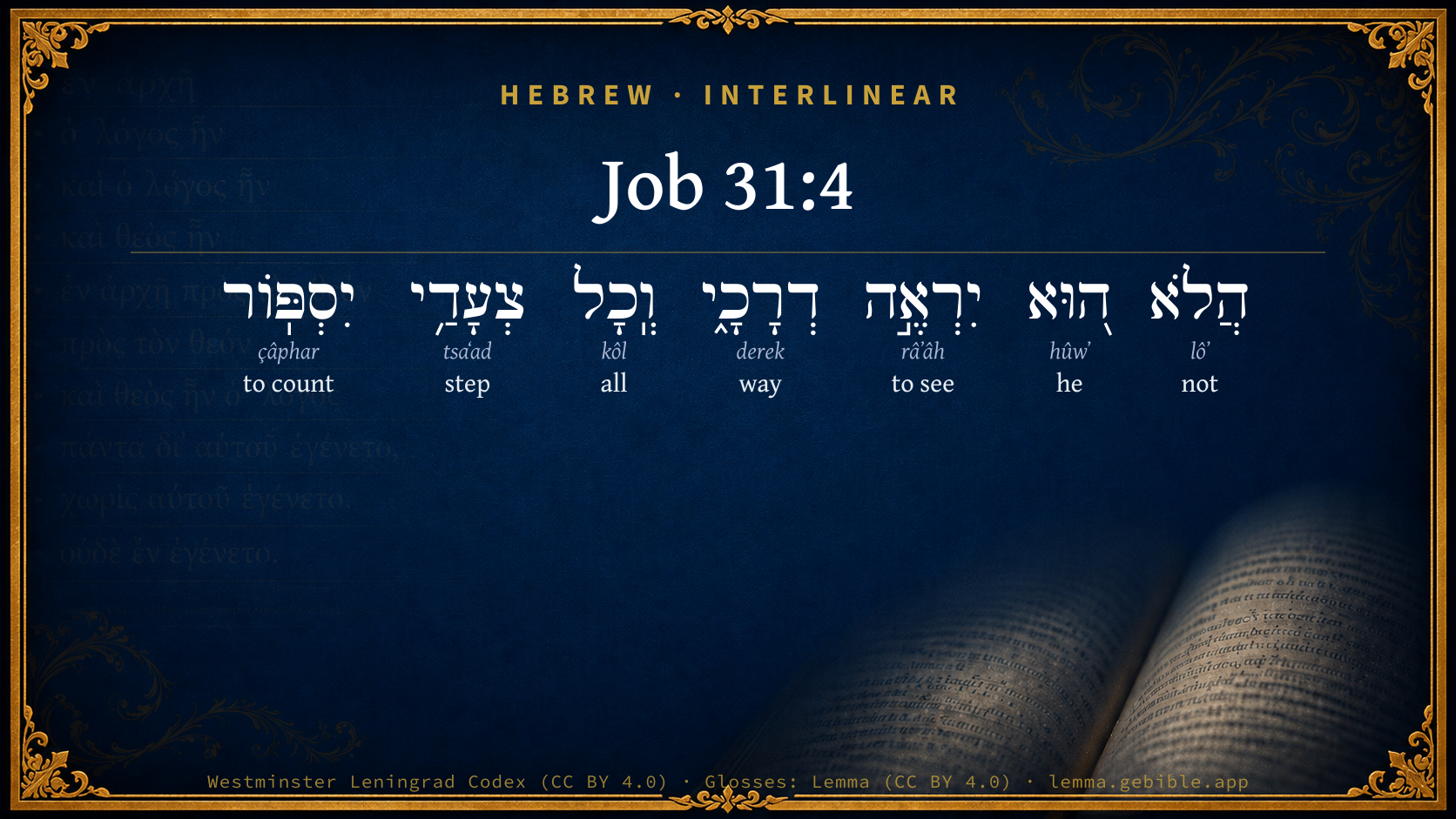
Hebrew (Westminster Leningrad Codex) Job 31:4 appears in the Hebrew Old Testament. The text above is from the Westminster Leningrad Codex. Each word links to its Strong’s number, a concise gloss, and parsing drawn from the Open Scriptures Hebrew Bible morphology. Click any word for its full Brown-Driver-Briggs (BDB) entry.
Download image
Cite this verse

Job 31:4 (World English Bible). Public Domain. Lemma interlinear Bible study tool, https://lemma.gebible.app/v/job/31/4.

Show BibTeX & RIS
BibTeX
RIS
English Translation
Doesn't he see my ways, And number all my steps?
World English Bible · Public Domain
Download a study sheet

One document with this verse’s original text, its word-by-word gloss line, the meaning frame, cross-references with their text, attributed commentary, and full source and license credits — printable, and it pastes into notes with its structure intact.

This verse Autodidact and up

Study sheet (.html) Plain text (.txt)

A passage Seminary Student

Up to 50 verses in one chapter. A passage sheet keeps up to 6 commentary sources and 12 cross-references per verse, in the order this page ranks them, and says so on the sheet whenever that leaves anything out. Ask for a single verse and you get the Autodidact verse sheet above.

Everything on this page stays free to read, with no account — the sheet is a download of what is already on screen, not access to it.

Want to remove ads? Support Godless Engineer
Compare translations 3

The same verse in 3 English versions, stacked beneath the original-language interlinear above. Click any original word for its lexicon entry.

Each is an independent rendering of the whole verse — the interlinear is not word-aligned to these translations.

Highlighted words mark where these versions differ — a whole-verse word diff, not a word-by-word alignment.

  • World English Bible Public Domain
    Doesn't he see my ways, And number all my steps?
  • King James Version Public Domain
    Doth not he see my ways, and count all my steps?
  • unfoldingWord Literal Text CC BY-SA 4.0
    Does he not see my ways and count all my steps?

unfoldingWord Literal Text — © unfoldingWord, licensed CC BY-SA 4.0. Word-aligned USFM3 via Door43 (git.door43.org/unfoldingWord/en_ult).

Versions to compare (up to 4)

3 of 4 selected

Show all 18 translations

Every available English version of this verse, each an independent rendering of the whole verse.

  • World English Bible Public Domain
    Doesn't he see my ways, And number all my steps?
  • Berean Standard Bible Public Domain
    Does He not see my ways and count my every step?
  • Majority Standard Bible Public Domain
    Does He not see my ways and count my every step?
  • King James Version Public Domain
    Doth not he see my ways, and count all my steps?
  • American Standard Version (1901) Public Domain
    Doth not he see my ways, And number all my steps?
  • Revised Version (1885) Public Domain
    Doth not he see my ways, and number all my steps?
  • Geneva Bible (1599) Public Domain
    Doeth not he beholde my wayes and tell all my steps?
  • Douay-Rheims (1899) Public Domain
    Doth not he consider my ways, and number all my steps?
  • Young's Literal Translation Public Domain
    Doth not He see my ways, And all my steps number?
  • Literal Standard Version CC BY-SA 4.0
    Does He not see my ways, || And number all my steps?
  • Unlocked Literal Bible CC BY-SA 4.0
    Does not God see my ways and count all my steps?
  • unfoldingWord Literal Text CC BY-SA 4.0
    Does he not see my ways and count all my steps?
  • Darby Bible Public Domain
    Doth not he see my ways, and number all my steps?
  • World Messianic Bible Public Domain
    Doesn’t he see my ways, and count all my steps?
  • Webster's Bible Public Domain
    Doth not he see my ways, and count all my steps?
  • Free Bible Version CC BY-SA 4.0
    Doesn't God see everything I do—even count every step I take?
  • Bible in Basic English Public Domain
    Does he not see my ways, and are not my steps all numbered?
  • JPS Tanakh (1917) Public Domain
    Doth not He see my ways, and count all my steps?

Literal Standard Version (2020), Covenant Press — licensed CC BY-SA 4.0. Text via the HelloAO Bible API (eBible.org). Unlocked Literal Bible (unfoldingWord) — licensed CC BY-SA 4.0. Text via the HelloAO Bible API (eBible.org). unfoldingWord Literal Text — © unfoldingWord, licensed CC BY-SA 4.0. Word-aligned USFM3 via Door43 (git.door43.org/unfoldingWord/en_ult). Free Bible Version, Dr. Jonathan Gallagher — licensed CC BY-SA 4.0. Text via the HelloAO Bible API (eBible.org).

Word by word

More ways to search: Search by grammar → Find every occurrence → Compare this word →

Practice this passage: Drill this verse → Learn its vocabulary →

About this verse

These counts appear in no published source. They are computed here, from the morphology-tagged text and Lemma’s own curated glosses. What Lemma adds →

7
words
7
distinct lemmas
Wisdom
section

Notable vocabulary

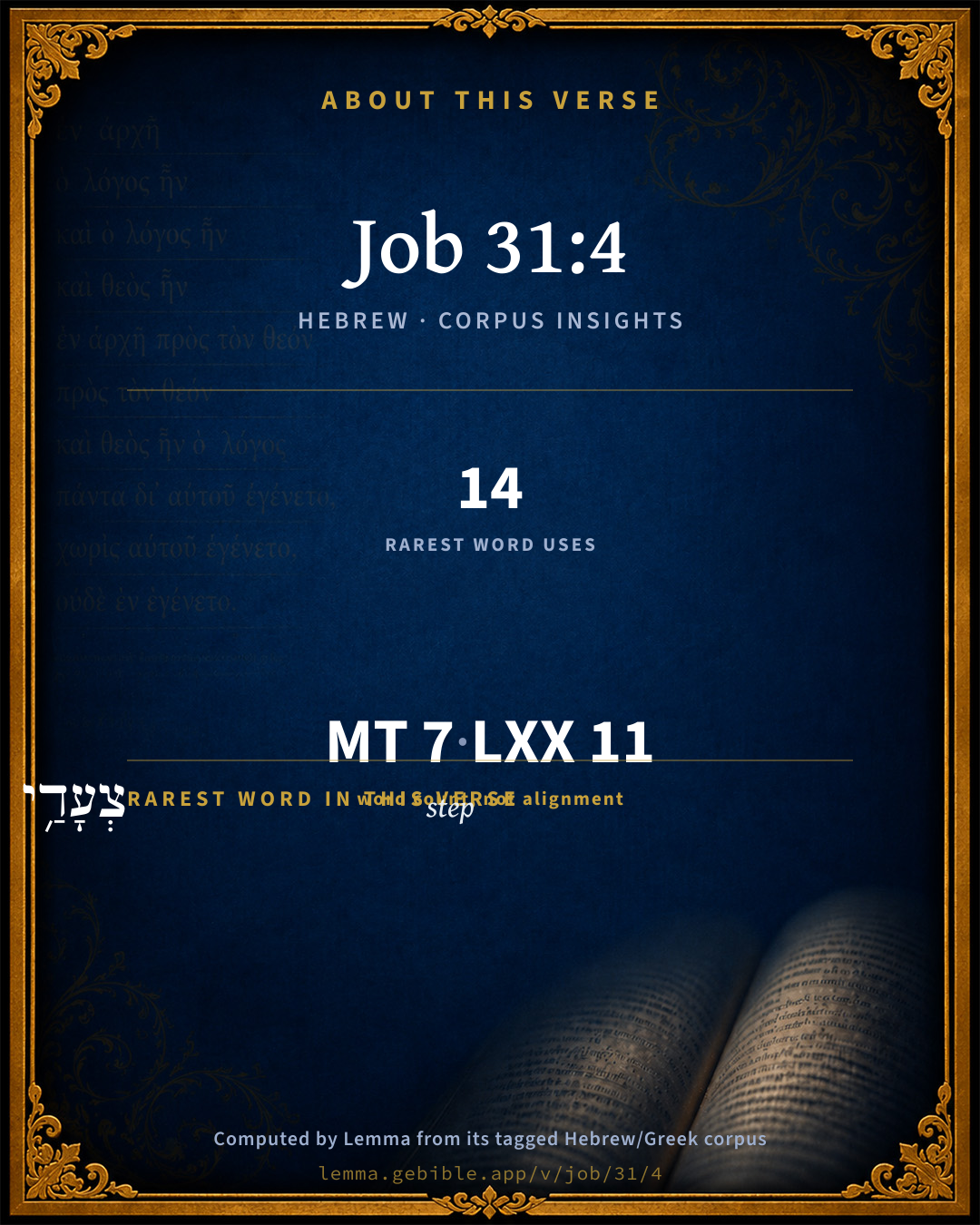
The rarest word here is צְעָדַ֥י step H6806 — appearing just 14 times in the whole Hebrew Bible.

Shared distinctive vocabulary

צְעָדַ֥י step H6806 occurs in 14 verses of the Hebrew Bible. Also found in:

Grammatical profile

  • 2 verbs
  • 3 nouns
  • 1 pronoun
  • 1 particle

Verb forms

  • יִרְאֶ֣ה Qal · Imperfect
  • יִסְפּֽוֹר Qal · Imperfect

Hebrew & Septuagint length

In English translation the verse runs 10 words from the Hebrew and 11 from the Septuagint (LXX English) — closely comparable.

A rough comparison of the two English renderings, which tokenize alike — not a word-level alignment.

Word counts can differ between the Hebrew and the Greek without any difference in meaning — e.g. the Hebrew direct-object marker אֵת has no separate Greek word, and Greek often adds the article ὁ.

In the original languages it is 7 Hebrew tokens and 11 Greek tokens — but the two are counted differently (Hebrew bundles its prefixes and suffixes into one token; the Greek is in lemma form), so that isn’t a like-for-like length.

Cross-references

12

Topical passages linked to Job 31:4 in the Treasury of Scripture Knowledge — connected by theme and wording, ordered by reader-vote popularity; previews shown in the World English Bible.

  • Job 34:21 "For his eyes are on the ways of a man, He sees all his goings.
  • 2 Chronicles 16:9 For the eyes of Yahweh run back and forth throughout the whole earth, to show himself strong in the behalf of them whose heart is perfect toward him. Herein you have done foolishly; for from henceforth you shall have wars.
  • Proverbs 5:21 For the ways of man are before the eyes of Yahweh. He examines all his paths.
  • Job 14:16 But now you number my steps. Don't you watch over my sin?
  • Proverbs 15:3 Yahweh's eyes are everywhere, Keeping watch on the evil and the good.
  • Jeremiah 32:19 great in counsel, and mighty in work; whose eyes are open on all the ways of the sons of men, to give everyone according to his ways, and according to the fruit of his doings:
  • Jeremiah 16:17 For my eyes are on all their ways; they are not hidden from my face, neither is their iniquity concealed from my eyes.
  • Psalms 139:1–3 Yahweh, you have searched me, And you know me.
  • Genesis 16:13 She called the name of Yahweh who spoke to her, "You are a God who sees," for she said, "Have I even stayed alive after seeing him?"
  • Psalms 44:21 Won't God search this out? For he knows the secrets of the heart.
  • Hebrews 4:13 There is no creature that is hidden from his sight, but all things are naked and laid open before the eyes of him with whom we have to do.
  • John 1:48 Nathanael said to him, "How do you know me?" Jesus answered him, "Before Philip called you, when you were under the fig tree, I saw you."

Cross-references courtesy of OpenBible.info (CC BY 4.0).

Hebrew and Greek witnesses Masoretic Hebrew ↔ Greek Septuagint

The same verse in the two great witnesses to the Old Testament, shown verse-for-verse.

These are two independent witnesses, not word-aligned to each other, and the Septuagint is shown in lemma (dictionary) form.

Hebrew Job 31:4 Masoretic · Westminster Leningrad Codex

הֲלֹא ה֭וּא יִרְאֶ֣ה דְרָכָ֑י וְֽכָל צְעָדַ֥י יִסְפּֽוֹר

Doesn't he see my ways, And number all my steps?

World English Bible · Public Domain

Greek LXX Job 31:4 Septuagint · lemma form

οὐ αὐτός ὁράω ὁδός ἐγώ καί πᾶς ὁ διάβημα ἐγώ ἐκἀριθμέω

Will he not see my way, and number all my steps?

LXX2012 (modern English Septuagint) · Public Domain

Hebrew: Westminster Leningrad Codex (CC BY 4.0). Greek: Septuagint (public domain); English from LXX2012 (modern English Septuagint) (Public Domain). How the Septuagint differs from the Hebrew →

Commentary

Notes on Job 31:4 from classic Christian and Jewish commentators (each source and its license shown beneath its notes). The classic Christian expositions comment on the surrounding passage and are grouped to its opening verse, so a note may address several verses; the Jewish commentaries on the Tanakh (Rashi and others) are per-verse, so they appear only where the commentator wrote on this verse.

Lemma curates 59 commentaries, every one of them public domain or Creative Commons licensed, each selected and text-cleaned for this edition rather than reprinted as found. About our sources →

Trapp's Complete Commentary

John Trapp

Job 31:4 Doth not he see my ways, and count all my steps?

Ver. 4. Doth he not see my ways, and count, &c.] Yea, sure he doth so; and the conscience of God’s omniscience, who would soon take him tripping, kept him from this great wickedness. So it did Joseph, but so it did not David; who is, therefore, said to despise God and his commandment, {2Sa 12:9-10} to do evil in his sight; and this was no small aggravation of his offence. Ne pecces, Deus ipse videt. "I have seen the lewdness of thy whoredom," Jer 13:27. "Even I know, and am a witness, saith the Lord," Jer 29:23. That should be a powerful retentive from vice, Pro 5:21.

And count all my steps?] Doth not he cipher them up? Habens omnia in numerato; not my ways only, my counsels and cogitations, but my steps also, that is, all mine outward attempts and actions. A most needful and useful consideration surely, to keep men within the compass of obedience. See this doctrine of God’s singular providence plainly and plentifully set forth, Psa 139:1-4.

John Trapp, A Commentary or Exposition upon All the Books of the Old and New Testament (1647–1656) — public domain. Text from a community e-Sword module.

Jamieson, Fausset & Brown

Robert Jamieson, A. R. Fausset & David Brown

Doth not he see? &c.--Knowing this, I could only have expected "destruction" (Job 31:3), had I committed this sin (Pro 5:21).

Jamieson, Fausset & Brown — Commentary Critical and Explanatory on the Whole Bible (1871) — public domain (CC PDM 1.0). Text via the HelloAO Bible API.

Adam Clarke's Commentary

Verse 4. Doth not he see my ways] Can I suppose that I could screen myself from the eye of God while guilty of such iniquities?

Adam Clarke's Commentary on the Bible (1810–1826) — public domain. Text from a community e-Sword/MySword module.

Ellicott's Commentary for English Readers

(4) Doth not he.—The “He” is emphatic, obviously meaning God. His appeal is to the All-seeing knowledge of God, whom nothing escapes, and who is judge of the hearts and reins (Psa_7:9; Psa_44:21; Jer_17:10; Jer_20:12). (Comp. Act_25:11.)

A Bible Commentary for English Readers, edited by Charles John Ellicott (1878–1897) — public domain. Text from a community e-Sword module.

The Cambridge Bible for Schools and Colleges

gen. ed. J. J. S. Perowne

4. Here “ways” and “steps” are said of things so slight as the glance of the eye. These are “seen” and “counted” by God. The thought of God in these verses is as lofty as the conception of morality is close and inward.

The Cambridge Bible for Schools and Colleges (gen. ed. J. J. S. Perowne; Cambridge University Press, 1878–1918) — public domain. Text from a community e-Sword module.

John Gill's Exposition

Doth not he see my ways, and count all my steps? That is, God, who is above, and the Almighty that dwells on high; he looks down from heaven, and beholds all the ways and works, the steps and motions, of the children of men; there is no darkness where the workers of iniquity can hide themselves; the fornicator and adulterer choose the night season for the commission of their sin, fancying no eye sees them; but they cannot escape the eye of God, who is omniscient; he observes the ways they walk in, the methods they take to compass their designs; he marks and counts every step taken by them, as he does indeed take notice of and reckons up every action of men, good and bad; and the consideration of this was another argument with Job to avoid the sin of uncleanness; for however privately he might commit it, so as not to be seen by men, it could not be hidden from the all seeing eye of God. Some take these words to be an obtestation, or appeal to God for the truth of what he had said; that he made a covenant with his eyes, and took every precaution to prevent his failing into the sin of uncleanness; and he whose eyes were upon his ways, knew how holily and unblamably he had walked; or else, as if the sense was, that had he given in to such an impure course of life, he might expect the omniscient God, that is above, and dwells on high, would bring upon him destruction, and a strange punishment, since he is the avenger of all such; others connect the words with the following, doth he not see my ways and steps, whether I have walked with vanity, &c. or not?

Doth not he see my ways, and count all my steps? That is, God, who is above, and the Almighty that dwells on high; he looks down from heaven, and beholds all the ways and works, the steps and motions, of the children of men; there is no darkness where the workers of iniquity can hide themselves; the fornicator and adulterer choose the night season for the commission of their sin, fancying no eye sees them; but they cannot escape the eye of God, who is omniscient; he observes the ways they walk in, the methods they take to compass their designs; he marks and counts every step taken by them, as he does indeed take notice of and reckons up every action of men, good and bad; and the consideration of this was another argument with Job to avoid the sin of uncleanness; for however privately he might commit it, so as not to be seen by men, it could not be hidden from the all seeing eye of God. Some take these words to be an obtestation, or appeal to God for the truth of what he had said; that he made a covenant with his eyes, and took every precaution to prevent his failing into the sin of uncleanness; and he whose eyes were upon his ways, knew how holily and unblamably he had walked; or else, as if the sense was, that had he given in to such an impure course of life, he might expect the omniscient God, that is above, and dwells on high, would bring upon him destruction, and a strange punishment, since he is the avenger of all such; others connect the words with the following, doth he not see my ways and steps, whether I have walked with vanity, &c. or not?

Job 31:5

job 31:5

job 31:5

job 31:5If I have walked with vanity,.... Or with vain men, as Bar Tzemach interprets it, keeping company and having fellowship with them in their vain and sinful practices; or in the vanity of his mind, indulging himself in impurity of heart and life; or rather using deceitful methods to cheat and defraud others; for this seems to be another vice Job clears himself of, acting unjustly in his dealings with men, or dealing falsely with them:

or if my foot hath hasted to deceit; to cheat men in buying and selling, being ready and swift to do it, and in haste to become rich, which puts men oftentimes on evil ways and methods to attain it; see Pro 28:20.

John Gill's Exposition of the Whole Bible (1746–1763) — public domain (CC PDM 1.0). Text via the HelloAO Bible API.

Albert Barnes' Notes on the Bible

Doth he not see my ways? - This either means that God was a witness of all that he did - his thoughts, words, and deeds, and would punish him if he had given indulgence to improper feelings and thoughts; or that since God saw all his thoughts, he could boldly appeal to him as a witness of his innocence in this matter, and in proof that his life and heart were pure. Rosenmuller adopts the latter interpretation; Herder seems to incline to the former. Umbreit renders it, “God himself must be a witness that I speak the truth.” It is not easy to determine which is the true meaning. Either of them will accord well with the scope of the passage.

Albert Barnes' Notes on the Bible (1834–1885) — public domain. Text from a community e-Sword/MySword module.

Matthew Poole's English Annotations

i.e. All my counsels and courses. This is another reason why he was so circumspect and exact in restraining his thoughts, and senses, and whole man from sinful practices, because he knew that God would discern them, and therefore punish them, as he said, Job 31:3.

Matthew Poole's English Annotations on the Holy Bible (1683–1685) — public domain. Text from a community e-Sword/MySword module.

The Pulpit Commentary

Doth not he see my ways, and count all my steps? (see Job_7:18-20; and below, Job_34:21. Comp. also Psa_139:3 Pro_5:21 Pro_15:3, etc.)

HOMILIES BY W.F. ADENEY Ver. 4. God"s watchfulness.

I ITS CONCENTRATION ON CONDUCT. God sees Job"s ways. He is not confined to the observation of external deeds, for he reads the hearts of men and he judges by the course of the inner life. Still, it is by a man"s actions, including the internal actions, that God judges a man. What is of most concern to our great Master is how we exercise our will, what way we choose to walk in, how we shape our daily conduct. He cares little for our opinions and emotions, except in so far as these guide and influence our behaviour. If, then, God values conduct chiefly, conduct should be of primary importance with us. Whatever other things we may be anxious about, our first anxiety should be to see that our ways are right.

II ITS ABSOLUTE THOROUGHNESS. Job speaks of God as counting all his steps. Therefore God takes note of every one of them. No false step can escape his notice. The little slip is not unseen by God. He sees us stumble when we do not fall, and observes how we stray for a brief time, even though we afterwards return to the right path. This truth has an encouraging side to it. God knows how many steps we have taken; therefore if the way is long and weary he has not forgotten us, and he can Rive us rest and strength. He knows how many steps we have yet to take; therefore he will give us a sufficient supply of grace, whether the road be long or short, and he will not expect more of us than the length or brevity of life permits.

III ITS PROMPTING MOTIVE. God does not watch as a spy, like Satan when he was eager to detect some weakness in Job in order to inform against him; (Job_1:7-10) nor with any design of ruining, like Satan who now goes about as a roaring lion seeking whom he may devour; (1Pe_5:8) nor with cold curiosity, amusing himself with the frailties of his children; nor with merely judicial insight, seeking for truth and dealing fairly, but with no sympathy or interest in his creatures. God watches with the most profound interest with the interest of love. His watchfulness is like that of the mother who bends over the cradle, carefully noting every changing symptom in her ailing child.

IV ITS ULTIMATE RESULTS. God does not watch for nothing. He is more than an inspector; he acts according to what he sees, and his watching is followed by his doing.

1. Sin cannot go unpunished. There is no eluding the eye of the great Watcher of men. The foolish notion that secrecy may find a door of escape is only a delusion when we have to deal with one who knows everything, to whom all secrets are open.

2. Need cannot suffer from neglect. The poor and suffering are forgotten among men, and miserable people drop out of sight after they have fallen into adversity, for great cities hide multitudes of unknown and solitary sufferers. Yet God counts every painful step in the path of disappointment, and as he knows all he will assuredly give the needful help. Because he saw the condition of men he provided for their recovery by redemption through the gift of his Son, W.F.A.

The Pulpit Commentary (1880–1919), ed. H.D.M. Spence-Jones & Joseph S. Exell — public domain. Text from a community e-Sword module.

Rashi

Rabbi Shlomo Yitzchaki (Rashi)

and count all my steps and see whether I went with falsehood.

Rashi on the Tanakh — English translations: “The Judaica Press complete Tanach with Rashi, translated by A. J. Rosenberg” (CC BY 4.0); “Pentateuch with Rashi's commentary by M. Rosenbaum and A.M. Silbermann, 1929-1934” (public domain); “The Metsudah Tanach series, Lakewood, N.J” (CC BY 4.0); and “The Book of Joshua, Metsudah Publications, 1997” (CC BY 4.0). Text via Sefaria.

Lesson kit

Teaching starters — assembled from the data on this page, not authored interpretation. Every prompt links to the verse data it draws on. Edit before teaching.

Job, in the Wisdom, opens this verse with 7 words (7 distinct Hebrew lemmas). Its most distinctive word is tsaʻad (“step”). A historical commentator’s framing appears above. Read the whole chapter for the surrounding context.

Discussion questions

  1. How does “step” (tsaʻad) shape what this verse is saying?
  2. How does 2 Samuel 6:13, which shares the word «step», read alongside this verse?
  3. These translations render this verse differently; the difference is in the English rendering, not the original. What questions does that raise?
  4. «יִרְאֶ֣ה» is a Qal Imperfect verb. How does that grammatical form shape the action described?
  5. Compare how Trapp's Complete Commentary and Jamieson, Fausset & Brown read this verse. Where do they agree or differ?

Things to notice

Reading settings

Reading text

Shown beneath each verse's original-language words.

Old Testament
Old Testament edition

Read the OT as the Masoretic Hebrew (MT) or the Greek Septuagint (LXX).

English shown for the Greek Septuagint (in the Hebrew ↔ Greek comparison).

Comparing translations? Open the Compare panel on any verse page to stack up to four side by side.